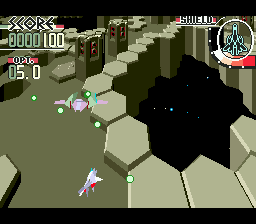
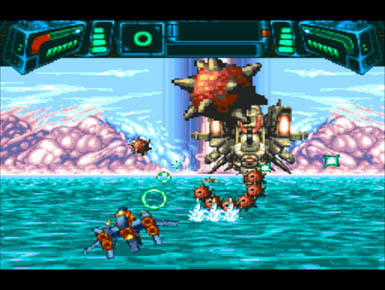
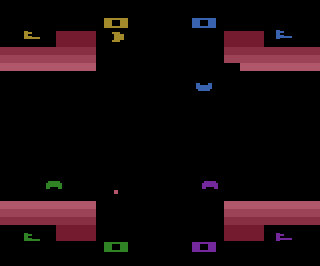
A History of Midway Games (and related companies)

I first got interested in Midway because they made many of the best arcade games of the ’80s and ’90s.  They were one of the best publishers on the Nintendo 64 as well, and that is, of course, my favorite console.  But after the N64 Midway entered a steep decline, and went out of business in early 2010.  They were not able to recover from the death of the American arcade, sadly.  Midway and the companies connected to it have a very complicated history.  I can’t mention every game Midway made here, so I’ll try to just focus on the highlights.

As for sources, this was mostly written based on Wikipedia, Klov, and GameFAQs information, though often I had to do some research into game credits, accurate publishers or release dates, etc — a lot of the publisher and release date listings on online sites can be inaccurate.  Perhaps I should have fully sourced this article, but I didn’t.  If someone has any questions about something please ask.  I do link the more important articles I used that aren’t from those three sites listed above.

Midway Logo (from Wikipedia)

The Final, 1997-2010 Midway Logo (from Wikipedia)

The Beginning, the Arcade Glory Days, and the Crash: 1958-1987

Founded in 1958, Midway Manufacturing was initially based in Franklin Park, Illinois. Midway was originally a developer of carnival midway games, as their name suggests.  They soon became a major pinball table manufacturer, and later arcade game manufacturer as well.  Midway was initially independent, then was bought by Bally Entertainment in 1969.  Midway was a major producer of pinball games from the 1960s until 1999, and arcade games from 1973 to 2001.  During this time Midway was perhaps the most prominent American producer of pinball and arcade games.  In arcade games they had no equal outside of Japan, and in pinball their main competition was Williams Electronics.  Williams was a nearby Chicago-based company, and Williams and Midway had a long, close relationship.

Midway, Williams, and Bally were all in the arcade or gambling machine business founded in the 1950s or 1960s, as Bally and Williams both made casino gambling machines.  After being bought by Bally, Midway would not be a separate company until 1998, and that would not last long before they were purchased again.  Along the way it bought numerous other companies, but first I will focus on these three.  Bally/Midway and Williams would both enter the arcade and pinball game businesses early.  Initially, in the ’70s, Bally made pinball games, Midway arcade games.  The two studios merged, but the naming and staff split remained.  The Bally name was the top name in pinball, so they kept it even after the games were being developed by Midway and Bally itself was not involved in videogames or pinball anymore.  Williams made just pinball at first, but then in the late ’70s started up an arcade division as well, headed by the great Eugene Jarvis.  His first game was the all-time classic Defender.  Williams’ arcade division was small compared to their pinball division, but released some of the top early ’80s hits.  Other top Williams games from 1980 to 1984 include Jarvis’ Robotron 2084, Joust, Sinistar, Bubbles, and Defender II (aka Stargate). Meanwhile Midway had its first hit when it became the US publisher of Taito’s Space Invaders in 1979.  Midway also distributed Pac-Man in the US as well, and was the original publisher of GCC’s Ms. Pac-Man (yes, Ms. Pac-Man, the arcade game, is American and not Japanese).  Unfortunately, Namco and Midway had a split over the rights to that game, as Namco claimed that Midway did not have the rights to make its own Pac-Man games.  In the end Namco got the rights to Ms. Pac-Man and Midway’s other Pac-Man game as well, and Midway and Namco’s relationship was over.  Midway also made games internally, such as the aforementioned Gorf, Satan’s Hollow, and Wizard of Wor in the early ’80s.  Midway’s 1983 releases SpyHunter and Tapper would be even more successful.

In 1977, Midway, while a division of Bally, developed and released a console, the Bally Professional Arcade.  The first machines launched under the Bally Home Library Computer name, but it was quickly changed to Bally Professional Arcade. The system released shortly after the Atari 2600, and even though it was quite substantially more powerful than the 2600, its high price put it out of reach for most people, and Bally’s marketing was poor; they sold it mostly in higher-end stores, not consumer electronics shops.  Also, the system has reliability issues.  As a result, despite its power Bally’s console sold poorly, and Bally/Midway stopped supporting their system in 1979.  Midway’s game library for the system is small, but does include good ports of Gunfight and Space Fortress. The system had a second life when the rights to the console were purchased by a small company called Astrovision. They relaunched the console in 1981, first titling it the Bally Computer System and then later the Astrovision Astrocade, and supported it for the next few years.  Astrovision did not have the rights to Midway’s arcade games, though, and Midway would not have its own home console game development division until 1996, so despite being a Midway console, it doesn’t have as many of Midway’s games on the system as you would expect.  The only Midway game on the system from after 1979, ported by Astrovision and not Midway, is Wizard of Wor, retitled to The Incredible Wizard here.  It’s a great port of a good game, but it is too bad that other great early ’80s Midway classics like Gorf or Satan’s Hollow do not have Astrocade releases.  Still, Astrovision did return the system to stores, until its final discontinuation in 1983. This is Midway’s only attempt at a home console, and they would not make home console games between 1980 and 1995.  All Midway home ports during that time were externally developed, usually by Acclaim in the early 1990s.

In 1981, Midway’s arcade release label was changed to “Bally/Midway” instead of just Midway.  Pinball tables mostly kept the Bally name alone.  In 1983 the great video game crash destroyed most of the home console gaming market in the US.  This hurt Midway and Williams because the size of the US arcade game market shrank at the same time; arcade revenues in the US peaked before the crash.  While arcade revenues leveled off for a while, and even saw a small boost in the early ’90s, ultimately they would decline again, and that time the decline did not stop.  But returning to the first crash, as a result of it, Williams scaled down the size of its arcade division; Jarvis’ recently-set-up Wiz Kidz division closed down in 1984, and Williams released only one arcade video game between 1985 and 1987, 1986’s Joust II.  Midway, however, never stopped making arcade games. They were surely less successful than in the years prior, but Midway kept releasing games anyway, including the hit game Rampage in 1986.

The Successful Williams Years: Williams Buys Midway (1988-1995)

Williams restarted arcade game development in 1988.  Also that year, Williams (who had changed their name to WMS Industries in 1987; they still use this name) purchased Bally/Midway, that is, the pinball and arcade game division of Bally.  Williams moved Midway to Chicago, where it stayed.  At this time Bally exited the pinball and arcade games businesses, but Williams-Midway (sometimes called Williams-Bally-Midway) got the rights to continue to use Bally’s name on arcade pinball titles because of how well-known the Bally name was in pinball.  Williams would merge the Midway (Bally) and Williams pinball divisions but continue to use both names on their tables, and with the merger Williams dominated American pinball; other manufacturers like Stern, Sega, or Gottleib were much smaller.  Williams seems to have merged the divisions, adding on Bally’s design staff to their own.  I’m not sure if the two design studios were immediately merged or if that happened later.  For manufacturing I have questions too, but my best guess would be that Williams moved manufacturing over to their plant after buying Bally-Midway. Even so, tables using pre-merger Bally back-box designs released until 1992; after that, Bally tables used backboxes just like Williams tables had, but with the Bally name on them. (Source) Unfortunately, it was a declining market, as the history of pinball in the ’90s shows. Still, “Midway” never appeared on a pinball table, only Bally or Williams, while Bally-Midway vanished from arcade games in 1991. It would be nice to be clear on the manufacturing question, that thread linked above is helpful but I can’t find anything to clarify this point. I’m a videogame fan, not a pinball fan, though, so I don’t know pinball history (or where to look to find more about it) like I do videogame history.

Unlike pinball games, Midway did return to using only its own name on its arcade games after the Williams purchase.  Bally’s name was dropped from Midway’s arcade games in 1991, and replaced with just Midway.  Evidently they had confidence in the Midway name for arcade games, at least. After the merger Williams seems to have merged the Williams and Midway arcade game teams into one studio, except unlike pinball, here Midway was the larger, so they got the Williams people. This label merger happened in 1991, so between 1989 and 1990, arcade games were released under both labels, but what isn’t clear is when the two groups were moved into the same studio — was in 1989, or 1991?  Between 1988 and 1990 Williams made NARC, Smash T.V., Hit the Ice (hockey), and High Impact (Football), while Bally-Midway did Trog, Pigskin (Football), Arch Rivals (basketball), Tri-Sports, and Blasted.  It may be that the two studios stayed entirely separate, but Mark Turmell says that Trog, Smash TV, and Strike Force were in development when he joined Williams.  Trog, of course, was released under the Bally-Midway label, not Williams, which suggests that the two had been merged to some extent by that point.  Strike Force was a 1991 release, so it of course was released under the Midway label; Bally-Midway and Williams had both been replaced with Midway. Either way, though, in 1991 they dropped the Williams name.  From 1991 to 1998, when Midway separated from Williams, the Midway name is on all of the company’s arcade (video) games.  From 1991 on WMS would only use the Williams name on the Williams pinball tables and its casino business.  It’s interesting, though, that they merged the arcade game labels, but kept two names for pinball machines.

In 1994, Williams bought the Leland Corporation, a company formed when Tradewest bought Cinematronics.  Cinematronics was behind the arcade hit Dragon’s Lair, but Midway did not get the rights to that game, or to Tradewest’s games either as far as I can tell; Don Bluth kept the rights to his games, while Tradewest mostly released outside titles like Rare’s Battletoads or Japanese games.  The only Leland game Midway has ever re-released is Super Off-Road, I believe; they surely got the rights to at least some others, but those games have not reappeared. Leland’s biggest hit was the arcade racing game Ivan Stewart’s Super Off-Road.  This is why the game is found in Midway Arcade Treasures 3. Danny Sullivan’s Indy Heat, another similar game from Leland, has sadly never re-appeared; perhaps its license is harder to strip off, as the Ivan Stewart license was removed from the version of Super Off-Road found in MAT3? Leland also had set up a new home console game side as well before being purchased, and who developed a few games for Williams, such as Kyle Petty’s “No Fear” Racing for the SNES.  The Leland name was soon dropped, but their staff joined Midway, since that was Williams’ videogame division.  Buying a studio with its own home console development team must have helped push Midway towards releasing home console games of its own. Several more reasons to do this would appear in the next few years.

In the early ’90s Midway made many hit arcade games, but the most successful of these were Cruis’n USA, Mortal Kombat, and NBA Jam. Midway most likely peaked in popularity between 1992 and 1995 thanks to those games and their sequels.  All three were sensations, some of the most successful games of the time.  Cruis’n USA was published in partnership with Nintendo, who helped boost the game in return for the IP rights. The game had a “Nintendo Ultra 64” logo at the start, even though it runs on a Midway board, in order to promote the coming Nintendo 64.  This created unrealistic expectations for N64 graphical hardware; it could never have matched a multi-thousand-dollar arcade board.  The Nintendo connection also brought Midway distribution rights for Rare’s three arcade games from 1994-1995, the two Killer Instinct games and Battletoads (Arcade), and continued on on the N64 once Midway started home console development.  Midway also made a couple of successful lightgun games.  Terminator 2: Judgment Day was the first one, and it’s always been a favorite of mine, both in arcades and the (Acclaim) home ports. Great game, and it was quite successful as well.  They followed it up with the cheesy Aerosmith-licensed Revolution X, which released three years later but clearly runs on the same engine.

All of the games listed except for the Nintendo-published Cruis’n USA were published by Midway’s usual partner, Acclaim.  However, in some cases, NBA Jam for example, Acclaim was making more money off of this deal than Midway was, and because Acclaim released the home ports of Mortal Kombat and NBA Jam, some people identified those games with Acclaim instead of Midway, which of course did not help Midway as much as it did Acclaim.  Then, Acclaim managed to get the IP rights to the NBA Jam name away from Midway through some corporate skulduggery.  As a result, Midway lost the NBA Jam name after the second game, 1994’s NBA Jam: Tournament Edition (T.E.), and had to call its next basketball game “NBA Hangtime”, while Acclaim made the completely different, and not as good, NBA Jam Extreme game for home consoles and its even worse successors. Hangtime and its successor NBA Showtime were successful, but not as much as NBA Jam had been.  This soured the Midway-Acclaim relationship, and in 1995, Williams/Midway set up their own home console division.  Mortal Kombat 3 released on consoles that year published by Williams, not Acclaim.  In addition to the financial reasons, perhaps Williams was worried about something happening to Mortal Kombat like had happened to NBA Jam; MK was Midway’s biggest hit at the time.

Midway the Home Console and Arcade Developer (1995-2001)

In 1995, Williams decided to get into home console game development and publishing itself. Instead of licensing out its popular arcade games, they would make them themselves.  Initially, the Williams name was used — Williams was on the initial Nintendo 64 “Dream Team” developer list, for instance.  They developed Cruis’n USA, which Nintendo published through a deal which had given Nintendo the Cruis’n series IP rights in return for them helping to market the game and get it as an exclusive for their system and supposed arcade showcase for what the Nintendo 64 could do.  Some games in 1995-1996 were released under the “Williams” label, such as the aforementioned “No Fear” Racing game for the SNES, or Williams Arcade Classics Vol. 1 for SNES, PS1, and Saturn.  In late 1996, though, they changed over to using Midway’s name on home console titles.  Buying Leland may have been Williams/Midway’s first home team, but the next item provided a big boost to Midway’s arcade and home console divisions as well.

In 1996, Williams/Midway bought Atari Games, the California-based studio who were the arcade division of Atari that had split from the home console division of Atari back in 1984, when Warner Bros. got out of the videogame industry for the first time after the crash and sold off Atari Consumer (Atari’s home console and computer divisions) to the Tramiels.  Atari Games became independent in 1986, and for a while was lucky compared to the travails of Tramiel’s Atari Consumer Corporation (I won’t get into that here, but they had many problems.).  It kept its staff and was in decent shape until the late ’90s. Atari Games only had the rights to use Atari on its arcade machines, not home console machines, but in 1987 decided that they wanted to do their own home console ports, so they had to come up with a new name for the home division.  Thus, Tengen was born. In 1989, Time Warner Interactive (yes, Warner again) bought Atari Games. Tengen lasted until mid 1994, when Warner decided to use the Time Warner Interactive label on Atari Games’ home videogames, instead of Tengen.  Thus, the Tengen name was retired. TWI did not last long, though, because Time Warner sold Atari Games to Midway in mid 1996. At this time, these home ports went under the Williams name, and then Midway by the end of that year.  San Francisco Rush, Atari Games’ first title as a part of Midway, was a fantastic game and very successful. It’s one of my favorite arcade racing games ever.  This purchase also got Midway, and thus WB Games now, the rights to the incredible 1984-1996 Atari Games arcade game library, including the classics Toobin’, Paperboy 1 and 2, Vindicators, Gauntlet I and II, Rampart, Marble Madness, Pit-Fighter, Super Sprint, Championship Sprint, Xybots, A.P.B., Cyberball 2070, and 720 degrees.  Midway would soon start making its own new Gauntlet games, and including the others in compilations.

Midway continued releasing popular games in the late ’90s. My interest in Midway peaked during this period, so I have more to say about their games from this era than the others.  Also, Midway was releasing its own home ports now, which meant more releases.  Midway’s games in the late ’90s were so much better than anything that came afterwards that the difference must be explained.  Trouble was right around the corner, but many gamers like me didn’t see it coming. NBA Showtime and NBA Hoopz were successful but did not regain NBA Jam’s smash-hit status, but they did make some good arcade hockey and football games. Midway had made arcade sports games before, such as Hit the Ice, but Wayne Gretzky’s 3D Hockey (1996, arcade and Nintendo 64) and NFL Blitz (the next year; for arcade, N64, and PS1) did better than past non-basketball Midway sports games had, I believe.  Both games started out in arcades, but soon were ported to home consoles.  NFL Blitz became particularly popular, as its brand of violent football action resonated. Another popular series around this time was the rebirth of Gauntlet, with Gauntlet Legends and Gauntlet Dark Legacy.  I personally really love these two games; they’re some of my favorite action-RPGs ever, hands down!  Midway’s Cruis’n series was also hugely successful in arcades; though the home console ports never did as well as the arcade versions did, the three Midway Cruis’n games are among the most successful arcade racing games ever.

The home ports of all these games did well also.  Midway also became a home console publisher, and published other developers’ games.  Midway released games on all popular consoles from 1995 on, especially the N64 and Playstation, but saw particular success on the N64.  Atari Games’ N64 titles were all exclusive (that PS1 Rush port was external and terrible), the Cruis’n games were N64-only because Nintendo owned the rights, Mace: The Dark Age, a quality 3d fighter, saw its only home release on the N64, and Midway published some significant external titles as well.  Midway published all four of Boss Games’ N64 games, for example, including Top Gear Rally, Twisted Edge Extreme Snowboarding, the fan-favorite World Driver Championship, and Stunt Racer 64. They also published Wipeout 64 for Psygnosis and Body Harvest for DMA Design after Nintendo dropped that game.  For a while Midway made more money from the N64 than from any other console.  By 2000 the N64 was fading, though, and Midway’s PS1-only efforts, such as Assault: Retribution (another externally developed title), Mortal Kombat: Special Forces (this started out as an N64 game before being canned and moved to PS1; good move, N64 gamers expected some level of quality from Midway), and Rampage Through Time were not nearly as the level of their N64 games.  Midway did try branching into handheld game publishing as well, but none of their handheld games were particularly great. Acclaim’s GB Mortal Kombat games had not been good, but Midway’s were no better.  Another GBC Midway game, Cruis’n Exotica for the GBC, looks nice, but has badly flawed gameplay.

Midway also started releasing classic compilations in the mid ’90s.  In the ’90s, Williams/Midway owned the rights to now only all of the other games described here, but also some pre-1984 Atari games.  Those rights would later go (through a sale I presume, or because it was a temporary license?) to Infogrames, which became the new “Atari”, but for a before then Midway released several collections on the PC, PS1, Saturn, and SNES which include pre-’84 Atari classics on the discs.  They did two collections of pre-’84 Atari games during this time, and two of other Midway/Williams games.  The first ones have Williams’ name in the title, the later ones Midway.  There was a further collection of mostly Midway games on the PS1 only.

Despite being a part of Midway, Atari Games/Midway Games West (as it was later called) maintained separate studios and a separate identity as long as it lasted. Atari Games’ home ports were, as under Tengen, often done internally — the SF Rush games for N64 were done by Atari Games itself, for instance, not Midway.  Atari Games also developed the N64 version of their arcade game California Speed.  Some games that were outsourced, like SF Rush for the PSX, were terrible.  Midway did outsource more games though anyway, such as Hydro Thunder, done by Eurocom on the N64 and DC and Blue Wave on PSX. Atari Games was successful for its first few years under Midway, but after the turn of the millennium, the continued collapse of Western arcade markets helped doom the studio, and later Midway as well. Still, the company went out on top; its last released arcade game was San Francisco Rush 2049.  Their home port of the game is, in my opinion, the greatest game ever made in which you control vehicles.  Midway Games West had another arcade racing game in development when it was cancelled in 2001 thanks to Midway abandoning arcade games.  I’d still love to play it someday.

However, despite these successes, overall arcade revenues were declining, and pinball, as mentioned earlier, was doing even worse.  Midway was a successful home publisher at this point, for their home ports of arcade games were doing well, and they published some good home-exclusive titles as well, but there must have been concern for the future. Williams wanted out.  So, in 1998, halfway through the release history described above, WMS Industries (Williams) spun off Midway.  Midway was still doing okay for the moment, but with declining arcade revenues industry-wide, Williams was done.  Midway kept all of Williams’ back-IP rights to console games, though; this is why WB now owns the rights to games such as Defender.  Despite this, Williams and Midway stayed close, and continued to share a board member for as long as Midway survived.  Williams got out of arcade and video games, going to just pinball and slot machines.  At this time Sumner Redstone, Viacom’s owner, started buying up Midway stock.  He started out with 15% of the company in 1998, and became majority owner in 2003.  He oversaw Midway’s decline and fall.  Midway sold most of its pinball assets to Williams and then abandoned pinball in ’99, finally ending the use of the name Bally outside of casinos.  However, Williams didn’t last much longer in pinball than Midway — after the failure of its “Pinball 2000” line in, well, 2000, Williams followed Midway out of the pinball business, leaving only little Stern still making pinball tables.  Like Bally, WMS Industries has been successful in their surviving business, casino games.

The Fall of Midway (2001-2010)

In 2000, Midway was the fourth largest videogame publisher.  They would drop precipitously from that position in just a few short years. In 2001, Midway stopped making arcade games.  This is where Midway’s quality level started to precipitously drop; the company never recovered from this move, as much sense as it seemed to make at the time. Midway had always been an arcade game developer, and the shift over to home console gaming went badly.  Midway never quite managed to entirely adjust over to what console gamers wanted, and game quality suffered badly as a result.  As something of a Midway fan after their great years in the ’90s, it was a sad time.  In 2003, Midway Games West (Atari Games) was shut down.  Midway Games West only made one console game between ’01 and ’03, the 3d platformer Dr. Muto for PS2, Xbox, and Gamecube.  It’s a good but not great game, but the teams’ lack of experience in the genre shows — the team had never done a 3d platformer before, since those do not work in arcades.  The game must not have done well enough, and so one of gaming’s oldest developers, one with a direct history to the original Pong, closed.  Things got even worse for Midway afterwards.

That really is the story of 2001-2010 Midway.  Midway still made some good games here and there.  Mortal Kombat had begun declining after MK Trilogy, but MK: Deadly Alliance was a bit of a boost for the series in ’02, after some down years after MK4’s relative failure.  It saw two sequels by ’06, on Gamecube, Xbox, PS2, and Wii, but while successful, the new MK wasn’t the phenomenon that the original game was.  They were among Midway’s most popular games of the period for sure, though.  Among other games, the new classic collections for Gamecube, Xbox, PS2, and PC were pretty good.  Many classic Midway, Williams, and Leland games appeared again in the Midway Arcade Treasures line in the ’00s.  Those collections include everything Midway still had the rights to from their PS1 discs (so, everything except for the pre-’84 Atari stuff), and many more games besides.  The first collection even includes all of the developer interview videos from the original PS1-era collections, though it’s missing the Atari ones of course for rights reasons. Midway also continued bringing back classic franchises with new games.  Their 6th-gen SpyHunter reboot was successful, and led to two sequels.  The first one’s pretty fun! I also really like the highly under-rated Defender reboot, Defender, also for the PS2, Xbox, and Gamecube.  Midway mostly let its arcadey racing game dominance die with its arcade divisions, stupidly, but they did make the good, and also under-rated, kart-ish flight racer Freaky Fliers.  The TNA wrestling games were popular, though. Midway had some other good games as well.  However, otherwise they were getting far off-base, and it’s not hard to see why they were failing financially.  Midway mostly left Nintendo behind in the early ’00s, thanks to the Gamecube’s lacking success compared to the N64, but it didn’t help.  Games like LA Rush and Gauntlet: Seven Sorrows, both for PS2 and Xbox, were debacles that ruined some of my favorite franchises and failed to sell well also.  Midway’s sports games in this period abandoned the arcade sensibilities that had made them successful in the first place in favor of more simmish designs like everyone else, but Midway wasn’t quite as good at that as EA or the other top developers, and so Midway just couldn’t quite hold on in the genre.  The third of the new SpyHunter games was a disappointment as well.  The NARC reboot was also bad.  Later Midway handheld games like Cruis’n Velocity and Gauntlet: Dark Legacy for the GBA are no better. Midway had never been great at handheld games, but they definitely did not improve in the ’00s.

In 2005, Midway bought Ratbag Games, only to close the studio four months later because the next generation was coming and rather than pay for Ratbag to become able to handle next-gen development, they shut them down.  Closing studios you bought is not uncommon, but such a short time between purchase and shutdown is pretty cruel, and a pointless waste of money.  Midway continued to decline.  By 2006, Midway was the 20th largest video game publisher, down 16 places from only six years prior.  People who remember this era’s Midway forget that only a few years earlier Midway was one of the biggest publishers in the industry.

The next generation brought even higher costs that Midway could not afford. Some games did okay, but the last generation was a generation of the destruction of the midsized publisher, which is what Midway was by 2006 because of how badly they had contracted from 2000, when they’d still been one of the big publishers. Midway published some good PS360 games, such as Epic’s Unreal Tournament 3, but costs were too high, particularly for a company barely surviving as it was.  Midway poured a lot of years and money into the open-world game This Is Vegas, but it never materialized, until finally dying with Midway when the company went under.  The PS3/X360 game John Woo’s Stranglehold did release in 2007, and is an ambitious, decent to good game, but it cost a lot to make and sold poorly, so it was something of a financial disaster.  The game is sometimes mentioned as one of the final blows to the company, sort of like BMX XXX was for Acclaim, though I doubt it reaches the level of THQ’s PS3/X360 UDraw debacle that ultimately destroyed that company.  Midway did see success from the Touchmaster series of casual motion and touch minigame collection games for the DS and Wii, but it wasn’t enough.

In 2007 Sumner Redstone owned 87% of Midway, but the company was losing a lot of money every year.  Even someone as rich as he was would eventually get tired of large losses and no gain.  Midway closed two smaller studios in 2008.  Later in 2008, Sumner Redstone, facing large losses in both Midway and his main businesses of Viacom and the National Amusements theater chain, sold Midway for nearly no money. Later that year Midway entered bankruptcy as a result.  Despite this, in 2009 Midway released games, most importantly a Mortal Kombat reboot which became very successful, sparking a rebirth of a franchise which had faded in the late ’90s.  It could not make up for all of Midway’s losses, but it showed that that team, at least, could still make great, and successful, games.  However, Midway’s end was not delayed long.  A lawsuit from stockholders against Redstone for his management of the company did not help either.  The company finally closed in mid 2009 and was officially shut down in 2010, after Redstone got tired of losing so much money.

Aftermath: WB Games and Conclusion

After this Midway did not exist anymore, but its legacy does.  After Sumner Redstone allowed Midway to go bankrupt, its assets were sold off. THQ bought the San Diego studio and the TNA license, only to shut it down several years later as they headed towards their own bankruptcy and dissolution.  Warner Brothers, perhaps interested in part because they had previously owned Atari Games twice before (as described above) and Midway owned that company’s back-catalog rights from 1985 to 2003, bought the main Chicago studio, the Seattle studio Surreal Software, and Midway’s name and game IP rights.  The other two smaller studios Midway still owned shut down.  Many people lost their jobs in Chicago as well; only one team, the Mortal Kombat team, survived the culling.  In the last year of its life everyone at Midway either left, or desperately tried to attach themselves to Mortal Kombat as best they could, since everyone knew that that was the only IP, and team, with a chance of survival.  Some made it, others didn’t.  The resulting studio, part of WB Games, is now known as NetherRealm Studios.  NetherRealm makes Mortal Kombat games, and some other fighting games as well such as Injustice: Gods Among Us, and has seen a rebirth in popularity.  Surreal had been working on This Is Vegas, but WB abandoned the game, and instead merged that team into their other Seattle team, Monolith, a first-person-shooter focused studio.  It’s too bad the game never finished, it could have been interesting.

In addition to NetherRealm and the staff from Surreal, WB Games also used the Midway back catalog in the 2012 Midway Arcade Origins collection for the PS3 and Xbox 360.  The collection, as with all Midway collections since the mid ’90s, is a mixture of Williams, Vid Kidz, Midway, Atari Games, and Leland titles.  Midway owned all of those back catalogs by the mid ’90s, and now WB has them.  Midway didn’t make all of those games, but they did make some.

So, Midway lives on as a part of WB Games, both in a library sense and a development sense.  However, Midway the independent developer, and most of Midway’s teams and staff, are gone.  Midway went from being one of the more successful developers around, back in the early to mid ’90s, to a money-losing failure.  This really shows how quickly the technology industry changes, and how hard it can be for companies to keep up with the changing marketplace and audience.  Midway’s downfall was the decline of arcades in North America.  Arcades declined because computers and consoles were getting more powerful, and the price of arcade machines was too high to support their reduced revenues.  Arcade machines could have done better graphics than home systems just because of their higher costs, but people thought that home computer and video games looked good enough.  Also, the growth of the internet further hurt arcades, as people turned to online play for multiplayer, instead of gathering in arcades.

Midway tried to adjust with the changing times by moving to console game development, but the company was designed to make arcade games, and it just could not adjust well to console development.  Midway was one of my favorite N64 publishers, but by the next generation they were barely even on the list by the end of the generation, thanks to how far their games had fallen.  And many other people weren’t even as kind as I; Midway became something of a laughingstock, like Acclaim, another company I kind of like, despite its faults.  That’s sad, but I’d rather remember how great Midway was up until the early ’00s. They had their faults for sure, but all publishers do, and Midway published some of the best games of the ’90s.  Nobody should forget that just because they could not keep that up once arcades lost their importance outside of Japan.


Today, WB Games owns parts or all of the back-catalogs of games published by the following companies and labels:

Midway Manufacturing
Bally Entertainment
Williams Electronics / WMS Industries
Bally-Midway
Leland Corporation
Atari Games / Midway Games West
Midway Games
Tengen Inc. (Atari Games division)
Time Warner Interactive (Atari Games years)

Posted in Arcade Games, Articles, Dreamcast, Gamecube, Modern Games, Nintendo 64, Nintendo DS, Nintendo Wii, PC, PC, PlayStation, PlayStation 2, Research, Saturn, SNES, Xbox | Tagged , , , , , , , , , , , , , , , , | Leave a comment

Rolling Thunder 3 (Genesis) Review – The Flaws of a Still-Good Sequel to a Classic

  • Title: Rolling Thunder 3
  • Platform: Sega Genesis
  • Developer & Publisher: Namco
  • Release: 1993 (US-exclusive title)

Rolling Thunder is a side-scrolling action series from Namco.  The original Rolling Thunder released in arcades in the late ’80s, and it was amazing!  The game feels like a slow-paced run&gun inspired by Elevator Action, but I think any Rolling Thunder game is far better than anything from that in my opinion slightly boring series.  This game, Rolling Thunder 3, isn’t quite as good as its forbears, but it’s still a good game.  I should start with the first game, though, for those who don’t know it.

title

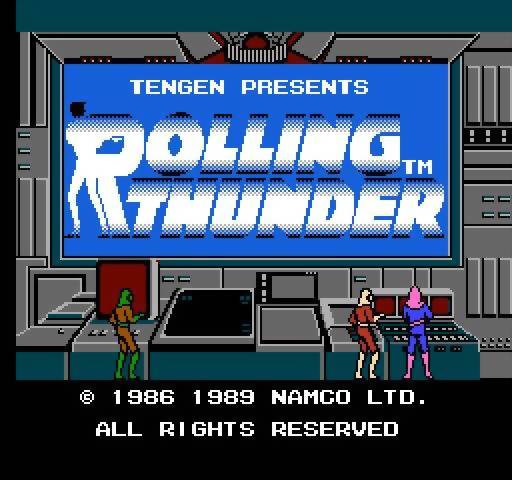
Rolling Thunder (NES) title screen

The first Rolling Thunder was a true classic.  The game is a modern spy-movie type game, inspired by James Bond and the like, and you play as special agent “Albatross” who has to slaughter his way through an army of evil cultists as he tries to rescue his female partner “Leila”.  So yes, it’s a rescue-the-girl game.  The cultists all wear hoods, which makes them look more menacing. You have limited ammo, and if you run out are in deep trouble, so conserve, and only shoot when you have to.  If you run out of bullets, that’s it; you have no melee attack. Rolling Thunder is a strategic shooter, essentially.  You need to duck, jump, or jump between platform levels to avoid fire, while shooting precisely to take out the enemies.  Some doors (see the Elevator Action element above) have weapon recharges in them, or rarely health ups.  You have eight hit points, but getting hit takes away half of it, and getting shot pretty much kills you, so watch out.  Die and it’s back to the last checkpoint. It’s unforgiving, and a bit slow paced as you carefully edge forward and take out the enemies, but it’s a fantastic game.  I first played it back in the ’90s in the arcades, and while I couldn’t get very far, I liked the game a lot.  The game also has a pretty good NES port which adds in a badly needed password save system.  It was released on other platforms as well.

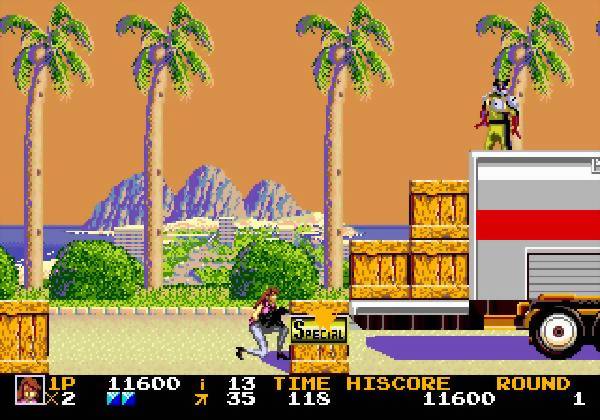
 Rolling Thunder 2 (Genesis) gameplay

Rolling Thunder 2 (Genesis) gameplay

Rolling Thunder got two sequels before the series sadly stopped.  I didn’t play either sequel until within the last decade, but the second game was released in arcades and on the Genesis, and it’s a great game.  It lets you play as either Albatross or Leila, adds bosses to the series, is just as hard as the original, and has a two player co-op mode, which is great to have.  The level designs don’t feel quite as good to me as those in the original game do, but it’s still great.  The third and last one here, which this review is for, was released for the Genesis only.  This is the only console-exclusive game in the series.  Overall though it’s a great series, and I wish that it’d come back; make a new (still side scrolling of course) digital-download Rolling Thunder game, Namco!  It’d be great.

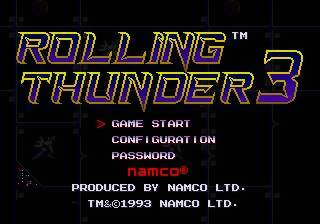
 Rolling Thunder 3 Title Screen

Rolling Thunder 3 Title Screen

Now, on to Rolling Thunder 3.  This time you play as Jay, another special agent for the same group as Albatross, and you’re out to beat the evil villain Dread and destroy his sinister organization.  Your mission apparently is happening at the same time as Rolling Thunder 2, which is why Albatross and Leila are unavailable.  There’s also a woman who is the usual female voice in your ear character; as I said above you can play as her with a password, but she has no story, just the levels, and plays identically to Jay, though that I would expect; Albatross and Leila played the same in the second game, too.

Overall, while Rolling Thunder 3 is a good to great game, I think that it’s disappointing and the worst of the three games for multiple reasons.  First, the game is easier than either previous title. On Normal difficulty the final boss of this game is very challenging, but the rest of the game before that really isn’t so bad, once you spend a little time memorizing it.  Second, the great co-op mode from the second game is gone for no reason.  And on that note, by default, and in the story, you only play as a male agent again this time; there is a female one to play as, but only through a special password, and she has no story.  It’s better than nothing though.  The game also gives you a special weapon in each level (except for level 9), which might sound good, but really it’s maybe a bit too much much firepower for a game that is supposed to be more about thought and careful action than it is about running around guns-a-blazing.  Rolling Thunder 3 also has less interesting level designs than the previous titles, except for the final bosses’ final form easier bosses than Rolling Thunder 2 (the first one didn’t have bosses, remember),  However, the game does have mostly great gameplay, the diagonal firing ability is great and was a very welcome addition, despite the flaws the game is plenty of fun if you’re a fan of the series, it’s is the only Rolling Thunder game with actual cutscenes between levels that tell a continuing, if generic, spy action movie plot, and it has some decent and varied graphics and sound too, so anyone who likes this series at all should definitely play Rolling Thunder 3.  Just don’t expect it to be as good as the previous two games.

As the list above suggests, the most important thing to know about Rolling Thunder 3 is that it’s a consolized game.  The story scenes between levels, changing locations, simpler level designs, heavier weapons in your arsenal, and more all add up to simplifying and consolizing the series.  The special weapons are emblematic of that change, I think.  You can choose from nine different weapons before each stage, or you can choose to not take one with you, and if you choose a weapon before a level, you can’t use it again in the rest of the game, unless it appears in a door as a pickup.  So, you need to conserve your weapon choices, and have the right one left for the final level, for instance.  I recommend the Bazooka!  It’s an interesting mechanic, but the special weapons in general aren’t needed, and give you a feeling of power that doesn’t really fit with the Rolling Thunder series’ theme. A bazooka, in Rolling Thunder?  Really?  Sure, the weapons have limited ammo and you are rewarded a bit for not taking one, as you can then use any for the final stage and also you do have a knife weapon if you don’t have a special weapon equipped (it does two bullets worth of damage per hit) and also if you go into a special weapon ammo refill room without one you’ll instead get healed (or have 1 added hit point added, if you have full health), and that’s great.  Really, I think this game is the most fun when played without special weapons, except for that bazooka to help against the final boss.  Take them if you want, but they’re not needed.

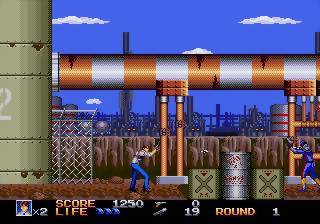
An early level in Rolling Thunder 3

An early level in Rolling Thunder 3

In terms of length and level designs, the game isn’t any longer than the first two games; on the contrary, thanks to its lower difficulty level, it’s shorter, and even without that, it’s not that long.  Rolling Thunder 3 has ten levels, three of which are somewhat short special stages, and most of the rest are straightforward. When compared to the previous games, and the first game particularly, in terms of level designs and weapons Rolling Thunder 3 tries to make things simpler and more actioney.  Level designs here are not as complex as they often were in the first game.  Levels just go to the right, or occasionally up or down a single screen at set points.  There are no large areas multiple screens tall for you to go through, as the first game had from the beginning.  Don’t expect anything like that big staircase in the first level of Rolling Thunder, either.  That’s disappointing. There aren’t even interesting set-pieces like the sections with all those tires in Rolling Thunder 1! There are some nice scenes to be sure, like that one time that enemies jump at you from a helicopter, or the explosive gas tanks, but those are in the first two levels,… and then nothing like either one happens again for the rest of the game.  Yeah, this game is like that. That level with the gas tanks you can blow up also has a very bland design; it’s mostly just walking to the right and shooting, simple as that.  The later levels get harder, and there are almost always two platform levels later on, but the game just doesn’t have those unique level design challenges like the ones that fill the first game from the first level on.  No, Namco, having every level take place in a different place, often with a different set of (similar) enemies, doesn’t excuse how bland the levels are once you take off the new paint jobs.

This game has many fewer doors than the previous games, too, so when you see a door, there’s an odds-on chance that something is actually behind it.  The level designs this time really are too simple and bland.  Most of the time you’re just on a one or two level sideways path.  The only variation is in the environment — and this game has many, as befitting its action-movie theme, as every level has a new setting — and in which areas have that second level of platforms and which don’t.  While playing this game it’s easy to forget this problem, as the game is fun and simple, but play this and then the first or second ones, and the problem becomes apparent.  There was plenty of imagination here in the settings, but not much in the level designs.

Compounding that issue are the three special stages, which are levels 3, 6, and 9. In the first one you are on a motorcycle, the second on a jetski, and the last in a hijacked airplane.  The first two are isometric, not side-scrolling, and they’re simple but fun.  Don’t expect much challenge, but they are entertaining diversions.  That airplane level is a real pain, though.  You aren’t allowed a special weapon in this level, and there are no alternate levels of play either; it’s just one long flat floor.  There’s no way to hide here. As a result it’s somewhat frustrating, and doesn’t feel like something with any place in a Rolling Thunder game, either.  At least the level isn’t too long; still, use the knife a lot, or you’ll run out of bullets. Learning that is the key to the stage.

Scene from the intro

There are some good things about Rolling Thunder 3, though.  Most obviously, as I said above, this is still Rolling Thunder at its core.  They put in too much actioney stuff, but the Rolling Thunder core is still here, and it’s a lot of fun.  First, that diagonal firing ability is just great to have. It’s no replacement for the co-op mode in the second game, but still, it makes things more fun in single player mode, for sure.  Also, the game may be easier than the first two games, but there is an unlockable Hard mode you get after you beat the game the first time, and given how crazy-difficult the first two games get, making a somewhat easier Rolling Thunder game isn’t all bad.  I mean, I can actually beat this one… it’s satisfying to finish a game.  Also, that final boss was a fun challenge. Sure, it took me dozens of tries, several days, and innumerable replays of the final level (yes, I got pretty good at it) before I finally got past him, but once I did it was quite satisfying.  I only wish that the game had more unpredictable challenges like that one, but it doesn’t; the first three bosses, and the first form of the final boss, have basic patterns that should be easy to learn.  Either that, or you can just beat them by moving in and attacking until they lose, it varies from boss to boss. Still, at least the final form was hard.

Also, the levels which are more traditionally Rolling Thunder in style, like levels 8 and 10, are both moderately challenging, and are quite fun to try to master.  At first they seem tough, and level 10’s boss is, but other than that, with practice I learned how to get through them without too much trouble.  Memorization is of course key, but that’s par for the course in this kind of game, and I don’t mind it. It’s unfortunate that the game takes so long to get good, and that the levels stay bland in layout and design, but at least they do manage to get more fun as you go along even if the floor layouts never match the original title.  And finally, the graphics are nice, the music is good, and the story, if simplistic and generic, is solid for the genre.  The ending is fitting for the genre as well.  I only wish that the female character had an ending, but ah well.  I like that they added cutscenes to the game; they’re decently done, and don’t go on for too long.

Overall, Rolling Thunder 3 is a very good game that I quite enjoyed playing through. I’ll probably come back to it and try it at least partway through on the Hard mode, too.  However, it’s just not nearly as good as either of its predecessors, and overall, as a Rolling Thunder game it’s a moderate disappointment.  Still, it’s sad that the series ended with this game; it’s a great series, and deserved to continue.  Ah well, at least there were three good games. Overall, definitely play this game, but consider it an intro to Rolling Thunder, and move on to its superior predecessors after spending some time with it.  I’m not sure what score I’d give this game, it’s honestly hard… a B or B-, probably, maybe a C if I was being hard on it, but choosing one rating is tough.  On the one hand it’s fairly good as a standalone game, but on the other hand, it’s moderately disappointing compared to the incredible original game.  That makes it tough to precisely score.  Anyway though, overall, Rolling Thunder 3 is a good, but not great, game.  I liked it a lot, but I would have liked it even more if it’d been more like the original.  I guess I give it a B; I do really, really love the original. Make a Rolling Thunder game again, Namco!  A 2d one would be great.

Posted in Classic Games, Full Reviews, Genesis, Reviews | Tagged , , , , | Leave a comment

Avenger (Turbo CD) Review – Under Defeat’s under-rated, and great, TCD spiritual predecessor

  • Title: Avenger
  • Platform: Turbo CD (PC Engine CD)
  • Developer: Telenet Japan
  • Publisher: Laser Soft
  • Release: December 7, 1990 (Japan only)

Intro

The Turbo CD is a great, and important, console.  Designed by Hudson and sold by NEC, it was the first ever CD-based gaming platform when it released in Japan in 1988. While I love cartridges too, that is an important advance.  I finally got my Turbo CD drive repaired in late summer 2013, and the system has been my most-played TV console since then.  This is the first Turbo CD game I finished (Alzadick aside, but that’s a special case), so it got my first full review.  The Turbo CD is awesome.  I wish more Western gamers in general knew about its greatness. The TG16+CD, or PC Engine and PCE CD as they were known in Japan, have some dedicated fansites, but very little awareness outside of that hardcore base.  Given the system’s low sales in the West, and thus low availability here, that is sadly unlikely to change, but it should.  Anyone who likes 3rd or 4th gen gaming really should play more Turbografx!  It’s really good.

Background

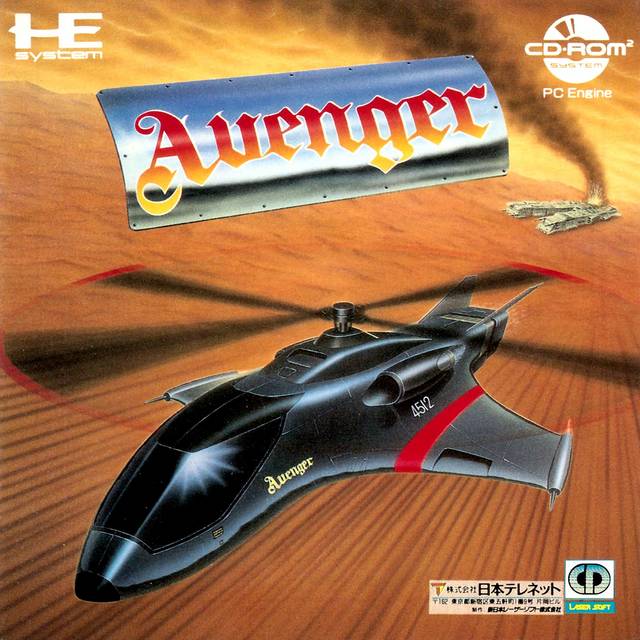
Case cover

The box does a good job of showing what the game is like.

Avenger is a shmup from Laser Soft, which was one of Telenet Japan’s many divisions, along with Riot, Reno, Renovation, and Wolf Team.  Telenet supported the Genesis and SNES as well, but while they did make cartridge games, they were also an early pioneer in CD gaming.  From 1989-1994, they supported the Turbo CD and then Sega CD as well. Telenet was the first third party to support the Turbo CD, which was the first ever CD-based gaming platform.  However, several years later, Telenet fell apart.  By 1995 Telenet was collapsing; Wolf Team was bought by Namco (they became Namco’s Tales Studio). Renovation, their American publishing arm which had focused almost exclusively on Genesis and Sega CD games, was bought by Sega. At the time they were just starting to support the SNES, so they released only one SNES game. Renovation never supported the Turbografx, sadly.  Too bad.  NEC released a few of Telenet’s TG16/CD games, most notably Valis II and III, but Avenger, like most of their games, stayed Japan-only.  The rest of Telenet either shut down or became a shadow of its former self, as Telenet itself devolved into being pretty much a gambling games only studio from about 1995 on, and closed in 2007.  Looking at their games from their 1989-1994 time as a major console games publisher, Telenet’s games are often flawed, and are not as polished as, say, Nintendo’s, but they made quite a few but while they lasted they made some interesting games.

————-
Review
————-

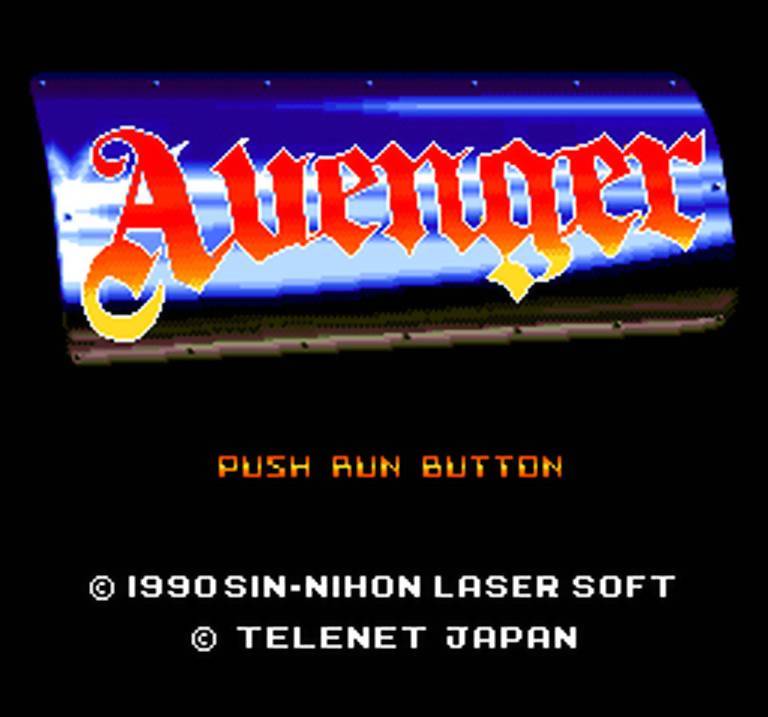
Title Screen

Title Screen

So, on to the actual game.  Avenger is not one of Telenet’s more popular releases, for sure, but I at least think that it is an under-appreciated, quite high quality game.  This review will cover all major elements of the game, including the gameplay, weapons and upgrades, cutscenes, ingame graphics, options, and music.  Lastly, final thoughts and a grade for the game (since I have finished the game, so I think scoring it is reasonable).

Game Design

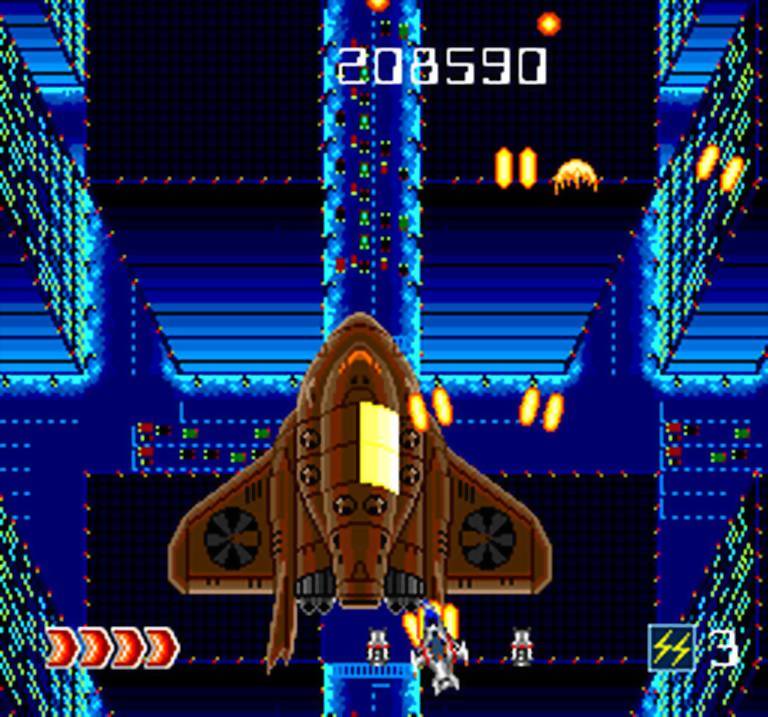
City level screenshot

The city level (level 3 or 4) is the best-looking level in the game. Also note the angled fire from your copter.

Avenger is a vertical shmup clearly inspired by Toaplan games like Kyukyoku Tiger/Twin Cobra, but it has one key original design feature: the aiming system.  Your helicopter rotates as you move right or left, and fires at the angle it is facing.  You can aim up to about a 45 degree angle in either direction.  By holding the II button while firing with I, your futuristic helicopter will lock at the angle you’re currently firing at, so that as you move around the screen you continue to fire in the locked direction while moving wherever.  This is the key design decision Under Defeat would reuse, over 15 years later.  That game is certainly better (and much, MUCH better looking) than this one, but any Under Defeat fan should find Avenger interesting.  It’s important to note, though, that you must leave the Turbo switches on your controller OFF for this game, or the controls will not work right!  The lock won’t work with the switches on.  You have autofire anyway, so it’s not needed.


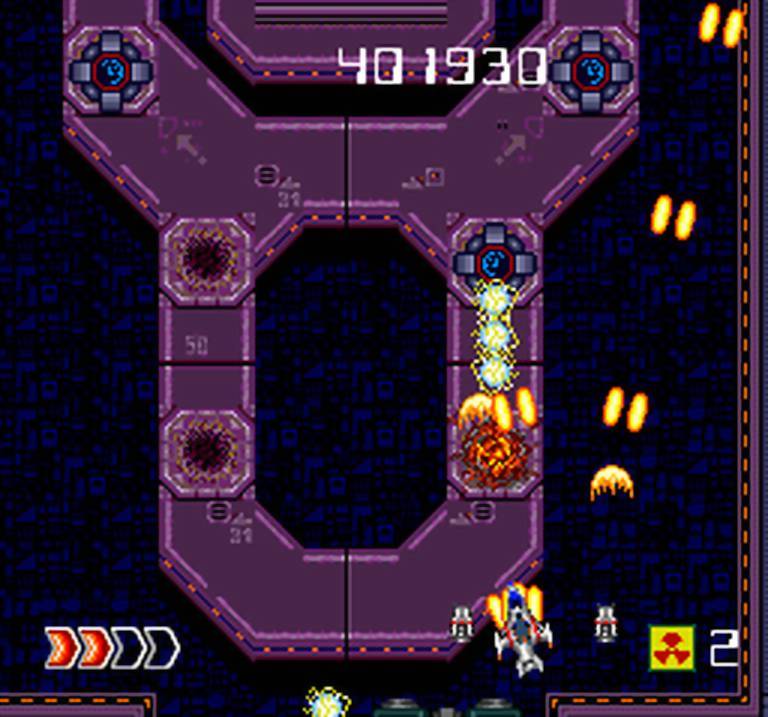
The last level

From the last level, this is one of the harder parts of the game, if you’re not at full power… but I did eventually figure out how to get through this corridor safely. Watch those bullet patterns!

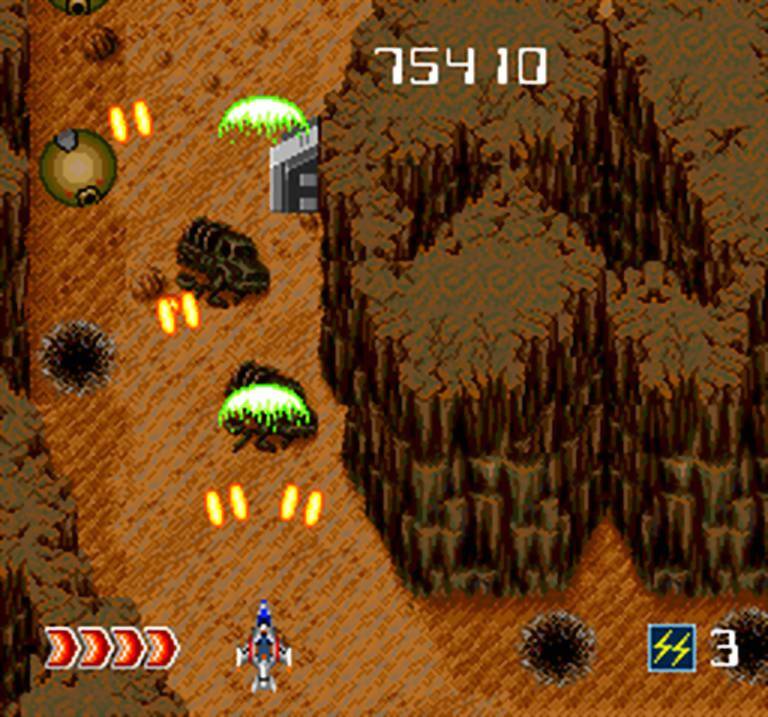
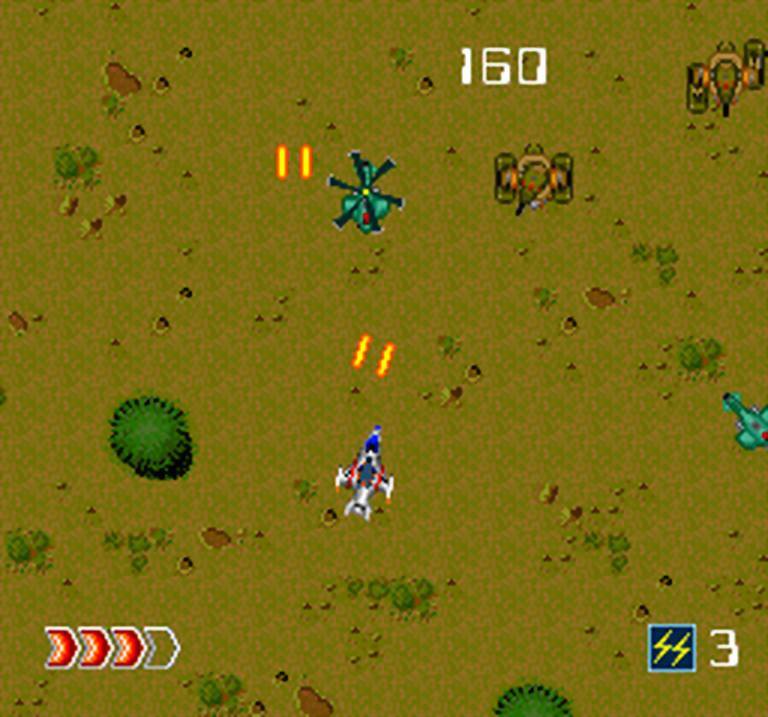
Apart from that, though, Avenger definitely feels inspired by Toaplan games and other major ’80s shmups like, perhaps, Raiden, though this is not a “Raiden-style” game like Cyber-Core (TG16) is.  The game is a vertical-scrolling shooter, and feels somewhat like Kyukyoku Tiger (Twin Cobra), except not quite as hard, and better looking than that game is.  The game has about eight stages, but is somewhat nonlinear — you will play all of the levels every time, but can choose which order to play the middle levels in (2-3, 4-5, 6-7).  You choose one or the other, then will go to the other stage next.  It’s a minor, but nice, addition.  Avenger heavily relies on memorization.  Each time you play the game you will get better and learn more, so your first few times through the game might be tough. This isn’t the hardest shmup, though, s stick with it and it is doable.  Even so, the game can be challenging in that classic shmup way because of how it demands memorization, and also punishes you for dying.  I think the difficulty level is balanced very well, though.  This game is not nearly as hard as Kyokyoku Tiger/Twin Cobra, thankfully.  I completed the game after some practice, and I’m definitely not the best shmup player around.  Overall Avenger isn’t easy, but it’s not super hard either — it’s just right.  While many enemies shoot at you, bosses and some certain enemy types shoot preset patterns instead.  These are not bullet-hell-impossible, though; with a little practice, and watching, I could figure them out.  There are often safe spots in a pattern, so look for them. I like the bullet pattern design in this game for sure.  It’s good.

Weapons and Upgrades

Canyon level

Level 2 or 3, the canyon. Hit the sides and you will blow up! Only some levels have instant-death walls, but this is one of them. So watch out.

Avenger lets you choose which weapon/item you want for each of your copter’s three slots: main weapon, secondary weapon, and special ability.  Helpfully, the weapon-select screen is entirely in English, even though the between-mission story text is in Japanese.  There are three things you will unlock in each category over the course of the game; at the start you have no choices, but by the end, or if you use that “unlock all weapons from the start” code you can find on GameFAQs and elsewhere, you have some choices for sure.  The three main guns are a machine gun, a laser, or rockets. I like the rockets at first, then lasers later, though all three are good.  You don’t start with a secondary weapon, but will get homing missiles at the start of the second level, and then later get a directional gun (useless) and side gunpods.  I find the homing missiles and gunpods both useful in different levels.  For special abilities, you start with one which destroys all bullets on screen (3 uses per level).  The other two come much later in the game.  One is a one-time-use invincibility item, and the last a two-uses megabomb (finally!).  You also have shielding on your copter which can take 5 hits before you are destroyed, which is very handy.

As in Toaplan games, or others, one enemy ship type drops powerups when destroyed.  The drop will cycle between different letters. “R” restores one hit point (up to a max of 5).  The others upgrade your main weapon and upgrade your special weapon (only appears in level 2 and on).  You cannot upgrade or restore your special item, so use them carefully. Your secondary weapon maxes out with only a couple of powerups, but the main gun takes four or five to hit max power, so try to stay alive.  If you die, though, you get game over and will have to continue and start the level over.  You have infinite continues in Avenger, but can’t save your progress, and this game can get hard at times if you die, due to losing all of your powerups.  This is an oldschool game, and getting reverted to base power HURTS.  Even though you can take multiple hits, which adds an very helpful margin for error to the game, it’s easy to take damage quickly once the hits start coming.  Some skill will be required, though again, the difficulty here is reasonable overall.  Tough, but reasonable.  Overall, the weapon and upgrade systems are classic, and work well.  It is very annoying how once in a while the upgrade icons will fly off the screen before going to the powerup you need, though, so watch them carefully and try to destroy the ships carrying them as far up the screen as you can!

Cutscenes

Intro cutscene

Beginning of the intro. Poor city… it is doomed, just in order to give you a game to play.

This game released in 1990, still in the early years of CD gaming.  So, the cutscenes here are important. Telenet did a nice job with the presentation in Avenger.  Unlike some early Turbo CD shmups (Legion, Daisenpuu Custom, Sidearms Special…), the game has not only CD-audio music, but also has voiced introduction and ending cutscenes.  The voice acting is in Japanese, but the basics of what is going on are simple enough to understand: with our high-tech futuristic helicopter, defeat the badguys attacking your country.   Beyond that, apparently the story is about a military commander from your nation who became a traitor and is trying to take a large carrier, which was supposed to be your helicopter’s base, to the enemy.  You have to stop him, and the carrier.  As with most Turbo CD games the intro and ending are “animated” in a very limited fashion.  The Turbo CD has only 64KB of RAM by default, and this game released before the RAM-expanding Super or Arcade Cards, so animation in cutscenes is limited and cutscenes have frequent black screens for loading.  Still, the two cutscenes look nice enough.

Options

Avenger has no options or settings, unfortunately.  This is a common issue in Turbografx games, and probably comes from NES-era design since most NES games work like that as well.  The game does have cheatcodes, but only to let you have all weapons from the start or for invincibility.  That first code is nice, though, for trying out after you’ve beaten the game. Beyond that though, all you can do is start playing.

Ingame Graphics

First Level

Beginning of the first level.  Yes, it looks bland.

Once you get into the game, you see what is perhaps the most-criticized element of Avenger: the bland in-game background graphics.  I first played this game, emulated, several years ago, because I heard that it controlled like Under Defeat for the Dreamcast, a game I absolutely love.  Well, I saw how bland these graphics look compared to other, later Turbo CD games, and didn’t play this much at all.  After finally getting my Turbo CD fixed, though, I made Avenger one of the first import games I bought, because it was something I wanted to play for sure, once I had the actual system.  I’m glad I did; the game is fun, despite the mediocre background art, and it’s cheap too.

Once you look beyond the backgrounds, however, Avenger actually looks okay.  I think that the ship designs are good, and while the ingame ship graphics aren’t quite at the level of the cinema scene ship graphics, they still look nice.  Look at the ship designs in the various screenshots above; this is no Nexzr, for sure, but I think they look okay to good.  The various laser bolts and bullets are well-drawn and large as well.  I think Avenger gets something of a bad rap for its graphics — play it for more than a couple of minutes and you’ll see that there are some nice things here, graphically.  Get beyond the first impression and there is more here.  The gameplay is definitely the biggest draw here, but Avenger doesn’t look THAT bad.  As I said earlier, the game at least looks quite a bit better than Kyukyoku Tiger’s TG16 port, and some other HuCard shmups besides.  The best looking level is definitely the level set in a city at night; that one honestly looks nice.  Unfortunately there are a few too many bland desert levels, but still, I think the game looks okay.

Level Completed Screen

An end-level screen. These are nice. Static, but nice. Each level has a different one.

While there are no cutscenes between the beginning and the end, there are Japanese-language text-only briefings befor missions, and nicely drawn static-image cinema scenes after them, with a fanfare, showing the level you just blasted through. The “game over” screen is also nicely drawn.  Looking at reviews of this game these screens receive praise, but the ingame graphics are often harshly criticized.  And while it is true that many of the environments are bland, I think that the art design of the ships is pretty good, and levels like the city or final level look decent as well.  There are also some interesting boss designs, and nice big flashy lasers sometimes too.  Avenger‘s graphics aren’t the greatest, but they are better than some of the critics suggest.

Audio
Avenger has a CD audio soundtrack, and it’s good.  I don’t know if I will really remember most of the songs in the game, but some of them are quite nice songs with do a very good job of backing the action and keeping the game more exciting.  I like the soundtrack, it’s solid early-game-CD music, and I love this kind of stuff!  I will definitely be listening to this soundtrack sometimes in the future.  Composers who previously had only worked on sound chips suddenly had access to CDs and could do higher-quality music, but still were often thinking in terms of videogame music.  The results are often unique, and it’s really unfortunate that the days of getting such soundtracks passed in favor of generic licensed soundtracks and the like.  Well, at least we still have stuff like Avenger.  The game doesn’t have one of the best TCD soundtracks, but it does have a solid, good one.  The sound effects are average; nothing special, but most games have okay sound effects I think.  Overall, the game looks okay and sounds good.  Youtube musical selection: http://www.youtube.com/watch?v=RNAYv0z50yk

Final Thoughts
Avenger is a good game that I liked quite a bit.  Despite the frustration some of the harder parts of the game induced, I kept coming back to this game anyway until I finished it, which says something for sure!  I have probably thousands of games now I haven’t finished, but this is one of the ones I quickly knew I’d be playing to completion.  It took a few weeks, but I accomplished that.  I am sure that I will replay this game, too — it’s quite fun, and I am certain to play it again, probably in the near future.  Avenger may not have the best graphics around, though they are better than, say, Kyuukyoku Tiger (Twin Cobra) on HuCard, but it has addictive, quality gameplay, and the game is well worth playing.  I’d highly recommend this to any Under Defeat fan, and recommend it generally as well.  This is a solid, fun, under-rated shmup. B+.

Yes, in the ending, you learn that your helicopter’s pilot is a woman.  This was secret up until the end. The “twist” was probably inspired by other games of the time that did similar things, I assume, but it’s a nice touch.  At the end you’re shown the “use all weapons from the start” password, but this comes first.

Finally, here’s a Youtube LP someone did of the game, for anyone interested in seeing the whole game. http://www.youtube.com/watch?v=JE9SYKDGPMU

Posted in Full Reviews, Reviews, Turbo CD | Tagged , , , , , | Leave a comment

Hexcite review updated! Also site updates

So, I worked on the Hexcite review again, and added some more details, fixed the images, improved the review, and particularly added more to the review of the PC version.  Go check it out and look up this incredibly highly under-rated classic!

Hexcite: The Shapes of Victory (Game Boy Color & PC) Review

Also, I’m going to be updating this site more frequently for a while, as I upload a bunch of older stuff I never posted here to the site.  Work on new content is slow (I am working on a Gamecube Game Opinion Summaries article), and the reviews coming up have been posted on forums or GameFAQs before, but they’re new here, and it’d be great to have all of my reviews in one place!

Finally, I updated the look of the page.  I stuck with the same theme, Twenty Ten, but actually chose a custom color and top-bar images, and changed the order and contents of the righthand sidebar items as well.  I like the look of the site a lot more now.  The three rotating top-bar images are my own pictures, of some of my games.

Posted in Updates | Tagged , | Leave a comment

Game Opinion Summaries: TurboGrafx (Turbo) CD / PC Engine CD – An Amazing System!

System History
—
The TurboGrafx-CD, also known as the PC Engine CD, was the first ever home gaming platform that used CD-based media. The only even remotely similar predecessor is the Japan-only MSX Laserdisc drive from the mid ’80s, but that was mostly just used for games which played video in the background while putting MSX graphics on top, I believe, and had very thin support and an extremely high price. The PC Engine/Turbo CD was pricey, but was within the realm of possibility for normal people. When Hudson first thought of the idea of a home system with CD media in the mid ’80s, it was a crazy-advanced idea. When the system released in late 1988 in Japan hard drives were far too small to fit all of the data from a CD, so they had to use very expensive setups in order to test games — and to try a game, you’d have to spend a lot of money to get a CD made. This was long before CD-Rs. But after NEC released the PC Engine, a year later they followed it with the PCE CD, so despite an initially extremely thin game library, the CD drive released. The launch games were Fighting Street, a fine port of the bad arcade game Street Fighter (1), and NoRiKo, a “game” about an idol singer popular at the time.

The original Turbo CD and PCE CD are in the form of a two-part addon, one a base unit that your TurboGrafx or PC Engine attaches to (the two regions have different designs, but the same internals), and the other a CD drive that also attaches to the base unit (these are identical between regions except for color and language text on the shell). It’s a somewhat odd system, but it works. The base unit has the added hardware in it, including a capacitor-backed save memory chip that allows games to save data to the system and a tiny 64KB of RAM to load data from the disc, plus another 64KB of RAM meant for audio loading, though some games used it for more data, if they could squeeze the audio into a smaller space. The base unit also has composite AV output jacks on the back, for better video quality than the RF that the original TG16 or PCE support. Hudson and NEC would later release many more models, and two more CD formats, the Super CD system card (with 256KB of RAM onboard) and the Arcade Card (with 2MB of RAM onboard), but with addons the first system can play any CD games. The Turbo CD and Turbo Duo (combo system with Super CD and HuCard systems built in to one unit) were miserable failures in the US, selling an unknown but not out of the tens of thousands number of systems. In Japan, though, it was a successful format, and had game support from its release in late 1989 until early 1997, followed by one final game in late 1999. The Turbo/PCE CD is probably the most successful console addon ever compared to the amount its base system sold, probably in no small part thanks to the Duo line getting CD drives into the hands of most everyone who bought a PCE from late 1991 on. However, because of how badly it did in the US, only a small fraction of the systems’ library released here. Many games have language barriers, but thankfully, unlike TurboGrafx-16 HuCards, the CD system is region-free, so import CDs work fine on any system. I do have a region-modded TG16, but still, not having to get the CD drive modded too or something is great.

—
Notes
—
This list seems to have the most text per review of any of the threads in this series yet, I think… but even so, they’re not quite as long as full reviews — compare that Avenger review thread I made recently to the Avenger summary below, this one is shorter. Still, some are not short. I had fewer games to cover, so I put more time into each one, and also a bunch of these games are imports which a lot of people probably don’t know all that well or have never heard of at all, so I spent more time explaining stuff. I hope it helps.

For one last starting note, I only have the regular Turbo CD system so far. I got the CD drive repaired, by PC Engine FX’s Keith Courage, this past summer, but only had a US system card 2.0 at the time, and haven’t gotten anything better yet. I think I’ll get a Super System Card pretty soon, and more Super CD games to go with it, but I wanted to do this thread as it is first, before I go into those games as well. The CD drive mostly works, but still has some issues, worse with some games than others — Avenger almost always runs fine for instance, but the sound very often fails early in level 1 of Daisenpuu Custom. There’s clearly still something not right with this drive, which is a bit annoying given that the laser is new (replaced with the repairs). Ah well, at least it usually works, and that’s fantastic, I love the system despite the occasional music-failure annoyances.

Of course, as I said above, so far I can only play regular CD titles on my Turbo CD system, so that’s all I actually review; I’ve played other games elsewhere, but I almost always only review games I’ve played on the original system in lists like this one. Super and Arcade CD games usually have better graphics than regular CD titles, since they have more RAM to work with, but these are what I’ve played so far, and some of them look nice. There are quite a few regular CD titles, so there’s been plenty to play.

[Later Edit: With some help from Keith Courage of PCEFX I finally found the correct CD drive laser pot settings within a few months of posting this article, and it has worked fine since.]

One last thing: if I don’t say what region of the game I have, it’s the US version (Japanese titles are marked). Also, for simplicity I just call the system the “Turbo CD” or TCD no matter what region the game is from. It’s all the same system after all.

Here normally I list my favorite games for the platform in question, but I’m not sure if I can make a list with much confidence yet, but I can mention some games I definitely like: Alzadick, Avenger, Cosmic Fantasy 2, Shanghai II, Splash Lake, Ys I & II, and Efera & Jiliora. There are more games than those that I like, though; it’s always hard to choose, and there are so many more games than these that I need to play, too… I’ve played some in emulation, but far from all!

Table of Contents
—
The Addams Family
Alzadick: Summer Carnival ’92 (J)
Avenger (J)
Bikkuriman Daijikai (J)
Cosmic Fantasy 2
Daisenpuu Custom (J)
Deko Boko Densetsu (J)
Down Load 2 (J)
Efera & Jiliora: The Emblem from Darkness (J)
Final Zone II (J)
Gulclight TDF2 (J)
Hihou Densetsu: Chris no Bouken (J)
Jantei Monogatari II: Uchuu Tantei Deiban: Shutsoudouhen (J)
Jantei Monogatari II: Uchuu Tantei Deiban: Kanketsuhen (J)
Last Alert
L-Dis (J)
The Legend of Xanadu (J)
Legion (J)
Mateki Densetsu Astralius (J)
Pomping World (J) [J ver. of Buster Bros.]
Prince of Persia
Puyo Puyo CD (J)
Ranma 1/2 (J)
Record of Lodoss War (J)
Road Spirits (J)
Rom Rom Stadium (J)
Shanghai II (J)
Sherlock Holmes: Consulting Detective
Side Arms Special (J) (aka Sidearms Special)
Splash Lake
Super Albatross (J)
Ultra Box Vol. 6 (J)
Valis IV — The Fantasm Soldier (J)
Ys Books I & II

==
TURBO CD Game Opinion Summaries
==


The Addams Family – One player. The Addams Family, from Icom, is a TCD-exclusive, and US-only-released, 2d platformer based on the Addams Family. Ocean also made Addams Family games, released on many platforms, based off of the movies from around that time, but this game is not Ocean’s game, it is entirely different. As with most of Icom’s platformers, though, the game has issues. Icom could make good adventure games, but their platformer abilities had more mixed results, and you can see that here. The Ocean games are also kind of mediocre, though, so I don’t know which is better. So, in this game, as you would expect from an Addams Family game, you play as… their greedy lawyer. Yes, you do not play as any of the Addams’s in this game, but instead play as their lawyer, armed with an umbrella which can shoot bullets, who is at the mansion attempting to collect some money from their safe, because apparently they owe it to him. As usual on the Turbo CD, the story is told through static images with voiceover behind them. This game does not have actual cutscenes or voice actors from the movie in it, but instead has static images and its own, lower-budget, cast. It’s good enough to do for a game. Your character’s job won’t be easy, though, because the Addams Family will not just allow him to go in and take the cash, he’ll have to earn it, if he can stay alive. It seems like a strange choice of characters to me, as the Ocean games all have you playing as Fester, Gomez, or Puggsly Addams (no, no games for the female characters, Ocean was sexist clearly), but I guess it works. You have several lives, but no continues, in this game, so it won’t be easy to complete. As with all of Icom’s platformers I’ve played, the game has somewhat suspect collision detection; they just never quite got it right. This game rarely demands super-accurate platform jumping, as you’ll probably be doing more shooting than jumping, but still it is annoying. The graphics and music are okay. They’re not high-budget work, clearly, but they’re acceptable and look better than some Western movie-licensed games. There are some nice details at times as well, such as areas where one of the Addamses is hitting golf balls at you from the background that you have to avoid, a fight against psychically controlled toys in Wednesday’s room, and more.

This game starts out with a linear stage where you go to the mansion, but once you arrive, it gets a bit more open-ended. Your goal in the mansion is to search for keys that let you go in doors, so as to explore more of the mansion and eventually find that money. Again, you do a lot of shooting in this game. Bosses take a lot of hits to defeat, and even normal enemies need a few shots, and you can’t jump on enemies to hurt them, that’ll just get you hurt. Level designs are okay, but nothing great. Because of the loading for each area, it’s annoying when I go through a door only to find a single-screen dead end room, because that means right back to the load screen… oh well. This game is on the short side if you know where to go and what to do, but it will take some practice before you get good enough to stay alive and go to the right places. I’ve gotten partway through it, but haven’t gotten more than a third of the way into it so far, I think. It’s an okay game, I guess. My first impression of this game was poor, but once I got used to the way the game plays, with having to avoid the enemies and shoot them, and also learning where to go at which point, it started getting a bit better. This game isn’t too expensive, so if you have a Turbo CD and like platformers, give it a try; it’s average at best and probably isn’t quite that, but there are much worse games out there, and this game does have some unique elements to it, such as all of the exploration required in this game that you didn’t usually see in platformers in 1991.


Alzadick: Summer Carnival ’92 (J exclusive) – One player, saves to internal memory. Alzadick is a time-trial shmup, or space shooter, designed for a contest held that summer by its publisher Naxat Soft. This game doesn’t really have a normal full single player game; there is a “Story” mode, but there are only two levels there, and they won’t take long at all to complete. Instead, it’s just got a 2 minute score attack mode and a 5 minute time attack mode on one level (it’s got two bosses, one at 2 mins and one at 5), and a 2 minute score attack practice mode on a second level that has no bosses. And that’s it. As a result of the extremely limited content, reviews of this game are usually harsh or dismissive. However, after trying teh game in an emulator, I quickly came to love this game, and I had to have it after I got the actual system, too. And yes, I’m still playing this game regularly. It may have only five minutes of content, but this is my favorite TG16/CD timed-mode level that I’ve played so far. Alzadick has great graphics for a regular CD title too, and even has some parallax scrolling! Very nice. The next shmup Naxat Soft published, the exceptional Super CD game Nexzr, looks better, but even so, Alzadick does a good job and looks great. The level designs are great as well. As you would expect from a CD title, Alzadick has a great CD audio soundtrack. That is really the only thing here that makes the choice of a CD necessary, but this electronic-music soundtrack is fantastic and easily justifies it on its own! I like Alzadick’s soundtrack a lot. There aren’t many tracks, but what there are are great. I wish that the game had more levels, of course, but the two that it does have are both good, very well-designed levels. Alzadick isn’t a pushover, either; it took me some time practicing until I was able to complete the 5 minute mode. The game actually requires some skill to complete. The game also saves (to the system) your best score in each of the three score-attack modes, which is nice.

Alzadick is a fairly traditional 4th gen shooter. Your ship has four weapon types, each of which is a different firing pattern for your gun. I prefer type 3 myself, since that gives the most forward and side fire coverage. Try not to get hit, since hits will reduce weapon power, and reduced weapon power will greatly decrease your scoring potential. If you get hit at minimum weapon strength you lose a life, and three deaths and you lose. With a little practice game over will be quite rare, but getting hit a time or two and losing weapon power happens, and ruins games. That’s okay, though; this game does require skill, and that’s great. I wouldn’t like this game nearly as much if it was easy. You also have a superbomb, but only have ONE per run and there are no pickups for more. You choose one of four firing patterns for the superbomb before you start each game. Each of the four patterns has advantages and disadvantages, but I think I like the six-lines-up or swirl styles best. I find the bomb most useful at the midboss (2 minute point boss), myself. Graphics and enemy types repeat often, but there is enough variety to keep things interesting. Each enemy wave usually waits until the previous one is done before entering the screen, which is a key strategic element — killing waves faster will fit more waves into the limited time. There are also some hidden bonuses, of course.

Naxat Soft based its 2 and 5 minute modes in this and their other shmups on Hudson’s 2 and 5 minute modes popularized in the Star Soldier series (from Super Star Soldier on), but unlike Hudson, where your goal in either mode is simply to score as many points as possible in the set time, Naxat changes the rules. Two minute mode works like Hudson: Your goal is to score as many points as you can in the set time. The applies to both the “Practice” mode, which is just another 2-minute mode just without a boss at the end due to that level not having one, and the regular 2 minute mode, which takes the first two minutes of the main 5 minute stage and has you play that. In 5 minute mode, however, your goal is actually to see how quickly you can score one million points. Once you score a million points, the game ends. If you fail to reach a million before the five minute timer runs out, you lose. In addition, you must meet a mid-point score requirement too. Oddly, while nothing else in this game is configurable, you can set the time and points needed at this midpoint score. The default requires 500,000 points at 2:30, which is challenging but possible with some practice. Avoid getting hit much! You can easily make impossible goals of course, too. Want to set it to requiring 900,000 points in a minute? You could never succeed, but it lets you set it to that anyway if you want. This is kind of a weird feature, though, considering that you cannot change the overriding 5 minute timer and 1 million point overall victory condition. Still, it’s kind of neat to mess with, for making things easier while you’re still learning the stage, or harder after you’ve played the game a lot. As for the “Story” mode, the two levels there are one for each of the two stages. Before and after each level there’s a screen of Japanese text telling you the story. I don’t know what it is. The levels are the same in Score Attack or Story mode, though, except in Story mode you only get one ship, so if you die you lose and will have to try again. The first stage (“Practice” in Score Attack) still doesn’t have a boss, unfortunately. Otherwise I like that stage, though; it’s a cool looking big red ship. The second stage (2/5 minute modes in Score Attack) is much longer and better designed, and has those two bosses, but the color scheme is more muted.

Overall, I really, really like Alzadick. The game is expensive — expect to pay $50-plus for the game — but I, at least, think that it’s great. The game has limited content, and playing it over and over will eventually reach diminishing returns as the game, like most 4th gen shmups, does not have a complex scoring system so all you can really do is try to kill more of the enemies and panels faster in order to get a few more waves to appear, but even so, this game is just so much fun to play through that I don’t really mind that. Alzadick was one of my most-played games in TG16 emulation, and now I’m playing it quite a bit on the actual system too. The game is one of my favorite regular-CD titles on the system, and is a great game to sit down with and play for ten minutes here and there.


Avenger (J exclusive) – One player. Avenger is from Laser Soft, which was one of Telenet Japan’s many divisions, along with Riot, Reno, Renovation, and Wolf Team. Telenet released many Turbo CD games, including this 1990 title, but faded mid-generation, and by 1995 Telenet had fallen apart. Wolf Team was bought by Namco (they became Namco’s Tales Studio), Renovation’s American publishing arm was bought by Sega, and the rest shut down or became a shadow of its former self; Telenet’s 1995-2004 (their last year) release library consists exclusively of pachinko, slot machine, and mahjong games. While they lasted though, Telenet made some interesting games. Telenet supported the Genesis and SNES, but they released the first third-party game for the Turbo CD, and supported the Sega CD for several years as well. Avenger is not one of Telenet’s more popular releases, however, but I think it’s an under-appreciated, quite high quality game. This game released in 1990, still in the early years of CD gaming. The game has a Turbo CD-style introduction (with mostly static images and a voiceover on top) and ending, which is nice; unfortunately the story before each stage is just told in Japanese text, but still, the intro is nice. Many other early, regular-CD Turbo CD shmups don’t do that and are just expanded HuCard games with CD music. In between levels there are also some nice static images with a fanfare, showing the level you just blasted through. These recieve praise, but the ingame graphics are often harshly criticized. And while it is true that many of the environments are bland, I think that the art design of the ships is pretty good. I think this game looks okay, really — the ships look nice enough and are well designed, and the action is fast, furious, and sometimes flashy. The CD audio soundtrack is also reasonably good. It’s not one of the system’s best, but it’s good and does a fine job of backing the action. Overall the game looks okay and sounds good.

In terms of its gameplay, Avenger reminds me a bit of a Toaplan-style game (like Twin Cobra or so) in design, but the game has one key original design idea: your ship, which is a futuristic helicopter, can rotate left or right, and by holding the II button (I fires; leave the Turbo switches OFF for this game or the controls will not work right!), you can lock your turret. With Turbo on the lock won’t work, so leave it off. You have autofire anyway. You can aim up to about a 45 degree angle in either direction. You also have a “bomb” attack and secondary weapons, and have a shield which can take 5 hits. One ship type drops powerups when destroyed, which then cycle between upgrading your main weapon, your secondary weapon, or giving you a hit point back if you’ve taken damage. There are three of each type of weapon, which you slowly unlock over the course of the game (though there is a code that lets you use all of them from the beginning). It’s a solid system, and I like the different options you have. The health is important too; it’s easy to get hit in this game and if you die you start the level over, so the health system gives you some margin for error. Also, the weapon-select screen options are in English, which is nice. The aiming-lock system is highly reminiscent of the design used in the much later title Under Defeat for the Sega Dreamcast. I absolutely loved that game (it’s my second favorite Dreamcast shmup, after only Ikaruga!), and then heard that this one does something similar, and that made me want to check out Avenger. The bland graphics left me initially unimpressed, but after getting my Turbo CD repaired this year I decided to buy the game anyway. I’m very glad that I did, because as I said, I think this game is good. I really love the aiming-with-lock controls, they are what makes the game so interesting I think. Avenger is a challenging game which will require practice to beat. YOu get infinite continues, but because you lose all powerups when you die, and there are some very challenging parts where having more power will be a big help, memorizing the game enough to stay alive is important. Some enemies shoot at you, but others shoot in patterns you must learn the safe points in. The last level can be very frusterating after you die the first time, for instance… but that’s how shmups worked back in 1990, I don’t hold that against the game. It just made beating it that much more of an accomplishment, anyway. Avenger lets you play some of the levels in different orders, which can add some variety, but you’ll need to play all the levels anyway in order to complete the game. Despite the frustration some of the harder parts of the game induces, I keep coming back to this game anyway, which says something. Avenger may not have the best graphics (though they are better than, say, Kyuukyoku Tiger (Twin Cobra) on HuCard…), but it has some addictive, quality gameplay, and the game is well worth playing. I’d highly recommend this to any Under Defeat fan, and recommend it generally as well. This is a solid, fun, under-rated shmup.


Bikkuriman Daijikai (J exclusive) – One player, password save. This isn’t really a game, and I’m not one who can “play” it. Bikkuriman Daijikai is bascally a fan/data disc, full of character descriptions and such, all in Japanese of course, and not much else. The only “gameplay” is some trivia questions, which is where the passwords come into play… though why a game on a system with internal saving has password-only saving, I have no idea. THis was one of Hudson’s earlier discs for the system in 1989, so at the time that they could do something like this at all — a disc full of images and audio clips and such — was very original, but it has aged very badly and tehre’s no reason to touch this today unless you know Japanese and are a serious Bikkuriman fan, which I’m not on either count. I have this because it came in a lot with some stuff I was interested in. Obviously the quiz questions are impossible to answer unless you know Japanese and know about Bikkuriman, too. I don’t know either one.


Cosmic Fantasy 2 – One player, saves to internal memory. Cosmic Fantasy 2, by Laser Soft (Telenet) and translated and published in the US by Working Designs, is a traditional JRPG. It’s a very simplistic one, with Dragon Quest-inspired but even more simplified combat that has basic, special attack, critical hit, and miss-free combat, but it is an RPG. The game has cutscenes (with minimal animation as per usual on Turbo CD), nice in-game graphics with decent-sized sprites and some nice graphical design, and a story that is part cliche, part original. The extreme simplicity of the battles may seem bad, given that even bosses will just do a set amount of damage per hit, every turn, but you get used to it, and the good graphics and decent, if initially cliche, story keep you going. As for that story, you are of course a boy from a medieval village who has to rescue his childhood friend/female love interest after she gets kidnapped because she is actually a princess. Yeah, zero points for originality there, even back in the early ’90s. It gets a bit more interesting later, though — as per the title, this isn’t a pure fantasy game, but does have sci-fi elements and a darker side to its story. I’m not all that far into the game, but honestly, even though I didn’t really expect to, I’m liking this game. The encounter rate is annoying, but it could be worse, and the presentation helps as well. Also, even though the combat is extremely simple, that isn’t all bad. Sure it means there isn’t much variety, but it also means you can plan what will happen quite nicely. I do like that. Cosmic Fantasy 2 got at least one US magazine’s “RPG of the Year” award in 1992, and I can kind of see why — between the then-impressive CD elements such as CD music, cutscenes, etc (this was the first menu-based RPG on a console in the US, after all), the good graphics, and the simple but decent gameplay behind that, it’s an okay package. I would have liked to see more complexity for sure, and don’t know if I have the patience to get all the way through this game, but still, for what it is, with good graphics, a decent story, okay gameplay, and more, it is good and was worth getting. Also available on Sega CD, in Japanese only, in the “Cosmic Fantasy Stories” collection.


Daisenpuu Custom (J exclusive) – One player. Daisenpuu, or Twin Hawk as the Western arcade release was called, is a vertical shmup from Toaplan. The game is somewhat like Twin Cobra (aka Kyuukyoku Tiger), but has several unique elements, most notably its allied-fighter system and its complete lack of any aerial enemies. In this game only bullets can kill you, all enemies are strictly land or water-bound. Indeed, almost all enemies in this game are tanks or ships. There are a lot of different kinds of tanks, but at first the very limited enemy variety can get repetitive. I got used to it after a while, though, and it does make the game unique. The idea is that your nation has planes, while the enemy in this World War II-analog world has only ground forces, tanks and ships particularly. So, you’re going in to stop them. You gain greater firepower yourself with some powerups, but it just adds more guns; there are no alternate weapons. This is a simple game. The allied-fighter system brings six fighters onto the screen when you press the other button. This replaces the megabomb many shmups have. These fighters will fly straight ahead and shoot, too, so they will increase your firepower. However, if they get hit by bullets, they’ll go down. They will shift left and right slightly if you move left and right, but you can’t really maneuver them much. Still, they can help kill enemies, or protect you in key moments if you plan ahead, since it takes a little while for them to fly onto the screen. Daisenpuu has lots of bullets to avoid, and is a challenging game as always from Toaplan. Daisenpuu isn’t their hardest game, but it is a good challenge.

This version, however, is Daisenpuu Custom, the CD release. Most reviewers are very harsh on the CD version, and say that you should play the HuCard version instead. Well, I have that version as well, and honestly, I like this CD version more. The biggest difference between the two versions is, of course, that the CD version has CD audio music. Unfortunately this was clealry a very low budget port, so there aren’t any cutscenes whatsoever, but at least it does have a quite nice CD audio soundtrack, which is a massive improvement over the poor, annoying music of the HuCard version. Toaplan could do great cartridge music, but Daisenpuu doesn’t show that at all. Fortunately though, this CD version exists as well. Second, the CD version adds one all-new level, and has new bosses for the first and last levels as well. Also, it breaks the game into levels, instead of being one always-scrolling game as the cartridge versions are. This was necessary because of the CD medium, but some people might dislike it. I don’t mind, though, and like the new bosses — the game fills in some areas where the HuCard has bizarre gaps, where I expected a boss but there is nothing. The new level is nice as well. However, and this has gotten a lot of criticism, they did change some things, and reduced level variety in some areas. So, the flooded-city section in level 2 is gone, replaced with more generic streets. Level 1’s bridge is gone, replaced with a rock bridge that matches the rest of the area. Some other areas later in the game are altered as well. This was likely done in order to give each level a more consistent visual look beginning to end for RAM-restriction reasons; remember that regular CD titles have only 64KB of RAM to work with. It’s not much. I do wish that that flooded city section had remained, but overall, I think the complaints about the graphical alterations are overplayed. The actual gameplay is exactly the same, after all, and there IS more content overall thanks to those added bosses and that new level, where you go through a desert city. Overall Daisenpuu Custom is a simple but very fun shooter that I think is pretty good. This game is not visually complex and doesn’t have much depth, but the simple fun of flying along and shooting tanks and ship turrets with solid Toaplan shooting design behind it holds up. This is another good, under-rated game. It can’t hope to compete visually with the later Super CD shmups, but the gameplay is good. Daisenpuu Custom is an arcade port with added content, so this version is TCD-exclusive, but the original Daisenpuu is available in arcades, Genesis (Japan only release), and TurboGrafx-16 (Japan only release).


Deko Boko Densetsu (J exclusive) – Five players (with multitap). Deko Boko Densetsu is a racing game from Telenet (yes, again!) that was clearly inspired by the Moto Roader games for the TG16. Essentially, Dekoboko Densetsu is a somewhat cutesey and simplified Moto Roader clone. The game is a top-down racing game where all cars are always on the screen together at all times, as you’d expect, and you have to complete a series of races. If you win, you move on to the next race; otherwise, try again. There are five racers per race, and each can either be a human or an AI, as in Moto Roader. Unlike that game, though, Dekoboko does not have car part buying or different course options. Instead, you just play through one championship, that’s it, and go straight from each race to the next. The part-buying element to Moto Roader added some strategy, but as it basically ended up being a frustrating puzzle minigame (in Moto Roader, you need to buy parts in the correct order if you want to have a serious chance at winning races), that’s not all bad. Losing the different circuit choices is unfortunate, though. To mix things up a bit, the game does have some weapon pickups, which is nice. As with Moto Roader though, if you’re at the forward edge of the screen, and thus ahead in the race, you have almost no forward vision. This means that either you must memorize all the tracks, or stay farther back on the screen until late in the race. You get used to it, but it can be frustrating sometimes. There are also obstacles and traps to avoid on the course. If a car takes too much damage it will explode, so try to avoid them if you want to have any hope of finishing even the first race — this game is challenging at first. With practice you will get used to the game, but there is a learning curve. As for the visuals, I like the graphics. The game has an amusing opening which starts out trying to fool you into thinking that this is some serious racing game before revealing the cute reality underneath that. Not bad. Ingame, the graphics are simple, but competently drawn and reasonably varied. The music is decent as well. Overall Deko Boko Densetsu probably isn’t as good as the Moto Roader games, since it is simpler and has less content, but it is a decent little game worth a try. Even though I find Moto Roader kind of annoying, I do think this game is alright.


Down Load 2 (aka Download 2) (J exclusive) – One player. Down Load 2, aka Download 2, is the sequel to NEC’s great HuCard shmup Down Load, and it’s an interesting game. Flawed, but interesting. Both games are cyberpunk-themed shmups with a decent story and good graphics and gameplay. As with the first game, Down Load 2 is a horizontal shmup. This game is easier than the first game, and indeed the low difficulty level is probably this games’ greatest flaw, but with some good cutscenes, solid gameplay, and good graphics with some impressive effects, Down Load 2 is a good game anyway. While you play as the same guy from the first game, this game changes the game system significantly from the first one. In the first game you had a health bar, but if you died you started the stage over. Also you could choose from two of each of your two weapons at the start of each level (which you were then stuck with for the stage), and had a speed-select button. This time your ship is larger — it’s a ship, not just a bike — and you can switch between your four weapons at any time. The weapons themselves are different, too. Also it now has speed powerups instead of letting you choose, and most importantly, you die in one hit this time. You do get multiple lives now, though, and most levels have some checkpoints. The reduced difficulty means that it’s much easier to avoid taking damage than it was in the first game, though; the removal of the health-up item, as there are no extra lives in this game, is really not a problem at all.

Now, for a HuCard game, Down Load had a lot of cutscenes. In a longplay where the player doesn’t die, cutscenes took up 17 minutes of DL1’s 45 minute length. DL2 is 50 minutes, but 25 minutes are taken up with cutscenes this time, so overall this CD game actually has several minutes LESS gameplay than its HuCard predecessor does; disappointing! Also, this time each level is about the same length. In the first game one level had only one section and was over in a minute or two, while the last had four stages and took over seven minutes. This time, all levels are two to 2 and a half minutes long, and have only one stage each. There is a boss at the end of each level. Some are easy, others are hard; this games’ difficulty balance could have used some work. Harder difficulty settings are badly needed too, since some bosses are way too easy. Ah well. The graphics in this game are fantastic, though. TG16 games, and regular CD titles in particular, rarely use any parallax scrolling, but this game is FULL of it! And it’s not only the basic “different vertical strips of the screen scroll at different speeds” stuff, either; this game has some real “scrolling plane behind the playfield” parallax too. Awesome. The visual themes are interesting, too. The first two levels look very similar to some stages from the first game, but after that it branches out as you start using your VR/computer to travel through time as you chase the villains. The cutscenes look nice; though the character art is by a different person from the first game (another change!), it looks great. Your main character guy sure has a lot of nude scenes in this game… As always animation is limited, but they did a good job with the system. Of course the voice acting is in Japanese, so I don’t really know what was going on, but the basics are easy enough to figure out. For one mild spoiler, yes, at the end of this game, you fight a reborn infant-Hitler-monster thing, on a level full of red biological stuff and Nazi imagery. Yeah, really. Killing Hitler once again? What could be better, for a videogame story? Some of the earlier levels, as you travel through time, are very cool as well. The Rome level is particularly interesting. I thought it was quite clever how the background “pictures” attack you. The Hindu-themed level looks great as well, though it was too short.

Overall, Down Load 2 is a good game, but don’t expect it to last very long at all. This game is short and isn’t very hard, and as with far too many TG16/CD games, there are absolutely no modes or options in this game; it doesn’t even have cheat codes! And since you have infinite continues, unless you artificially limit yourself by not continuing, getting to the last level will be easy. I had a bit more trouble with the final boss, and he did take some effort, but still, this game left me wanting more. I like the game system here — it’s different from the first game but is also good — but while the first Down Load is probably one of the best HuCard shmups I’ve played, this game is not quite on that level. The game isn’t cheap, either — expect to pay $25 to over $30 for this. If it was cheap I’d probably be more forgiving, but it’s not. Still, this IS a good game. I like the graphics and gameplay, and I’m sure I’ll replay it. DL2 is a decently good game, and a nice technical accomplishment for sure.


Efera & Jiliora: The Emblem from Darkness (J exclusive) – Two player simultaneous (with multitap), saves to system ( blocks). Efera & Jiliora, from Brain Grey, is a clearly Ys-inspired top-down fantasy action-RPG starring a pair of female warriors, one a mage and the other a fighter. This game has a somewhat dark story, good gameplay, two player co-op multiplayer, and good graphics, as well. Indeed, Efera & Jilora looks FAR better than Ys I & II does, with both a larger play window and larger, better sprites too. Very nice. The gameplay probably isn’t quite up to Ys’s level, though. While this game is pretty good, it can be frustrating at times — your melee weapons have a very short range, and this game does use a button to attack instead of Falcom-style bonking (see Ys below), so be careful. Grind is also required in this game, just like in Falcom games; after reaching the first town, for instance, the very next combat area is quite tough. Fortunately, like Ys, you can save anytime. Also, naturally, language is a factor here. It’s nice that the gaem does have voice acting in many cutscenes, and the cutscenes look good (even if, from the beginning, the story is not exactly happy), but there’s text as well, in towns and the like. Most of the time this game is easy enough to play, but you will need to talk to everyone in town, and then wander around as well looking for where to go next, if you can’t read the language as I can’t. Figuring out how to buy items takes practice too; stand on the little platforms in shops to buy. There are no walkthroughs in English for this game, so you’re on your own. Make sure to talk to EVERYONE, and explore the towns thoroughly. This game is manageable, as it’s reasonably linear, but I did get stuck sometimes starting early on, and had to explore and/or grind more in order to progress. The good gameplay and graphics made me want to keep going, though. I wish that someday this game gets a translation patch, and that would be really awesome, but it IS playable with a little effort — and that effort is worth it! Despite the occasional frustration, I definitely like this game more than Ys I & II. It looks better, and when I know what I’m doing it plays just as well or better, too. It’s also very cool that it has two player co-op! In single player you have to play as either Efera or Jiliora (I prefer playing as the mage, myself), but with another person, both can go through the game together. This is a relatively long RPG, so of course this will take a while, but if you have someone to play this with, go for it. Recommended! This game is sometimes overlooked, probably because of the language barrier, but it’s a great game that I really like, and it’s well worth getting.


Final Zone II – Final Zone II is a top-down run & gun developed by Telenet and released in the US by NEC. It’s considered somewhat average, but I like it. This game is the sequel to a Japanese computer game which was not released here; “Final Zone” on the Genesis is actually a version of the third (and last) game in this series. Final Zone II is one of the earlier CD releases in the US, which means, yes, horrendously bad voice acting! Somewhat like Last Alert, Final Zone II has comically bad voice acting its cutscenes which make even the tragic moments (such as the intro) kind of funny. It’s not all bad, though; this is “so bad it’s funny” stuff sometimes for sure. Final Zone II is a fairly simple game: get through the eight levels, all linear, vertically-scrolling stages, and you win. The graphics are good-sized and look pretty good for an early CD title. No complaints there. The music is decent to good, as well. The game has a sci-fi story, as you play as a small group of soldiers in powered armor suits who are teh only survivors from their ship and have to defeat the enemies and escape from the planet they crashed on. You start with only one guy, but unlock more as you progress. The female characters are in pink armor, of course, and there are some pretty sexist moments in the story, sadly. Fortunately, the actual gameplay is a lot better than the story. Yes, I like this game! Final Zone II is a simple game, and does not have Last Alert’s great strafing controls; instead, more like a Commando game, you simply shoot in the direction you’re facing, can use a special attack with the other button, and that’s it. The levels are well-designed and can be challenging at times, which is great. With enough replay I’m sure this game gets easy, but I think it has a good difficulty curve, and die regularly even on the first level. It’s not impossible though, just a solid challenge — which is great, compared to way-too-easy Last Alert. This is a simple, classic shooting game, and it’s a reasonably good one. I can understand why it gets some criticism, but I think its gameplay is a bit under-rated — I found myself having a lot more fun with this game than I expected to. Final Zone II doesn’t quite have Last Alert’s flash, as it has many fewer levels, simpler, more dated controls, no saving, and not as many cutscenes, but it does have solid gameplay, and it costs a lot less than Last Alert, too! So yeah, pick it up for a few bucks. It’s worth it, if you like action games (but if you don’t and can’t speak Japanese, then probably don’t bother with the TG16…).


Gulclight TDF2 (J) – One player, saves to internal memory. Gulclight TDF2 is a very basic, and flawed, turn-based tactical-style strategy game from Data West. This is an incredibly simplistic top-down sci-fi strategy game where you control a fleet of warships which have to defeat an alien menace. There aren’t any cutscenes here, though; the only story to be found here is the Japanese-language manual and the sentence or two of Japanese text in each mission briefing. The story is that you control the T.D.F. (Terrestrial Defense Force), Earth’s defense force of planes, land vehicles, and mechas who have to save the world from the evil Plea alien monsters. Production values don’t get much better ingame. Indeed, this is one of those games where the only thing justifying its choice of CD media is its CD music. The music is decent to good early-CD-videogame stuff. I like the opening-screen theme, and the ingame music is nice too. As for the graphics, the sprite work is decent; it’s average early ’90s mecha and monster stuff, which is a plus if you like that kind of thing. There are little “battle” animations between ships, when they fight, but they’re nothing a HuCard game couln’t have done. Military Madness’s are better, in fact — those actually have a custom background. Here, larger versions of your and the enemy’s ships appear with the stage map as a background, nothing more. And those stage backgrounds are not too thrilling. The first level is supposed to be a city at night, but it just comes across as a blue map with little rectangles and stuff on it, with no variation. The second level is better, with trees, roads, and hills (plus your units can move farther on roads than through the trees, too), but still the graphics are basic, and it doesn’t get better. This game has to have been made on an extremely limited budget! It is interesting that your units change from mission to mission, though. You are not following one unit, or one person’s, story, here, it seems. Instead, you’re just following the TDF’s battles in this war against the Plea.

As for import-ability, while the gameplay is too simple, this game is at least easy for the English-only speaker to play. The main screen displays and ingame menus are in English. Only the manual, mission briefing screens (there is nothing important on them), and ship and weapon names are in Japanese. Ship stats? What stats? All you can see is each TDF or PLEA ship/monster’s name, location, health bar, “Lv” bar, and movement range. Yes, this game is really stripped-down. Also, all units attack the same way: left/right/up/down only, and only to the next space. There are no ranged attackers here, no units that can use special abilities, heal the other ships, etc. Each one of your ships IS different — the weapons they are armed with (each unit has one or two weapons, but which ones each unit has vary) are not the same, and max health and movement ranges vary as well — but still, since all units operate and attack the same way, the game feels samey. Enemies have a similar lack or worse of variety — generally each mission has only a couple of enemy types. Since units don’t have real strength stats, levels, or anything, it’s hard to know exactly how strong any ship is, which is frustrating. On that note, as for that “Lv” bar, I’m not sure exactly WHAT it means. I’d to be able to read the manual to know that, and I can’t read Japanese, sadly, and there is no information about how to play this game online. I can tell that it changes based on which weapon you equip, though, so my only guess is that it represents max weapon power, or something along those lines. Lv is definitely not much of an indicator of unit strength. For instance the enemies on the first level have low Lv levels, but are much stronger than your individual ships anyway. This lack of numbers really is an issue. Imagine playing something like Fire Emblem, except your specific potential damage range and hit-chance percent are never displayed to the player! Yeah, it’s a pain. Those numbers have to exist, but you aren’t allowed to see what they are. Awful design there. All you can do is just look at how far the enemies’ health bar goes down, or doesn’t if it was a miss as it often is.

On the note of damage, at first I thought this game was broken and impossible. Looking at the two bits of “review” this game has online in English that I could find, at Mobygames and GameReviewDen, both comment on how hard this game is. And indeed, I lost badly my first handful of times I tried the game. The first level pits five of your ships against six enemies, and as I said earlier, on a one-on-one basis you are outgunned. Even though all units heal a bit every turn, I lost badly, rarely even managing to take out one enemy before being wiped out, or losing my lead unit; if your leader, the unit in the center of your starting group, loses, it’s an instant game over. I didn’t give up on the game, though, and eventually through luck and experimentation managed to figure out the key to the game: You can stack units! Specifically, you can put two units on a space. Then, if you tell one of those two units to attack, your first unit will attack, then the enemy will attack your first unit, and then your second unit will attack, become the “top” unit (swapping with the other unit). The enemy cannot attack that second unit, which is really important because they CANNOT stack like you can. There is one thing to be cautious of, though: your other units cannot move through a space which currently has two of your units on it. In the first mission this is irrelevant, since it’s in the air, but in land-based mission two, for example, this matters. Also, since you often seem to start with five units, you don’t start with an even number of units to group. Still, with this strategy, I was able to get through the first mission in only a couple of tries. Since luck is such an important factor in this game, both in hoping for enemy attacks to miss and for yours to hit, victory took a few tries, but this made it possible. What was my reward? A screen, in Engrish, saying “Congratuation”, of course! I could expect no better. However, I WAS surprised to see that the game saved my progress afterwards! The game does not initially create a save file, you see, so I thought it didn’t save… until I hit reset after losing a few times at mission two, and I found that yes, the game does indeed then create a file, so you can continue from any level you have reached. That’s fantastic. I also liked that mission two has a somewhat more strategic map, as I described earlier. So yeah, the very few things I’ve read about this game in English call it a terrible game, but it’s not THAT bad. The game is too simple (not much variety here!) and definitely has flaws, but I kind of enjoy it anyway, and will continue to play it once in a while for sure. It may or may not be worth a look, if you like this kind of game.


Hihou Densetsu: Chris no Bouken (J exclusive) – One player. Hihou Densetsu is an okay, but not great, platform-action game from Arc Co. Ltd, now known as Arc System Works. Yes, they did not always make good fighting games. Hihou Densetsu clearly was inspired by sources such as Indiana Jones, Ghosts n Goblins, Ys I&II, and other popular platformers and TG16 games. The game stars Chris (or something like that; the game has absolutely no English text either in the manual, CD, or ingame, so that’s just the best guess at how names should be spelled), a girl (yes, she is a girl, even though her sprite design and costume are somewhat androgynous) who is searching for her father, an archaeologist or something, who is missing in South America. So, she’s off on an adventure to go through tombs, kill Indians, villains, monsters, and the like. You know, it’s your usual racially insensitive adventure story through jungle tombs. There are a few twists along the way, though if you can read Japanese you’ll be spoiled for them, since apparently the manual describes every one of them in detail! Yeah, great idea there… or not. The story is told by cutscenes, and there is a cutscene between every level. They are done with TGCD-standard very limited amounts of animation. This game has even less animation than most games on this system, though; usually it’s just got a sequence of stills with a voiceover. The art design is solid, though. It’s nothing great or original, but the game is decently drawn. Don’t expect anything fancy like parallax here, though, and the graphics could look better, but aren’t awful either. Overall, the graphics are probably average. The games’ sound is also average.

Hihou Densetsu is a somewhat short game, but it makes up for its length with its difficulty. Please note, this game does NOT have saving. You do get unlimited continues, but have to start the game over if you turn the system off, always a very unwelcome “feature”. Each level in the game is made up of two stages and a bossfight at the end of the second stage, and the saving is between levels, not stages; run out of lives, and you start the level over. The stages in this game are short, but there is a clock and the time limits are even shorter, so it will take practice and memorization in order to get through each level. Thanks to the traps and tricky jumps this game really is memorization-heavy. The game is linear, though — there are very few times when you’re doing anything other than moving straight along a set path, so there isn’t really exploration. I don’t mind that, myself, and honestly kind of like the level designs, but some dislike the games’ fairly simple, linear stage layouts. The environment often is more of a threat than the enemies, but you will need to fight them off along the way as well, and learn boss patterns at the end of each level. One hint: The first disappearing platforms in the first level won’t disappear if you are standing on them, so after jumping on one don’t rush to try to get to the top quickly — you’re in no danger of falling. By level three or four the game won’t be so kind, though, so don’t get used to it. I haven’t managed to finish this game, but it’s decent enough that I expect I will eventually. Thanks to all the traps, memorization, and frustration the game sometimes stops being fun, but I do want to see the rest of the levels, and the game is decent enough to certainly be worth a try, at least for platformer fans. There are very few non-Super CD Turbo CD platformers outside of the Valis series, but this is one of them, and while nothing above average overall (and perhaps below it), it’s decent enough that I kind of like it.


Jantei Monogatari II: Uchuu Tantei Deiban: Shutsoudouhen (J exclusive) – One player, saves to system. Jantei Monogatari, published by Atlus, is a series of mahjong games. Yes, Atlus’s longest-running TG16/CD production was a mahjong series. As with most mahjong games, you play as a guy and play against various girls, with fanservicey scenes your reward for victory. This game has more story than just that, though — as the title (detective something) suggests, this is a sci-fi game. You play as future detective Deiban, and with your female sidekick have to stop various female villains before they can accomplish their villainous plots by beating them at mahjong. You start out defending some children who are in trouble in their school thanks to one of the villains’ underlings, for instance. The story scenes play out with limited interaction — you don’t just watch all the time and then finally play mahjong, but do make choices. There are two choice wheels at the bottom, with eight total options, but this is a simple game and trial and error will get you through even if you don’t know the language, fortunately; just keep trying options until something works and progresses the story. There is plenty of voice acting, which helps as well. The visuals are nice, too — the cutscene/adventure part of this game looks good for a regular-CD title. Once you get to a mahjong battle, your guy faces off one one one against the opponent. Yeah, this is 1-on-1 mahjong only, no full four-player games unfortunately. Also the game fills up a bit too much of the screen on my HDTV, so the bottom half of my tiles is cut off — very annoying! It does display the whole picture on my CRT, though; must have a smaller cut-off area around the screen (my HDTV is rear-projection and not new…). Also, if you are successful in the battles, there are some special options you can buy with points between rounds. The options are all in Japanese text, though, so good luck figuring out what they do. You can also transform into super mode, for a slight power boost I presume, but only do so if you have a good hand I would expect.

Beyond that though, this is a mahjong game. It is important to note that like most such games, this game game does NOT explain how to play. The manual has a several-page-long comic, some basic control and interface descriptions, and that’s it; nothing at all about how the game plays. You’d better already know how to play two-player mahjong. I don’t know the rules very well, and aren’t any good at memorizing what winning hands are, so I haven’t managed to win rounds of this game. I don’t know poker, and with more tiles in your hand and a great many complex rules, mahjong is a lot more complex than that game is to learn. This game will not help you with that in any way. I’ll return to this after I manage to learn some more about how to actually put winning hands together in this game. Overall though, with good visuals in the story scenes and okay mahjong action, this seems like a decent mahjong game. The system has a lot of them, though, so I have no idea how it compares to the others.


Jantei Monogatari II: Uchuu Tantei Deiban: Kanketsuhen (J exclusive) – One player, saves to system. Released a couple of months after the above title, this second volume of Jantei Monogatari II is very similar to the first, except with a few additions. Most importantly, the story is new, and you fight new opponents. Also, this game adds a Mahjong mode in addition to the main Story mode, if you want to go straight to the action and do some one-on-one fights against five opponents from the game. This is a welcome addition for sure. The interface graphics have also been improved a bit, particularly in the story scenes. The game does reuse a lot of animations from the first game, though; even though the story is new, the hero’s transformation scene, the overlong die-roll animation, etc. all are reused from the first volume. The gameplay is just the same as the first one, too, with no changes. The few improvements it has, though, put this as slightly better than the first volume of JM2.


Last Alert – One player, saves to system. Telenet’s Last Alert is a top-down run & gun action game. With many cutscenes, lots of levels, some variety in level designs along the way, and that the game saves your progress as you play, Last Alert is a pretty impressive game for 1990, when it released. The gmae also has fantastic controls — unlike many run & gun games from its time, this one has a strafe-lock button, so you can lock your firing direction with ease! It makes shooting easy. Controls are good, as well. The game has some flaws, though. Most notably, the voice acting in this NEC-published US release is absolutely abysmal, to a comical degree. Also, the graphics are small, there is no multiplayer, and the game is easy and sorely lacking in challenge. This game gets a fair amount of praise from Turbo fans, and it deserves some of it, but the downsides are real. In Last Alert you play as Guy Kazama, a muscular ’80s style action hero. You’re off to beat a series of villains who want to take over the world, naturally. The game has cutscenes between missions, with the usual Turbo CD-style barely-animated-scenes-with-voice, and conversations with each boss once you reach them. However, the story is generic action/spy movie stuff, and the voice acting really is awful. That bad voice acting is entertainingly bad at times, though, so there is that. Also while the story’s far from great, a game, or even movie, in this genre rarely does much more. Back in 1990, just having voiced story cutscenes in a game was a pretty big deal, of course. Now it’s not, but the story here is mostly fine. Gameplay is what matters the most in games, anyway, and the plot sets the scene for each of Guy Kazama’s exploits.

Last Alert has 23 levels spread across a sequence of missions. Each mission is made up of several levels, and sometimes you can choose the order you play a missions’ levels in. The game will also autosave after you complete a mission, which is great (it does not seem to save after each level, though.). Levels are reasonable length in Last Alert, and you get experience as you kill enemies. As you level up you’ll get more health and unlock more guns. However, as I said earlier, the game very rarely provides much challenge. I’m not the greatest at games, but I do not die very often in this game, that’s for sure. Honestly I find the game getting tedious after a while, thanks to the low difficulty level and long length of the game. Sure, the controls are great and wiping out the enemies is usually easy, but it’s often TOO easy. You can also often shoot through cars, which is weird. The games’ internal rules for which things you can shoot through and which you can’t don’t make much sense, and more obstacles to your fire probably would have been a good thing. And as with many TG16 games, like a NES or SMS game don’t expect to find any difficulty level options here, there are none. The game does have a few different level types, though. The variants don’t change much, but in this genre anything is nice. In most levels, you’re navigating through a fairly linear level, looking for the boss and wiping out the enemies along the way. A few missions have you instead “infiltrating” a base trying to rescue prisoners. Here, the amount of enemies you face depends on how often you shoot your gun. So, arm your machine gun and fire away if you want to face endless waves of respawning foes, or use the pistol and have an easy time of it. There are also some levels where you have to explore around an area, finding all of the bombs to disarm for example.

The basic gameplay of going around and shooting enemies as they appear never changes, though, and nor do those small graphics. HuCard games in this genre like Legend of the Valkyrie or even Bloody Wolf probably look better than this game. This game does show off its CD format by having a lot more levels than those games do, of course. The game also has a decent CD audio soundtrack. Overall, Last Alert is an okay game. The firing-lock button makes moving around and shooting where you want easy, and the game is plenty long and it is a fun game, at least for a while at a time. The game costs quite a bit more than the other Turbo CD topdown run & gun, Final Zone II and I don’t know if it’s a better game, though. Since it saves you don’t have to play the whole game all at once, though, unlike that game, and that’s great. Still, slightly bigger graphics and some difficulty level options would have gone a long way here. Still, Last Alert is reasonably good, overall. It’s worth a look for sure.


L-Dis (J exclusive) – One player. L-Dis, from NCS Masaya, is a hard cute ’em up-styled horizontal shmup. This game is reasonably well regarded I think, but isn’t one of the better-known Turbo CD shmups. For a regular CD title, though, this game looks and plays great. L-Dis has a very basic sexist videogame plot: you play as a boy who has to save the girl he likes, who has been kidnapped by aliens. Yeah, this plot again. Fortunately the game is a lot better than the story, though. You pilot a cute little ship, flying through six or so several-part levels on your quest. L-Dis is a very tough game, and beating it will take quite a bit of practice; I haven’t gotten even close yet, so far. If you run out of lives you can continue, but you start the whole level over, which is quite cruel when you’ve gotten to the final boss. Most levels do have obstacles to avoid, and of course the level designs get even tougher as you progress. The game has a powerup system of course, with floating powerups some enemies drop. There is a problem here, though: unlike almost all shmups, the powerups here are Japanese text boxes. So yeah, memorize which one is which, or else you’ll have problems getting what you want. It’s kind of annoying, but with some practice you will get used to it. The text color tells you which of the two different powerup types the powerup will give you, weapon or ship, so that’s a help. Weapon powerups give you different weapons, while the ship ones can give you helper ships (like Gradius Options), a shield, and and such. You can have a few (but limited) options, and have to choose between either option helpers or bombs which do nothing until you use them as screen-clearing superbombs. The weapon system works well, as long as you can figure out what you’re getting.

L-Dis is a pretty good looking game. The game does have some parallax scrolling, though not in every level. Still, on the Turbo, any parallax is great to see. Backgrounds are well-drawn as well, and the sprites are done in a nice cartoony style which looks quite good. The ships all have big eyes on them, which is a nice touch. The game makes use of the CD format to have some enemies, and the bosses, talk during your fights with them. It’s a nice addition and gives the game more personality. The music is good, fitting stuff as well. Overall, L-Dis has graphics and sound about as good as you can expect from a regular-CD title, and plays about as well as it looks, too. L-Dis is a hard game, but it’s well worth the effort, and I will definitely be going back to this one as I try to get farther. This is one of the better Turbo shmups I own, though it’s hard to choose when they’re almost all so good… but even so, it’s one of the better ones.


*The Legend of Xanadu (J exclusive) – One player, saves to system, Super CD game. This is another Super CD game, so I haven’t played it yet… and from what I’ve read about it, I’ll have a hard time once I do. The Legend of Xanadu, from 1994, is a later release on the system from Falcom, and it’s one part Ys I & II, one part Ys III, and one part confusing, apparently. This game has top-down Ys-style action with somewhat small sprites but actual fullscreen gameplay (unlike all previous Falcom games or ports of Falcom games on this system), along with side-scrolling levels that have nicer graphics. However, it also apparently has some pretty tricky puzzles which are very, very hard to figure out for those like me who don’t know Japanese — you need to talk to people then go to specific places at specific times, since this game has an ingame time system, in order for some things to happen. There is a partial walkthrough for the game, but it’s far from complete; hopefully someone works on it soon. Even if I don’t get oo far though, I’m very interested to play this game, since it looks pretty good. The gmae has a sequel, LoX II, which has some of the system’s best graphics. That one is apparently a lot shorter than this game (people say 30+ hours for this one, maybe half that for the sequel), but it sure looks nice. This game does have one thing that game doesn’t, though: it comes in a dual-jewel case, and comes with not just a slightly thicker manual, but also a map/poster that was one of the reasons why I got this. On one side, you have the poster with art for the game. It’s very ’90s anime-style stuff, but it’s kind of amusing. On the other side, there’s a map of the floor layouts for all of the floors of the apparently very tricky dungeon at the end of the game. That’d probably be very useful, once you get that far.


Legion (J exclusive) – Two player simultaneous. Legion is usually regarded as being one of the Turbo CD’s worst shmups, and it’s easy to see why. This game is not without any value, however. Legion is by Telenet, and was released the same year as Avenger. This game is a far cry from that great should-be-classic, however. Legion is a brutally hard, unforgiving game with average to subpar graphics and lacking music. This game is mostly for masochists and people who really want another two-player co-op shmup for the TG16/CD, since there are so few on the platform.

Legion is also interesting for having English-language voice acting telling the story. The art design is okay, and has that Telenet look to it, but clearly did not get the budget of even Avenger. This game doesn’t have parallax, of course. This cut-rate game has no actual cutscenes, but it does have audio logs from your ships’ pilot which play over the level, all voice acted by a native English speaker. Is he the same guy who did one of the voices in The Ninja Warriors on Sega CD? I’m not sure. Anyway though, the story is somewhat amusing, and some of the lines are weird. You’re a space pilot sent to defeat an enemy ship fleet threatening your planet. However, it comes at the cost of CD audio — this game has none! Instead, the actual soundtrack is chiptunes, and don’t sound as good as Turbo CD shmups usually do as a result; the TG16 can do some good music, but it doesn’t have one of the best audio chips of its time. Still, the music isn’t all bad. It’s very repetitive, but some of the songs are kind of catchy, such as the between-levels space map tune. Others are just annoying. Ah well.

As for the gameplay, this game is about trial and error above anything else. Sort of like Telenet’s Valis games, the enemies zoom in at you from off the screen, and if you’re in the wrong place you will get hit. As a result you will die, and die often, and hopefully memorize everything as you do so. This game is reasonable-length, too; this isn’t one of those 20-minute shmups. That will be the only way to survive this frustrating game. When I can manage to stay alive for a while the game can be fun at times, though. You do respawn where you were when you died, but those lives will go away quickly, and you have limited continues, so finishing this game is hard. You lose all of your powerups when you die, which in this game is a SERIOUS setback — you start out quite underpowered, and being reverted to nothing will surely cause more deaths. Try to avoid taking any hits, somehow! In order to add some replay value, the game does have some branching paths, where you can choose between multiple stages. That’s nice. In two player mode killing the enemies will be easier, but you share credits and environmental obstacles and hard-to-dodge enemy fire will still take you down sometimes, so the game is still hard. Overall, I don’t entirely hate Legion. The game has okay controls, decent graphics for its time, and certainly provides plenty of challenge. If you don’t mind frustratingly difficult games, go ahead and give Legion a try if you find it for quite cheap. Otherwise pass. I don’t regret buying it, since there is some fun to be had and sometimes I like a challenge, but it’s definitely not one of the better Turbo CD games.


Mateki Densetsu Astralius (J exclusive) – One player, saves to system. Astralius, from IGS, is a traditional-style JRPG that is pretty much hated by the few people outside of Japan who have played it. I got this as a part of a lot, and unfortunately, here the critics are right: this game isn’t good. I do like the graphics and story, though. Astralius has decently good graphics for its time, good-sized sprites for an RPG from 1991, and the art design and enemies look good enough, when you’re looking at them. The monsters could look better, but it’s not too bad. This game is no Square or Enix title, but it looks fine, much better than I expected given its reputation. The problems are almost everywhere else. First, load times in this game are long and very frequent. Every battle has a long load, and you can’t even see the enemies on screen at first, either — you only can look at them through a menu option, or after you’ve chosen your strategy for the round. Argh. Some people also dislike that the game does not retarget if a characters’ target dies before their turn, but I don’t mind that; the GBA Golden Sun games worked that way, and it was fine, and added some strategy. Still, the slow-paced battles, with their odd menus-only-while-selecting-moves design and load times, slow this game down to a crawl. Your movement speed on the overworld is far too slow as well, and the random battle encounter rate is very high. That is not a good combination, and gets me to either stop playing games, or stop trying to explore in games, which is awful since exploration should be one of the more fun things to do in this kind of game.

As for the story, Astralius uses the classic story concept of having a group of normal Earth people who are pulled into a fantasy world. In this case, you play as a musician guy, and your three musical group members are the other party members. No, not a rock band; the main character is a flutist, and the game starts on an ocean liner where you are supposed to entertain the guests, before you get sucked into another world of course. In the other world, you naturally turn out to be the hero who will have to save the world, as expected. You’ll eventually gain music-based magic attacks for each character, fitting with the games’ theme. The game has a few cutscenes, and some voice acting, but also plenty of text of course. Use the walkthrough ( http://www.unlimitedzigworks.com/149…pc-engine.html ) if you don’t know Japanese, it’s essential. Or just don’t play the game. I haven’t gotten too far into this one, and can’t see myself sticking with it long enough to finish it, but I will get at least a bit farther, I think; I’m not too far into it, and while it definitely is frustrating and I’m sure I’ll lose patience with it eventually, I do at least like the basic story. That “modern person pulled into another world” setup is a good one, and it’s one only infrequently seen in RPGs.


Pomping World (J ver.) [aka Buster Bros.] – Two player simultaneous. Pomping World, or Buster Bros., is a port by Hudson of Capcom’s arcade game of the same name. This game has a US release as ‘Buster Bros. Collection’, but I have the Japanese version because the game is the same and this was cheaper. The original arcade game was called Pang in Europe, so the game has a different name in each region. From the second game in this series on, in Japan the series also took on the “Pang” name, but here it stayed “Buster Bros.”. So yeah, why that title, “Pomping World”? I have no idea. Whatever you call it, though, this game is decent fun. I don’t love this game, but it’s alright to good. Buster Bros. is a single-screen shooting/platform game. Unlike a lot of single-screen platformers from this era, though, this game is nothing like Bubble Bobble. Instead, it’s more of a shmup. Each of the players — and yes, that this game has two player co-op is awesome — can move around the bottom of the screen, or up ladders to higher platforms if there are ladders in the stage in question. Each level is just one screen, but there are 17 stages full of levels and limited continues so the game is plenty long. The attacks in this game are unique: you can only shoot straight up. The enemies in this game are bouncing balls, which get smaller as you shoot them, but much like Asteroids, as they shrink they also break into multiple parts. Instead of a gun, your default weapon is more of a grappling hook gun, or something — if it hits the ceiling or a platform above you, it creates a rope which will damage an enemy (ball) if the ball bounces into it. This will destroy the rope and let you fire again. However, when one of those is out, you can’t shoot, so be careful with your placement! Also, since you have to stand under or right in front of enemies to hit them, the game requires quite a bit of risk, and can be frustrating when you’re down to a few tiny balls which aren’t bouncing very high, giving you very little margin for error. This is a one hit and you die game. There are some weapon powerups that can make things a bit easier, but you still fire upwards only. That’s what makes this game unique, but I do find it kind of annoying sometimes, and I wish I could shoot sideways too. Ah well, you do get used to it. The game has a variety of backgrounds as you progress, and new obstacles and trickier stage layouts appear as you get farther. The basic gameplay stays the same, though. Overall this is a decently fun game, but I do have some issues with the design (always firing up only, most importantly), and there’s no enemy variety either, just lots of balls, balloons, or whatever they are. I also dislike how you can get stuck sometimes if you didn’t do things right in a level. Still, the game can be addictive and definitely is a solid and mostly well-designed challenge, and the two player co-op is pretty cool as well. I can see why this game was successful enough to get a couple of sequels, though they didn’t come to this system. The first three Buster Bros. games were all included in the Buster Bros./Pang Collection for the PS1. All three titles are also included in the Capcom Puzzle World collection on PSP, along with Super Puzzle Fighter II and one other game. There are also European ports of this game on some computers (Spectrum, Commodore 64, Amstrad CPC, Amiga, PC, and Atari ST). There is a SNES port of the second Buster Bros. title, but not the first. I haven’t played that one.


*Prince of Persia – One player, saves to system, Super CD. I haven’t played this yet (Super CD…), but as for PoP in general, it’s not a game I played much of at all as a kid, and I haven’t gone back to it much either. The game seems okay, but that time limit… maybe I’ll try this one someday and actually play PoP for once, I don’t know.


*Puyo Puyo CD (J exclusive) – Two player simultaneous, Super CD. Haven’t played this yet either, but Puyo Puyo is a pretty good series.


Ranma 1/2 (J exclusive) – One player, password save. Ranma 1/2, by NCS Masaya, is a side-scrolling action-platformer beat ’em up game with lots of cutscenes. The game is based on the first season of the classic anime, and many scenes from the anime appear in this game. Or, well, a few do — this game is quite short, in terms of actual content. The game tries to make up for that with long cutscenes and a steep difficulty level, and while that adds frustration, it does work; while this game would be excessively short if you got through it all without dying and skipped the cutscenes, it feels longer thanks to how many times I have to replay each level until I beat it. The cutscenes are entertaining and fun, too. I really liked the Ranma 1/2 anime, so even though this is in Japanese I have a solid idea of what’s going on — there’s nothing new here, it’s all based on stuff from the show. For those who don’t know, Ranma 1/2 is an action/comedy manga and anime from Rumiko Takahashi about a martial artist boy, Ranma, who turns into a girl when water is poured on him. There’s a silly cast of characters, some of which can also turn into other forms when doused with water, his love interest Akane, and more. The anime was very successful and lasted a long time, and I’ve watched almost all of it. In the game you play as Ranma, sometimes only in boy form, sometimes only in girl form, and sometimes, in levels with water present, in either form. Girl Ranma is faster and can jump higher but doesn’t do as much damage, so they are different, which is good. In a nice touch, in levels where you can transform back and forth, the game actually changes the end-level cutscene depending on Ranma’s gender, so you will see the scene with girl Ranma if you’re female, or boy Ranma if you’re male. I wasn’t expecting that, but it’s there! Of course as usual the cutscenes are mostly static, but that’s the best they could do here.

Gameplay is simplistic. In each level or section of a level, you either walk to the right while avoiding obstacles (if there are any) and beating up the enemies which come at you, or do a 1-on-1 fight against a single opponent from the show in a smaller arena. The first type of level generally are short, and don’t go on for very long. These generally seem to be the easier part of the game, at least earlier on that is; they do get harder. The 1-on-1 fights, however, can be hard right from the start. You’ll have to learn the controls well in order to win, since your opponent has more health than you do, and if it’s a fight in a level which also has a first section against normal enemies, you might enter with only partial health. The controls and hit detection are not too well thought through. Essentially, you only hit a specific distance forward with each hit, so you can cheese some enemies by standing on them, jumping up, and doing the “land on head” kick, for instance. And time your high kicks (down+attack) well, because they only hit at a certain distance. In better games you would not have these problems, but Ranma games were not exactly all great — the first few SNES Ranma games are no better than this either. Lose a life and you start at the fight again, but at game over it’s back to the start of the stage. You have infinite continues, but if you choose game over instead, you’ll get your password for the level. These passwords are in the form of a head, body, and legs of various Ranma characters, with three parts each from a different character, so they’re kind of annoying because they’re purely visual. Identifying some of the characters from just their legs can be tricky. I had to memorize what the part looked like then go scrolling through the password screen sometimes, because there it’s easy to tell which part goes with which. Couldn’t they have just supported saving to the system? At least this is better than not having saving, though! This game may be short, but it can be frustrating and I’m happy to not have to replay all the levels every time. Overall, this game really is only for side-scrolling beat ’em up fans and Ranma fans. I don’t like side-scrolling beat ’em ups all that much, but I do like Ranma, so I like this game despite its serious flaws. It’s fun to play a Ranma game which goes through the first and best season of the anime, and the game is playable even if it’s not the greatest. I also like that this is a sidescroller, considering how very few of those there are on the regular Turbo CD. Non-fans may not like this game, though, I would guess. But I think it’s alright. It’s flawed, annoying at times, and could be a lot better, but despite that I find it at least a little bit fun.


Record of Lodoss War (J exclusive) – One player, saves to system. Published by Hudson, Record of Lodoss War is an RPG based off of the popular anime series of the same name. This game may be an anime license, but it’s a big, ambitious game. This game comes in a dual-jewel case, and has a decent-sized manual and a nice spell list/poster as well in the box. The poster is a quite nice image of Deedlit, but that spell list on the other side is also useful (particularly if you know Japanese). Unfortunately, it’s also got a lot of language issues for those like me who don’t speak Japanese. I have watched, and mostly liked, the Lodoss War anime, but apart from the characters, that isn’t much help here; the basic setup is somewhat similar, but the game itself is very different from the anime. So, you play as Parn, a human warrior type guy who will of course end up saving the world. You will eventually gather together a party of six, all of them from the party in the anime. I haven’t gotten nearly that far, but I have played it enough to figure out the basic menus, which took a while because of all the language issues. This game is more complex than Astralius, and doesn’t have any kind of guide online, either; hopefully someone makes one sometime, because some help, particularly for where to go, is badly needed! This game is not linear, you can wander all over the map. If you don’t know Japanese, you won’t be able to read the people telling you where you should be heading, so you’ll end up just randomly wandering around, fighting random battles, until you bump into the right place. That does not sound like much fun. This game has constant loading, too. Loading for menus, loading for the camp screen, loading into and out of each battle, etc. This game is already slow, and the loading slows down the pace even more, that’s for sure. This is a slow, slow game. You’ll need patience for this one.

Fortunately, the battle system is fairly good, and the game has some great music as well. The graphics aren’t as good; this game has small sprites in the overworld, and even Astralius looks better. The art design is good, but everything is small in both the overworld and battles. Battle screens are very bland visually apart from the sprites, as well. Also, as with most of Falcom’s TGCD games, the game plays in a bordered window; there’s a border around the viewing area, and your characters’ stats are permanently on the right side of the screen, as well. The play window is larger than it is in many Falcom games, but still, I wish it was fullscreen. I believe this games’ sequel is, which sounds good. The towns are done as static images, though, instead of regular explorable “JRPG towns”, so they look better; the static-image art in the cutscenes and towns is done well. In the town you have a little map letting you choose which place you want to go to, and then once you go to a location that place appears on the screen. In the first town, there’s a town square where you can access the menu, several houses you can go to to talk to people, a temple where you get Parn’s first ally, Etoh the priest. Then it’s best to go to the market to buy Parn some equipment and get some healing items. Etoh starts with equipment, but Parn doesn’t. In the market, there are six sellers to buy from. The bottom one sells items, of which there are four kinds in the game. The first one heals your LP (health), the second heals your MP (magic), and I’m not sure yet about the other two but I assume at least one is a resurrection item. The five weapon/armor sellers are trickier to buy from, since the game only tells you who can equip each item and not what it is. Either try to translate stuff yourself, or save beforehand and try stuff out until you find what you need then load and buy the right thing, I think. The third menu option on the weapon/armor sellers’ list lets you equip things, and the last lets you give equipment to other party members — handy things to have there. While I wish that the game showed what type of weapon or armor each item is, I do like that the shops at least tell you who can equip each piece; that is handy. Newer games usually also tell you how it’d change your character stats, but this game doesn’t have that unfortunately. At least it has something.

As for the camp pause or town square menu, the first tier of this menu has a heal/item view option as the top option, go to Camp screen as the second option, and change party order as the third option. In the Camp screen, it shows how much of each of the four items you have and your money total on the screen. You can save in this menu at any time, so you don’t need to go back to town or something — very handy! This makes the game playable, I think. I strongly prefer RPGs to let you save anywhere when not in battle, and this game does. Just know that Save is the THIRD option on that screen; the second is Load. Don’t mix them up. The first option is Equip, I’m not sure what the fourth does yet, the fifth and last is for battle options. I don’t know what they do. In battle, the game goes to a top-down map of the single-screen battle area. Instead of your standard “you stand on opposite sides of the screen and hit eachother” battles, Lodoss War have a strategy element, as you can move around the battle area at will. Very nice! I always have preferred strategic battles to just plain “stand on opposite sides” stuff. The pathfinding for movement is sometimes iffy, and the game doesn’t tell you movement ranges, but you’ll get used to it. It’s kind of like Lunar, except you can tell people to move to a specific point on the field, something not possible in those games. Like Lunar though, the parties generally start out out of range for melee attackers, so you’ve got to move first. I like it better this way. Those tiny sprites are kind of hard to make out much detail on, though… ah well. At least they are well drawn. In the battle menu, the top option goes to the attack menu. Below that (in order) you can change your character turn order, ???, use auto-battle (note: you can’t disable this once selected until the battle ends!), go to that battle options screen here too, or last run away. Once you choose to attack you can use your normal weapon to attack the selected enemy (you will move towards them automatically if out of range), move to a selected spot, use a spell or item (menu: spell, item, item? Not sure what that last one does, yet.), or defend. Each character has different spells, so try them out and figure out what they do. Enemies can take a little while to kill, but they, or you, will go down eventually.

Naturally, being an old RPG, this game is all about fighting lots and lots of battles. Save often, because this game is hard; I’ve gotten killed not too far from the first town. You basically have to grind right from the start… argh. If this wasn’t a Lodoss War game, I’m not sure if I’d try; sure this game is good, but it’s not usually a kind of game I stick with, grindey top-down old RPGs that is. But it is, so yeah, I will play this more, until I run into a wall of not knowing where to go, I imagine. Overall though, while the graphics aren’t the greatest, the gameplay here is solid. The game has a fairly good battle system, a large world to explore, and more, and it’s mostly playable once I figured out the menus, too; the main issue is just not knowing where to go. Even just a basic guide telling you where to go at each point would be fantastic… I want one! Ah well. Even as it is though, for Lodoss or classic RPG fans, this game is definitely worth a look, and shouldn’t cost much either. The game has a sequel, which is on the Turbo Super CD, and is different from the other Lodoss games at the time on Japanese computers and the Sega CD.


Road Spirits (J exclusive) – One player, saves to system. Road Spirits, from Arc System Works (then Arc Co.), is a good-looking but sadly vapid racing game. This game was clealry inspired by Outrun, as just in Outrun you drive towards the horizon in a “scaler-style” linescroll racing game. You have several sports cars to choose from, and there are over a dozen tracks in this game beginning to end so it will take a good while. The graphics are quite good, as well. The menus and interface look decent, the game saves your best time on each track (nice!), the cars are large, the environments beautiful, and trackside objects are present as well. There are very, very few racing games on the Turbo CD, and this is just about the only behind-the-car one (apart from the scattered racing bits in Zero 4 Champ II, this is about it I think), but visually it makes a good impression. The music is pretty good as well, and is nicely varied. I like it. The gameplay, however, is seriously lacking. Specifically, this game is brain-dead easy. Your only opponent in this game is the clock; other cars are just traffic to avoid, and avoiding them is not difficult. Staying on the road is just as easy, as it won’t be until almost the end of the game that you finally reach tracks that even begin to challenge in terms of the actual turns! Most of the game consists of about two minute long races that are absent of any serious chance of failure. You’re given plenty of time, and the track won’t turn beyond your ability to easily respond. There aren’t any difficulty level options in this game either, of course. It’s really sad, because the game could have really been something, but by making the game so excessively easy, it makes this game kind of hard to recommend. It’s a cheap game though — import-only, but cheap — so it might be worth a pickup because of how few racing games there are on this system, and for something easy to play through sometime you want to play a game but not actually have any chance of losing. I just wish that they had made the game a bit tougher. Something in between this and the extreme challenge of Victory Run (TG16) would be perfect, I think. That’d probably be Outrun, but OutRun (HuCard) costs a lot more than this game does. Anyway, Road Spirits is okay, I guess, but could have been a lot better if it wasn’t near-impossible to lose.


Rom Rom Stadium (J exclusive) – Two player simultaneous, saves to system. This is a baseball game from NCS Masaya, and sadly it’s not a very good one. Rom Rom Stadium is an early TCD release, and it shows: like most of the earlier HuCard baseball games on the system, this has a strictly overhead view and looks barely improved over NES titles visually, too much of the time. The sprites are very small, and the field is too. There also isn’t a full season mode here, just a pennant-chase as you try to beat the other teams with the one you select. At least the game will save your progress between games. You can also create your own custom team, and load it to another persons’ game by a ridiculously long (like, hundred-plus-letter) password you can view… though with passwords that long, it’s not worth it. The teams in this game are based on the real Japan League baseball teams, but I doubt it has a real license so it’s just clone teams. I love baseball, and it is interesting to see what has to be one of the first ever CD-based baseball games, though, so I do find the game kind of interesting, even if objectively it’s definitely a bad game. The graphics are only the first problem with this game. It also barely makes use of its CD medium, and the baseball mechanics are flawed as well. The only things reminding you that this is on a CD are clearer voice samples than you’d find on a cart or card game, some little “cutscenes” where an anime-style girl wearing various outfits, who is watching your game on TV, cheers or criticizes you during and after games (depending on how well your team is doing), and… well, that’s about it. There are no cutscenes here apart from those bits with the girl.

As for the gameplay, the game has the overhead field view, and a behind-the-batter view for the pitcher/batter duel. Once you manage to get the timing down to hit the ball, the main problem is that runners are much faster than the ball. Good luck trying to keep people from getting, or staying, on base… the computer may do fine at it, but human players will find that difficult. There is no field indicator as later top-down baseball games have, either, so you’ll just have to watch the ball to figure out where it’s going. Good luck trying to line up fielders who are off the screen with the ball flying towards them… or getting ground balls that get past your infielders, since who knows where the outfielders are. I don’t care for those later top or isometric view with minimap baseball games much either — Hardball III (PC/Genesis) completely spoiled me and I just can’t get used to any other kind of classic baseball game — but those games are at least a lot better than this. So, yeah, this game is challenging, and the computer probably cheats. It does make some mistakes, such as frequently throwing away the ball while trying to throw to first, though… but that’s more bad than good, when you think about it, because of how stupid it is. Exploit this anyway, though, because scoring in this game can be tough. Find a human to play against if you want to have “fun”, and even then the slow ball will annoy both of you, and the ugly graphics won’t impress anyone. Rom Rom Stadium may be one of, or maybe the, first CD-based baseball games, but that doesn’t make it good.


Shanghai II (J exclusive) – One player, saves to system (scores/settings), passwords (for direct access to puzzle layouts). Shanghai II, by Hudson, is the second version of this classic solitaire game using the Mahjoing tileset. It’s a good game with outstanding music but limited variety. I first played Shanghai clones on the PC back in the late ’90s, and it’s a great fun concept which can be challenging. There are four of each tile type somewhere in the field, except for special tiles like the dragons, flowers, and such, which you match with the others in their category. With a little practice you get used to what is what. The game works by matching similar tiles, but you can only remove tiles which have a fully uncovered (not touching another tile) left or right side; tiles in between other tiles cannot be touched. Because the tile patterns have multiple layers, luck is a huge factor in this game; losses will not always be your fault, there’s no way to know what is underneath the stacks. Of course, card games always have a luck factor, and mahjong tiles are essentially the same thing as cards in terms of function. This game has six different board layouts, each named for a different animal, and each one has probably a thousand possible tile layouts within it. Later Shanghai games have many more than six board layouts, and add new game modes, multiplayer, and more, but this is one of the earlier ones, so it doesn’t have any of that. The Saturn and Game Boy/GB Color Shanghai games I have do have those options (I review both in their respective system summaries), so I wasn’t sure if I would really find this game worthwhile because of how much less content it has than those games. Well, it is. The graphics are simple but effective, but I really have to say how incredible this games’ music is! I read that the Turbo CD Shanghai games (Shanghai III also has a TCD release) have great music, and that is absolutely true. Even if the gameplay here is lacking options and features compared to newer games like this, the music is so great that I’ve been playing game a lot, and surely will continue to.

The basic gameplay here is classic Shanghai done well, and that’s good. The game has four different tileset options, though it doesn’t have the number or symbol options you commonly see in newer Shanghai titles and clones; all four in this game are standard Mahjong characters only. I recommend the fourth one, since it has some color, which really helps differentiate the tiles. I also would hightly recommend using the fastest cursor speed; in the timed game, every second counts. There is also a difficulty level option, but Easy is hard enough, I haven’t tried the harder ones. Once you choose your options, the only other thing to do is start the game. The game sends you to the Tiger board first, but you can access any of the six from the menu, which you open by hitting Start. The middle menu is the board select. The names there are in Japanese, but once you choose a board it says the name in English on the table, so it’s easy to figure out.). The lefthand menu lets you take back a turn or reset the board. Again the menu is in Japanese, but it’s no problem. The righthand menu lets you start the timed challenge game (top option), view your high scores in timed mode, or enter a password to go to a specific table layout. There is no scorekeeping in the main game, unfortunately, only timed mode. Newer Shanghai games or clones would keep track of your best scores whether or not you won the game, but this game is more basic. It is disappointing, but at least the timed game has a leaderboard, and that high score table is saved to the system. The timed game is quite difficult, as the time limit is tight and finishing each table before you run out of time will be a real challenge. Also, actually getting a good score will be even harder, given how much luck is involved in this game. Takebacks are limited too, so you can’t just take back every mistake. You can retry tables if you fail, but your score resets if you do so, so the only way to really beat the game would be to complete all six tables without any failures. After completing each table, there’s a simple but nice little congratulations scene, slightly different for each tables’ animal. I haven’t managed to beat all six in one go yet, it’s quite hard. I’ll keep trying for sure, though! As for the passwords, the first two digits set the table (TI for tiger, etc.), the next is difficulty I believe, and the last group is the table layout. This lets you access any of the many, many variants, if there’s some specific one you want to try; by default the game randomizes which one you see. Overall, Shanghai II is great, and I love it. The featureset may be limited, but what’s here is done very well. Other versions of Shanghai II are on plenty more platforms, but none have this versions’ awesome soundtrack. I’ll have to get Shanghai III for Turbo CD (the first game wasn’t on CD, just HuCard, or Sega Master system, for console releases). The third game looks like it has a lot of nice additions.


Sherlock Holmes: Consulting Detective – One player, saves to system. See my Sega CD summary of this game — this is the exact same Icom FMV-heavy detective game as that one, just on Turbo CD instead of Sega CD. This was the first console port of the game. Yes, Sega was so desperate for a game with video in it that they included as a packin with their new Sega CD a third-party game which had already been released on the competitions’ system the previous year. The Sega CD version changed the graphics some, and might look slightly better, but the gameplay is the same, and overall the visuals are just a bit different, more than anything. This version looks decent, just about as okay as the Sega CD version. Unfortunately this means that the video is very low quality and plays in a small window. I was hoping that maybe the higher-color Turbo CD could put some more colors in its video, but if it does, I can’t really tell. Ah well. I guess it was probably hard enough to manage to squeeze video playback into the regular TCD’s 64KB of RAM. Unlike the Sega CD, the Turbo CD has very, very few games with live action video in them, since most such games, including this one, were Western-developed and the Turbo CD of course was quite the failure here. As such, while the game isn’t the most exciting thing, it does stand out more on the Turbo CD, which has so very few games with live-action video, versus the Sega CD. As for the gameplay though, this is a video adventure game. You watch videos, read newspaper articles, book segments, and the like, and slowly try to figure out what is going on in each of the three cases on the disc. You can’t pick up items in this game, but instead have to figure out who to talk to or where in London to go at each point in the case. Time matters, as the faster you finish the case the better your score at the end, but along the way this is a slow-paced game which requires careful reading and viewing in order to uncover the truth in each case. The game can be fun, once you get into it and take your time. I did enjoy trying to figure out what had happened. However, there is almost no replay value since each case is always the same, so this game won’t take long. Still, this is an okay game. Also on PC (DOS), Sega CD, and iOS/Mac/PC (Win6+). The latter three releases are a modern re-release with better video quality than the old ones.


Side Arms Special (J exclusive) – One player. Side Arms Special is an enhanced CD edition of the TG16 HuCard version of this NEC-developed console port of Capcom’s arcade horizontal shmup Hyper Dyne Side Arms. This game was an early release for the CD system, and it shows, but it is a pretty interesting game even so. The HuCard version got a US release, but this CD edition did not. Side Arms is one of Capcom’s shmups which lets you fire in multiple directions. First was Section Z, then Side Arms, and then last Forgotten Worlds. Forgotten Worlds lets you rotate and fire in any direction, but this game is simpler: I fires right, and II fires left. It’s simple, and it works. Just make sure to turn up both of those turbo switches for this one, most of the time, it’s needed. When you die you respawn right where you were in the main game, but have almost no invincibility so one death will often become three, or five, before you recover. That’s painful, when you’re only given two continues to complete the game with. Memorization is key! I’ll go into more detail about the original mode in this game when I do a TG16 summaries thread, but Side Arms is a great shooter with a few annoying issues. The game has five different weapons, and in the main game you can switch between them on the pause screen. Apparently in the arcade game you are just stuck with the last weapon you got, but here they improved things by letting you switch. The three-way gun and shotgun are my favorites, though the MBL is best against most bosses. There are hidden powerups, so shoot the walls and memorize their locations! These include point orbs, extra lives, and most importantly the super-mode powerup. When you get that, an orange ship (the player 2 ship from the arcade game) come in and merge with your ship to form one stronger unit. Now you’re in robot form, and shoot eight shots at all angles with every shot you fire. This will last until you get hit and lose the powerup, and the extra shots will really help keep you alive so try to avoid that. Normal powerups appear from one specific enemy type, and give you more weapons and increase their power; change the pickup by shooting the powerups to cycle through the options. Note that POW actually increases your ship speed, not weapon power. Odd choice of words there, that confused me for quite some time. The reverse POW decreases your speed. Apart from the respawn problems, this is a very good game. The game feels a bit lacking in color, but the arcade game looks the same way, so this is just being accurate to the original. Unfortunately the original arcade game’s two player mode is absent in both TG16/CD releases. Another issue is that the bosses repeat a lot — you’ll fight the same three or four bosses over and over, until finally you reach a new boss at the end of the game. Ah well, it’s fun anyway, and I did finally manage to beat the HuCard version of this game earlier this year (in 2013). I do like that bosses have health bars on the screen, it’s very handy. When compared to the HuCard version of the game, there are two major changes in the CD version. As in Daisenpuu Custom, there aren’t any cutscenes in this game, despite it being on a disc. There is a CD audio soundtrack though, and it is a great CD-audio version of the games’ music. It’s very cool to hear CD versions of the songs.

The other addition is even more interesting: in addition to a perfect (exept for the added load times and change to CD audio) copy of the HuCard game, there is also a second game mode available, called B.C. mode. In B.C. mode, the levels are shorter but harder, since in this mode you are sent back when you die; no respawn-where-you-died this time. While the levels are cut up versions of the original modes’ levels, the enemies in B.C. mode are mostly new designs, and the bosses are all new here. The weapon-switch and boss fight mechanics are different this time as well. You cannot switch weapons at will in this version; instead, you’re simply stuck with whatever weapon you last pick up. Instead of shooting the powerup orbs to change their powerup, they will now cycle between the different options automatically. This is as much good as bad, as it can take a while to cycle. There are only four weapons in B.C. mode, and all four are new. The best one feels like a hybrid of the shotgun and 3-way laser from the original mode, as it has the shotguns’ short range and many shots, but does not destroy enemy bullets, unlike the original mode shotgun but like the other weapons. There is again a straight laser as well, and a weird ball shot which rebounds forward and back. I think the original game has stronger weapons, but some of these are interesting. The powered-up robot mode is gone, and with it the 8-way helper fire as well. Instead, you can pick up some helper ships, which will protect you from hits (that is, act like a limited shield) and shoot out a bit, Gradius Options-style. Keeping these is important, as they’re your only hope for staying alive later on in the game. As for the bosses, bosses in B.C. mode do not have health bars anymore, so you’ll just have to shoot them until they die. They are more varied than in the original mode, though, which is good, and once again all of the boss designs here are new. You have to fight these bosses differently from the original mode bosses, though: B.C. mode bosses will only take damage from charge shots, not any normal fire! You’ll have to charge up and fire at their weak points to hurt them. This can be quite difficult by the later levels, and as a result B.C. mode, while being shorter than the original mode, is much more difficult. With new enemies, new weapons, new bosses, and perhaps slightly altered background graphics too, though, this is a very interesting game that any Side Arms or classic shmup fan should play! Despite the wealth of shmups on this system, Side Arms Hyper Dyne is a fantastic game and is one of the better US-released HuCard shmups. On CD it may not stand out quite as much, but the B.C. mode is great and makes this game definitely worth a purchase, whether or not you have other versions of Sidearms. No other version has B.C. mode in it, after all. The original Sidearms is on arcade and PS2/Xbox in one of the Capcom Classic Collection discs, but the TG16 version is TG16/TCD only, and B.C. mode is TCD exclusive.


Splash Lake – Two player simultaneous, saves to system. Splash Lake is a puzzle-action game, and it’s nice looking and plays great too. In this interesting title from NEC (and distributed by TTI in the US, since this was a later 1992 release here apparently), you play as a pair of cute, cartoony, legless ostriches which for some reason have to walk… er, bounce, rather… over floating pathways infested with hordes of monsters. This game is entirely playable in two player co-op, which is really awesome! One button jumps and the other button pecks. You can jump one or two spaces forward, but as you’re an ostrich, you can’t fly of course. You can defeat the monsters by pecking the bridge’s floor tiles. There are two main types of tiles, bridge pillar tiles and bridge floor tiles. Pillar tiles cannot be pecked, and will always be on the map. Floor tiles, however, can be destroyed. When you peck a bridge tile once, it cracks. Once you have cracked all tiles in an area which touch a solid tile, cracked two tiles next to eachother, or cracked enough tiles to cut off an area from the rest of the level, that area of the bridge will collapse, sending anyone on it into the water, both player or enemy. After a couple of seconds, the dropped bridge will reappear. Early enemies are easy enough to drop into the water with simple traps by pecking tiles behind an enemy and then waiting for them to approach you. Later on, however, enemies will get trickier, gain their own limited flight, and even require you to peck out long stretches of bridge all at once in order to kill them. There is also a boss at the end of each of the games’ six 10-level worlds. As a result, the game has a good difficulty curve, starting easy but gradually getting more challenging as you go along. Even so, 60 levels isn’t that long, and the game may seem to be short. However, there are two full additional hidden 60-level sets in this game! Yeah, they should have unlocked each after beating the previous, or told you abot this in the manual, but the only hint to their existence is a cryptic line in the story section: “We can even discoer items hidden behind teh pillar which will be a bonus point for both of us.” “Behind the pillar”? Huh? That’s not a very useful clue! How it works is that in order to unlock the second set of levels, you have to find the hidden fruit in each level in the first set. You find this by pecking three times on each bridge pillar until you find the one with the hidden fruit in it, and picking it up. Do that again in the second set of levels, and you unlock at third and final one. It’s great that there is more to this game, because Splash Lake is pretty good and can be a lot of fun. The game saves your progress as you go, unlocking levels in the level select as you reach them. Your best scores and options are also saved.

Splash Lake has a lot of options, on that note. You can choose from four ostrich colors, two bridge-drop types (all at once or one tile at a time), the number of lives per game (3 to 10; you have infinitne continues of course, but this matters if you’re playing for score!), whether you have 3 hit points per life or one (the game is much harder with one hit deaths!), whether you can pass through the other player in two player games or if you have to jump over them, how much time you get per level (the default is generous), the background color and bridge pattern, music on/off, and finally whether you want to view the amusing little in-between-area “ostrich theater” scenes which appear after you beat each boss. They’re all silly and amusing, so don’t turn them off, I would say. The options menu is great, I like being able to choose the menu background color and ostrich color. The music in the game is reasonably good as well. This isn’t one of the most memorable soundtracks around, but it’s a light, fun soundtrack that perfectly fits this kind of game. However, the CD audio is pretty much the only reason why this game is on a disc. Unless the game data takes up more than 8KB, which may or may not be the case, this game otherwise would be fine on a HuCard — there aren’t any videos, voice acting, real cutscenes, or anything in this game. Just fun gameplay. However, the good music is good enough excuse to put this on a disc, I think. Overall, Splash Lake is a pretty good game which I highly recommend anyone with a Turbo CD should track down! The game is great with either one or two players, and has lots of levels too if you find the hidden fruits. The game has a US release, too, which I have; it shouldn’t cost too much, for a Turbo CD game, but there’s also the import version of course. Either way, play Splash Lake, it’s good.


Super Albatross (J exclusive) – Super Albatross is an early CD golf game. By Telenet’s Laser Soft division, Super Albatross tries to use its CD format well, but has some seriously questionable gameplay mechanics. I generally find golf games very boring and almost never play them, but I was willing to give this one a try after looking at how it wasn’t just a golf game, but also has a story mode with cutscenes and everything. There are several modes in this game, including a single game on one of the courses in the game against several human or computer opponents, solo practice, or the story mode. In practice or single game modes, you can play as any of a variety of characters. In the story mode, though, you play as the guy on the cover. The intro cutscene explains his tragic past; the voice acting may be in Japanese, but it’s easy enough to see what’s going on. As usual animation is limited, but I like the effort — golf games did not have things such as this back then! Even now, a full character story mode in a sports game is uncommon, I think. The story explains how our hero’s sister (I think) dies of something or other, so he’s taking up his golf club to continue what she started… or something. I haven’t gotten past the intro, because this game is hard and I’m awful at golf games. One of the playable characters in single game/practice mode is a cyborg, so later on this game must go in a sci-fi direction.

But as I said, this game is not quite a normal golf game. Unfortunately, that isn’t a good thing. As with most golf games from the 1980s, this is a strictly top-down game, and does not have a behind-the-character viewpoint like most later golf games have. The graphics are okay, but apart from using more colors, this isn’t too much of a step over what the NES can do. In that respect this isn’t much different from other early HuCard golf games on the TG16. What is different is how you hit the ball in this game. Normally, golf games have a meter. You press the button several times with the right timing in order to swing. In this game though, there’s no meter; instead, how hard you press the button down determines how hard you hit. Yes, really, and it doesn’t work very well because without a meter, hitting the ball precisely, as is of course required, is quite difficult. It will take quite some time to get used to exactly how hard tyou have to press the button in order to go each distance you need. There is some essential help for this in the manual: the back cover of the manual shows you the maximum hitting distance each of the characters in the game will get with each club type. You’ll need the manual for this, because this is not told to you ingame, but have the manual and use that chart if you want to hit the ball the distance it needs to go! It’s the only way to have a chance. I couldn’t find anything of note about how this game plays online in English, but yes, this is how it works. Overall I can’t really say what I think of this game because I’m awful at golf games in general, but the odd, simplified control scheme makes me think that it probably isn’t exactly some lost classic. I do like the inclusion of a story mode, though.


Ultra Box vol. 6 (J exclusive) – One player, some games save to system (see below). Ultra Box was a digital magazine series. I think this is the last ‘issue’, unfortunately; it’s interesting. Really though, while it calls itself a magazine, this is more of a mini-game collection, or magazine cover disc but full of of original content instead of demos. The disc has five games on it, plus a variety of extra stuff. I’ll cover each of the games separately. All games are one player only though, so I won’t list that each time. They are all surely short games, though the length varies somewhat from title to title.
–Jangken & Fairies – Saves to system. This game is a rock-paper-scissors RPG. Rock-paper-scissors is called “jangken” in Japanese, and I believe you have to rescue some fairies, so the title is descriptive. This game looks like a very basic NES-esque early TG16 RPG, as you start in a town and are on a quest, except you do rock paper scissors for battles. Yeah, it’s weird like that.
–Alice in Flagland – Saves to system. This menu-based adventure game stars a girl named Alice in a weird somewhat Alice in Wonderland-themed world. The game plays like Snatcher, so you don’t move a cursor around, but instead just select options from the menu. The game is entirely in Japanese, of course, so I didn’t get far before hitting a game over screen, but there are amusing pictures and some voice clips that made me want to keep going anyway. I imagine this game isn’t that long, but it’d probably be fun if you know the language. And yeah, it’s weird!
–Dokikoki Driveland – No saving. This is a little minigame of sorts, and is shorter than the three main games on the disc (above and below). This game is a topdown racing game, and it’s a pretty fun one; I wish there was a full game based on this engine, but I don’t think there is. This game is also a bit “ecchi”, in that if you’re successful in the game eventually the two girls on the games’ title screen will remove their clothes one piece at a time. The game is a timetrial title, so you have a set, tight time limit to get through each course. It’s tough, short, and fun.
–“Henai” Lecture – No saving? This is a little dating sim/quiz game, I believe. I can’t get anywhere in it, given that it’s a game where you have to answer questions in Japanese, but you control some guy who seems to be trying to date a girl, maybe? Anyway, a girl is asking you questions. Given that ‘Henai” is in the title, I imagine that it’s some kind of love-related thing. I don’t know though.
–Cusuto Special – Saves to system. Cusuto Special is probaby the longest game on this disc; I played it for maybe an hour, but didn’t finish the game. This game starts with a long, fully-voiced sequence of cinema scenes. This part features an archaeologist and his daughter, I belive it is. The animation is limited as always on the system, but given that there is so much other stuff on this disc, it’s impressive that this could all fit. There’s the expected nude bath scene with the girl, badguys chasing them, etc. Eventually you end up in a maze with a first-person view, and have to get them through. Fortunately it’s not too hard. After that, the game shifts to a different guy, and becomes a menu-based conversation/adventure game. You’re going around town, looking for the now-missing archaeologist I think, and have to talk to quite a few people along the way, all in text-only Japanese. I don’t know if you can actually fail this, as I didn’t despite just choosing stuff at random, and eventually I stopped playing during this section. I don’t know how long the game continues on after this, but I’m sure I’ll try it sometime, since this seems like a fairly ambitious title, and the graphics and voice acting are high-quality stuff for a regular-CD title.

There are also a few non-interactive things on a second screen of the menu. First, there’s a huge software database with information on 340 PC Engine (HuCard, CD, SuperGrafx, etc.) games that had been released up to December 1991. It has cover art, game information, and I think a little review (from a magazine I assume?) for each title, and you can sort them by price, format, genre, release date, and the like. From here you can also access a menu with some images that have voice clips behind them. A few seem to be previews for upcoming games, such as the never-released Marble Madness, but I’m not sure about the rest. Second, there’s a large fanart gallery with REALLY weird, crazy art on its title screen. Going through this (press “down” to go to the next picture) takes a while, and getting through the whole thing was tedious, but the ending was interesting — the last three, probably the winners, have little voice clips with them. Also it’s not just PC Engine fanart; you’ll also see Sonic (yes, really), Goku, and Dragon Quest art, for example. Last, there’s a menu with a text message from the editor and a few other text blurbs. Overall, Ultra Box 6 is interesting. Most of the games have major language barriers, but even so this is pretty neat stuff to look through, and I”d like to get the other Ultra Box volumes in the future. I only have this one because that’s the one that came with the game lot I got.


Valis IV – The Fantasm Soldier (J exclusive) – One player, saves to system. Telenet’s Valis II, starring Japanese-schoolgirl-turned-magical-warrior Yuko, was one of the earliest platform-action games to release on the Turbo CD back in 1989. The series started on Japanese computers (and the NES), and there are also Genesis and SNES cartridge versions of all four Valis games, but the Turbo CD releases are probably the best known. They aren’t just platformers, but are games full of voice-acted cutscenes, something very new at the time. Valis IV is, chronologically, the last Valis game. After 1992’s Valis IV they made the SNES port of this game, a TCD remake of the Genesis remake of Valis 1, and then the series died, as Telenet stopped making platformers after ’92 and then broke apart a few years later. Because of how big of an impact the idea of a game with a story and fully voice-acted cutscenes was, though, the Valis series is at least somewhat remembered. Valis IV’s story is okay. It tells a new story with new protagonists, but is connected to the earlier games as well. It’s mostly cliche stuff as usual, as you will have to defeat the evil forces and such, but has some good moments in it. As usual on the Turbo CD the cutscenes have minimal animation, but at least there is some, unlike some games. Ingame graphics are great — this game has parallax-scrolling backgrounds in many levels! On the SNES or Genesis that would be nothing, but on this sytem, it’s impressive. Sprite work and bacakgrounds all look good as well. The soundtrack is also good. The voice acting is in Japanese, so I don’t entirely know what’s going on, but that doesn’t affect the gameplay, and you do get some sense of it.

However, all of the games have gameplay design issues, and this one is no exception. As usual with Telenet, the games are definitely not without their flaws. One constant in the Valis series is that the designers love to have enemies zoom in on you from all directions, necessitating either good reflexes, or memorization. Valis level designs can be very annoying due to the constant traps and flying enemies that you won’t be able to predict until after you’ve seen them already. You have a health bar, but it’ll frequently be being chipped away. Valis IV does have some good-sized levels with solid layouts, though. Most levels are linear, but some let you explore along the way as well. The game has decently good controls, and there are powerups to collect that increase your health, increase weapon power, and fill your magic meter, which can be used for special attacks or charge shots. When you get a game over you can continue, but from the beginning of the level, and with weapon power reset. By the middle of the game, this is a significant setback. Even so, it is great that the game saves your progress as you go. The previous two TUrbo CD Valis games also do so, but the rest of the series do not. Saving helps immensely in this game, and makes it much more bearable! At least after getting through a level in this version I don’t have to replay it if I give up later on in the game, unlike the SNES or Genesis Valis games… or TCD Valis 1, I think.

The game has three playable characters, much like Valis III did, except all three of them are new here; none of Valis III’s characters return in playable form. The game also has the Valis series’ only male playable character, though the guy is a large alien thing, not a human. The other two are girls, the main character a warrior-type and the other more a magic-type. The main character in this game is kind of weak, though; her attacks aren’t that strong, and the other girl has a great double-jump too. I much prefer to use her, and fortunately this game lets you switch between all three of them (once you have them all) whenever you want… most of the time. There are some areas where, annoyingly, the game forces you to use the main character. I wish it wouldn’t, but it does have a story to tell. Overall, Valis IV is a decent to good game that is definitely fun for a while. I do think it’s well worth getting. Even so, when I think of playing Valis games, ‘frustrating’ is probably the first word that comes to mind. This might be the best Valis game I’ve played, but it still can be frustrating. Still, the game has decently good graphics, a fair amount of levels, multiple characters, and more. Valis IV also has a SNES port which also got a US release, but that version removes all story cutscenes except for the intro and ending, and only has the main character playable, not the others; they aren’t in the game. Also of course you can’t save your progress. Levels have been redesigned, making them larger than they are in this version, so the game might take longer, but being stuck with that weak weapon of the main characters’ won’t help either. The game does have an enhanced powerup system which lets you pick up, and switch between, multiple weapon or ability powerups, and it’s a great addition, but it’s not nearly enough to make up for the cuts. This is the better version.


Ys Books I & II – One player, saves to system. Ys (‘ees’, not ‘whys’) I & II is probably one of the Turbo CD’s most popular, or at least best-known, games. The two games on this disc, which you must play in order, are both top-down action-RPGs from Falcom. The game uses Falcom’s signature combat system, where instead of having to press a button to attack you simply run into enemies to attack them, as with most all TCD Falcom titles. It is a simple game, focused on combat, exploring, and grinding above all. Some people compare Ys to Zelda, but the two games have very little in common — Ys has almost no puzzles. It does have save anywhere, though, as in all Ys games I know of, which is fantastic. You get five save slots. In this game, and in the Ys series in general, you play as Adol, a red-haired warrior who goes around from place to place and ends up saving the day and discovering every local mystery in every place he seems to visit, as usual for a videogame hero. In these games he saves several places while discovering the mystery of why, as the subtitle goes, “Ancient Ys Vanished”. Ys is a lost ancient civilization, you see, but there are rumors that it’s still out there somewhere, hidden away. Ys I & II has okay graphics, but not great. As with most Falcom-derived TCD games released into 1994, the game runs windowed, for some reason or other, and I find that annoying, as the game window is a little small. There is a large status bar on the bottom with your health, experience, enemy health, and money, and a thick border around the rest of the screen. This leaves you with a vertically narrow play window. I know that the regular Turbo CD has only 64KB of RAM, but why is the play window on the Sega Master System version quite a bit larger than this next-gen port? It has smaller status bars and a much thinner border. The ingame graphics in the Turbo CD version are improved compared to earlier versions, but still are small and limited in detail. This game looks okay for 1989, but it doesn’t look great. Of course though, the main new feature in this version, visually, are the CD elements. The game has a few cutscenes, high-quality voice acting, and some great CD audio music. Ys always had a great soundtack, and you see that in every version of the game I’ve played (even the SMS version sounds good), but this is one of the best renditions. NEC did the US release of this game, and unlike most titles after it, actually got good voice actors for this one. I’m sure that in 1989 this was amazing, but even now the game sounds great and has a good intro. The voice acting adds to the story during the game, as well.

Gameplay in all Ys games is grind-heavy, and this one set the standard, though this version is easier at the beginning than earlier versions are. The game does have some basic objectives along the way, and occasional story scenes, but the “quests” generally amount to excuses for you to grind and that’s about it. You need to grind enough money to get item X for person Y, explore/grind in the dungeon in question until you find what you need, and then go to the next location to grind in. Until you find the heal ring, you won’t recover health in dungeons, and will have to go back outside to heal; there, just stand still to do so. The game is a bit nonlinear at times, so you will need to explore, and I found myself looking at a guide a few times because I didn’t know where to go next. Sometimes going down in the current dungeon isn’t the right path, but instead after getting to a certain point you need to leave and go elsewhere next. That’s alright, though, as you’ll figure this out quickly — the harder areas will kill you fast, and it gives this simple game a little complexity. As for the level designs, level layouts get mazelike quickly, and this game does not have a map. That dungeon where you can only see a few feet in front of you is an interesting challenge! The TGCD version redid the dungeon maps versus older versions, so the game is not exactly the same as it was before. Future remakes would do the same thing again. On the whole Ys is no Zelda, for sure, but it is somehow fun despite its simplicity. On the issue of levelling, Ys I & II on TCD has maybe ten times more character levels than the Master System version had for the same amount of experience, so you level up significantly more times, but the end result, that you will spend most of the game grinding, is the same. You spend most of your time with this game working your way towards the next level so that you can go a bit farther and fight the next tier of enemies. Combat in Ys works by running into enemies, and it’s actually a pretty interesting system. You don’t want to always just run into them, but should pay attention to where you are running into the enemy, or vice versa — enemies are much more likely to hit you in head-on collisions than when you hit them on the sides or back, and you will probably take a hit if you get hit on the sides or back, so protect yourself. Now, I first played Ys seriously in the Sega Master System version, which I got a couple of years ago. That game has a much lower gameplay speed than the Turbo CD version, changing the feel of the game so that everything takes longer and carefullylining up angled attacks is easier, and vital. The game works at either pace though, so I don’t think speeding it up made the game better, just shorter. On TG16, you run around rapidly ramming enemies. On that note, the SMS also seems to punish you much more for head-on attacks. The basic combat is the same on both systems, but I just played the beginning of both games. In the SMS game, I died twice, in a hit or two each time, when I tried to ram front-on-front into the swordsmen on the first screen. On the TG16, I wiped them out no problem, and only took about a third of a healthbar of damage. At first I thought the difference was that the higher game speed made off-angle attacks more difficult, but no, they still happen; it just doesn’t punish you as much for running straight into enemies, it seems, and that really disappoints me. I like the challenge of having to be careful when approaching enemies! It adds strategy into the game. There still is strategy on the TG16, as if they hit you on the sides or back it’ll hurt, but from the front it feels different. I could be wrong about this though; what do people who have played the game a lot more than I do think? The first boss is definitely much, much easier on the TG16; it went from hard to a joke. Probably the designers wanted to get Ys I out of the way more quickly to make room for the bigger and more varied Ys II, but going through the game so quickly feels unsatisfying in comparison to how it is on the dedicated releases. Ys I & II is not an easy game though, to be sure, and starts getting harder in the temple, once you have to watch your health. And anyway Ys I may be quite a bit shorter than it is on SMS, but there’s also Ys II on the disc. Still, my first reaction to the TCD version’s combat was not good.

Overall, Ys will never challenge Zelda, but as Zelda is my favorite videogame series that’s kind of too bad; anyway, Ys doesn’t try to do that, and instead does its own simpler thing. I haven’t gotten far enough in this game to say anything definitive about it, because I stopped playing partway through Ys I out of disappointment and hadn’t gone back yet until I played it a bit for this summary, which actually would have been much more negative if I hadn’t done so. Between the too-easy early gameplay, seemingly reduced strategy in combat, and smaller gameplay window, I might like the SMS version of Ys I better than this one. Even so, Ys I & II for Turbo CD is a pretty good game. Ys I & II has decent graphics, great music and voice acting that were groundbreaking at the time, and good gameplay that still does hold up alright. Gameplay matters the most in games, and Ys’s gameplay could be better, but it is fun to explore around and run into enemies. But which version of Ys is the best? I don’t know, I haven’t played most of them nearly enough. There are many newer versions of Ys I & II, each with its own differences. Ys I & II, in various revisions, is available on the TCD (this one), PC (several versions, one US-released), PSP, DS, and PS2 (Japan only). I have the PSP version; it adds some new stuff to the beginning of the game, and has all-new graphics, but at its core it’s still Ys. Overall that might be the best version of Ys I/II that I’ve played. The original Ys I was released on the NES, SMS (only US version), and many Japanese computers. Ys II was on all of the same platforms sans the SMS. Ys II saw its first US release in this TCD compilation.

Posted in Classic Games, Game Opinion Summaries, Turbo CD, TurboGrafx-16 | Tagged , , , , , | Leave a comment

Game Opinion Summaries & System Review: Magnavox Odyssey 2, my first 2nd gen system. Especially featuring UFO! and Turtles!


I got a Magnavox Odyssey 2 in August 2012. I only have seventeen carts, with 21 games on them total, but it’s a start at least. It’s an interesting system; I’d never had a working second gen machine before the O2, so it was a new thing for me. I got an Atari 7800, which I’ve played many 2600 games on, in 2013, but I got the O2 first. I’d been unsure for years about how much I really wanted to get into pre-NES gaming — the NES is the console I knew as a kid, so this stuff is somewhat foreign to me. Games were different before the NES, with so many endless games, multiplayer-only titles, and extremely short games… very different styles of gaming from what would develop starting from 1985 and afterwards. Overall I have mixed feelings about this system; it does have a pretty small library, and a lot of really short or not so great games. Still, the few good games are interesting enough that I feel like it was worth the purchase. You can’t play O2 games anywhere else, legally, either — there are no collections of O2 games on newer systems, something not true for the 2600 or Intellivision. That’s unfortunate, since some of these games are good.

Table of Contents
—
Hardware Review and Background History

Favorite Games
Some of My Top High Scores So Far

The Summaries

Alpine Skiing!
Bowling! / Basketball! (2-in-1 cart)
Blockout! / Breakdown! (2-in-1 cart)
Computer Golf!
Football!
K.C. Munchkin!
Out Of This World! / Helicopter Rescue! (2-in-1 cart)
Pick Axe Pete!
Pocket Billiards!
P.T. Barnum’s Acrobats!
Speedway! / Spinout! / Cryptologic! (3-in-1 cart)
Thunderball!
Turtles!
UFO!


Very cool box, wish mine came with one!

System looks okay to good. There are several revisions, but this is the model I have.


Hardware Review and Background History
—
The original Magnavox Odyssey was of course the first ever home videogame system, released in 1972 and designed by Ralph Baer. This system wasn’t designed by Baer, however, but it was the first videogame console that is a successor to an older one. After making some dedicated Pong-style systems in between the two consoles, the Magnavox Odyssey 2 was Phillips Magnavox’s second videogame console and their first with true rom cartridges. It is a second generation machine and released in 1978 in the US, so it released over a year after the Atari 2600 that was its main competition. In the US, it was supported from 1978 to 1983. In Europe, where it was called the Phillips Videopac G7000, it lasted from 1980 to 1984. During that time, the system amassed a small, and almost entirely first party, 45-50 game library; the O2 had minimal third party support. In fact, even the first party stuff was mostly by one single guy — Magnavox didn’t have a large staff to make games for its new system to say the least, so basically this one guy had to do a lot of them. He ended up making 24 games, a majority of the games released for the system during its lifespan. This results in a lot of games with definite similarities — there’s a reason for that beyond the hardware design, many are by the same person. The system has one addon, the voice addon The Voice. It was only released in the US, and adds English-language speech effects to the nine games that support it (plus homebrew titles; most of them support it too). No games require it, however, unlike the IntelliVision’s IntelliVoice voice addon; it’s optional, flavor-speech stuff.

The Odyssey 2 has somewhat unique hardware inside the box. The O2 was the first, and one of the only, consoles ever to use an Intel CPU. Programmers were unfamiliar with it at the time, so it probably hurt in terms of getting third party support, but I think it’s pretty cool that it has Intel in the box. The CPU is faster than the Atari 2600’s, but it isn’t nearly as hackable. As a result, O2 games have little graphical variety. First-person or behind-the-car/ship viewpoints are impossible on the O2. Sprite “scaling” effects such as in Solaris or even Outer Space on the 2600 cannot be done, and nor can third-person racing games. The system also has some limitations on sprite variety, as I will explain. However, what you get for this is zero flicker. Unlike the 2600, which has many games loaded with flicker, O2 graphics are rock-solid and never flicker. What it can do, it does flawlessly. O2 games don’t seem to ever have any slowdown either.

To go into more detail about graphical variety on the O2, the system also, uniquely, has a built-in character set that includes a lot of graphical elements. You can see many of them in the screenshots posted throughout this article. It is not a coincidence that so many of the games have the same “small person”, “large person”, “tree”, and such sprites; instead, those are all taken from the system’s built-in character set. The system is designed to easily use sprites from that character set. Using custom sprites is more limited; I think that it can only display a few of these at a time. If you look at O2 games, you’ll notice that you never see more than a couple of sprites at any one time that aren’t from the standard character set. Some games get creative here, such as how O2 Demon Attack uses the “tree” sprite for your spaceship, or UFO! and Turtles blinking between two symbols, such as a circle, X, or +, quickly in order to represent an enemy. It works, actually. It is unfortunate, however, that the O2 has such limited graphical variety. It’d be nice if it could do things like Solaris or Enduro on the Atari 2600. Still though, it’s a good console with good games, and you get used to its graphics after playing the system for a while.

http://www.dadgum.com/halcyon/BOOK/AVERETT.HTM – An interview with Ed Averett, the guy at Magnavox who made 24 of the O2’s games

The Odyssey 2 was supposed to have a successor in 1983, the backwards-compatible Odyssey 3. However, because of the videogame crash that started that year, the US release was abandoned while the system was still in testing. Some prototype O3s exist, but it was not released. This system was released in Europe, however, as the Phillips Videopac+ G7400. I’ll call it the Videopac+. The Videopac+ has three exclusive titles, and twelve more games that were released in Europe as dual-mode titles. These games play the same on either a Videopac or Videopac+, but have high-color backgrounds behind the playfield on the Videopac+. Those three exclusive games use the upgraded graphics hardware in the foreground too. Unfortunately Videopac+ systems and games are all entirely PAL region, so you can’t play them in the US unless you have a PAL television to play them on. Many O2/Videopac games do work on either PAL or NTSC, but the Videopac+ console itself will not. O3 prototype systems cannot run Videopac+ games without modification, either. Homebrew O2 releases often have Videopac+ backgrounds, but I don’t know of any that require it; that’d cut off almost all of your American audience, after all. The system does seem a bit more popular in Europe than here, but still, homebrew games just support it, and The Voice, they don’t require either.

So, the Odyssey 2 may have a small game library, and only a relative few of those are good, too. And on top of that, many of the better ones are games inspired by more popular arcade or Atari titles. Even so, I find it an interesting system with some fun games; I don’t regret buying this, actually. The system’s graphics are simple, but actually in terms of hardware power it’s actually more powerful in many ways than the 2600, even if you can’t always tell by looking at the games. The system uses an Intel CPU, rare at the time, so programmers weren’t too used to it. Some of the homebrew titles released in recent years show that the system is actually capable of much better visuals than are seen in most of the titles released during its life.

http://www.youtube.com/watch?v=WcD6qczYIJY – Here’s the trailer for the 2012 release Mage: The Enchanted Crystals. This trailer has the Videopac+ background, but apart from that it’d look the same on O2. The music might be from The Voice. Looks like a decent game, and it’s in a genre that the system doesn’t have much of, action/adventure games. There’s a cancelled and thus unofficial-release-only release of Tutankham, this, and not much else.

As with was normal for the era, many O2 games are two player only titles. This is, of course, frustrating today, but that’s how games were. This means that some games are more playable than others with only one person, excepting the one player only games of course which are fine. Also there’s no saving of anything, so it’s vital to write down your scores for the games — apart from sports games everything else here is score-based, and without any other form of saving, writing down scores is the only way for the games to mean anything.

Beyond those usual basics, though, O2 gameplay has some idiosyncrasies, some of which surely result from one guy making so many of the system’s titles. Most (first party, but almost all O2 games are first party; there are only 5-8 third party releases anywhere) O2 games seem to fall into one of five categories. First, sports games (Football, Baseball, Bowling, what have you). Second, games which use the keyboard (there are analogs of Simon, Hangman, Concentration, and more.). Third, action games where you have one life, and start a new game after dying once (the KC games, UFO, Pick Axe Pete, etc.). Fourth, competitive games where you play to ten points (usually against a human, sometimes a computer; examples include Alien Invasion Plus, Out Of This World, etc.). And fifth, timed games, where each game is 2-3 minutes long. Few games don’t fall into any of these five categories, though I guess a couple of the racing games could be a sixth category, racing games that aren’t timed but instead end after you go through enough laps/gates. Yeah, the O2 has some unique game design elements, most notably in the one-life stuff.


The system also has three boardgames with O2 videogame components. I am very interested in two of these, Conquest of the World and Quest for the Rings. Both sound pretty interesting, regardless of how good they are. The games have a boardgame element, where you move around or strategize on an actual, physical board, and a videogame element, where you avoid enemies, fight eachother, and what have you. Obviously these are multiplayer only games.

As for hardware design, the system looks like something out of its time. That is, it looks very late ’70s to early ’80s. I love some of the box art design — the flying letters and logos look really cool. The box art of the system and games is a real highlight of the system, and is one of the reason I’d always recommend getting complete copies of games, or at least copies with the manuals (all of which have the box art on their covers) — it’s great stuff! Sometimes the box art and manuals are better than the games, that’s for sure… I’ll post some examples of box arts here. Really cool stuff. The cartridges themselves all have handles, which preclude the use of end labels, but the boxes make for good storage devices anyway, with the flap covers, so that’s alright.

The system itself is well enough designed. It’s nothing amazing looking, but it’ll do the job. The built-in flat keyboard is a nice touch. Some games play on the keyboard, so you’ll need the system close. Of course, with controller cords as short as second-gen cords all are, you’ll need the system close anyway. On that note, the controllers are basic, Atari-inspired controllers, but they’re not the same as Atari joysticks. Unlike those these have more throw, so you can move them farther in each direction. They’re eight-direction sticks, too, with notches cut out of the sides of the well, so that you can lock the stick into any of the eight directions. This is handy in many titles. It is a digital stick and not analog, but that’s okay. Like with the Atari, though, the system has only one button. One more might have been nice… oh well. The system I have has black, hardwired controllers, and a flat keyboard. Six models of O2 systems were released in the US, but the one I have seems one of the most common kinds. I just got it a few weeks ago, and it’s working fine. The system attaches to the TV via an RF box. It has twin leads on it, but fortunately they are attached to a small box with a normal (UHF) cable plug on it, so I don’t need to buy a special adapter to use it with my television, since of course no TVs from the last 25-plus years have those two-prong plugs on them. It does have one of the old-fashioned slide switches, though, so you need to manually switch it to game mode; it won’t autoswitch like the NES and beyond can do. The antenna out part on the switch IS twin lead, so instead of using an adapter I don’t connect this system directly to my TV, where the cable input is, but instead hook it up to the VCR. That works well, and I can leave the switch on “on” that way too and not have to keep messing with it. Unfortunately the RF box is hard-wired, so I do need to remove it when not using the system — and unlike all my other consoles, I can’t keep this one plugged in all the time. The system is pretty large and needs to be right at my feet, where my pile of controllers for other systems is… The power supply plug is removable, but the RF and controller plugs are not. (except for inside the system, of course.)

I got the system locally and paid $50, which might have been a bit too much, but I thought it was worth it because it was guaranteed to work, returnable, and came with six games (mediocre games mostly, but games), and all of the games were complete, too. Not bad, I love the boxes as I’ve said. Honestly with less cool boxes, I might well have passed… but it does. The manuals are all in full color, and are printed with white text on black paper, just like the boxes. They look very stylish, and are full of art, full color screenshots, and very detailed descriptions of how to play the games. The writing is often silly stuff — whoever worked in O2 marketing and manual-writing were marketing geniuses! Seriously, O2 games trumpet things such as “digital scoring”, and the sports games all talk about how “extremely realistic” the simulations of their sport they are. It’s great stuff. O2 game boxes are cardboard in the US, plastic in Europe. The cardboard ones are fine, I think. They have flip-open covers, sort of like the IntelliVision. This makes accessing the game in the box easy.


Wow is that amazing boxart!

I have seventeen games as of the writing of this article, those six, plus some others I got from EBay. All are complete. I want to have the great boxes for these games!


Favorite Games
—
1. UFO!
2. Turtles!
3. K.C. Munchkin!
4. P.T. Barnum’s Acrobats!
5. Blockout! Breakdown!

Honorable Mentions: Speedway!, Alpine Skiing!, Out Of This World!, Pick Axe Pete!, Spinout!

(Oh, before I begin, yes, all titles have exclamation points at the end of their names. It’s just a thing Magnavox did.)


Some of My Top High Scores So Far:
UFO: 170
Pick Axe Pete: 99 (starting from screen 1)
Acrobats: Mode 3: 657. Mode 0: 637. Mode 6: 430. Mode 6 (I think; could be wrong): 897. With moving balloons, modes 0-2 are no shield, 3-5 are a stationary shield, and 6-8 are random shield. The first of each listed range is for is one player, the second is two player team, and the last is two player alternating. Stationary balloons are modes 9-A-B, C-F, and F-H, in the same order as the others. I prefer moving balloons. And yeah, the game actually is kind of fun with a random shield.
Thunderball: 38,840
K.C. Munchkin: Mode 1: 317. Mode 2: 144. Mode 3: 189. Mode 4: 110. 1-3 are the easy, normal, and hard preset maps; 4 is normal random maps.
Turtles: 8590 (reached screen 5 of 8, loop 1)

The Summaries
—


Box

Game. The left player has missed gates, the right hasn’t yet.

Alpine Skiing! – 1979, Two player simultaneous racing game. Alpine Skiing is a very simple ski racing game where two players ski down a mountain. One player is on each side of the screen, and this is a two player only game so either you play on your own, or against someone, but either way both skiiers will be on screen (even if the other is doing nothing). There are three courses in the game, Slalom, Giant Slalom, and Downhill. Each course has a different gate layout, with different spacing between gates as you’d expect from those different events. There aren’t really any turns in Alpine Skiing; instead, you just go down. The only turns will be to get through the gates. That doesn’t mean that the game is easy, though. Quite the opposite, Alpine Skiing is a hard game. The primary reason for this is that if you miss one gate, it’s game over. The only way to get a finishing time is to go through all 44 gates on the course; otherwise, all you’ll be told at the end is how many gates you missed. As usual on the O2, once both players are down the hill, the game will lock, requiring a press of the Reset button to continue. The graphics are extremely basic, with the usual O2 “man” character, on skis this time, as the players. The gates look like gates, and that’s all there is to the visuals. You have good control of your skiier with the stick, as left and right turn while up and down adjust your speed. Alpine Skiing is a simple game, but if you want to finish in a good time, you’ll definitely need practice in order to finish without missing gates. Alpine Skiing isn’t a great game, and it is too bad that there’s no computer opponent (of course, such things were normal back then, but still, it’s too bad), but at least you can play for time with one player. This is an alright game, really simplistic but not too bad.


It’s another classically awesome O2 cover… and it reflects the gameplay well, too!

Ingame screen. The left player (on the top bar) is currently the paddle, as that “-” indicates (no, it isn’t a negative score), while the right player is the wall guardians, as the little guy indicates. The ?? spaces by them will be filled in by their best scores once there are some. The timer is in the middle.

Blockout! / Breakdown! — 1980, One or two player. Blockout! / Breakdown! is, as the name suggests, a Breakout-inspired game with its own twist: it’s all two player! Despite the unique elements, it is clearly Breakout-inspired at a glance. Notice how “Break” is in one mode’s name, and “Out” is in the other… clever, huh? Anyway, as the name suggests there are two modes, but the basic game mechanics are the same in both. Released in 1980, this game is from before the Challenger Series, but, despite its simplicity, it is one of the better games from the first half of the O2’s life, that is, the 1978-80 part, when the games were simpler and often not as good as the later ones. This game is an exception to that. The game also has both single and multi player support, so this is NOT a multiplayer-only game, fortunately — there is AI. You can even have the computer play itself if you want.

And on that note, yes, the most unique element in this game is that the game is a versus game. It’s not one paddle against another like Pong, though; instead, one player is the paddle, and the other one defends the wall. So, even though there are a million Breakout clones out there, and many are on systems that Well, this game is limited in longevity, as both modes are timed — there are 60 seconds max per round for one mode, 90 max for the other. Now a full round really is twice that, as you play two separate phases, each that length, but still, each “game” is 2-3 minutes long, or less. That’s all you get here. Fortunately the game is pretty good, so the replay value is high, but still, there’s no Breakout-style infinite score-based mode, only these two timed versus challenges. The games graphics are decent, but are good enough. I like that the blocks are large, and close to the paddle; the original Breakout’s huge field of tiny blocks, far from your paddle, is tough to deal with, and the fact that you’ll only ever hit one block each time the ball goes up the screen in that game makes playing it VERY tedious. I love Arkanoid, but find Breakout incredibly boring. Fortunately, this game entirely avoids that issue. It does have its own block-hitting quirks, as I will describe, but it is a fun game.

There are two different modes in this game, as the title says. Each game in either mode consists of two parts, where each player plays one round as the paddle, and one as the wall’s demon guardians. Both modes are endless — this game has no defined end, unlike the “to 10 games” O2 multiplayer games which do end. As usual in such O2 games, the manual tells you to decide on a number of games to play to, and call that the “end” once you reach it. Oh Magnavox writers, you’re so good at what you do…

Anyway, Blockout! is the main mode. In this mode, the ball bounces off of the blocks when it hits them. The way this works is quirky, though — the ball only bounces away if it hits a block from the bottom. If you hit blocks from the top or sides, the ball will continue through the blocks as if they weren’t even there, though yes, they will be destroyed as it passes through. It’s interesting and makes the game a bit different; I don’t mind this. It’s better than Breakout’s “passes through and goes down without breaking them” tedium, by far, and it’s fun to destroy more blocks. The round ends if the player controlling the paddle gets through the wall and reaches the top of the screen. Yes, in this mode you don’t need to destroy all the blocks to progress, you just need to get through. You have 90 seconds to do this. If you succeed, your best time so far will be displayed on the screen, with the other player (or computer)’s best time on the other side. Note that these scores are for the player as the paddle only — the player as the wall demons doesn’t get an individual score, but instead is trying to make the paddle player fail to get through. I will address how, exactly, you defend the wall below, but essentially, as the picture shows, each of the four rows of blocks has a separately controllable demon on it. Move to the edges of the screen to start blinking and get the power to fill in a space, and move into a gap while blinking to replace that missing block. If a demon is knocked off the screen, that line will be without a fixer for a little while, before a new one comes on. The defense controls are confusing and take getting used to, but work reasonably well once mastered.

In Breakdown!, the goal is for the player as the paddle to break all the blocks on screen. Unlike in Blockout, in this mode the ball doesn’t get stopped when it hits blocks; instead, it passes right through them. So yeah, it’s like one of those Arkanoid bonus stages, or when you get the powerup of that same effect. The ball, and the demons, both move twice as fast in this mode as they do in Blockout, so it’s a much more frenetic game. You have 60 seconds to clear all of the blocks on screen. The controls and visuals are largely the same as the other game, though. The game’s tougher than it may sound, as hitting every block in such a short time isn’t easy, when the wall is also being rebuilt at the same time. Destroying a row doesn’t get rid of it for good, either; after a little while the block on the right, and the demon in it, will respawn, so you’ve got to hurry to win this. Your score is based on how many blocks remain when time runs out.

One of the most important issues any blockbreaking game is how the paddle controls. Now, as anyone who knows the O2 (or has read my summary above) would know, the O2 has only one controller, its digital joystick. It’s a good stick, but it isn’t a rotary or mouse/trackball controller, it’s just a digital stick. Don’t expect analog precision from the controls. However, you do get used to it, and paddle controls here work about as well as they could, given the limitations; the paddle is a bit slow, but it works otherwise, and the game does have the ball bounce off the paddle at different angles depending on where on the paddle it lands, which is great. There are also some design elements that help out in making the game work better than it could have. Most notably, you have infinite balls; the only limit is the timer, not a life counter. As a result, if you miss the ball because you couldn’t get there because of the slow paddle or poor paddle positioning or what have you, don’t worry, just press the button and get a new ball.

When playing as the demons defending the wall — and yes, the manual makes clear that they are called demons, even though it’s the usual O2 “little person” sprite — as I’ve said above, the controls are odd. First though, remember that the O2 joystick has notches cut into all eight corners, so that you can easily hold the stick in any one of the directions. This game relies heavily on that fact. In order to move the lowest-tier demon, push the stick to the lower-left or lower-right corners to move left or right respectively. To move the second from the bottom level demon, push left or right. To move the third row up demon, push up-left or up-right. And to move the top row demon, press left or right while holding down the button. Yeah, it’s about as complex as one-button-and-a-stick controls can be, but thanks to the notches in the joystick well it does make sense, after some practice. Expect to do badly at first on defense, but you will get better. Just remember to always go to either edge of the screen to get a block; walk out with one of those guys while not flashing, and you’ll just fall off and lose that row’s guy for a while.

Overall, Blockout! / Breakdown! is a simple, short, and fun game. I know I wrote a lot about a very simple game, but it’s pretty fun, and a unique and original take on one of gaming’s most popular second gen era game concepts, so it’s worth the time. This game is cheap, too.


Okay cover, though somewhat average for the system.

Bowling.

Bowling! / Basketball! – 1978, 2-in-1 cart.
Bowling! – One to four players. Bowling is a horrible bowling game, and might be the worst bowling game I’ve played before. The graphics are extremely simplistic, but worst is the physics — the pins don’t move around after being hit, in this game, so there’s almost no possible way of dealing with a split, for instance. To play, the ball moves back and forth along the bottom of the screen. Press the button when you want to roll the ball. Once it’s moving, you can adjust its movement with the stick. The game is for one to four players, but of course in one player mode you’re all by yourself, there’s no computer opponent. The gameplay certainly isn’t anywhere near good enough to be something you’d want to play with others, either, not with this complete lack of physics or graphics of note. Don’t bother with this one.


Basketball

Basketball! – Two players required. Basketball is a two player only side-scrolling basketball game. I haven’t played it properly yet, but it looks like a pretty mediocre game that might be amusing for a few minutes. The graphics are extremely, extremely simple; this is an early O2 game, and looks it. The baskets are barely recognizable as such. The game is side-scrolling 2d, and the controls work like this: So, one player starts with the ball. The other player will take the ball if they pass through the first player. You can shoot, however, with the button. You can’t adjust the shot power or trajectory; it’ll be random, pretty much. If it goes in the basket, you get 2 points. The takeaway ability is kind of amusing, and that’s the only hope that this game has to be any fun at all, I think… I’ll have to try it. I’m not expecting much to say the least.


Box. Note the map of the course.

Gameplay isn’t quite as bad as it might look.

Computer Golf! – 1978, One to four players. Computer Golf is a simple topdown golf game. The game plays on a nine hole course. Each hole has a different design, and you’ll have to avoid the sides of the hole and the trees as you try to hit the ball towards the green. Trees and the sides are the only obstacles in the game, but it’s enough. Once on the green the screen will zoom in to a green view, where you try to hit the ball into the hole. The game is slow paced, as your character walks slowly and the ball isn’t too quick either. Hitting the ball also will take a little practice; read the manual and practice, because it explains which direction the ball will go in from each character position on screen. It’s not entirely intuitive just by looking at it, but you’ll get used to it. You’ll often have to rotate around in order to hit the ball in the direction you want.

Overall, this is a bland game, but I don’t like golf in general, so considering that it’s not too bad. I do like how the cover of the box (and the manual) have a map of the nine holes, showing how they actually arrange into a connected course that you never see in the game — nice touch! The manual also gives you par numbers for each hole and the course, which is good to know. This is a slow, simple golf game, and of course you’ll only have opponents if you’re playing against another human, but it was entertaining to play through once, at least.

Nice box.

Gameplay

Football! – 1978, Two players required. This is a very basic single-screen football game that I haven’t yet played. I don’t like football, and this isn’t exactly the two player game I’d want to play for sure. The players are all your usual “small person” O2 figures. Decent box though.


The box is really cool looking! I love this box.

Gameplay is just as good.

K.C. Munchkin! – 1981, One player. K.C. Munchkin is the Odyssey 2‘s best known, and most popular, game. The game is most infamous for being banned from sale after Magnavox was sued over how much the game is like Pac-Man. Magnavox lost, but ironically, this game actually has some real differences from Pac-Man — it’s not just a straight clone. I think the courts got it wrong. Fortunately the game was on sale for long enough before being banned that plenty of copies are out there, so this is not a rare game.

K.C. Munchkin is indeed a game working from the Pac-Man playbook, but it does some of its own things, as I said. First, the game plays on a strict, 7×9 grid. This really is a tile-based game. Press the stick in a direction, and K.C. will move one space that way. You can’t stop moving halfway into a space and turn around if enemies have moved into it; you’re doomed if that happens. This is somewhat restrictive, but it does work. The upside of this is that this grid system allows for any possible wall configuration — unlike Pac-Man, this game does not have only one maze, it has near-endless mazes, within the rules. But more about that later. The other major difference from Pac-Man are that there are only twelve dots to eat in each level, three in each corner of the map at the start, and they move. And not only do the dots move, but as you collect more dots, the remaining ones speed up. The last dot on each level will move at the same speed you do, so you’ll have to strategize a bit and cut it off. Nice. After a couple of screens, the game will speed up and dots will occasionally go through walls, making things tougher, so it does get more difficult over time.

As you’d expect, there are enemies trying to get you, called Munchers, though only three instead of four like Pac-Man has. With the small playfield, it’s plenty. Four of the dots are power pellet analogs which allow you to eat the Munchers. Once you do this the Munchers will change color, and can be eaten. Eaten Munchers will flash white and won’t be a threat again until they go to the center block and stay there for a few seconds; only then can they return to life. This takes a while, so often you’ll finish the level before they return. Munchers you don’t eat will turn back to their normal dangerous state after a couple of seconds, though, and this game is one of the O2 action games where you only get one life (like in reality!), so one slipup and it’s game over. K.C. Munchkin has three built in mazes, an easy, medium, and hard one. It also has a random maze option which creates a maze for you. Unfortunately this maze won’t change between stages, so once you’re playing on it it’s set, but still it’s a very cool option. The other four game modes are for invisible maze versions of the first four options. In the invisible modes, the map can’t be seen while you’re moving. If you stop or hit a wall, the walls will appear. Needless to say, this adds quite a bit of challenge. Cool feature.

Lastly, the game has a map editor, so you can create your own map. You cannot remove the rotating thing in the center of the screen where the ghosts start (and on that note, this rotating block is interesting and makes for some great game mechanics in some stages; too bad you can’t move it or add more of them), you can’t change the one warp (where you travel from one side of the screen to the other), and the dots will always start in the four corners of the screen, but you can put the walls wherever else you want. Of course you can’t save custom maps, so the random map mode is probably more useful, but still, for 1981 this has to have been a very cool feature. K.C. Munchkin deserves its reputation as one of the O2’s best games; this certainly is a very good game. It’s better than I was expecting, too, after having watched some gameplay videos of the game. It may not look like too much in videos, but it’s actually a lot of fun to play. Since you have only one life per game games are short, and the game keeps you coming back for more, trying to get a bit higher score next time. All the different maps mix up play quite a bit, too.
Gameplay video: http://www.youtube.com/watch?v=5J0jrd_kuHI


Box. Great cover art! And note how it only reflects one of the two games in the package… that’s saying something.

Out Of This World is decent.

Out Of This World! / Helicopter Rescue! – 1979, 2-in-1 cart.
Out Of This World! – Two player simultaneous. Out Of This World, completely unrelated to the other Out Of This World game released much later, is a two player gravity spaceship sim game. It’s in the “first to ten wins” category of O2 games. In this quite challenging game, your goal is to connect your spaceship with a floating command module ten times. Think Apollo moon lander modules taking off and connecting to their command modules above before the return to Earth, that’s the idea here. However, you have very limited energy (fuel), so getting anywhere near ten connections, and winning the game, won’t be easy. You start with just 50 energy, which the manual says is measured in megajoules. When you hold down the button, you’ll burn energy at a rapid clip. However, you need to do this, because you have to land very carefully and slowly, or you’ll crash. Crashing takes away 10 energy, while landing successfully will score you 20. Meanwhile, the Command Module zips by overhead again and again. You need to touch it again, just right, in order to connect and score a point. If you miss, and you will… well, too bad. You’ll probably be too low on fuel to continue, so get your timing just right, every time! That’s easier said than done of course. If either player does connect, both are reset to 50 energy (provided that they are alive that is, and the process starts again until either one player scores ten points, or, more likely, both players run out of fuel and lose. If one player runs out of fuel the other can keep going, but scoring a point won’t bring back the one who has failed.

The game has three modes of play, each with a different gravity level. There’s a very low gravity mode (the Moon), a medium gravity mode (Mars), and a high gravity mode (Jupiter). The manual says that higher gravity should be harder, but I found it a bit easier, because it’s a bit easier to hover in place with the tighter controls you get in higher gravity. Of course fuel will burn more rapidly, but control is better. Overall, I liked this game. It’d be fun to play against someone, I think, but even with one player it’s got some play value, until you’re good enough to connect ten times of course that is. It is of course very simple, but well, second-gen games are like that. This game could be better, but it’s not too bad.


Helicopter Rescue, however, is atrocious.

Helicopter Rescue! – One player only. Unlike the other game on this cartridge, Helicopter Rescue is a completely atrocious, abysmal waste of time. This game is one of the timed games, and it has no modes or options — there’s only one mode of play, and it’s brain-dead simple, two minutes long (literally), and has almost no replay value, either. Yes, this game is that bad. You can tell that it’s kind of just thrown on here, because the game box and cartridge only have Out Of This World art on them. Even in the manual, there’s no Helicopter Rescue art, only spaceships and such. Even marketing knew that promoting this game didn’t make sense… but really, they probably shouldn’t have released it at all.

The problem here is that the game has nothing to it. This is a single screen rescue game where you fly a very large helicopter across the screen, pick a person up from the other building that is apparently on fire (you can’t tell, ingame, that anything’s wrong with it), fly back to your base, drop them off, and repeat until the two minute timer runs out. Each pickup or dropoff is accomplished by raising or lowering a basket, and this takes some time. You’ll probably score about five or six points in this game. The scoring shows double digits, but I don’t know if it’d be possible to score ten points. I don’t think it’s worth trying out. There’s absolutely no reason to play it any more and try to get better. The one and only draw here is the rotating chopper blade, which is nice for the second gen I guess, but the “game” is so, so limited that it’s kind of amazing that this was actually shipped.


I know it’s from 1982, but it’s so ’70s it hurts!

Simple graphics, okay gameplay.

Pick Axe Pete! – 1982, One player only. Pick Axe Pete is a challenging platform action game. It’s an okay game, but not great. It clearly took its largest inspiration from Donkey Kong, but it goes off in its own direction in several ways, so this is not just a clone. At a glance it might look like one, with a screen made up of lines, spheres bouncing around you have to avoid, and a little guy with a swinging weapon, but the actual gameplay is quite different. This isn’t a game where you just go to the end of a level; instead, it’s a more freeform title. The game is difficult and has a fairly high learning curve for a second-gen title; this isn’t one I was good at right away. The 16-page manual is essential, too, as it goes into detail about all of the game’s systems.

Essentially, this is a score-based game. As you’d expect, yes, you get only one life per game, so expect short games and low scores, like in other O2 action games. That’s alright, the one-life thing is more unique than bad, I think. The graphics here aren’t anything new; as usual on the O2, most of the sprite work is reused from other games. I’ve certainly seen this “person” figure before, multiple times. Passageways are just colored squares, too. Yeah, bland graphics. Oh well, it’s not too bad. As for the gameplay though, there are six ways to score points in Pick Axe Pete. First, avoiding a rock via jumping or ducking will score you a point. Next, hitting a Gold with your pick gets 3 points. Getting a new pick gets 5 points. Getting a key gets 10 points. Last, going through a door gets 20 points. While you have a pick, you’ll destroy rocks with ease. However, the picks are timed, so after a fairly short amount of time you’ll lose it. At this point, you’d better polish up your rock-avoidance skills. To jump in this game, you press a direction with the stick, and then hit the button. Pete will jump, or duck, in the direction you pointed. So, diagonal up will make a flying leap, left or right a longjump, or straight down to flatten yourself to the floor. Pete will point his arms in the direction you’re going to jump, before you press the button. The manual shows all the signals. This gives you a lot of different moves, but using them well, and effectively avoiding the rocks, is quite challenging.

In order to get keys, or new picks, you’ll have to wait until rocks hit each other. When two rocks run into eachother, there’s a chance that the collision will create either a pick or a key. Picks will fall to the bottom level of the field; keys will go to the top one. Both will only stick around on the screen for a few seconds, so the best way to get one is either to stick around the top or bottom of the screen, or to try to get in position to grab it as it goes up or down the screen towards its resting place. If you do get a key and go through a door, you’ll go to the stage that the color you went through represents. The game has ten different stages. You can start from any stage, by pressing different keys (0 through 9 will start on each different level), but you won’t stay on the one you choose; the keys warp between levels. The levels are all similar, except for the placement of the holes in the platforms, but still, it’s a nice touch. Oh, and unlike Mario, Pete doesn’t die if he falls; you can fall down holes no problem. Also, ladders appear regularly, but at random, for you to climb up or down levels. The manual suggests that if one appears right under a door, you can get up to the next level anyway (since you cannot pass through doors without a key but have to jump over them) by getting on the ladder and then doing a diagonal jump, which will take you to the next level. This does indeed work.

Overall, Pick Axe Pete is a somewhat complex scoring-based, Donkey Kong-inspired platform action game. It’s tough, and I don’t know how much fun it is, but it certainly isn’t a bad game, anyway, once you get used to it.


Decent box.

The gameplay however is may be even more bland than it looks.

Pocket Billiards! – 1980, two players required. Pocket Billiards is another pretty awful O2 sports game. As usual it has a great cover, but the contents sure aren’t great. This game is a basic game of pool for a couple of players. You have to play with two people, unless one player plays as both players of course. This is a slow, and extremely bland, pool game — rotate around the white ball, press the button to hit it, and watch it inch along at a slow speed. You don’t get much speed control here, and hitting the balls into the pockets is neither easy nor fun. Really, play a different pool game instead of this one, on some other system. The basic graphics have some charm, but the game is so slow, bland, lacking in ball physics, and tedious that it’s not really worth playing. It’s fairly comparable in quality to Bowling, except here the balls at least do move around when hit, unlike those pins, so it’s slightly better than that one.


Box. Very ’70s costumes…

Good fun game, with decent graphics.

P.T. Barnum’s Acrobats! – 1982, one or two players, The Voice enhanced. Acrobats is, in a few words, a Circus Atari clone with some almost painfully ’70s acrobats on the cover. Just like that game, in Acrobats you play as two acrobats on a seesaw springboard in a modified game of Breakout. One starts on the seesaw and the other on a platform. You have the one above jump down, land on the empty part of the seesaw, and send the other one flying into the air. Your goal is to break as many balloons as you can before you run out of tries. There are three rows of balloons in the air, and if you pop all ten in one of the rows, that row will be replenished. Where the acrobat lands on the empty end of the seesaw determines how high the other one will be flung into the air — the closer to the end he lands, the higher the other one goes. Watching the little guys bounce around is fun.

Unlike most O2 action games, this one actually gives you ten tries, so it’s not another one-life-and-done game. This is perhaps because of how tricky the game is — in Acrobats, or Circus Atari, in order to keep the game going and not lose a life the clown in the air has to land exactly on the end of the empty, raised part of the seesaw. If you miss, and he lands on the ground or too close in on the seesaw, you’ll lose a try and the guy will climb up the side back to one of the starting platforms and you’ll continue from there (though, again, this will NOT reset your score, the game won’t end until you’ve missed ten times). So yeah, it’s exactly like Circus Atari, as far as I know; I haven’t played that one myself, but this game is an obvious clone. The game is pretty fun, and the graphics are solid — unlike in Circus Atari, the balloons in this one actually look round, and not square, because the O2 does have better graphics than the 2600 when programmed for well. This game is one of only nine officially released titles that supports the uncommon, and US-only, The Voice speech unit addon, too, for some voice bits here and there. If I ever get one, I’ll have to see if it adds anything. It’s the only The Voice game I own so far.

Acrobats has a good number of modes, too. You’ve got six basic modes, with two basic variables. First, there are either stationary bubbles, or moving bubbles. Second, there can be no shield, a static shield, or a shield which appears in a new, random location each time one of the acrobats springs off the seesaw. This last one is quite tricky, needless to say — the shield is a hindrance, not a help, as it creates a platform somewhere above the field that the flying acrobat might hit. And if he hits it, he’ll bounce down, and probably then land on the ground and cost you a try.

The game has two two player modes, too, in addition to the one player game, and each can be played in any of the six modes. First, you have a standard mode, where each player plays until they lose a guy, at which point it switches to the other one. Second, you have a much more challenging sounding co-op mode where play switches every time that an acrobat springs off of the seesaw. So yes, after every hit the other player will get control. Might be interesting, might just be frustrating. Overall, while Acrobats is just a clone (a clone with a well-known license, but a clone all the same), it’s a good one. This is one of the best O2 games I own — I’d probably put it in fourth, after UFO, Turtles, and K.C. Munchkin.


All three games are represented on the boxart.

Speedway. Simple but fun.

Speedway! / Spinout! / Cryptologic! – 1978, 3-in-1 cart released as a pack-in with the system at launch.
Speedway! – One player only. Speedway! is a timed game. Each game is two minutes long, no longer. The game has two modes, Practice (1) or Race (2). On the slower speed, the game’s pretty easy. In this game, you control a car which is driving along a straight, endless (until time runs out) road. Your goal is to avoid hitting all of the cars coming down the screen at you. On difficulty 1, this isn’t too hard; max speed isn’t too high, so getting a perfect game, getting through two minutes without hitting anything, won’t take long.

Difficulty two is another story, however. This one is clearly the main game, and it’s a lot more challenging. Speedway has about the simplest graphics around for a racing game, with no animation on the cars and only dashes on the sides of the road to show the environment, but it’s a fun game that I enjoyed playing. This is a fun one to put in and play a couple of minutes of. Of course, the game ends after two minutes, but you can always try again and try to master it. Maybe if I manage a perfect game at the faster speed (should be somewhere around 6,000 points, I think) I’ll stop playing, but that’ll probably take a while… it’s hard to avoid all of the cars coming at you at the high speed, and when you crash you stop getting points until you start moving again, so each hit results in a sizable point reduction. Oh, and your score is tied to your speed, too — you get points based on distance, so the faster you drive, the higher your score will increase. Speedway is an incredibly basic racing game, but it’s fun. As usual on O2 games which end, once time runs out the game freezes. You’ll have to press Reset to try again, but I guess it’s nice to give you a chance to write down your score first.


The basic Spinout track.

Spinout! – Two players versus (required for anything other than time-trial). The box claims that this is a one or two player game, but it isn’t; this is a two player only game, unless you’re just trying for a lap time or something, and don’t mind having to race as both players for the race to actually end. Spinout is a top-down racing game, along the lines of an extremely basic Super Sprint. There is one track with four variants. The base track’s a loop with a bump on it; it will always be the same, underneath. The variants add some walls you’ll have to go around, and obstacles to avoid. There are two different modes in this game, three lap or 15 lap. I haven’t played it in multiplayer yet, but it seems like an okay, if unexciting, topdown racing game. I like top-down racing games, of course, but without anyone to race against it’s a bit boring. Of course, it doesn’t help that there’s only really one track. This game doesn’t have car controls either, really — instead, the car goes in the direction you point the stick. Holding the button down gives you turbo speed. When you hit the other car, it spins out, hence the title of the game. This game is alright for 1978, but there’s little reason to play it for more than a few minutes over other, much better top-down racing games. Still, I would say that this 3-in-1 cart is worth getting; at least you’re not paying for this one on its own.


Cryptologic has … basic … visuals.

Cryptologic! – Two players required. Cryptologic is the only game I own that actually uses the keyboard. There are a bunch more that do, but I don’t have them yet. As I don’t have another person to play with I haven’t tried this game yet, but it’s an extremely, extremely simple Hangman-style game, except without a visual hangman. To play, one player types in a word. Then, the computer scrambles the letters, and the other player tries to guess what the word is. The game keeps track of how many tries it took to guess it, and displays which parts you’ve got right too. And that’s really all there is to the game. Yeah, give this one a pass. I mean, anyone with the system surely has it on this extremely common cart, but don’t bother playing it, I don’t think.


The promise

The reality

Thunderball! – 1979, One player only. Thunderball is a subpar pinball game. You get five balls per game in this title, and can score in the tens of thousands of points, so it breaks all the rules of O2 games, probably in the name of being more accurate to the type of game it is supposedly representing. Unfortunately, the actual pinball table in question isn’t anything to speak of. The game has a rectangular “table” that fills the screen. Various targets are arrayed around the screen, and you whack the ball up and try to keep it going as it randomly bounces off of them. There’s virtually no skill here that I can tell; the only real “strategy” is “keep the ball alive, and hope it hits stuff for points”.

Thunderball has one unique element, which of course the O2 marketing people trumpet on the box. (I mean, if “Digital Scoring!” is such a big point, this is sure to make the box!) That is that you can move the paddles left and right slightly, within the center of the screen. This is somewhat helpful, but certainly not enough to make this game interesting or all that fun. Oh, the button activates both flippers at once; you don’t have independent flipper control. The best thing about Thunderball by far is the very cool box art; the actual game’s boring and not very fun at all.


Decent box. The art is silly.


Game screen, the first map. The player is on the right. The six ? spaces are marked. The small x in the center is the bomb refill spot. Placed bombs are also xes, but differently colored. There are three beetles, in blue mode, on screen. Bottom bar, left to right: Lives Remaining, Bombs, Points, Turtlets Saved (total), and Level (that you are currently on).

Turtles! — 1983, One player, The Voice enhanced. Turtles is one of the last US-released O2 games, and it’s Magnavox’s only internally developed arcade port, too. That is, this game really is a port of a Pac-Man-style arcade game from Konami, not a game inspired by, but not a port of, an arcade game, like the rest of their arcadelike games are. The back of the box claims that it was a “superhit arcade game!”, but that’s a blatant lie; Turtles is quite obscure, and like many people, I’d never heard of it before looking into the O2’s library. If Turtles was such a “superhit”, then why is the game only on home consoles on the O2, Arcadia 2001, and Entex Adventurevision, and not on any of the most popular consoles (2600, 5200, Colecovision, Intellivision… no for all four.)? Heh. So yes, there are several ways that Turtles stands out among Magnavox’s O2 library: it’s their only direct port of an arcade game, it’s one of the only arcade-style O2 games where you get multiple lives (you get four lives per game here, plus an extra life every 5000 points), too. And on that note, scores here will be much higher than in your usual O2 game. It’s also got a different intro from anything else they did on the system, as I will explain below. And of course, as one of the last releases for the system here, it’s interesting for that reason as well.

Fortunately, though, even if it was not popular, Turtles IS a quite good game. This game is easily in the upper tier of O2 games. It’s a classic example of second-gen game design across the board: it’s simple, repetitive, addictive, challenging, and fun. The game has very little variety, but more thank makes up for it with its high challenge and fun factor. This is the kind of game that second-gen fans love; I’ve never been one before, and I do find this game very repetitive, but I must admit that I can see the attraction. And while it’s in the Pac-Man genre, this is its own game; the goal isn’t just to pick stuff up, but to get things (turtlets) and bring them to the houses that randomly appear on the sides of the map. Also, you can drop bombs (mines, really) behind you to attack the enemy with. Only one bomb can be on screen at a time, but still, being able to fight back like this is great, and the strategic thinking of where to place the bomb at any given time helps add to the fun, and the challenge.

In Turtles, you play as a mother turtle who has to go into a large house, or hotel, or something, in order to rescue the many kidnapped baby turtlets which have been brought there. In your way are evil bugs, which are trying to stop you from rescuing them. The building has eight floors, so each loop of the game is eight levels long. There are simple little “going up a floor” scenes between levels, too, a nice touch. Getting to the end of a loop will be no easy task, though, that’s for sure — this game is hard! Hard but good, though. It even starts with a little intro scene, something almost never seen on this system. It’s a very simple one where your turtle walks across the screen and into the building, but it works. That intro is here in lieu of a “Which Game?” screen; yes, this game doesn’t have that. Just press any direction on either joystick to play. It’s a one player only game, but you can play with either controller.

One important note: Unlike KC Munchkin, this game is NOT tile based. That is, you have free movement, and aren’t stuck with that game’s simpler “press the direction to move to the next square” design. This is great, and really helps with your control over the action. So yeah, in the game, your goal is to navigate the maze, dealing with enemies along the way, as you try to rescue all the baby turtles. The game starts with three or four enemy bugs on screen, but more can be added later. The six questionmark spaces are always in the same place in all four levels, so your goal locations are the same. Similarly, the bomb refill item is always in the center. In order to play, first you go to a questionmark space, then quickly retreat — some contain enemies! If there is a turtlet there though, go back and pick it up. Now, a house will appear somewhere on the edge of the screen. You will need to get there, without dying, in order to rescue the turtlet. If you do die, it will be reset to its space. You clear the level once all turtlets in the current stage have been saved. The map changes every other level; the second map is quite similar to the first, but the new stage design in level 5 will really be quite a shock, the first time you get to it — it’s a very different, and MUCH more challenging, layout. Good luck getting through the second half of the game, you’re going to need it! Unfortunately this game does not have a map editor, unlike KC Munchkin,

One more unique element is the way the enemies work. They start out blue; blue enemies will just move around randomly. After a little while, though, they will turn yellow. Yellow enemies can now see you along straight lines, and will usually chase you on sight. Finally, they will later turn red. Red enemies can see around a corner, to home in on you from even farther away. If you hit a bug with a bomb, though, it’ll be reset to blue, and will be momentarially stunned so you can pass over it. You cannot permanently kill enemies. When there are five enemies on screen, all moving around in different directions, some chasing you, as you try to get to a house, the game gets crazy. Fun stuff.

For graphics, your turtle does look like a turtle, and the green background is decent, but the bugs leave something to be desired. They’re just circles, which occasionally blink over with +es. That’s it. I know that enemies like this are common on the O2 (see UFO!, etc.), but still, come on, couldn’t they have drawn something with legs at least? The graphics definitely are basic; the maze looks about on par with KC Munchkin, but the circle/+ enemies aren’t as visually interesting as that game’s baddies. Your turtle does look nice though, and does animate, which is cool.
Also like KC Munchkin, this game uses a 9×7 map, as far as the wall layout goes. The original Turtles arcade game had a 9×9 square playfield, but the O2 version is cut back a bit. The level maps are different from the arcade game, though. Other than the smaller field, there are also now only six questionmark points where turtlets can be, instead of eight like the arcade game, and the level designs are all altered as well. They are recognizably similar to the arcade levels, but are not the same. At least it does still have four different mazes, like the arcade version, though; this game isn’t one of those cut-back arcade ports, like the O2’s single-screen-only version of Popeye. There are two different basic floor layouts, with two variants of each, but the arcade game is similar in that respect.

As for the sound, the audio is your basic O2 stuff, as expected. The “Warning!” tone when you have no bombs is annoying, but helpful — it’s good to know when you’re out. There is one interesting thing here, though: Turtles makes innovative use of the O2 The Voice addon to make music. Without it there’s no music, as usual on the O2, but with it, the game actually does recreate the arcade machine’s music. Very cool!

Overall, Turtles is a great game with plenty of challenge and depth. As it was a late release this game isn’t cheap, but it’s not overly expensive, either; be patient and you should be able to get a copy for as little as $10, maybe $20 on the high end. Turtles is highly recommended! This game may be obscure, but it’s a great game, and this is maybe the best home version of it around.


Cool box

Simple graphics, but it’s a very good game! There are usually more enemies on screen than this. Also, you can’t really see the circle around the player’s ship; it blinks, so screenshots won’t catch it.

UFO! – 1982, One player only. UFO! is a space shooter, and my favorite O2 game of the ones I have. UFO has only one gameplay mode, simple graphics (pluses, ovals, and such represent enemy spaceships), only three enemy types, and absolutely no options, but fortunately the one mode it does have is incredibly fun and addictive. (Oh yeah, and the box art is amazing too, as expected from the O2!) The game’s a “one life and you die” game, as expected, but you do have a shield on your ship, so there is some protection. This game is an original and unique take on the single-screen shooter genre.

The game is always mentioned as having been primarily influenced by Asteroids, and I see the comparison, but that comparison ends with the basic visual look of the screen. In terms of actual gameplay, this game is entirely different from Asteroids, and in fact is well ahead of its time. Indeed, if it hadn’t been completely forgotten, I’d say that later titles like Robotron 2084 or Every Extend Extra might have been taking a few notes from this title. Yes, essentially this is an arena shooter. Now, in Asteroids, you control a spaceship which flies around a field of rocks, and you shoot them. Alien ships appear every so often, and shoot back, but the regular rocks just fly around. Shooting rocks breaks them up into smaller rocks, which fly around faster and are harder to hit. Your ship has momentum when you move, and you rotate when you press turn instead of moving directly in the direction you press, so careful movement is required. You also have a warp which places you in some random location on screen.

UFO! takes a few ideas from that, but not many. First, in UFO you have a shield. When you press fire, or when an enemy hits your ship, the shield goes down momentarily. You only have one life of course, as I said earlier, so be careful while firing — you’re vulnerable during the moments after shooting. Second, in UFO, your ship moves in the direction you press — no Asteroids-style controls here. Firing is entirely different from the norm too, and that’s why I mentioned the later title Robotron — while UFO does not have full twin-stick controls, it has something about as close to that as I’ve ever seen from a pre-Robotron title — you shoot not just in the direction you’re pointing, but in the direction that the white dot on the shield ring around your ship is pointing. The dot rotates, one point at a time, clockwise only, towards the direction you are currently moving in. This takes a bit of getting used to, but once you get it, it’s easy to hit targets. The key is understanding which direction the firing cursor is currently pointing in versus where you’re trying to hit. If you’re moving left and it’s full left, it won’t move. If it’s one point south of left and you move left, though, it’ll spin all the way around the ship until it reaches left. If you stop moving, it’ll stay where it is until you move again, so you’ll be able to fire in the direction it’s pointing as much as you want while standing still. This is, of course, really, really handy, and incredibly unique. I love this single-stick take on a twin-stick control method, and this is from 1982 too, several years before Robotron! Really cool stuff. And also, there’s one more thing — when you kill an enemy, they shoot out three small pellets, one each at a diagonal up left, diagonal up right, and straight down direction. If those pellets hit another enemy ship, it’ll destroy that ship too in a chain reaction. You don’t get bonus points for these beyond the regular score for each kill, unfortunately, but still, it’s really cool to set up chain reactions (and yes, this is what made me think of Every Extend).

For the three enemy types, the first one are randomly drifting shapes which simply float across the screen, the analog of Asteroids’ regular asteroids. One point to kill one of these. The second kind are Hunter-Killers, which follow you and try to ram your ship. Three points each. Last are the Light-Speed Starships. These nasty guys come out of the corners of the screen and shoot straight at you with fast-moving bullets. These guys can be hard to avoid getting hit by, so most games of UFO will end when you get ambushed by some Light-Speed Starship fire.

The game will speed up a bit as you stay alive, so it does get somewhat more challenging over time. There aren’t any more enemies, or modes, or anything, though. That is disappointing — this is a great game, but some alternate play modes would have been cool. The game is certainly lacking in variety, no question. Still, UFO is incredible for a game from 1982. I love arena shooters, and this is a very early, forgotten arena shooter that most people have probably never even heard of. Well, now you know. Go play it! Oh, the European version has Videopac+ support, so it’s got a color background. The background is black here, but the gameplay is the same.

Here’s a gameplay video. It shows the game off well. http://www.youtube.com/watch?v=xIplxrAVouU

Posted in Classic Games, Game Opinion Summaries, Odyssey 2 | Tagged , , , , | Leave a comment

Game Opinion Summaries: Sega CD (Mega CD) – The Genesis’s Good Addon

Platform Summary and History
—
Ah, the Sega CD, Sega’s first disc-based platform. The Sega CD was released in late 1991 in Japan, fall 1992 in the US, and 1993 in Europe. The system attaches to the Sega Genesis, and, as the name suggests, plays CD games. The system also has save memory in it, and some additional hardware as well — in addition to some more RAM, the Sega CD has hardware scaling and rotation support, unlike the Genesis. The additional RAM makes video fairly easy, though hardware restrictions, and the Genesis 64-color limit, mean that video often has only 8-16 colors in it. It is real, moving video, though, which was an accomplishment at the time. Games which use the scaling and rotation hardware often look quite nice, as well.

As I mentioned, The Sega CD has 8KB of internal rechargeable battery-backed save RAM for game saves, and also has a memory cartridge, the Sega CD Backup RAM Cart, for a much larger save space — it’s 128KB! Unfortunately almost no action games support any kind of saving; it’s mostly only used by FMV games, sports games, and RPGs. Unlike the Turbografx CD, there are no shmups or shooting games which support saving your high scores to the system, for example. It’s disappointing. Still, for the games that do support it, the very large size of the memory cart is fantastic. You’ll really only ever need one.

System

Sega CD Model 2, the kind I have.

The Sega CD was Sega’s answer to the Turbografx CD (PC Engine CD in Japan), which was successful and gaining in strength when the Sega CD released in 1991. It was also a pre-emptive strike against Nintendo’s upcoming [but never to be released] SNES CD. Sega failed to take over the CD market in Japan, and the TGCD easily won there, but it did do well in the US. Sega’s newer system has some hardware advantages versus the Turbo CD… advantages which Japanese games did not always take advantage of. The Turbografx CD, the first console CD addon (it released in Japan in late 1988), didn’t add any new hardware features other than the large disc and some internal save memory, but the Sega CD has hardware scaling and rotation, which is a huge plus. The additional RAM when compared to the original Turbo CD also makes video much easier; on the Turbografx cutscenes are more often than not inanimate stills, even for many games that require RAM-expanding system cards, but on Sega CD, video is easy. The Sega CD is limited by the Genesis’ 64-color limit, however, and when playing video, that 64 color limit is restricted even more. As a result, video on the system is often using only a handful of colors. It … can look bad. Even so, it IS video. I know that some Turbo CD games have [animated or live action] video (particularly on Super CD), but many titles do have only animated stills, while animated Sega CD games generally have video. Overall, compared to the TGCD, the Sega CD is more powerful, with easier video support and hardware scaling and rotation, but is severely limited by that 64-color limit. The TG16 can display hundreds of colors (even though both systems have 512-color palettes), so it wins in that for sure.

Now, the library. The Sega CD saw its greatest success in the US. Of the up to six million Sega CD systems sold, 2.5 probably million sold in the US. We do not know actual Sega CD sales numbers, and even a good estimate has eluded us, but it’s somewhere between 1.5 and 6 million systems, anyway, and was most successful in the US. That 2.5 million number, if accurate, is more than two and a half times the probable total of TG16 plus TGCD plus Turbo Duo systems (about 900,000 TG16s plus ~20,000 Turbo CDs and 20-60 thousand Duos are the best estimates I’ve seen), and it’s significantly more than the Sega Saturn sold in the US as well — that system only managed about 1.5 million systems sold here. It’s highly likely that the Sega CD did indeed outsell the Saturn in the US. And going by game availability I’ve seen around here, I believe that the Sega CD outsold the Saturn; I’ve certainly seen more Sega CD games around than Saturn games. In fact, the TG16 plus addons’s worldwide total is in the same ballpark as the Sega CD’s sales total! The system didn’t do as well in Europe, but still, a solid majority of Sega CD systems sold in the West. Of course, that the Genesis sold tens of millions of systems in Western markets, while in Japan they finished in third place, obviously was a major factor behind that as well. The Japanese game library for the Sega CD is, overall, underwhelming. There are some great games in the Japanese library, including six shmups, several great strategy games and RPGs, and some more, but Sega of Japan itself failed to capitalize on their own hardware. There are almost no Japanese SCD games which make good use of the scaling and rotation hardware, for example; there’s the Sonic CD bonus stages (average, looks like SNES Mode 7), the disappointing After Burner III, the impressive Formula One World Championship, and not much of anything else. And those latter two titles were outsourced, and not actually developed by Sega, even though Sega did publish them. For third party Japanese titles, Night Striker is about it; it’s solidly done. Most of the games which pushed the scaling hardware are Western, though, primarily titles from Malibu/Clockwork Tortoise and Core Designs. The Japanese title Silpheed looks amazing, but ther than that, most of the most impressive looking games on the Sega CD are Western.

One major problem with the Sega CD’s library is that Sega of Japan simply did not put the effort into supporting their CD system that NEC and Hudson did with the Turbo CD in Japan, and it shows. While NEC and Hudson moved the primary format for their system over to CDs, Sega of Japan mostly stuck with carts for the top games, and left the CD for enhanced ports of games from other platforms (mostly Turbo CD or Japanese computer games) and only a handful of internally developed top-tier efforts. Some games which did start on the Sega CD, such as Phantasy Star IV and Outrun 2019, ended up being cartridge releases. And Sega released the 32X in late 1994, only a few years after the Sega CD, and the Saturn at the same time as well. While the Sega CD released in 1991, Sega of Japan had almost no first-party software at first. The whole next year saw no improveemnt. You can see this when you look at the US launch, 9-10 months after the system released in Japan. Sega of America had so few options that they were forced to make all of their packin games in the first year of the systems’ life be third-party titles, including first Sherlock Holmes: Consulting Detective (a game also available on Turbo CD and PC) and Sol-Feace (later also released on cartridge; it’s a port of a Japanese computer game), and later Sewer Shark (later ported to 3DO). The situation improved somewhat in 1993 as Sega of Japan did release some high-quality major Sega CD titles in 1993 and 1994, most notably Sonic CD but also including Shining Force CD, Dark Wizard, Panic!, and more. Later Sega CD and CDX models in the US were packed in with Sonic CD, for example. However, at the end of 1994, with the 32X and Saturn releases Sega of Japan essentially abandoned the Sega CD. All of Sega of Japan’s first-party releases in Japan in 1995 were Western titles, and they didn’t even release all of them there. As a result of this, the Sega CD’s first-party Japanese game library is singularly unimpressive. There are some hits, but far too many ports of B and C-tier games from other platforms (many of these never released in the West), and almost nothing that made any use of the scaling and rotation hardware, either.

In comparison, Sega of America put serious effort into supporting the Sega CD between 1992 and 1995. These efforts are often unappreciated today, as the largest part of their release library went into games full of live action video, but in 1992-1995, that kind of game was popular and highly desired, so regardless of how questionable many of the titles are as actual games, I think that SoA’s decision to focus so much on live-action video FMV games was a reasonable, defensible choice. That FMV-game library is the primary reason why the Sega CD sold as well as it did in the US, after all; games like Sewer Shark, Night Trap, and the like sold a large number of those systems. I know many people hate FMV games, and I’m not much of a fan of them myself (I dislike a lot of them), but it was the right decision at the time. I do think that this was a factor in the Sega CD fading in 1995, as that year FMV was being replaced with polygonal 3D as the thing everyone wanted to see, but still, it brought it a level of success for a while, which is something. It would have been nice to see more platformers and action games from Sega of America on the Sega CD, but ah well… at least they did a few. Sega of Japan’s library, Sonic CD aside, is extremely heavy on the RPGs, adventure games, and such, and very light on much of anything else. Those are games which work better on a CD than a cartridge, certainly, but it wasn’t the kind of library that had made the Genesis successful in the West and wasn’t going to sell here, and didn’t succeed at making the Sega CD equal the Turbo CD in Japan, either. Continuing to support the Genesis was a good idea, but Sega needed more stuff on the Sega CD as well. Of course Sega was overloading themselves with far too much hardware, and thus supporting any one platform enough was a problem, but they should have been able to see that. They didn’t until too late.

Regardless of that, largely thanks to third party efforts both Western and Japanese, I do like the Sega CD’s library. Both Sega branches produced a few lasting classics for the system, and third-party companies like Core, Working Designs, and more made some great games as well. The Sega CD is a good console well worth owning. The library is only moderate-sized (100-something, in the US), but it is far larger than the 32X’s library, and games like Silpheed, SoulStar, Battlecorps, and F1 World Championship are quite impressive looking (and playing!) as well. The Turbo CD is the better platform for CD versions of games that could have been on cartridge (minus the cutscenes and music), but the Sega CD has a clearly distinct library. Overall the Turbo CD IS probably the better platform, but the Sega CD is much cheaper and more affortable, and its top titles include some great classics, and some of the best shmups playable on the Genesis, too. Any serious Genesis fan should absolutely get a Sega CD. It has enough great games to definitely be worth it, even if Sega didn’t capitalize on it as much as they could have.

There are several models of Sega CD. First, there is the original model, with a tray-load drive, which sits below the Genesis and was designed to match the original-model Genesis. Next came the side-by-side top-loaded Model 2 Sega CD, pictured above. It is more reliable than the model 1, and was designed to match the model 2 Genesis best. The last first-party model was the Sega CDX, a small Genesis and Sega CD combo unit which also works as a portable CD player. There are several third-party models as well, including the Sega PAC for the LaserActive, which can play regular Genesis and Sega CD as well as LaserActive-exclusive Mega LD games, and the JVC X’Eye and its Japanese equivalents, the Wondermega line. The X’Eye/Wondermega systems are all-in-one Genesis plus Sega CD clone systems licensed by Sega.

I bought my Sega CD in June 2006, one month after I got a [model 2] Genesis. I was very lucky, and found a Sega CD, attached to a model 1 Genesis, with one power supply and no controller, for $5 at a local pawnshop. It’s the only time I saw a Sega CD for sale there, and it was really cheap! It was untested, though, so I was taking a chance, but when attached to my Genesis 2, not only did the Sega CD work, but it’s worked flawlessly ever since. It even still had save files on the system when I got it, somehow! That Genesis 1 attached to it never worked, however. The power light turns on, but nothing else happens. Oh well, I have a Genesis 2. At first I did play quite a few games on CD-R, since the system has no copy protection, but over time I’ve bought a good-sized library of actual titles. The Sega CD is a good system worth having. It’s not as good as the Genesis, and the Turbo CD is better overall even if it very rarely manages actual moving video because it’s got more great games, but the Sega CD is still a very good console with more than enough good games to absolutely be worth owning. It’s also an interesting piece of history, thanks to its huge FMV-game library, but there ARE great non-FMV games on the console as well.

My favorite games for the Sega CD
—
1. Lunar 2: Eternal Blue
2. Sonic CD
3. SoulStar
4. Dark Wizard
5. Keio Flying Squadron
6. Silpheed
7. Robo Aleste
8. Shining Force CD
9. The Adventures of Batman & Robin
10. Popful Mail

Honorable Mentions: Battlecorps, Snatcher, Rise of the Dragon, Ecco the Dolphin, Ecco 2: The Tides of Time, Mickey Mania, Flink, Formula One World Championship: Beyond the Limit, Night Striker, Wirehead, Lodestar: The Legend of Tully Bodine, Star Wars: Rebel Assault (kind of), Lunar: The Silver Star

Worst Games: Bram Stoker’s Dracula, Double Switch, Supreme Warrior, Tomcat Alley

Table of Contents: Games Covered
—
Sega CD
—
4-in-1 Classic Arcade Collection
5-in-1 Classic Arcade Collection
The Adventures of Batman & Robin
The Adventures of Willy Beamish
After Burner III
AH-3 ThunderStrike
Android Assault: The Revenge of Bari-Arm
Annet Futatabi (J) [Annet Again]
Battlecorps
Bram Stoker’s Dracula
Brutal: Paws of Fury
Chuck Rock
Chuck Rock II: Son of Chuck
Cliffhanger
Cobra Command
Dark Wizard
Demolition Man
Devastator (J)
Double Switch
Ecco the Dolphin
ESPN National Hockey Night
Fahrenheit (SCD) (CD/32XCD two-in-one)
Flink
Formula One World Championship: Beyond the Limit
Ground Zero Texas
Jurassic Park
Keio Flying Squadron
Lethal Enforcers
Lodestar: The Legend of Tully Bodine
Lunar 2: Eternal Blue
The Mansion of Hidden Souls
Mickey Mania: The Timeless Adventures of Mickey Mouse
Midnight Raiders
Mortal Kombat
Night Striker (J)
The Ninja Warriors (J)
Panic!
Popful Mail
Racing Aces
Revengers of Vengeance
Rise of the Dragon
Robo Aleste
Sewer Shark
Sherlock Holmes: Consulting Detective — Volume I
Shining Force CD
Silpheed
Snatcher
Sol-Feace
Sonic 1 Megamix (PD)
Sonic CD
Spider-Man vs. The Kingpin
Star Wars Chess, The Software Toolworks Presents
Star Wars: Rebel Assault
StarBlade
Stellar Fire
Surgical Strike
Third World War
Time Gal
Tomcat Alley
WireHead
WWF: Rage in the Cage
Yumimi Mix (J)
—
Sega CD 32X
—
Fahrenheit (32XCD) (game is CD + 32XCD two-in-one)
Slam City with Scottie Pippen
Supreme Warrior

—
There are about 62 games covered here. Games do not save unless I say so (listed after the number of players). The Sega CD Backup RAM Cart is the system’s only memory card. It goes in the Genesis cart slot, and has a lithium cell battery in it (not a CR2032, though; it’s a higher-density battery than that). The Sega CD itself has only 8KB of save space, which goes fast, but the Backup RAM Cart has 128KB. Not all games support saving directly to the cart, so for some games you have to transfer files back and forth in the Sega CD system menu, but either way, the Backup RAM Cart is an essential accessory. They’re kind of pricey, but a must have. I also list it if games support the 6-button controller, and would mention the mouse if I had any of the few games that support it. I also mention the Cyber-Stick joystick/XE-1AP analog controller the few games that support it. It’s an analog joystick and gamepad (both work the same way) that was only released in Japan, naturally. I list this as “XE-1AP” but the Cyber-Stick works with those games too.

As always, I only cover is only games I’ve played on actual hardware, not in emulation.

Summaries – Sega CD
—

4 in 1 Classic Arcade Collection (contains Golden Axe (new version), ). This disc was a pack-in with the original US release of the Sega CD, and includes a slightly redone version of Golden Axe and straight, unaltered ports of three Genesis games, Revenge of Shinobi, Columns, and Streets of Rage. Yeah, it says “arcade collection”, but it’s basically a Genesis collection. Golden Axe’s graphics are from the Genesis game, but two changes have been made, one good and one bad. On the good side, the game has CD audio, which is great. I like the CD audio mix of the soundtrack. On the bad side, for some bizarre reason the game was made single player only. Very disappointing! Multiplayer is one of the major reasons why beat ’em ups are fun, so with no multiplayer it’s just not nearly the same. Still, this is worth considering if it’s cheap, for the CD music. My copy of this is a dual-case game with the 4-in-1 on one side, and Sherlock Holmes: Consulting Detective on the other, as it apparently came in the original packin. (The other pack-in game with the original Sega CD 1 release, Sol-Feace, came in a separate paper jewelcase.)


5 in 1 Classic Arcade Collection – This is the same as the above collection, except with one game added to the collection of straight Genesis ports on the disc, Super Monaco GP. Otherwise it’s identical to the first version. My copy of this is a dual-game paper case with the 5-in-1 and Ecco the Dolphin CD as the other disc. This Ecco and 5-in-1 dual-pack apparently was the pack-in with the Sega CDX, though I don’t have a CDX; I got this by itself. And yes, Golden Axe is still single player only, but with CD audio, just like with the first version of this collection.


Adventures of Batman & Robin

Impressive graphics, and good gameplay too.

The Adventures of Batman & Robin – 1 player. The Adventures of Batman and Robin is a later Sega CD title (1995), developed externally by the same awesome but very short-lived team, Clockwork Tortoise, that also made the Genesis Adventures of Batman & Robin game. Sega published both titles, though the team had come from Malibu Interactive, who had made Batman Returns, Ex-Mutants, and some other games. Malibu had a great engine for SCD scaler games, as you can see in the Sega CD versions of Batman Returns, Hook, and Cliffhanger, and Clockwork Tortoise inherited it. The Adventures of Batman & Robin has the great graphics and solid gameplay you might hope for from a later release. This game is one of the best-looking Sega CD games. Unsurprisingly considering its developer, the game is a sequel of sorts to the Sega CD version of Batman Returns. Specifically, it is a sequel to the driving levels in that game, and it runs on the same engine, I think. Like that game, it’s a “3d” (though sprite-based), scaler driving-shooter game. Some stages are in the Batwing, so they’re straight-out rail shooters, though the whole game plays in that style. Unlike Batman Returns for the Sega CD, though, this game only has driving levels; once Batman reaches his destination, you see a cutscene instead of gameplay. The cutscenes are awesome, though. They look just like the cartoon of the same name as this game, and that cartoon, for those who haven’t seen it, was probably the best Batman TV show ever. This game is essentially a “lost episode” of the TV show — in total, there are 15 minutes of fully-animated cutscenes in the game, all fully voiced by the real voice actors from the show. As in the show, there’s some dark imagery here sometimes; the scene of Batman and the plant monster has a memorable ending, for instance. Eerie.

The Adventures of Batman & Robin has fantastic graphics ingame, too. It makes great use of the Sega CD’s sprite-scaling powers. It’s really too bad that so, so few Japanese Sega CD games actually make use of the systems’ sprite scaling power, but at least some Western games do, and this is one of the best. There’s more to say about the game, but in short, The Adventures of Batman & Robin is a definite must-play Sega CD game. It’s gruelingly hard, but keeps you coming back again and again, as the game is incredibly fun to play. You’ll die a lot, and get game overs, but will keep coming back. The difficulty is something I need to say more about though. First, as with almost all Sega CD action games, the game does not support saving. I have no idea why almost no action games on the Sega CD support any form of saving (even just for high scores would be awesome!), but they don’t, and this one is no exception. The game has limited continues too, and a very, very high difficulty level. Even just getting past the third level will be a very serious challenge, and I have never finished the Joker’s cyber-world stage. It’s a crazy-hard maze of dodging and shooting. Relentless, brutal stuff. But even if you can’t beat it, as I can’t, definitely get this game! It’s a visual standout, it’s connected to a great ’90s cartoon, and the game plays great, even if it’s unforgiving. Highly recommended!


The Adventures of Willy Beamish – 1 player, saves (to system only). Willy Beamish is a Dynamix (Sierra) adventure game from the early ’90s. It’s a good classic adventure game where you play as a “normal” fourth-grade boy, Willy Beamish, and have to go through various adventures in your town. You start out in detention, because you played a prank on the teacher, and ahve to get out, and try to get home before your bad report card does. Yeah, I can’t relate to that much, but it’s a solid setting for a fun adventure game. However, the game has a problem: the frequent long load times makes this version hard to justify playing today. The game itself is a fun, interesting graphic adventure from a great adventure game studio, but those load times… argh! I actually find most Sega CD loading tolerable, but in this game they’re just so frequent (every screen!), and so long, that it is a problem, unfortunately. Still, the game is a good cartoon-style game. And yes, the game may start out normal, but it gets weirder farther on. This version is a port of the PC original. It’s a lot like the PC game, except here it’s on a CD, so of course it’s fully voice acted, something you won’t find in the floppy-disk-only PC game. The voice acting is okay, as usual for Sierra adventure games. I like Sierra adventure games, and this is a fun one, so it’s cool to have for Sega CD. There’s only one problem, but it’s a really bad one: The load time are horrendous and frequent. If you play this game, you will spend a LOT of time staring at loading screens. In 1993 that was probably tolerable, but now? I do recommend playing this game, but play the PC version if you value your time. Fun stuff… if you can survive the innumerable loading screens. Overall though, I recommend playing the other Sega CD port of a Dynamix adventure game, Rise of the Dragon, instead; it’s also a good game, but isn’t crippled quite as badly by loading screens. That’s a very different kind of game though, of course. Much more serious and adult. Anyway though, Willy Beamish is good classic adventure-game fun, but I just can’t take the waiting. Also on PC, Mac, and Amiga (in Europe only on Amiga).


After Burner III – 1 player, supports XE-1AP analog controller. After Burner III is a port of a Sega rail shooter. While it has the “After Burner” name on it, this game is much more like a subpar predecessor to G-LOC than it is a sequel to After Burner, unfortunately. The game is a home port of Sega’s arcade game “Strike Fighter”, so the After Burner name was tacked on for greater sales of the home versions. The home ports were actually outsourced, too — though Sega made the arcade game, the home versions were done by CRI. and they did a mediocre job. Yes, Sega’s only first-party-IP Sega CD scaler-style game is a highly disappointing, bland, oursourced port. Sega of Japan’s Sega CD release list was … quite weak, and Sega of Japan never did do much of anything with the scaling and rotation powers of the system, Sonic CD bonus stages excepted. And compared to Wetsern stuff like SoulStar or The Adventures of Batman & Robin, those bonus stages, or this game here, look awful. It’s really, really disappointing that Sega of Japan didn’t put any effort into making action games for the Sega CD. They did some RPGs (mostly ports of Japanese computer games), sports games, and a handful of (2d) exclusives mostly in the RPG, strategy, and adventure fields, but not much like what you’d expect from Sega. I think I could make a good argument that there are more good great exclusive Sega of Japan games on the 32X than on the Sega CD, strangely enough, considering that they mostly dropped the 32X after like six or seven months, but supported Sega CD for three years!). Anyway, yeah, this game’s actually by CRI, and it has very bland graphics. The objects on the ground are small and uninteresting. The game has limited motion, as in G-LOC — you can’t fully fly around like you could in After Burner I and II. You get used to it, but it’s not quite as good. Also as in the aforementioned G-LOC, which released later, this game has you flying in the cockpit of a fighter plane, as you shoot down all of the planes coming at you. The graphics are just so, so bland, though, that the game quickly gets boring. I liked G-LOC (the arcade game, at least), but this one isn’t much fun. I don’t know if Strike Fighter is better, but I imagine the better arcade graphics, and a flightstick controller, would make this a bit more fun. Even in arcades, though, this surely was never After Burner’s match. The arcade game isn’t the greatest, but does look better than this, and the system can do better. This game is just decent enough to maybe be worth getting for a few bucks, but only get it if it’s very, very cheap, and have very low expectations. If you want to play a great After Burner game on the Genesis, get After Burner for 32X — it’s a fantastic port of After Burner II, and it’s a great game. This is not. It could have been had Sega cared about making good action games for the Sega CD, but they didn’t, so it isn’t, and Sega’s attempts at publishing ports of arcade scaler games on their first system with scaling and rotation chips ended here. Pretty pathetic, that. Ah well, at least After Burner and Space Harrier made it out on 32X… though I badly wish Outrun had as well! Also on Fujitsu FM Towns (FM Towns Marty compatible, Japan only) and in arcades. Apparently the FM Towns version is just as bland as this one.


AH-3 ThunderStrike – 1 player, saves (to system only). AH-3 ThunderStrike is the first of Core Designs’ three scaler action games on the Sega CD, and it’s the only one of them that supports saving, stupidly enough; the two later games, Battlecorps and SoulStar, are better games than this, but it’s really frustrating that they removed the save system from those games that this one has. This game was successful and popular, unlike those two games, and became a lasting franchise — the game has two sequels, one on the Saturn and Playstation, and the last on Playstation 2. ThunderStrike was clearly successful. The game is a helicopter action game. You fly around, shoot at stuff, and win the mission once all of your objective targets have been destroyed. Unlike, say, Desert Strike, though, here you control the copter from a third-person view directly behind your vehicle. The game is a fairly simple shooting game. You fly around, use your different weapon types against their appropriate targets, and try to stay alive. There are military-style briefings before each mission that tell you your objectives. I don’t find this game nearly as exciting to play as Battlecorps or SoulStar, as I prefer the deeper gameplay those games have, and like their sci-fi settings more than this modern-military setting as well, but still, ThunderStrike is definitely worth getting. It’s a good game, first and foremost. It’s not the best Core Design game for the Sega CD, but it’s a fine one, and it’s definitely fun enough to be worth playing at least some of. And with that save system there, you won’t have to play it all in one sitting, either, which is great. Try it.


Android Assault: The Revenge of Bari-Arm
– 1 player. Android Assault is a horizontal shmup. In this game, you control a plane that can transform into a robot, as you fight to save the universe from evil etc etc. The intro cutscene is solid, but predictable. The plot comes from Macross or Gundam or something like that, and the gameplay is a hybrid of Gate of Thunder (for Turbo CD) and the Thunder Force games (for Genesis). Don’t expect any original ideas in this game, you won’t find them. It’s a clone, through and through. The game is a good game, it’s well made, has good graphics, solid robot designs, and some solid level designs as well… but I can never shake the feeling that this game is too derivative to love. I just can’t entirely respect this game; they clearly didn’t use any original ideas when designing it. The game does have some areas which are a few screens tall, but Lightening Force has that, so that wasn’t first seen here either. The weapons are good, but the green laser can be tricky — it shoots a column of narrow beams, so hitting enemies with it requires precise placement. Still, with good graphics, fine level designs, and plenty of fun, Android Assault is a pretty good game, it really is. It’s probably my least favorite of the Sega CD shmups that I’ve played (and I’ve played all of them except for Lords of Thunder, which is probably better than this), but still, it IS a good game; the Sega CD’s six or seven shmups are just all very good games. Android Assault isn’t particularly expensive, and is a fine, quality shooter, so absolutely pick it up. I would recommend playing better games like Lightening Force or Gate of Thunder over this, if you have to choose, but still, Android Assault’s worth playing sometime too, for sure.


Annet Futatabi (J) (Annet Again) (Japan only release) – One player. I don’t own this game right now, but I did play and complete the game on my Sega CD several years ago. I’ll get a copy eventually for sure, even though it has issues. Annet Again is the third game in the series that includes Earnest Evans (GEN/SCD), the first game, which starred adventurer guy Earnest Evans and is generally considered to be poor, and El Viento (GEN), the second game, which is a good platformer. This one’s entirely different from the first two, though, as it’s a beat ’em up this time. As with El Viento, you play as Annet here. This time she’s gotten involved with some evil neo-Nazis, or something, at a castle in Europe I think. The story is decent, as usual in the series. Unfortunately, the game has no multiplayer, which is never fun in this genre; one of the best things about a beat ’em up is always playing them co-op with others! You can’t do that here, sadly. Otherwise though, it’s a serviceable beat ’em up. It’s not one of the greats of the genre certainly, but isn’t awful either. Perhaps the most annoying design decision is that you can’t use your super attacks during boss fights. The super meter charges up, and when full you can unleash a powerful blast against everyone on screen… as long as you’re not in a situation where you actually need it, that is, in a boss fight. Actually letting you win bossfights without tedious frustration? That’d be crazy, these designers seem to have thought! Argh. And when you die in a level, you start it over; no continuing where you died here. You do get infinite continues though, at least, and the levels are on the short side, so it’s not quite as bad as it sounds, but it is frustrating. The graphics are decent, and there is CD music of course. The game also has plenty of cutscenes which are fully voice acted in Japanese. Even though I don’t know what’s being said, with the pictures and vocal words (as opposed to text), I can get some of the sense of what’s going on. The story and cutscenes are well-done, I wanted to keep playing in order to see what would happen next. Still, I’d like to see a translation sometime. I think that the game doesn’t exactly end in the most conclusive of fashions, but unfortunately they never made another game, so this ending will have to do for the franchise. Maybe someone will bring it back someday… okay, likely not, but you never know.


Battlecorps – 1 player, 6 Button Controller supported. Battlecorps is Core Designs’ second Sega CD scaler action game, and this one’s quite the game. Battlecorps is a first-person mech shooter. It’s got a cool futuristic theme, and looks and plays great. First, a guy explains what your mission is. The speech is kind of hard to understand, but fortunately the game is pretty straightforward. You walk around in a mech, exploring around a nice variety of levels, killing enemies and finding your way through the stage. Some levels have bosses to fight, so kill those too. You have six weapons, and can switch to them with X, Y, Z, and Mode plus X, Y, and Z; the 6-button controller is highly recommended for this game, it makes switching weapons much easier. The graphics are fantastic; this is one of the better-looking Sega CD games around. The mech cockpit looks very cool, and the “walking” sound you make asy ou move around is awesome. You can choose between three playable characters in this game, too. They have different stats, but also act as your lives — after each dies you choose one of the others, and then lose all three and it’s a game over. This game is hard, and long too; this really needed a save system! You had one in ThunderStrike Core… bah. At least there is a level-select cheat code. I recommend using it in lieu of that badly needed save system. Regardless, definitely, absolutely play Battlecorps. With great graphics, a nice variety of environments, lots of challenge, and plenty of reasons to come back and keep trying, Battlecorps is a must play Sega CD game. And fortunately, it’s cheap and fairly common as well! Pick it up for sure. It’s one of the system’s best, and Core’s second-best game on the console as well.


System

The background graphics are the only good thing about this bad game. Also, note the final boss’s health bar there, at all times in the game.

Bram Stoker’s Dracula – 1 player. Bram Stoker’s Dracula is a FMV platformer. Note that this is a Sega CD exclusive; it’s not a port of any of the other “Bram Stoker’s Dracula” games on other systems. Unfortunately, it might be even worse than what I’ve heard of the other games. So, you control a digitized actor-sprite, and walk to the right hitting bats and rats on your “epic” quest to stop Dracula. This game is a complete disaster of a game; the background graphics are great, but the “gameplay” is so bad that it’s not much of any fun to play. The first problem is that the controls are very stiff and aren’t any good. Your actions are restricted, perhaps because it’s a digitized sprite of an actual actor. Good control? Yeah, you won’t find that here. The gameplay is repetitive, simplistic, and seriously subpar, as well. This was one of the first Sega CD games I got, and man am I glad that I also found Battlecorps early on, because this game is quite the opposite of that one in quality. I do like the FMV backdrops, which get interesting a few levels in, but the gameplay… avoid! The game has very little enemy variety, too. Bats, rats, and not much else, a lot of the time. Hit kick to stomp on the rats, punch to punch the bats, and jump to attempt to jump over pits. Good luck with that; fortunately you don’t die if you fall in them, only take damage, but still, they’re annoying. Later on more enemy types appear, but this game doesn’t have much variety. You can tell that the design was questionable once you notice that on the lower left of the screen, there’s an enemy health bar… the FINAL BOSS’S health bar. Yes, that “Dracula” bar will sit there, full, all the way until you get to the very end of this tediously unfun game. I didn’t stick with it long enough to get that far, and I wouldn’t recommend anyone else do either. It’s not worth it for the bad video clips, the bad controls, the bland and uninteresting gameplay, or much else either. Awful game.


Brutal: Paws of Fury – 2 players, 6 Button Controller supported, Password Save. Brutal: Paws of Fury is a slightly enhanced port of the Genesis cartridge version of this not-very-good fighting game. They added CD audio and adds one new character to the SNES/Genesis original ten. The game was apparently popular, because it got released on not only the Sega CD but also later had a 32X cart release as well, but it’s not good on any system. This is a bad European fighting game inspired by the fighting game craze of the early ’90s, which means think Mortal Kombat, but with comic-book-style animals as the fighters, and a WHOLE lot worse. The game isn’t irredeemably terrible, admittedly, as the graphics are okay, the writing amusing, and the fighting average at times, but it’s definitely not good, either. The characters are moderately entertaining, but once you actually get into a fight, you’ll see how bland and lacking this game is. The game has a few unique features, including that you have to actually earn your special moves by winning matches, and some decent story bits in between fights too, but while that RPG element is kind of interesting, it also makes the early matches even MORE bland, as you don’t even have special moves to use early on! And even once you get them, moves are hard to use. Argh. The password-only save system is also incredibly lazy. I know some other games do this too (Earthworm Jim CD, both Ecco CD titles…), but it’s never forgivable, and these passwords are long! Have a password option too if you want, sure, but support save files on a system which can do it! Ah well. Overall I had low expectations for this game, given what I’d heard about Brutal, and unfortunately, the game lived up to my expectations: it’s not that good. You can certainly do much worse than Brutal, and there are worse fighting games even on Sega CD, but you can do a lot, lot better, too. There isn’t a whole lot of reason to play any version of Brutal, honestly, unless you really like the concept (anthropomorphic animals in a fighting game) or character art, or something. This game is an enhanced version Sega CD exclusive, but it’s a slightly enhanced version of Brutal for the SNES, Genesis, Amiga, and Amiga CD32. The final version was the 32X version, Above the Claw, which adds two more characters to the game, but sadly removes one of the few good things in the Sega CD game, the story scenes. So yeah, if you MUST play Brutal, maybe try this version (Sega CD). It’s below average at best, though.


Chuck Rock
– 1 player, Password Save. Chuck Rock is another Core Designs game, but unlike the two Core games earlier on this list, this one isn’t a Sega CD exclusive. Instead, it’s a port. This game is one of the many Sega CD gaems which is simply a Genesis game with CD audio and a few video sequences added. Chuck Rock was a moderately successful 2d platformer, and was released on many platforms. This version is the same as the others, except it has pretty entertaining cartoon animation sequences added in at the beginning and end of the game. The intro’s pretty good, and is well worth watching. As for the game, though, whether you like Chuck Rock or not depends somewhat on how much you like classic Euro-style platformers, because that’s what this game is. In the game, you play as caveman Chuck Rock, out to save his kidnapped girlfriend. Yeah, zero points here for story. The gameplay has a few original elements, though. You don’t just walk to the right and hit things here, Bonk-style; instead, this game has some puzzle elements. You have to figure out how to progress through the game, and there are some puzzles to solve, as well. Chuck has a … large belly … and can bump things in front of him with it. You can interact with stuff this way. Unfortunately, that is also Chuck’s main attack, so your main weapon requires you to be at very close range. I think the game is alright though, with decent sprite work, a solid musical score, and okay gameplay, but it doesn’t grab me and keep me coming back, and you can get stuck in this game, unless you use a guide, since it does have the puzzle elements. The game does have password save, but that they didn’t toss in save files shows that it was yet another lazy port, even if they did those animated cutscenes. Still, it’s an okay to good game. I can see why it was successful, even if I don’t love it. Because of the animated scenes, this probably is the best version of the game. Without the animated parts, the game is also on SNES, Genesis, Game Gear, Game Boy, and, in Europe only, the SMS and five or six computer platforms.


Chuck Rock II: Son of Chuck – 1 player. Chuck Rock II is actually fairly different from the first game. While it is another caveman platformer, this time it’s a more conventional game. In this game you play as Chuck’s baby son, who has to rescue his father, who got kidnapped this time. He has a club, so you’ve got more attack power in this game than in the first one. The levels are also more straightforward, though there are still some puzzles, where you hit things around with your club. Unfortunately the save system was removed from this game, so there aren’t even passwords. Lame! There is another nice animated cutscene at the beginning, though. As with in the first game, it’s entertaining and worth watching, even if it is cliche. It’s even better than the first games’ intro, and is good length too. The CD version has more animations than the cart versions do, as well, and there is some use of voiced sound effects in the game also, as in Mickey Mania. Pretty nice. Overall Chuck Rock II is a fairly generic platform-action game, but it’s decent to good, and I think I like it a bit more than the first game. It’s nothing original, and may not hold your interest all the way through, but is decent fun for a while anyway. Pick it up if it’s cheap. Also on Genesis, Game Gear, and in Europe only SMS, Amiga, and Amiga CD32 as well (without the CD extras on all but the last platform of course).


Cliffhanger – 1 player. Cliffhanger is another Genesis-to-Sega CD port, but this one has enough added content to definitely make it worth considering. Cliffhanger is a licensed game, based off of the Stallone movie of the same name where he plays a rock-climber guy. I’ve never seen the movie, but it involves guns and thieves or something. Unsurprising. The game is mostly a very mediocre, but overly difficult, beat ’em up. Expect to die a lot, run out of continues on a regular basis, and keep having to start over because the game has no saving on top of those limited continues, of course. This game has some long movie clips on the disc; many Sega CD games have only short movie clips (the ones in Bram Stoker’s Dracula are only seconds long, for example, and may be new and not from the film), but a full 20 minutes of video from the movie were crammed onto this CD. The video quality is poor, of course, but still, it’s impressive that they fit so much on the disc. In addition to the movie clips and some CD music, the other major addition is a scaler-style snowboarding section. The isometric snowboard levels of the SNES and Genesis game are gone here, and replaced with something much more impressive. Malibu Interactive made the SNES, Genesis, and Sega CD versions of this game, so they got their guy who’d done the Batman Returns scaler levels and had him do something like that for this game as well. The results are pretty good; it plays great and looks even better. It really shows off what the Sega CD can do when people who knew how to push it programmed for the system. There is a downside, though: it’s HARD. The snowboarding levels come all at once, instead of being spread out through the game, and are a grueling, almost nightmarish ordeal of pain and suffering. Did you like how hard The Adventures of Batman & Robin quickly gets? Then this is a must-play too! You’ve got to dodge lots of stuff coming at you, and don’t have much time to do that in given how fast you move in this game. The speed is impressive, but makes the game harder. I actually gave up before finishing the snowboard levels, myself… it’s just so hard. Still, this game is absolutely worth getting; whether or not you get through the snowboard levels, they’re a definite showcase for what the Sega CD can do, and the game is well worth getting on those grounds alone. And they are fun to play, too, when you’re not hating them for their difficulty. Unfortunately there’s no “snowboard only” mode in this game, unlike Batman Returns, so you do have to also play the mediocre beat ’em up before the snowboard section, and for the rest of the game after if you get farther than I did, but still, it’s good. There are some little mini snowboard courses you can directly access form the main menu via a cheat code, which is cool. Try them out. This game is based off of the SNES and Genesis versions of Cliffhanger; though the snowboard section is entirely different, of course, and video clips were added, most of the rest of the game is the same. On one final note, Malibu also added some scaler parts into their other Sega CD game, 3 Ninjas Kick Back. I haven’t played that one myself though.


System

Too soon?

Cobra Command – 1 player. Cobra Command is an animated, Dragon’s Lair-style QTE FMV game. It’s actually a Japanese game, though it’s dubbed here of course. In the game you have control of a helicopter, and have to do various missions to save the day from terrorists and the like. The first level’s set in New York City, too. Yeah, it’s ahead of its time! As it’s a Dragon’s Lair style game you have to press the correct direction, or the button, when prompted. This game does tell you what you should hit, but that doesn’t make it easy, for sure. This game is tough. Is it fun? Eh… it’s not awful, but this is definitely not my kind of game. The graphics are decent and the art and animation are nice, but the simplistic Dragon’s Lair gameplay gets old fast, as it does with every game in this genre. I kept playing for a little while, to try to see more areas, but eventually got frustrated with the game and gave up. I’m not the greatest at this kind of game, and the interaction definitely is limited. Still, for its genre, decent effort here from Wolfteam. Arcade port.


Dark Wizard – 1 player, saves (to system or Backup RAM Cart). Dark Wizard is one of Sega of Japan’s best releases for the Sega CD. The game is an outstanding, deep, and relatively complex fantasy strategy game. The game has anime-style character art and a generic ’90s fantasy anime setting and art style, and it looks pretty good. The story is a fairly generic one of heroes who have to save the land from the ancient evil lord, but hey, at least there’s no princess to rescue; just defeat the demon lord, and save the world. Simple enough.

However, while the story may be predictably average, the game isn’t at all. A lot of effort clearly went into Dark Wizard, and it’s awesome that it got a US release! This game is more complex than some others from its time on consoles, and it’s a pretty interesting game. First, you have four different characters to choose from, two male and two female, and each with a different story to play through. If you want to beat all of them, there’s a lot of content here. The four stories do eventually merge, but still, there are enough differences, particularly in their unique beginnings, to encourage repeat play. You control your chosen main character, and an army of troops that you can take from mission to mission as well. Yes, leveling up units is important, because some of them do carry over between missions. On that note, each mission takes place in a specific area of the world, but it really is one big map. Units can also become new classes once they reach high enough levels, too. But perhaps most importantly, the game uses a hex grid, instead of the usual square one. This was a just fantastic idea! Squares are okay, but hexes allow for more strategy, which is why the most serious strategy games, wargames, almost always use hex grids. It’s very rare to see a Japanese fantasy strategy game with hexes, but here one is, on the Sega CD. The game has some complexity to it, too. As you send your army out around each mission, there are various secret things to find, as well as the main objective of simply defeating all of the enemies. The game also has various cities around each mission. If you take cities, you will then get additional income from each one. You can then buy items and such for your army with your income. Castles can only be taken by your leader, but cities can be taken by any member of your forces.

As for negatives, there really aren’t many. I guess I can mention a few things, though. First, if you turn on the attack animations, the load times for those attacks is tediously long. Fortunately the designers realized this, and you do have the option of turning off attack animations. The only other real issue is that some of the secrets, in that classic JRPG/Japanese strategy game tradition, will be near-impossible to find unless you play the game with a guide. That kind of game design is always annoying, even if Japanese games do it all the time… ah well. Do make sure to talk to everyone, of course; some quests or conversations won’t trigger until you talk to the right person, or unless you have the right item in your inventory, or unless you say the right thing. Some solutions are quite obscure. Whatever you do find though, may be helpful; this is a challenging game, and having a strong party is important. Overall, Dark Wizard is an absolute must-play for any strategy game or strategic-RPG fan. It’s an outstanding game, easily one of the best on the console. Get Dark Wizard. It’s one of the best console strategy games of its generation, hands down.


Demolition Man – 1 player, Password save. Demolition Man is a port of the Sega Genesis game of the same name. Yes, this is another cart-to-CD port. This game isn’t as much enhanced as Cliffhanger or Mickey Mania, though; this is pretty much just the Genesis cart game, but with CD audio, CD cutscenes from the movie, and that’s about it. It’s yet another annoying game with password-only saving on a console with internal save memory, too. Even if it doesn’t make the best use of the medium, though, Demolition Man is actually a pretty decent game. Yes, even 4th gen licensed games published by Acclaim could be okay. Demolition Man has good graphics (as with the Genesis game), decent controls, and solid action. The game has ten levels, mostly side-scrolling but a few top-down isometric. In either perspective, the game is an action-heavy game. This is an action game through and through, and you’ll do a lot of shooting. With fine controls and decent, if average, level designs, though, the game’s fun to play. I went into this game with low expectations, but it exceeded them. The game is a cartride title with CD audio and FMV cutscenes from the movie, so if you have a cart version this may not be worth getting, but for those without any version of the game, definitely consider Demolition Man for Sega CD. That CD audio soundtrack is good, and regardless of platform, the game is a fun, solidly above-average run & gun action shooting game which I certainly recommend playing on some platform. Also on SNES and Genesis. Apparently the SNES version might be slower than the Genesis and Sega CD ones, so they’re probably the better choices.


Devastator (J) (Japan only release) – One player. Devastator is a side-scrolling action/shooter game based on an anime of the same name that I have not seen. Devastator was yet another giant-robot-mech anime, clearly, because that’s what this game is too. There are cutscenes, probably from the film, in the game every so often. They’re well animated and look decent for the system; though they aren’t quite as nice as, say, The Adventures of Batman & Robin, they’re fine and add a bit to the game. I don’t really know what the story is, but I do know that what you do in this game is simple enough: use your mech to defeat all the badguys and save the day. Devastator is a bit short, with only six or seven moderate-length levels and an average to low difficulty level, but the last two stages are tough, so the game will take a little effort to finish. The level designs are good, though, so the game kept me coming back until it was over — I definitely didn’t want to stop playing! There’s also no saving, so you do have to play it in one sitting. Still, this game is definitely not going to last all that long, unfortunately. While it lasts, though, it’s a pretty fun side-scrolling action-platformer/shooter. Devastator has decent to good graphics and fun gameplay, until you hit that hard part. The game is mostly a scrolling run & gun style game, but there is a flying level or two which feel more shmuplike (though it’s mostly not autoscrolling). You’ve got several different weapons, and plenty of enemies to shoot at. It’s simple, straightforward stuff, but fun. Devastator is too short, and when I was over I was left wanting more, but still, while it lasts, this game is good. I’d recommend playing it, but do try to find it cheap; the short length is a drawback. I wish this was in English so I knew what the story was… the cutscenes are voiced, so I can get the idea of the tone of voice and such, but I don’t know what they’re saying. Ah well. Overall, I like this game. The shooting action is good, the graphics decent, and it’s fun to play. It’s too bad it didn’t release here.


Double Switch – One player, saves (to system only). Double Switch is, in terms of gameplay, the sequel to Night Trap. The gameplay is the same as that “classic”, and the game is from the same developer, Digital Pictures. Now, I don’t own Night Trap, and haven’t played it, but I have played this game, and I absolutely hate it. So, I think I’d hate Night Trap too. But why do I dislike this game so much? From what I’ve read, it’s supposedly better than Night Trap is, gameplay-wise. Ouch… if this one is this bad, and it’s actually IMPROVED… seriously, why DID that game ever get popular? It’s not like ALL of the live-action-video games were as bad as this one and Night Trap are, they aren’t. But somehow that game succeeded. Ah well. But anyway, in the game, you have to trap thieves who are trying to break in to an apartment building that you are defending with a security system and traps. As in Night Trap, there are several different rooms in the building, and you have to monitor all of them at the same time. Now, the thieves usually appear in empty rooms, not occupied ones. So, just like in the first game, you have to spend most of your time looking at empty rooms, while FMV video scenes that you might want to be watching, but can’t because you will lose, occur at the same time in other rooms. It’s brain-hurtingly bad design… why have all that video there, and then not let you watch it? Really, really stupid. And beyond that, trying to trap the thieves is frustrating too. You have to hit the right button to activate the right trap while the enemy is over it, and timing things correctly can be frustrating. I don’t feel much satisfaction from getting things right, either, honestly. This game is painfully horrible, one of the very worst “games” I own for the Sega CD. I can’t think of anything good to say about it, not one thing. And once people finally realized that about Digital Pictures’ games…, that’s probably when they went under. Also on Saturn and PC.


Ecco the Dolphin – One player, Password Save. Ecco the Dolphin was a very popular game on the Genesis. The game’s a brutally difficult, and very weird, undersea action-adventure game where you play as a dolphin who has to save the world from aliens, or something like that. Yeah, the plot starts out normal, but then gets very strange… and unique. With a difficulty level as high as Ecco’s, though, only the best players got to the end. I haven’t, myself. I keep meaning to put some serious time into this game sometime, but still have not. The few levels I have played I really like, though. It’s a confusing, frusrating, and original title, as you swim around under the sea, try to solve puzzles, use your sonar, and look for air (since, as a dolphin, you have to breathe of course), but it’s brilliant, it really is.

As for this version of the game, Ecco CD is a slightly enhanced cartridge port. The CD version adds six more levels (so 33, instead of 27), enhanced sound, two live action FMV videos of real dolphins at the beginning, and adds checkpoints to the levels, which is very nice. It’s unfortunate that htye didn’t add saving to the system, though. The sequel, Ecco 2, has no such enhancements, but does add animated CGI cutscenes telling backstory; they’re good, Both games’ CD versions also add one other major thing: those amazing CD soundtracks. Ecco CD’s other additions are nice, but the music makes it an ABSOLUTE MUST OWN for anyone who likes electronic music. The Ecco CD soundtrack is absolutely exceptional. It perfectly fits the setting, and is just really, really good undersea atmospheric electronic sound. Awesome stuff. Buy Ecco CD, and get Ecco 2 CD too. (I haven’t reviewed it here since I still don’t own it, but I’ve listened to the soundtrack, and it’s just as good as this games’ is.) Also on Genesis and PC.


ESPN National Hockey Night – Two players, saves (to system only). ESPN National Hockey Night is a bland, generic, and mediocre hockey game from Sony. This game isn’t awful, but there’s nothing really to recommend it, either. I see that it got solid reviews, but I can’t find this game fun at all. With average at best graphics, average at best controls, nothing original or interesting about the game at all, pointless CD addons like random little videos that it stupidly inserts at random points during play (with the expected loading screens too, into and out!), and more, there’s no reason to play this game at all, unless you really, REALLY like 4th gen hockey games. Even if you do, though… play EA’s NHL ’94 for the Sega CD instead. That game is actually good, quite unlike this one. I only paid a couple of dollars for this game, but really, I don’t think it was worth it; it’s not fun, not worth playing, and not really worth owning either. Also on SNES and Genesis. Those versions are probably slightly better, but really, being slightly better than a bad game is not saying much positive. Pass!


Fahrenheit (SCD) (CD/S32XCD two-in-one) – One player, saves (to system only). See my review of the 32X CD version, below, for my coverage of this game — this is the same thing, pretty much, just with worse video quality and fewer colors. In short though, Fahrenheit is an adventure game, pretty much. It’s an okay game, for an FMV game… but man is it frustrating.


Flink – One player. Flink is a European side-scrolling fantasy platformer from Psygnosis, and it’s a great, highly under-rated game that should be a classic. Flink is a young apprentice wizard, and in this game he, and thus you, is the last hope to save the day from evil forces with, as you expect from a videogame, your platforming skills and magic. In addition to jumping on enemies and shooting them with spells, you also can collect items, in order to create new spells. There’s a puzzle element to this part of the game, and if you don’t look up the combinations, figuring out what will create what will take trial and error. If that frustrates, though, just look up the combinations. I did some of that myself; Flink is great, but I do like knowing what I should be doing, and looking for. And with a game as hard as this one is, you need the help.

Flink is yet another cart-to-CD conversion, but this time the cartridge version was only released in Europe, so if Americans want to play this game without importing, you’ve got to buy it for Sega CD. Fortunately the CD version is better than the cart. In addition to the expected CD audio and intro cutscene, it’s also got enhanced sound and some added level segments in this version as well, so it’s a bit longer. Also, having an intro is nice; the cart version doesn’t really have one. As for the game though, Flink is a beautiful Euro-platformer. The cartoony graphics look fantastic, and the game controls quite well for a Euro-platformer too. The game is mostly linear, but the puzzle and spell-component-collection elements add some exploration to the game as well. Overall, as I suggested, Flink really is a fantastic game, and I highly recommend it! The game has only one flaw, its very high difficulty. That flaw is a potentially significant one, as this is a long and grueling game with many levels and even more areas. Since there is no saving allowed at all and not even any continues, beating Flink will take practice and serious effort. Well, unless you use the cheat menu, that is; I haven’t. I think it’s worth the time, though: this is one of the better Sega CD platformers around. Pick it up. The developers of this game went on to make the possibly even more obscure The Adventures of Lomax for the Playstation. It’s a platformer with graphics very similar to this one, except you play as a Lemming and thus have Lemming skills, instead of magic. Look for that game as well. Also on Genesis, Amiga, and Amiga CD32, all in Europe only.


Formula One World Championship: Beyond the Limit – One player, saves (to system or Backup RAM Cart). Formula One World Championship: Beyond the Limit, known as Heavenly Symphony: Formula One World Championship 1993 in Japan, may have a very long name, but it’s also a very interesting game. This game is one of the very, very few Japanese Sega CD games which actually push the hardwares’ scaling and rotation powers. There’s this, Night Striker, and not much else of note. Fuji Television directed and produced the game and did the videos, but Sega programmed it. The game has some flaws, most notably its very slow, tedious pace that will turn off most people who are not serious Formula One racing fans, something I am most definitely not. So, yes, I find this game incredibly tedious, boring, and dull. However, even so, the game is an extremely interesting one on technical grounds. Formula One World Championship’s graphics engine really is great. This game really is in true 3d, and has a smooth framerate as well. Sure, everything is made out of sprites, but you’re in a real 3d world, and the tracks in this game are laid out just like the real tracks are. No other 5th gen racing game could say the same; even Mode 7 games on SNES don’t have anything on this in terms of accuracy. I badly wish that Sega had taken this engine, or team, and had them make an arcade-style racing game too; it could have been fantastic! It’s really a big missed opportunity. With an engine this good, it’s a real shame that it was only used for a hardcore sim.

Now, some people take issue with this games’ controls. If you want the best controls in this game, you will definitely need to customize the car settings, and know what you’re doing with them too. I don’t, myself, so I can’t really do that. I’m horrible at this kind of game anyway, though, so I doubt it would help very much. I do wish that you could skip the practice and qualifying before every race, though. By the time I get to the actual race, I’m pretty bored; you have to do quite a few laps around a mostly-empty track before you finally can race against actual cars, which, for me, is the only fun part. Ah well. Yeah, this game really isn’t for me, but because of its technical accomplishment, I gave it a serious try anyway. I think it’s worth playing, seriously. Play this game, watch some videos of the actual tracks, and be impressed at how accurate this game is. No linescroll game could ever, ever even hope to match this. I think that racing games benefited from 3d more than almost every other genre; sure, I love stuff like Micro Machines and Top Gear, but 3d gave racing games options that just didn’t exist before. Other genres struggled to adapt well to 3d, but racing games took off on it from the beginning, and this game is one example of that. Give it a try, whether or not you find the subject interesting.


System

Keep your trigger finger ready, you never know who’s actually an alien…

Ground Zero Texas – One player, saves (to system only). Ground Zero Texas is a two-CD-long live-action-video FMV shooting game. The plot is that aliens, who are disguising themselves as humans surely for budget reasons, have invaded a small Texas town. Well, you’ve been called in to shoot them all dead. This is another Digital Pictures game, so when I put it in the system, I was expecting the worst. Well, I didn’t get it. While some people hate this game, I actually think that it’s the most fun of the Digital Pictures games that I’ve played. Objectively it’s not exactly a great game, but it’s worlds more fun to play, and competent as an actual game, than dreck like Double Switch or Supreme Warrior are, in my opinion anyway. The acting manages to be fun-bad, which is nice; some Digital Pictures stuff is just awful, but this one’s amusing. As for the game, Ground Zero Texas is a light-gun style shooter, except it has no gun support. Wait, don’t leave; it’s actually decent. As with Night Trap and Double Switch, in this game you’re watching four cameras at once, and have to shoot the bad guys. Except, this time, you actually get to WATCH the videos! Yes, sometimes you do have to look away and go through a shooting gallery segment in an empty area, but most of the time, you actually get to watch the actors this time. It makes a huge difference, actually being able to watch the thing that the game exists for. But you need to pay attention, too, because during each video, at some point someone will turn into an alien. It’s not always exactly the same, as there are some variants of many scenes, so you need to pay attention and react quickly, in order to shoot the alien once revealed, before it can hit you. It’s a tricky game, but it is some fun. The game is tough, and beating it will be a challenge, but it’s fun enough to be worth playing for a while, anyway. With two CDs full of video to play through this game’s got a decent length to it, too — the case boasts that the game has over 110 minutes of video, though you will not see all of that in every playthrough of course. On that note, I love two-CD Sega CD jewelcases… that additional plastic part where the second disc goes is great. It’s very cool that they can fit a second disc without needing a special larger case. So yeah, Ground Zero Texas is fun. It’s got entertainingly cheesy acting and simple gameplay. This is not exactly an objectively great game, but for a 4th gen live-action-video title, it’s decent. Try it, I think. Also, unlike many Digital Pictures titles, this one is in fact Sega CD exclusive — can’t play it anywhere else.


Jurassic Park
– One player, saves (to system or Backup RAM Cart). Jurassic Park is a first-person graphic adventure game. The game is all hand-drawn art, so it’s not FMV. Don’t expect any video from the movie in this one; it’s not there. Instead, what you get is a very tough Myst-esque graphic adventure game. The game is good in concept, and good in exceution as well, except for its difficulty level. You see, you have a timer in this game. You have about twelve hours to beat the game. If you go over time, you lose and have to start over. The timer is strict, so some replay is quite likely. I hate timers in games… argh. It’s a real issue here. Other than that though, or if you don’t mind timed games, this really is a pretty good adventure game. You have to scour every screen looking for items, and then explore around and figure out where those items can be used in your quest to escape from this dinosaur-filled island which you have found yourself on. The music’s good too, and keeps you on your toes with dinosaur sounds as well. Jurassic Park for Sega CD was made by a Sega of America internal team, Sega Multimedia Studio. The studio was something of a disastrous money pit, as Sega spent a huge amount of money to set up the studio, only to have it release only two games (this and Wild Woody) before being shut down, but at least both games they managed to release were pretty good… that’s better than some teams, certainly. Jurassic Park for Sega CD is a pretty original game for a Jurassic Park title; it’s one of the only JP adventure games, and it’s a good one. Definitely play it if you like graphic adventures. And yes, needless to say, this game is Sega CD exclusive, and is ENTIRELY different from every other game on other platforms with the same name. None of the others are even in the same genre.


System

It’s a good old fashioned 2d shmup, in cute ’em up form. Great, even.

Keio Flying Squadron – One player. Keio Flying Squadron is a cartoony shmup, and it’s a tragically rare and very expensive game; it’s surely the most expensive game to buy of all the games on this list, if you get the US release of the game, anyway. That’s really too bad, because this is a fantastic game! Keio is my favorite Sega CD shmup, in fact, just edging out Silpheed and Robo Aleste in greatness. The game is a very anime-styled game, and is a cute ’em up through and through. The game has a completely silly alternate-world plot, and you play as a young witch in a bunny-girl outfit (leotard, bunny ears, the works), who has a very, very frustrating day ahead of her. Nothing goes well, and you’ve got lots of enemies to shoot down as a result. She flies around on a dragon, and you can power the dragon up with powerups. The enemies are all cute cartoon anime designs; it’s a fun, well-drawn game. The level designs, graphics, enemy patterns, and gameplay in Keio are all top-notch stuff. The game has a good difficulty balance too, as it starts out easy, but gradually gets more difficult over time. This game’s just plain fun through and through. The cutscenes are quite entertaining as well; the story’s completely absurd, but that’s what makes it fun. It’s all lighthearted stuff as well; the whole “young girl in bunny suit” element is a bit creepy-anime, but there’s nothing objectionable here beyond that. It’s just such a silly, silly game; she takes on everything from the US Navy and Russian Army to endless legions of an evil raccoon-god militia. The good graphics, music, and design all combine to make a great game that I highly recommend. It’s just really, really too bad that it’s so stupidly expensive… ah well. At least you get a great game for your money.


Lethal Enforcers – Two player simultaneous, Genesis Justifier Light Gun supported. Lethal Enforcers is a port of the popular Konami light gun game of the same name. Lethal Enforcers was a light-gun game with digitized actors to shoot at. This game was also on the Genesis among other platforms, though, and honestly, I can barely tell the difference between this and the Genesis version. The graphics are decent, but doesn’t look better than the Genesis version, not by much. I guess it has more speech and maybe some minor visual enhancements, but seriously, they could have done more with this — it feels way too much like a cart game on a disc. Even the music is mostly cart stuff. As for the game itself, Lethal Enforcers is okay, but honestly, it’s aged. This game was kind of cool back when digitized characters were the new, awesome thing, but they aren’t anymore, and without that, all you really have is a very average light-gun game. This game is set in the modern day, so you’ve got endless waves of bank robbers and the like to shoot down. Lethal Enforcers is an okay game, but I almost never go back to either this game or its sequel, which I have on cart. Still though, if you haven’t played Lethal Enforcers before and, preferably, have the Justifier and a CRT to use it on too, pick it up. It’s not a bad game, just very (too) average, and the near-complete lack of enhancements in this CD version is disappointing. The game’s also hard, of course; avoiding damage is tough, and I doubt I’ll ever beat it. Overall, it’s alright, but nothing special, not now. Also on arcades, Genesis, SNES, and PS1.


Loadstar: The Legend of Tully Bodine – One player, saves (to system only). Loadstar was the first game from Rocket Science Games, and it’s an FMV game, predictably. This game is esentially a bigger, better, and even harder version of Sewer Shark. The game starts with a fairly well-made intro video with live actors. The acting and video quality are well above average for the Sega CD. You play as Tully Bodine, rocket-sled driver in the future. You’re on another planet, and have to get through networks of rails to your destinations, without crashing into oncoming sleds or blocked paths. Because of some troubles you had in the intro, though, you’ve got a time limit, so move quickly! Meanwhile, you also have to shoot enemies which fly around and shoot at you. You’ve also got a shield you can activate which will absorb a certain amount of enemy fire. The ingame graphics are pretty good. There’s almost no graphical variety, but the rails look great, high-quality stuff. However, the game has a problem: navigating is INSANELY hard. In order to beat each level, you need to reach a destination. The problem is, all rails look the same, and there’s no map, so figuring out how to get where you’re trying to go takes a mixture of extreme patience, great luck, and repetition. The only real way to tell where you’re going is to look at the on-screen compass and figure out which compass point, or building in the horizon, you should be turning towards, because the background does turn as you do. Yeah, it’s not exactly precise navigation, to say the least. Your robot copilot will occasionally tell you which way to turn, but this is very rare. If you manage to reach a recharge area you know you’re going the right way. I’ve honestly never managed to beat the first level of this game; I drive around endlessly, shooting enemies and maybe once in a rare while managing to bump into the recharge station, but I never manage to get to that goal. If there was a map I’m sure I could get there easily, but in this game you have to do it all based on near-blind reckoning. And even if you do head in the right direction, sometimes an oncoming sled will force you to take a long detour. It’s all incredibly frustrating stuff. If you ever do manage to beat a level in this game, though, it does save your progress, unlike Sewer Shark, so that’s great. The game has only four levels, but beating them will be quite tough. Still, despite its incredibly high frustration level, I kind of like Loadstar. It’s more fun to play than most Sega CD FMV games, I think. Also on PC.


System

Even back in 1995, long before I had much interest in anime or JRPGs, this ad caught my attention…

Lunar 2: Eternal Blue – One player, saves (to system or Backup RAM Cart). This game is the second of Game Arts’ great Sega CD RPG series, and it’s my favorite 4th gen traditional console JRPG as well. Lunar 1 was a pretty good game on Sega CD, but for several reasons I prefer the PS1 remake (because they added Luna as a playable character in the early parts of the game, because of the visible enemies and added puzzles in the dungeons, and such; there are also some not so good changes, like removing random battles in the overworld, but overall I think it did more good changes than bad). The original version’s great too, but I haven’t bought it because I’d rather just play that one on PS1. Lunar 2, though, I think is better for Sega CD, so this one I have for the Sega CD… and a great, great game it is. Lunar 1 is a very good RPG, but it’s got a much simpler plot than the sequel. Lunar 2 is a deeper and more complex game, and I like the cast more too; they’re still all stereotypes, but they’re quite different ones from the characters in the first game. For instance, how many JRPGs have the main healer character being a gambler-addict man? Well, Lunar 2 does. Lunar 2 is the story of Hiro, initially a self-styled treasure hunter. He’s got a bit more character and personality than Lunar 1’s hero does, and that’s a good thing. He meets a mysterious girl, Lucia, who has great powers, Lucia, and naturally gets drawn into a quest to save the world from evil, as usual in games. The story is decent to good and the characters entertaining. Much like how Hiro is more interesting than Alex, Lucia is a far more interesting character than Luna, and actually travels with you through the game, too. The other characters include that priest I mentioned earlier, a dancer/martial artist girl, and a mage girl, as well as Hiro’s flying dragon/cat Ruby, of course (who is kind of annoying). Lunar 2 has good graphics and music, fun cutscenes, a good story which has some interesting parts and some twists that you may or may not see coming, the same great semi-strategic battle system that the first Lunar had, and more. I haven’t said much about the battle system, but it really is very good. The characters actually have to move around in combat in order to reach eachother, so the game requires a bit more thought than the simple menu-based battle systems of too many JRPGs. I love that, the battle system is great. Lunar 2 is a truly exceptional game and well deserves that accolade I gave it in the first sentence of the review. Working Designs’ translation does have a few silly ’90s references tossed into the script here and there, but I don’t have a problem with that. I also don’t mind that in the US version you have to spend upgrade points to save; you have enough upgrade points (points you spend to upgrade your magical skills) to both upgrade all the magic you need and save on a regular basis. Plus, as always in Lunar games, the save-anywhere system was maintained. That all Lunar titles have save anywhere really is another one of the best things about the franchise, and it makes the games tolerable in ways that many JRPGs are not. No more frustration in losing hours of progress because you’re far from the save point! If you lose a lot of progress, it’s entirely your own fault. That’s much better design.

Now, I would like to spend a while comparing the PS1 and Sega CD versions of the Lunar games, and Lunar 2 in particular. The PS1 remake of this game is more similar to the Sega CD version than PS1 Lunar 1 is to Lunar 1 for SCD, but unlike that game, the main story changes made in Lunar 2 made the game worse, not better. The PS1 version messes up Lucia’s character in several ways, for one thing. I really like her character in the SCD version, but while the PS1 version is similar, a few of the changes really don’t make sense. You see, Lucia is a complete innocent to the world. She comes from teh Blue Star, and knows nothing of the ways of humans. One major plotline in the series is trying to make Lucia understand humans more. It’s a good concept, and it’s executed quite well, on Sega CD at least. The PS1 version is close, but makes a few changes that don’t make sense. On Sega CD, Lucia’s character is consistent, and she shows gradual change over the course of the game. On PS1, though, some stuff is just weird. For one thing, the game adds a pointless, but fanservicey, bath scene early in the game; this scene does not happen in the SCD version. However, The SCD version also actually has more total cutscenes than the PS1 remake! Yeah, they added in that thing, but cut out (or turned just into in-engine dialog) other, better cinema scenes. Disappointing. Another change was to the other bath scene, the one that IS in the Sega CD game. In the SCD version, Lucia’s reaction in the scene is consistent to her character and makes sense. On PS1, though, it’s completely over the top and kind of stupid. Not good. I’m sure I’d have more complaints if I’d played farther into the PS1 version, but I haven’t. I just can’t do it, I always end up playing the better Sega CD version instead. On that note, while I said above that I like PS1 Lunar 1 better than the SCD version, and I do, I do admit that in terms of overworld design, the Sega CD is far better for both titles. The Sega CD Lunars have random battles in the overworld, but on PS1 that was removed. Without the battles, the overworld feels kind of pointless — which they clearly eventually realized, since the GBA and PSP remakes of Lunar 1 remove the overworld entirely and just have a map screen you select locations from. Lunar 2 has no remakes since the PS1, unfortunately, but still, the direction is clear. And as much as I like PS1 Lunar 1, Sega CD Lunar 2, with its larger, harder to navigate, battle-filled overworld is, quite simply, the more challenging, and more fun, game to explore. Random battles are frustrating, but just wandering around everywhere with no opposition isn’t really better… ah well. As for the dungeons, there the Sega CD games have larger dungeons with more mazelike layouts, but the PS1 versions have visibile enemies and occasional puzzle elements. I think that one of the worst things about JRPGs is that they almost never have puzzles in their dungeons (yes, that Golden Sun actually has puzzles is one of the best things about the series, honestly!), but the PS1 Lunar games don’t have enough puzzle elements to completely make up for the shrunken size. I still think that the other enhancements make Lunar 1 a bit better on PS1 (GAH the sewer area early in the game is so hard on Sega CD, with no healer!), but for Lunar 2, it’s a pretty clear-cut case: The Sega CD version, with its more complex, more challenging to navigate dungeons, is the better version of the game.

In addition, the US Sega CD cover art looks just AWESOME! I really, really love this games’ cover; it’s almost certainly my favorite cover for a Sega CD game. I was disappointed when partway through the game Lucia changes outfits, that outfit she has on the cover is so much better… ah well. At least the cover’s as it is. When this game released in 1995 I didn’t care about anime at all and hadn’t really watched any (and wouldn’t until about 2002, either), but even so, I remember seeing an ad for Lunar 2 for the Sega CD, and thinking that it looked pretty cool and wishing that I could play it. And yeah, the game is, and so is that cover. Lunar 2 is my favorite game for the Sega CD. This version is Sega CD exclusive, but there’s also a remake for the Playstation and, in Japan only, the Saturn.


The Mansion of Hidden Souls – One player, saves (to system or Backup RAM Cart), supports Sega/Mega Mouse. Mansion of Hidden Souls is a first-person adventure game, in the genre inspired by games like Myst or The 7th Guest. In the game you’re a boy who’s traveled to a mysterious mansion, looking for your sister, who was chasing butterflies. Apparently in traditional Japanese lore butterflies can represent the spirits of the dead, and those are what you will run in to in this haunted, creepy mansion: butterfly spirits. Your challenge is to try to get out again alive. Unlike those other games though, this game isn’t so much about solving set-piece puzzles, as it is finding items and figuring out where to go with what. It’s a very simple game — you have no cursor, and simply can try on each screen to interact with something, if there is anything there to interact with. Generally screens will have zero or one thing you can interact with on them. Yeah, don’t expect Myst-like depth from Mansion of Hidden Souls, you won’t find it. The game is short, too, if you know what you’re doing. However, despite that, I do think that it’s a good game. This is definitely not a game for everyone, as it’s slow paced, and yet so simple and small in scope; you spend most of the game in a small mansion. There are people (well, butterflies) to talk to, simple and yet sometimes frustrating puzzles to solve, and the like. You’ll either like it or you won’t, but those with an interest in first-person adventure games should definitely check this game out. The game has a sequel for the Saturn, which was, confusingly, given the same title in the US; it’s not a port though, it is a new game. The developers also made a third game with similar gameplay, Lunacy for Saturn. See my Saturn thread for my review of that game; it’s got a wider scope than this game, and is also good. This game is a LOT cheaper than that one, though, that’s for sure, so start with the first game.


Mickey Mania: The Timeless Adventures of Mickey Mouse – One player. Mickey Mania is a multiplatform platformer from Traveler’s Tales Traveler’s Tales made some good games and some not so good ones, but this game is widely regarded as being one of their better ones for sure, and this is the best version of the game. Mickey Mania is, for the most part, a straightforward, and traditional, platformer. The game doesn’t do anything particularly new, gameplay-wise. What it does do is have great controls, level designs, and presentation. This is a Mickey Mouse history game, and each level is set in a different classic Mickey cartoon. You start in Steamboat Willy, with black and white environs, and gradually move into color as you progress through the game. It’s very cool. The Sega CD version has additional audio, too, which makes it feel even more like the cartoon. Those added audio elements are the main reason I’d recommend this version over the cartridge releases; they are also pretty good, but the presentation here is even better. The great, traditional platformer gameplay is the main reason why this is such a good game, though. Mickey Mania is challenging fun, with increasingly tough levels and obstacles for Mickey to make his way through as you try to get through each cartoon. There’s not really all that much to say about this game; it’s just a great traditional platformer, from late in the great age of 2d platformers. Apart from its irritating but all-too-common lack of saving, the game has no major flaws — no jumping puzzles full of leaps of faith, no questionable controls, no bad level designs. The game is a definite challenge, but it’s a challenge well worth facing! Mickey Mania is recommended to anyone who hasn’t played it already. Other versions of the game, without the CD enhancements, are on the Genesis and SNES. There is also a Playstation version released only in Japan and Europe.


Midnight Raiders – One player. Midnight Raiders is a live-action-video FMV shooting game published by Sega. The game has a light-gun-game style, but does not support any guns, or even the mouse; instead, it’s gamepad only. That is not a good sign, and the game lives up to those low expectations. Really the only value this game has is entertainment value for those looking for some comically awful video. The gameplay… is not so good. You play as a hotshot helicopter pilot on a Gulf War-inspired mission to stop a Middle Eastern madman from using his chemical/biological weapons arsenal. At first, the game seems okay; the acting in the cutscenes is ridiculous in its “so bad it’s good” FMV goodness, and the shooting works. In the first of the games’ three levels, you’re in your helicopter. You move the cursor around the screen, and have two fire buttons, one for anti-air missiles (for air targets), and the other for air to ground missiles (for ground targets). Yeah, you’ll need to be careful there, to use the right button for the right type. In Normal difficulty you only barely have enough ammo. I recommend Easy; this game is still extremely hard even in “Easy”, and it gives you extra ammo. If you get hit, you have two backup helicopters (extra lives). The second level is the last one I’ve reached myself. In this level, you land and go in to the facility on foot. Here you hvae only one life. Get hit once by a bullet and it’s game over and you start the whole game over from stratch. Period, no way to get around it. Yeah, it’s brokenly unfair, horrendous design! This decision alone completely wrecks thegame, in my opinion. The first level is amusing, but no way is this game good enough for me to put the time and effort in that would be required to master level 2, much less get to the third level. According to the manual, in the third level you have to get to a jeep and then escape the area in it before the plant blows up. Overall, absolutely get Midnight Raiders! It should be extremely, extremely cheap, and the silly-bad acting is quite entertaining. It’s not worth playing enough to actually finish, but it’s worth watching some of at least. There was supposed to be a 32X CD port of this game, but unfortunately it was cancelled. Too bad.


Mortal Kombat
(1993) – Two player simultaneous, 6 Button Controller supported. Yes, it’s Mortal Kombat, on Sega CD! This port of the super-popular arcade classic starts up with an original intro that is an expanded version of the great TV ad for the console release of Mortal Kombat. MORTAL KOMBAT! I’ve never been a big Mortal Kombat fan, but that intro’s great anyway; go watch it. Beyond that intro, the main changes between this and the Genesis cart version are that this time you don’t need a code in order to see red blood; instead, the blood’s red by default. Nice. Behind all that “SNES has no red blood” controversy, people forget that you had to enter a code even on the Genesis to see the red blood. That’s not true here. The game also has some other minor visual and audio enhancements. However, the load times are annoying, particularly for Shang Tsung’s morphing. There’s an option that restricts his morph to only the two characters here (so he could only morph into your clone) if you want to cut the during-matches loads that are otherwise required. The loading is annoying, but despite that, overall I do think that this is a better port of Mortal Kombat than the Genesis version. It’s quite similar, but a bit better in almost every way. Mortal Kombat is a real classic, and while this is definitely not the best version of the game around (perfect ports of the arcade game can be played on many modern consoles, after all), it’s one well worth owning if you’re a Sega CD owner. Also on almost everything.


Night Striker (J) (Japan only release) – One player, supports XE-1AP analog controller. Night Striker is a rail shooter from Taito, and it’s one of Taito’s two Sega CD releases; the other one is below. You play as a guy in a well-armed flying car, and have to save the day. In most levels your flying car is in the air, but there are a few where you’re on the ground only, instead. Night Striker’s Sega CD port is pretty good. The game gets mixed reviews, but I like it. Night Striker is a short but fun rail shooter. The game has very blocky graphics on this platform, and all stages are flat (so there are no “hill” elements), and it’s got no added content unlike the later, better (and also Japan-only) Saturn port, Night Striker S, but it’s fun while it lasts. “How to play import Sega CD games” issues aside this is also a perfect import, because the game has absolutely no Japanese text ingame; the story (it’s text-only, not voice acted), menus, and game interface are all in English text. I think the graphics look good; blocky or no the game has good art design, and it shows. Night Striker is a simple, fun rail shooter. The game has branching paths, Outrun-style, which gives this very short, only moderately challenging game a bit more replay value. It’s a good game, and even if the presentation is basic — why doesn’t it even have voice acting for the story? — the good gameplay and hardware scaling clearly show why this was a Sega CD game.


System

Walk right, cut things.

The Ninja Warriors (J) (Japan only release) – Two player simultaneous. The Ninja Warriors is a good port of a mediocre arcade game. The Ninja Warriors is a side-scrolling beat ’em up. You walk to the right, Kung Fu style, and hit everyone as they approach. Walk, hit, duck, repeat until bored or you win or lose. It’s simple and repetitive. However, even if the game itself isn’t the best, this game is the best version of it you’ll find. The game has good graphics, an outstanding soundtrack, some entertaining added story sequences, full English voice acting for all cutscenes (with Japanese subtitles, and the two player mode is intact, too! The other console port of The Ninja Warriors, which is a Japan-only Turbografx-16 game, has worse graphics and sound and is single player only. This is far better than that. The original arcade machine, like the first two Darius games, used a triple-wide monitor, so this single-screen port is necessarily zoomed in, but it works. You can see far enough to get by. The game has limited continues and no saving, so beating the game won’t be easy and will take practice. It may or may not be fun enough to be worth the effort, I’m not sure. Playing with two people helps a bit. The graphics aren’t amazing, but are decently good, for a port of a then several-years-old arcade game. The two titular “Ninja Warriors” who you play as are actually robots, and as you take damage parts of their clothing/”skin” tear off, revealing the robot underneath. It’s a nice touch. The fully English voice acted intro, ending, and Zuntata Mode backstory cutscene sequence (separately watchable from the main menu) all are decently done. It’s weird that this Japan-only game has English voice acting, but it does, and it’s by native speakers too. Why did this not release here? It’s stupid! It should have, and Night Striker too.

On the note of Zuntata, The Ninja Warriors has a fantastic soundtrack from Zuntata, Taito’s sound team. It’s a classic work of early videogame CD music, from the days when cart-style music was just being adapted to CDs. Great stuff, it’s one of my most-listened-to Sega CD soundtracks. Zuntata Mode is a weird little 6 minute or so long cutscene, fully voice acted in English with Japanese subtitles. It tells the backstory of why the “Ninja Warriors” were chosen for their mission, and is done in the style of a noir film, I think. It’s pretty weird and interesting; do watch it! Unfortunately it’s made up of stills, not moving video, but still, it’s interesting. The visuals are of live actors (members of Zuntata, I believe, playing the roles?), not animation. It’s a weird extra that you’d only see on an early CD game like this, I think. So yeah, overall, The Ninja Warriors is worth getting, probably, even though the game itself is bland. Also in arcades and on the Turbografx-16 (Japan only). The game has a sequel, which was released in the US on the SNES as “The Ninja Warriors”, but is “Ninja Warriors Again” in Japan. The game has much better, much more varied gameplay than this one, but sadly cuts out the multiplayer mode. See my review of it in my SNES thread.


Panic! – One player. Panic!, aka Switch? Panic!, is an animated FMV-style game from Sega. At its core, this game is Dragon’s Lair-esque. Basically, in each section you’re presented with various switches you can press. Pressing each one will cause something to happen, but only one (or a few) is the correct answer. This is a weird, crazy, and very Japanese game, but it fortunately did get localized here. Panic! is a very genre title, and has limited “gameplay”, but it’s amusing to mess around with for a while, pushing buttons and seeing the silly things which happen as a result.


Popful Mail – One player, saves (to system or Backup RAM Cart). Popful Mail is a great fun, cartoony side-scrolling action-RPG from Sega. It’s a remake of a game from Falcom, the same company which made the Ys and Legend of Heroes franchises, among others. This game is their only Sega CD release, but it’s a good one. Unlike those long-running series, this game unfortunately was a one-off title; they should do a sequel sometime, it’s a great game! The game plays somewhat like earlier Falcom titles like Faxanadu or Ys III, but this is one of the best games in the genre, with good graphics, good music, a silly, entertaining plot, good controls, solidly animated and voiced cutscenes, and a reasonably long, and challenging-but-not-too-hard (in the US version at least) quest to work your way through. In the game you play as a team of three characters, but the lead is the female elf warrior Mail. The comedic fantasy tone with a female lead makes me think of Slayers, which is a good thing; I love that franchise. I like that the game has a strong female lead. The comedic tone works great as well; this can be a funny game at times. The other two characters are a male human mage and a (male) baby dragon. They definitely have their uses, though Mail is overall the best. You can switch between the three characters at will, and as each one has their own strengths and weaknesses, and their own health bars too, you will need to do that. The baby dragon can jump/fly much higher than the other characters, for example, and the mage has magic (obviously). It’s a good system; the separate health bars is a particularly nice feature. The game is broken up into levels, with a basic world map (level-select style), and sometimes you may have to revisit an earlier stage to go to a specific store, go to a new area, and the like. The game is mostly linear, so it’s not too confusing, but it has just enough depth to add a bit to the game without making it complex or dated. I love that Popful Mail isn’t a grinding-heavy game, unlike, say, Ys III; you will need to grind a bit, particularly in the US version since Working Designs made it harder, but it isn’t an Ys game, and you can mostly keep moving forward. That’s how games should be! And the silliness, varied environments, and great gameplay all kept me coming back, too. Popful Mail has save anywhere too, which is fantastic, and fits with Falcom tradition.

So yes, Popful Mail has cute anime art and solid side-scrolling action-RPG gameplay. The characters all look cute, the baby dragon particularly. The Sega CD version of Popful Mail is a graphically enhanced remake of earlier Japanese computer versions of the game. The original Japanese computer game also has a console port on the Turbo CD. The game is a Japan-only Super CD game with Arcade CD enhancements, and is a straight but enhanced port of the computer game, so it’s got very small graphics in that classic Falcom fashion, and plays in a border in that annoyingly usual (Legend of Xanadu excepted) Turbo CD Falcom fashion. As usual for Falcom games, there’s no attack button; you just run into enemies to attack on the Turbo CD. Sega changed that on the Sega CD, so this version has an attack button. The larger, redrawn graphics of Sega’s Sega CD port look much better overall, even if fewer colors are used, and the more traditional control scheme on the Sega CD is an improvement as well; Ys is great, but I do like having an attack button. In the cutscenes, the animation is much better on Sega CD, but looks different — Sega drew the characters looking a bit older than they do on the computer/Turbo CD version. Both versions are good, but Sega’s has the edge overall (despite lacking colors) because of the much superior animation; as is common on the Turbo CD, animation in the cutscenes is limited; the Turbo CD cutscenes look great in screenshots, but don’t animate nearly like the Sega CD ones do. The basic level maps are altered in the Sega CD version, but they are clearly enhanced versions of the computer original. Looking at the Sega CD and Turbo CD games, many levels look similarly, major graphical differences aside. Sega CD Popful Mail is a great game, must-play stuff for any action-RPG fan. There was also a SNES version, also Japan-only, but that version redoes the level maps, so it’s really a complete remake, not an enhanced port/remake like this version is — the SNES levels are entirely unrecognizable compared to the other versions, they’re all new. The SNES version does have quite nice graphics though, but sadly restricts saving to inns only. Hopefully it gets a fan translation patch someday, though. The Sega CD version was released in the US by Working Designs, and, as they often did, they made the game harder. It’s quite doable and fun, though; it’s definitely not too hard. Just fun, and occasionally challenging. This version is Sega CD exclusive, but other versions are on the NEC PC88 and PC98 computers and the Turbo CD for one version, and the SNES for the other, though this Sega CD version is the only version of the game released outside Japan.


Racing Aces – One player, saves (to system only). Racing Aces is a 3d airplane racing game, with sprite-based planes in polygonal environments. Yes, it is a highly ambitious game; it’s one of the only Sega CD games in a polygonal, fully 3d world. Many worlds, in fact — this game has a huge amount of content. However, the game is as flawed as it is ambitious. On the one hand I want to like this game, but on the other hand, the horrendously low framerate is a serious issue. Yes, the framerate is this games’ biggest problem. Now, polygonal 3d games on the SNES and Genesis almost always had framerates just as bad as Racing Aces does. However, the Sega CD is more powerful than the Genesis alone. The developers probably didn’t get everything out of the system. And regardless, if you can’t do a game like this well, I’m not sure if it was worth doing. Maybe it was, maybe it wasn’t… I like that it exists, but I’d be much happier with it if the game ran faster. Now, Racing Aces is, as I said, a plane racing game. The game has minimalist presentation — there is no video intro here, you just go straight to the menu and then the game. First you choose one of a variety of airplanes (there are at least a dozen pilots here), then the main game or a single race on one of the game’s substantial track selection (there are dozens of them!), and take to the sky. The game saves your progress, if you make any, which is nice. Controls in the game are simple, and that’s one of its other flaws — you don’t really have any speed control here! Seriously, I really wish I could get going faster, but you can’t. It’s frustrating. The problem might be having to make a game that will run on the 3-button Genesis controller, and all three buttons are used, but the game really needs better speed control. Also, this game has weapons — you can shoot guns and other projectiles out of your plane. Hitting things can be tricky, though, as you might expect given the framerate issues. Still, it adds something to the game for sure. You collect powerups by managing to fly through them. Good luck… but actually staying on the track is the harder challenge, often.

In each race, you have to try to get around the course enough times to complete it, and in a good finishing position too. Between the framerate, the lack of speed control, the other planes trying to get you, and the course designs — each level is a large open area, and you are NOT railed on a path, you just need to try to follow the correct line — this is a very challenging game. To make matters worse, the game has an upgrade system in the main game, and getting enough money to upgrade your plane enough so that it is competitive is a serious problem — you’ll lose a lot at first, and it’s not fun or well designed. I admit, I’ve never gotten far into it; I like the concept, and I think it’s a very interesting, ambitious game that’s well worth trying, but it either isn’t programmed quite well enough, or just was trying to do more than the hardware could manage. Any racing game fan should try the game anyway though, it’s one of a kind.


Revengers of Vengeance
– Two player simultaneous, saves (to system only), 6 Button Controller supported. Revengers of Vengeance is a fighting game RPG with some shmup elements. Yes, this game tries to be a lot of things. The cover is fantastic work, but unfortunately, the game inside has some problems. The presentation is pretty good, though. This game doesn’t have the best graphics around, but they’re decent enough to do. Still, the system can do better than this; this game is just somewhat mediocre. After you choose a character and watch the nice introduction, you start in the town. The graphics are somewhat ugly, but there are a few things to do, including buying stuff, getting shmup missions if you have enough gold, saving, training your skills, or going to the overworld to fight a fighting game match. Unfortunately, things don’t get better in fights. The graphics are better than the town, certainly, but the fighting is bland and generic. Each character has a few moves, and your character will get better over time as you win fights and train, but the fighting game here is nothing above average, certainly, and probably is a bit below that. The moves, action, and characters in RoV are nowhere near the level of, say, Street Fighter II, that’s for sure, or even Mortal Kombat. Fighting in this game is slow and simplistic, and lacks depth and strategy; spamming exploitable attacks can work well. The RPG system also is annoying at times. This isn’t a linear game. Instead, you have one year to beat the boss, Venum. Your goal is to train enough in that year to be strong enough to beat him at the end. Each action, whether it’s a fight or training, takes up energy, and you only have so much per day. This system is often seen in dating sims, I believe, but here it’s in a fighting game. So, you go around fighting people, and can fight any of the other characters any day, so some fights will be near-impossible to win because of your level, but you won’t know that until you’re in the fight. Now, when you lose it’s not game over but instead you just get sent back to town, but still, losing repeatedly is frustrating, and once you get better at the game, it’s far too easy to win with cheap moves, too. Yeah, this game is flawed. As for the shmup element of the game, those levels are fun. If you have the money, at one of the buildings in town you can go into some shmup levels, where your character walks up the screen and shoots down all the enemies which appear. These levels are basic, but fun enough; I only wish that they looked better and that there were more of them. Still, the shmup parts of RoV aren’t bad. They’re a bit better than the fighitng game, I think. However, they really are a sideline here; most of the game will be spent in the town or in fights. And for that reason, Revengers of Vengeance is, despite its great cover, a disappointing game maybe worth passing on, unfortunately.


Rise of the Dragon – One player, saves (to system or Backup RAM Cart), supports Sega/Mega Mouse. Rise of the Dragon is Dynamix’s other PC-to-Sega CD adventure game port, following Willy Beamish. The game has hand-drawn art and is fully voice acted. This game is a cyberpunk adventure game, and you play as a detective in this cyberpunk world, initially investigating a suspicious death. The game is quite good. It has very good art design, a solid story, decent to good voice acting, and plenty of puzzles to solve. The game is heavy on inventory puzzles, as you’d expect, but that’s fine with me. Rise of the Dragon was censored a bit on the console, as a few thing were cut out of the PC original, but most of the serious themes are still here, and the game is absolutely worth playing. The game defintely has dark themes, including murder, drug use, and more. This game may get overlooked by people who only focus on Snatcher, but while obviously thematically somewhat similar, the two games have important differences. For one thing that game is entirely menu-based, while in this game you have a cursor. That makes the games play quite differently. This one also doesn’t have action scenes, and is a Western game instead of Japanese so it has a different style. It’s nice to see a Western game that natively supports the Backup RAM Cart, too; that was oddly uncommon. I don’t want to say too much about this game because I’d rather not spoil the story or the puzzles. Instead, play the game for yourself! This is a good classic adventure game anyone who likes adventure games or cyberpunk should definitely play.


Robo Aleste – One player. Robo Aleste is Compile’s Sega CD shmup. The game released in 1992, the same year as Spriggan mark 2 for the Turbo Super CD, but this game is nothing like that side-scrolling game; it’s a vertical shmup. Sadly those games were Compile’s last 4th gen shmups; after them all they did were two 8-bit games in 1993 (a Game Gear game and a Master System game), then years passed before Compile’s last shmup, Zanac X Zanac for the PS1. It’s really too bad that Compile abandoned the shmup market not too long after releasing this game, because this is one of their best shmups ever. In its basic gameplay, Robo Aleste comes from the style of MUSHA (Genesis) and the first Spriggan (Turbo CD), except with a completely different setting and story. Like those two games though, you collect colored powerups which give you different weapon types in various combinations depending on which ones you have. Compile had several different shmup styles, including this one, the one seen in Blazing Lazers and Space Megaforce, and the simpler style of their earlier titles, and each has its strengths and weaknesses, but of the three done in this style, I like this game the most. Spriggan and MUSHA are very good games, but I think Robo Aleste is better for sure. It’s got better graphics, a more interesting story, and improved gameplay and level designs as well. The game is a little on the easy side, and I’ve beaten it repeatedly, but there is a difficulty level selection if you want it harder, and the game is great fun regardless of how hard it is. The game gives you infinite continues, which makes completing it easier, but doesn’t support saving sadly; none of the Sega CD shmups do, not even for high score backup. I know, I’ve said this before, but it’s stupid!

Returning to the story, one thing that’s different about this game from Compile’s earlier shmups, but is somewhat like Spriggan mark 2, is that the game has much more story than their earlier titles. The game has regular cutscenes between levels, and there are conversations between your character and the bosses at the end of each stage, too. The game is set in a fantasy version of Oda Nobunaga’s Sengoku Japan, except with giant robots of course. The plot has some twists and turns, but the end results aren’t surprising. You play as a guy out to defeat the other warlords in Nobunaga’s quest to unite Japan, but Nobunaga has some dark secrets of his own as well. The story may be predictable, but I think it enhances the game. The high-quality graphics and good art design help as well. I like all the character portraits of the various Sengoku characters. Some people prefer MUSHA’s graphics to Robo Aleste, but I’m absolutely on the other side of that one — I think Robo Aleste is significantly improved, visually, over MUSHA. The game unfortuantely doesn’t make much use of the Sega CD’s sprite scaling and rotation powers, as is true with most all Sega CD shmups not called Silpheed, but the game does have a few little bits of scaling here and there, which is nice, even if it makes me wish for more. Ah well. This US release also had one cutscene with a bath scene in it removed, but it doesn’t hurt the game much at all. All of the actual gameplay is entirely intact. The bath scene isn’t really any more explicit than the intro to Sega CD Lunar 2 though, and that was left intact in the US, so it’s too bad that they removed it. Minor point though. Robo Aleste is an outstanting game! With good graphics, great, extremely well polished game design, fast-paced action, great level designs, and a decent story, Robo Aleste is one of the best shmups around. The Turbo CD may have more than six times more shmups than the Sega CD, but individually, the Sega CD’s shmups stand up to anything on the Turbo CD in quality, and this is one more reason for that.


Sewer Shark – One player. Sewer Shark is a railed first-person shooting games where you fly through tubes shooting sewer creatures. It is also, of course, a FMV-heavy game with many live-action video cutscenes. Sewer Shark was an early hit on the Sega CD, and was a pack-in with the system for a while too. Despite that, the game isn’t very good. I think that this game was popular because it was unique, as one of the earlier video-heavy Sega CD games, much more so than for actual good gameplay. Sewer Shark has a cheesy sci-fi story, mediocre acting, and lots of sewer tunnels to fly through. Yes, the visuals in the actual game are not thrilling. Get used to shooting rats, you’ll be doing a lot of that in this game. The other major issue with this game is that, much like its spiritual successor Lodestar, navigating can be frustrating. This game is not as hard as Lodestar, and you won’t get lost quite as much, but unlike that game Sewer Shark doesn’t support saving, so you have to play the whole thing through in one sitting. This is a real pain; there’s only so much annoying getting lost in identical looping tubes that I can take before I turn off the game. The story and acting aren’t as good as Lodestar, either. The control issue where your targeting cursor is also your movement cursor is here too, unfortunately. Yes, it’s very easy to accidentally go the wrong way while you are just trying to shoot some badguy. This game can be had for very cheap, and might be a nice nostalgia trip for some, but the gameplay hasn’t held up very well. Only get it if it’s very cheap, and even then, think twice. It’s mediocre at best. The bad acting is kind of amusing I guess, and the gameplay could be worse — this is a lot more fun than Night Trap! — but still, it is by no means a good game.


Sherlock Holmes: Consulting Detective — Volume I – One player, saves (to system only). Sherlock Holmes: Consulting Detective was a series of adventure games from Icom released in the early ’90s. There were three games in the series, and this first one was one of the very early CD titles with video in it. The game first released on Turbo CD in ’91, but was ported to Sega CD and PC in ’92. As I said at the top, this game was a packin with the Sega CD when it launched. The game may not make a good first impression, as you just read or watch stuff and do not interact otherwise and the videos all play in a small, fuzzy window, but if you stick with it and take your time, I do think that the Consulting Detective games ar quite decent. First thing, the acting is actually decent. They got competent actors for this game. Each game has three cases, and there’s next to no replay value here, unfortunately; that is definitely the games’ biggest flaw. Everything will be the same every time. The actual gameplay of each case is slow and deliberate. You are first given your case, and then have to go about figuring out how to solve it. This is not a linear puzzle adventure game; instead, for each case you’re given a few issues of the newspaper, a list of people you can go talk to, and a list of people with descriptions. I recommend reading through the papers thoroughly, vital information will be in the articles. It takes time, but it’s worth it. Also talk to everyone you can, and pay attention to the video clips. By talking to people and reading stuff, you can make progress in the case and maybe get more people to talk who hadn’t before. If you can get into it, trying to figure out the mystery of each case can be compelling. This is a slow game, with limited interaction and a lot of reading and listening, but still, I do think that it is a good game worth playing. The game may be slow, but the cases are well thought through and interesting, and the challenge of trying to figure out who did it kept me through to the end. The developer has been trying to re-release these games (including a failed kickstarter), but the original release was on DVD (version you’d play with your DVD remote), PC, Mac, Sega CD, and Turbografx CD.


Shining Force CD – One player, saves (to system or Backup RAM Cart; Backup RAM Cart required in order to see all content). Shining Force CD is a strategy game in the long-running Shining series. This one is mostly a port/remake of the first two of the three Game Gear Shining Force games (the last one released after this game, so it could not be included), with some original content added on at the end. This may be a pair of ports, but these are hugely enhanced ports. With better graphics, voice acted story scenes, more content, and more, this is the best way to play either of these games for sure! Unlike the Genesis Shining Force games, the Game Gear games, and thus Shining Force CD as well, are somewhat simplified strategy games. In particular, you do not explore an overworld yourself in this game; instead, towns are just menus, and you straight from town to mission to town. In towns you can buy stuff for your group members, save, etc, the usual things. Fans of the Genesis games may be disappointed, but I like this setup; I prefer strategy games to RPGs overall, this gives the game a more strategy-focused feel compared to the Genesis Shining Force games, which are somewhere in between strategy and RPG. The battles here are as good as ever in the franchise. It’s a turn-based strategy game, and you move your characters around the map, trying to defeat all of the enemies. The game has RPG levelling and inventory systems, and as I said earlier you can buy items in the towns, or maybe get stuff from enemies sometimes. There is a lot of content here, too, with two games and two unlockable bonus modes to play through. Each Game Gear game is not as long as the Genesis games are, but both combined, plus the exclusive bonuses, adds up. This will keep anyone busy for a good while.

Shining Force CD has only a few issues, and none are major. But of them, first, the load times for battle animations are, as in Dark Wizard, annoying. Also, this game isn’t nearly as ambitious as Dark Wizard. It’s a great game, but most of the content isn’t Sega CD exclusive, and the game is simpler than that game is as well. And last, Shining Force CD pretty much requires the Backup RAM Cart, which most people don’t have. Each games’ save file takes up the entire system memory, and you must have complete files from both games in order to unlock the two bonus modes. There are no third party memory cards for the Sega CD, or alternate backup memory options, so in order to play the whole game, you must buy a memory cart. Fortunately they are worth owning for reasons beyond this game, so just go get one. They aren’t cheap, but are worth it. Overall, Shining Force CD is a great compilation with exclusive content, and absolutely is one of the better Sega CD games. Play it!


System

The game has such impressive visuals for the system! And good gameplay, too.

Silpheed – One player. Silpheed is a vertical-scrolling shmup, and it is one of the Sega CD’s most visually impressive games. It’s also one of the system’s better games, as well. Silpheed is a great visual accomplishment, and has the good gameplay to back up its great graphics. The game has a slightly angled playfield, some audio chatter playing during the levels, polygonal ships (or sprites emulating polygonal ships; it’d be hard to tell the difference), and a prerendered CG “polygonal” FMV backdrop. Yes, the background is video. It’s very impressive video, takes up most of the screen and is hard to tell from real-time polygon graphics except for that it’s putting far more polygons on screen than the Sega CD could ever handle, but it IS video. The overall effect is very impressive. The backgrounds zoom by, as in the many levels in this game you pass through fleets, asteroid fields, hyperspace, fields of hexagonal pillars, and more. Most of the background is non-interactive, but there are some areas here and there where your ship will take damage by hitting background objects. Also, of course, there are the enemies and bosses to deal with. You do have a shield in this game, so you can take multiple hits, but you’ll need it! Your shields don’t fully recharge between levels; instead, you only get a few hits back each time. Also after each level you can re-equip your ship, and you unlock new weapons as you progress through the game. You’ve got a left weapon, a right weapon, and a special to choose. You can make a nice variety of fire types with them. If your health gets low, uniquely, you have a few more hits — the first hit after your 6-hit shield is lost will take out one weapon, the second will halve your speed, and the last will finally destroy you. So, you have a total of 9 possible hit points in the game. Silpheed isn’t an incredibly difficult game, but it is challenging, and doesn’t let you save (of course) and has limited continues as well. Given the games’ length, it is easy to run out of lives late in the game and have to start over. If you want though, there are cheat codes to get around that. Silpheed is a must-play game, as it shows off what the Sega CD’s hardware can do better than almost any other game on the system. The enemy ships, bosses included, are a bit small compared to the size of background ships, and maybe the gameplay isn’t quite as amazing as the visuals are, but still, this is a very, very good shmup. I really love it! Very highly recommended, this game is one of the system’s best. It’s got great graphics, an impressive and great use of the systems’ hardware to pull off something unique, very good gameplay, good level designs, some impressive stages (that hex-block level is particularly cool!), a fun challenge level, and more. Silpheed is a Sega CD exclusive, but the game is part of a series; the first game was for computers (released in Japan on MSX, in the US on PC and Apple IIGS), this is the second, the third is for PS2 (Silpheed: The Lost Planet; it’s sadly mediocre compared to this one), and the last is a 3d space combat game, Project Sylpheed, for the Xbox 360. It’s decent to good. The Sega CD game is the best game in the franchise, though.


Snatcher – One player, supports Genesis Justifier light gun in , saves (to system or Backup RAM Cart). What is there to say about Snatcher? It’s a legendary classic, really. The game is a menu-based cyberpunk graphic adventure by Hideo Kojima. The basic concept here was clearly inspired by Blade Runner, because your character is a detective looking for humanoid robots. The game has drawn art for graphics, and has voice acting for the story, of course, and the voice acting is well-done. The game has a pretty good Japanese cyberpunk story, reasonably interesting characters, good graphics, a great sense of mood and atmosphere, and good music, but only decent to good gameplay. Indeed, the gameplay is a little weird — instead of having a cursor in this game, instead you just choose options from a menu, exclusively. You see a picture of the current location on the upper part of the screen, and your options below. As this is a port of a Turbo CD game, animation is limited; the game is mostly stills. They are well-drawn, though; that good art helps this game for sure. The only time you aren’t just choosing items from a menu is during the shooting sections, where you can use either the light gun or gamepad. And even there, the gameplay is still basic — you just aim at one of the nine parts of the screen, and shoot when enemies appear. It’s very simple, easy stuff. You get used to it, and it makes the game move quickly, but I do think that removing the cursor element of the adventure game was a mistake. And it’s not like you have a text parser here instead! No, you just choose menu options. It makes the game a bit too streamlined and easy; just ask everyone everything, investigate all the menu options, and you’ll get through. There are some puzzles, certainly, but they aren’t as hard as the puzzles in a more traditional adventure game would be, I think. With no text parser and no pixel hunting, that’s not surprising. Despite this though, for its well-told story and decent gameplay, Snatcher’s definitely worth a play. The game has a good length; they partially compensate for the simple controls by making this game longer than some adventure games, though it is not a really long game; online reviewers put it at 6-12 hours. Not too bad. Because of the simple design though, you will rarely be challenged much along that length. It’s a compelling game with a good story to tell, but the challenges of adventure games, such as item puzzles, environment puzzles, etc. are only in limited display here. There are definitely some puzzles, but they are infrequent. This game is somewhere in between visual novels and true true adventure games, unfortunately. I much prefer the latter to the former. You are frequently making choices, but it’s mostly just going through menus, not being challenged. The game has a great setting, story, writing and voice acting, music, and visuals, but the gameplay is minimalistic, unfortunately. The question is, which do you care about more?

So, is the game worth buying? Probably… but it is a question, thanks to the absurd prices the game sells for now. Honestly, considering the price, I don’t know if I recommend this one or not… the only game on this list that costs more than Snatcher is Keio Flying Squadron, and I absolutely love that game and have to recommend it. This one, though? Well, for Hideo Kojima fans, it’s an easy buy of course. But for everyone else, and this would include me; I’ve never cared much for the Metal Gear games? Well… maybe, maybe not. It’s a good adventure game, it’s just a bit too straightforward because of the menu-only design… and those shooter segments really are disappointing, particularly when played with the gamepad. The game does a great job of increasing tension, making the situation feel tense and the threat dire… and then it turns into a basic shooting gallery. Lame! It’s much better with the light gun I’m sure, but with gamepad, it’s not great, even more so than usual for lightgun games because of the extremely basic “nine-point targeting” design. I still enjoyed them, because of the great presentation and story, but the actual shooting is far too easy compared to the level of tension the story raises things to. Snatcher was first released on Japanese computers (MSX2 and NEC PC-8801), with no voice acting of course, but this Sega CD release is a US-exclusive port of the Japanese-only Turbo CD remake of the game. There’s some minor censorship in the US version (of two scenes of partial female nudity), but otherwise everything else is intact. Yes, as usual, the sexuality is cut from the US version, but the violence is entirely intact. There are also later Japan-only Playstation and Saturn versions of the game.


Sol-Feace – One player. Sol-Feace was another one of the original pack-in games with the American Sega CD, but as I said at the top, it is a third party game, and actually is a port of a Japanese computer game. The game’s decent to good, and I think it gets under-rated; this game often seems to be considered the worst of the Sega CD shmups, but it’s actually a good game. I like it more than Android Assault, anyway, though there aren’t really any bad Sega CD shmups — they’re all good games. Sol-Feace is a simple, straightforward horizontal shmup, but it’s got good gameplay, good controls, and some fun level designs and decently good graphics with plenty of good ship and vehicle designs. I like things like the moving arms that try to grab you, too. These probably are done in software, not Sega CD hardware, since they look the same in the cartridge version of the game, but regardless, they’re cool. I like the CD audio music too, and the game has a nice voiced introduction at the start. Sol-Feace has only seven levels, but they get hard by the later stages, so this won’t be as easy to finish as it might initially seem. The difficulty balance is done just right, I’d say. Overall, Sol-Feace doesn’t have Android Assault’s multi-screen-high stages, multiple ship types, innovative graphical design like that in Silpheed, or Compile’s greatness, but even so, it’s a great traditional shmup from the high age of great classic shooters, and that’s awesome. I was surprised at how much I liked this game after I got it, but it really is quite good. The game should be cheap, too. Get it. Sol-Feace is also on the X68000 computer and, under the name Sol-Deace, later got a port on Genesis as well. The cartridge version is similar, except it doesn’t have the CD audio or the introduction and ending, of course.


Sonic 1 Megamix (PD) – One player, saves (to system only). Sonic 1 Megamix is a player-developed game that you can burn on a CD-R and play on your actual Sega CD console, or an emulator of course. No, it is not for sale. The game is built in the Sonic engine, but is definitely not an official release, and isn’t a port either — the level designs here are new. Stages use familiar themes, but the actual maps are original. There are a bunch of playable characters in the game, too, which is cool. Most characters play very similarly, but still, it’s nice to have some choices. Sonic 1 Megamix doesn’t really do anything that the Genesis game didn’t, but it’s not supposed to; being similar to the original, but with new fanmade content as the actual levels, was the goal of this project, and they succeeded. Try it out, the game’s decently fun, and it’s very cool to see a fanmade game on actual hardware, not just modern PC or something.


System

Level two, the water level, rail-shooter segment. The free-roam section after this is hard…

SoulStar – Two player simultaneous, 6 Button Controller supported. SoulStar is the last of Core Designs’ scaler action games on the Sega CD, and it’s probably their best as well. SoulStar is half rail shooter, half free-roaming vehicular combat game in open levels. With great graphics, decent controls (with the 6 button controller, particularly), multiple gameplay styles, a fantastic soundtrack, and some pretty good level designs as well, SoulStar is fantastic. The game is a sci-fi game, as the title suggests. You control a spaceship which can transform into three forms, one plane for rail shooter stages, one plane for the open-area levels, and a walker mech for other open-area levels later in the game. SoulStar has some of the best graphics on the system, and has both good art design and great hardware scaling. The game has a multiplayer mode too, though player two only controls an additional cursor, not a whole ship. Still, it can be extremely helpful. However, the game does have some issues. The first thing you see in the game is a rail shooter stage. It looks great, and is only moderately challenging. Fantastic level. Once you get to the end, you move to the first open-area area, which is the second half of the first level…

And probably proceed to die quickly, because the free-roam levels are far harder than the rail-shooter ones. And even if you don’t die, this area can be confusing, because it has three exits, and the one you choose determines which difficulty level you’re selecting for the rest of the game. Yes, this is how you choose your difficulty, not a menu. Whichever one you choose though, this games’ difficulty balance is not quite right, why are the open levels so, so much harder than the railed ones? I seem to get hit more and die more in the open stages. Another issue is that the game doesn’t let you save. Sure, there are only six to eight levels, depending on which difficulty level you choose (each higher difficulty adds a stage), but with a difficulty level this high, beating any of them will be a serious challenge. Core knew how to include saving in games, and it’s unconcionable that SoulStar and Battlecorps both don’t let you save. And last, the on-screen interface is confusing and cluttered. Sure, it looks kind of nice in a spaceship-ey way, but it’s not too functional, and figuring out exactly how much health you have left is kind of tricky. Your health bar is this small angled bar, and starts at about the one-third level, which is odd. The cancelled Jaguar CD port of the game has a much-improved on-screen interface, but no luck here. Even so though, despite those issues, SoulStar is a fantastic, fantastic game, and it is an absolute must play game without question. Levels like the desert level (Hard path exclusive stage) absolutely must be seen! SoulStar is exceptional, flaws or no. The game is Sega CD exclusive; 32X and Jaguar CD ports of the game were cancelled, unfortunately. There’s a beta rom of the Jaguar CD version out there, but all you can play is the first part of level one.


Sonic CD – One player, saves (to system only). Sonic CD is, of course, the Sega CD’s Sonic platformer. The game was designed by Sonic’s original creator, and Yuji Naka didn’t work on this one. As a result, it has a distinctly different style from the Genesis games, and some people like it, while others don’t. For some time Sonic CD was considered this lost classic, this one great game on the Sega CD that hadn’t been ported anywhere (other than the PC, but that version needs Windows 9x to run competently). However, the game finally got a port in the Sonic Gems Collection, and now is available on many modern platforms. So, today, this isn’t really a system seller for the Sega CD itself like it was in the past. Despite that, though, it’s still a great game, and if you get a Sega CD, definitely pick up Sonic CD. Sonic CD is pure Sonic — you play only as Sonic, and have to get through various worlds on your quest to stop Robotnik. This isn’t just a linear platformer though, as I will explain. Amy and Robo-Sonic make what I think are their first appearances, but for other characters that’s it. Sonic CD also has a good soundtrack. The game has two soundtracks, as many know; the US version replaced the original music. I have the US Sega CD version, but I think the soundtrack is great, so no complaints here. Both soundtracks are good, really. The animated introduction is good as well.

As I said, Sonic CD is not like other Sonic games in gameplay. Instead of just having to run to the end of the level, or get to the end while finding bonus game areas like in Sonic 3 & Knuckles, in Sonic CD, the game has the element of time travel. There are four different versions of each stage — the Present, the Past, the Bad Future, and if you unlock it, the Good Future. The level map is the same in each version of the stage, but the graphics and music change. Now, in order to get Sonic CD’s good ending, you have to do one of two things: First, you can beat all of the bonus games and get the Chaos Emeralds that way (the bonus game here is a Mode 7 style area you run around). Alternately, you can go back to the Past in every level (well, every X-1 and X-2 level; the third area of each world is just a boss fight and does not have time travel gates), search for the machine in the stage, and destroy it. Once you destroy the machine, the Future map in that stage will change from the default Bad Future to the Good Future, and you should then go to the end (in the Good Future). With this method, you must find the machine in every single stage in order to get the good ending, but it’s the method I chose, because I find having to beat all of the bonus games harder; the only SOnic game I’ve ever actually gotten all of the Chaos Emeralds in that way was Sonic 3 & Knuckles, and there the save files were key to helping out. Here though, I went with the more interesting route, and did the “go to the past” way. Now, every Present level is full of “Future” signs, but has only a few Past signs. If you hit a sign and then run fast enough for a while, you will time-warp. Each sign is one time use, so if you try but fail to warp with a sign, because you hit something or an enemy hits you or something before you’ve gotten far enough to warp, you’ll need to find another sign. That there are so many fewer Past signs, but so many Future signs you need to avoid, is a part of the challenge. I liked the challenge of having to do something other than just running to the ending each time, it made the game a bit longer, and once I got used to it, was pretty fun.

However, the game does have a few oddities. First, the environment stuff for all four versions of each level are all on top of eachother, so you’ll often see coins you can’t access, random pieces of walls that mean nothing cluttering up space, etc. It give sthe game a somewhat randomly-laid-out feel, even though it’s not. Some people may not like that. Also, early in the first level, there’s a part where you run up a giant ramp, rotate, and go flying into the air. It’s pretty cool… but is almost never repeated. What a waste of a cool use of the hardware scaling! ALso, while the time travel mechanic is interesting, it feels kind of wasteful to have four versions of every level, when the game itself is only average-length. I understand why they did it, but I wish that the game was longer, and if you’re playing the game correctly, you’ll probebly almost never even SEE a huge amount of what they designed. The Bad Future levels are to be completely avoided, the Good Future ones you’ll only see for moments, the Present you want to get out of quickly, etc. They put a lot of work on each stage into making stuff that most people will never see. Perhaps the game could have had a few more levels, instead. Ah well. Sonic CD also has a different method of spin-dashing than Sonics 2 and beyond on the Genesis. You’ll get used to it. Overall, though, Sonic CD is a quite good game. It’s not the best Sonic game ever, but it is a great, and interesting, Sonic experiment. I definitely recommend it. Sonic CD has been ported to the PC (twice), PS2 (Japan and Europe only), Gamecube, cellphones, Ouya, PS3, and X360.


Spider-Man vs. the Kingpin – One player. This game is an enhanced port of Sega’s Spider-Man game for the Genesis. It’s a fairly popular title, but just doesn’t interest me much at all, and I can’t give a fair review of the game — I’ve never managed to stick with this long enough to get more than a level or two into it. The game has average at best controls, mediocre level layouts from what I’ve seen, and I just don’t find it particularly interesting at all. I’m not a big superhero-games fan, which doesn’t help, but if the games are good, I’ll play them anyway. This one… it’s mediocre. Spider-Man isn’t actively bad, but it’s not good either. For one thing, this game is somewhat open-world. Instead of just following a linear quest, yhou have to find these bombs which The Kingpin has planted around the city (in the process of falsely accusing Spiderman of being the villain; the intro cutscene’s decent), and you can got to various different areas around the city, choosing from a map. Many will be pointless excursions, though, while only a few will have your actual goals in them. Having to search around a bunch of empty levels looking for the ones that matter isn’t really my idea of fun. So yeah, in the rare case that I actually play it, I always end up just turning this off. I know that this is a quite popular game, but I’m not entirely sure why. Other versions of the game are on Genesis and Game Gear.


Star Wars Chess, The Software Toolworks Presents
– Two player simultaneous, saves (to system only). Star Wars Chess is essentially a Battle Chess clone that uses Star Wars characters on the board. So, just like Battle Chess, it’s a chess game which plays “fight” animations when pieces are taken. The attacking piece always wins, of course, since this is Chess and not Archon or something, but the animations are fun to see, the first time at least. However, much like Battle Chess, after a while it could get old, so this probably doesn’t have the longevity of a Chessmaster. The AI is decent and can beat me, but it’s no Chessmaster for sure. Also, this clearly isn’t the highest-budget production; it may be a Star Wars license, but the game is by Mindscape (Software Toolworks), not Lucasarts, and you can see the difference. Still though, Star Wars Chess is a decent to good game. It’s a perfectly decent chess game with Star Wars pieces and battle animations. Pick it up if you see it for cheap. Also on PC.


Star Wars: Rebel Assault – One player, saves (password only). Rebel Assault is a Star Wars CD action experience! So yes, it is a horrendously badly dated early CD title. Still though, for nostalgia value at least, I still like this game even if objectively it’s probably not that great. The PC version of Rebel Assault was one of the first CD games I ever owned, and this version is very similar to that one, so I have some strong nostalgia for the game. This Sega CD version cuts out one level and removes the option to play as a female pilot, so you’re male only here, but is otherwise intact. It’s also not a bad space shooting game, either. Not all game modes are equally good, but this game is decent fun. The games’ introduction is a video clip from the original Star Wars (episode IV), but past that, Rebel Assault has hand-drawn backgrounds, not live-action-video. There’s some animation, but also some stills; it’s a mix. The game is fully voice acted of course, and has that great Star Wars music playing in the background, so presentation-wise, it’s great. As for the actual gameplay, Rebel Assault has quite a variety of tasks. The game has rail-shooter levels, where you control a ship from behind, trying to avoid obstacles and perhaps also shoot enemies; first-person cockpit shooting levels, where you have to move a cursor around the screen, shoot targets, and maybe do some very basic avoidance (move cursor to side to shift ship very slightly out of the way of something, you can’t actually fly around); a few top-down areas where you do a basic vertical shooter; and a third-person on-foot shooting game, sort of pre-Time-Crisis-esque, as you can hide behind something, or pop out and shoot. The original PC version had two of these levels, but they cut the second one from this version. Too bad; these levels are frustrating, but this game is a bit short, so it’s too bad that they made it shorter. They pretended tyhat it has the same number of levels by splitting up one other level into two parts, but yes, this version is missing a level from the PC game, and doesn’t add any new content. Now, Rebel Assault is a hard game. The rail-shooter levels particularly can be quite tricky, but some of the space shooting sections can be tough as well. When I was a kid I never managed to beat the third level, which is a rail-shooting stage in a canyon full of rock pillars you have to avoid, so I only got farther by looking up some passwords. With this version I did actually finish the game, but it does have some tricky moments for sure. Rebel Assault is short, but challenging. Overall, I would say that Star Wars fans should try Rebel Assault. It’s badly dated, and most people today likely won’t like it, but darnit, it’s got charm… I still kind of like this game. It’s flawed certainly, but give it a chance. Also on PC and 3DO. All three versions look quite similar visually, unfortunately (so yes, the [DOS] PC version is horribly blocky, just like Sega CD FMV), but the Sega CD version probably is worst thanks to the cut content. It’s still decent though.


StarBlade – One player, supports Sega/Mega Mouse, supports XE-1AP analog controller. Starblade is a light-gun-style shooter that many people call a “rail shooter” because it’s set in space and you’re in a spaceship. You have no control over your ship in this game, though. It’s a first-person title, and you fly along a preset path through the game, trying to shoot as many of the enemies as you can before they stay on the screen long enough to hit you. I’d call that a light-gun-style game myself, even though you can’t use a gun here; to be a rail shooter you need some control over the ship! In Starblade, you have none, not even speed controls like After Burner. Starblade is extremely challenging on the Sega CD, because unlike other ports of the game you only have two continues in this version, so I have not finished it yet, but it is a good, and good-looking, game. The game uses a unique mechanism for displaying its graphics — instead of being all rendred by the system (the Sega CD could not do that, too many polygons), or all FMV for the background like Silpheed, Starblade seems to use a unique system where it sends preset vertexes to the system, which then renders the polygons. It’s not exactly video, but this only works because the game plays exactly the same way every time, like a video would — the Sega CD could never render this in any situation where things could change. You can tell interactive parts because all enemy ships are wireframes, while background objects have flat-shaded textures filling their frames. It’s a kind of weird look, but you get used to it, and I think the game actually looks pretty good for the Sega CD. Starblade is a very simple game which clearly shows the limitations of early CD- game technology, but still, it’s a fun one to play for a few minutes here and there. The graphics are good, the action fast and furious, and the game well designed, in its simple way. Starblade is an arcade port, and also is on the 3DO and Playstation. Those versions are fully polygonal and give you infinite continues, so they’d be much easier to finish, but I haven’t played them myself.


Stellar Fire – One player. Stellar Fire is another Sega CD game from Dynamix. This one isn’t an adventure game, though; instead, it’s a Battlezone-style vehicular combat game. And Battlezone is definitely the title to mention here. Much like the contemporary PC/Mac/SNES game Spectre, Stellar Fire looks very much like an enhanced version of Battlezone, so you control a tank in a world of plain ground and flat-shaded objects, shooting enemies. Yes, the game uses hardware scaling, which is nice. While Spectre is a multiplayer-focused arena combat game, though, Stellar Fire is a single player only experience. The game has a nice voiced story introduction, with live-action-video and prerendered CG elements and voice acting by Star Trek (TNG/DS9)’s Michael Dorn, telling you why you’re here on your quest to stop the evil alien threat, and then you’re off. Stellar Fire is a decent to good game, but it’s got a problem — it’s very hard! I’ve never gotten past the first or second level of this game, in fact; it’s that tough. Levels in Stellar Fire are very large, and there are bosses at the end, as well. In each stage, you have some crystals that you have to collect, while seemingly endless waves of enemy tanks try to take you down. Once you collect all the stuff, you go to the boss and try to defeat it, but this can take a while because of the distances you have to travel, and because everything in each level looks the same, so it gets very repetitive very fast. The radar on the bottom shows you where enemies, obstacles, and objectives are, and the game points you to your next goal, but getting there without taking too much damage is difficult, and the bosses at the end of each level are hard. I want to like Stellar Fire, but it’s just so frustrating that I can’t quite… dying at the boss, and getting sent back all the way to the beginning of the level yet again, is not fun. I would recommend getting this game for cheap for anyone who likes Battlezone or Spectre, or wants to play a first-person [vehicular] shooting game on the Sega CD, but be prepared for a challenge. Saving would have been nice, here. Oh well. The game is reasonably well designed, though; the challenge isn’t entirely unfair. Decent game overall, I think, but it could be better. This game is a part of the Stellar 7 series of Battlezone-inspired titles from Dynamix. The first game, Stellar 7, was on Apple II and Commodore 64, the second (also Stellar 7) was for PC/Mac/Amiga, the third (Nova 9) for PC/Amiga, then this game, and last was Stellar 7: Draxon’s Revenge for the 3DO.


Surgical Strike – One player, saves (to system only). Surgical Strike is a FMV sci-fi vehicular shooting game, and it was the last game released in the US for the Sega CD. The story is basic and cheesy, as you’d expect. The gameplay is maybe a little bit like the first level of Midnight Raiders, but it’s far, far better than that game, and it uses some interesting design, too. Even though this is an FMV game, it’s not entirely on rails! Instead, the game plays out on a large city map. You can choose which street to drive down, and can turn at intersections too. Now, since the game is FMV, sort of like a Sewer Shark or Lodestar, you see the same video clips over and over reused in different areas in order to turn a limited amount of video backgrounds into a large world. This means repetition, but unlike those games you won’t get lost, because there is a map screen you can access with a button press. Very nice! It really makes the game much, much more playable than those others, and having choices in where you can go makes this more replayable than linear games like Midnight Raiders, too. The graphics are about as good as you’ll see in a Sega CD FMV game. Sure, color is lacking as always (lots of grey…), but that’s unavoidable. The story and acting is cheesy and silly as usual on the Sega CD. It’s the future, and you’re going in with your hover-tank to take down the badguys before they can destroy your nation with their missiles. So, destroy everything they’ve got, tanks, soldiers, missile launchers, etc. You’ve got a couple of different weapons, and have to be paying attention in order to hit all the targets, which appear with yellow boxes around them. You do a lot of blowing things up in this game, but it’s not easy; you have a health bar, unlike Midnight Raiders, but will take plenty of damage. The game gets frustrating because if you die, or let the missiles launch, you have to start the whole thing over, and watching those same “weapon firing” and explosion videos again and again and again gets repetitive. Still, for a Sega CD FMV game, this is one of the better, and more playable, ones. It’s got issues, and isn’t as good as a normal (non-FMV) vehicular shooter for sure, but it is an interesting product of its time maybe worth a look. There’s also a 32X CD version of the game, but it was cancelled in the US, unfortunately, and ended up only getting released in Brazil. That release is incredibly rare and nearly impossible to find even there, so just stick with the Sega CD version.


Third World War – One player, saves (to system or Backup RAM Cart). Third World War is a hybrid turn-based and real-time Cold War strategy game, of a what-if if the Cold War had turned hot, and was fought on battlefields, not just with nukes. You can use nukes, but also conventional arms. The game is complex and dated and is hard to get into; I find ’80s and early ’90s strategy games can be very hard to enjoy today, interfaces then were often horribly obtuse and frustrating. I love strategy games, but games like this… it’ll have a sizable learning curve, let’s just put it that way. At the start of the game, you choose a nation to control. There are sixteen countries in the game, all major nations; most of the Third World is just grey space here. After you choose one, then you go to the world map, and here you can control your nation. There are quite a few menus and options, so take your time learning everything. You can look at nations’ military and economic power, try to influence other nations to extend your nation’s power, etc. Eventually, after you send troops to a nation where your enemies also have troops, you’ll end up in a battle. There, the game goes to a close-in isometric RTS-style battle. You can move around your various types of vehicles, or call in air and sea support fire types as well. While the strategy map graphics are quite basic, consisting of menus, graphs, and a basic map, the battles look much better. Graphics in the battles look fairly nice. The graphics are pixelated and battles are slow and somewhat time-consuming, but still, it looks good and plays well. Give your orders, and try to destroy the enemy! Overall, Third World war is a dated, but interesting, game. The battles really save it; the strategic view is a very badly dated early ’90s menu-based strategy game, but the battles are more interesting to look at and play. Definitely pick this game up if you’re a strategy game fan, it’s an interesting game. On one final note, I have the US version, but the Japanese cover is pretty silly stuff — it’s got Bill Clinton and Saddam Hussein shaking hands! Hah. Please note that the Backup RAM Cart is VERY highly recommended with this game — it uses up the entire Sega CD internal memory for a single save file. Get the Backup RAM Cart if you want multiple files, or want to save any other game.


Time Gal – One player, password save. Time Gal is a Japanese Dragon’s Lair-style QTE FMV animation game. The game was originally an arcade game, but this Sega CD release is the only version of the game available in English. Unlike Dragon’s Lair, Time Gal does have indicators telling you what you should be pressing, and also has passwords to save your progress. Those are both very nice features that make this game easier to play than Dragon’s Lair is. Of course, though, the gameplay is the same — the game is a video, and you have to press the right buttons at the right times or you lose a life. This game sometimes reverses the inputs, so just memorizing won’t get you through, you have to pay attention to the inputs shown. That makes it trickier. In the game you play as the Time Gal, Reiko, and travel through time, chasing time-travelling criminals. The game has anime-style art, and Reiko turns into a cute little chibi character during the many death animations, so this isn’t the most serious of games. That’s fine with me. I think that Time Gal Reiko isn’t quite as hopeless as the version of her in Castle of Shikigami III (Wii) is, but yes, she isn’t the most competent protagonist, though I guess that fits with the genre; nor was Dirk the Daring, after all. I never liked Dragon’s Lair much, but this is one of the better games in the genre. It’s still extremely basic and frustrating, but at least you can continue if you beat a level, and it does hint at what you should be doing, which is good. Time Gal’s an amusing game, and it’s worth a try if you can find it and have any interest in the genre. The game is also in arcades, Laseractive (Sega PAC), and more, but all other versions of it are Japan-only and are not in English.


Tomcat Alley – One player, saves (to system only). Tomcat Alley is a complete disaster of a live-action-video FMV game. In the game you’re the pilot of a Tomcat fighter plane, Top Gun-style, and are out to save the day from a Russian madman in Mexico with a store of chemical weapons. How original. The acting is bad as expected, but the video quality is good for the system. The “gameplay”, though, is irredeemably bad. Some people seem to actually like this game, but I am most definitely not one of them! While you may be a pilot of a fighter plane here, make no mistake, this is NOT an action game, or a flight simulator either. Instead, it’s a button-pushing game, sort of like Panic! but harder and worse. Make sure to read the manual before you play, because if you want to get anywhere in this game, you must know what the various commands do. Once the game starts, you control a cursor over the screen. Various icons appear on screen, each for one different action you can take, and you’ve got to do the right thing each time, following the instructions you are told. They won’t tell you what button to push, though, just what end-result you need, so read that manual. Timings are quite strict, so memorization is key here; the game will not tolerate many mistakes. In the background your plane is flying around, you might shoot at badguys, etc., but all you ever have to actually DO in this game is press the correct buttons before you run out of time and lose a life. It’s miserably unfun, and is one of the worst games I have played for the Sega CD, in my opinion. Also on PC.


System

Which way to go? One way you escape, two ways you get caught!

WireHead – One player. Wirehead is a Dragon’s Lair-style live-action-video FMV game. That’s a bad sign, right? I have not been kind to most of the Sega CD’s live action video titles. This one is one of the few I like, though. Wirehead is a completely silly and utterly over-the-top game that’s great fun to watch, regardless of if the gameplay itself is so limited. Unlike Dragon’s Lair, in this game, the game pauses at each input point until you choose something. So, the challenge isn’t in pressing inputs with precise timing, as it is sometimes in Dragon’s Lair, but is just about figuring out what is the right choice at each point. The game has limited continues and no saving, so write stuff down, or print out the walkthrough on GameFAQs, if you want to get through the whole thing, probably; you could perhaps memorize it all, but it’s a decent-length game and that would be a lot of memorizing. Wirehead is fun enough to be worth playing regardless, though. As the name suggests, in the game you play as a guy, Ned, who has a remote installed into his brain, so someone with a remote control — you — can control him from afar. Evil people want to kidnap him (for science!), though, so you need to protect him and get him out of there. That will be a challenging task, as these guys after him just won’t give up! You start in Ned’s house, but as this is essentially a ridiculous action movie, the game moves through a variety of settings, including the street, an airplane, a Western town, and more. The real star here is the acting, script, and scenarios; this game knows it’s ridiculous, and goes with it full-force. So, Ned doesn’t just take a plane, he’s forced to jump out of the plane midair without a parachute. Holding on to a raft from the plane, he flips it over, uses it to slow his descent, lands in a conveniently placed river, and off you go towards the rapids! Yes, really. The game is full of comically silly stuff. It’s obviously intentionally silly, and it’s good stuff. You generally have three choices at each choice point. Sometimes there is only one correct answer, but sometimes you can choose multiple paths. As the example above shows, the correct option is not always obvious — who’d think that the correct thing to do in a plane is … jump out of it? Experiment, or use the walkthrough, to find all the alternate options. The video quality is on the better tier for Sega CD games, too. Unfortunately the 32X CD port of the game that was in development was cancelled (should have released it, Sega!), but still, definitely get Wirehead. It’s fun, entertaining, and quite enjoyable to play or watch.


WWF: Rage in the Cage – Two player simultaneous, 6 Button Controller supported. This is a wrestling game. It’s from the same developers as the Royal Rumble, WWF Wrestlemania: The Arcade Game home port, and WWF Raw games on the SNES, Genesis, and 32X, this version is Sega CD-exclusive. Apparently it’s quite similar in gameplay to those other titles, just with more wrestlers to choose from, and video clips of the actual wrestlers, of course. There are 20 wrestlers in this game, which is far more than you’ll find in the Genesis or SNES wWF games. The Cage Match mode is also apparently the only one in a 16-bit WWF game. I do not like wrestling games at all and never play them, but the game seems to control reasonably well (it’s a button-mashing-heavy wrestling game, as usual), and it’s got plenty of content too. Pick it up if you’re a wrestling fan, or if you see the disc for a dollar or so like I did. Do use the six button controller with this game though, the controls are much better that way.


Yumimi Mix (J) (Japan only release) – One player. Yumimi Mix is an animated FMV-style adventure game. The game is in Japanese, so it’s not the easiest game to play, but even though there are some issues, it’s amusing anyway. So, the game starts out normally. The main character is Yumimi, a Japanese schoolgirl. Things seem normal at first, but they get weird later, as eventually aliens show up. Well, why not? The animation and stills are good, and the game is voice acted. The problem is that instead of being like Dragon’s Lair where you hit a direction, in this game, you’re given a popup box of Japanese text options to choose from at each decision point. So, unless you can read Japanese, what you choose at each choice point will be random. You can sort of get some understanding from the voice parts (tone, inflection, what’s happening on screen, etc.), but from text? Sorry. Ah well. That aside though, this is an amusing little game. The interaction is limited, but know that going in and it’s not too bad for what it is. The game has solid art design, and the animation is fairly good too; the game often uses moving static images or only animating facial expressions instead of full animation, but does have actual animation too when it’s needed. It’s not quite as animated as an actual anime would be, but it’s close enough. The music is catchy, and the voice acting good. Also released on FM Towns (Japanese computer) and remade on Saturn as Yumimi Mix Remix, all Japan-only of course. It’s too bad that this didn’t become an actual anime… ah well. Even just as is, without knowing what I’m choosing, this game is entertaining and silly. The concept may have been slightly influenced by Project A-Ko, but this is a much more normal school, and cast… with aliens that show up. Good stuff.

—
32X CD (3 games)
(note: these summaries are also in the 32X list as well.)
—


Fahrenheit (32XCD) – One player, has saving (to system only). Fahrenheit is a live-action video FMV game which includes both Sega Cd and 32XCD versions in the box. The 32XCD version has much better video quality and many more colors in the video, as you’d expect. The five 32XCD games are all FMV titles that use the 32X for better video, and it makes a real difference — the Sega CD’s tight color limit was a big problem, and the difference is huge. As for the games though, they’re still live-action-video FMV games, so don’t expect much… this one is probably one of the better ones, but it’s frustrating. In Fahrenheit you are a firefighter going into burning buildings, trying to find people to rescue and dangerous objects to remove. You have a time limit based on your air supply, and lose air when you trigger dangers or gain it when you rescue people. So yes, the game takes skill and some trial and error to get right, you will need to learn the helpful things and the hazards. The game is first person, and you go between screens with the arrows then look around and choose what to interact with. Some things will damage you, others help you. It’s kind of frustrating and random, the game involves a lot of memorization. The levels are mazes which are pretty confusing to navigate. The later levels are huge and extremely complex, but even the first, simple level can be a little confusing because of the first-person perspective and how it can be hard to remember exactly what is in each direction at all times. If you just look at the maps in the manual navigating the levels may seem easy, but it is much more challenging in the video, with the camera moving around, as you try to remember which other rooms are where and which direction will send you towards what. I guess being in a real burning building could be confusing, but not as bad as this I would hope! The second and third levels increase in size on the higher difficulty settings, so at least they do make it a little easier to deal with if you play on Easy. Despite the frustration though, for an FMV game, Fahrenheit’s not bad. Hard, but not bad. Also on Sega CD; uniquely, both versions are included in the case.


Slam City with Scottie Pippen – One player, has saving (to system only). Slam City is an FMV basketball game from Digital Pictures. This game comes on four CDs, but it’s four CDs of awful gameplay. While Slam City is more playable than Supreme Warrior (below), it’s also a bad game and is not worth your time unless you’re looking for some great examples of how unplayable and lacking in fun FMV games really were. In the game, you can move your player, who you see in a third-person-behind view on the screen, around the court. Unlike Supreme Warrior, you do actually have control over where you go, which is great. Actions are somewhat limited by the FMV, though — you can’t just play, of course, and your opponent is running in a video clip in the background. It is very hard to figure out when you can do what — you need to memorize what buttons work with the opponent in each state, pretty much. When the opponent is doing a specific thing, you need to do the right thing in response in order to get past them or score. It’s frustrating and not any fun. A few minutes of this FMV “basketball” and I pretty much had enough. Scottie Pippen is the games’ final boss, but good luck tolerating it long enough to get to him… Also on Sega CD.


Supreme Warrior – One player, has saving (to system only), 6 Button Controller supported. Supreme Warrior is an utterly abysmal, atrocious two-CD FMV fighting game from Digital Pictures that’s so bad that even by the incredibly low standards of Sega CD FMV games, it’s a very bad game. The good-quality video of the 32X CD gives it a good first impression, but as soon as the actual gameplay starts and what the game actually is is revealed, that quickly fades away. Supreme Warrior is, as the name might suggest, a fighting game. You are a martial artist, and have to defeat an evil martial artist, but first you have to defeat his underlings of course. The story is mediocre. Oddly, you can play the game with either English or Chinese voice acting, since the game was filmed in Hong Kong I believe… but there are no English subtitles for the Chinese voice acting, so you’re stuck with the much worse English dub unless you know Chinese. Stupid! As for the gameplay, the game is a first person fighting game where your opponent moves around in front of you while you try to use your attacks (have a six button controller, the game is even less playable without it) to hit them. You’ve got a block and various different kinds of attacks. Read the manual, the moves are not listed in the game and you must know them well, and practice them, to get anywhere, because the enemies are brutal. Honestly, I haven’t beaten the first fight yet, and I don’t know if I ever will. The learning curve to figuring out how to not lose is high, and the game is so incredibly unfun that it doesn’t give me any kind of a reason to want to even consider spending that time. It’s a very frustrating game where the enemy moves around in front of you doing stuff while you press buttons trying to figure out what in the world you’re supposed to be doing… and supposedly, even if you do figure it out, it’s still not fun. Don’t bother with this game, it’s very, very bad. Also on Sega CD, PC, and 3DO.

Posted in Classic Games, Game Opinion Summaries, Genesis, Sega CD | Tagged , , , , , , , , , | Leave a comment

Game Opinion Summaries: Nintendo 64

The Nintendo 64 is my favorite console ever, and has an incredible library of great games. I got my first N64 back in September 1999, and quickly came to love it. The system is one of the best-looking consoles ever, and has one of the best gamepads ever as well. I know some critics dislike the N64 controller, but I couldn’t disagree any more strongly — it’s incredibly well designed! It does have one weakness, in the way the analog sticks break down, but that takes a while, and those can be replaced. Otherwise, they’re near-perfect, as is the console as a whole.

I bought 24 or 25 N64 games during its active life, between Sept. 1999 and January 2002. I never entirely stopped playing the games I had for the system, most notably Rush 2049, but did stop buying games for it for several years, in favor of the Gamecube and PC. I did get one game game in early ’03, but otherwise, I got the rest of the games below over time since I started getting games for the system again in 2004. Most recently, just this year (2013) I got some Japanese import games, including Neon Genesis Evangelion and Sin & Punishment.

The reviews or summaries below are complete in that all games have a summary, but eventually I will rewrite some to make them longer — some of these games deserve many more words than I’ve given them! Still though, there’s something here for everything. I wrote most of this list last year, but added 16 more reviews to the list, and posted it here, this month.

Notes – I mention when games are available on other platforms. If I say nothing, the game is N64 exclusive as far as physical releases go. That is, I mention any PC, PS1, DC, etc. versions, but don’t always mention Wii Virtual Console or other digital re-releases of games. Most of the games that I have are exclusives because the N64 had a lot of exclusive games. The list is largely in alphabetical order, but I ignore that for series, so I have the three Rush games together and in order, for instance, and the Cruis’n games listed in release order.

I will list whether games save to cartridge or controller pak (memory card) because N64 controller paks don’t hold much, and I think that it’s important to know whether you’ll need one for your game because of how much of a pain it can be. I do not list whether games have a password save option unless the game ONLY lets you save via passwords, though; I expect most people would only ever be saving to a memory card. As a result I will also list how many pages each controller pak save game uses to save. Remember that each controller pak has 123 pages (blocks), and can have a maximum of 16 notes (files) saved to it. I also list if games have Expansion Pak support or not. I won’t bother listing everything with Rumble Pak support, because most games from mid ’97 on support it, and it’s not that big of a deal either way.

Finally, review length and game quality have no relations, here. Don’t assume that I think games are better just because I say more about them, it’s rarely true. I say more about games that I have more to say about, or ones I think are lesser-known, mostly; it’s nothing to do with quality.

Table of Contents

007: The World Is Not Enough
1080° Snowboarding (aka 1080 Degrees Snowboarding)
A Bug’s Life
Aero Fighters Assault
Aero Gauge
Aidyn Chronicles: The First Mage
All-Star Baseball ’99
Armorines: Project S.W.A.R.M.
Army Men: Air Combat
Automobili Lamborghini
Banjo-Kazooie
Banjo-Tooie
BattleTanx
BattleTanx: Global Assault
Battlezone: Rise of the Black Dogs
Beetle Adventure Racing
Big Mountain 2000
Bio F.R.E.A.K.S. (aka Bio Freaks)
Blast Corps
Body Harvest
Bomberman 64 (US) (JP title: Baku Bomberman)
Bomberman Hero
Buck Bumble
Bust-A-Move ’99
California Speed
Carmageddon 64
Castlevania
Castlevania: Legacy of Darkness
Chameleon Twist
Chameleon Twist 2
Charlie Blast’s Territory
Chopper Attack
ClayFighter 63 1/3
ClayFighter 63 1/3: Sculptor’s Cut
Command & Conquer
Conker’s Bad Fur Day
Cruis’n USA
Cruis’n World
Cruis’n Exotica
Custom Robo (J)
Dark Rift
Destruction Derby 64
Diddy Kong Racing
Donkey Kong 64
Doom 64
Doraemon: Nobita & the 3 Fairy Spirit Stones (J)
Dr. Mario 64
Dual Heroes
Duck Dodgers starring Daffy Duck
Duke Nukem: Zero Hour
Excitebike 64
Extreme-G
Extreme-G 2: XG2
F-1 World Grand Prix
F-Zero X
Fighter’s Destiny
Fighter Destiny 2
Flying Dragon
Forsaken 64
Gauntlet Legends
Glover
Goemon’s Great Adventure
GT64 Championship Racing
Hercules: The Legendary Journeys
Hexen 64
Hot Wheels Turbo Racing
Hybrid Heaven
Hydro Thunder
Iggy’s Reckin’ Balls
Indiana Jones and the Infernal Machine
Indy Racing 2000
Jeremy McGrath Supercross 2000
Jet Force Gemini
Kirby 64: The Crystal Shards
Knife Edge: Nose Gunner
The Legend of Zelda: Ocarina of Time
The Legend of Zelda: Majora’s Mask
Lego Racers
Lode Runner 3D
Mace: The Dark Age
Mario Kart 64
Mario Party 2
Mario Party 3 (J)
Mario Tennis
Mickey’s Racing USA
Mega Man 64
Micro Machines 64 Turbo
Milo’s Astro Lanes
Mischief Makers
Mission: Impossible
Monaco Grand Prix
Monster Truck Madness 64
MRC – Multi Racing Championship
Mystical Ninja Starring Goemon
NBA Hang Time (aka NBA Hangtime)
Neon Genesis Evangelion (J)
The New Tetris
Nightmare Creatures
NFL Blitz 2000
Ogre Battle 64: Person of Lordly Caliber
Paper Mario
Penny Racers
Perfect Dark
Pilotwings 64
Pokemon Puzzle League
Polaris SnoCross
The Powerpuff Girls: Chemical X-Traction
Quake II
Rally Challenge 2000
Rampage: World Tour
Re-Volt
Resident Evil 2
Ridge Racer 64
Road Rash 64
Roadsters
Robotron 64
Rocket: Robot on Wheels
San Francisco Rush: Extreme Racing
Rush 2: Extreme Racing USA
San Francisco Rush 2049
S.C.A.R.S. (Super Computer Animal Racing Simulation)
Scooby-Doo: Classic Creep Capers
SD Hiryu no Ken Densetsu (J) [SD Flying Dragon Legend]
Shadowgate 64: Trials of the Four Towers
Shadow Man
Snowboard Kids 2
Space Invaders
Space Station Silicon Valley
Star Fox 64
Starshot: Space Circus Fever
Star Soldier: Vanishing Earth
Star Wars: Shadows of the Empire
Star Wars: Rogue Squadron
Star Wars: Episode I Racer
Star Wars: Battle for Naboo
Super Mario 64
Super Smash Bros.
Supercross 2000 (EA Sports)
Tarzan (Disney’s)
Tetrisphere
Tigger’s Honey Hunt
Tonic Trouble
Tony Hawk’s Pro Skater 3
Top Gear Rally
Top Gear Overdrive
Top Gear Rally 2
Top Gear Hyper-Bike
Tsumi to Batsu: Hoshi no Keishousha – Sin and Punishment (J) [Sin and Punishment: Successor to the Earth]
Turok: Dinosaur Hunter
Turok 2: Seeds of Evil
Turok: Rage Wars
Turok 3: Shadow of Oblivion
Twisted Edge Extreme Snowboarding
Vigilante 8
V-Rally Edition ’99
War Gods
Wave Race 64
Wayne Gretzky’s 3D Hockey
Wayne Gretzky’s 3D Hockey ’98
WCW/NWO Revenge
Wetrix
WipEout 64
Worms Armageddon
Xena: Warrior Princess: The Talisman of Fate
Yoshi’s Story

The Summaries – total 163 games covered (I think, if I counted right)
—


007: The World Is Not Enough – Good FPS from later in the N64’s life. Good graphics, good gameplay, fun levels. The game is a blatant Goldeneye clone from Eurocom, but they did a fairly good job of it and the game’s a pretty fun one. In high res this game really does look quite nice, this game probably has some of the best graphics in an N64 FPS. You have a nice variety of weapons and items to use too. This is a good game, recommended for N64 FPS fans and anyone who liked Goldeneye, particularly Goldeneye’s single player mode (I haven’t played this in multiplayer, so I don’t know how it compares.). The game has great level designs as well, and every mission has the multiple objectives, gadgets, enemies, and trickery you expect from a Goldeneye sequel. The game plays even better than it looks, I would say. Note that the PSX title of the same name is from a different developer and is completely different, and worse. Four player multiplayer. Expansion Pak support. Controller Pak saving (2 pages).


1080° Snowboarding
– I like this game less than many people, but it is okay. I don’t know, I just find it a little boring… I’ve never stuck with it long enough to finish the game, and it’s a pretty short game. It is a quality game though. The graphics are reasonably good. I wish that it was more of a racing game, though — while there is one-on-one racing, 1080 has a strong focus on stunts, and I don’t find stunts as fun as I do racing, in snowboarding games. Also, as I said, this game is short, probably even shorter than something like Wave Race 64. People who love it will find plenty of replay value I’m sure, but still, it won’t take long until you see everything. Oh, even if I don’t love this game nearly as much as many people did at the time, it’s still better than most any Playstation or Saturn snowboarding game. Two player multiplayer. Oncart saving.


A Bug’s Life – A Bug’s Life, from Traveller’s Tales, is the first of two games from the longtime licensed-game developer for the N64. Unfortunately, while TT (now TT Games of Lego ____ fame) could sometimes make good games, their N64 ports were badly botched and subpar. Whether this game or Toy Story 2, both games have worse presentation, closer draw distances, lower framerates, and worse graphics on the N64 than they have on PS1. It’s really, really sad. A Bug’s Life is a 3d platform/action game based on the decent Pixar movie. The game is quite linear, and plays from a behind-and-above angle. It’s not well thought through, and making jumps is much harder than it should be because of the horrible camera angles. If you had a problem with something like Croc, don’t even think about trying this, because it’s much, MUCH worse. The game is very linear, too; branching paths exist, but always dead-end. You throw stuff at enemies to fight, while wrestling with the bad camera of course. Very basic. There are some puzzle elements though, and they do add a bit to the game. Generally the puzzles are simple, as you figure out which things to use where in order to get to a higher area for instance, but I did like that element. In addition to the main story mode, there is also a Challenge mode where you have to do specific goals within a strict, and tight, time limit. Challenge mode is actually quite challenging, surprisingly enough, but mostly not for good reasons — the objectives are not always clearly explained, the time limits are tight, and the bad camera makes success difficult. One other major problem is, as I said earlier, how bad the porting job was from the PS1. I imagine that this game isn’t that great on the PS1 either, but this version is, unfortunately, worse. The FMV cutscenes are of course gone, replaced with still images. The framerate is bad, and I just couldn’t adjust. Normally I have no problem with N64 framerates, but somehow this games’ choppyness was just a little bit too bad. It’s like the worse moments in Banjo-Tooie or Conker, except the whole game’s framerate is like that, and there are no good graphics to explain the awful framerate away, either. Just bad programmers, sadly. Making this worse is a horrendous camera. It’s really bad, and makes the whole game harder and much less fun. Play this game and then something like Mario 64 or Jet Force Gemini and you’ll appreciate all over again how competent those sometimes-tricky camera systems are in comparison to this one! So yeah, this game is bad. Don’t get it. One player, Controller Pak saving (12 pages). Also on PS1.


Aero Fighters Assault – This is the closest thing the N64 has to a flight sim, and it’s thoroughly mediocre and disappointing. It’s an arcadey flight combat game probably closer to Rogue Squadron than a flight sim, which would be fine if the game was actually fun. Unfortunately, it’s not. The graphics are average, and the game simply isn’t much fun. It’s a fairly short game, but it gets frustrating later on and probably isn’t worth the time. This is a sequel of sorts to the great early to mid ’90s shmup series Aero Fighters, but unfortunately this game is nowhere near as good as those, genre shift aside. At least the two player versus mode is okay. Two player multiplayer. Oncart saving.


Aero Gauge
– Aero Gauge is a futuristic racing game where you fly through the air, instead of just hovering or driving on the ground as you do in most racing games. The graphics aren’t very good, and look pretty outdated for a 1998 release. It has a lot of pixeley textures, the N64 can do much better than this. There’s a lot of fog, too. The game has some good sized areas, but with all that fog around you really can only see what’s close to you. They could have done better than this. The menus and interface are stylish and cool looking, though, and the music’s fairly good, so some elements of the presentation are done well. This game got mostly poor reviews, and I can understand why, it is a flawed game. One thing to know is how to boost start; the game doesn’t tell you how, you need the manual or internet, and you will never win a single race if you don’t boost start every single time. You hold down A+B before the race begins, then let go of B after the announcer says ‘set’. Turbo around corners to get ahead, as well, by pressing A+Z with left or right to powerslide; after powersliding let go of A and Z and then press A again to hopefully boost, if you did it right. These two techniques are important. There are no weapons or items in this game, and the six tracks are on the short side. The game mostly tries to make up for that with its very high difficulty level, which somewhat succeeds — this is not an easy game. Unfortunately, the main result is just that it gets quite frustrating. I kind of like the game anyway, because flying racing games aren’t very common and the game does some things right and is some fun to play, but I am a huge futuristic racing game fan. Non fans of the genre are unlikely to like the game, I think. Two player multiplayer. Oncart saving, with controller pak support for ghost saves (93 pages per ghost; like Mario Kart 64 the cart can’t save any ghosts, only controller paks, and it takes most of a controller pak to save one.). Do not have a controller pak plugged into controller 1 unless you’re using it to save replays.


Aidyn Chronicles: The First Mage – This epic RPG was a late N64 release in 2001, got poor reviews, and was forgotten. Unfortunately this game will never get the sequel that the title suggests there should be. Admittedly, Aidyn Chronicles has some serious bugs (it can corrupt your save files, for instance! ALWAYS keep backups!) and is in some ways a deeply flawed game — for example, if a character dies they’re dead forever; make use of the save anywhere feature and save often, loading if anyone dies. Apparently they were going to have resurrection, but it was too buggy so it was removed late in development. Also, the character art is pretty bad. Despite these issues though, once you get used to it, Aidyn Chronicles is a great game unlike anything else on the N64. It is a complex, deep Western RPG, and it is a slow paced game as well, so it will take a long time to get used to the game and even longer to finish. The world is large and fun to explore — I love the big overworld, the N64 does fairly large worlds well and the system is being used well here. There’s a lot to explore, and finding your way around and finding the secrets is great. The controls are great. I particularly like the use of the analog stick and C-buttons in the menus, it works very well. The detail put into the game really is impressive, from the magic system to the world to the game design. The combat engine was inspired by Quest 64’s, except it’s improved here. The battle system is a good, strategic system where all characters appear on a map, with movement circles. You move your characters around, attacking the enemies with weapons or magic when in range. You do more damage attacking enemies from behind. Magic requires reagents, so you can’t just cast spells as much as you want — you have to be judicious about your use of magic. Spells early on aren’t just fireballs and stuff too, you’ll need to think more in this game. Your starting spells are things like shield, vs. necromancy, weakness, and strength — useful spells, but subtle compared to fireballs or even Magic Missile. It works though. Enemies are visible in the overworld, so there are no random battles, which is fantastic. The story isn’t incredibly original, but it’s a good epic story of your hero’s rise. And for once, no burning village; the hero sets off on his journey for a reason that is just as good, but is a little more unique. Yeah, despite its big problems, I really like this game. Just be warned, it is long and slow. Oh, and the framerate is pretty slow, though steady, particularly in High Res mode. This bothers some people, but not me; at least it’s steady and doesn’t jump up and down. The slow pace of gameplay also helps make the framerate matter less. Overall, Aidyn Chronicles is an incredibly ambitious games, in some ways one of the system’s most ambitious games in fact. It fails as much as it succeeds, and is very much a love or hate game, but if you can get into it you might get hooked for a long time. I think it’s good to great. Expansion Pak support (use High Res mode!). Controller Pak required to save (28 pages per save file). One player.


All-Star Baseball ’99 – This is a decent baseball game from Acclaim from 1998. With dDecent gameplay and graphics, it’s a fine baseball game for its generation. This was the first of three N64 All-Star Baseball games. I’d like to play this more, but don’t have enough memory cards to have one dedicated just to this game… Controller Pak required to save (107 pages).


Armorines: Project S.W.A.R.M. – An FPS from Acclaim. It got mediocre reviews, unlike Acclaim’s other N64 FPSes, the Turok series. This is Acclaim’s only N64 FPS that also was released on the Playstation (the first two Turok games had PC ports, but not PSX), but reviews of that port say that it’s quite a bit worse than the N64 version. I believe it, the game, clearly running on the Turok engine, uses the power of the system and wouldn’t downgrade well. I actually think this game is decent, despite the reviews. I love N64 FPS controls, Turok-style FPS controls are the best console FPS controls ever, in my sure to be lonely opinion. Armorines is a straightforward, linear FPS running in the Turok engine, where you shoot lots of bug alien invaders, solve some simple puzzles as you explore each area trying to figure out how to progress to the next one, and then shoot more bugs and move on. It’s simple, but fun enough that I can definitely enjoy myself, and the graphics are reasonably nice though not the greatest. You can play as a male or female character, which is cool. The game has four player versus mode multiplayer, and a two player co-op option in the campaign, which is awesome. Expansion Pak support. Controller Pak required to save (1 page).


Army Men: Air Combat – Army Men Air Combat is a port of the Playstation game Army Men Air Attack. It is improved over the original version, with four player multiplayer, better graphics, and more. This series was 3DO’s attempt to take on EA’s Strike series, and I think it worked pretty well. This is probably one of the best Army Men games, and I like the game. You fly around, in a top-down perspective where you do not have actual 3d control — that is, you have no control over height you’re flying but the game used 3d graphics. You spend your time shooting enemies and turrets, picking up powerups, etc. The graphics are nice enough, and the game is a lot of fun. The only real negatives are that it’s a bit easy and too short — Army Men Air Combat strips out most of the Strike series’ high difficulty level, to be much more accessible for young audiences — but it’s fun while it lasts. I like this game more than the 4th gen Strike games, in fact, though it’s a closer fight versus the 5th gen ones. Do you prefer simple and fun, or complex and challenging? None of those have a four player mode though… Four player multiplayer. Controller Pak required to save (1 page).


Automobili Lamborghini – Titus’s first N64 racing game, Automobili Lamborghini is their second Lamborghini game, after Lamborghini American Challenge on the Super Nintendo. The game has nice graphics for a 1997 N64 game, but bland, generic gameplay that probably won’t hold most people’s interest for particularly long. The game has six or so tracks, a decent number for the time, and four player splitscreen, which is nice. There’s only a somewhat barebones single-player game — choose difficulty and tracks and go — but while somewhat weak, it could be worse. Overall, the game is fun for a little while, but unfortunately it gets dull fast. There’s not much variety here, average, mostly-arcadey controls and handling, and no special gimmicks to hold your attention. Still, it’s not actually bad, just bland. I find the game fun for a while. Four player multiplayer, controller pak saving (7 pages).


Banjo-Kazooie – This game is one of the all-time classic 3d platformers, and it is indeed a great game. It isn’t my favorite Rare 3d platformer, but it is a great one that deserves most of the praise it has received. The graphics are quite good, the game is well designed in both general game design and levels, and there’s a lot to do. I do dislike how you have to re-collect notes and such each time you go into a level unless you get all of them, though. You can be in a level without a power you’ll need to get all 100 notes, but you don’t know it and start collecting them… only to realize some time later you wasted your time and will need to do it again later. It’s quite annoying. Other than that though, this game is pretty good. Rare’s first 3d platformer is still a great game. Like all of Rare’s 3d platformers, BK has a lot of content and will take a good while to finish. It is also on XBox 360 Live Arcade, but I haven’t played that version so I can’t compare them. One player, on cart saving.


Banjo-Tooie – The sequel to the previous game, bigger and better than the first one in most respects. Tooie is a pretty good game. It doesn’t repeat the first game’s problems, and has some pretty cool levels too. It’s not as original as the first game, though, and some people dislike the multiple characters you now have. I don’t mind that, but I did find it kind of annoying at some points and haven’t finished the game, despite owning it for many years (since 2002, precisely). The game has some framerate problems — they simply tried too much for the un-enhanced N64, I really wish that this game had had Expansion Pak support, I think it needed it. Some parts have some bad framerate drops. Still, the game is great overall. Like the first game it is also on XBox 360 Live Arcade, but I haven’t played those versions so I can’t compare them. Four player (battle mode and minigames for multiplayer), oncart saving.


BattleTanx – I did a thread about this game once. It’s great fun, the first of 3DO’s tank action games and is still well worth playing. While it’s great overall, it does have some issues, most prominently the quite mediocre graphics. The game is short too, just like its sequel – this game won’t take long to finish. There are only three kinds of tanks in the game, so there’s not too much variety. The post-apocalyptic story is simple but effective, and it works as a setup. Multiplayer was the focus here, and it shows — even the single player missions are all fought in the same levels as the multiplayer, large, square cities full of stuff to destroy and players starting at different points. The sequel would add much more level variety. Fortunately, it’s still incredibly fun to drive around and shoot stuff. That’s the core of Battletanx, and that’s why it’s great. Buildings crumble as you shoot them. Levels are large and a lot of fun to navigate and are full of enemies, obstacles, and buildings, many of which you can level. This game’s good and well worth playing. Four player multiplayer (various versus modes). Controller Pak to save (1 page).


BattleTanx: Global Assault – The sequel to the above game, and better than it in every way. The story is better, there are a lot more tanks to control, the campaign is longer (though still short and easy), there are more maps, there is a much greater variety of level designs, there are more multiplayer modes and mission types in single player, there are more control options, and more. I really loved this game, it’s one of the best multiplayer games on the N64, and yes, I know that’s saying a lot. My only complaint is that I wish there was a sequel, because this game ends with a cliffhanger that was never resolved. Bah! 3DO did make some more vehicular action games after this, the two WDL games from 2000-2001 (both PS1 and PS2 exclusives, quite sadly), but they are entirely separate story-wise and do not continue this plot. Still though, BTGA is fantastic. It would have been nice to see actual height differences in the levels — there are tunnels you can go down, and little hills, but no real rolling terrain — but really, this game’s very good and extremely fun to play. Of the multiplayer modes, the two player co-op campaign is really cool, and for versus play BattleLord mode (it’s Capture the Flag, essentially) steals the show. That mode’s so great I rarely even touch the others. You can play against any mixture of four human and computer players, can play 2v2 with one human and one computer on each team, and more. There was a later Playstation version of the game, but it’s got new, worse prerendered FMV CG story scenes, entirely redesigned, smaller and less interesting (but more numerous, though it doesn’t make up for the problems) levels with completely different level maps, and more. It’s nowhere near as good as the N64 version and is two player only. N64 BTGA has a two player co-op campaign, and four player versus modes. Play the better BTGA game, this N64 version. Controller Pak to save (1 page).


Battlezone: Rise of the Black Dogs – This isn’t like the ’80s arcade classic, but instead is the only console game based off of the late ’90s PC strategy/action series of the same title. The concept is that it is the Cold War, and the US and USSR are fighting a secret war on the moon between forces they have landed there. Yeah, it’s a cool concept. Activision tried to bring back Battlezone, but as a strategy/FPS/RTS hybrid, like some titles from 3DO and Microsoft such as Uprising. There were two games in this series on the PC, but only this one on consoles, which is an original title and not a port. The game is simplified from the PC original, understandably, given that it is on a console and needs to use a gamepad instead of keyboard and mouse — the PC games had complex controls, using lots of keyboard keys for various stuff. You can drive around and shoot enemies, but you also have to build a base, build units, and give them orders in your efforts to defeat the enemy. The controls work on the N64, but are complex and they will take a while to get used to. Once you do though it’s a pretty good game. The graphics are just average, and there is ever-present fog in the not-far-enough-away distance, but they do the job just well enough to do. There is also a shooting-only arcade mode, but the strategy mode is the core of the game. Four player multiplayer. Controller Pak required to save (1 page).


Beetle Adventure Racing – This is a very popular classic racing game from Paradigm and EA. The game plays like a hybrid between San Francisco Rush and Need for Speed, and is about as great as that sounds. I think that the Rush series is better than BAR, no question, but BAR is pretty good too. The tracks, while few, are huge and lots of fun to drive around and explore. The tracks in this game are absolutely full of shortcuts, so it will take a good amount of time to learn each one. The games’ visuals are good as well. The game has plenty of replay value due to its high difficulty level, point boxes to find hidden all over the stages, and more. The multiplayer mode is disappointing, though. Race mode is two player only; only the not-that-great battle mode supports three or four players. Too bad. Also, the tracks sometimes feel like they are too long for their own good. The game’s great fun at first, but by the later tracks, the long race times make failures frustrating — at times one mistake can force you to restart the race or more. I never finished this game because, as good as it is, I got tired of it after a few tracks. Still, with good graphics, good controls, and lots to do, BAR is a great racing game. Controller Pak required to save (4 pages). Two player only in multiplayer race mode, four players in battle mode.


Big Mountain 2000 – This little-known skiing/snowboarding game is actually my favorite winter sports game on the N64. The developer, Imagineer, made some of the N64’s more mediocre racing games — MRC, GT64, Rally Challenge 2000 — but this one is genuinely good. All four games are somewhat lacking in content, but this one’s more fun while it lasts than the others. Big Mountain 2000 is a port of a Japanese release from 1998, so the graphics are not exactly the equal of other N64 games from 2000, but I think that the great gameplay makes up for it. BM2k is a simple, straightforward, and racing-centric skiing and snowboarding game — this is not an SSX or even 1080 style trick-centric game, but a game that really is about the racing, and that’s how I like it. The controls are just about perfect, and are exactly the way I would want them to be for a game of this kind. There is a very minimal trick component, where you can do tricks off of specific jumps if you want, but it doesn’t get you anything of note and there is no stunt mode. I am entirely fine with this; I always prefer race to stunt mode in 1080 and SSX games. Indeed, the half pipes are usually my most hated “tracks” in those games. The game is somewhat short, with just four mountains, but that’s still one more course than Imagineer’s first two N64 racing games have, and there are three races on each mountain, so the game’s not TOO short. You have a normal race down the mountain, Downhill, and two different races where you need to go between the flags, Slalom and Giant Slalom. The two have different flag and path layouts for each of the races of course. There is also a reverse mode, after you beat the normal, and you can choose a character and skiis or snowboards, though I didn’t notice much of a difference between the two. I got hooked by this game and played it quite a bit until finishing it. It’s fun to just race down the mountain. Two player multiplayer. On-cart saving. (Yes, it’s one of those rare third-party N64 games with on-cart saving! Imagineer’s other three N64 racing games don’t have it, for sure.)


Bio F.R.E.A.K.S. – Arcade port fighting game from Midway, also ported to Playstation. This game, released in 1998, was Midway’s one of Midway’s later 3d fighting games, and unlike most other Midway fighters that generation, this one actually supports saving, which is great. Only this and MK4 do (and the DC version of MK4, MK Gold, doesn’t either!). Anyway, in Bio Freaks, you’ve got everything you expect from a Midway fighting game, plus more — it has ridiculous character designs, decent graphics for the system, multi-tiered arenas, fatalities, etc. The characters can fly too, so uniquely, it’s got both air and ground combat. All characters have both projectile and melee attacks as well. It is a 5th gen 3d fighting game, though, so it’s not exactly anywhere near the mark 6th gen 3d fighters hit. It’s a bit slow for instance, like so many N64 games. Still, for an N64 3d fighter, not bad. There is also an in-game moves list, which makes this game one of the only N64 fighting games with that awesome feature! The gameplay’s only above average — it definitely is not exactly balanced, which hurts, and it’s a bit slow — but the feature set in the game is pretty good, and it is unique and at least somewhat fun. Two player. Controller pak to save (3 pages).


Blast Corps – Blast Corps is an early N64 Rare game. The game is both original and brilliant, and, despite the many incredible games that Rare made for the system, still stands as one of their best. The graphics are poor, first gen work, but the incredibly fun gameplay makes up for it. In Blast Corps, you have to destroy all the buildings that are in the way of a runaway nuclear missile carrier which cannot stop. If it hits anything, it explodes. You control a variety of different vehicles in your destructive work. The game is essentially an action/puzzle game, and figuring out the fastest and best way to beat each level is both a lot of fun and very challenging. There are medals, and you unlock bonus stages, and the ability to try for platinum medals, if you manage to get all the gold medals. Good luck there, the difficulty is crazy. In addition to the destroying, there are also occasional bonus stages where you do other stuff such as flying around with a jetpack-like thing, and some racing levels where you do some top down racing. It’s a great, great game. Controller pak or internal save. One player. Note that the game will give an error message (“foreign object detected in controller pak port” or something) if you have a rumble pak plugged in, and you cannot access the internal save unless you do NOT have a controller pak plugged into controller one. Also, if the space is available, the game will automatically make four 10-14 page notes on your memory card to save onto. How nice. So, before playing Blast Corps, make sure to remove anything from your controller’s accessory port! One player.


Body Harvest – Body Harvest is an interesting N64 on foot and vehicular combat game from the same studio as Grand Theft Auto. The game suffered years of delays, originally being planned as an early N64 game but not coming out until 1998. It also saw a publisher change, as Nintendo dropped the game during development and it was picked up by Midway. Fortunately they kept the on-cart saving. In the game, you, a time traveling soldier, have to fight off a bug alien invasion. What it it about N64 alien invasions so often being bugs… Starship Troopers influence I guess? Anyway, these bugs aren’t just attacking, they’re attacking throughout time! So, use your time machine and save all of the affected eras from the bugs, one after another. The graphics are first-generation poor, and the controls are just okay. The main hook is that you can control many different kinds of vehicles during the game, different ones during each time period. Like in GTA (except before any 3d GTA games), you can jump in and out of the vehicles at will. It’s a good game, but I don’t love it and always lose interest after a while. I haven’t actually gotten too far in this game as a result. One player, on-cart saving.


Bomberman 64 – Bomberman 64 is the first Bomberman game of four on the N64, and it is to this day still the only full, Mario 64-inspired open 3d world Bomberman 3d platformer. All Bomberman 3d platformers after it followed much more linear designs, and the Gamecube ones don’t even have 3d multiplayer, just the usual 2d grid stuff. Bomberman 64 was different. The game is very, very difficult, too difficult I would say, but it’s a very good game. I do need to say though, the graphics are mediocre at best. Don’t expect a lot from this game. It’s just good enough to get by, but nothing above that. It’s clearly first gen work. My other main complaint is that there is an entire sixth world in the main game that you can only access by getting ALL of the golden tickets (this game’s equivalent to Mario 64’s stars). ARGH! Some of those tickets are very hard to get… I’ve never seen world six. It’s pretty annoying, I’ve heard it’s cool. Even so though, I like the game a lot. The levels are fun to explore and well designed, and there’s a lot to do in the game. This game is pretty good. The bossfights are a challenge too, but often fun. The multiplayer is great, too. The maps are actually 3d, and instead of cross explosions like classic Bomberman, are circular like in the single player game. This is the only 3d Bomberman game where normal bombs explode in circular blasts in multiplayer mode; The 2nd Attack also has 3d arenas, but cross bombs (super bombs excepted, those have round blasts), and the two GC/PS2 games have, as I said, the classic 2d style of gameplay only for their multiplayer, though their single players are (poor, subpar) linear-path 3d platformers. Thus in both single and multi player, Bomberman 64 is an original game unlike anything else in the series. 3d platformer and Bomberman fans who haven’t played it should try it. Four players. On-cart saving, though if you want to save a custom multiplayer character (a unique look for your multiplayer character, made up of parts you unlock in the main game), you’ll need to save that character to a memory card, so you can bring it to a friends’ and use it there, I assume. Each of those character files are one page.


Bomberman Hero – Bomberman Hero actually started out as a Bonk game. When I learned this suddenly this game made a lot more sense to me, because at the time I thought that Bomberman Hero was pretty strange for a Bomberman game. It has no multiplayer, it’s linear and you just follow a path instead of wandering around larger worlds like in Bomberman 64, and you mostly throw bombs instead of just dropping them. Well, it didn’t start out as Bomberman. The game’s alright, with some fun linear-corridor 3d platforming challenge and Bomberman 64-esque boss battles. The graphics aren’t much improved over Bomberman 64, but oh well. It’s not the game people expected it to be, but it’s an okay to good game even so. Oh, this is the only N64 Bomberman game to be released on the Wii Virtual Console, for whatever reason. It’s too bad the two Bomberman 64 games weren’t. One player, on-cart saving.


Buck Bumble – Buck Bumble is a 3d flight combat game where you control a heavily armed bee. You fly around, killing enemies and doing missions. The graphics are okay at best, nothing special, and the gameplay’s no competition for Factor 5’s Star Wars games. It’s a good game I guess, though not great. This game has lots of fog. Way too much of it really, given the only average graphics. The N64 can do a lot better than this. Even so, for anyone who likes flight combat games, Buck Bumble is probably worth a look — there aren’t too many games like this on the N64, and even if it could be a better, the game is okay and definitely will provide plenty of challenge. Indeed, this game isn’t easy. It’s also got multiplayer, something Factor 5 didn’t attempt. Four players, controller pak to save (3 pages).


Bust-A-Move ’99 – BAM ’99 is a port of the arcade game Bust-A-Move 3. It was also on PSX and Saturn. Compared to the other versions, the N64 has a plus and a minus. On the good side, the game has an N64-exclusive four player splitscreen multiplayer mode. There’s no music in 3 or 4 player mode, but still it’s and awesome feature to have, and this is still one of only a very few BAM games with a 4 player splitscreen mode. On the downside, some people will like the cart remixes of the music less than the CD audio on other versions. I think the music’s fine, though, and love this game. It’s easily one of the N64’s best puzzle games. I love the characters in BAM2, it’s my favorite BAM cast. I like the music and graphics. I love that BAM3 has more modes and options than most other BAM games — there isn’t just a puzzle mode, a versus mode, and an infinite mode or something, like BAM1, but a total of eight different modes — in Arcade Puzzle, Arcade Vs. CPU, Arcade 2-P Versus, 4-P Versus (separate because in this mode the windows are much smaller and there’s no music; with just two people play in arcade mode, not here.), Win Contest (another versus mode where you see how many CPUs you can beat), Challenge (another puzzle mode, try to meet some specific conditions to finish the stages. You are graded, see how well you can do!), a collection of 1024 puzzles made by Japanese fans that are included on the cart, and puzzle edit mode where you can make your own. In the series, only BAM4 (PC/PS1/DC) comes close to this game in features, and it doesn’t have a four player mode. There are multiple graphic sets in this game for the bubbles too — the game as at least three different looks in different modes and stages. This game has a lot of content, for sure, and will consume you for many hours. My only real complaint is that the save file is insanely large. What in the world HAPPENED here? Why is it 64 pages? BAM2 for Saturn’s file is about 64 blocks, and that’s out of 500… in a 32KB memory space. This game uses 64 pages of 123 on a 256KB space. Featurewise the games are very similar — both have a puzzle edit mode with 16 user-creatable puzzles (Saturn exclusive in BAM2, but present in all versions I think of BAM3; N64 certainly has it at least), etc. The N64 game does have more modes and unlockables, but that should only account for a little more space, not the exponential increase in comparison it has. This is really the only blemish on an otherwise exceptional, incredibly addictive game. It’s annoying, but doesn’t ruin the game. This is one of my favorite puzzle games of all time. Four player multiplayer, controller pak to save (64 pages).


California Speed – California Speed is a port of the Midway/Atari Games arcade game of the same name. The game is essentially Atari Games’ take on the Cruis’n USA concept, and repurposes the San Francisco Rush engine to run a Cruis’n-ish point-to-point racer with more Rush-like handling. While only moderately popular, I liked California Speed quite a bit in the arcades back when it came out. It’s a somewhat easy game, but being a cross of Cruis’n, which are fun games, and San Francisco Rush, which is my favorite racing game series, I thought it was pretty good. On that note, the controls do feel a lot like a Rush game. The cars handle a lot like Rush cars, so don’t expect to be able to turn on a dime. You’ll need to learn the courses and prepare. I really like the Rush series’ handling, so I think this is great. Fortunately, as I said, this game isn’t that hard, and the courses are mostly straightforward. The graphics are okay too. There is fog in the distance, unfortunately, but it’s far enough away to not be too bothersome, and I love many of the environments you race through. There really are some great tracks in California Speed. Some of my favorites are the roller coaster section of one track (it’s really one of the more distinctive things in the game, in my opinion), the mall you go through in another track (straight from the country to a giant mall…), the part where you seem to be driving inside a giant computer circuitboard, or the alien ship. Yeah, I love the track designs here, the designers did a good job. The graphics are about the same as Rush 1 or 2 on the N64, or perhaps slightly improved over those, so they aren’t great, but once you get used to the style it looks okay. Easy or no I like this game a lot, it’s just so much fun to drive through the levels. There is some challenge later on, too — the game’s got a solidly lengthy single player mode to race though, with multiple circuits and modes, and three different sets of vehicles too. There are three or four different championships and several difficulty levels, so there’s plenty of content if you like the game like I do. I just wish it had on-cart saving like the Cruis’n games do. Two player multiplayer, controller pak to save (35 pages).


Carmageddon 64 – Carmageddon 64 is widely hated, and indeed loathed, but I actually like this game. I can understand why people hate it, but I think it is actually a decent game in some respects, and it definitely can be fun. Based on one of the later Carmageddon games for the PC, Carmageddon 64 may not be as good as the original PC Carmageddon game — and it isn’t — but neither were Carmagedodon’s sequels, and Carmageddon 64 is not anywhere near as awful as reported. Really, in plenty of ways it’s a decent game. As usual with Carmageddon, there are three ways to complete each level — either finish three laps of the race by going through the checkpoints enough time (as always in the series there are no finishing places, or positions recorded. If you finish at all you win.), crush all zombies in the level (harder than it sounds), or destroy the other three cars and be the last car standing (yeah, only four cars in the race). This last one is often the easiest way to win, and the computers are aggressive and attack eachother constantly, so that’s their tactic too. If you’re following the checkpoints, though, do know that the checkpoints are VERY touchy — pay attention, it’s easy to miss a checkpoint if you were too far from the marker. I’ve had multiple times where I reach the next checkpoint, only to be told to go back because I missed the last one. The game has only three environments, but all three are huge, and contain a variety of different courses. Each level brings you through different areas of the environment, through different routes, and more, so they do feel different. Each layout is marked with arrow signs that you must follow. I find it easy enough to stay on course, but there are no rails, so you do have to pay attention. The handling is pretty much standard Carmageddon handling, so it feels somewhat Rush-ish, but not quite as well done. Handling is tricky, and I find myself regularly running into walls, but I think the controls are solid, overall; I don’t have a problem with them. In narrow paths like you’re often driving through in this game, it’s understandable that it’d be tricky to stay on the track. It can be done, just drive more carefully and get used to the controls. The button combination to heal up your car some — hold Z and then press R to heal a little, or hold Z and then double-tap R to fully heal — is quite important, you take damage easily and will need to heal frequently. Fortunately, though healing costs money, you usually have plenty. The graphics are decent, and there are a fair number of “zombies” to run over. Silly console censorship, they’re supposed to be people… it’s more fun running over humans, but oh well. Sometimes you can complete whole races without seeing the zombies, but they are out there, 80-160 of them per course. Often they’re hiding, though in some courses you’ll run across plenty of them to easily squish. Fun stuff. Carmageddon 64 is clearly a somewhat low budget game, and needed some more bug testing for sure, so I can see why so many people hate it, but no, this is NOT the worst game on the N64, not by a longshot. I’m not sure what kind of score to give it, I could almost see anything from a B to a D, but I do know I’m entertained and will be playing this game more. Two player, controller pak saving (1 page).


Castlevania – The first 3d Castlevania game, this game has a pretty bad reputation. While I will agree that the early N64 graphics don’t look that good (the graphics definitely are the worst thing about this game), the gameplay is better than the graphics. However, the improved version below makes this game outdated for all but its most hardcore fans. I will describe the game, but considering that LoD is pretty much the same thing but better, there’s not much reason to get this. On its own though, Castlevania is a fairly impressive achievement in some ways. First, as should be expected from Konami, the music is fantastic. In addition, the levels are large and well designed. Castlevania for the N64 has elements of 3d platforming, 3d action, and adventure gaming in it, and the platforming and adventure elements are done especially well. As an action game it’s probably not above average, but the game’s focus is elsewhere so that’s fine, in my opinion. I love the adventure game elements, this game has a great sense of suspense sometimes and the puzzles in the game are often challenging and fun. The game follows multiple routes with the two characters, who share some levels but each play some the other character doesn’t. The little girl (mage) character is way better than the guy with the whip, because his weapon is short range while she can shoot far, which is a huge help in a 3d game. There are multiple endings too, depending on how long you took to finish it. The platforming controls are pretty good — your character will grab onto any platform edge you get anywhere near while jumping, so absolute precision is, thankfully, not necessary. Overall, flawed but good. One player, controller pak (9 pages) to save. The Japanese version has on-cart saving, but like all Konami N64 games it was removed from the Western releases because Konami are cheap and annoying, apparently.


Castlevania: Legacy of Darkness – I got this game in the mid ’00s not expecting much, because of how much bad things I’d heard over the years about the N64 Castlevanias, but I was very pleasantly surprised, and I think this is a pretty good game. LoD is an improved version of the above title. Essentially, it is everything Castlevania for the N64 is, and more. It has better graphics, more stages, more playable characters, some level design changes, and more. The expansion pak support is an optional Hi Res mode; the framerate is lower, but the graphics look great. The graphics are improved over the first version even in low res mode, but high res is particularly good looking. Many people dislike the slow framerate of hi res mode, but I think it’s fine and always play LoD in high res. The new stages are great too. I love the new first level, on the ships; it’s a better intro stage than that dark forest the original starts with (and that is level 2 this time), I think. Great boss too. The new characters change the game’s progression. In LoD, first you play as Cornell. Cornell is a werewolf and is incredibly powerful; few bosses will be much of a challenge for wolf mode Cornell, so save your red gems for boss battles and then just destroy the bosses. This lets you focus on what’s best about the game, the platforming and puzzles. Cornell is pretty cool, he’s my favorite character in this game. This mode has only one ending and no time limit, and you go through all of the stages in the game. After you beat the game with Cornell, you unlock a second character. This guy has a time limit and has to find five children hiding in a certain set of stages you play through before time runs out. Do that and you unlock the original two characters from the first version, and can play through their two modes, much like the first game but with some minor changes here and there, so it won’t be exactly the same experience, just similar. One player only, controller pak (17 pages) to save. Expansion Pak supported for a high-res mode. I always play with high res on, but people bothered by the framerate might want to disable it. The Japanese version has on-cart saving, but like all Konami N64 games it was removed from the Western releases because Konami are cheap and annoying.


Chameleon Twist – Chameleon Twist is a fun, but somewhat short and easy, 3d platformer. In this earlier N64 game (it’s from 1997), you control a chameleon. Your character is a pretty cute big-head creature that only looks vaguely like a chameleon, but oh well. The main feature here is that your chameleon has a very long tongue, which you can use to grab onto things to swing yourself around, to attack, and more. The tongue mechanic is somewhat original and leads to some fun gameplay challenges, as you swing yourself around to figure out what to do. It’s nothing deep and epic, but it is a fun little 3d platformer that I enjoy. Sure, the graphics are mediocre and it could be harder, but what’s here is solid fun. Four player (multiplayer battle mode). On-cart saving (note that Chameleon Twist 2 does not have multiplayer or on-cart saving, and requires controller pak save instead; reasons to prefer the first one!).


Chameleon Twist 2 – The second Chameleon Twist game is similar to the first one, but with slightly better graphics and new levels. This game feels a little more cheaply made than the first game, since the multiplayer versus mode was removed — this is a single player only game, though you can choose to play as any of the chameleons from the first game during play — and the internal save was replaced with controller pak only saving, but the base gameplay is the same, and it’s still good. The graphics are still average at best, though. They may have improved a bit, but they’re still second or third rate. This time the player characters look much more like chameleons, though. In the first game the “chameleons” are very cartoony figures that look little like their supposed form, but in this game they do look like chameleons, albeit cartoony ones. I like the new character designs. Chameleon Twist 2 feels something like a 4th gen third-party platformer, in that it has six big levels but is much more linear than platformers from Nintendo and won’t last you nearly as long. Each of the six levels are long, with multiple sections followed by a boss fight, and the game has some challenging parts for sure. You do get a lot of health though, so you can make many mistakes before losing a life. Unless you care about how well you are doing (as you are rated at the end of each level) or whether you’re finding the collectables along the way, beating the game probably won’t take long. There is a little replay value in going back and trying to find everything, but it’s limited. As before, levels are completely linear areas, often on platforms floating in space. This is a 3d platformer, but your path is mostly linear. Some areas may have multiple routes, but often those are just hiding places for collectables. I do like the level designs, though. The controls work similarly to the first game, so once again, the central focus is on your chameleon’s long tongue. You can attach to things with the tongue, swing around, and more. Getting used to it is tricky, so practice — you’ll need it! Swinging with precision is central to the game. The training rooms can be tough, but you will need to have mastered the moves, with the tongue particularly, in order to get through the levels. As with the first game, you get used to it with practice. Overall, Chameleon Twist 2’s structure, with the small number of big long levels, is dated, but the gameplay is fun. This is a classic, simple platformer. There aren’t all that many 5th gen 3d platformers developed in Japan, but this series is. They are no match for the top N64 3d platformers, but are simple, fun games that 3d platformer fans should try. Expect a short game though — there’s not much to this one. Fortunately it’s fun while it lasts. One player, Controller Pak saving (5 pages).


Charlie Blast’s Territory – Charlie Blast’s Territory is a small, low budget N64 puzzle game. It’s a puzzle game of the “figure out how to solve it” variety, not the block dropping variety, and you have to figure out in each level how to destroy all the bombs, and thus the stage, in the 3d, tile grid design levels. You move Charlie around, pushing bombs to get them arranged correctly to blow up the stage with a single blow. The game is okay, but has a very simple look and you can tell that the cart size is small. The game’s by Kemco, and is basically and N64 version of what was released on Playstation as “The Bombing Islands”, except with the new character Charlie Blast as your character instead of Kid Klown and perhaps some different puzzles. One player. Saving is by password only. This is the only N64 game I know of with password-only saving. All others with password options also have controller pak support.


Chopper Attack – This is game is another Strike series clone on the N64, except this one is played from a behind-the-helicopter view instead of the 3/4ths overhead view of the Strike games and Army Men Air Attack. Despite the change in viewpoint, you have no more vertical control in this game than you do in those. That is, you have no control over vertical flying height. Once you accept that, this game’s actually somewhat fun. You fly around, shooting enemies and turrets and buildings and such and accomplishing your objectives. Not bad. The graphics and sound are nothing special — there are lots of big blurry textures here — and nor is the gameplay really. Oh, and the game is short, it won’t take long to finish. This game is average, but it’s fun anyway. Despite the problems, it’s an okay game overall. I never liked the 16-bit Strike games, but do like most of the 5th gen games of this style. One player, on-cart saving.


ClayFighter 63 1/3 – This is a fighting game, and the first of two N64 ClayFighter games. The game is okay, but not great. The graphics are amusing, in that ClayFighter style, and the 3d arenas are cool. There is 3d movement, so this isn’t just a 2.5d game. I like that. There are combos, KI style, as well as special moves. There are several hidden characters too, accessible by cheat codes. In addition to the ClayFighter characters, the other Interplay characters Earthworm Jim and Boogerman are also playable, which is cool. I don’t like KI-style combo systems, but you don’t need to know it to play this game. This isn’t a great game, but it is stupidly amusing, which is about all you should hope for from something like this. Two player, no saving.


ClayFighter 63 1/3: Sculptor’s Cut – This rental-only N64 game is somewhat rare and pricey as a result of its limited release, but I lucked into a cheap copy. Sculptor’s Cut is a somewhat interesting modified version of the first Clayfighter 63 1/3 game. While the environments and characters are similar (all of the stages and characters from the first version return, and the story, such as it is, is not different), there are many changes, both minor and major. First, the game’s now entirely 2.5d — 3d movement has been removed, so gameplay is now on a 2d plane. That’s disappointing, I liked the 3d movement of the first version. Now instead of having to maneuver people towards areas where stages change, you just push your opponent to the edge and you’ll move in to them naturally. It makes stage changes easier, but overall wasn’t a good change. On the other hand, four new characters have been added, which is great — more characters is very nice, in a game like this, and the new characters are all great to see. But again on the other hand, there were yet more changes made in order to save space and simplify gameplay — the KI-style combo system was mostly removed, leaving just moves, special moves, and super moves in place. Some returning characters have fewer moves, too. I never liked KI-style combo/combo breaker systems at all, so I think this was probably a good change (apart from the removed special moves), but I’m sure some people disagree. Overall, I don’t know that this is worth the money — there are as many negative changes as positive, and this is one of the pricier US releases. Still, it IS still to date the most recent Clayfighter game, and it does have four characters exclusive to this version, so series fans at least should certainly check it out. Fighting game fans who prefer 2d gameplay to 3d in their polygonal fighting games also might like this version more. Two player, no saving.


Command & Conquer – C&C for the N64 is a remake of the PC original, except with 3d graphics. The live action FMV cutscenes have been removed, of course, in favor of static images, text, and some speech. That is too bad, C&C series FMV is always entertaining stuff. There’s also no multiplayer, and the game only includes the original campaign, not either of the expansions, which were never released for N64. There are four additional N64-exclusive levels, though. The actual game’s the same, though, except in 3d instead of drawn 2d. The visuals actually look pretty good, particularly in high res mode. The game looks and plays better than I expected, I wasn’t expecting it to be good at all but it’s actually fun and works reasonably decently. You can zoom in and out, so you can hopefully get it to the size you want. Small units are always an issue in C&C games, with all that tiny infantry, but they do what they can here. The 3d graphical redo is interesting and makes the game different enough to be worth a look, even if the gameplay is the same, and that gameplay functions about as well as can be hoped for on a console controller with analog stick. C&C for the N64 may or may not be worth playing, but at least they tried something a little different. One player, on-cart saving, Expansion Pak support.


Conker’s Bad Fur Day – Rare’s last N64 3d platformer, Conker’s Bad Fur Day was long in development but worth the wait. Conker has impressive graphics, though it does have some framerate issues like Banjo-Tooie likely because it doesn’t use the expansion pak. It also has great platformer gameplay, with the usual good Rare level design. This game is less about collecting than Rare’s other 3d platformers; the game does have some, you are collecting items, but it’s more straightforward than Rare’s other 3d platformers. This game is streamlined versus the previous ones. I’m not so sure the change was a good one, I like the other three more overall, but it does make for something different and is a pretty good game as well. What Conker is best known for, however, of course, is its mature theme. This game’s M rating is well earned. The game has a later Xbox remake, but while the graphics on the Xbox are better, the game is actually censored more on that platform — many swears that are unbeeped on the N64 (the game is fully voiced) are censored on the Xbox. The game is full of dark, British humor and just crazy situations, perhaps most famously the Great Mighty Poo. Normally I am not one for poop jokes, but that whole bossfight, with an opera-singing giant poo monster fighting against Conker, who you defeat by throwing giant toilet paper rolls at it, was pretty awesome stuff. Not everyone is going to like the adult nature of the game, and this is not a game for kids, but it’s a very good game all 3d platformer fans should try. Thanks to the lesser censorship the N64 probably has the better version, though it won’t be cheap. Four player multiplayer (various modes, many of them shooter-style; the Xbox version has different multiplayer content, so the two are not the same in that regard), on-cart saving.


Cruis’n USA – Cruis’n USA is a port of the 1994 arcade classic and one of the most successful arcade racing games ever. While the home ports have been hated almost since the release of the first one, this game for the N64, the arcade machines always have been very popular, both in the Cruis’n and followup (from the same people) The Fast & The Furious arcade games. Cruis’n USA is a simple racing game where you drive along long, often wide roads, tearing across America in your quest to become the first racer to go from San Francisco to Washington D.C.. The game clearly has a strong Outrun influence, except newer and American-made instead of Japanese. The arcade game was fun, but there are flaws in this home port. The N64 version is a straight arcade port, with absolutely no added features. This means that you simply access the hidden cars via cheat codes, not unlocking, and once you’ve beaten the main race mode there isn’t much reason to revisit this game except to try to improve your times in the courses. That’s disappointing, because while fun this game won’t last long. Also, the multiplayer is two player only. At the time though, the biggest letdown was the graphics, people were expecting it to be arcade perfect but it’s definitely not. There’s fog and popup too. Still, there’s enough fun here to make it worth a few bucks, and this was a very early N64 release. Two player, on-cart saving.


Cruis’n World – Cruis’n World is the second of the three N64 Cruis’n games. The gameplay is the same as ever, as you race along roads all over the world this time looking at the scenery, avoiding traffic, and winning races. All Cruis’n games were better in the arcades, but if you like simple racing games from the Outrun school, the Cruis’n games really aren’t that bad. I at least find them fun. Though it is true that they’re simplistic and boring after a little while, they’re fun while they last and good for plenty of return plays later. It’s the best reviewed game of the series and probably is the fans’ favorite Cruis’n game. This N64 version can’t match the graphics of the arcade, but it does add a lot of great features when compared to Cruis’n USA for the N64. First, the single player mode was significantly expanded in this game. Instead of just racing through all the tracks and that’s it, multiple variants of each track have been added. In arcade mode you just play through the arcade game, but in the new mode you play several different variants of each track. You have to unlock the hidden cars, which there are a few of, as well, which is a nice improvement versus the original. It’s great to see Cruis’n with more content. The new four player multiplayer mode is great too, and the visuals have been improved. However, there still is fog in the distance. Four player multiplayer, on-cart saving.


Cruis’n Exotica
– Cruis’n Exotica is the last of the N64 Cruis’n games, and it has the most features, content, and options of the trilogy. It’s a little less popular than World, though, for some reason. I think that Exotica is the best of the three, myself. I like some of the new options. It’s good to have a Cruis’n game that will take longer to finish, if World greatly expanded versus USA Exotica greatly expands again. This time you have even more variants on each track, including drag races, which, if you do right, will earn you boosts you can use in the other tracks. In the Exotica mode, you race a drag race, circuit lap race, short race, and two part long race in each environment. You unlock hidden cars based on miles driven, too. It will take quite a while to unlock all of the cars. There are also several alternate graphics modes that can be unlocked, including one where everything uses negative colors and looks squished, and another one where everything is stretched out and crazy warped. It’s hard to play in these graphics modes, but they’re pretty amusing options. However, of course, the basic gameplay is as simple as ever. All Cruis’n games are simply about driving forward along the endless road, going as fast as you can, avoiding traffic, and trying to finish in first. They are very simple and straightforward racing games. Also, even in this third game there is still fog. I guess the system simply can’t render farther out. Your vision goes far enough out for you to be able to see well, but things do appear in the distance and it is a little distracting. Four player multiplayer, on-cart saving.


Custom Robo (J) – Custom Robo is an outstanding game which started a great and highly under-rated series. For anyone who has played the (US-released) Gamecube or Nintendo DS Custom Robo games, this N64 original is very similar, just in Japanese. The series’ basic gameplay has been the same from the start, and it start off great. The Gamecube game is the best one in the series, since it is the only Custom Robo game with a simultaneous four player battle mode and those three and four player battles are really, REALLY fun, but otherwise, this game holds up very well. Custom Robo is a fighting game RPG, essentially. Each fight happens in a small arena. You move around the arena, and try to defeat your opponent with your weapons. You have three weapon types to use, a main gun, a missile weapon, and a bomb, each mapped to a different button. There are many types of each to unlock. You can also jump up, or dash forward. The games’ graphics are average at best, but the game is extremely fast and fluid. If they compromised the graphics here to keep the framerate up, it worked! I was worried that this would be yet another slow-paced N64 fighting game, but it isn’t at all. Fights in Custom Robo are just as fast and fun as they are in the Gamecube or DS games, and controls are better than the DS game too, since you have an analog stick. Normally I would talk about graphics after game modes, but it’s very important to say how well the game plays. It makes the game great. Once you learn the moves, you can run around, jump and dodge attacks, charge enemies, use your three weapon types judiciously in order to leat the enemies into your fire (as the guns, missiles, and bombs each have different firing patterns and uses), and more. It’s a great fighting-action game, one of the better ones around. Fighting is simple but great fun, and there is depth.

Custom Robo has three main modes, a battle tournament mode where you fight through eight or so opponents in your usual tournament game, a two player versus mode, and a story mode where you play through the RPG-ish main game. All Custom Robo games have an “RPG” mode like this one. Here you play as a young boy who is just getting into Custom Robo battles, battles fought between mini robots which you can customize with various parts. As you progress you unlock more and more parts for your robot, which with to make it better and try out new weapons. You don’t really gain levels, but instead unlock parts. It is very unfortunate that this game wasn’t released here, because it really is a great game and I’d like to know what the story is, too. Fortunately, Custom Robo is a fairly simple game, so even not knowing the language it is not hard to figure out how to play. As with the later games, the game mostly plays out in a city, and has a basic overworld map with the various places you can go, connected by paths, and the various areas (buildings, usually) once you go to them. As I said earlier the battles are entirely polygonal, but the environments you explore as a person have sprite-based characters in polygonal worlds. They look okay, not great, but do use that Custom Robo style you also see in the later games. Occasionally you will need to wander around to figure out where to go, but none of the Custom Robo games have all that many areas, so it’s not hard. The game doesn’t even have a guide online worth mentioning, but it’s entirely playable. The main language-barrier issue with the game is the part names. Instead of being able to figure them out by name, you’ll have to try the parts out. That’s alright, though, it’s not too bad.

Overall, Custom Robo is a fantastic game. I was hoping that it’d be alright, considering how much I like the GC and DS games, but it exceeded my expectations, and I’m very happy to have gotten it. The game also has a Japan-only sequel on the N64, Custom Robo V2. I’ll need to get it eventually. There’s also a GBA game only released in Japan as well, though it’s entirely 2d (side-scrolling battles and everything) and doesn’t look quite as interesting as the other games. Regardless, the Custom Robo series is a great fighting/action/RPG game series, and I highly recommend it, and this game. The US-released ones will probably be easier to find, but this N64 game is fantastic as well and is well worth tracking down! I actually got this game complete with the box, and it was worth it. It’s not too expensive either. Two player multiplayer, on-cart saving.


Dark Rift – Dark Rift is a terrible 3d fighting game for the PC and N64 made by the same developer who had previously done Criticom on Playstation and Saturn. Trying to sell games by releasing your next game on different platforms which won’t know of the kind of “quality” your games are, huh? I wonder if it worked… anyway, yeah, Dark Rift is bad. The game has okay graphics for its time, and it IS 3d and not 2.5d or something, but the gameplay is poor, the game is no fun, and the computer opponents are insanely hard. Seriously, beating this game once was a very, very stiff challenge, and not for any of the right reasons. The controls are mediocre, the enemy unfair, and you don’t have much of a chance at victory. As far as N64 fighting games go, this is right at the bottom of the list, along with, or maybe even below (because that game might be even worse, but has more humor value) War Gods. Two player, no saving.


Destruction Derby 64 – DD64, the only racing game published and actually released by Looking Glass Seattle, is a somewhat interesting and fun, but flawed, N64 spinoff of Psygnosis’ Destruction Derby series. This game shares the name and concept of the Playstation series, but has some important differences in gameplay and execution, some good and some bad. DD64 has eight tracks, four crash arenas, and a capture the flag arena, so there are a decent number of tracks. Graphically the game looks okay to good. The graphics are somewhat pixelated and grainy, but they look decently nice most of the time even so. The framerate feels a little low, too, but I did get used to it in not too long; still, I wish it was smoother. There is vehicle damage, which is fun to see. There could be even more (the doors don’t seem to come off…), but there’s at least some. The most unique feature about this game is that instead of starting all the cars in a grid, the cars are started in three groups of four (or in one track two groups of six), at different points in the track and driving in different directions. In tracks with three groups, the player’s group goes one way while the other two go the other. This concept is pretty cool, because it makes for a lot more crashing and banging than there would be if everyone was driving the same direction. However, having two groups going one way and you going the other unfairly breaks the game in your favor — it’s much harder for the cars in the two groups to compete, having only one group of cars to crash into instead of two. This design decision made a lot of the game pretty easy. In addition, once you die, the race ends in seconds — no matter if you crashed out with 9 cars still going in the race and after only two checkpoints reached of the seven maximum allowed, it’ll be done in instants and you’ll do fine and maybe even win overall. It’s kind of stupid, and makes most of the races FAR too easy through the first three of four circuits. Fortunately, the crash arenas, the one track with 6 cars in each direction, and the top difficulty level are more challenging, and the game is fun enough to be entertaining even if it’s flawed. Driving around crashing into other cars is quite entertaining. I don’t know if it’s better than Destruction Derby 1 or 2 (far better graphics, but maybe not quite as good gameplay overall, and not nearly as hard), or the Dreamcast (but not PS1!) version of Demolition Racer — it certainly can’t match that great crash-racing game — but even so it is a fun game. Four player multiplayer, on-cart saving.


Diddy Kong Racing – Rare’s first attempt at a Mario Kart clone, DKR is a great game in its own right. The game’s fully polygonal, unlike MK64, and has an extensive, challenging single player mode. Indeed, when I played this game back in 1999-2000, I found it TOO challenging — I could never beat the first Wizpig battle at the end of the game, it’s just insanely, insanely hard. There are a lot of tracks, a battle mode, decently good multiplayer, three vehicle types, and more. I love the planes, they’re a lot of fun to fly around with. Overall, I think that Mario Kart 64, though much shorter, is a little bit better game. Even so, DKR is a fantastic, must-play title. There is a DS version, though it has a few changes; I haven’t played it myself though. Four player multiplayer, on-cart saving.


Donkey Kong 64 – Unlike many people, I love this game. Indeed, DK64 is my favorite of the Rare 3d platformers on the N64. I got this game shortly after it came out in late 1999, and absolutely loved it. I played the game steadily through until I beat the game with every single golden banana and got the best ending. DK64 has fantastic graphics, great level designs, a lot of variety, a huge number of things to do, a bunch of different fun minigames, unlockable versions of two classic games (Rare’s Jetpack and Nintendo’s Donkey Kong), and more. There are five playable characters, and you do have to revisit each of the eight levels with each character, but you do different things with each one, so it works — you’re not just doing the same thing over and over, you’re exploring new areas and doing new things with each character. Everything you collect with each character saves, so there’s no repeat play required, unlike BK. The levels, characters, gameplay, graphics, music, bosses… everything about this game is just fantastic and among the best on the system. Four player multiplayer (battle mode; it’s okay but kind of average), on-cart saving. Expansion Pak required.


Doom 64 – Doom 64 is an N64-exclusive Doom game. It is not a port of the original Doom, but instead is a new game with an all-new set of 32 levels done by Midway. The graphics are great — this game really looks quite good. The game’s actually polygonal 3d, not raycasted fake 3d, so the environments actually look 3d, and can do things that Doom couldn’t before like have a path you can walk on above another one, something impossible in the original Doom engine. The new levels have some challenging puzzles, lots of enemies, and impressive graphical enhancements versus the PC original. It’s a challenging game, but rewarding. The game uses an atmospheric soundtrack, instead of the musical style of the original game, and while I do miss Doom’s great soundtrack, the atmospheric sound does work well and fits the tense, dangerous world of Doom very well. Doom 64’s biggest problem is the lack of multiplayer, which is quite unfortunate but isn’t a deal-breaker. This game is definitely worth playing anyway. One player, password or controller pak saving (1 or 2 pages; if two or more pages are free it will create a 2 page file with 16 save slots, but if you have only 1 page free on a cart it will create a 1 page file with 8 save slots.)


Doraemon: Nobita & The 3 Fairy Spirit Stones (J) – This is the first of three 3d platformer Doraemon games on the N64. All three were only released in Japan, of course. With average graphics, not the best controls, and no really special gameplay elements, we didn’t miss all that much here, but this game is moderately amusing if you like 3d platformers. The game does have a language barrier at first, but there is a good GameFAQs guide which can help with that. I recommend reading it if you don’t know the language. Doraemon is not a complex game, as expected from a game based on a childrens’ cartoon, but you do need to go from place to place and need to know what the menu options do. Doraemon and friends have to collect the pieces of the titular three spirit stones, which have been broken. The intro is far too long, for how simple the story is. In the game, you start out as Doraemon, but as you progress you can switch to Doraemon’s human friends as you save (and unlock) them. Doraemon also gets a few new abilities as well. It’s the usual stuff — items to swim, fly, and such. The game has an overworld, from where you go into missions in the levels. You have to talk to a person then get the right item and go to the right place to reach each level, so a guide is helpful if you can’t read Japanese, though the areas are not that large, so you’d probably figure it out eventually anyway. The levels themselves are each a linear sequence of rooms to get through. Each area has some jumps, enemies, collectables, invisible walls (argh), etc. This game is probably too simple and predictable; it’s got nothing original about it, and the levels aren’t large or complex enough to really grab me, either. The graphics are okay, but bland. It’s quite average visually, just like the gameplay. It looks alright, but doesn’t have the size, scope, or graphical quality of the systems’ better 3d platformers. I was interested to try this, but the mediocre reviews I see of it online are, unfortunately, accurate. Still, I don’t regret getting it; it’s interesting to see one of the only N64 3d platformers not released in the US (there are these three and that’s about it, the Taz game aside…). And even if the game is probably below average for an N64 3d platformer, it’s still playable. I wonder if the sequels are any better. I’m not sure. At least it does have on-cart saving. One player, on-cart saving..


Dr. Mario 64 – A late N64 release, one of Nintendo’s last first party N64 games and a US-exclusive release on the N64, Dr. Mario 64 is a game many people never played. It wasn’t released in Japan at all on the N64, though they did get a port of it in the Japan-only, but American (NST)-developed, Nintendo Puzzle Collection on the Gamecube, along with Panel de Pon 64 (the unreleased on the N64 Japanese version of Pokemon Puzzle League) and a new version of Yoshi’s Cookie. As for the N64 version though, it’s a great version of Dr. Mario that I think more people would love if they’d played it. This game’s fantastic fun. The visuals remind me of Paper Mario — the characters all look “flat” in the 3d map as they move around between stages. The game has a simple but good visual look, with plenty of style and good design. Actual gameplay is entirely 2d, and plays like Dr. Mario but with saving this time, finally. There are six gameplay modes, including Story (a fairly difficult versus mode with story scenes between levels), Original (clear the stages), infinite, vs. CPU, and Flash (like the Columns mode, destroy the flashing virus to win). There are also 2 player and 1-4 player multiplayer modes, and you can have computers fill in in the 4-player mode, so you can play a 1 player game against three opponents there, which is awesome. I wish that the single player game modes had some four player matches, but at least there’s this, and it’s pretty cool. This, The New Tetris, and Bust-A-Move ’99 were the N64’s main three 4-player puzzle games, and all are fantastic. BAM’99 is incredible otherwise but the 4-p mode isn’t quite as good as the rest of the game, while aside from the slight shrinking of the graphics this is (plus there’s music in 4p mode in Dr. Mario 64 too, unlike BAM’99); it’s closer between The New Tetris and this, but I think that was humans only so this might be the best of the bunch… either way though it’s great to have. The game’s simple but complex, with a high difficulty level and a good amount of strategy to use once you get into the game and start learning how to play. The three color system seems very simple, but in fact the game’s difficult and requires a lot of thought about where you’re going to put the pills, and you don’t have much time to make the decisions in either. No infinite spin here, that’s for sure. This is a quite good game, it’s too bad it recieved so little notice, likely because of its late release date. Oh, the game’s d-pad only, no analog control. I know this game is going to be better with the dpad, but I wish they let you use it anyway if you wanted to. Oh well, not a big deal. I do have one complaint though, I kind of wish that they’d added a “3d” mode of some kind like Pokemon Puzzle League did. That game’s tube-style 3d mode was pretty awesome, it’d be really cool if some other puzzle games had copied the idea and done something similar, but I don’t know of any for anything. Oh well, this clearly wasn’t the largest budget game. Anyway though, game’s very good, with great gameplay with a bunch of modes, good enough graphics, and good music. Four player multiplayer, on-cart saving.


Dual Heroes – This fighting game, developed by Produce and published by Hudson in Japan and Europe and Culture Brain in the US, is okay. First, one oddity — the game requires you to use the analog stick to move, strangely for a 3d fighting game. Apart from that it’s standard stuff, with three action buttons, Punch, Kick, and Block. The game is nothing great, to be sure, but it does a couple of slightly interesting things for its generation, and does at least have decently fast paced action for a 5th gen 3d fighter. That should be taken to be the quite lukewarm praise it is, but still, I think this game is better than the 2.8 and 3.7 out of 10 that IGN and Gamespot gave it. Dual Heroes is a sentai-style fighting game, where you control one of eight different Japanese superhero show-inspired (think Power Rangers) characters, fighting to stop an evil invading alien force in a future destroyed Earth. The game has average graphics, with blurry textures and minimal environments. The framerate is decent, though, and the action moves at a good clip for its time. The game’s a 3d fighting game with an emphasis on 3d — you can’t jump unless you press jump+direction together, up alone does nothing. Still, you do need to hold a button (Z by default) to move in 3d, like with most 3d fighting games that generation; there is a duck move when not holding it, so there is something you can’t do with Z held. Because holding Z does give you true 3d movement though, not a static “shift into/out of screen” motion like you see in, say, Mace, the game does have a nice 3d fighter feel to it. As for moves, you don’t have too many; there’s a super mode, where your character gets stronger, and some basic specials, but mostly you’ll just be doing various punches and kicks. It’s somewhat bland in that respect, but tolerable. Arenas either have edges — and do try to not fall off, unlike Soulcalibur if both people go off it’s a draw, and a draw here means the round is void and needs to be refought — or in a glass-walled arena. The two types have different gameplay, as you’d expect. You don’t fight your own character in this game, but do fight three bosses at the end, so there are ten matches. There’s no flavor text between the rounds, or insults, or anything — it just goes straight from match to match. There is a story text block at the beginning of the game, and each character has their own backstory, but the endings are all largely the same, and are very inconclusive — this game’s “ending” seems like a setup for a sequel that never happened, and the stories set up in the characters’ bios largely go nowhere. Pretty annoying. The game does save your settings, your best times for getting through the story mode, etc. Still, I went into this expecting it to be awful, but instead it’s just bland, generic, and a bit dull, particularly in retrospect, so I was a little bit positively surprised by Dual Heroes. I found it just entertaining enough to play through a couple of times, though I don’t expect to return to this one very often. Two players, controller pak saving (20 pages).


Duck Dodgers starring Daffy Duck – Duck Dodgers is a 3d platformer from Paradigm, and it’s their only attempt at the genre — their other N64 games were all flight or racing games. The game makes me think a bit of games like Croc or Bugs Bunny: Lost in Time (both on PC/PS1) — it’s a fun, but somewhat unpolished, game with a very Looney Tunes graphical style. Now, I love the Looney Tunes — it’s my favorite cartoon series by far. Duck Dodgers is a fantastic character, too. In this game you play as Duck Dodgers, of course, and have to collect fuel and such and defeat badguys helping out in Marvin the Martian’s latest plot to destroy the earth. This game is inspired by the original Duck Dodgers cartoons, and predates the newer Cartoon Network show, so unfortunately characters that series added, such as the Martian Queen, don’t appear here. That’s too bad, but the classic cartoons are great too. The characters that are here are all fully voiced, which is nice; all of the voice acting is well done, and it’s great that Daffy has a voice. It really does add to the game. The game is somewhat linear, as in each world, you’ll go through a succession of areas. Each area is somewhat small, so this game doesn’t have the scale of the system’s top 3d platformers. Still, while small, the areas do have some good design elements and nice visual touches; as I said, this looks like a classic Looney Tunes cartoon gone 5th-gen 3d. It would have been nice if they were larger, though; these areas really are Croc-small. That’s okay though I guess, and I do love Croc. Anyway, the areas are connected together with doors. When you enter an area, the game will show on screen how many fuel items there are left in the area. These serve as the game’s stars or such. The other pickup are some blue crystal things. These respawn when you enter an area, and collecting fifty will get you an extra life. Run out of lives and it’s game over, of course. The game over cutscene is quite amusing. The game starts out simple, but quickly gets more challenging. The controls here are somewhat flawed — you don’t have perfect control over Dodgers like you do Mario, or a Rare 3d platformer character. Jumps can be hard to make, and I found myself frequently missing them. Distance can be hard to judge, and the camera is mediocre at best. You can move it around, but good luck getting a perfect angle while zipping along on a moving mine car. However, the underwater controls are fantastic — swimming with Daffy feels natural, and it’s much easier to control him underwater than it is above. There’s also a tiptoe button while on land, with the matching Looney Tunes sound effects. Still, most of the game is on land and you don’t need to tiptoe very often. The controls are another reason why I compared Duck Dodgers to the games I did earlier, in addition to the visual style and mostly-linear-sequence-of-areas game design. Managing to get where you want, or WHAT you want, in trickier jetpack sections can be frustrating too. It’s unfortunate that the controls aren’t better; this game’s good, but because of the controls, and somewhat simple level designs, isn’t a match for Rare’s great classics on the system. Still, Duck Dodgers is certainly worth a look. It’s a decent game that many 3d platformer fans probably haven’t played, and even if it has some problems, it does some things right too. And of course, it’s a voiced Looney Tunes game on the N64, which is great. This game’s better than most of the 16-bit Looney Tunes games too, I would say. If the controls were better this game would be a definite recommendation, but as-is, I would say that it’s probably mostly for genre, or series, fans. I am a big fan of both 3d platformers and Looney Tunes, so I do enjoy the game for sure, but if you’re not, the frustrating controls might well drive you away. Oh, and it’s not the longest game either, certainly; Duck Dodgers is a bit on the short side. One player, on-cart saving.


Duke Nukem: Zero Hour – One of three console-only third-person Duke Nukem action-shooting games, this one’s the N64 one; the other two are on Playstation. I haven’t played those, but this one, from accomplished developer Eurocom, is a pretty good game. The controls do take some getting used to, as the game uses a lot of buttons and combinations, but once you figure them out, the game plays well and you have good control over Duke. This game’s good — the levels are huge and challenging, and there’s a lot to do and find in the game too. I do find the game pretty tough, but I’m not that good at this kind of thing. Even so, this game’s quality clearly shows. This isn’t the best third person action-shooting game ever, but it is a good one. I’m not a big fan of third person shooting games, but this one’s good. Four player multiplayer, controller pak saving (17 pages).


Excitebike 64 – Excitebike 64 is one of the best motorcycle racing games ever made, and is one of the N64’s top tier of racing games without question. Excitebike 64 is a beautiful, ridiculously feature-rich extravaganza full of many tracks, numerous modes and unlockables, fantastic graphics, perfectly balanced gameplay, and one of the best overall packages on the system. The N64 does have a lot of great racing games, and I wouldn’t call this one the very best, but it’s right up there. I particularly love the outdoor tracks, and the bonus modes; the indoor courses aren’t nearly as interesting as the outdoor ones. Unfortunately, while the game does have a track editor, like many motocross games that generation, it’s for making arena-style tracks only. Kind of disappointing. Also, the music’s only okay, but that’s largely because I don’t like rock very much, and this game has a rock music soundtrack. It fits the sport, but it’s not my thing. This game’s tough and challenging, but once you finally do complete something, there’s a great feeling of accomplishment. Each circuit consists of five races, with a standard points system used. As for the bonus modes, there’s a multiplayer-only soccer game, a pretty great, and tough, Hill Climb course, an endless (single player only) desert course where you drive from checkpoint to checkpoint in an infinite, generated-on-the-fly desert, an unlockable version of the original NES Excitebike (only with saving now for your custom track!), and finally a 3d version of the original Excitebike’s first track, which is cool. Four player multiplayer, on-cart saving. The cart has three slots for saving tracks you make in the track editor, but any beyond that can be saved to controller paks (4 pages per track). Expansion Pak supported, but this is the one case where I rarely use the high- res mode — high res is letterboxed only, which I don’t like, and has a lower framerate, so I play this in normal res. It still looks beautiful.


Extreme-G – The first game in this classic futuristic racing game series set the franchise off to a great start. Extreme-G may have been surpassed graphically by later N64 games, but its gameplay and creativity hold up well. Extreme-G has twelve tracks, each quite different from the last, and a good number of bikes to choose from as well. The graphics, (techno) music, and gameplay all are about average for the time, which means dated, but give this game a chance — there is a very good racing game here, if you stick with it. The later tracks are particularly cool and interesting in design, and I love the gameplay. Four player multiplayer, controller pak saving (9 pages).


Extreme-G 2: XG2 – XG2 improves over the first game in every way. It’s got more course layouts, more bikes, better graphics, more modes (multiplayer battle mode’s in!), and an outstanding overall package that I absolutely love. I do think that the PC version of the game is even better, with CD audio and no slowdown, but this N64 version’s great too. I think that the framerate’s high enough to be entirely playable, at least, even if it’s not completely smooth like it is on the PC, and the graphics really are nice. The course designs in this game are just fantastic. Each of the twelve environments (and 36 layouts, because there are three course variants in each setting) looks great, and the tracks are complex circuits full of twists, turns, branches, and more. The variants are not completely different — instead, some section(s) of each variant are different, while a part of the track, sometimes a large part, is shared between the three variants — but still, the game has a lot of courses to explore. XG2 has some of my favorite track designs in the futuristic racing genre, and the rest of the game’s just as great too. The game has a succession of circuits, each harder than the last, and up to 12 races long each. You can only save after every four races, or three races for a 6-race circuit, so the challenge is high. Just get that PC version too if you can find it… the CD audio alone makes it worth it! Four player multiplayer, controller pak saving (36 pages).


F-1 World Grand Prix – The first of Paradigm’s two F1 games on the N64, F-1 World Grand Prix is a very good game for its genre and time that I personally have only a very low interest in playing. I’ve never liked racing sims nearly as much as I do arcadey racing games, and this is a sim for sure. I just don’t find racing on these kinds of realistic tracks that fun… still though, for an N64 F1 sim, this game’s good — it’s got tough controls, accurate courses, good graphics, and more. This is probably the best F1 game released in the US on the N64 — this game’s sequel was Europe-only on the N64 and only saw a US release on Dreamcast. This game was on the N64 first, but did later see ports to the PS1 and DC, though I don’t think Paradigm made the ports. Two player multiplayer, on-cart saving.


F-Zero X – F-Zero X, the long-awaited sequel to the great SNES classic F-Zero, is a truly exceptional game and another one of my favorite racing games ever. I generally find it very hard to decide between F-Zero, F-Zero X, and F-Zero GX, but all three games are so outstanding that it doesn’t really matter. F-Zero X does have a very simple visual style — unlike most racing games that generation this game has a 100% smooth 60fps framerate, so the visuals are simple — but the style does work, and the smooth gameplay means that any mistakes are your fault, not the game’s. The game has a lot of tracks, even more cars, a random track mode that sets you up against randomly designed courses, and a stiff but beatable difficulty level. It’s really exceptionally designed all around — it’s hard, but not F-Zero GX hard. I think X has the best difficulty balance of the three games, though while losing again and again to one of those racers that love to always stay just ahead of you you might not think so. But yeah, overall, fantastic. The music’s okay to good too, though the machine-like “3-2-1-Go” voice is kind of weird. There’s also a roulette option, in multiplayer, to let dead players mess with the ones still living… I think it adds a fun challenge to the game, I’d like to see more things like it in racing games. It is unfortunate that even two player multiplayer mode has only four total vehicles though — Wipeout 64 for instance has a full field in 2-player mode, and only cuts it to four with 3 or 4 players. It hurts the 2 player mode, versus Wipeout. Still, overall, this is a fantastic game. Four player multiplayer, on-cart saving.


Fighter’s Destiny – Fighter’s Destiny is an interesting and unique 3d fighting game. The game has unique design and concept, and apart from its sequel isn’t exactly like any other fighting games out there. The game’s true 3d, so you don’t need to hold a button to move in 3d, you move in 3d by default. Matches are fought on a raised platform (size variable), and the game’s most unique feature is the points system. You don’t just win in Fighter’s Destiny by winning two out of three matches, you see. Instead, there are five ways to score points, including a ring out, knockout, throw, draining out their health bar, etc. Each method gets you a different number of points, and if you dislike the defaults, you can change all of the point values in the options menu. The first to seven points wins. It’s a very unique system, only seen in this game and its sequel, and it makes these games still worth playing. Fighter’s Destiny and its sequel are some of the best fighting games on the N64, no question. Oh, the graphics are okay, but nothing amazing. Music is okay but nothing special. Don’t expect too much story either — the main draw here is the unique scoring system. Fortunately, it’s a good one. Two player multiplayer, on-cart and controller pak (2 pages) saving. I’m not entirely sure whether the controller pak file is a backup or required, and what is saved on the cart. It may be unlocked characters, and I believe the file is required.


Fighter Destiny 2 – This game is similar to the first game, but with some more characters and features, essentially. So yeah, it’s still a 3d fighting game with a points system where you get different amounts of points depending on how you defeat your opponent in each round. The most important new feature is a boardgame-style mode where you choose a character and them move them around a board, fighitng enemies as you land on tiles or run across some bosses. It’s an interesting mode and is a nice diversion from the main game. Still, if you have the first game, this game isn’t necessarily a must-buy — it IS very similar overall, without dramatic changes. For anyone who did like the first game, though, it’s probably worth it to consider picking up a copy of this sequel. It’s the only other game like Fighter’s Destiny, and it is every bit as good as the first version. Two player multiplayer, on-cart and controller pak (2 pages) saving. Both files required, same as the first game.


Flying Dragon – This is a 2.5d and 3d fighting game by Hudson. There are two modes here, SD and VR. The VR mode, clearly inspired by Virtua Fighter, is a 2.5d (no 3d movement) fighting game with adult characters. Choose a character and go — this game’s a basic arcade-style game. It’s fun, but isn’t as good as Virtua Fighter. The larger mode is SD mode. As the name suggests, here the characters are all super-deformed. In addition, there’s also something more than just the arcade-style mode — there’s also an RPG-ish mode, where you get items and such for winning matches that you can then equip on your character. This adds a lot to the game and will take a while to master. SD mode is 3d, too — you do have 3d movement. The gameplay’s a bit slow, as was often true that generation and on the N64, but it is a decent, though not great, fighting game. Two player multiplayer, controller pak saving (47 pages). Yeah, it’s a big file. Kind of annoying.


Forsaken 64 – Forsaken 64 is a pretty good Descent clone. This is not a port, either — unlike Playstation Forsaken, which is a straight, downgraded port of the PC Forsaken title, Forsaken 64 is an entirely different game from the PC title, and was made by a different developer as well. I need to mention the game’s biggest flaw first, though — there’s no map, unlike in Descent. You’ll just have to figure out the stage layouts on your own, with no help from a map. This makes the game confusing for sure at times, but the quality’s high enough that it’s a great game anyway, and the level designs are pretty good and well thought out — this game has good graphics and varied stage designs for sure. Forsaken 64 is an action-focused game, with only a bare minimum of text-box story to get you going before you’re sent out to the action. That’s fine with me, that’s all you need here. The frantic action, shooting, and flying more than carry the game on their own. This game is HARD, too — you can only save after every four levels, and good luck getting through four levels without dying much. You have limited lives, so if you want to have much left to challenge the next four levels with, you’ll have to play very well. I find it tough to make much progress in this game, as much as I love it… Four player multiplayer, controller pak saving (1 page).


Gauntlet Legends – I absolutely loved Gauntlet Legends in the arcade and N64 back in the late ’90s. It’s a fantastic game, and is one of the few games in its genre that generation — while the 6th gen saw a proliferation of multiplayer action-RPGs, there were only a few in the 5th gen, and this is the most prominent of them. However, this game’s value is somewhat hurt because all but one level in this game were also included in Gauntlet: Dark Legacy for the GC/Xbox (and PS2, but that version’s worse and not worth getting compared to the GC or Xbox ones). Dark Legacy has better graphics, nearly twice as many stages in total, twice as many characters (though based on the same four base types), and more. Even so, Legends is still a good game, and the N64 does have the best home version — the Dreamcast version’s not really Legends, it’s actually the first half of Dark Legacy with the second half removed. If you want a home version of Legends, this is the version to get. It’s the only version of Legends where you an save the items you have picked up in a permanent inventory. It’s bug free, something not true about any of the home ports of Dark Legacy (all have crash bugs and more). It’s got a great inventory system, the best in the franchise in fact, that lets you view your character stats, experience, XP to next level (no way to view any of this in Dark Legacy!), how many gems you have towards each of the five bonus characters, etc. This is also the only version where you can sell every item — in DL, there are some items which can’t be sold. Also, only N64 Legends, and GC and Xbox DL, allow you to buy health in the shop. Seriously, these games are no fun at all without this feature… and being able to sell all items makes getting more health easier. DL rebalanced things too, to reduce XP from lower-level enemies (slowing levelling) and to make items time out faster against bosses. DL also versus this game), doesn’t have a specific number for how long items will last, unlike th N64 version where you can see a specific number. Also, in this game bonus coins are saved, which makes it easy to get the bonus characters — if you fail to get all the coins, just come back later and try again. In Dark Legacy, if you fail the stage is reset your next time, so you must get every coin in order to get the character — obviously a much higher challenge. Also, the unlocking systems are different between the games, so some things will be different between Legends and Dark Legacy. And there is that one level not brought over to DL — it’s in the Airship world, and it’s a great level. So yeah, while the casual player probably won’t want to bother with this, the real fan, like me, should consider the N64 version of Legends still a must-own title. Despite all its flaws DL is the better overall game thanks to all that added content, but I still love Gauntlet Legends. Four player multiplayer, controller pak saving (4 pages per character file). Expansion Pak enhanced.


Glover – Glover is a fairly unique, but extremely difficult, 3d platformer. Initially an N64 exclusive, the game later had PC and Playstation ports. The PS1 port is pretty bad, however. Is the N64 version worth playing, though? Well… that depends. The graphics are mediocre for the system, and the fog is not just present, but too close. It’s no visual standout, that’s for sure. The gameplay’s the main potential draw, though, and it’s polarizing. Are you prepared for a difficult, frustrating 3d platformer that will test your patience again and again and again? If so, then maybe give it a try. The key to Glover’s gameplay, and uniqueness, is the ball. Your character, Glover, is a disembodied hand, and he fights, or operates puzzles, with a ball. The ball can take several different forms, including a bowling ball, marble, and crystal, and each is useful in different situations. You’ll need to roll it around the levels, keeping it away from hazards, hitting switches by throwing the ball at them, defeating enemies by slapping or bouncing the ball at them, and more. COntrolling the ball can be a pain at times, and you’ll often die by accident. Howver, the ball mechanic is unique, and if you can get used to it, there’s a lot to this game — it’ll take a good while to finish, and the challenge, and reward, are certainly there. I could see some people really getting hooked by this game, but others hate it for sure, and both reactions are reasonable depending on the player. Myself, I think it’s okay. Frustrating, but a decently good game. One player, on-cart saving.


Goemon’s Great Adventure – One of my favorite N64 games, Goemon’s Great Adventure is a fantastic, fantastic 2.5d sidescrolling platformer with isometric towns. The game is very, very Japanese, but that’s part of what makes it so much fun — it’s got a very strong style and great world that is a lot of fun to explore. This 2d-gameplay, isometric-towns style is one taken from several of the (Japan-only) SNES Goemon games, and it works very well. GGA has good graphics, great level designs, almost endless fun, lots of secrets to find, a substantial quest for the genre, a funny, weird plot, and more. It is unfortunate that the Impact song sections were removed from the US release, even though they’d been left into the first N64 Goemon game (Mystical Ninja Starring Goemon), and that the vocal song that plays on the main menu was removed as well, but those are minor changes — neither cut affects the plot (unlike MNSG, neither song is plot-relevant), and they did keep the fully Japanese voiced intro and ending to the game, which is cool. GGA has four playable characters, the four characters from Goemon’s gang, and though it’s normally a two player co-op game, it does have a hidden, unlockable four player mode (see below). This game’s main collectable are Tickets, and you get them through a wide variety of ways. Some come from beating stages, but many require you to do missions for people in the towns. Search the towns high and low, and do all the missions! Many send you through a platformer stage, but some are crazy fun stuff, and some are just absurd, like the one where one of the characters has to do a phone support line… :lol This is my favorite 2d or 2.5d platformer on the N64. Four player multiplayer (two player only by default, but a hidden 3-4 player mode can be accessed after beating the game, look up the code on GameFAQs), controller pak saving (7 pages). Like with some other Konami N64 games the game has has on-cart saving in Japan, controller pak only elsewhere because Konami are mean.


GT64 Championship Racing – Imagineer’s second N64 racing game, GT64 is a very bland and generic GT racing game. It’s got average arcadey-with-a-hint-of-sim handling, three not-too long tracks, and little else. There is a championship circuit, at least, but still, this game really doesn’t have much to it. This is really for fans of those early PS1 and Saturn racing games that are much like this, the ones with only 1 to 3 tracks, few options, and often somewhat bland gameplay. That doesn’t mean it’s a completely terrible game — actually, I find it kind of fun to play for a while. It’s just as bland, generic, and subpar for the N64 as they come. Also, two of the three tracks are too easy and rail you on the course pretty much the whole time, keeping you going forward at a fast clip. Only one has shoulders, which makes that track much more challenging than the others as you need to pay much more attention to the turns. There are some branching paths at times, but still, this game’s simplistic stuff. Two player, controller pak saving (3 pages ea.).


Hercules: The Legendary Journeys – Hercules: The Legendary Journeys is one of only two games based on Kevin Sorbo’s Hercules TV show; the other one is a GBC game. So, it’s a licensed game based on a TV show set in a fantasy version of ancient Greece. As it apparently is in the show this doesn’t feel much at all like Greece, and has lots of medieval fantasy elements in it, but it’s always that way, unfortunately. The game was also published by Titus, another bad sign. However, the game is actually okay! Yeah, I was surprised too. That’s nice; I haven’t watched the show before, myself, but did love Sorbo’s next TV show, the sci-fi series Gene Roddenberry’s Andromeda (which sadly never had a videogame; it should have). Hercules: The Legendary Journeys, though, is a 3d action-adventure game with beat ’em up-style combat and Zelda-inspired towns and adventure elements. The game has decent graphics, too. They aren’t the best, and you can clearly see the Ocarina of Time influence in the games’ graphical design, but they did a good job of making something that looks somewhat similar. The game does have fog, and I wish the draw distance was farther back, but it is enough to see where you are going, and the graphics are reasonably good. Just remember to center the camera behind you frequently. You play as Hercules at first, but eventually unlock two more characters you can switch between, or use in areas that the others cannot reach. This gives the game some nice variety. Hercules is slow and strong, Iolaus fast and agile, and Serena is better at ranged attacks (and is a centaur). The game feels different with each character, which is good. Enemies are definitely tougher with Iolaus than Hercules. The battle system does get repetitive, though; don’t expect greatness here, just average stuff.

The game is linear in that you have to do things in order, but has puzzles and exploration along the way, as you would expect. You’ll have to talk to people in the towns, solve some puzzles, and the like, in addition to going around fighting enemies and exploring. Talk to everyone! This is often necessary to progress. This game is not nearly as great as a Zelda game, but still, it’s a fun little game. The game does have some parts where you have to find specific objects or people but aren’t told specifically where to go, but just explore and talk to everyone again, that will usually help. Or use a guide, if you’re really stuck; the game does have them. As I said earlier, though, the combat is nothing like a Zelda game. With Hercules, it plays much more like a beat ’em up. Hit the buttons to punch and kick the enemies (or hit them with your weapons), use basic combos to keep the hits going. Enemies all have health bars on them. You can ignore some enemies, but some you will have to fight, either to progress or in order to get drops (health, money, and such) you need. There are also bosses occasionally. Overall, this game is unoriginal, but it’s alright. It’s a decently average game (or maybe slightly above average? It’s in that range, anyway), which is pretty good considering we’re talking about a licensed game published by Titus. One player, Controller Pak saving (16 pages per save).


Hexen 64 – Hexen 64 is a port of the original PC game Hexen. I had Hexen for the PC back in the ’90s and liked it quite a bit, so this game isn’t new to me, but it is a good port. Hexen was ported to the N64, Playstation, and Saturn, and isn’t too different on all three platforms, but the N64 version does have one thing going for it the other versions don’t — four player split-screen multiplayer. The other ports are one player only. I believe this was the N64’s first four player FPS, and it’s a decent start — the game has solid visuals, which do a nice job of updating the Doom-engine classic with N64 effects, and the level designs and gameplay is just as you expect from the original. It is unfortunate that none of the console ports include the expansion pack’s content, but oh well… Hexen’s a pretty good game, and this is a fine port of it, though there isn’t too much of a reason to play it over the PC original of course. Oh, and all three versions have VERY large save files; indeed, on Saturn it requires a memory card (and not Action Replay) to properly save. This is because the game has save anywhere, just like on the PC. I don’t believe any other N64 FPSes have true save anywhere, but Hexen does… and has the huge save file that that requires. Oh well. Four player, controller pak saving (90 pages).


Hot Wheels Turbo Racing – Hot Wheels Turbo Racing is an okay futuristic racing game. The game is a Playstation port and looks it, unfortunately. This game also has some very narrow tracks. Perhaps that’s being accurate to the license, but the best Hot Wheels games, such as Stunt Track Challenge, aren’t like that. That is a newer game than this one, though. This game looks dated. As with many earlier polygonal racing games, environments feel small, too many tracks have walls cloose by on both sides as if this game was from years before it released, and the graphics are mediocre at best — the N64 can do much better than this. But of course, this is only a PS1 port. Still, the graphics are below average for the N64. There aren’t all that many tracks, either, and the game isn’t fun enough to make me want to master them and unlock the hidden ones. The game does have some nice track elements, such as loops, curving walls, traps to avoid, and the like, though, so there is something interesting here. Each track will take a bit of practice to master, but even so this isn’t that long of a game. The stunt system is another disappointment, though. It’s kind of like Rush 2 or Rush 2049’s, except without a dedicated stunt mode and with far fewer ways to get points; instead, you just get points for spins and flips and the like that you make during jumps during races. Spinning a bit during jumps is vitally important because it can get you turbos, but it’s nowhere near as fun, varied, or interesting to look at as Rush 2049’s, or even Rush 2’s. As for modes, you’ve got circuit championships in several difficulties, a single-race mode, and two player splitscreen. That’s about it. Futuristic and arcade style racing games are one of my favorite kinds of games, but this one isn’t particularly good at either. This game isn’t really worth playing. Two player multiplayer, Controller Pak saving (28 pages). Also on PS1.


Hybrid Heaven – Hybrid Heaven is a sci-fi Action-RPG from Konami, released in 1999. The game clearly was a high-quality effort — it’s got a fully English voice acted introduction, for instance, and pretty good character graphics as well. The story tells a complex and interesting sci-fi story involving many classic sci-fi themes. The gameplay’s unique too, with an original mix of traditional RPG elements and action-RPG or action-adventure elements. There isn’t anything else that plays exactly like Hybrid Heaven. The game is slow, with a somewhat low framerate and often slow-paced gameplay, and isn’t as long as many people would like, but it’s pretty good while it lasts, and the gameplay and are as good as they are original. Your character’s a pretty tough guy, and you have a lot of martial arts style moves to beat the enemies up with. One player, controller pak to save (53 pages). This one did require controller paks in Japan too. The game has Expansion Pak support, which enables an optional High Res mode. High Res mode has a lower framerate, but better graphics.


Hydro Thunder – The N64 version of Hydro Thunder released in early 2000, some months after the Dreamcast release at that system’s launch the previous year, but Eurocom’s time was not wasted — the N64 version of Hydro Thunder is fantastic, and has one exclusive mode you still can’t get anywhere else, a three or four player mode. Yeah, if you want a home version of Hydro Thunder with 3 or 4 player splitscreen, this is your only option. Apart from that though, the N64 version is largely the same thing you’ll find on the Dreamcast, PS1, or arcades. The tracks are all the same, and the unlock system is identical to the Dreamcast version’s — as you beat groups of tracks, you unlock the harder groups. This means that there are only about 15 races in the whole game, but the very high difficulty level will keep you coming back for a long time before you beat it. Hydro Thunder has beautiful graphics, and really shows what the N64 can do visually. It looks about as close to the arcade game as you could get on the system, I think. I know that the Dreamcast version, or its ports in Midway Arcade Treasures 3 (Gc/Xbox/PS2) have better graphics and a faster overall speed, but I think the N64 version of Hydro Thunder holds up pretty well, and is still a great, very fun game. Of the six point-to-point racing games Midway made on the N64, this is one of the best (only California Speed is close, but I think Hydro Thunder might edge it out). I have the DC and GC versions of this game, and they do have even better graphics, but but I still return to the N64 version sometimes anyway… it’s also the only version I’ve actually beaten, too. Four player multiplayer, controller pak saving (6 pages). Expansion Pak enhanced. Three or four player modes require an Expansion Pak, and in 3 or 4 player mode you cannot switch out of the first-person camera, which is kind of annoying, but helps keep the framerate up.


Iggy’s Reckin’ Balls – Iggy’s Reckin’ Balls is a 2.5d sidescrolling platform racing game. Yeah, it’s pretty original stuff. In this game, four different ball-shaped characters race through a stage, sidescrolling platformer style, trying to complete three laps before the other characters do. The graphics are simple, but plenty good enough — you have your ball characters, your platforms, your lengthy levels… what more do you need? The platforms are thin and stacked high, so though the gameplay is 2d, the game has a strong 3d look. The game quickly reaches a frenetic pace, as you frantically run, jump, and grab your way through the stages, trying to find new routes that get you through the course faster. There are a variety of different special tiles and effects, attacks with the grabber arm to push back your opponents, stage elements that force you to memorize the best route through trickier areas, and more. The computer’s a stiff competitor, but you can win once you get good enough. This game’s something that both platformer and racing game fans should try for sure. Four player multiplayer, controller pak saving (3 pages).


Indiana Jones and the Infernal Machine – This game is a port of the PC original, and is the only console port of the game. Factor 5 did a great job with the port, and the graphics and textures are among the system’s best, as expected from Factor 5. The audio is of course also fantastic, and the controls are somewhat improved versus the PC original too. This game’s not too common, but if you can find a copy of it, pick it up! This is the closest thing the N64 has to a Tomb Raider game, and fortunately, it’s reasonably good. I don’t think it’s as good as the classic Indy adventure games — none of the actioney 3d Indy games match Fate of Atlantis’ level of greatness — but it is a good game full of plenty of challenges, good puzzles, solid level design, and fun. This was a rental-only game, so copies of this game are somewhat scarce. One player, on-cart saving.


Indy Racing 2000 – Indy Racing 2000 is one of Paradigm’s later N64 games, and is not the sim that its name and developer might make you think it is. While you are racing IndyCar cars, on IndyCar tracks, the gameplay here is fast, fun, and somewhat arcadey. This is a pretty good, fun game with fast gameplay and plenty of options. Paradigm always made very good games on the N64, and this one is no exception. Don’t ignore this game because based on its title you think it’s a sim, or because you want to play F1 sims and not IndyCar — this game’s something anyone who likes fast, fun, somewhat arcadey N64 racing games should try. Four player multiplayer, on-cart saving.


Jeremy McGrath Supercross 2000 – Acclaim’s attempt at a motorcycle racing game, Jeremy McGrath Supercross 2000 (for both N64 and Playstation) is an okay game. It’s nothing above okay to decent, though — it’s got decent but not amazing visuals, playable and sometimes fun but not great gameplay, the expected track editor, four player splitscreen, etc. It’s about what you’d expect, though at least they did put in 4-player splitscreen, versus the PSX version. This game’s not quite as simmish as EA’s Supercross 2000 game, but isn’t as arcadey as Excitebike 64 or Top Gear Hyper-Bike, either. Instead, it’s sort of in between, and as usual for such titles it somewhat suffers because of it. I can’t think of too many reasons to be excited about playing this game. Still, it’s not actually bad, just solidly average stuff for its generation and genre. It might be some fun, particularly for people who like motocross games from this era. Four player, controller pak saving (2 pages for options, plus 2 pages per season save).


Jet Force Gemini – Jet Force Gemini is another Rare classic for the N64. Most people probably already know it, but it’s a third person platform/shooter, with three playable characters, different routes for each character, and a good mix of shooting and platform action. The graphics are good as you expect from Rare, and the game’s fantastic. About the only negative of note is that the game gets quite tough later on, and the final collection quest is unreasonably broad and annoying — imagine if you had to get every single star before you could fight the final Bowser in Mario 64, for example. That’s basically what JFG does. Yeah, it was Rare’s love for collection quests going a little too far… apart from that, though JFG is an outstanding, must-play game. One of the system’s best! Four player multiplayer, on-cart saving.


Kirby 64: The Crystal Shards – Kirby 64 is Nintendo’s second try at a sidescrolling platformer on the N64, and it’s a good one. I do think the game is somewhat disappointing — I was hoping that this game would be as great as Kirby 2 for the Game Boy, but it just isn’t — but still, it is a good, nice-looking game with some nice features. Kirby 64’s best feature, expanded on from the “powers plus friends” combinations of Kirbies 2 and 3, is power combination. Kirby doesn’t use friends for power combinations here; instead, Kirby can have two powers at once, and your ability will change depending on which two you possess. You have more than twice the number of combinations you did in Kirby 2, as a result. It works well and really adds something to the game. The game looks like a Kirby game, and plays a lot like Kirby 3, except with polygonal graphics. It’s that Kirby 3-style gameplay that is the problem, though — much like that previous game, Kirby 64 is a slow paced game. Kirby really seems to trudge along, and the good pacing of the three 8-bit Kirby platformers, or Super Star, is missing here. That hurts the game. An even bigger problem is that like in Smash Bros., Kirby has limited flight here. Really, this is a borderline unforgiveable mistake. I think that HAL had been playing too much Smash Bros., and not enough Kirby, when they made this game, but limited flight should never, ever have happened. Sure, it keeps you from flying over the stages, and you get used to it eventually, but it’s antithetical to the concept of Kirby games! I can understand putting it into SSB as a balancing mechanism, but there’s no excuse here. I also disliked how most minibosses don’t move — they just stand still and attack you with something, which is kind of boring. It was fun that Kirby teams up with some other characters in this game, though, including Dedede, but unfortunately, the two player co-op modes that both of the SNES Kirby platformers had are missing here — this is one player only in the main game. In addition, the amount of collecting has been substantially ramped up. Instead of six or so shards to find, like in Kirby 2. this game has over a hundred. As usual in Kirby platformers finishing the game is easy, but this collection quest is much more difficult — some shards require specific power combinations not available in the stages they are in, so you’ll need to get through several levels with the right power, without losing it, to get those. It adds challenge, but is annoying at times as well. The game’s multiplayer mode consists of three somewhat Mario Party-esque minigames. One, the apple collection one, is somewhat boring, but the other two are fantastic. Hundred Yard Hop is very simple but ridiculously addictive fun in multiplayer, and the tile-dropping game is good as well. Overall, Kirby 64 is a decently fun game, but the slow gameplay, dpad-only controls (I know it’s a sidescroller, but I wanted analog controls, like Goemon’s Great Adventure has), and shard-collection frustration dragged it down. GGA is the better game overall, though I do love two of the minigames, and like the game. Four player multiplayer (three minigames only, main game is single player), on-cart saving.


Knife Edge: Nose Gunner – Knife Edge is the N64’s only lightgun-style shooting game. That is, you move a cursor around the screen and shoot enemies without any control over your movement. The game’s okay, but not great. Really, this game could be a lot better. If you do like rail shooters or lightgun games it’s probably worth a try — the game’s not entirely without its good moments, and some of the areas, and enemies, are fun to fight — but this game’s definitely a C-grade effort. It’s got no saving, for instance — you start from the beginning again each time, and there’s no savying of scores or anythign else either. This isn’t the SNES anymore, people… I know, a bunch of N64 fighting games don’t save either, but it’s stupid there too. Also, while through most of the game you can choose your route, on the final level the route is chosen randomly each time, and because the level is of course quite difficult, this means that you have no control over if you’ll be on an easier or harder path every time, and just have to try to memorize them all. It’s kind of frustrating. Oh well… I kind of enjoyed this game anyway, though I did give up after many tries at the final stage. But yeah, despite its mediocrity, lightgun and rail shooter fans probably should try this. The four player co-op mode’s a nice feature too, you won’t find that in most lightgun games or rail shooters from before the Wii, and even many of the ones on it! Four player multiplayer, no saving.


The Legend of Zelda: Ocarina of Time – The Legend of Zelda: The Ocarina of Time is generally regarded as one of the greatest games ever made, and it is. OoT is the best console game ever made. I have loved the Zelda series for a long time, and OoT is one of the best of them. Zelda has a formula that few other games try to entirely emulate, and even fewer do well. This game does it right, with a great balance of action and adventure. Zelda has always been about exploration, puzzle solving, action, and bossfights, and this game has all of that, but with a new reformulation of the formula, and a move to 3d that worked better than almost anything. Of course, as with all games it is not flawless, but the overall package just can’t be beat. The controls were revolutionary at the time, and for good reason — the game’s “Z-targeting” system became the genre standard for 3d combat systems. The lockon range here might not be quite as long as in some later titles, but still, it works great. C-buttons are perfect for inventory items, too. Unfortunately this game has no item combinations like LA does, but oh well, it does have stuff that game didn’t, like magic, many more playable songs on your instrument, and a horse to ride. The game has a classic Zelda story, but it’s well told, and overall is one of the best stories in the franchise; of the “traditional” Zelda stories, where you have to save Zelda at some point and defeat Ganon, it’s the best one. Zelda is also a stronger character in this game than she usually is, and plays a relevant role in the story. That was good to see. All of the Sages’ stories are well done too. So yeah, the characters are good, the story is interesting, and the cutscenes look nice. The music, of course, is outstanding at all times, and is easily among the system’s best. The graphics are quite good as well. They show the usual limitations of their generation — for instance I have always thought that the “tree-walls” that block off your path look kind of silly — but there’s not much that could be done about that, I think. The overworld’s big enough. It is somewhat unfortunate that the overworld has less to do in it than in LA or MM, though; it’s fun to explore, but with so little to do there, and with an overworld that’s only so large, the gameworld may feel small and lacking in content compared to later 3d Zelda games. However, what is there is beautifully designed, and I’ve never lost my appreciation for how nice this game looks, as you’re riding Epona, or visiting the lake, or what have you. Also, importantly, OoT has far more to do in the towns than had ever been present in the series before; indeed, while previously towns were things you spent only relatively small amounts of time in, overall, in OoT they’re quite important, and are full of minigames, challenges, and more. LA may have been moving towards this, but OoT is well beyond it. The characters inhabiting the towns all have amusing, unique characteristics, too. It’s good stuff. The biggest star are the dungeons, though. The game’s nine dungeons are all huge, usually epic in scope and stunning in design. The dungeons start shorter, but by the fourth dungeon, they are long, complex affairs. My favorite dungeon was the Spirit Temple. Also, while many people complain about the Water Temple, it was always one of my favorites; the design is pretty cool, and I love the execution and challenge as well. The dungeon was hard, but not TOO hard. My least favorite dungeons are the third and fourth ones, Jabu-Jabu’s Belly and the Forest Temple. The Forest Temple has great atmosphere, but somehow I’ve just never liked it that much… even so though, all nine dungeons are very, very good. OoT set new standards when it released, and it’s still the very best of its series. One player, on-cart saving.


The Legend of Zelda: Majora’s Mask – Majora’s Mask, the sequel to OoT, is a somewhat controversial game, and rightfully so. While on the one hand it’s regarded as one of the most original Zelda games, which it is, it also has some design decisions which can be hard to like. Back when I got this after it came out, I wasn’t sure what kind of score it deserved, it’s so good in some ways but so annoying in others. The problem is, the core of its uniqueness is also its biggest problem. The game runs on a time system, so you only have a certain amount of time before the moon crashes and it’s game over. So, all of your actions are on the clock. No time to take your time and explore here. You do eventually find a song that doubles the amount of time you have, and it’s absolutely vital, but still, time is an everpresent issue. For instance, if you run out of time in a dungeon, you’ll have to go back to the start and start the whole thing over. I don’t think I should even have to say how awful that is. Also, after you beat each dungeon, it changes the world — so beating the ice dungeon melts a lot of the snow in that area, etc. The problem is, these changes reset when you go back in time, so if you want to see it without snow, you’ll have go to through the dungeon AGAIN and beat the boss again too! Why would they do it that way? It’s annoying! Similarly, when you reset time you lose all consumable items, so you’ll need to get arrows, sticks, etc. all over again. Some stuff can be stored in the bank in town, but you can’t always get back there, and you can’t store everything. All of the repeat elements that I had to redo over and over got annoying. In addition, there are only four dungeons, an extremely small number for a Zelda game. Some are good, like the Stone Tower temple, but others are mediocre, like the water temple, and there are far too few of them. The combat in this game is easier overall than OoT, too, and you can get white-rimmed hearts (halves damage) midgame, instead of only at the very end like in OoT. So yeah, combat-wise this game is easier, and dungeon-wise it is half as long. The main balancing factor against those is that the game has many sidequests, which are kept track of in your quest book, and many of these are pretty difficult. This is where much of the challenge in the game comes from, and plenty of the fun as well. Also, it is pretty cool that each character follows a path through the three days you keep repeating, so stores are only open during the day, the postman makes his rounds, etc. It’s cool stuff for a Zelda game. In addition, while the overworld is smaller than OoT’s (which I did find disappointing), there is a LOT more stuff in it, so you’ll probably spend more time in the overworld overall — there’s more to do. That’s great. So, overall, MM is a mixed bag, with some great elements, like the living town and more detailed world, and some beautiful areas, like Ikana Canyon, but also a lot of frustration and questionable design elements. SOme people consider this one of their favorite Zelda games, but I’ve always had a much more mixed view of the game. One player, on-cart saving. Expansion Pak required.


Lego Racers – Lego Racers is a Lego-themed kart racing game. It’s got okay graphics and gameplay, but isn’t incredible. The game’s a bit easy,the graphics aren’t amazing, the kart customization (you can build your kart up with Lego bricks), while cool, is somewhat limited… still, if you want another kart racer to play but have already played the Nintendo and Rare ones, it’s a decent choice. There aren’t many others on the N64, and the game’s certainly competent, even if it’s not excitingly great. Also on PC and Playstation. Two player multiplayer, controller pak saving (62 pages).


Lode Runner 3D – Lode Runner 3D is a sort of 2.5d, sort of 3d platform/puzzle game. It’s an N64-exclusive entry in this long-running series. In the game, you move along sidescrolling paths that curve through a 3d space, sort of like Iggy’s Reckin Balls. However, here the paths branch, so the game has a 3d movement element when you switch from one path to another. The goal, as always in Lode Runnner games, is to collect all of the gold and then reach the exit. Blocking your way are the Mad Monks, out to kill you like usual. You can dig holes to your left or right, to trap the monks or to cut through the ground to reach areas below. Each level generally has a specific solution, so it’s as much more more puzzle game as it is platformer. The 3d element is really cool and gives this game an original feel — even today, there aren’t too many games that play like this. Lode Runner 3D’s something of a hidden gem and is well worth playing. It’ll provide plenty of challenge, has good gameplay and design, and even has oncart saving. The graphics are average stuff, but the gameplay more than makes up for that. Overall though, play this game! It’s pretty good. One player, on-cart saving.


Mace: The Dark Age – Mace: The Dark Age is a 3d fighting game from Midway. An arcade and N64 exclusive, Mace is Midway’s only fighting game that was console-exclusive on the N64. Fortunately, they chose a good one to make exclusive — Mace is one of Midway’s better fighting games. Mace is a dark fantasy fighting game set in a medieval world, where a varied cast of characters fight over the great power of the Mace. While most Midway fighting games either are Mortal Kombat games or play like Mortal Kombat (see War Gods), Mace is its own thing. Mace has slower paced gameplay than MK, and is a weapon-based fighter too, from before MK added weapons. The slower pace makes me think some of Street Fighter; Mace doesn’t have the balanace an SF game would and is breakable, but still, it’s about as close to an SF-paced game as you’ll find from Midway. I like that; I always preferred SF to MK. The game has the fatalities you expect from Midway fighting games, and hidden characters too. The character designs in this game are pretty good, with a nice variety of fantasy medieval warriors, demonic soldiers, and comic figures. I like this game’s cast, it’s one of Midway’s better ones. As for the gameplay, this is one of the 3d fighting games where you do have 3d movement, but the 3d move is done with a separate button. R moves you into the screen, R+Down moves you towards. Yeah, it’s kind of limited, but it works well enough for the game. The characters all have standard special moves, combos, etc. as well. The arenas are pretty innovative for their time, or for the genre in general, as well — Mace arenas aren’t flat! Yes, Mace arenas can have multiple levels, steps, raised platforms, and more. They also have traps in them, for you to try to knock your opponent into. Stage edges either are walls ore damage areas that hurt you if you land in them (sort of like DoA1, I guess, in that respect); which it is depends on the stage and layout. The stages in this game are pretty cool and definitely make the game more interesting. Overall, the game is flawed — not all characters, or moves, are equal, and button mashing with certain characters can bring you a long way — but it’s a pretty good game even so, for its time, and is one of the N64’s best 3d fighting games. It is kind of lame it doesn’t save anything, but it’s good overall apart from that. Two player multiplayer, no saving. (You unlock the hidden characters with a cheatcode — look it up, and use it when you turn the game on each time!)


Mario Kart 64 – Mario Kart 64 is, in my opinion, still the game that all other kart racing games should be compared to. A substantial improvement over the SNES Mario Kart game, Mario Kart 64 is an exceptional masterpiece of game design. The tracks are all fantastic, the graphics are good enough, and the fun, particularly in multiplayer, is about as good as it gets. About the only flaw here is that the single player game won’t take all that long to finish. Even so, it is a lot of fun while it lasts. Only the DS and Wii Mario Kart games rival this title’s greatness, within the series. Four player multiplayer, on-cart saving. Ghost saves are controller pak only, 121 pages per ghost.


Mario Party 2 – This is the only one of the three N64 Mario Party games I’ve played for any length of time, and while it is a fun multiplayer game, it does suffer in single player. Some multiplayer-focused games I do enjoy a lot in single player, like Gauntlet Legends or Rush 2049’s stunt mode, but this one… it’s okay (a lot better than Sonic Shuffle at least!), but it does get boring. Anyway, Mario Party 2 is the second Mario Party game, and it’s much improved over the first game — the controller, and thumb, destroying “spin the stick fast” minigames from the first game are gone here, thankfully. In their place are a wide variety of new minigames, some fun and others not so much, of course, but good overall. This is a good game for sure. I think it’s worth having at least one of the Mario Party games, and 2 or 3 are the better ones, on the N64. Four player multiplayer, on-cart saving.


Mario Party 3 (J) – Mario Party 3 is the third Mario Party game, and it’s pretty much the same basic thing as the second game, except with new minigames, new boards, and a few minor new modes. Unfortunately, since the US version of this game was the last game Nintendo released for the N64 before abandoning the system before its time, the US version is not cheap. I ended up getting this Japanese version in a lot with several other games (Doraemon, Flying Dragon SD). And… yeah, it’s pretty much more Mario Party, just with a language barrier that makes figuring out how to play it a little harder. Once you do figure out how to get into the main game, though, it’s the same Mario Party as ever. Well, minigame instructions are also in Japanese, but most games are simple enough to easily figure out. The new mode is a mode with very few minigames; instead, you go around and try to take as many of the board spaces as you can. Honestly though, it’s kind of boring, since the minigames are the best part about Mario Party games. The main tables and minigames are fine, but I don’t think this game is quite as good as Mario Party 2, language barrier aside. That game was quite an improvement over the first game, but this is pretty much more of the same. Also, as always, the game isn’t very fun in single player mode. Mario Party and Wii Party games just aren’t remotely the same when played single player, and Nintendo, Hudson, or the current series developers have never figured out how to solve that problem. This game certainly doesn’t do that. So yeah, probably just stick with Mario Party 2, for your N64 Mario Party needs — that game is cheaper. Four player multiplayer, on-cart saving.


Mario Tennis – Mario’s Tennis is, surprisingly or not, a very good tennis game. Free of the overdone super-smash things of Mario Power Tennis (GC) and beyond, this is a more solid game of tennis than that title; I do think the N64 title is the better, here. Choose a character, start a tournament, and play tennis… this is a great Mario-themed tennis game, definitely better than I was expecting it to be. The game has a similar character roster to the N64 Mario Party, Kart, and Golf titles, so there are eight characters to choose from. The game is for the most part a classic tennis game, just with Mario characters and a simple, arcadey style. Mario Power Tennis adds in super moves which completely change the game, for the worse in my opinion, but you don’t have those here; instead, you’ve got to actually play well to win. It’s great. The graphics are reasonably good as well. It’s not the system’s best, but the characters look like they should. There are various tournaments to play through, so the game has some single player life to it, but multi probably the biggest draw. Either way though, this is a great tennis game that’s well worth playing. Four player multiplayer, on-cart saving.


Mickey’s Racing USA – I reviewed this game once, but this later Rare title is an under-appreciated, but quite good, game. Mickey’s Racing USA is a good kart racing game with a solid cast of Disney characters, a lot of different tracks to race on, and fun, high speed gameplay. I do wish that it’d used the expansion pack and that they could have pushed the fog back more — it is somewhat noticeably present — but still, the game has good graphics and very solid kart racing gameplay. The game gets faster on each difficulty, and by the time you get to hard, it’s a quite fast, challenging game. This is a pretty good game, I definitely like the tracks, challenge, and design. Four player multiplayer, on-cart saving.


Mega Man 64 – This is a very, very (three years later) late port of Mega Man Legends from the PS1. It’s a solid, but unenhanced, port. All of the voice acting is still here, which is nice, but the failure to give the game true analog controls — instead, the analog stick controls Mega Man as if it was a d-pad — is a pretty serious letdown. This game released in 2001, over 3 years after the PS1 release… there’s NO excuse for not giving the game analog controls, none! Apart from that though, the graphics at least do benefit from the N64’s hardware features, and the game’s the same. It’s not very Mega Man like, and has little in common with the great platformer games, but on its own it’s a decently fun game. I didn’t go into this expecting very much, but while it definitely has its issues — the controls, not being very Mega Man like in gameplay, not getting powers from bosses, etc — as a standalone title it was more fun than I expected. One player, on-cart saving.


Micro Machines 64 Turbo – This is a port of Micro Machines V3, also on PC, PSX, and GBC. It’s a pretty good port of the game, and has good graphics and all the content of the other versions. Micro Machines is a great, classic racing game series, and this was the first effort at the game in 3d. It’s classic Micro Machines all right, with top-down gameplay, lots of tracks, and a high challenge level. However, the game is in 3d, and this comes into play with the camera. The camera moves around constantly, and it can make the game harder at times. This would also be an issue in MMV4 (PC/PS2/DS/PSP), and it is a real problem — until you memorize the courses, the shifting camera definitely can make them tougher than they are. I almost would rather play the GBC version; sure it needs passwords to save and doesn’t look nearly as good, but the camera’s static… Still, despite the camera this is a great game, well worth getting if you don’t have MMV3 for another system already. Oh, and as always in the Micro Machines series, it’s a fantastic multiplayer game. The MM series has a great, and unique, multiplayer system where all players race on the same screen, and the first player to hit the top of the screen gets a point. Over the course of the race the players fight over the points, trying to max out their gauge, or have the most points at the end. It’s crazy and fun stuff, and is always a major draw in the franchise. Eight player multiplayer (via controller sharing — two people on each controller, one with dpad and other with c-buttons), controller pak saving (8 pages per character file).


Milo’s Astro Lanes – Milo’s Astro Lanes is a bowling game, as the title suggests. However, instead of being earthbound, this is a futuristic bowling game in space. Each lane has a different design, with obstacles and tricks to learn on the course. So yeah, the game has a decent concept to make things a bit more interesting than average. The graphics are basic, with lanes floating in space and very simple, small hub areas to choose levels in. The game looks okay, but it’s quite simple for the platform. There are powerup icons on the courses too, and part of the strategy of the game is learning the powerups and deciding when to use each one. The bowling action itself is done well too, though. The ball and pin physics all work as they should. However, this is a very difficult game — even the very first matches will require very high scores to complete. The game may seem simple at first, but you’ll need to be very good to get beyond the second match. I find it maybe a bit too hard, actually… it’s frustrating to score well but still lose. Apart from that though, it’s good. I imagine that people good at bowling will have a much easier time with this game; I’m not all that good at it, clearly. The computer cheats, too — it adjusts its play to match, and slightly exceed, yours, during matches. This makes winning frustratingly difficult. I can’t compare this to the other bowling games on the N64, though, because I haven’t played the other two for the system. Four player multiplayer, Controller Pak saving.


Mischief Makers – Mischief Makers is a sidescrolling, 2.5d platformer from Treasure. The game is largely 2d, but there are some polygonal elements here and there, so it is a 2.5d game. The game centers around one thing, a grab-and-shake mechanic. Your character, Marina the robot, defeats enemies and interacts with objects in the world by grabbing onto them and shaking them with a voiced “shake-shake”. Yeah, it’s silly stuff, as is the anime-style plot in this game. Whether you like the game or not will basically depend on whether you like the shake-shake mechanic, because you will be doing a whole lot of it in this game. Yeah, the game does have somewhat lacking variety. Even so, it’s a pretty good game that any platformer fan should play — the unique mechanics aren’t like other games, and the game’s a lot of fun to play most of the time. One player, on-cart saving.


Mission: Impossible – This stealth action game, also on Playstation, was heavily hyped on the N64 before its release, but when it finally did come out, it was considered disappointing, or at least only average and not great like people were hoping. I’ve always had mixed opinions about stealth games — on the one hand, I like the concept, but on the other hand, I often have trouble being patient enough, or get frustrated after failing something repeatedly. This game’s like that sometimes. It is alright, though, with some okay puzzles, average graphics, and decent action, but yeah, it’s nothing outstanding. I haven’t gotten too far into the game, but it’s not really bad, just more average. One player, on-cart saving.


Monaco Grand Prix – Monaco Grand Prix is another F1 sim. This one isn’t licensed, though, so it doesn’t have the real cars and teams. As a game, it probably doesn’t quite match up to Paradigm’s F-1 World Grand Prix series, but it is pretty solid too, and is a good game for its genre. That is, I quickly get bored, but for what it is — a F1 sim on the N64 — it does a fine job. The graphics are good, the tracks are all here, and the game plays fairly well. I’d just rather play a different kind of racing game, though I have given this one a few plays here and there. Two player multiplayer, on-cart and controller pak to save (on-cart saves settings, driver names, and options, but seasons require an ~8 page controller pak file.)


Monster Truck Madness 64 – Based on Microsoft’s Monster Truck Madness 2 for the PC, I found MTM64 fairly underwhelming despite some good reviews. The fog in this game is pretty close, and the graphics mediocre at best, first. Sure, it has four player play and a good number of tracks and monster trucks, but I wish I could see farther, and it’s just not as fun as many other N64 racing games are. I did enjoy the first MTM game on the PC back in 1997, but looking back it probably was because it was one of my first racing games for the new computer we’d gotten as much as anything… it’s not a terrible game, but it gets boring fast. This game is similar, except with weaker graphics because of the hardware. Of course, it also doesn’t help that I don’t care much about monster trucks. Four player multiplayer, on-cart saving.


MRC – Multi Racing Championship – Another racing game from Imagineer, MRC was one of their first N64 games, and it’s pretty mediocre. The game has three tracks, and not a lot of options or modes either. The graphics are pretty poor for and N64 game as well; it looks far too close to a PSX or Saturn game for comfort. However, I do know a few people like this game, probably because it plays more like a ~1995-1997 PSX or Saturn racer too, much more so than most N64 racing games do. Also, the game is a little bit simmish, so you will need to learn the tracks if you don’t want to fail — it’s not an easy game. For me though, I consider this one of the weakest of the N64’s racing games. Two player multiplayer, controller pak saving (45 pages).


Mystical Ninja Starring Goemon – The first N64 Goemon game was also the first Goemeon game Konami released in the West in years. Yes, after skipping the last three SNES games, and the PSX ones, Konami finally bought the series here again on the N64. MNSG is a 3d action-RPG-platform game with a large open world, and it’s a lot of fun. The graphics are simple and it looks very first gen, but then again it is from 1997, so it is first gen. The game also has some control issues — this is a 3d game, but doesn’t has OoT style lockon because that hadn’t been invented yet (this is a year before OoT after all), so you’re stuck with difficulty actually hitting your enemies, far too often. Hitting them in 3d can be tricky sometimes. However, the game is great even so. The large world is fun to explore, and there’s plenty to find as well. It makes the game feel somewhat Zelda-ish, and this is before OoT, too! If you can look past the visuals and get used to the controls, MNSG reveals itself to be a great adventure, lots of fun from beginning to end. I do wish the game lasted a bit longer, but still, it’s fantastic fun while it lasts. The overworlds, dungeons, Impact sections (complete with Japanese-language intro song!), bosses, and everything else have lots of character and are fun to explore through. So yeah, overall the game has a few issues, but it’s a good game on the whole. One player, controller pak saving (16 pages). This one also did require controller paks in Japan, I believe.


NBA Hang Time – NBA Hangtime is a home port of Midway’s third arcade basketball title. While Midway lost the NBA Jam name to Acclaim, they kept making games in the series, just under new names. The first of those was NBA Hangtime, and the second NBA Showtime (which I have for Dreamcast). Originally an arcade game, Hangtime was ported to multiple platforms (SNES, Genesis, GB, PS1, N64), but the N64 has one of the best versions. The game is classic NBA Jam, and has 2-on-2 arcade basketball, with that great NBA Jam gameplay that holds up so well. The graphics are quite good, too — this game is sprite-based, and looks quite nice on the N64. Of course it has real sprite scaling, as you’d expect for a 5th gen platform. As a result, the game looks and plays great. However, some of NBA Jam T.E.’s innovations are sadly cut out of this version, however, which is a real disappointment; overall, I like T.E. more than I do Hangtime as a result. Most notably, turbo mode (2x, 3x, and 4x speeds), Hot Spots, and Power Ups are all gone. Also, T.E.’s quarter-based player replacement system is gone. Instead, you can only switch players at halftime, instead of each quarter. This completely gets rid of the slight strategy element T.E. had in having to manage your players’ injury ratings (since the player on the bench healed up; remember that in T.E. there were only three players on most teams). Those first three mode removals are unfortunate, but that last change really is bad. I thought that the addition of injury ratings and quarter-based player replacement were probably the best thing about T.E. compared to the original NBA Jam. Why in the world did Midway remove it from their next game? That was a big mistake. There is one new feature, though, apart from the better graphics and the roster update: there is a player creation feature now. If you create players it’ll take up some memory card space of course, but it’s a nice feature to have. Midway’s later basketball games would bring this feature back, though; it’s not only in this game. Still though, despite its flaws, NBA Hangtime is a good game that is great fun to play, and I’d absolutely recommend it. It is a good arcade basketball game with some nice scaling 2d graphics and great gameplay. Unfortunately some feature cuts place it slightly below its predecessor in my opinion, but still, it’s a very good game. Four player multiplayer, Controller Pak saving (7 pages per player file, more for create-a-player files). Also on Arcade, PS1, SNES, Genesis, and Game Boy.


Neon Genesis Evangelion (J) – Neon Genesis Evangelion is one of the most popular anime series of the last couple of decades, or at least it’s one of the best known in the West. It is a series about teenagers who fight in giant robot suits called EVAs, defending the Earth from monsters called Angels which are trying to destroy it. Well, that’s just the story on the surface; below that there’s a very complex story going on about the characters and Shinji (the main character)’s psychology that I won’t get into. Evangelion was an interesting anime, I liked it. In Japan there have been many Evangelion games, but most were adventure or board/card games; only a few are action games, and this was the first of those (there have since been PS2 and PSP Evangelion action games). As such, back during the N64’s life, this game became known as the “good Evangelion game”, because it’s the one that Western gamers could actually play. Is it actually a good game, though? Well… not really; it’s a below average collection of minigames of sorts, sadly. The GRAPHICS, however, are absolutely incredible! Seriously, Evangelion is one of the very best looking games on the N64, and should be on any list of the best-looking N64 games. This game looks fantastic, the EVAs look extremely impressive. They even get the animations and expressions down perfectly. The games’ presentation is also spot-on. The menus and cutscenes look like something straight out of Evangelion, and there are plenty of speech samples in this game, too. The music is also fantastic, and sounds just like the music from the show. The music is MIDI, so there aren’t voices in the ending theme (which is used in the end-level screen, cleverly enough), but still, the graphics and music in this game are outstanding.

But that gameplay? Yeah, that is the weak link here. The many cutscenes during missions are flashy, and the ingame graphics good as well, but the actual gameplay isn’t as good. The Story mode starts with several battles against Angels, 2.5d fighting game-style. You control your EVA, and can walk forward and back, do a weak attack with A, do a strong attack/grab with A+B plus a direction, block with B, or use your shield (AT Field) with C-down. The EVAs are huge, so the long delay between when you press a button and when something happens actually makes sense, sort of. I hope it was intentional, anyway. It is annoying and frustrating, but you’ll have to get used to it. Timing is key in this game, both in the fighting missions and later. Attacks, blocks, etc. must be done at the right time to succeed, and the game is not forgiving. AT Fields are great, but you can only use it occasionally; the bar on the center-left of the screen tells you if you can use it or not. When trying to break through an Angel’s AT Field with your own, alternate button presses on C-down and A if you want to succeed. The gameplay is simple, but hard at times. The first level isn’t too bad, but the second one is quite challenging, even on “Easy”. In addition to your and the Angel’s health (on the upper left and right corners), you also have a sync ratio between your pilot and EVA. There’s an extremely useful guide on GameFAQs that tells you which moves you can do depending on your sync ratio — the lower it goes, the fewer moves you can use. Fortunately the game saves your progress at each match, but still, I’m sure some people have just given up at level two. I sure was tempted to. If you get past match two, the game starts varying what you do in each mission. You play as Shinji in most of the 13 (13.5 really) missions, but Asuka has two (2.5 really, since one is split into two parts) missions, and Rei one. There is a sniping level (very short), a rhythm-style level where Shinji has to synchronize with Asuka (I hate this stuff…), some levels entirely about timed button pressing, and more, though it does return to some fighting-style levels later as well.

However, regardless of mission type the gameplay is never better than average, and that’s probably being kind. You don’t fight all the Angels from the TV show, either. Since there are only 13 full missions, some are skipped over, unfortunately, probably for cartridge space reasons. There are multiple difficulty levels to complete, though, and the second and third difficulties do each have one more level on the end, versus Normal, to encourage you to replay the game a few times. You also unlock a mission-select option after beating the game on Hard. Given the mediocre gameplay, though, you may or may not want to do that. There is also Simulation mode, which basically is just a series of target-shooting tests. You choose any one of the five Children — yes, here you can play as any of the five, including Kawada, Toji, and Rei, as well as the two from the Story mode. However, it really is just a shooting gallery, so that’s a minor bonus unfortunately. These Angel target-shooting tests are pretty hard to get a good rating in, though, despite their simplicity. Try to hit the weak points if you want to do well — it’s not easy. Overall, whether NGE is worth getting or not depends almost entirely on what you think of the anime. The game is easily playable for non-Japanese speakers who know the series, since menus are in English, the story is the same as in the anime, and the controls are easy to figure out, but the lacking gameplay is a problem. I highly doubt that people who don’t know, or don’t like, the anime would have much interest in this game, apart from looking at the quite impressive graphics, but I do like the anime, so yeah, I do think this game was worth getting. This game could have been a lot better, but fans of the series, or those who want to see some of the systems’ best graphics, might want to check this game out. It’s not the cheapest import, but isn’t one of the most expensive either, fortunately. I wouldn’t want to pay the cost for a boxed copy, though; as cool as that box looks in pictures it probably isn’t worth it. One player, on-cart saving.


The New Tetris – The New Tetris is an N64-exclusive version of Tetris. One of the premiere four player N64 puzzle games, along with BAM ’99 and Dr. Mario 64, The New Tetris is a very good game. The game has a techno-style soundtrack that sounds good, and it plays like a Tetris game should. The visuals are good, with solid 2d ingame graphics and menus. There is some 3d, in these monuments that you can build by getting enough points in the game, but the game’s mostly 2d, which is just fine for a puzzle game. As expected for a newer Tetris game, there are various different gameplay modes. Long-term play of course relies on your wanting to play again and again, but a lot of people love Tetris, so that shouldn’t be too hard. I don’t love Tetris as much as some people — I do get bored with this game after a while — but it is a pretty good Tetris game, and maybe the best Tetris game of its generation. Four player multiplayer, on-cart saving.


Nightmare Creatures – Nightmare Creatures is a port of the PC and Playstation game of the same name. It’s a third person, 3d action/adventure game from the early days of 3d, and the graphics and gameplay are both on the mediocre side. I know some people like this game, but I never have much at all… the controls aren’t good, I only occasionally like these third-person action-adventure games, and the gameplay certainly doesn’t make this one of the good ones. First, the controls. They’re not the worst, and you can run forwards, jump back, turn, jump, and strafe, but your motions can be tricky to get right, particularly with the even bigger problems — the camera and draw distance. This game has close, close fog — anything more than a few feet away is a black wall. Of course, it’s the same on the other platforms too, and that’s how it keeps the game tense, by having the enemies constantly jump out and surprise you, but it’s frustrating. I want to be able to see! The camera does the game no favors either; while it’s often behind-the-character, on occasion it takes some more … cinematic … angles, and you can be in trouble sometimes when the camera won’t show you where you’re going, or an enemy coming at you. Camera controls are limited, too. As for the combat, basically, the idea here is to hold down block until you see an opening, at which point you should start mashing the attack buttons until the enemy dies. It’s important to block before this, though — enemies do a lot of damage, and you die easily and can’t save very often. This is a pretty challenging game. I do like that there are two playable characters, male or female, and the graphics are okay with some decent art design and appropriate settings, but overall, this game isn’t very good. One player, controller pak (2 pages) to save.


NFL Blitz 2000 – A port of the arcade game, this is also on PSX and DC. I greatly dislike football as a sport, but have this because I got it for free. The game’s a solid version of NFL Blitz, with all of the arcade action you expect from a good Midway sports game — this game isn’t as sim-ized as Gretzky ’98 is, I believe, it’s still very arcadish.That’s good, Midway was great at making arcade style sports games, but not very good at sims. I played one match of this and kind of enjoyed myself, even though it’s football. Do know it’ll take a whole memory card to save though. I’d probably play a little more of it otherwise. Four player multiplayer, controller pak (123 pages, full card) to save.


Ogre Battle 64: Person of Lordly Caliber – Ogre Battle 64 is the N64’s biggest epic Japanese strategy game. A sequel to the SNES classic, Ogre Battle 64 is a strategy game with RPG elements, and it’s a very, very good one. The game uses a mixture of 2d and 3d elements. The characters are sprites, and battles and town scenes are drawn, but the overworld maps are done in 3d. The graphics look good, and it shows what the N64 can do. The music’s great and fits the game perfectly. It’s catchy stuff. The story, about a rebellion against an evil empire, essentially, isn’t the most amazingly original thing, but it is good, and the game’s both long and challenging as well. The game has the story depth, layers, and good and evil paths you expect from Ogre Battle games. As usual in Japanese games you can’t customize your main character, and are given certain preset commanders to lead some of your forces, but otherwise you can entirely customize your army, choosing commanders and troops for your units, so everyone will probably play this game somewhat differently. In each map, first you listen to the story setting things up for the map to come, as the drama of Ogre Battle moves forward, and then you move to the action. In the main map in each mission, you move your various troops around, exploring the world, siezing towns, fighting enemies, and uncovering secrets. Battles are fought on the battle screen once two troops bump into eachother, and like in the original Ogre Battle, each fight goes for just two rounds only per combat — they don’t fight until one side loses, only a few times each. This means that you’ll have to use your forces wisely, and can’t just flatten everything with one group. The game rewards strategic thinking and good planning. Remember to explore towns too, it’s always fun to talk to the townsfolk. For negatives, as usual for epic Japanese games, some game systems are hidden, and there are a lot of secrets. Don’t expect to get the most out of this game without a guide. Still, it’s a great game, and the game does give you enough information to have a lot of fun, certainly. The game is a bit pricey today, but it’s expensive for a reason. I was lucky enough to find a cheap, complete copy, but I doubt everyone else will be too. Still, it’s worth it, Ogre Battle 64 is a fantastic, addictive epic strategy game. One player, on-cart or controller pak saving. The game also allows you to back up your save files to controller pak, or even use a save file on the controller pak, if you hold Start when you turn the system on.


Paper Mario – Paper Mario is one of Nintendo’s later N64 games, but it shouldn’t be forgotten because it’s outstanding. Paper Mario is an RPG, and is a sequel (from a different developer) to 1996’s Mario RPG on the SNES. The game’s fantastic, and a nice improvement over Mario RPG in my opinion. Intelligent Systems really did a fantastic job with this game; it’s my favorite RPG Mario game, and it’s really just a great experience beginning to end. The game’s not too long for an RPG, at only 30 hours or so, but it’s so much fun along the way that that doesn’t really matter. The game uses a unique “paper characters in a 3d world” visual style that looks fantastic. They really are paper, too — they float down like paper when falling, turn on edge, etc. The sequel made even more use out of this, but it’s in the first game too, and it’s amusing stuff. The battle system is inspired by Mario RPG, but it’s improved over that game, with even more fun action elements to the combat. Yeah, this game isn’t just selecting things from menus, you also have to do timing minigames of sorts in order to increase your damage, do timed button-presses to reduce damage when attacked, etc. These are all fun elements of the game. Mario is the main character here, but he does have party members, all coming from the Mario enemy library — a Bob-omb, a Koopa, a Koopa Paratroopa, a ghost, and plenty more join Mario. You can have one teammate fighting at a time along with Mario, and can switch at will. Each has their own special ability, so you need to choose the right one for each situation. The system works quite well. The story’s nothing special — Bowser has kidnapped the princess yet again — but the game has fun with it, and it is soemwhat self-aware of how many times that story has been done. There are also some short segments where you play as the kidnapped Princess, in between the main chapters where you play as Mario and his allies. These segments, and the silliness of the plot, are quite entertaining. So, overall, this game is fantastic. There aren’t many RPGs on the N64, but this one at least is great. One player, on-cart saving.


Penny Racers – Penny Racers is based on the Japanese Choro-Q toy line. These toys are, as the name suggests, small little cars that will drive forward when you put a penny on the back of them, or something; I’ve never used one myself. There are many Choro-Q games, some of which have gotten US releases (of other US releases there are several on the PS2 and one on the Wii, in addition to this game, for instance), but they’re very much of mixed quality. This game is no exception. While on the one hand it can be a fun multiplayer title, as a single player game the game has some serious issues. First, the handling takes a LOT of getting used to. The cars are very touchy, and you flip over and roll sideways very easily. Flipping is really the bane of this game… while there are certain situations where it’s actually good and you’ll want to do this, more often you’ll find yourself flipping out in the middle of a turn, and falling behind. It gets quite annoying. In addition, the graphics are fairly average. They’re fine, nothing bad, but nothing great either for sure. There is plenty to do if you can tolerate the controls, though — as you play you can wager parts for your car, and winning new parts gives you more options to upgrade your car with. There are a lot of different parts in multiple categories. There are also a bunch of cars to choose from, and a decent selection of tracks as well. But those controls… gah! This game does have a sequel that was only released in Japan, but I haven’t played it so I don’t know how it compares. Four player multiplayer, on-cart and controller pak saving (68 pages, and it is required). The on-cart EEPROM chip saves your races completed and lap times, but if you want a full single player game you need a custom car with parts you collect from winning, and that requires one of these gigantic controller pak files that also includes multiple custom track files; I wish the custom tracks were saved individually, if you wanted to make them, and the car file was just a small little thing, but no, one stupidly large file is the way they went with…


Perfect Dark – Perfect Dark is Rare’s second FPS on the N64, and it’s an exceptional game. Goldeneye versus PD is a frequent issue of debate, among N64 and Rare fans, and I’m squarely on the PD side — I think it’s a better game all around than Goldeneye (I don’t own Goldeneye, but have beaten it before.). Perfect Dark is a sci-fi FPS starring the British secret agent Joanna Dark. The game has great graphics, lots of options and modes, incredible attention to detail for the platform, lots of content, and more. The main game is of good length, and has three difficulties, like Goldeneye, to make it even longer. Higher difficulties add more objectives, not just harder enemies. The game also has an arena challenge mode, where you fight against bots in a series of challenging stages, a standard multiplayer mode with bots (you can have up to eight!), a co-op mode, a counter-op mode where one person is Joanna and the other controls the regular enemies in the stage, and more. The game’s challening but beatable — if even I can finish this game on Agent, and get to the last mission on Secret Agent, anyone can. The story is good and well told for the genre, and the cast of characters are reasonably interesting and at times amusing (Elvis the alien… ). Perfect Dark really has it all, and is the N64’s most full-featured FPS. I don’t know if it’s my favorite N64 FPS or not — it quite likely is, but it does have some tough competition — but it’s a very, very good game. Four player multiplayer, on-cart saving. Expansion Pak enhanced, and required for the main game.


Pilotwings 64 – The sequel to the Mode 7 SNES launch title, Pilotwings 64 was again a launch title, this time for the N64. Pilotwings 64 is the N64’s only civilian aviation game, but while it is a bit short, fortunately it is a good game. The game was made by Paradigm, so it’s Western-developed, and they do a good job with the franchise. There are multiple islands to explore and several different events, so it’s got more locations than the one island in Pilotwings for the 3DS. Each event controls differently, of course, and the three main events vary in difficulty. The islands are fairly small, but still, the variety is nice. As for the graphics, the game is clearly a launch title, and there is a definite draw distance, but I think the game looks reasonably good. It’s got that clean, nice Nintendo look. I wasn’t sure if this game would hold up or not, but it ended up being good. It’s too bad it has no multiplayer and isn’t longer, but what’s here is good. One player, on-cart saving.


Pokemon Puzzle League – Pokemon Puzzle League is a Westernized port of the never-released Japanese title Panel de Pon 64, or, alternately, it’s the sequel to Tetris Attack and prequel to Planet Puzzle League. Whatever you call it though, Pokemon Puzzle League is a great game. I do kind of wish that it had the original Panel de Pon theme instead of Pokemon, because I didn’t like Pokemon at all back in the ’90s (I know, Nintendo fan but I couldn’t stand Pokemon), but apart from that this game is great. NST made the port, and I must admit that they did a good job of making the game feel a lot like the Pokemon TV show. The game has a story mode, endless modes, puzzle mode, and more — there’s a lot of content here. It doesn’t have a three or four player mode, unfortunately, but it as just about everything else you expect from Tetris Attack/Puzzle League. There’s one unique mode you won’t find in Planet Puzzle League, too — 3d stages, where the field is a rotating 3d ring of tiles. 3d mode is pretty awesome, it’s too bad that they dropped it from the most recent Puzzle League game. Two player multiplayer, on-cart saving.


Polaris SnoCross – Polaris SnoCross, from late 2000, is one of the N64’s last racing games, and it’s a pretty much unaltered Playstation port. Both versions got awful reviews, so set your expectations low. This is the N64’s only snowmobileing game, but that doesn’t mean it’s really worth playing. However, for a snowmobile game, this actually isn’t too bad. The graphics are decent, with a nice sharp look, first. The game clearly has visually benefitted from the move to the N64. The audio is incredibly horrible, though — the songs are literally around ten seconds long and looping. It’s painful. Fortunately, gameplay is a bit better. This game is bland and generic, but I found myself having fun, actually. The game’s simple — race against three other snowmobiles and try to finish in first. The game’s got lots of catchup, so you’ll catch up without too much difficulty unless you fall far back, but can’t build up a big lead without some luck. The tracks, of which there are about ten, are decently designed, and do have some minor alternate routes to keep things a bit more interesting. The physics are somewhat iffy, though — some hits that look like they should knock you down won’t, while some minor taps will send you flying. The best solution is to try to avoid hitting walls, ever. The game’s also somewaht easy — there are a fair number of circuits, but each is only three races, and because you can upgrade your snowmobile as you go, as you win the game gets easier and easier. It’ll be over in a matter of hours. Overall, this game is certainly not as good as Sled Storm on the PS1, but it is better than some other snowmobile racing games from that era, so it’s not a total loss. Polaris SnoCross isn’t quite as bad as reviews say — I think it’s okay. Generic, too short, and kind of disappointing, but not completely awful. This game has a sequel of sorts, Sea-Doo HydroCross, but that was only released on Playstation; the N64 version was one of the many casualties of the fading final year of the N64. I’m not sure if I’m sad about that or not… maybe? I’d have to play the PS1 version to see. Anyway though, don’t spend much, but this one’s nothing great, but is a decent diversion for a few hours. Four player, controller pak saving (21 pages).


The Powerpuff Girls: Chemical X-Traction – Based on the popular, and amusing, cartoon, this game was released in late 2001, and is one of the later N64 releases. However, the game is abysmal. Seriously, don’t buy this, it’s the worst game I own for the Nintendo 64 — yes, it somehow manages to dethrone War Gods for that “honor!” This is a 3d fighting game perhaps somewhat inspired by Power Stone, but the designers were either incompetent or had no time to actually make a half-decent game, and the results are horrible. This game was also released on the Playstation, and this game feels like a down-port of that version, but oddly it seems to have released on N64 a month before PS1. On PS1 probably this game doesn’t stand out nearly as much in its badness, since there are so many bad PS1 games, but games this awful almost never also released on the N64… but this one, somehow, did. This is a 3d fighting game where you fight in tiny little arenas. The game has six arenas and nine characters (the three Powerpuff Girls and six villains), but extends its single player game by not giving you the ending until you beat all 6 rounds with each PPG member. When it comes to gameplay, though, the game has very little in terms of move variety. You can punch, kick, block (C-left/right), punch or kick repeatedly to do a very basic “combo”, jump plus punch or kick, and that’s about it. You can also block, but it’s hard to use, since it only blocks one hit, no more. This means that a block must be followed immediately with an attempted attack, or at least a jump, and you cannot block continuing enemy attacks — you’ve got to try to get out of the way. What a bizarre design decision, and it’s a bad one for sure. In a game where skill mattered that could potentially be interesting, but in this it’s just frustrating. On that note, jumping is the only good way to get out of a “combo”, when you are being hit by one. And by “combo” I mean “mashing one of the attack buttons repeatedly”, because that’s all you have to do to keep an attack going that only a well-timed jump or block plus jump or attack can get the victim out of. The AI will combo you a lot, so learn how to get out of them. This system gets very annoying, very fast, and is quite awful game design. Regardless, it’s stupid and horribly designed. Why is blocking so hard in a game that otherwise involves almost no skill? It’s bizarre! Also, you can try to throw objects in the arena at your enem (to stun them), but actually hitting them is hard, while they will hit you almost every time with the objects they throw. Argh.

The controls are also bad, because jump is mapped ONLY to the Z button, while L does nothing. So, if you want to use the D-pad, somehow you have to use it with Z, which is not going to be comfortable. Horrible design! The controls are not particularly responsive, either, I don’t think. However, the graphics are reasonably nice, honestly. The arenas are very small, but somewhat detailed, and character graphics are okay. The music, however, is another story. On the N64, this game has only one music track, the Powerpuff Girls theme, which plays in the menu and during every match. Yes, really. The rendition of the song isn’t that great, either. Unacceptable. Also, compared to the PS1 version, that version has a CGI intro video, while the N64 has a plain-text-only intro, without even any stills or something, like competent games would. And the text’s font is so bad that I honestly couldn’t read some of the words. Really. Also, there’s more speech on the PS1 version — on PS1, but not on N64 (in text or speech), there are silly little stage intro lines and it says the characters’ names before the fight. Characters do speak furing fights though on the N64, for their moves and such. Also, the PS1 version supports memory-card saving. On N64, bizarrely, saving is password only, making this one of only two N64 games I know of with password-only saving (the other is Charlie Blast’s Territory). However, the N64 version does have better in-fight graphics, thanks to its much cleaner graphics, so there is that. Overall, PPG:Chemical X-Traction is shamefully incompetent, horrible game for the N64. It may or may not be the overall worst game on the N64, but either way, it is definitely near the bottom of the list. Two player multiplayer, password save. Also on PS1 and PC.


Quake II – Quake II for the N64 was Activision’s first and only N64 FPS, and it’s not the port many people may have been expecting. Instead of being a port, like Quake 1 is for the N64, Quake II is more like Forsaken 64 and Doom 64, and has all-new level maps and some gameplay changes. Quake II isn’t one of my favorite FPSes on the N64, with a somewhat bland visual style and gameplay I just don’t like quite as much as the Rare or Acclaim FPSes on the system (or Doom 64), but it is a solid effort, and it was great to finally see an id-based N64 FPS with a four player mode. The levels do have some minor puzzle elements, in addition to lots of shooting, which is nice, and the game isn’t as unfairly hard as the earlier Acclaim N64 FPSes are, either. So yeah, it’s a good game with some good gameplay and all-new levels. I’d just rather play PD or Turok. Four player multiplayer, controller pak saving (3 pages). Expansion Pak supported.


Rally Challenge 2000 – Rally Challenge 2000 is Imagineer’s fourth and last N64 racing game. Released in Japan in 1999 and the US in 2000, this game has the best graphics and most content of the four. Yes, it’s an Imagineer racing game which actually looks decently good! Nice work. I like the graphics in this game; they’re not amazing, but they’re quite solid for the system. Each track looks different, and the car models are done well too. Rally Challenge 2000 has nine cars and nine tracks as well, so there’s more content here than in their previous games. The tracks have no shortcuts, as you’d expect from a rally game, but they’re all fairly well designed. There are no tracks anywhere near as bad as most of GT64’s tracks, for instance, thankfully. I came into Rally Challenge 2000 with low expectations, because the game has average review scores of around 6/10, or maybe 6.5 on the high end, but it surprised me — this game may not be great, but it certainly is fun! The racing is done well, controls are good, graphics are solid, and the track designs are good, too. The game does have some flaws that do hurt the game, but it is good overall. For modes, there are three — Arcade, Championship, and Versus. Arcade mode was inspired by Sega Rally. Here, you choose one of three sets of tracks. In each set, you’ll go through three tracks, doing one lap on each course, just like Sega Rally. Try to catch up to the computers and win — and yes, like Sega Rally, it’ll be quite tough. There are nine cars in each race, one of each of the nine in the game. The game will save your best lap time on each track. Arcade mode is fun. Versus mode works as you expect — choose a track and go. The game does have four player support, unlike the other Imagineer games. Championship mode has more problems, though. The basic concept is your standard points-based championship that goes through all nine tracks and allows saving between races, so this mode is more involved than the others. You do three laps per race in this mode too, not just one. There’s more added than just that, though — this mode also adds car customization and car damage. Customization allows you to adjust four different sliders, for the gear ratios, tire type, etc. I have no idea what to do with these, I know nothing about such things (though there is a guide on GameFAQs with some good suggestions for what settings to use in the game; quite helpful). You can save three car customization settings. The car damage element is probably the toughest thing about Championship mode, though — your car will wear down as you drive, so by the third lap your car will be harder to drive. Tire type does affect this, but it’ll be there at least somewhat with any of them. Championship mode is, as a result, MUCH more difficult than Arcade mode — while I’ve finished in the top three in all three Arcade mode championships, I can’t get above seventh in Championship mode races. It’s just brutal. Still though, this game is at least average, and is a fun game. Four player multiplayer, on-cart and Controller Pak (2 blocks) saving, both required. The on-cart part will save the options, car customization settings, and your best time in each track, but you’ll need to make a 2-block file to save your progress in the 9-race championship mode.


Rampage: World Tour – Rampage: World Tour started Midway’s rebirth of the Rampage series. The first Rampage, a popular ’80s arcade game that was ported to the NES and other systems, didn’t immediately get a sequel, but with this game, it finally got one. As in the original, you play as three monsters, and go around destroying cities. The monsters are humans who were transformed into monsters in science experiments gone wrong, and now you’re getting your revenge on humanity by levelling all of its cities, from a 2d side-scrolling view. Yes, this game is entirely 2d. The graphics are okay, but aren’t anything great, and use a pre-rendered style popular in the ’90s. The game has a simple concept, but it’s a simple series. You walk left or right, jump onto buildings to grab onto them and climb them King Kong style, and punch and kick them into rubble. There are human tanks, helicopters, soldiers, etc. shooting at you. Lots of hits cannot be avoided, as always in Rampage games; the series requires a little skill, but luck and endurance are more important. Rampage is a series which is fun for a little while, but gets old fast since there is never any variety whatsoever. World Tour tries to help that a bit with several different city environments, but the base gameplay never changes and does not require enough skill or strategy to not get tedious. It’s always been that way in Rampage games, and it is here. However, it is a fun game for a while, and unlike in the arcade version of World Tour, or any version of the first Rampage, the console versions of World Tour do let you save your progress. That is great, and that’s one reason to get this game for the N64 instead of just playing the emulated arcade version that was included in various Midway games and collections; there you’d have to play the entire long game in one sitting, which just is too boring to endure. As a result of that, the N64 version of Rampage: World Tour is still the best version — it’s the only one with both three player support AND saving. On that note, unlike the two-players-only PS1 or Saturn ports, N64 World Tour supports three player simultaneous play, which is great. The first Rampage was always a two player only game, but World Tour’s arcade version had three player support, and this does as well. Overall though, Rampage: World Tour is a somewhat average game. The game is a good port of an average game. The game has a sequel released in the arcades, PS1, and N64 called Rampage: Universal Tour, but I don’t have that one. There’s also a final PS1-exclusive one, Rampage Through Time. Both games are basically rehashes of this game though, with the same gameplay but some new environments and monsters to play as. Finally, there’s Rampage: Total Destruction for the GC/PS2/Xbox/Wii. It adds some new things to the series, such as isometric 3d gameplay (side-view-with-depth stuff, not full-roaming 3d); it’s alright. It’s still Rampage though, for good and bad. Rampage: World Tour is, ultimately, repetive, simplistic, and gets boring after a while. However, it’s fun to wreck cities for a while, and the game does save, so sure, pick it up if you like this kind of thing and it’s pretty cheap. Three player multiplayer, Controller Pak saving (7 pages). Arcade port, also on PS1 and Saturn. The arcade version is also included in Midway Arcade Treasures 2 and Rampage: Total Destruction.


Re-Volt – Re-Volt is a simmish RC car racing game from Acclaim. Released on the PC, Dreamcast, N64, and Playstation, the game is far better on the former two platforms than on the latter two. Indeed, I can’t recommend that anyone with a Dreamcast should consider buying this game. Stick to the far superior DC version. For those who do want to play it, however, Re-Volt for the N64 has some good graphics for the system, and has all of the content too including all the tracks and cars, the track editor, four player splitscreen, and more, but they had to make some significant compromises here, versus the DC and PC. First, the framerate is worse. Smooth on the Dreamcast, the framerate’s quite choppy here and it does affect gameplay. I wouldn’t complain, because I can normally tolerate somewhat low framerates, but here it actually makes the game harder versus other versions. In addition, some moving track elements are gone — the opening and closing doors on the supermarket tracks are MIA here, for example, and many other things. It makes the tracks a little less fun to race on. Also, while the graphics are good, there is fog, and it’s a bit close for comfort, too. Acclaim kept pushing the N64 about as far as it could go, visually, but the results were many games with iffy framerates. THis is one of the worst of them, honestly. It’d be tolerable if this was the only version of the game, because the core gameplay IS fun — Re-Volt is a hard, hard game, with tough, realistic handling, interesting course layouts, and plenty of game to get through once you master the controls — but… play it on Dreamcast, or PC if it works on your system. Don’t play it on N64 unless you’re desperate. Oh, Re-Volt has a sequel of sorts, RC Revenge for the PS1 and PS2 only. It drops most of the sim elements in favor of arcade action. I doubt very much it’s as good as Re-Volt, and got worse reviews, but haven’t actually played it. Four player multiplayer, controller pak saving (16 pages for the main game file, 28 pages per track made in the track editor.). Expansion Pak enhanced (Hi Res mode, lower framerate but better graphics)


Resident Evil 2 – Resident Evil 2 is a very good, impressive port of the Playstation original. The port was done by teh US studio Angel Studios, and they did a great job cramming the whole two CD game onto one 64MB cartridge. Very few sacrifices were made — the only cuts are that video quality (in the FMVs) isn’t quite as good, and some videos are shared by both players instead of being slightly different for each. Apart from that, it’s the exact same game that took two discs on the PS1, except with better ingame graphics, an optional better control scheme never to be repeated in the series, and some exclusive bonus content. I have always had less interest in actually playing RE games than I have in thinking that I should like them because I like graphic adventure games, so I haven’t gotten anywhere near the end of this or any other RE game I own, but it is a very good version of the game, certainly. The higher-detail polygon models look great, and I love the real analog movement option — tank controls aren’t the worst, but when you’ve got real analog controls as an option too, it’s not a hard decision. It’s too bad Capcom itself never has allowed this as an option in the series. The game doesn’t have the Battle mode that the PC/DC/etc. versions add, but it does have some remixed modes with different item locations, and added info messages telling more of the story. It also has optional content locks, for reduced gore and green blood, if anyone wants them. By default they are off. Overall, this is one of the better versions of RE2 out there. One player, on-cart saving. Expansion Pak enhanced.


Ridge Racer 64 – Ridge Racer 64 may be based on the Namco series that had been Playstation exclusive, but the N64 game was made by Nintendo’s then-new American studio NST. RR64 released after all three PS1 RR games, but isn’t a straight port of any of them — the game is N64 and DS exclusive (released on the DS as RR DS, but it’s the same game). For courses, RR64 includes both variations on the track from the first Ridge Racer, one new variant based on the RR1 track, the three variants of the track from Ridge Racer Revolution, and three variants based on a new course, for a total of five old and four new variants. This game doesn’t have as many tracks as R4, much less most of the newer RR games (Vita version excepted, of course ), but still, while more tracks would be great, it’s enough to have some decent variety. It’s certainly worlds better than those first two PS1 games. It’s got a lot more to do than those games, too, though again R4 does have a longer campaign. As opposed to the team season championship mode from that game, it’s much simpler in RR64 — you simply have to win a series of individual races. The game’s a couple of dozen races long I believe, beginning to end, so it’s not short, but not as long as R4, or other newer Ridge Racer games, either. The game does try to make up for it with a fairly high difficulty level, and it somewhat succeeds. The game has good production values, too — it looks quite slick. The graphics are at least as good as well, and look quite nice. The game clearly has better visuals than any of the PS1 games. The game also has four player splitscreen (don’t bother looking for that on any other Ridge Racer game! This is the only one with it, I’m pretty sure.), a good number of cars, and more. There are two handling options, but both are classic, drift-heavy Ridge Racer stuff. So, overall, it’s a pretty good classic-style Ridge Racer game. The question is, how much do you like Ridge Racer? I’ve never been much of a fan, myself. Maybe part of it was that I identified it so much with the Playstation, but just looking at this game on its own — and RR64 was my first serious exposure to Ridge Racer — the game’s tough, frustrating, and overly hard. You must win races to progress, and you start far, FAR behind the lead car, so you basically have to race catchup through the whole race, with the hopes of catching the leader late in the race. I prefer racing games where you all start together and have to outrace your competition, as opposed to this stuff… this game’s frustrating. I don’t entirely like the handling, either; the auto-drifts are odd, I don’t really like the style. RR64 may have good graphics, style, and a decent amount of content, but there are plenty of other N64 racing games I’d rather play. Still, overall it’s an okay to good game worth a look. I’ve just always had some issues with the series’ design. It’s better than the DS version for sure — the analog controls make a difference. However, in the end I’d rather play almost any of Midway’s N64 racing games than this… Four player multiplayer, on-cart saving.


Road Rash 64 – Road Rash 64 may be based on an EA property, but sort of like Ridge Racer 64, the game’s actually developed and published by a different studio. The game is okay, but not great, and I find it gets boring after not too long. Road Rash 64 was developed by Pacific Power & Light and published by THQ. The game started out as a port of Road Rash 3D on the Playstation, but it ended up as an entirely different game. Like Road Rash 3D the game has polygonal graphics, but this N64 game has much better graphics than the PS1 game, for sure. The game has decently good 3d. There is fog in the distance, which can be a little distracting, but it’s far enough back that it doesn’t affect gameplay, and the environments are large — you won’t find any rails holding you on the course here, the tracks are surrounded by wide expanses of grass and hills. Many people probably will prefer the 3DO/etc. Road Rash game’s sprites-and-polygons mix, overall, and I probably would agree with that, but this game doesn’t look too bad. The music’s rock music with vocals, which of course fits the motorcycle racing theme well. As for the gameplay, it’s fairly standard Road Rash stuff — you drive through long, one-way courses on a motorcycle, trying to finish first and beating up the other racers along the way. Of course, there are cars and pedestrians to avoid (and run over) as well. The tracks in this game are wide and not always exciting, so the focus really is on fighting over challenging driving. I find driving more interesting than fighting, in this kind of game, so I think I might actually prefer Road Rash 3D to this game, oddly enough. That game’s hideously ugly, but is much more about driving than this. Road Rash 64 enhances the fighting element even more by keeping the field in a tight pack most of the time — there’s usually a lot of bikes all mashed up together whacking on eachother. It’s a decent game. Still though, after a few races I get bored with this game. it’s not bad, but I would have liked it more with harder, more interesting tracks and more emphasis on the racing. Four player multiplayer, controller pak saving (1 page per player file). Expansion Pak enhanced — it adds an optional High Res mode. High Res mode still has a good, solid framerate, so turn it on.


Roadsters – Roadsters is Titus’s second racing game for the N64, after Automobili Lamborghini. Unlike that game, this one’s multiplatform and can also be found on Dreamcast and Playstation. Expect it to be worse on PSX, and very similar to maybe slightly better on DC, though apparently the DC version is actually missing some graphical elements from the N64 game. The N64 version came first, though, with the other two releasing months later. Titus clearly put some effort into this game, and it’s perhaps their best game on the N64 — yes, it’s an actual quality Titus game! The game does have some signs of being a Titus racing game, though. It’s entirely focused on driving with normal cars, with few gimmicks or frills beyond the nice graphics and car customization. There’s no limited use of turbo, and no realistic handling, weapons, crazy drifting, or anything of the sort here, like with all of their racing games. It’s just standard, generic arcadey racing. They tried to make it sort of a sim, but it really isn’t, many cars have very easy controls. However, even if that’s all it is, it’s somewhat good at it. First, the graphics are quite good — this is a visually impressive game with a good sense of speed and a solid framerate. The graphics might be the best thing about this game, in fact, as each track is full of pretty nice looking environments and scenery. The cars, all licensed, open-roofed roadsters as the title suggests, look great as well. Because all cars are open-roofed, you can see your driver too, so you’ve got a decent selection of drivers to choose from. The game has no fog, too — you can see to the horizon. It’s just too bad that the gameplay’s so much blander than the graphics… Titus almost had something here. However, even if the gameplay’s nothing special, the game’s fun enough that arcadey racing game fans should try it out. It’s worth seeing for sure, and the gameplay’s not bad, just bland. Four player multiplayer, controller pak saving (13 pages). Expansion Pak enhanced. It doesn’t give you an optional hi-res mode; instead, whatever it does is enabled by default.


Robotron 64 – Robotron 64 is a significantly improved port of Robotron 3D from the Playstation. The most important improvement on the N64 is the camera — instead of being stuck far too close in to the field, on the N64 you can zoom it out and get a good view of the whole field. Very important fix, always use the Arena camera angle! As for the game, it’s a good, but not amazing, update of the all-time classic Robotron 2084. The game has a solid, up-tempo techno soundtrack that fits well with the action. The polygon graphics are just okay, with some somewhat odd art (your character’s a strange-looking guy) and aren’t as timeless as the sprites of the early ’80s classic, but still, it’s a fun game. The game plays like Robotron, as you move around with the analog stick, and fire with the C-buttons. Naturally the N64 controller works well for this; it’s not dual analog, but it’s the next best thing. The game is too easy for too long, and it lets you save after levels too, something that makes it even easier, but even so, it’s fun to just run around and blast robots. Fortunately, the game does finally start to get challenging after level 50, so it eventually puts up a fight. It just takes a while to get there. If you save, of course, you can just keep trying and quickly get through the whole game, so I’d recommend that anyone decent at arena shooters not save except unless you want to stop playing, because otherwise the game’s not challenging enough. Once you get to the tougher parts though, it’s fun. Two player multiplayer, controller pak saving (16 pages).


Rocket: Robot on Wheels – Rocket: Robot on Wheels is a 3d platformer from Sucker Punch, the team that would go on to make Sly Cooper and be bought by Sony. Their first game was an N64 exclusive, however, and it’s a great one. Rocket is a physics-based 3d platformer. IN the game, you play as a robot who needs to save the futuristic theme park you work in. Each level is themed after something that could be in a theme park, and it’s got good variety. The graphics are somewhat bland, with only average models and a definite draw distance, but the physics modeling and variety make this game much more interesting than just looking at the graphics would suggest. I wasn’t too impressed by this game’s graphics when I got it back in 2000 or so, but I was quite impressed by the gameplay. Your robot has real physics when he jumps, for instance, so you’ll bounce off of things appropriately. You can also use grappling arms, beams to throw balls with, etc, and all of the stuff you interact with bounces and moves as it realistically should. Some pretty cool puzzles result. This game’s usual 3d platformer minigames are as likely to involve something with physics (throwing, or what have you) as anything else, though of course it’s also got plenty of enemies to fight and large worlds to explore. Overall, Rocket’s really a must-play for 3d platformer fans. Sucker Punch made a pretty original game here, and it’s still one of their best works; I like this more than the Sly trilogy, those games are quite good but feel more generic than Rocket does. Rocket’s got more originality, and those original ideas work. One player, on-cart saving.


San Francisco Rush: Extreme Racing – San Francisco Rush: Extreme Racing is a significantly feature-enhanced conversion of the arcade games San Francisco Rush and SF Rush The Rock: Alcatraz Edition. There’s also a bad Playstation version of the original Rush arcade game, but ignore it — it’s bad, and has none of the N64 version’s added content, so it has less than half the number of tracks and cars, and no coins to find, to name just a few issues. Midway Arcade Treasures 2 does have a straight port of the arcade game, so it has better graphics, but that doesn’t have the coins to find, or multiplayer. As for this version though, it’s great. SF Rush is my favorite racing game series, and the series got off to a very good start on the N64. SF Rush really is one of the N64’s best 1997 racing games; there’s some tough competition that year, but it’s a fantastic game. The game is very, very difficult, with a strict time limit and tough AI that will blow right past you if (when) you mess up, but if you can learn the tracks and actually get good at this game, it’s amazing. I do wish the AI was more dynamic — they mostly just follow a line, and stay fairly close together (and mostly ahead of you until you get good). Oh well. The graphics are okay, but not great; the system would do better later on. Similarly, the music’s alright, but not the best. Still, the environments are large at least, so it is doing a decent amount. The game has a total of seven tracks: the three from the original arcade game, three new tracks designed for this home version, and, hidden away behind an unguessable cheat code, a slightly stripped version of the The Rock track. Yes, the second arcade version Rush The Rock: Alcatraz Edition, was originally planned to have only one new track, Alcatraz. However, they saw the three tracks the N64 team were making, and decided to add those to the arcade game too, so Rush the Rock has seven total tracks. Graphics aside they’re the same here, all long, complex, and full of challenging turns, jumps, and more. The handling is tough and somewhat realistic — you’ll have to learn the courses, these cars won’t turn on a dime. Of course, as is Rush-standard, they also go flying in the air when they hit a jump, and the tracks have plenty of shortcuts, often with jumps on them, to find. All seven tracks are great, and I like Rush handling. The version of Alcatraz was not supposed to be available in a home game yet when this released (they wanted people to go to the arcdes to play that track), so it’s hidden behind a crazy password, but you can find the code on the net now of course. It has some stuff removed, in order to squeeze it into the tiny amount of remaining space on the cartridge, but it’s pretty cool that it’s there. The game also has coins to get in each track, in order to have something to do beyond just trying to get good at this quite challenging game. The coins aren’t available in any other versions, of course. Rush The Rock: Alcatraz Edition is one of my favorite arcade racing games ever, and while the N64 version can’t match its 3DFX-powered graphics, it does play just as well. This is a fantastic game, one of the best. Two players, controller pak saving (16 pages).


Rush 2: Extreme Racing USA – Rush 2 is an N64-exclusive sequel to the first Rush game for the N64. It runs in the same engine as the original game, so expect only a minimal graphical improvement if any. That’s too bad, as Rush 2049 shows, the N64 can do better than tis. The tracks also aren’t as interesting as the first game’s tracks are, either — these tracks are even longer, with fewer shortcuts and more cruel track elements to memorize (stupid walls in the road, where you have to know to turn to a side path!). Car control works pretty much the same as the first game as well, which is great. The game does have some AI improvements over the original game, so it’s not quite as brutally hard, which is nice. Rush 2’s still tough, but not quite AS tough. I like that. Also, as the name suggests, this game’s tracks are set across the USA. San Francisco is a fantastic racing game setting and overall probably can’t be beat as a place to put a racing game, but it’s cool to see some other locations too. The game has quite a few tracks, too — more than the first game had for sure. There are some fun unlockable ones as well, such as one where you drive through a giant version of the Midway offices. This was also the first Rush game to have a Stunt mode, set on its own Stunt course. There’s only one Stunt course, but it’s a big arena full of jumps. You get points based on the types of spins and flips your car does in the air after you launch yourself off of the jumps. The music’s okay, and is similar to the first game’s. There are coins to find again too, to unlock stuff and for additional stuff to do. Some are quite hard to get. It’s outstanding fun, but Rush 2049’s addition of wings makes Rush 2 stunt mode seem somewhat frustrating in comparison… there’s no way to readjust yourself in the air, so you’re just at the mercy of where you go, and that means even more explosions on impact than in Rush 2049. Still, it was a great start. A friend of mine in college loved this game the most of the N64 Rush games, but it’s always been my least favorite… still, it is Rush, so it is a very good game, one of the best. It’s also N64 exclusive, you can’t play this elsewhere! Two player multiplayer, controller pak saving (34 pages).


San Francisco Rush 2049 – Before I begin, this is my favorite racing game ever, my favorite third party N64 game, and my most played console game ever. This is a game I still play on a regular basis to this day, and rarely has it not been in my N64 at least once every month or two since I got it in early 2001. Yes, I love this game more than almost any other. As for the game, it is a vastly enhanced arcade port (provided that you’re using an Expansion Pak; you are, right? Use one for this game!). There was another version of this game on Dreamcast, and that version was later ported to the PC, GC, XBox, and PS2 in the Midway Arcade Treasures 3 collection, but while they are similar, there are some differences of note between the N64 and DC versions of the game — the DC version has polygon-wise nearly identical, but sharper, graphics (I will note the differences later), and allows 3-4 players in race mode, while the N64 version is 1-2 only there. It also doesn’t have the slight framerate issues the N64 ver. does in a few places (track 6, most notably). Also, the games have different soundtracks. And lastly, the N64 version allows you to choose the exact colors you want for the three color areas on each car, so you can customize the car’s color scheme to a great extent. On Dreamcast, all you can do is select from one of eight car-wide presets — no direct color customization is available, unfortunately. Anyway, SF Rush 2049 is an exceptional futuristic racing game all around, brilliantly designed, feature-rich, beautiful, and with some of my favorite music ever in videogames, too. There are three major gameplay modes in Rush 2049, plus an unlockable bonus mode. The first mode, from the arcade game, is Race mode (for 1 to 2 players). Second is Stunt mode, for 1 to 4 players; there are no computer opponents, but I have always found it very fun alone anyway. Third is the 2 to 4 player only Battle mode. Last is the unlockable, 1 player only Obstacle Course. In addition to the latter three modes, coins, and different shortcuts, the other major addition versus the arcade version is that the cars have wings now. The wings, extendable by pressing a button, don’t let you fly, but let you control your car in the air, spinning it around or helping level it. Even with wings these cars still blow up on impact all the time (they have quite a propensity to land on their rooves, which of course makes the cars immediately explode, just like in Rush 1 or 2), but the wings help you make things a little easier, or do more exciting stunts. The game’s graphics are outstanding, as good as they get on the N64, pretty much. There are multiple handling options too, but I always use Extreme handling. The game looks incredibly close to the Dreamcast and arcade versions as well. Apart from some missing lighting effects (no projecting headlights on the night races, no car reflection on the car selection disc, no cone of light emanating from a building on track 3), it’s otherwise identical apart from the lower resolution and texture detail (things I find easy to ignore, it looks plenty good). There’s no fog either of course, except as a weather effect. The game’s a futuristic racing game of course (see the title), and has the great techno soundtrack you expect from the genre. The music in the N64 game is similar to the arcade and Dreamcast music, but it is not the same, and, while the N64 game has fewer total music tracks, in my opinion it has the best soundtrack. This music is just so insanely addictive and brilliant, I can listen to it forever. I got kind of hooked to this game back in 2001 when I first played it, I actually broke a TV remote or two tossing them in the air like Rush 2049 cars… So, the music and graphics are about as good as it gets on the N64. There are six tracks available in race mode. Five of the six tracks are significantly shorter than Rush 1 or Rush 2 courses; instead of the long courses of those games, Rush 2049’s tracks are mostly average length. Only one is longer. I think that works fine, though; the tracks in the first two games WERE quite long, I think the game has better pacing here with shorter, but more exciting, tracks. So yes, the game has fewer and shorter tracks than either Rush 1 or Rush 2 have, but the other modes, and great designs of the six that there are, make up for that. All six tracks are just brilliantly designed, and are absolutely jam-packed with shortcuts. The tracks in Rush 1 or Rush 2 had a shortcut here and there, but in Rush 2049, in many tracks you can actually spend a majority of the time off of the main course, provided you’re good enough to handle the shortcuts. The shortcuts are often more challenging than the main track, so it’s very much a risk/reward decision, but they’re lots of fun to find and explore. The tracks are complex and detailed, with buttons to press that change things, moving subways, planes, trolley cars, and trains, ramps, crazy shortcuts, and more. There’s a huge amount to find on each course, and I have more fun driving the tracks in this game than any other racing game. On the note of exploration, there are 16 coins in each Race and Stunt track this time — 8 usually easier to find Silver ones, and 8 harder Gold ones. You’ll unlock bonus cars by getting coins, and the race and stunt coins are separate, so there are a total of six cars to unlock. You’ll get one car in each mode for getting all silvers, half of the golds, and all of the golds. As much as I’ve played the game, I’ve only managed to unlock the two half of the golds cars; I’m close with all silvers, but a few stubbornly difficult ones have always eluded me. It’s really annoying, hopefully I’ll get them sometime. There are four championships in the game, starting with an eight track championship, and ending with a 24 track one (all tracks regular, mirror, reverse, and reverse mirror, that time.). As with the first two games, there’s also a Deaths Mode, where one explosion and you’re done for the race and move on to the next one. I never play with Deaths on in Rush 1 or 2, which is why I didn’t mention it there — with races that long, and without wings, it just makes those games too hard — but I do often play in Rush 2049 with Deaths on. It makes the game harder and more exciting, I think. As for Stunt mode, there are four stunt arenas. Arenas two and four are the best ones by far; 3’s not nearly as good, and 1’s too simplistic. I’ve played dozens of hours of Rush 2049 Stunt mode over the years, racking up millions of stunt points. It’s my favorite stunt mode ever. The last main mode, Battle mode, is multiplayer only and has no bots, unfortunately, so I’ve used it less. It’s too bad they didn’t do bots and make this a whole game, because it’s outstanding! I’d rather play this than any Mario Kart Battle mode, it’s got more arenas (there are eight, four to unlock and four at the start), a bunch of great weapons, and more. It’s just fantastic. Last, the Obstacle Course is a very difficult track you unlock by getting a million stunt points. It’s quite tough to get through, but is a lot of fun. Overall, this game has depth, variety, and overall quality like nothing else. Four player multiplayer (two player only in race mode, four player in stunt and battle modes), controller pak saving (9 pages). Expansion Pak enhanced, and required for some features — without the expansion pak, you’ll have no ingame music (!!!), can’t race on race mode tracks 5 or 6, won’t be able to play the third or fourth circuits as a result, and won’t see the moving objects ingame, such as the planes in track 3 or the cable cars in tracks 1 and 4. Yeah, don’t play this without the expansion pak!


S.C.A.R.S. (Super Computer Animal Racing Simulation) – Also on PC and Playstation, S.C.A.R.S. is essentially a hybrid kart racer and futuristic racing game. The game’s set in the future, and looks like a futuristic racing game, but the heavy weapons focus is more like a kart racer than most futuristic racing games. The game was supposed to have elements of both, and it does. The mix works — S.C.A.R.S. is a good game. The game has good graphics and sound; they’re not the best on the N64, but they’re more tha ngood enough, and it’s a better looking game than a whole lot of N64 racing games for sure. As the full title suggets, the cars all are designed to sort of look like specific animals. The plot here is that the cars are being controlled by supercomputers in the future which entertain themselves by racing against eachother in animal-shaped “cars” in digital environments, so basically you’re playing a videogame in a videogame. Heh… why not. The game’s got a solid amount of content, and is a pretty fun game. S.C.A.R.S. is pretty good, overall. Of course the game can be frustrating sometimes, when you get blown up and lose a race you were going to win, but that’s weapon-based racing… hopefully you’ll have better luck next time. Four player, controller pak saving (32 pages).


Scooby-Doo: Classic Creep Capers – Scooby-Doo: Classic Creep Capers is an N64-exclusive graphic adventure game. Yes, it’s an adventure game. There are a few other Scooby-Doo graphic adventures, including the Genesis game and the GBC game, and this is the other one I know of. In the game, you control Scooby and Shaggy, and have to solve some of the gang’s most classic monster mysteries, as the title suggests. At each site, you explore around looking for clues and items, get help from Fred, Daphne, and Velma in their usual areas of expertise, solve puzzles (mostly involving items), and eventually unmask the crook. Yeah, it’s a classic adventure game. The graphics are only okay, but each location does look like the place it’s supposed to, and it was cool to see these classic Scooby-Doo mysteries turn into a game. It’s not the longest or most challenging adventure game, which is understandable given the audience it’s probably aimed at, but it’s a good game, and anyone who likes console adventure games, or Scooby-Doo, should give it a try. The game will put up some challenge, at times, too; it’s not all easy. It is a pretty simple adventure game overall, but I always have liked the show, so I had some fun with this game anyway. One player, controller pak saving (3 pages).


SD Hiryu no Ken Densetsu (J) [SD Flying Dragon Legend] – SD Hiryu no Ken is Flying Dragon’s sequel. This game is another Japan-only game, and it’s got a big language barrier, because there is absolutely no English text in the game anywhere; it’s 100% Japanese, with some Arabic numerals for numbers. Fortunately there is a guide for the game on GameFAQs. Use it! Otherwise figuring out what to do in the menus will be quite tricky. The game is fun enough to perhaps make it worth the effort, though, though it is unfortunately very easy. As the name suggests, though, this time there is only one gameplay mode, the cute-looking “SD” (super-deformed) mode from the first game; the “Virtual Hiryu” mode, with more realistic, Virtua Fighter-esque, graphics, is gone. In the first game, SD mode had 3d-dodge buttons, while Virtual mode did not, as in VF 1 or 2. This time, you can choose whether you want to be able to enable the 3d-dodge buttons or not. The feature is disabled by default, but I much prefer it on, and that’s how I’ve mostly played the game. SD Hiryu has slightly better graphics and a better framerate than the first game, as well. For the most part it looks similar, but it runs a bit better, which is great; Flying Dragon does have some framerate issues. This game is not as smooth and well-playing as the best 5th gen 3d fighting games, but it is an improvement over the first game, which is good. The game plays alright, though even in “Hard” AI opponents are easy to beat, and in “Normal” I found myself winning almost every single round even on my first time playing the game. As far as modes go, there is a story mode which has you play as the series’ main character guy only. The story is all in Japanese of course, and there isn’t voice acting, but you can at least do the fights and maybe figure a few things out by what’s going on. The GameFAQs guide gives you some story details as well. There is also a tournament mode where you fight the usual eight or so enemies, versus mode, options, training mode, and the like. As in the SD mode in the previous game, you can buy items with the money you win in the various modes. This adds an “RPG” element to the game, as you try to get the better items. Of course, all item descriptions are netirely in Japanese, but the FAQ does have an item list with descriptions, which is nice. The other main unlockable are alternate tournaments for tournament mode. In addition to the basic one, there are seven more unlockable themed tournaments you can get if you do specific things and have certain items. Not bad. There are more characters to play as in this game than the last one as well, and the Virtual-only characters have been brought over into this game, in new superdeformed forms of course. Overall, SD Hiryu no Ken is an okay to good game. It’s slightly better than the first Flying Dragon overall, thanks to the improved framerate most notably. If you like Flying Dragon, definitely check this game out. However, it is easy, and do use that FAQ if you can’t read Japanese. Two player multiplayer, Controller Pak saving.


Shadowgate 64: Trials of the Four Towers – Shadowgate 64 is another adventure game, but this one is first-person. The idea of a 3d, first-person graphic adventure is not a common one, but Shadowgate 64 tries it. This game is somewhat controversial among Shadowgate fans, as some like it, but many others definitely do not. I think that it’s a very good, under-rated game. I will admit that the graphics aren’t the best — there’s a lot of fog, for one. I know that some of it’s done to increase the sense of atmosphere, but it IS quite foggy. The art and level design is good, though. But really, the most important thing to realize about Shadowgate 64 is that that this is not a shooter, and that you won’t be killing anything with weapons. Instead, you explore a castle and solve puzzles. Accept that, and it all falls into place. The game’s a definite challenge at times, with some pretty tricky puzzles. Shadowgate 64 has a fantastic sense of atmosphere, as well; the castle can be a creepy place. There aren’t as many ways to die in this game as there are in the original Shadowgate, but there are a decent number, and most players will probably find many of them. Yes, make sure to save. The story of the game is that you play as a halfling who, after a carriage wreck, has ended up in the creepy and dangerous Castle Shadowgate. You have to explore through the place and uncover its mysteries. The plot’s not amazing, but it’s good enough. The castle is of course the real star, though, and I think they did pretty well with it. One player, controller pak saving (30 pages per file).


Shadow Man – Also on PC, Playstation, and Dreamcast, Shadow Man was clearly a massive undertaking. This game is another impressive N64 game from Acclaim, that’s for sure. The game has voiced dialog, a large world, good graphics (with a high res mode), a dark, serious story, and more. Yes, this is a quite mature game, that’s for sure. Shadow Man is based on the comic book of the same name, and stars a black guy in Louisiana who uses the power of a special mask to travel between the land of the living and the land of the dead, with some voodoo powers. The voice actors fit perfectly with the characters, and the story and characters are far more interesting than you might expect; this game’s good. I would recommend using either the paper map that came with the game, or an online map, though — there isn’t a good ingame map, and the world is huge and confusing. You will get lost unless you use one, and the box did come with a map in it. As for the gameplay, it’s part 3d platformer, part 3d action-adventure game. There’s exploration through two different worlds, puzzles to solve, platforms to jump, enemies to fight, story sequences to listen to, and more. This is a big game, and it’ll take some time to get used to and play, but it’s worth it if you take the time. Versus the other versions, the N64 version doesn’t have graphics quite as good as the PC or Dreamcast, and does have too-large save files, but it does have no load times, which is great in a game like this, and really helps make it more fun. One player, controller pak saving (73 pages per file). Note that compared to the size of the cards, these files are much larger than the PSX or DC versions’ save files, for some reason or other. Bad programming? Also, the game lets you choose which file on the card to load, even though the files are too large to fit more than one on a card… Expansion Pak enhanced.


Snowboard Kids 2 – Snowboard Kids 2 is Atlus’s second of the Snowboard Kids games, and like the first, it’s basically a kart racer on snow. Yeah, Snowboard Kids doesn’t play like a traditional snowboarding game at all, but instead is essentially a kart racing game in terms of gameplay. There are fun, crazy courses, a bunch of different weapons to use, a cast of silly, superdeformed (but human) characters, and more. The track designs in this game are pretty good. The graphics are solid too; some tracks look pretty cool, and there’s nice variety. Do quickly learn where the lift is at the bottom of each hill, though — you finish each lap by going into the lift gate to be brought back to the top, and the bottom may be wide, but the gate is small. Aim right for it! This is a very good, recommended game. Years later Atlus made a third Snowboard Kids game, for the DS, and I do like it, but this game’s probably a little better overall, and of course the splitscreen multiplayer is great. Four player multiplayer, on-cart saving. (Note that Snowboard Kids 1 requires a controller pak to save, and uses 100+ pages of one for its file, too. The first game also has an awful, Japan-only PS1 port, but the second is N64 only.)


Space Invaders – Also on Playstation and PC, this Activision Space Invaders remake is a good game. While it’s made by Activision and not Taito, the game’s clearly Space Invaders, and has some elements you’ll also find in newer Taito Space Invaders games like Revolution or Extreme. For instance, one of the key new mechanics in this game is one where if you kill several enemies of the same type in a row, you get a powerup. You’ll find that exact same system in both of those newer Space Invaders games, and it’s a good one in all of them. The 2.5d graphics are unique to this game, but Activision did a pretty good job with this one. It plays like Space Invaders should, and is quite fun. The N64 version’s basically the same as the others, so don’t expect major changes. Like all of the late ’90s classic remakes, this Space I don’t have the other one, Invaders game does eventually end, so you can actually win this time. I like that a lot, I much prefer being able to beat games. On any platform though, it’s a good game. Also, it’s great that this game was released on the N64 — most of the other 5th gen classic remakes are from Hasbro, though, who sadly only minimally supported the N64, only releasing Glover and Monopoly. Of the classic remakes during that era, only the two Activision ones (Asteroids Hyper 64 is the other) and one Namco one (Ms. Pac-Man Maze Madness) came to this system. Two player multiplayer, controller pak (2 pages) to save. The game supports cards in any controller port, but only will read the first port with a card in it when you turn the system on during play — so have your card with the save file in the lowest-numbered controller with a controller pak in it when you turn the system on.


Space Station Silicon Valley – First for the N64, there’s also a worse, Europe-only Playstation version. This game was one of DMA Design’s two N64 games, along with Body Harvest. Neither one looks as good as the average N64 game did by the time of their releases in 1998, but both are pretty good games well worth playing. This one is a 3d platformer with some somewhat unique game design. SSSV has a silly, entertaining story with an amusing intro cutscene. The idea here is that you’re on a spaceship full of robotic animals, and control a small computer chip which can take over and control any of the animals. Each one has different abilities, strengths, and weaknesses, so you use each as they are needed, and then switch to another one when it dies or when you want to use something else. The different creatures are fun to play as, and the game’s good. The game has a good number of puzzles, too, as you often have to figure out what to do next, what animal to use, where, and how. You can also go around as the chip itself, but don’t do that for long… it dies easily. Oh, due to a bug, the game is impossible to complete 100%. Oops. It’s still a good game overall, worth a try. One player, on-cart saving. Note that some people have problems with this game with an Expansion Pak in your system, though I haven’t had any myself.


Star Fox 64 – Star Fox 64 is the N64’s premiere rail shooter, and also one of Nintendo of Japan’s few attempts at the genre. Fortunately, they did the genre right. No, it would be better to say that they just about mastered it. Star Fox 64 is one of the all-time greatest rail shooters. It was brilliant back in 1997, and it still is. The game has it all — good gameplay, graphics, sound, controls, and everything else. It’s the total package. As the space mercenary Fox McCloud, you need to lead your group of humanoid animals to save the day from the evil Andross. Fully voiced and complete with an epic soundtrack, the game has a suitably space-epic feel that adds to the presentation. First, the controls are pretty much perfect. They got them right, and htey’re quite a bit better than the original SNES Star Fox, too (having a targeting cursor all the time makes a huge difference, for one thing!). The game’s a traditional-style arcade game, so there’s no saving a game in progress, or unlimited continues — you’ll need to play all seven or so missions through. I think this works well enough, and the game’s not too long to play through in one sitting. As for difficulty, the game is challenging, but doable; it’s hard, but not so hard that having to start over if you fail makes you want to quit. Instead, it just makes you want to try again, and get it right this time. The game does save things like scores and stuff you’ve unlocked. The game has two main modes. The first are standard rail-shooter levels, on railed paths. The second are free-flight arenas, where you have full control of your movements as you fight a boss or dogfight in a limited space. The mixture of styles works well, and both types hold up. Also, the game has branching paths, so that your path through the game depends on your play. Play better, and figure out how to get “Mission Accomplished” intead of “Mission Complete” on each mission, and you’ll be rewarded with the option of turning to the harder level path. There are two different final missions, depending on which path you take to it, and two endings. I love this dynamic branching system, it works very well and is a real advance over the preset paths of the original Star Fox. Also adding to the replay value of this otherwise short game is that if you get enough kills in each mission you’ll earn a medal on the mission. Get all the medals to unlock a harder mode and some extra stuff in multiplayer, and get THOSE medals for the final unlockables, if you can! As for flaws, the graphics are fine for 1997, but the system would do better later. However, the good art design still holds up very well. Also, I never liked this game’s multiplayer battle mode much at all; it’s as much frustrating as it is fun, and overall I’d rather play other games instead of this. Finally, you do need a fair amount of time to play each game, given that there is no saving your progress. But apart from that, Star Fox 64 is truly exceptional, and is right up there with Sega’s best rail shooters (and the Sin & Punishment games) at the peak of the genre. Four player multiplayer, on-cart saving.


Starshot: Space Circus Fever – This is an N64 and PC only 3d platformer. The game is generally disliked, with mediocre to poor reviews, but while I would agree that the game clearly has some design and budget problems, Starshot is also a pretty original, unique game. You simply don’t see things like Starshot anymore, unfortunately. Anyone who likes interesting, unique 5th gen 3d platformers like Rocket or Glover should definitely give Starshot a try. The game’s definitely on the short side, but it’s interesting enough while it lasts to make it worth a play. In Starshot, you play as a member of a futuristic space circus who has to, of course, save the day. You’ll be given a series of missions, across several different planets (with each planet serving as a stage), as you attempt to save the circus and stop the people trying to put you out of business. You don’t just run and jump in this game, missions are more varied than that. The graphics and sound here are average, but decent; they’re good enough, but won’t really impress either. At least the art design’s somewhat interesting. Level designs in Starshot are pretty good. They’re large and spread out, with plenty of floating platforms, tricky jumps, and areas to explore. Levels are big (for the time) and not entirely linear, so on occasion it can be a little hard figuring out where to go next, but it’s not too bad; just explore around, and you’ll figure it out. I think that Starshot’s flaws, like the short length, minor bugs (a few times I had to restart levels because of bugs. Kind of annoying.), occasionally annoying platforming, and sometimes confusing objectives caused many people to write this game off, but I found myself liking this quite a bit. It’s flawed, sure, but it’s interesting and unique, and I like the character, gameplay, and level designs. Starshot’s a better game than its mediocre reviews or forgotten reputation would suggest. One player, on-cart saving.


Star Soldier: Vanishing Earth – One of the only traditonal scrolling shmups on the N64, Star Soldier Vanishing Earth may not have a lot of competition in its field, but even so, it is a pretty good game. A sequel to the classic NES and TG16 Star Soldier games, Vanishing Earth is the final Star Soldier game with a full single player game. The game has a main arcade/story mode, Two and Five minute modes (commonly seen features in Hudson shmups), and some hidden stuff to find too. The game’s a 2.5d shmup with average at best graphics (as in most all of Hudson’s titles), but good gameplay. The voice acting’s cheesy electronic-computer-voice stuff, and can be amusing. As for the gameplay, each level is solidly long and varied. There are three hidden levels to find, too, scattered through the game, if you can figure out how to alter your route to end up at them. The game’s mostly a conventional shmup, though you don’t have multiple weapons here — you choose one of three ships at the start, and each has one weapon. One ship has a laser, another a spread shot, etc. The three have different speeds, too. The game’s fun to play. The gameplay’s a bit more original than the presentation is, though, and has two original gameplay twists that make Vanishing Earth feel unlike most other shmups. First, the game has a timer-based combo system. That is, as long as you keep shooting enemies before the bar empties, your combo will increase. Once you fail to hit anything for a second, you’ll get the bonus and it resets. You don’t have much time to keep the combo going, so high combo scores will need practice and memorization. It’s a pretty cool system, and definitely adds something to the game. Second, the game has a deflection system called Rolling. There are two options here — either you can bounce back bullets for a moment automatically, when you press a button (but there’s a delay, so you can only use this once every few seconds), or you can set a mode where you activate the Rolling shield by quickly turning from right to left (that is, the shield activates when you switch direction while moving). This one has no delay, but will take more practice to get good with. I also find it easier to use with the analog stick than the d-pad, so I usually play this game with the stick, because I prefer the second Rolling option. Oh, you have two different super-shot variants, too, one that shoots forward, and another that shoots everything on screen. Use each as appropriate. Overall, Star Soldier: Vanishing Earth is a good game. Sure, it’s not the best shmup ever, but it is a good game. Hudson was known for consistently making good shmups, and this one is no exception. One player, on-cart saving.


Star Wars: Shadows of the Empire – Shadows of the Empire was an early N64 game, and was one that Nintendo hyped up before the system’s release. It was also on PC, but not other consoles. Shadows of the Empire has several different gameplay styles, from level to level, but it’s essentially one half third person shooter, one half miscelaneous vehicular stages. The vehicular stages include one where you fly a snowspeeder on Hoth, which helped inspire the better Rogue Squadron series, one where you drive through Tatooine on a speeder bike, and some rail-shooter or cockpit-gunner style levels. The vehicular levels are all at least moderately fun, and sometimes are pretty good, but the third person shooter side of the game struggles more. SotE simply is a very early game, and it shows. The controls aren’t very good, first — this is far from Turok’s level of great controls, that’s for sure, and there’s not much that can be done to improve them. The graphics are repetitive, too — most of that first snow base level looks pretty similar. Sure, I’m not a FPS/TPS fan, but I like some of these games for sure… this isn’t one of the better ones. I like it because it’s Star Wars, and for the vehicular stages, but this is the weakest of the N64 Star Wars games for sure (It’s still better than several of the PS1 ones, though!). One player, on-cart saving.


Star Wars: Rogue Squadron – Star Wars: Rogue Squadron was Factor 5’s first Nintendo-platform game since 1995’s Super Turrican 2 on the SNES, and it’s a great one. Also on PC, Rogue Squadron was a big hit when it released in late 1998, and it’s easy to see why. First, the game has pretty good graphics which are even better with an Expansion Pak in. The game looks great. Second, the gameplay is great as well. Rogue Squadron is an arcadey flight combat game, and you fly vehicles throughout. Don’t expect PC Star Wars sim controls here — this is pure arcade handling as you fly around and blast the enemies. Expect challenge, but not complex controls, as always with Factor 5’s flight action games. I like Star Wars sims a lot, even more than I do Rogue Squadron, but still, it’s a good formula that worked well. The story’s pretty simplistic too, basic Star Wars stuff that takes you through some of Luke Skywalker’s missions with Rogue Squadron during the war against the Empire, but it’s good enough to do; this kind of game doesn’t need much plot. What plot there is fully voiced with high quality voice acting, as always with Factor 5’s N64 games. Every mission in the game is well designed, challenging, and fun, with plenty of replay value as you go back and try to get better medals. You will only get a medal once you meet the requirements in every category, so while the main game isn’t too long, trying to get all of the medals as high as you can, and unlocking the hidden levels that will result once you get bronze, silver, or gold medals on all the levels, is quite a steep challenge. Rogue Squadron does have better graphics on the PC than it does here on N64, and also is graphically exceeded by its quasi-sequel Battle for Naboo, but even so, it’s still a pretty good game, and certainly highly recommended. One player, on-cart saving. Expansion Pak enhanced. This was one of the first wave of Expansion Pak enhanced titles to release in late 1998, along with NFL QB Club ’99, Top Gear Overdrive, and Turok 2.


Star Wars: Episode I Racer – Also on PC and Dreamcast, Episode I Racer is probably the most popular and successful game based on the Episode I universe (unless Lego Star Wars beat it out, that is). The game deserves its success, but there are a few issues holding it back from being quite as great as it could have been, and sometimes is. But first, the good. Episode I Racer may not look quite as good as the PC or DC versions, but it’s an absolutely beautiful game, particularly with an expansion pak — this game really is a visual stunner. Some tracks, such as the oens going through an asteroid, complete with zero-g segments, are particularly impressive. There aren’t too many N64 racing games that look much better than this. In addition, the gameplay is well thought out, challenging, and technical. You have good, somewhat realistic control over your pod, and will gain altitude off jumps, need to manage the heat on both engines, and more. There’s even a dual-controller mode where you control one engine with each analog stick, if you want to control it tank-style. Pretty cool. The game’s also solidly long, with plenty of races to try to win, a lot of different podracers to choose from and unlock, and many upgrade parts to buy for your pods. You win money by winning races, and can upgrade pods with those proceeds. All of the racers from the film are here and more, and there are 24-25 tracks, too! And they’re not short, either — Episode I Racer tracks are often as long as several minutes long per lap, in fact, so races often will take a while. That leads to the negatives of the game, however. First and foremost, Episode I Racer is a very hard game. The game is unforgiving, cruel, and brutally tough, with unfair AI that will leave you behind with no hope of catching up if you mess up at all, by later points in the game. With races this long, that’s a lot of chances to mess up, and yes, in many cases one single mistake can doom the entire race. There are no blue shells here to get you out of trouble. I’ve never managed to get past the middle of the third circuit; Grabvine Gateway is my nemesis, or something. This makes the game quite frustrating. Even worse is the second track of the fourth circuit, Abyss… that track is simply insane. The first turn is a twin-layer track. If you fall, or are pushed, off, in this part, on any of the three laps, that’s it — you’re on a much longer course, and have no chance of finishing above 9th or 10th (because there are two or three computers who always hang around you, no matter where you are; I did mention that the AI’s cheating stuff, didn’t I?). Yeah, it’s frustrating to say the least. It’s also kind of too bad that the game is just two player only, not four. Still, this game is probably worth playing despite the occasionally questionable track designs, the AI, and the sometimes too-long laps in some tracks. Ep. I Racer has both good and bad elements, and I both love its good elements, and hate its bad ones. Overall it is a pretty good, and impressive, game, but I do have some qualifications on that. Two player multiplayer, on-cart saving. Expansion Pak enhanced.


Star Wars: Battle for Naboo – Also on PC. Battle for Naboo is Factor 5’s second and last Star Wars flight combat game on the N64, and essentially is the second “Rogue Squadron” game. The game was popular but not quite as successful as the first Rogue Squadron, but Factor 5 showed off all of their ability in N64 graphics and sound here. Indeed, this game makes the first Rogue Squadron look kind of ugly in comparison — the texture work’s among the system’s best, and there’s even more voice acting too. There are even hidden developer commentary tracks on each level, unlockable with a cheatcode! Impressive stuff for sure. The gameplay’s just as good, or better, than the first Rogue Squadron’s is, as well. Once again you fly around in Star Wars vehicles, blowing up enemies and protecting convoys, but this time, in addition to the Episode I setting, you also have a lot of ground missions, where you’re controlling hover-tanks and the like. Some people don’t like these ground vehicle missions, but I think they’re plenty fun, and don’t mind them at all. The game’s similar in length to the first Rogue Squadron, and has just as much replay value as well, as you attempt to get better medals in the missions in order to unlock the hidden levels. As always, beating the game once may not take very long, but mastering the missions and getting good medals will be a serious task. Perhaps because it’s an Episode I game, doesn’t say “Rogue Squadron” in the name, and came out in late 2000 the game was overlooked by some people, but BfN is one worth going back to! Even better than the first Rogue Squadron game, BfN is perhaps the N64’s best flight combat game. One player, on-cart saving. Expansion Pak enhanced.


Super Mario 64 – Super Mario 64 is one of the most imporatant, and best, games of its generation. A true revelation when it released in 1996, Nintendo has made some more great 3d Mario games in more recent years, most notably the Super Mario Galaxy series, but despite that, Super Mario 64 is still a great game, and one of the great 3d platformers. For a long time this was my favorite 3d platformer ever. It may still be, but I do have to admit that Mario Galaxy’s tough competition… I’m not sure which one I like more overall, honestly. Also, while Mario 64 looked absolutely amazing in 1996, and still does hold up well visually, in some ways the game does show its age, for the platform. For instance, something like DK64 has polygonal trees, not sprite-based ones like Mario 64. The game has larger levels, too, as do many later N64 3d platformers (much less newer ones). Even so, don’t under-estimate Mario 64 — the game’s still absolutely brilliant, and a surprisingly solid challenge as well. Mario 64 set many 3d platformer standards, including in game design (such as the star-collecting concept), level design (such as having larger, open level, instead of linear paths), and more, and the game’s still incredibly fun to play throughout. Like most 3d platformers that generation enemies are less common than they were in 2d games in the genre, but while that is kind of too bad, Mario 64 tries to make up for that with great level designs and lots to do, and it succeeds. As with all Mario 3d platformers, and unlike many others, Mario 64 has strict missions — once you go into a stage, you’ve got one specific task to do in order to get that star. You can’t just wander around and get the stars in any order, as you could in, say, a Rare 3d platformer. This focuses you, and I think works well. And as I said, the game is a good challenge, too. All of the 3d Mario games have a solid challenge level to them, but it started off here for sure. With some work it’s not too hard to beat the final boss, but if you want every star, expect to spend quite a bit of time with this one. I never actually did that, I must admit, I’ve never gotten all of them… oh well. Overall though, it’s kind of hard to judge Mario 64 objectively, for me; this game is one that completely blew my mind when I first heard of, and played, it in 1995-1996. Whomp’s Fortress was the first level of the game I ever played, in a store demo, and it’s probably still my favorite. However, while when I finally got my N64 and this game in 1999 I could tell that it’d aged a bit compared to how amazing I’d thought it was a few years earlier (I definitely liked OoT more than Mario 64, and I got both with the system), it’s hard to forget that first impression… and it really is an exceptional game, too; it’s not just nostalgia, it’s still one of the best in the genre. One player, on-cart saving.


Super Smash Bros. – Super Smash Bros. was Nintendo’s first fighting game using its mascot characters, and spawned an ongoing, very successful series, too. Well, the series got off to a great start: SSB is an outstanding 2.5d fighting game. The main problem it has is that compared to SSB Melee, it’s clearly dated and much slower paced… not everyone will want to go back to this, after playing the newer ones. The character selection is also a lot more limited than in either of the later games, too. Still, even if it’s somewhat dated in comparison to its sequels, the first SSB is not without merit. Taken on its own, it’s an outstanding game, with fantastic gameplay, a clever concept, and brilliant design. The idea of making a fighting game that is both accessible to anyone, and also deep for those that wish to spend the time to learn it, was a good idea, and they really pulled it off. Concepts like only reducing enemy lives by ring-outing them, instead of just by draining a health bar, and in not having traditional special moves to memorize, but instead moves that just involve a single direction and button press, give the game unique, fun, and yet deep gameplay. For there is depth here, both in learning the moves, and in learning to use Smashes effectively, and in learning the shield as well. But how much worth playing is this compared to Melee or Brawl? I do think that it’s fun to return to once in a while, because of the very different pacing, but yes, the sequels are overall better games. Even so, this first one’s great too. Four player multiplayer, on-cart saving.


Supercross 2000 (EA Sports) – Note – there is a PSX game with this same name, but the two are different games, and this one got better reviews. Anyway, Supercross 2000 from EA Sports is the N64’s most realistic motorcycle racing game. It’s a supercross game, as the name suggests, so expect to drive around large dirt arenas. The game’s okay, but I find the graphics and gameplay both fairly bland. I much prefer a more “fun” experience, to this more realistic one, and like open-course designs a lot more than motocross or supercross arenas, so I’d rank Excitebike 64 and Top Gear Hyper-Bike well above this game. Still, it is an okay to good game and as good a supercross game as you’ll find on a 5th gen system, I think. Four player multiplayer, controller pak saving (6 pages for the setup file, 23 pages per season).


Tarzan (Disney’s) – Playstation port. This N64 version loses the video clips from the movie, as you’d expect, but otherwise it’s a quite good game. This is a solid, fun 2.5d platformer, with good level designs and plenty of fun. The difficulty level’s probably on the low side, but it’s a good game. This game’s not as well known as it should be; it’s one of the N64’s relatively few sidescrollers, and it’s a solid, fun one. One player, controller pak saving (2 pages).


Tetrisphere – Tetrisphere started out as an Atari Jaguar game, but Nintendo saw the project and decided to buy the rights as an N64 exclusive, and then pasted the Tetris name onto it in order to sell more copies, I assume. Well, I think it worked, because Tetrisphere’s one of the N64’s more popular puzzle games. It deserves to be, as this is a great game. Tetrisphere isn’t much at all like Tetris, but it is original and really fun. In Tetrisphere, your goal is to break through a “sphere” made of blocks in order to reveal the core inside. You play by spinning around the sphere and dropping blocks, which will be destroyed when they’re touching enough of the same shape. Yeah, not much like Tetris at all. What it is, however, is frenetic, sometimes crazy fun. Tetrisphere’s a very good game. The game has a solid number of modes and options, too, so it’ll last a decently long time. (Oh, I put “sphere” in quotes because it’s far from clear the thing’s actually a sphere… it could be something else, just distorted to look like one thanks to the camera.) Two player multiplayer, on-cart saving.


Tigger’s Honey Hunt – Tigger’s Honey Hunt is a 2.5d platformer, and while it is quite easy, it’s actually kind of fun. As the name suggests, in this game you play Tigger, the tiger from Winnie the Pooh. While most Winnie the Pooh games are basic educational games for little kids, though, this one is a real platformer, and yes, it’s alright. The main game is, that is; the minigames are unfortunately horrible. Yeah, do NOT play this for multiplayer. In the main game, Tigger’s Honey Hunt has you bouncing through a somewhat short quest as you, as Tigger, have to find Pooh’s honey (sorry, hunney), since, as always, he messed up and spilled Pooh’s honey. Your goal in each level is collecting enough of the honey to unlock the next stage. Tigger can jump, but also can bounce high on his coil tail. You’ll have to explore each level reasonably well in order to get everything, though this is at its core a linear platformer. There are only nine levels, though, so this is a short game. Still, there’s a little replay value if you don’t manage to find all of the honey on the first try; this generally isn’t that hard, but for the target audience here it’s probably perfect. You also do get a few more abilities during the game that will have you going back to the earlier levels if you want to get all the honey. But even for adults, even if the game is far too short and easy, I found it a fun game. Tigger’s Honey Hunt has decent to good graphics, too. You can tell that this is a multiplatform title and that it doesn’t really push the N64, but still, it looks good. I like the graphics, you couldn’t do 5th gen 3d Pooh characters much better than this. There aren’t many 2d or 2.5d platformers on the N64, so it’s great that this one was released. Unfortunately, the sound is weak. There is no voice acting in the cutscenes, so children will have to be able to read for this one (or have someone read it for them). On PS1 there are voices, but they didn’t want to pay for a larger cartridge to fit them in this release, I presume. Too bad. Also the game is only a few hours long, with somewhat limited replay value. And last, those minigames really are bad. There are only three of them, and they are Simon Says, Rock Paper Scissors, and a really tedious “watch sticks float down a river” game. That’s it — pretty bad! Still, overall, Tigger’s Honey Hunt is a fun little game. If it’s cheap, it’s worth checking out, I think. It won’t take long to play through, and it’s a simple, fun game while it lasts. Four player multiplayer (minigames only; main game is single player only), on-cart saving. Also on PS1.


Tonic Trouble – Also on PC, Tonic Trouble was delayed a bit too long to be popular. That is, the game was originally supposed to come out first, but instead released after Rayman 2. The two games are similar, both 3d platformers with linear-path stage designs and limbless heroes, but Rayman 2 is quite simply the better game. Of course, Rayman 2 is also one of the greatest 3d platformers ever, so being worse than Rayman 2 isn’t TOO much of an insult. And indeed, Tonic Trouble is a good, fun game. The game’s got some definite similarities to Rayman 2, but it’s its own game too, with its own style and gameplay. In the game you play as a robot who needs to recover the parts to his ship, which were lost on the Earth. Unfortunately, it won’t be so simple… you’ll face plenty of opposition as you try to collect them all. The level designss are solid, with a good amount of variety and challenges for your robot to face. I think this game would have been fairly successful had it released before Rayman 2, instead of after it. One player, controller pak saving (15 pages).


Tony Hawk’s Pro Skater 3 – A port of the Playstation version of this multiplatform title, Tony Hawk 3 released nine months after the previous N64 release and is the system’s last game. However, that doesn’t make it one of its best; this is a pretty straight Playstation port, much like the first two N64 Tony Hawk games. It does have voiced rock music for a soundtrack, like only a handful of other N64 games, but yeah, this is a port for sure. The graphics are average at best, and the gameplay’s standard original Tony Hawk stuff — you have a couple of minutes in each stage to do as many tricks as you can. I may love Rush 2049’s stunt mode, but I never got into these skateboarding games when I was younger, so I’m not very good at them at all. As a result, I can’t really get far into these games… Two player, controller pak saving (24 pages per player file, 96 pages per replay). Expansion Pak enhanced.


Top Gear Rally – Top Gear Rally was the first N64 Top Gear game, and it’s probably the most popular one, too. I think that all four games deserve to be pretty popular, because they’re all great games that are among teh N64’s best racing games, but with this first release, teh series certainly was off to a great start. Top Gear Rally is from Boss Games, and it was their first of four N64 racing games. The game’s a lap-based rally racing game. There are about six tracks, and you go through them in many seasons as you progress through the main championship mode. The game gives you a new set of three or so cars each season, each with better stats until you get the best ones late in the game. The game has pretty good graphics, good track designs, and very well thought out controls and handling. The game’s not a sim, and is a fast-paced, fun driving game, but it’s not entirely arcadey either; Boss Games liked having at least somewhat realistic controls in most of their games, and this one does have that. This is one of the generation’s better rally-car games. Two player multiplayer, controller pak saving (The required notes are 1 pages for Options and 2 pages for the Season file. Other optional notes will fill up a card with things such as custom car painting skins. Yes, you can entirely customize your car’s entire skin, if you want to dedicate a memory card to the design.).


Top Gear Overdrive – From Snowblind Studios, Top Gear Overdrive wasn’t as successful or high-prominence as its predecessor, but it’s also a very good game. This is a quite different kind of game from Rally, though. First, you are driving normal cars, on pavement mostly, not rally cars on dirt. The game’s very fast too, with a quick pace and classic Top Gear gameplay. Indeed, of the four N64 Top Gear games, this one is the most like the great SNES games. It is clearly its own thing, but Snowblind took inspiration from those classics, and it worked out very well. The game looks great, too, particularly in the expansion pak required full screen high res mode. Beautiful graphics. All six or so tracks are well designed and have shortcuts. This game has rock music with vocals, too, a rarity in 1998 for this system. The game’s only real downside is that it’s not very long; this game doesn’t have a campaign that’ll last nearly as long as Rally does. Indeed, the game’s over all too soon… but while it lasts it’s great fun. It’s a classic driving game, and it’s a good one. Overdrive is something of a hidden gem, and is one of the best of the N64 Top Gear games. Four player multiplayer, on-cart saving. Expansion Pak enhanced.


Top Gear Rally 2 – The third Top Gear Rally game is from yet another developer; this time it’s from Saffire. Saffire set out to make a rally sim here, and they succeeded. Top Gear Rally 2 is a much more realistic simulation of rally driving than the first Top Gear Rally was. It’s got long, one-way courses, instead of lap tracks like Rally 1; it’s got more realistic handling and car customization options (including parts to buy and such, too); and it’s got some car damage and repair systems, too. Your car really can break and become barely functional, so watch out for rocks! The game controls well, and it’s pretty fun to play. The tracks are interesting, and feel like they’re all pieced together from a bunch of different parts, so every track in each environment is different, but they share many chunks, just in different orders. Obviously that system was done in order to give the game more variety of courses without individually desigining dozens of tracks, and it does work reasonably well, even if it means slightly repetitious graphics. This system is very much like the one used in Cruis’n World and Exotica in their lap, and extended, versions of the tracks. Oh, this game has license tests of a sort, too. Fortunately, they’re not TOO hard and frustrating, and only some are required; the rest are there for if you want to challenge yourself. The game has pretty good graphics as well; it’s definitely a nice looking game for its generation. Overall, a good game worth playing. It’s different from the first Top Gear Rally game, and it’s probably not quite as good on the whole, but even so it is a good game in its own right. Four player multiplayer. controller pak saving (6 pages). Expansion Pak enhanced.


Top Gear Hyper-Bike – Snowblind’s second Top Gear game, Hyper-Bike was somewhat rushed, and had some features cut during development. Originally the game was supposed to have four player support and on-cart saving, but sadly both were axed. Kemco apparently wanted to get the game out as early in 2000 as they could, unfortunately — the first three N64 Top Gear games released late in their years, but Hyper-Bike was a spring title. Even so, despite the cuts, Snowblind did manage to put together a pretty good game here. I came into this game with the lowest expectations I had for any of the four N64 Top Gear games, because of its not quite as good reviews, but this game surprised me — it’s actually a lot of fun! Top Gear Hyper-Bike is a fun motorcycle racing game, where you drive through outdoor environments, and not traditional, less interesting in my opinion, motocross or supercross courses. The game has good graphics, and good, long track designs as well. There’s also a stunt system, as you’d expect, and in some modes you do get points for stunts. The tracks have plenty of shortcuts, some with jumps on them, so you can get some air and try some tricks. Hyper-Bike isn’t quite as good, or as varied, as Excitebike 64, certainly, but it is a pretty good game even so, and is worth playing for sure. Play Excitebike 64 first, but don’t pass on at least trying this one. Two player, controller pak saving (35 pages). Expansion Pak enhanced.


Tsumi to Batsu: Hoshi no Keishousha – Sin and Punishment [Sin and Punishment: Successor to the Earth] (J) – Sin and Punishment is surely the best-known and most popular N64 game that was not released outside of Japan. The game is a rail shooter (of sorts) by Treasure, and it’s a quite good game as well. The game even is fully voice acted in English. The anime-esque story is confusing, and the ending in this N64 version has some text-only Japanese in it, but still, it IS mostly in English. However, some idiots at Nintendo decided that they wouldn’t release the game outside of Japan, despite how badly me and so many other people wanted the game, and that was that. This was the N64 import game I really wanted, but could not have gotten, or afforded, back then; I wouldn’t even have a credit/debit card until the mid ’00s, never mind a way to import games from Japan. So yeah, Nintendo was stupid. I ended up looking up how to play N64 games emulated just to play this game, but always wanted to own the real thing too. Even after I got a Wii, and picked up the US Wii Virtual Console release of the game, I still wanted the actual cartridge. Well, I finally got it, complete in box. It cost about $40 shipped, but that’s what it costs now. I do think that VC release cut the price of the game in half, though, which is good; it used to cost even more. It’s easy to see why when you play the game, though. Sin & Punishment is not a perfect game, though, Most importantly, it’s way too short — there are only three levels, each made up of three stages. That’s not many, and not all of the levels are equally great, either. However, when it’s good it’s very, very good, and that makes up for the flaws. The game also keeps me coming back to try to get better scores. This is a Treasure game, and it’s got some depth to it to make players want to keep playing it, try harder difficulty levels, and get better scores. That’s good, when a game is as short as this one is. Still, the game needed more stages. Only nine, and one of the last ones is a random side-scrolling stage which isn’t quite as great as the rail-shooter levels are? Plus the last stage is just the final boss fight, no more. It’s a long boss fight, but still, all in all the games’ length is disappointing. As for modes, the game has a main story mode (with saving), difficulty selection, some minor hidden options to unlock depending on which difficulty level you beat the game on, a training mode to help you through the controls, and high-score tables for each stage and difficulty. There is multiplayer, if someone hits start on controller two, but it just lets controller two control the cursor and fire, nothing more. Pretty disappointing.

Sin and Punishment is a rail shooter, but it is not a conventional one. Instead of flying a spaceship forward, Star Fox style, instead this is more like Jet Force Gemini bossfights, or perhaps Wild Guns and such on the SNES — you move a character on a 2d plane in front and can run or jump to avoid projectiles, while also moving a cursor around the screen to shoot at enemies. This game isn’t a static-screen game, though; instead, you’re usually moving forward. Sometimes the screen will stick for a while while you fight some tougher enemy, or a boss of course, but usually you’re moving forward, either on the ground somewhere or on some flying platform. So, it is indeed a rail shooter. You use the analog stick to aim, and the C-buttons to move. R jumps, and A switches between lock-on fire (with lower damage) or aimed fire (with higher damage). The controls take getting used to — learning how to use R with the C-buttons and analog stick all at the same time isn’t easy. I honestly find the controls even harder to use on the Gamecube controller (with the Wii VC release), though. X or Y to move left and right, plus R to jump? Argh! Not comfortable. And I like the C-stick even less. So, even though the controls are kind of odd, I do think that the N64 version has the better control setup. It’s easier to use the C-buttons plus R than the various GC or CC options. And yes, jumping is very important. Once you get used to it, the controls do work well, and the gameplay is somewhat unique and plays great. Indeed, the great gameplay is why this game is so good, despite the various issues the game has. As for graphics and sound, the graphics are good, but not really great. This game looks good, but the N64 can do better. Some stages, most notably 2-2, the flying battle against an enemy fleet, look great, but others are less impressive. I’d have liked to see more stages like 2-2. Still, overall the graphics are decently good. The art design is great, as well. I like the box-art quite a bit. Enemy and boss designs also are often pretty good. The music is reasonably good, and it’s cool that the voice acting is in English. You probably won’t remember the music after playing, though.

Returning to the story, in Sin and Punishment you play as two teenage resistance fighters, Saki (a boy) and Airan (a girl). They are led by Achi, a girl with mysterious powers and an unknown agenda. Monsters called “Ruffians” are attacking the Earth, and yet again things are not looking good for Japan. The resistance is fighting Ruffians, while other enemy forces are using Ruffian powers instead. They are a private military corporation here to crush resistance, I believe; I’m not entirely sure. At the beginning of the game, their troops wipe out some other resistance bases, leaving only the three characters to continue their fight. Achi has her own secrets, which you learn later in the game, but the story isn’t really the main draw here; it’s okay, if you like dark anime-esque plots, and when you when you can actually figure out what’s going on, but it’s not great. It would be nice if it made more sense without having to go read online about what was happening, though. Ah well. You play the first and third levels as Saki, and only the second as Airan. No, you cannot choose who you play as, it’s all preset according to the story. That’s too bad; the sequel (Sin & Punishment: Star Successor for Wii) lets you choose either of that games’ two characters during the game. Better. That game has a LOT more content than this one, too, and probably is the better game overall. Still, the first Sin & Punishment is a great game. The game has some flaws, most importantly the short length but also the learning curve on the controls, the lack of good multiplayer, no character selection allowed, etc., but the action is fast and furious, the game design somewhat original, and the game fun and high quality overall. This is a good game, and I don’t regret getting the N64 version. I’ve always wanted it, and now I finally have it. The game definitely is not perfect, but it is good. Two player multiplayer (limited), on-cart saving.


Turok: Dinosaur Hunter – Also on PC. Turok: Dinosaur Hunter was one of the more successful third party N64 games early in its life. The game’s a very high quality, innovative (for consoles, particularly) first person shooter. Turok set the standard in N64 FPSes in many respects, the first being controls. The game uses the analog stick for aiming, and the C-buttons for moving. This system works fantastically well, and in my opinion is one of the best FPS control schemes. I think digital movement works really well, myself, and it’s easy to get used to moving with the left side and moving with the right. Beyond the controls, Turok also had good graphics. The game does have a relatively close draw distance with a lot of fog, as with many games at that point in time on any console, but you can see far enough to see enemies coming at you, and the game has good visuals with huge, detailed levels, lots of dinosaurs and humans to kill, and a lot of different weapons to use too. The game’s a challenge, and the save points are pretty far apart, and you do have limited lives, but it’s a pretty good game. The challenge serves more to make you want to keep trying, instead of to just give up. The levels are mostly set in the jungle or in caves, but there’s enough variety that the game keeps looking interesting. There are jumping puzzles in this game, too — get used to jumping in first person, you’re going to need to be good at it. Failure is punished harshly in this game. It’s not too bad, but it does take some getting used to. Turok was quite a game in 1997, and while it has many sequels, and FPSes have changed a lot since then, the game’s still a great game. One player, controller pak saving (16 pages).


Turok 2: Seeds of Evil – Also on PC. Turok 2 was highly anticipated at the time, and it’s a huge, epic game that goes beyond the scope of the first game. Turok 2 has better graphics, more content, more variety, futuristic and alien settings, a four player multiplayer mode, and more. However, that doesn’t mean it’s a better game than the first one. Turok 2 has a few issues that hold it back. This is a very, very good game, but it does have flaws. So, the game has huge, huge levels, with somewhat less fog than the first game, too. This is good. The weapons are even crazier too, and some are fairly gory (Cerebral Bore…). However, the game still has save-point-only saving, and limited lives, so it’s a very steep challenge. The save points are far apart, and the sheer number of enemies, puzzles, areas to explore, and jumping puzzles in between one and the next makes the game probably too hard for me. Essentially, in this category, the game’s high points are also its weak points, depending on who you ask. The huge, expansive levels heavy on exploration are great… but it can be frustrating if you don’t know where to go next or how to solve the puzzles in the area, or if you’re very low on health and have far too far to go to get more, or to find the next checkpoint. Turok 2 is not forgiving. I like the exploration and puzzle elements of the game for sure, but wish it had a more forgiving save system, essentially. In addition, while the graphics are fantastic, particularly in high res mode, the framerate does suffer. Turok 2 in high res doesn’t have that good of a framerate. You do get used to it, but it is an issue. Also, many people disliked that the game changed from a “fighting dinosaurs in the jungle” theme to fighting cyber-dinos in futuristic bases; the setting’s not quite as original. Still, despite the problems, Turok 2 is a great game… just be prepared for a challenge. Oh, and you’ll need a lot of controller pak space for this one, too. As for the multiplayer, it’s okay to good, but not the game’s high point, the single player is. Four player multiplayer, controller pak saving (90 pages!!! What in the world, Acclaim… There is NO excuse for this!). Expansion Pak enhanced.


Turok: Rage Wars – Turok: Rage Wars is Acclaim’s attempt at an answer to games like Quake III and Unreal Tournament. Like those PC games, Rage Wars is an arena combat only multiplayer-focused game. The single player game is a tournament mode, where you play through a succession of arenas with your chosen character. Many characters have somewhat different paths, so while each character’s game isn’t too long, the game encourages replay in order to see everything. There’s a decent amount of single player content here, I think. The levels are solidly designed multiplayer FPS stages, as well. This is the best N64 Turok game for multiplayer play, so if you want to play some multiplayer Turok, or a good multiplayer-focused N64 FPS, get Rage Wars. Four player multiplayer, controller pak saving (7 pages). Expansion Pak enhanced.


Turok 3: Shadow of Oblivion – Turok 3, from fall 2000, was Acclaim’s last N64 game. Well, they went out with a bang — Turok 3 is a fantastic game, easily one of the best in the franchise. First, the graphics are great, of course, and probably with a bit better framerate in high res mode than you’ll find in Turok 2, too. Indeed, when designing this game, Acclaim was apparently listening to complaints like the ones I had above about Turok 2, because this game gets rid of almost all of the worst elements of that game (setting excepted; this one’s mostly in a slightly futuristic city). It’s also clear that the designers had been playing Half-Life, because that game’s influence shows strongly here. Turok 3 is an FPS of course, but the game’s more linear than Turok 2 for sure. Instead of Turok 2’s huge, expansive levels and endless expanses between save points (and remember those limited lives!), Turok 3 has a stage-based design, where you can save at any point, and if you die, or load, will start from the beginning of the stage. The stages are reasonable lengths each, so you won’t have to replay too much if you lose. Stages are large, and often open, enough to have a good amount of exploration, and there are still puzzles and some jumping, but this is a different game from Turoks 1 or 2. That’s both good and bad, really; on the one hand, it’s a great game, but on the other, it is fairly different from the original. Taking it on its own though, this is a quite good Half Life-inspired FPS, that keeps you moving through a story through many different areas. The game has some cool level designs and set-pieces along the way, too. From skyscapers to sewers to subway trains, there’s a lot of variety here, and it’s fun to go through. There’s plenty of good stuff here to find. There is some exploration as well, in many of the stages, so you’re not just running through cooridors like you would in a modern FPS. Also, you start each stage with the health and ammo you started it with, you don’t get reset. It works well. This game has two playable characters, too, each with an ability the other doesn’t — the female character is larger and stronger, while the male character (a younger boy) can fit into small spaces. This time, you need to get revenge for your father’s death and save the world at the same time. It has another okay multiplayer mode too. Any N64 FPS fan should definitely play Turok 3. Four player multiplayer, controller pak saving (16 pages per save file). Expansion Pak enhanced.


Twisted Edge Extreme Snowboarding – Boss Games’ attempt at a snowboarding game unfortunately didn’t work out quite as well as their three N64 racing games all did. This isn’t actually a bad game, but it’s just not as good as other snowboarding games on the system like 1080 or Big Mountain, either. Boss was trying to make a fairly realistic snowboarding game here, and it is for its time, but it isn’t that fun. The graphics are decently good, and there’s a fair amount of content here, but it’s just not compelling enough to get me to come back and keep playing. Two player multiplayer, controller pak saving (5 pages for main game file, 75 pages per ghost if you wish to save one.).


Vigilante 8 – A Playstation port, but it’s a good one (note the sequel’s also on Dreamcast, but not this one). Vigilante 8 is a vehicular combat game, where you drive around a somewhat arena-like stage blowing up other cars for fun. This means it has a heavy multiplayer focus, of course, but there is a decent single player campaign as well. The graphics are alright, but not great; the N64 can certainly do better. I never loved these car combat games, like Twisted Metal, Interstate ’66, etc., and this is no exception. I don’t know, somehow the theme just doesn’t grab me much at all. I like larger stages more than these glorified arenas, too. Still, for its genre, this is a fine game. I know there’s a sequel, but I haven’t played that one. Four player multiplayer, controller pak saving (1 page). Expansion Pak enhanced.


V-Rally Edition ’99 – V-Rally is a European rally racing game that started on the PS1. While the PS1 game had the Need for Speed license put on it in the US, it wasn’t originally a NFS game, and this N64 port doesn’t have the license either. V-Rally Edition ’99 is a late N64 port of the first V-Rally game. This port released not far off from when V-Rally 2, the much-improved sequel, released on PS1, but this has none of the second games’ features, sadly. Instead, players will have to make do with all of the signs of a shoddy port; this may have released long after the PS1 version, but it sure doesn’t look like the developers knew how to get much out of the system. V-Rally has some of the most “Playstation-like” graphics I’ve seen on the N64, with some pretty ugly polygon models and even attempts at PS1 pixelization; this game has some of the most pixelated N64 graphics I’ve ever seen, I don’t know how they managed to make it look so bad. Impressive work there, I guess. There is also heavy fogging, since apparently these poor graphics somehow were all they could manage. Really, this game looks bad visually. As for music, there is none during races, something “simmish” rally racers do sometimes, to their detriment. The menu music isn’t very good, but something would have been better than nothing, in-race. The gameplay is only slightly better. The game has 50 tracks, all one-way courses, just like the original had, but the gameplay is bland and unexciting, and as there are only seven actual environments for those tracks, the tracks blend together and feel similar. Great fun gameplay could make up for that, but this game doesn’t have that, for sure. This is a common problem in more “realistic” rally racing games, but it does get repetitive. Car controls and physics are even worse, unsurprisingly. At first you’ll skid on every turn, and the AI opponents are tough and those crash physics frustratingly floaty and definitely nothing approaching realistic. That’s okay, since I prefer arcade racing games to sims, so I probably like this game more than I would a hardcore sim on a subjective level, but objectively it’s no good, for sure. Try not to hit things or spin out on turns. It’s not easy to learn how to control the cars in this game well, and it’s absolutely not worth the effort either. If you want to play a great N64 rally racing game, play Rally Challenge 2000 or the two Top Gear Rally games; this one probably isn’t worth it. You can do worse, but you can also do a lot better. Test Drive V-Rally (aka V-Rally 2 in Europe; this is no more Test Drive game than it is NFS), the Dreamcast port of V-Rally 2, is much better, for example; play that one. This game, however, has awful graphics and plays poorly too. There are worse N64 racing games than this, and it’s arcadey enough that it can be okay once in a while, but there aren’t really any good reasons to get this game for people who aren’t trying to own every N64 racing game, as I am. Two player multiplayer, on-cart saving. Also on PS1.


War Gods – War Gods is probably one of the worst N64 games I own. The game’s an early attempt at a 3d fighting game, and clearly looks like Midway trying out some of the tactics they’d use later on in MK4, just in something not with that license so people wouldn’t care quite as much if it wasn’t good. Well, this isn’t good. First, the characters are just awful. They’re a pitiful assortment of terribly designed characters. Like the 2d MK games this game uses live actors in costumes, but these costumes sure are silly, even by Midway standards. The gameplay’s no better than the costumes are, either. The game is 3d, so you can move around the arena, and it is pretty fast-paced too — this clearly was designed as 2d Mortal Kombat gone 3d. I was never more than a pretty casual Mortal Kombat fan, though, and prefer a somewhat slower paced fighting game, so I at least don’t think that makes it better. And this isn’t as good as 2d MK games, either, that’s for sure. It’s uglier, doesn’t play as well, and isn’t as fun. About the only thing this is good for is entertainment value; this can be amusingly bad in multiplayer mode, as you laugh at how ridiculous it is. Two players, no saving.


Wave Race 64 – Wave Race 64 is one of the N64’s early releases from Nintendo, and like some others like Mario 64, it stands out as one of the system’s best. There are a lot of racing games on the N64, and I don’t think Wave Race 64 is the system’s very best racing game, but it is an extremely, extremely good game, the best water racing game of its generation, and still one of the greats of the field. While the character models are only average, the environments are top class. Indeed, Wave Race 64 has beautiful environments to race through on your jetskis, and the waves, wave effects, and changing water (and in some tracks even water level) from lap to lap is extremely impressive for the time; indeed, even many much newer jetski games don’t compare in water effects or wave physics. Every track in this game is memorable and so well thought through compared to most other racing games of the time. The game’s music is good, fitting stuff as well, and each track has audio that fits its nature well. The game is somewhat short, but what it lacks in length it makes up for with great gameplay and fun. This is one you’ll return to, and is not just the generation’s best jetski racing game, it’s arguably the best one ever. Two player multiplayer, on-cart saving. Can back up your save file to a controller pak.


Wayne Gretzky’s 3D Hockey – Arcade port. This was one of the N64’s first sports games, and it got things off to a good start. As with all Midway sports games of the time, Wayne Gretzky’s 3D Hockey is a very arcadey game with almost no rules and constant action. The graphics are very rough early N64 stuff, but if you can ignore that and look at the gameplay, this game still shines. Indeed, this game is one of Midway’s best ever hockey games, as far as the gameplay is concerned. The hockey action is fast and furious, as your small teams skate back and forth on the ice and score goal after goal. You can beat the other players up too, of course, and it has a turbo meter as usual as well. I don’t like this game quite as much as my favorite Midway sports title, NBA Jam T.E., but it’s one of Midway’s better sports games for sure. Oh, and yes, it does have all the real teams and real players. Four player multiplayer, controller pak saving (7 pages).


Wayne Gretzky’s 3D Hockey ’98 – Also on Playstation. Unfortunately, with this sequel, Midway decided to make things a bit more simmish. It was a bad decision, and the result is a weaker game than its predecessor; I’d recommend the first Wayne Gretzky’s 3D Hockey to anyone who likes arcade-style sports games, but this one’s a much tougher sell. First and foremost, this sequel makes scoring goals much more difficult than it was in the first game. That means you’ll have to work a lot harder for your points, and winning games will be more challenging as well. It’s just not nearly as fun as the first game. I guess the graphics have been slightly improved, and the game does save a lot more stats than the first version (as you can tell from the increased file size), but Midway sports games are at their best when they’re arcadey fun, not when they’re arcade/sim hybrids like this one is. Stick with the first Wayne Gretzky 3D Hockey game. Oh, there is a third Midway hockey game on the N64, Olympic Hockey ’98. Apparently it’s essentially this game, reskinned with the Olympic teams instead of the NHL, and with virtually no other changes. I don’t have it. Four player multiplayer, controller pak saving (61 pages).


WCW/NWO Revenge – I never liked wrestling at all, either on TV or in videogames, and only have this because I got it for free. I remember playing one N64 wrestling game once, one of the better ones like this one (I mean, better as in wrestling game fans like these Aki ones the best, not that I have an opinion on the matter), but I don’t know if it was this or another game. I guess it’s good for its genre, but I don’t want to play this kind of game. It’s just not fun. The closest I want to get to a wrestling game is probably King of the Monsters… Four player multiplayer, on-cart saving.


Wetrix – Later had upgraded ports/sequels on Dreamcast and PS2, as Wetrix+ on DC and AquaAqua on PS2. They’re both just enhanced versions of this game, though. Wetrix is an intresting and original Tetris-inspired puzzle game. In the game, you have to keep water from leaking out of a board. You keep the water in by building walls out of Tetris-style blocks to form lakes. The challenge is to build up good lakes with the selection of wall pieces you’re given, as the water keeps coming down. It’s a fun, challenging puzzle game, and is well worth a try. Two player multiplayer, controller pak saving (5 pages).


WipEout 64 – Wipeout 64, Psygnosis’ one and only N64 game, is an interesting game — I mean, this is an N64 game from a studio owned by Sony. Sony killed Psygnosis’ independence, and their N64, Saturn, and PC releases, shortly after this game was released, but at least they got this one out, and later two last PC games before the final end. Wipeout 64 is an outstanding, outstanding game, and one of the system’s best racing games as well. Based on the first two PS1 Wipeout games, Wipeout 64 mixes and matches elements from tracks from both previous games to create a new, better set of circuits. Indeed, these are the best designed tracks in the series that generation. The game system around them is perfected, as well. The game’s as technical and challenging as ever — using your hovercars, you need to race through futuristic courses, trying to master them and figure out the best way to get through each track. You have two airbrakes as always, for sharp turns. First, you have very good analog controls, better than the various analog options in the PS1 games. Annoyances from the first Wipeout game like the height ceiling (that reset you down to the track, causing you to lose a LOT of time, if you flew up too high) are of course gone. The circuit setup from the first two games, the cause of so much of the frustration, is gone too — this time you can save after every race, instead of having to play five or six or seven tracks with limited continues and no saving, as with both of the first two PS1 games. That works in Mario Kart, but Wipeout is harder than that. At least the third PS1 game did continue with this, but though it’s good, it made some other questionable decisions. It’s also far more difficult than this game. Now, Wipeout 64 is a pretty hard game. It’s a serious challenge for sure, and some parts of the game, the timetrial challenges particularly, are really hard. But… it’s not quite as brutal as Wipeout 3, and I think that’s a good thing. They got the difficulty balance just right, here. I do kind of wish it had some kind of circuit mode (with saving, preferably, like in Wipeout 3), and I also wish that there were some single player mode races that use the seventh, unlockable track; it’s quite odd that it’s unused outside of single race mode, once you unlock it. Apart from that though, this is a fantastic game. It’s also the one and only Wipeout game with a single-screen four player splitscreen mode. The three and four player modes do remove trackside graphics, so they are limited, but the two player game is great, with a full 16-car field. Cool. Four player multiplayer, controller pak saving (6 pages).


Worms Armageddon – Worms Armageddon is the only N64 Worms game, and it’s a somewhat rare game too. It’s unfortunate that this game is as expensive as it is, though, because as usual in the Worms series, Worms Armageddon is a great game. This game has most of the content from the original PC Worms Armageddon game, downsized to the N64. Obviously a gamepad doesn’t give you quite as good control as keyboard and mouse have, but actually it works pretty well, overall — the controls are pretty good, as good as they could be. The game’s fantastic fun in multiplayer too, of course. Naturally it’s missing the online play you’ll find on the PC, but if you have some people to play with, this game’s great. The single player mode’s good too of course, but Worms always shines in multiplayer. That classic Worms gameplay, of side-scrolling 2d turn-based strategy with cute worms blowing eachother up with various over-the-top weapons, is here strong. There wouldn’t be another 2d Worms game on a Nintendo home console until the Wii, but at least this one is great! Four player multiplayer, on-cart saving.


Xena: Warrior Princess: The Talisman of Fate – Xena for the N64 is a somewhat beat ’em up-inspired 3d fighting game based on the popular Xena TV show. The show was initially a spinoff of Hercules, except with a female lead, and like Hercules it’s got very little to do with its supposed Greek/Roman-era setting, design-wise. Sorry, but as a history major, this stuff bugs me. But yes, as with Hercules, I barely ever watched this show, so I’m not really familiar with the source material outside of what I’ve heard about it. In the game you can play as eleven different characters from the series, including Xena, Gabrielle, and various others (no, not Hercules). This game is a full 3d fighting game, and you move around the arena with the stick (or dpad, but the stick probably gives better control). The four C buttons are your attacks, two punch/kick and two weapon attacks. Each character has a couple of baisc combos (two to four hits) and a few special moves, though not many. R and Z jump and crouch, which are useful since most distance attacks cannot hit crouching characters. Fire breath can, but not stuff like thrown weapons. You can also block while standing or moving backwards. A changes targets in multiplayer matches with three or four players. The game is simplistic, but winning in the later fights, or Hard difficulty, will require a bit of thought — enemies will block, and you’ll have to time your attacks well in order to get through the block. This can be frustrating at times, as the AI blocks constantly and then hits you the moment you try to attack sometimes, but I did get used to it after a little while. The game also has balance issues, and the moves and characters are not at all evenly balanced, unfortunately. It also can be difficult to tell exactly whether you can hit someone before you swing, because of the 3d arenas and how the characters are constantly circling around eachother, while the camera always stays in one static position in front of the arena. When the enemy is between you and the camera, it can get annoying. So yeah, the gameplay here is definitely nothing better than average, and probably is below average. Run around, whack at the enemy, try to time your hits right, hit the button a few times to do a short combo, rinse, and repeat. That’s about all there is to the game.

The graphics and sound are okay, though. The characters are okay looking and do look like the characters from the show, and the audio is alright. The arenas are bland looking, though; there aren’t any obstacles in them, and they aren’t very large either since each one has to fit on a single screen. However, yes, this game has four player matches! It’s pretty cool… except for the critical design flaw that the game only allows one AI opponent in any match, so it’s impossible to play with more than two characters on screen in single player. That’s very disappointing and is a real problem with the game. The game would be more fun with four-player single player matches. That is only one of the signs that this game was made on a tight budget. Another one is that after you win matches in the main tournament (“Quest”) mode, there isn’t any kind of victory screen, score screen, or anything. The announcer says that you win, and then it’s straight to the next match with no interruption. It’s kind of odd, I’m not sure if I’ve ever seen a fighting game quite like that. Also, in the tournament you fight all 11 characters, so it takes longer to get through than most fighting games, since in these games you usually only have 7 or 8 characters per tournament. Once you’re done, though, replay value isn’t that high, as far as the single player goes; this isn’t a fighting game many people will keep returning to on their own. At least each character does have a (very short) custom ending, so there is that at least. Other than Quest mode, your only other options are single match (vs. 1 CPU or up to three humans), training mode, and options. On normal the game isn’t that hard, but it’s not a complete pushover either, which is good. You also unlock the ability to play as the boss after beating the game once, and there are a bunch of entertaining cheat codes too, such as a big-head mode for instance. Overall though, Xena: The Talisman of Fate is a very mediocre game, and is below average overall. It’s somewhere between bad and mediocre, I think. It’s probably much more fun in multiplayer (with three or four people particularly!) than it is in single player, though, so keep that in mind. Four player multiplayer, Controller Pak saving (1 block).


Yoshi’s Story – Yoshi’s story is a 2d platformer. The game’s super, ultra cute graphics and collection-themed gameplay have made this game controversial ever since its release — many people were expecting something like Yoshi’s Island, which this game simply is not. And yes, Yoshi’s Island is the better game. Even so, Yoshi’s Story isn’t actually a bad game. It has several things going for it, actually. First, the graphics are great. This game really shows off how beautiful you can make a 2d game look on the N64. The game really looks like a storybook come to life. People who dislike cute graphics will certainly hate this game, but I think it looks and plays great. The game has a pretty good variety of stages, too. The game is structured like a storybook, and you go through six pages (levels) from the beginning to end. That may sound short, and it is, but there are four different stages to choose from on each page, and they’re all entirely different, so there are actually 24 stages. In addition, you can’t just choose any at will, but some will be unlocked based on prior stage choices and your performance in the game. Also, while it may seem like you can’t save a game in progress, you actually can — if you turn off the system while playing, you’ll be given the choice to restart the level you are currently on. In addition to saving your progress for later, this is an invaluable feature for anyone wanting to collect everything in each stage but has messed up; you don’t need to restart the whole game, just the stage through a restart. That said though, the game’s almost exclusive focus on collecting is an issue for sure. Instead of trying to get to the end of the stage, your goal in each level is to collect 20 fruits. Once you have twenty, you’ll win and move on. You cannot die, either, not really. That doesn’t mean that the game is easy, though; many fruits are well hidden, particularly if you want to get the best path by getting 20 melons, and melons only, in each level. If you want all the melons, this game becomes a frustratingly hard game only fun if you use a walkthrough, I’d say — melons are often very well hidden, including in random places on the ground you’ll probably never guess. I at least don’t find trying for all the melons too fun. Overall though, the game’s okay. The graphics and gameplay are good, but the collecting focus is as much of a downside as it is a strength. One player, on-cart saving.

Posted in Classic Games, Game Opinion Summaries, Nintendo 64, Reviews | Tagged , , , , | Leave a comment

System and Game Opinion Summaries: Atari 7800 (& 2600 Games): 3rd-Gen Console, 2nd-Gen Games?

The Atari 7800: My Thoughts & System Overview

I’d never owned an Atari system before, and had barely ever played one, but that changed when I got an Atari 7800 back in April. It’s an interesting system to have… and yes, I do like some of the games. The Atari 2600 is a true classic, certainly one of the most important videogame consoles ever. The games are generally EXTREMELY simple, as was true in all consoles up until about 1984. Think basic cellphone-game level stuff, only often with even less variety. Prices are similar too, though… most 2600 games cost between $0.50 and $5 for the slightly pricier ones. More than that is only for the true rarities. 7800 games cost a bit more; it’s maybe $3-5 for the cheaper games, $30-50 for the rarer ones. There are hundreds of 2600 games, but only about 65 for the 7800, which is about the same number as the system Atari had in between those two, the Atari 5200.

On that note, Wikipedia and GameFAQs may call the 5200 a “second gen” console, but the non-NES new systems of 1982-1983, including the 5200, Colecovision, Sega SG-1000, and Vectrex, came 2 1/2 to 3 years after the last system released, and were called “next-gen” at the time. They clearly should be considered third generation, along with the NES, 7800, and Sega Master System. Yes, Sega and Atari both had multiple third gen consoles, one early and the other later. Atari did that because of the crash, Sega because they liked releasing new hardware at an unhealthily steady pace.

The Atari 2600 was one of the most important consoles ever. Released in 1977, the system was the first console to be a huge hit, and it won its generation (the second) by a huge margin. I didn’t play the 2600 during its life, though; the NES was the first console I knew. It actually wasn’t until I bought this system that I owned an Atari console. I had played some emulated Atari games before, but that’s not like the real thing, and I had spent almost no time with 2600 games, even there. So yeah, a lot of this is new to me. The first 2nd gen console I got was the Odyssey 2, which I got last year. See my thread on that system for my thoughts on that console; I like it. O2 graphics are in some ways better than the 2600, but they are more limited. The 2600 can be pushed in all kinds of crazy ways, while the O2 runs faster and more smoothly, but with extremely limited graphical variety (I don’t know if it can even do curves at all, for example, beyond round sprites and the like…). It’s interesting to compare the two; the 2600 can put more colors on screen and has been hacked to the base of the hardware in many ways, while the O2 is much less alterable (in addition to being pretty much all lines for environments, you also see the same sprites a lot across games, and can’t really do behind-the-character/vehicle games either), but is faster and doesn’t flicker, which can be a major problem in many 2600 games. I like 2600 games which do stuff like bright shaded color palettes, because that stuff looks great.

Unfortunately, my 7800 doesn’t display properly on my HD television. I have to use the system on my SD CRT TV. The O2 works on the HDTV; colors are slightly off, but it’s entirely playable. The 7800, though? Nope. Not playable at all. Ah well. The 2600 has several kinds of controllers, including regular joysticks, which have a stick and a single button (I have several of these), paddle controllers, which are a rotating dial with a button, and have two on each wire so that you can play four players on a single system with these (I have one pair of paddles, which do work), the racing controller, which is similar to the paddle but spins all the way around (and works only with one game; I don’t have this), and the keypad, which is used by Star Raiders and a few other things (I don’t have this either yet). The paddle controller is fantastic; it’s really too bad that newer systems have nothing like it! The regular controllers, or 7800 controllers, are stiff digital sticks, but the paddles give you extremely smooth analog control. It really needs to be experienced to be understood; I’d heard before about how much Atari fans like paddle controllers, but until I actually used it myself, in a game, I didn’t get it. Well, now I do. Paddle controllers are really great.

Atari 7800 Box

The Atari 7800 was originally designed in 1984, as the 5200, and the rest of the industry, collapsed. The system has solid graphics for the time, which are better than the NES in some respects and worse in others, but very poor audio; it only has the 2600’s audio chip for sound. The excuse was that games would have sound chips in the carts, but that was a questionable idea. GCC, who designed the system, should have designed it better — the audio is simply awful. Only two games ended up using that audio chip. The graphics are solid, though. Games generally are small, for reasons explained below (almost no games make use of anything beyond the smallest cart sizes available), but look decent enough for their size. As with the Sega Master System, the system is poorly designed and has the Pause button on the console, instead of on the controllers. That was a terrible idea on both systems; I know the 2600 had the access buttons on the system, but the 5200 had had a pause button on the controller! Dropping that was stupid. At least it really is only used for pausing here; it’s not like the SMS, where some games use it as an essential options selection button.

The Atari 7800 system feels a bit cheap. Buttons are squishy. It does still work, but this isn’t exactly the best build quality externally. It also doesn’t have a color/B&W switch, so some 2600 games are not properly playable, and is incompatible with a few 2600 games (including one I have). Some 7800s work better than others, compatibility-wise; there’s really no way to know if you have a good one or not without trying the games. Weird. Some have an expansion port on the side, others don’t. Mine does have the port. It’s not used by any official accessories, though some homebrew ones that use it may be coming.

I’ve mostly been playing everything with the regular US 7800 controllers. They are two button joysticks, with a long and narrow design, two buttons, one on each side, and a stick in the middle. I know 2600 games, and 1-button 7800 games, can work with Genesis controllers, and I tried that too, but the 7800 stick’s not so awful that I want to switch controllers all the time just to use a better one (since 2-button 7800 games require 7800 controllers, Genesis controllers only work with 1-button games or 2600 games). Maybe sometime I’ll get one of those gamepad-style controllers they released in Europe. The US stick 7800 controllers are moderately uncomfortable, and the buttons are squishy, but there’s worse out there. At least they work.

Atari built some and test-marketed them in one city, with a handful of games (~9), all arcade ports. Releasing a new system just two years after their last one was a stupid idea, but Atari was going to do it. However, Warner Bros., who owned Atari at the time, decided to get out as the crash got worse, and the system went into legal limbo. Finally, Jack Tramiel bought Atari Consumer in late 1984. Atari Games, the arcade branch, was separated out into an independent studio. Atari Games would go on to form Tengen as their home division, would get bought by Warner again, and then got sold to Midway (before getting shut down in 2004, some time after which Warner once again bought up those rights by buying Midway’s remnants.). Tramiel got the home computer and console side of the company, which lasted until its shutdown in early 1996. Tramiel was focused on making a profit more than anything; Atari was losing a lot of money when he bought it in 1984, and he turned things around by being incredibly cheap. Tramiel’s Atari never had much in the way of internal game development, quite unlike the Atari of old. He also couldn’t get the rights to many of the major arcade games, because of course Nintendo had their illegal monopoly going. He eventually sued Nintendo and won, but that didn’t help sell systems. Anyway, 7800 games were mostly all outsourced. Many are from different studios, as Tramiel always searched around for the lowest bidder. Few push the system well; the 7800 graphically actually is as good or better than the NES, but few games show that off. Blame that on Tramiel’s cheapness in not allowing larger cartridge sizes, spending to build up internal development teams or fund enough development in a timely manner, those onboard audio chips, and also not releasing the system’s high score backup passthrough cartridge that GCC had designed (nice idea!).

Overall, the Atari 7800 is an okay system hamstrung by poor decisions. The system could have been interesting, but instead, it’s a system with a small library heavy on last-gen ports. The popular 7800 games are mostly ports of old arcade games like Ms. Pac-Man, Galaga, Donkey Kong (since Atari had DK, DK Jr., and Mario Bros. rights, they did 7800 versions), and the like. The system has some later titles which push it more, such as Commando or Ninja Golf, but few were released; Atari didn’t seem to get significant resources aimed at the system until 1989, and then stopped developing for it by the beginning of 1991. It really was a failure of leadership, I think. I mean, there was a legal battle over the 7800’s rights that delayed Tramiel from starting plans to release it until May 1985, but after that, what did he do? Well, he released the system sometime in 1986, with those games that had been made back in 1984 by GCC available at launch. But as for new games… those took quite a while. The original 1984 games were re-released again in 1987, this time with cheaper cartridges (the sliding cartridge pin connector that the 1986 editions have was removed; I have only one 1986-edition cart, Galaga) and 1987 license dates, but as for new games… uh, wait for 1987, it took that long until new games started appearing. Why didn’t he immediately start developing games for it as soon as he had the system rights in May 1985? Pure cheapness, I assume, but trying to run a console without putting any money into making first party studios was a very bad idea. Atari may have managed to succeed despite that with the 7800, but the Lynx and Jaguar’s failures were in large part to the paucity of first-party output, as well as Atari’s consistent failure to get many third parties on board, even after the Nintendo monopoly was broken down. If you can spend less for something Tramiel may not have really cared about about as a core element of his business anyway, why not do it? He seems to have thought of the 7800 as a system to make a cheap buck off of, not as something that should be a great videogame console. Too bad. And so, the 7800 was aimed at the budget market, for people who wanted to spend less to get a console. For people who wanted to spend more, Atari later released a THIRD third-gen console, the Atari XE, which is a consolized Atari 8-bit (Atari 400/800) computer. Yeah, that’s way, way too much competing against yourself there. Choose one system, and stick to it.

Despite the dated, thin library, though, the Atari 7800 sold decently in the US and Europe. The system sold 3.9 million systems in the US, and is said to have sold that much or better in Europe. Not bad, considering all its limitations. I’m not sure if it deserved that level of success or not, but I will admit that it does have some pretty solid ports of classics. However, so does the NES… they just weren’t focused on as much as they were on the 7800. Atari almost completely missed most of the stuff that made the NES a hit, such as Super Mario Bros., only edging into making some slightly larger games in 1989-1990. There is only one true Super Mario-esque platformer on the system, for example, Scrapyard Dog, and it was a late release. As some people have said before, where was, for example, the Bentley Bear (Crystal Castles) platformer, earlier on in the system’s life? That kind of thing could have sold more consoles. Their sales show that some people were interested in this more 2nd-gen-esque game selection, though, so it worked out. Despite the tiny budgets, the 7800 was profitable for Atari. That would not continue with their next two systems, the Lynx and Jaguar, though, of course; both bombed hard at retail, and also had very little software. What had worked on the 7800 didn’t continue to, and once again, Atari’s failure to build up a better first party studio, and make third party relationships, hurt it badly.

Still though, yeah, the 7800 is a decent system. It’s a single system that plays both the 7800 games, which are interesting to see, and also most 2600 games, and that 2600 has a massive library. It’s worth having, I think, though probably more so for the 2600 than the 7800 part, though the 7800 has a few good exclusives, anyway. Just make sure to keep a notebook handy, because 2600 and 7800 games are very frequently score-focused games where the only thing that matters is how many points you got, because you can’t actually win. Since the games don’t keep track of your score, you will have to do so yourself, at least when you get a good score, or else there isn’t much point to playing.

I have not had the system long enough yet to say for sure what a top 5 or top 10 or something are, but I will list some games that I particularly like here (in no order).

Atari 7800
—
Desert Falcon
Galaga
Pole Position II

Honorable Mentions: Centipede, Asteroids

Atari 2600
—
Buck Rogers: Planet of Zoom!
Enduro
Megamania
Dodger Cars (Dodge ’em)
Warlords

Honorable Mentions: Dragonfire, Amidar, Astroblast, Commando Raid, Pheonix, Demon Attack, Space Invaders, Demons to Diamonds, Moonsweeper, Kangaroo, Turmoil

The Games: Table of Contents

Atari 7800 Games

Asteroids
Centipede (7800)
Choplifter
Desert Falcon
Dig-Dug
Galaga
One-On-One Basketball with Larry Bird and Dr. J
Pole Position II
RealSports Baseball

Atari 2600 Games

Air Raiders
Air-Sea Batttle
Amidar
Astroblast
Atlantis
Berzerk
Buck Rogers: Planet of Zoom!
Casino
Centipede (2600)
Circus Atari
Combat
Commando Raid
Cosmic Ark
Crystal Castles
Defender
Demon Attack
Demons to Diamonds
Dodger Cars (aka Dodge ’em)
Enduro
Freeway
Grand Prix
Haunted House
Joust
Kangaroo
Lock ‘n Chase
Maze Craze: A Game of Cops and Robbers
Megamania
Midnight Magic
Missile Command
Moonsweeper
Night Driver
Outlaw
Pac-Man
Phoenix
Raiders of the Lost Ark
Riddle of the Sphinx
River Raid
Robot Tank
Othello
Space Invaders
Space Jockey
Street Racer
Super Breakout
Target Fun
Towering Inferno
Turmoil
Vanguard
Video Olympics (aka Pong Sports)
Video Pinball
Warlords
Warplock
Yar’s Revenge

Here I will say a little bit about each 2600 and 7800 game that I have. I say how many players each game supports, and for 7800 games, if they support the save cart.

Atari 7800 games frequently have four difficulty settings, and have an ingame menu to choose the options. There’s a pause button on the console, as in the Sega Master System. It only works with 7800 games, not 2600, and, well, pauses the game. The other buttons on the system are generally not used by 7800 games; they’re usually for the 2600, though a few 7800 games do use the difficulty switches.

Atari 7800
—


Asteroids – 1-2 player simultaneous or alternating, supports score save cart. Asteroids on the 7800, part of the original 1984 library, is an enhanced remake of Atari’s classic single-screen rock-shooting game. The game has a graphical overhaul and looks pretty nice. The gameplay is the same as ever, as it’s still an endless game you just play for score. The controls work well, and one button fires while the other warps you to a random point on the screen. As ever, the controls are momentum-based, so you’ll keep moving in the direction you’re pointing; there’s no gravity in space, after all. To slow down you have to turn and move in another direction. Left and right rotate, and up turns on the thrusters. Asteroids’ controls take a lot of getting used to, and I’ve never liked them all that much; it’s fine while you aren’t moving, but once you start moving, it gets difficult. It works with practice, but isn’t natural. This version has several exclusive multiplayer modes, including a versus mode where the two players shoot at eachother while also dodging asteroids, and another where the two players work cooperatively to see how far they can get. Pretty cool stuff, those modes make this version worth owning for sure. The game also has four difficulty levels to choose from, a common theme in 7800 games from Atari. Overall, I may be a bit of a skeptic of Asteroids, but I will admit that this is a quite good version of the game. I like the colorful graphics, and the gameplay is about as good as it gets for Asteroids. They probably should have added some kind of campaign game with an ending, in addition to the endless main game, but this is pretty good as it is. Nice added content.


Centipede (7800) – 1-2 player simultaneous or alternating, supports score save cart. As with Asteroids, Centipede is a part of the original 1984 library, and it’s a nicely enhanced remake of a true Atari classic. The arcade game of Centipede used a trackball, but here you have to make do with a digital pad. It works decently well, though it’s not quite trackball smooth. It’s unfortunate that the 7800 never got a version of Millipede, but it did get this game, and it’s a great version of this great classic shooter. The game has co-op and versus modes, and is a quite good port of Centipede all around. Centipede is a classic single-screen shooter where you can move around the bottom part of the screen, while shooting up at mushrooms, centipedes which break apart as you shoot their segments (which then sometimes turn into mushrooms after being shot), and tricky-moving spiders. Yes, the bugs are out to get you! Shoot them down. It’s a good version of an addictive, very good game. Oh, and yes, there are four difficulty levels, on top of the very cool exclusive co-op and versus modes. This is a game to definitely play.


Choplifter – 1 player. Choplifter is a mediocre port of an Apple II classic. The game is a scrolling shooting/rescue game, where you control a helicopter and have to rescue people taken prisoner in some bases. You can shoot angled at the ground, or straight down to hit tanks, which can’t be hit with the angled fire. Your goal is to rescue as many of the hostages and get back alive. It’s a fun game with solid controls, mediocre graphics (seriously, the tanks look pretty bad…), and poor audio. Despite those issues, Choplifter is a fun game, and series, so this is fun to play. However, the game has a crippling flaw. As with most versions of Choplifter, this game is based on the Apple II original. That means that it has only one level, period. So, win or lose, Choplifter will be over in minutes. Very disappointing. Sega expanded on the game in Choplifter for the Master System, which is a fantastic game, but this game pales badly in comparison. I like Choplifter a lot, which is why I got this game anyway, but overall, I can’t recommend it; just get the great Master System game. Also on Apple II, other computers, Atari 5200, etc. etc.


Desert Falcon box

Desert Falcon gameplay

1-2 player alternating. In Desert Falcon, you play as a falcon soaring over the Egyptian landscape. There are a bunch of different enemy types to shoot, obstacles such as obelisks and pyramids to avoid, and at the end of each level, a sphinx boss to defeat. After each level, there’s a short bonus area where you collect powerups, and then the screen theme color changes for the next stage. Levels are long and get tough, and there are no continues of course, so I don’t know if the game has an ending or not; it gets very difficult. It goes on for a while, at least. Desert Falcon’s development was started in 1984, but says 1987 on the title screen, so they must have added something to it later. Unlike the other 1984 games, this one’s an original game. The game was inspired by Sega’s classic arcade hit Zaxxon, and is an isometric shooter with depth which plays very similarly to that classic, but it has its own unique elements, and is a quite good game overall. This and Galaga are my favorite 7800 games so far for sure. Once I got the 7800 I knew I had to have this game — I mean, it’s a game where you play as a falcon! Come on. My username may refer to the legos, but falcons, the birds, are awesome too. This falcon is kind of cute, too. If you land on the ground, it hops along (aww!), and you have to press for each hop (or stroke through the water); in the air, however, you automatically fly forward. Good stuff. You’ll want to land for a few reasons. First, it’s much easier to actually hit things on the ground (in the air, lining up shots is hard), second, some obstacles are hard to avoid while flying, and last, you can only collect the powerups if you land. On that note, the powerup system is maybe the game’s most unique element, other than playing as a falcon — that’s rare in games! On the ground, there are various hieroglyph tiles. If you land and walk over tiles, the tile will appear in part of the status bar on the bottom of the screen. Once you get three tiles, something happens. Each different hieroglyph combination does a different thing, so if you don’t want it to all just be guesswork, either get a complete copy or print out the list of combinations from a scan of the manual (on AtariAge, for instance); knowing what the hieroglyphic combinations are makes the game more fun for sure. The game is fun even without paying attention to that, but paying attention to the combinations does make the game better and more interesting. Desert Falcon is, as with most 7800 games, a simple game. It has little variety, and hitting enemies in the air can be tricky, due to perspective issues. But the great graphical style, good gameplay, and interesting powerup system carry it through. Recommended, if you have a 7800 anyway. I just wonder if it has an ending or not…


Dig-Dug – 1 player, supports score save cart. Dig-Dug is another one of the 1984-original 7800 games. It’s a port of Namco’s popular game Dig-Dug, the game where you go around a side-view underground screen shooting enemies with this odd pump weapon. You have to inflate and then pop all of the enemies. Once only one is left it’ll try to run away, so you’ll have to be positioned to be able to cut it off. Simple concept, and the port is good. However, while Dig-Dug is an okay game, I find it gets boring quickly. The game just doesn’t have enough variety, and it kind of wastes its underground setting since you rarely have to make many tunnels. I think that Mr. Do (Colecovision/Arcade/SNES) is a much improved version of a similar concept. It’s too bad that that game isn’t on 7800, or NES either for that matter. Dig-Dug’s just a bit too repetitive and simplistic; all you do is kill the enemies, there’s nothing to collect or anything. You can dig around underground, but the only reason to do so is to get to enemies. It’s okay, but is kind of boring compared to Mr. Do!. Also in the arcades, on the Atari 2600, and on many, many other platforms. The game has sequels as well, including Dig-Dug 2 (NES) and Mr. Driller (franchise).


Galaga – 1 player. Galaga is another one of the early 7800 games, and it’s a very good port of a true arcade classic. Galaga is a single-screen shooter from Namco. The game was clearly inspired by Space Invaders, but has some unique elements like how you can get two ships (by letting one get captured and then rescuing it); at the time, that kind of firepower enhancement was revolutionary, and even now it adds a strong risk-reward element to the game. Do you go for the two ships, knowing that if one gets hit you lose a life, or do you stick with one, and not risk that life, but have a harder time shooting the enemies? The enemy patterns, which zoom into the screen, are fun to look at and shoot, too. This game has four difficulties, as expected, but I recommend the highest one; the other three run slowly, but on the top speed, this game is fast and challenging, just like the arcade game. The music is good for the system, and the spritework is good too. Galaga is also on the NES, and many collections, but still, this is one of the best 7800 games that I have, and is fun to play. This really is a great, classic shooter, one of the best single-screen shooters ever. Also in the arcades, on NES, and in many Namco Museum collections, though the difficulty level choices are 7800-exclusive.


One-On-One Basketball with Larry Bird and Dr. J – 1-2 player simultaneous. This is a port of a PC game that also had been on Colecovision. The game is a half-court 1-on-1 basketball game, and the two players in the title are the only two you can play as. Audio is awful as expected, but the graphics are good and gameplay okay. It’s a decent game for its time and genre. I don’t know how interesting it is today though; this doesn’t hold my interest for long. Still, it could be worse. The players look decent as they run around the court, and you can shoot easily. It’s better than some basketball games, for sure. Also on computers and Colecovision.


Pole Position II

Pole Position II – 1 player. Pole Position II was the 7800’s packin title. It is a port of Namco’s racing game of the same name, and it’s pretty good! I like this game for sure. As with the first Pole Position, this is a behind-the-car racing game. The fake scaling is competently done, the engine noise is about as “good” as you could expect from the 2600 sound chip (even if Pole Position 1 for the 5200 does sound a lot nicer, since that system has a better sound chip in it, at least this one has better graphics), and the graphics look pretty good. There are four tracks in this game, as in the arcade version. First you choose a track. Then, you run a qualifying lap. If you do well enough to qualify, you then race a full 4-lap race. You have a tight timer running, which is extended after each lap with just enough time to get around if you have no mistakes, so you’ll only finish races if you run very cleanly, with few mistakes. Remember, as a Pole Position here, the timer is the real enemy; you may start in a starting grid, but there are no actual cars to race against, and the only thing you get at the end is a finishing time. It’d have been nice to see a mode where you race against other cars, I think. Ah well, it’s still a good game. The game is quite challenging, but fun. I like this game quite a bit. It’s also too bad that it has only single races and doesn’t have a championship mode (even just with going through the four tracks would be a real challenge…), but what it has it does well. I like this game more than any behind-the-car style racing games I’ve played on the NES; honestly, as much as some people like it, Rad Racer is no match for Pole Position II. Console-exclusive at the time, but later the game has been in many Namco Museum collections.


RealSports Baseball – 1-2 player simultaneous. RealSports Baseball is a pretty terrible baseball game. This game is an “enhanced” port of a gmae also available on the Atari 2600 and 5200, but going by reviews, the 5200 version is actually better! Ouch. That version had better field graphics and speech, which of course is absent here. As with the previous versions, RealSports Baseball is a single-screen baseball game with small, poor graphics, a very abstract style, poor controls, and questionable fun value. This game was probably fine in 1982 or 1983, but in 1988, when this released, it was unacceptable. At least the game has AI to play against, unlike most 2600 sports games, but the 2600 and 5200 versions of this game had that as well. In a game like Hardball III being able to see to the outfield on a single screen (well, several screens, for left/center/right view, but there was no scrolling around) worked well, and I’ve never liked the “way zoomed in top-down” view most NES and SNES baseball games that aren’t Hardball games use, but this game, with such a tiny little single-screen field, it just feels cramped and dated. The game has extremely limited options, too. The teams are made up of course, and thre isn’t any kind of season mode either. Disappointing. People must have expected better than this pretty awful effort. The controls are confusing and hard to get used to, as throwing the ball and swinging the bat are not nearly as simple as you’d think they would be. Even just pitching the ball is kind of a chore. And after the ball is hit, the game automatically selects the player nearest the ball, without any control on your part. This is frustrating and very hard to get used to; the computer will get a lot of hits in this one, I think. If you actually keep playing, that is. I’d recommend against it. There were only two 7800 baseball games, and I did only pay $2 for this… but even so, it’s bad. Baseball is my favorite sport, but this is not a good baseball game. Also on Atari 2600 and Atari 5200.

—
Atari 2600
—
A few notes:

-Unless I say otherwise, games use the standard joystick controller.

-I do not list when games are in modern collections. Some games are in various retro collections or download services for the PS2, Gamecube, Xbox, PS3, Xbox 360, PC, PSP, and others. Maybe I’ll specify exactly which eventually.

-If I don’t say who the publisher was, it’s almost certainly Atari.

-If you’re buying loose Atari games, look up the manuals on Atari Age. Atari 2600 games almost always put vital information you must know in the manual, such as what the game variations do or, in more complex games, how to play, period.

-The Atari 7800, and 2600, have several buttons on it. There’s Pause, which is for 7800 games only, and for 2600 games, Reset, Select, and A-B difficulty (and, on 2600s, Color/B&W TV). Select changes game mode selection, and Reset, in most games, starts the game with the selected mode. Yeah, it’s kind of odd. Some games, mostly third party, allow you to start with the stick or button, but most require you to push a button on the system every time. It’s kind of annoying. The difficulty switch is odd too; “B” is easy, and “A” hard. B is the usual setting, A is for if you want to make games harder, usually. I won’t mention what the difficulty switch does, usually, but it works in almost all games, giving you an easier or harder option. I’ve mostly played with it on side “B”.

—


Air Raiders – 1 player. Air Raiders is a first person flight combat game from Mattel. The graphics are basic of course, and the game has no variety, but 2600 games almost never do. In the game, you fly around and shoot enemies until you run out of ammo. At that point, you can try to land and refill your ammo. Otherwise, you’ll get shot down. It’s an alright game, but the game doesn’t hold my interest much. The 2600 isn’t powerful enough to do a great flying game, it just isn’t. There are a bunch of games sort of like this on the 2600, but I haven’t bought any of the others yet.


Air-Sea Battle – 2 players required. Air-Sea Battle is one of the two player only versus games, so I haven’t played it because I haven’t played any 2600 multiplayer yet. The game has quite a few game modes, including plane v. plane, plane v. ship, and ship/sub v. ship/sub.


Amidar – 1 player. Amidar is an interesting maze game which created a small subgenre. The game was somewhat inspired by Pac-Man, in that you move around a maze dodging enemies, but instead of grabbing dots, in Amidar you have to walk over all territory in each level in order to move on to the next one. There is only one maze, unfortunately, but there are two different graphical modes, which alternate between levels. In one you play as a gorilla, and in the other as a paint roller. Yeah, it’s random stuff. I like this kind of silly setting, 2600 games had some great game concepts. The game is very slow paced and is quite challenging, but I like it. Some later games that use this same concept, including Crush Roller, Amazing Penguin, and Zoom!, are better than this game, but it’s quite interesting to see what I think is the first game to work on this concept. The slow pace can make enemies hard to avoid, but you can “jump” several times per level by pressing the button, which makes you invincible for a few seconds. It’s important to strategically use each one of those. Overall, Amidar is an interesting piece of history, and I do enjoy playing it once in a while, but the game has been exceeded by later titles in its subgenre. Arcade port.


Astroblast – 1 player, Paddle Controller supported as well as the regular Joystick. Destroy the falling asteroids! Astroblast is a Mattel game, and it’s similar to Astrosmash on the Intellivision. While the graphics of this version aren’t as good of course, the gameplay holds up well, particularly with the paddle controller. This game is really good with the paddle controller, that much is for sure. You move left and right along the ground by rotating the paddle, and shoot up at the descending rocks with the button. Every rock that hits the ground reduces your score, so the game has a classic 2600-style risk-reward design, where you want to get in the way of those rocks to shoot them, but someimes that will lead to you losing a life. You get ~9 lives per game, but you can lose them quickly. Yeah, it’s a fairly frenetic game. The game is alright with the joysticks, but the paddles are the real reason to get the 2600 version of this game. Atari paddle controllers are awesome, and this is a good paddle controller game. The graphics are basic, with rocks that break apart into smaller rocks and a simple ground and vehicle, but they’re enough, and the extremely fast pace of the action keeps games short but exciting (if frustrating, but that happens in these games).


Atlantis – 1 player. Atlantis is a popular game from Imagic, which was a popular developer of Atari games that sadly only lasted a few years before being taken down by the video game crash. Imagic the Atari developer has no relation to the later PC strategy game developer Interactive Magic, which also sometimes was called imagic. Imagic games have cool silver cartridges, though they do seem to be a bit harder to fit into the 7800’s cartridge port than the other games I have. They do fit, though, just not all that well. Atlantis is a game where you control some bases on the ground and shoot up at descending aliens, so it’s sort of like Space Invaders crossed with Missile Command. Atlantis isn’t as complex a game as those in some ways, though. The graphics are great, with a highly detailed underwater city to defend made up of many levels and bases, but all you do is fire three cannons, each of which has a preset firing angle. One fires diagonally left from one side, the second diagonally right from the other side, and in the center there’s a cannon which shoots straight up, but can be destroyed by enemy fire (the side cannons cannot). You can’t win of course, as usual in 2nd gen games that last more than a couple of minutes. You can just try to keep poor doomed Atlantis alive for a few minutes more. Who knew that it was actually aliens who took out Atlantis? There are various types of enemy ships, and each one moves at different speeds and patterns. There are several modes, including some with the center cannon removed (for greater challenge). The game gets tough quickly, but is quite fun for a few plays at a time. Once you lose a small ship escapes from Atlantis; this was one of the first games with an “ending scene” like that. That set up for the games’ sequel, Cosmic Ark (below). Overall, I can see why Atlantis was popular. It’s a very simple game, as was often true with Imagic, and I do wish that it had more depth or variety (again often true with Imagic…), but what’s here is great, and anyway, depth and variety, from the 2600? Yeah, that’s uncommon. Good game for sure. Atlantis had ports on many platforms, including the Intellivision and Odyssey 2, but each is slightly different; the O2 has only two cannons for instance, and a much more basic city, while the Intellivision lets you fly around in the air in a little ship, shooting at the baddies, as well as controlling the cannons. I don’t have those versions; sadly the O2 version is pricey, and I don’t have an Intellivision (yet).


Berzerk – 1 player. Berzerk is an extremely popular game that Atari fans usually seem to absolutely love. The game is a topdown shooting game. This is another endless game; you are trying to escape from a planet full of killer robots, but sadly you are doomed. The game has a bunch of game modes that vary the difficulty and settings. I wish you could win this game, I think it would help it. I also wish that the game had twinstick shooting controls, but those hadn’t been invented yet when Berzerk came around. Still, by 1981-1982 games like UFO! and then Robotron came up with better ways than this game, which merely allows you to fire in the direction that you are facing. It’s kind of an issue at times; it’s easy to die because of only being able to shoot forwards. Both you, and the robots, die if you touch any walls, so you can sometimes lure them into walls, which is interesting. There’s also a bouncing smilie face which chases you around. In some game modes he’s invincible, while in others you can kill him, until he comes back of course. You can avoid him by going into any exit. There isn’t any kind of maze here, though, so it doesn’t matter which route you take; all just send you through a pretty much random assortment of screens. Later, more complex games like Robotron in some ways, or Shamus in others, make things more interesting, but this game is one of the orignators of the genre. Still though, this game does not hold my interest. It’s just not all that fun to play; I’d much rather play something newer that has better controls and an actual objective. Make it into an actual maze, for example! Even so, Berzerk is alright. The game is an arcade port and has a Colecovision/Arcade-exclusive sequel, Frenzy.


Buck Rogers: Planet of Zoom!

Buck Rogers: Planet of Zoom! – 1 player. Buck Rogers: Planet of Zoom!, by Sega, is a port of the Sega arcade game of the same name, known in Japan as Zoom 909. The game was Sega’s first-ever scaler arcade game, so it is a very important game. The game is a space shooter, as you fly a ship through various different scenes, shooting baddies. It’s a rail shooter, essentially. There’s a great article on Hardcore Gaming 101 about the game. Go and read it, now! This version of the game is the most simplistic one that exists, but it still tries to look “3d” at least in style. As with many console ports there are only a few different environments, including flying through gates over planets, flying through gates while also shooting at enemies, and shooting waves of enemies that fly out on a curving path on a black screen. There’s a boss at the end of each round, though it’s just another wave of enemies, essentially; you have to shoot both halves of the boss ship before it leaves the screen, that’s it. You have to finish each planet before your fuel gauge runs out, or you lose a life and have to start it over. Unlike all of the other versions, 2600 Buck Rogers is a flat, 2d-plane game. All you can do is move left and right and fire; there is no height component. This simplification makes hitting the enemies easier, and considering the hardwares’ limited power, was surely a good decision. Buck Rogers is a fast-paced, fun game. The game has little variety, of course, but it’s got a soundtrack of sorts, with this pulsing noise that it makes while you’re playing, and the shooting action is lots of fun. I really like this game, actually; it’s one of my favorite 2600 games so far. I really wanted to play some of Sega’s 2600 games, and this is the first one that I have. It’s the most expensive 2600 game I have (I paid $6.50 for it), but it was worth it; this game is pretty good. Sega’s 2600 carts are pretty cool, too — they have the word “SEGA” embossed into the plastic on the back. Pretty nice. Buck Rogers is a simple game, but I, at least, think it’s a good simple game. Move back and forth, go through the gates, get better a t your aim, and try to get farther each time! I love that music too; it’s this weird, simple pulsing beeping noise with a grindey engine sound running over it, but it’s great. The solid tone that plays over the title screen is strange as well, as is the odd layout of that screen. What happened there… Oh, and I don’t know if epileptics should play this game. Beyond the fact that pretty much every sprite is flickering at all times while it’s on screen (that software scaling takes hardware power to pull off after all!), the screen also flashes for quite a while after you beat each boss. Yeah. It was the 2nd gen, they did stuff like that. This game has versions on many platforms, though this one is a bit different from the others. The best home console version is the Colecovision release, apparently. This one is unique and great, though.


Casino – 1-4 players, requires Paddle controllers. Casino is a card game collection. It’s got Blackjack, Poker, and one other game. The game has four player play with the paddle controllers, which is surely why it uses them. Controls are simple; rotate the paddle to select an option, and click the button to choose the current choice. I’m no good at poker, but blackjack here is fun enough. The game does have AI to oppose you if you don’t have humans to play against, which is good. That was not a given in the second generation. This is a simple game, but it’s probably the card game to get on the 2600. There’s also a standalone Blackjack cartridge, but if you have this, there’s little reason to get that one.


Centipede (2600) – 1 player. Centipede is a port of one of Atari’s great classic arcade games. While in the arcades the game used a trackball, the 2600 doesn’t have a trackball (well, there is one, but it’s actually just a dpad replacement; the 2600 “trackball” actually does not support analog proportional controls, oddly enough), so this game is digital. The controls do work. The graphics here are basic, of course. The game is a single-screen shooter, where you control a ship at the bottom part of the screen (you can move around, but only in the bottom area; still, it’s not a left/right only game), shooting at a giant centipede descending down at you. The screen is full of mushrooms, though here they just look like squares. There are also spiders to try to avoid or shoot. Centipede sections turn into mushrooms after you shoot them. Centipede is a true classic, and this is a fine version of the game for its time. There is no real reason to play this on a 7800, as the 7800 version of Centipede looks and plays better and even has some exclusive multiplayer modes, but still, this game is extremely cheap and common, and is fun, so it’s worth a look anyway. Versions of Centipede are in innumerable platforms.


Circus Atari – 1-2 player alternating, requires Paddle controllers. Circus Atari is Atari’s version of the Exidy arcade game Circus. It’s essentially Breakout, except you have a teeter-totter for a “paddle”. Basically, it’s the Atari game that Magnavox based Acrobats! on the O2 on. I liked that game quite a bit (see my review in my O2 article), and paddle controllers are awesome, so I was hoping that this game would also be good. Well, it is, but I think I might actually like the O2 game more, paddles or no. Circus Atari is a great game, though. Anyone with paddles should consider this a must have. In the game, you have to bounce two guys off of the swinging board at the bottom in order to try to break three rows of square “balloons” up on the top of the screen. One guy is on one end, so you have to have the falling person land on the free side. The “paddle” is much larger than that in Acrobats, so the game is in some ways a bit more forgiving, but still, this is a very hard game, and you get fewer lives than you do in Acrobats, too. There are also a lot more blocks on screen, and they feel a bit farther away than the balloons in Acrobats, which can be frustrating because that means you have to hit closer to the edge of the teeter-totter in order to reach the blocks. This means greater risk. Still, at least the guys to bounce off of the blocks that they hit, which is fantastic; 2600 Breakout and Super Breakout are sleep-inducingly boring because of how the ball can only bounce off of one block each time, then must hit the paddle or a wall before it can hit another one. That’s just awful design, but Circus Atari does not share it. Best Breakout-style game on the 2600? Well, no, Warlords is better, but this is probably second. Anyway, in both Circus Atari and Acrobats!, sometimes you’ll get situations where the only blocks left are very hard to reach. At least in this game you can switch the direction of the paddle by pressing the button — that is, you reverse the free side. This is a really, really nice feature, because it allows you to bounce a guy the other way, for when you’re kind of stuck on the other side. Very nice. In Acrobats you only have one guy, and have to bounce off of the indicated side each time, so you can get “stuck” in one part of the screen at times. The paddle controls are extremely precise, but the guys are small, so missing them, and losing a life, is very easy. This is a hard game. Hitting the ball up to the top row of blocks can be tricky, too, and requires either luck (with the guy bouncing around up in the air) or a hit right off the end of the paddle. As in Acrobats, when a row is destroyed, it respawns, so the game keeps going until you lose. The balls jitter around a bit in this game, unlike that one, so they’re not exactly static. Circus Atari has eight variations, including some with shields, which in this game are a row of moving shields right under the bottom row of balloons, so it works differently from the shield in Acrobats. Keeping the guy bouncing around in the air is hard, but with great controls — paddle controllers really are fantastic — and decent gameplay, Circus Atari is a fairly good game. The graphics are ugly, though, and it’s unfortunate that the balloons aren’t round. The game also can have a high frustration factor as you just miss the falling guy yet again. Still, this is a pretty good game overall, well worth playing. It’s challenging, fun, and well designed. The rough graphics and tough gameplay hold it back a bit, but still, play it. Arcade port.


Combat – 2 players required. Combat is one of the most common Atari games; it seems to show up with several copies per system sold, for whatever reason. The game is a two player game where you control various vehicles, most commonly tanks, shooting at eachother. I haven’t played it, as I haven’t played 2600 multiplayer yet. The game does have a bunch of different modes and stuff, which is cool. All are single-screen two-things-shooting-at-eachother variants, of course. Based on an arcade game.


Commando Raid

Commando Raid – 1 player. Commando Raid is a game from US Games somewhat inspired by Missile Command, but with its own twist. The early ’90s DOS PC game Night Raid is very much like an improved version of this game; I liked that game quite a bit as a kid, so once I got the 7800 and heard about this game, I wanted it, and found a copy around here. In the game, you control a turret in the center of the screen, and have to shoot down an endless stream of helicopters and parachute soldiers, as well as the occasional bomber and bomb. You only get one life in this game; if a bomb hits you, or if too many paratroopers land, you lose. The paratroopers fall in four specific paths, so it’s not random; Night Raid has more variety on that front. In this game, they only drop over the four buildings that they are trying to capture. If you shoot helicopters before they drop people, you’ll get a moment of breathing room. Unfortunately the helicopters don’t fall to the ground and take out paratroopers either in the air or on the ground, unlike Night Raid, but ah well; it’s still fun. This game has an interesting element, in that a certain number can be allowed to be missed on each of the four paths, but once each one of those four buildings have been fully captured, further paratroopers landing on those spots make permanent tunnels in the ground under your base. Once those tunnels get under the turret, a guy goes down and blows you up, and it’s game over. At certain score intervals you will get your most-damaged building restored, but the tunnels cannot be filled in. Commando Raid is a simple game, and US Games has a poor reputation, but I quite like this game. The game has some good graphics, with a very colorful background and fun action. This is a pretty good turret-shooting game. Try it. Also try Night Raid for DOS.


Cosmic Ark – 1 player. Cosmic Ark is, story-wise, the sequel to Atlantis. In terms of gameplay, though, it’s completely different; this is not a target shooting game, but instead is its own thing. Cosmic Ark has two gameplay styles, each on a static screen. In one screen you are in space, and have to shoot down asteroids coming at your ship, the Cosmic Ark (alien abduction ship!). The asteroids, conveniently, only approach you from the four cardinal directions. Press the direction plus fire to shoot. It’s sort of like the ’70s arcade/Bally Astrocade game Star Castle, I think. This is simple, but in the later, faster sequences, it can get tough. In the second screen, you hover over a planet, and have to abduct some … specimens. You control a small flying saucer which descends out of the large mothership. By pressing the button, a beam goes down to the surface. This tractor beam will pull up the required people, animals, whatever. Once you have two captured, return to your ship and move on to the next asteroid screen. The game stars out very easy, but gets tougher once the planets have laser towers to avoid, and the asteroids get fast. Cosmic Ark is an okay game, but I don’t love it; I haven’t played it much since getting it. The space mode is too simple, and the planet part, while fun, isn’t the best. Still, it’s a good enough game, well worth getting considering its low price and somewhat fun gameplay. It’s probably not one of Imagic’s best, but it’s solid. It would be better with more variety and challenge.


Crystal Castles – 1 player. Crystal Castles, from Atari, is essentially an isometric 3d take on Pac-Man. As you might expect, the transition to the 2600 is… rough. Isometric 3d, on the 2600? Yes, Crystal Castles technically pulls it off, but I don’t know if it SHOULD have. This game has incredibly blocky graphics and frustrating gameplay; I’d recommend playing something better instead of this. It is interesting to see how an isometric 3d game works on the 2600, but… yeah. This is one of those “it’s ambitious, but the hardware just isn’t good enough to do this well” titles. There are three or four screens, which is nice; more than average on the 2600, particularly with how each one really is very different. As in Pac-Man, you have to collect all of the items on each screen. In this game you’re Bentley Bear, and have to collect all the honey, of course. The “honey” blocks can be frustrating to pick up, as they’re kind of small and are easy to walk past while you go around the screen. Pac-Man-like railed paths have some definite advantages. The arcade version had a trackball, apparently, but no luck here. There are also multiple levels, and you can get between them with stairs or elevator platforms, depending on the stage. I like the stage layouts, and after you get used to the controls and graphics this game is alright and is quite playable, but still, this really is something which needs better hardware than the 2600. There have been many comments about how Bentley Bear should have had a platformer series, on the 7800 and such, as Atari’s answer to Mario; I agree, that would have been a good idea for sure. He was finally brought back as the only classic Atari character in Atari Karts for the Jaguar, but that was far too late to make a difference. Crystal Castles also has an arcade version, and there’s a cancelled, but leaked and complete, 5200 version. It was also on some computers.


Defender – 1 player. Defender is a remake of Williams’ exceptional classic arcade game of the same name. The arcade game Defender was Eugene Jarvis’s first game, and Williams’ first arcade game (they did pinball only before Defender), and it’s one of the greatest games ever made, no question. Jarvis would go on to make Robotron, Cruis’n USA, Smash TV, and more, but his first game might be his best. This Atari version of the game isn’t by Eugene Jarvis, though; it was done by Atari. The game redesigns the concept, and is quite different from arcade Defender. Instead of being in space, this game is set on land, over a city. You still fly both directions, trying to save the people from aliens who are trying to abduct them to power up their ships, but it’s all blockier and simplified. The blocky buildings are easier for the 2600 to draw than that angular space-ground design was in the arcade game. Enemies are much blockier too, of course. The arcade version also used a button to reverse direction, instead of a two-way stick; here; you have to turn around by pushing the stick the other way. It’s a bit odd, compared to ports of the arcade machine (the arcade game had a two-way joystick and 5 buttons, fitting it onto the 1-button-and-4-way-stick 2600 took modification). There is still a radar on top of the screen, because this game does still scroll. The radar shows all enemy locations in the level, though there’s not as much to it as the arcade game. This 2600 version of Defender is decently fun, but I can’t help but think that I’d rather play the arcade game… arcade Defender really is one of the greatest all-time classic games. For the time this was surely a quite good game… but it’s not quite on arcade Defender’s level. The worse graphics, simpler controls, less interesting gameplay, and more all take their toll. 2600 Defender is probably worth having, for a dollar or two, but don’t go in expecting something the equal of the arcade game. It isn’t; it’s decent, but it isn’t DEFENDER.


Demon Attack – 1 player. Demon Attack is a popular Imagic single-screen shooter. The game was somewhat inspired by Atari’s Phoenix, and actually Atari sued Imagic and Imagic settled. The games aren’t the same, though. They have definite similarities, but aren’t identical. Demon Attack is a very simple shooter. You move left and right, and shoot at the flying “demons” as they appear in waves of three. The graphics are quite nice, and the effects as the demons come onto the screen look great. Very cool effect there. Demons have a central part and, sometimes, two wings. You can shoot the wings off, but they will regrow; to kill them, you have to shoot them in the center. Some waves have only wingless demons, but the actual target is the same size; those wings don’t get you anything if you hit them. Demon Attack apparently crashes after wave 84 or something, but I haven’t gotten nearly that far. This is a very simple game, but it’s fun. The visuals are good, and the gameplay simplistic but solid. Demon Attack was ported to a bunch of other platforms, but the 2600 version came first.


Demons to Diamonds – 1-2 player simultaneous, Paddle Controller required. Demons to Diamonds is a fairly ugly looking, but decently playing, shooter. In the game, you move left and right with the paddle, and fire your beam with the button. Instead of shooting bullets, you shoot a solid beam which extends into the field. In one player you’re on the bottom, but in two player there’s also a player on the top of the screen. Enemies appear in the middle, passing from one side to the other along several paths. Enemies come in two colors, white and red. You want to avoid the red ones, though; shoot them and they turn into turrets which shoot at you. Enemies can change color after passing across and moving to another level of the field. You can’t kill turrets and just have to wait until they time out and disappear. After shooting a white enemy, it turns into a diamond which will then quickly fly across the screen to the other side. Shooting the diamonds gives you bonus points. So, as the name suggests, in this game you shoot demons, turn them into diamonds, and then shoot the diamonds. Yeah, the name is silly, but it’s descriptive… 🙂 Demons to Diamonds has basic, early-looking graphics, but the controls are good (the paddle is good for shooting games!), and the gameplay is quite good too. Fun game.


Dodger Cars (Dodge ’em) – 1-2 player simultaneous. Dodge ’em, or Dodger Cars in this Sears Tele-Games release, is a single screen maze/chase game. The game has basic graphics, but they’re enough. As in Pac-Man, you have to collect all the dots on screen. However, you can’t stop in this game; you move quickly at all times. You can go even faster by pressing the button, though. Also, the screen is broken into several different lanes, with passing areas on the top, bottom, left, and right. If you run into the computer car, you lose a life and have to try the stage over. Yeah, it’s a tough, tough game. You have to try to predict where the computer is going to go in order to succeed. Even beating the first screen is tough. In the two player game, both try to collect the dots, while avoiding each other of course. Dodge ’em is a tough, fun game, and I like it. Games are very short, but fast and somewhat exciting while they last. Simple fun. Apparently this game crashes after only a few screens, but it’s tough to get even that far.


Dragonfire – 1 player. Dragonfire is another Imagic game. The game has a pretty cool cover with a dragon on it. The game is, as expected, simple but good looking, as usual from Imagic. You play as a guy (a prince I think?) who’s trying to retake treasures from dragons who have occupied the castle. Dragonfire has two screens. In the first, you run across the screen, dodging fireballs. You can duck and jump, and fireballs can come high or low. You’ll only have to dodge a few each screen, but still, it can be a bit tricky. It’s too bad that the platformer element of this game wasn’t expanded on; it’s good, but extremely limited. In the second screen, it’s now top-down and you can run anywhere on the screen. Here you have to collect all of the treasures on screen while dodging fireballs from the dragon on the bottom of the screen. There are several different colors of dragons, and they get harder over time. You can’t win the game, of course, so your quest for treasure is ultimately doomed. The game quickly gets frenetic, as you try to dodge the fireballs in each screen type while collecting those treasures. This is a popular game, and after playing it I can see why — the game’s got a great pick-up-and-play style, and is fun to play and tense. You can’t fight back, so all you can do is dodge and collect. Good stuff.


Enduro

Enduro – 1 player. Enduro is a behind-the-car-style racing game, and it’s a very good one. This is by far the best racing game I’ve played on 2600, and from what I’ve read, is one of the best for the platform overall as well. Really, the only big problem with Enduro is that after playing this game, going back to other 2600 racing games isn’t easy. Ah well, that just shows how good this game is. Enduro is a very good looking game, and plays just as great as it looks. In the game, you have to pass a certain number of cars each day in order to keep driving. The first day has a low, easy-to-reach target, but after that the number goes up to 300 per day, and it will require skill and some luck to keep going. There is only one environment, and the cars that you have to dodge appear randomly, but you can control your speed, and there are four different parts of each day. First, there’s daytime. This is the easiest part. Then, it gets cold, and the road ices over. Controls are slippery here. In the third part, it’s night, and all you can see of the other cars is their taillights. And last, early morning fog rolls in and you’ll have to slow down if you want to avoid crashing, as your view distance gets QUITE short. All four parts of each day look different, and it keeps the game interesting even if each day has the same four parts. The background graphics are bright and colorful, though cars are only one color each. Still, it works. The game has some nice sound too; the car engine noise has a nice grinding sound to it. Enduro doesn’t really have variants, but surviving in this game for more than a couple of days is tough, and the game keeps me coming back wanting to get farther the next time. This is a fantastic game. It’s fast, fun, challenging, and there’s some nice variety in each day with the four different sections. Overall, Enduro is certainly one of the best 2600 games I’ve played.


Freeway – 2 players. Freeway, from Activision, is an extremely basic game based off of the first half of Frogger, except for two people. In the game, you run across a highway made up of 8+ lanes. You cannot move left or right in this game, only forward or back as you try to dodge the cars. You get a point each time you get across the screen. There’s no AI, so there’s no point to this game in single player, which is disappointing. This game is too simplistic, and needed more depth, both in single player, and in at least allowing you to move around the screen. Regardless though, even if Freeway is two player, just stick to Frogger. It’s a much better, more varied game.


Grand Prix – 1 player. Grand Prix is a very basic racing game from Activision. The game has good, large graphics, but limited gameplay. This is a side-scrolling racing game — you drive to the left, starting from the right. There are four courses, but all go left only, and each one is pretty much identical to the last, except longer. Essentially the course has four segments, and you can choose to not play all of them if you want. A narrow section separates each segment. Each one takes maybe a minute at most to get through, so this is a very short game — once you reach the end, that’s it, write down your time if you like it but otherwise it’s over. The replay value is from trying to get a better time, as there are cars to dodge which affect your time. Still, this is an extremely bland game. This kind of “dodge the cars” racing game is common in the 2nd gen, and can be fun, but though the graphics are quite nice, and the cars look much more like cars than usual for 2600 games, the game just doesn’t have enough to it to keep me playing for more than a few minutes. The cars are a bit too large on the screen, the game’s too easy, and getting a good time is simple and won’t take long at all. Games like Enduro or Speedway! keep me coming back, but so far this one doesn’t at all. It’s just too easy and simple. I think that they focused mostly on the graphics here, and not the gameplay, and it shows.


Haunted House – 1 player. Haunted House is an action-adventure game. In the game, you have to find some pieces of an urn scattered around a dark house at night. All you can see of your character is a pair of eyes, which you move around. You can’t see the urn pieces, though, so you have to hold down the button in order to light a match, which lights up the area around you. If an enemy is near, the light will go out, so you have to dodge the enemies. You can’t fight back in this game, so the enemies have to be avoided. You can see the enemies, at least, if not the things you’re looking for. You can also pick up an item which wards away enemies, but you automatically put down any urn pieces you’ve gotten when you pick it up. Once the urn is together, go back to the lower right entrance on the first (blue) floor to exit and win the game. There are four main variations, and in three of them the walls are invisible too unless you have a match lit. Only the first one has walls visible all the time. The house has four floors, which all have the same layout, but some passages can have moving doors in them in higher difficulties, and there are of course the enemies. It’s basically a proto-survival horror game. The fact that you can’t see the items you’re looking for is kind of frustrating, but if you could see them this extremely short game would be even shorter, and the light mechanic is central anyway. Yes, as usual in Atari games that you can actually beat, this game takes just a couple of minuites to complete. There’s a little replay value, in trying the harder difficulties where the walls are invisible and there are more enemies, but still, this is a very, very short game. That may have been okay in the 2nd generation, but we have higher standards now, and have since the NES. Also, you have nine lives, which takes away a bit from the suspense; you can take a good number of hits and still keep going, for all the agonized sound it makes after you get hit. Still, for what it is, this game is decent. The atmosphere is solid, as you try to dodge the enemies and systematically search every room for the urn. This game is very much a product of its time, but it’s an interesting piece of history.


Joust – 1-2 player simultaneous. Joust is a port of the Williams arcade game of the same name. This game was ported to many platforms, and has shown up in many Williams and Midway collections besides, so there are much better versions of the game that you can play than this one, but still, for the platform, Joust works impressively well. Joust is a single-screen sidescrolling action-flying game. You play as a jousting flying ostrich rider. You knock out the other flying ostrich knights by hitting them from above; get hit from above yourself, and you lose instead. Yes, the concept is awesome. The game was very successful, and has been cloned by games such as Nintendo’s Balloon Fight, but I’ve honestly never loved it. I remember playing Joust back in the early ’90s, but it never held my interest, unlike other Williams titles such as Robotron 2084 or Defender. Still, it is a decent game, and isn’t too bad. This port is fairly impressive considering the hardware. Of course the graphics aren’t nearly arcade quality, but for the 2600, it’s about as much as you could hope for. The characters move around the screen quickly, and the game plays pretty well. I’d still rather play Defender or Robotron, but this is a pretty good game. Joust is on many platforms.


Kangaroo – 1 player. Kangaroo is a single-screen side-scrolling platformer. Basically, Atari wanted to make something sort of like Donkey Kong, and so they did. This game has 3 screens, so it’s got more than Donkey Kong for the 2600. The graphics are simple, but the game plays pretty well. In the game, you play as a female kangaroo who’s trying to save her child, who has been captured by villains. So, you have to jump and punch your way around, as you get to the top of each screen. Enemies at the top drop stuff down on you, and enemies also come from the right side, either to hit you, or to shoot at you. The game is unforgiving, as any fall of pretty much any height means instant death. Every jump is a deathtrap. Even so, I like platformers, and this game is fun to play, so I like it. The game is simple and yet fun, and there’s plenty of challenge for sure. Kangaroo isn’t original, but is good and solidly designed. Arcade port, also on Atari 5200.


Lock ‘n Chase – 1 player. Lock n Chase is a Pac-Man clone. That’s really about all this game is. In this game, you’re a robber trying to take stuff. So, you go around the maze, collecting everything in each screen. Collect everything and the door at the top will open; go there to get to the next, identical, screen. The graphics are extremely basic, and your character looks really patheticly drawn; the enemies look okay, but not your guy. Environments couldn’t be more simplistic. At least there’s no flicker, though, unlike Pac-Man. The maze is fairly wide open, but the game has one original mechanic, that you can create walls by pressing the button. Unfortunately these walls only can appear as horizontal bars, so you can’t wall off horizontal paths, only vertical ones. I wish you could do both, that would make the game more interesting. As it is, though, this is an extremely simple, and extremely derivitive, game. It’s not very interesting, but it’s not awful either; it’s just bland, and a knockoff of course. The wall-dropping mechanic is a little interesting, but isn’t enough to keep me playing for all that long. This game is from Mattel, based on a Data East arcade game and other versions are on the arcades, Intellivision, and Game Boy.


Maze Craze: A Game of Cops and Robbers – 2 players simultaneous. Maze Craze is a top-down single-screen maze game. The graphics are about as basic as can come, with a very simple maze, tiny little guys moving around in it, and squares as enemies, in game modes with enemies in it. In the game, you have to get through a maze. It’s a two player game, so if you’re playing with only one person the only modes worth playing are the ones with the enemies to avoid; the game doesn’t keep track of your time, so the only goal is just to get to the end of each maze. In the modes with enemies, there are two squares which move around the maze, starting from the end point. They can be tricky to avoid at times, and even in 1 player the game can be a bit of fun with them to get around. Still, this game is mostly designed for two people. With only one person there’s not much to do. For what it is it’s good though. Very basic, but decent. You move around the maze at a decent speed, at least; the mazes are a bit on the small side, but don’t take too long to navigate, unlike, say, Snail Maze on the Master System (that game is glacially paced! At least it comes free on the system…).


Megamania

Megamania – 1 player. Megamania is a single-screen shooter from Activision, and it’s one of my favorites for the system. Megamania is obviously inspired by Space Invaders, but it has its own take on this genre. First, the enemies you are shooting are a random assortment of crazy things, from rings to cheese wheels. The games’ story is that you are in a dream, fighting an endless space battle against random stuff in that dream, and the enemies fit the somewhat silly theme of the game. In addition, in this game the enemies move back and forth on the screen, loop around from one side to the other in their sideways patterns, and move towards you as well. They’ll wrap around to above the top of the screen after leaving from the bottom. In some stages, the start is key — there’s one where you need to shoot at least one enemy in all three lines of enemies if you don’t want to have to die in order to get through without dying, for example. The game isn’t one of the hardest shooters around, as it’s fairly easy to loop through it the first time at least, but it’s a lot of fun. The way the enemies move around, left and right across the screen, makes the game more interesting than many shooters of its time, and I like the comical theme as well. One other mechanism is the timer. You’ve got a timer on each stage, and if it runs out before you kill all the enemies, you lose a life. Overall, Megamania is a great game. It doesn’t have any alternate modes of note (only straight or aimed shots), but it’s a very fun game I quite like; it’s weird, interesting, and fun, something I enjoy (see: I like Jeff Minter games). The only real negative is that there’s also an Atari 5200 version which is the same, except with better graphics. On 2600 you can’t really tell what many of the enemies are, but on 5200, they are detailed enough that you can make them all out. If I ever get a 5200 I’ll have to get it. This version will do in the meantime, though, for sure, and it probably controls better. Also on Atari 5200.


Midnight Magic – 1 player. Midnight Magic is a pinball game from 1987. See Video Pinball, below, for my thoughts on Atari’s first pinball game for the 2600. This game came many years later, and is much, much better. Midnight Magic has impressive graphics for the 2600, and this pinball table really looks like a pinball table, or at least as close to one as the 2600 can. Not bad. However, it still has very poor “physics”. The ball bounces around crazily, just like it did in Video Pinball. Yeah. There are also very few targets on the board. There are two little paths on the sides, five targets on the top center, a couple of bouncers in the middle with a spinner between them, and that’s about it. There are two sets of paddles on each side, two on the bottom and two in the middle, but there isn’t much to do other than try to hit the other stuff, or get all five targets on the top center. Throughout it all the ball bounces around somewhat randomly. There’s a small bar below the paddles in the well, but the ball will often bounce off of it and well back into the playfield, so draining doesn’t always mean losing a ball. For the 2600 this is probably about as good as a pinball game could get, and it visually looks good, but with the awful physics and lacking amount of stuff to actually do, I think that this game shows that 2nd gen consoles just weren’t good enough to do good pinball games, something you also see with other 2nd gen pinball games like Video Pinball (2600) or Thunderball! (O2).


Missile Command – 1 player. Missile Command is a port of one of the great early ’80s arcade games. In the game, you’re on a doomed mission to save some cities from an endless barrage of nuclear missiles. You have three bases to shoot missiles from, and a limited supply. Missile Command is a true classic, and it was a great, great arcade game. The 2600 version isn’t quite the match of the arcade version, of course, but they do what they can. The arcade game had a trackball controller, with three buttons for the three cannons. However, on the 2600, you have only one missile base, and of course have to use a digital joystick to move the cursor around with. It doesn’t control anywhere near as well as the arcade game, that’s for sure, and it’s not quite as hard with only one base (and more missiles). Still, you WILL lose eventually, of course, as in any endless game. The goal is to get a high score by blowing up as many missiles as you can. They come in waves, and your missiles are replenished between rounds. Once you lose a city, it’s pretty much gone. Missile Command is a simple game, and a great one. Play it, or the original version at least. This version definitely isn’t a system seller today, but if you have a 2600, play it for sure; it’s a good version of a classic. Other versions of Missile Command are on many, many platforms.


Moonsweeper – 1 player. Moonsweeper is an Imagic game. This game is quite visually impressive; it’s from 1983, and looks very good. As with some other Imagic games, Moonsweeper has two different sections to the game. First, you’re in space. Your ship flies forward into the screen. There’s a sun in the distance, but you never can reach it; it’s just there for looks. Your goal here is to avoid the asteroids and comets which approach diagonally from the lower sides of the screen, while touching planets, which come from the same places to go down to the surface. It’s an endless game, so you keep going until you lose. The challenge of avoiding things which will hurt you, but touching planets, works well. You can also turn on a shield in space by holding down, which works for as long as you hold the button, but you can’t move, fire, or interact with anything (including planets) when you use it. Once you go down to a planet, the game changes. It’s still a forward-flying game, but now you’re passing over a planet, isometric-style. The planet graphics look great. There are several different planet color schemes, so there’s some variety. On planets, your goal is to pick up five kidnapped people, and then touch four warp gates in a row to get back to space, while avoiding the towers that are all over the planets’ surface, and fire from enemy ships that fly around. By pressing the button here, you can shoot at towers, though they look similar to people from a distance, so you can easily kill the people you have to rescue by accident. Luckily towers won’t shoot at you, though the enemies which do can be annoying. Larger enemy ships pass by in space overhead. You can shoot at them by holding down while pressing the button; this will fire up into space, though these shots won’t hit ground enemies. The large enemy ships sometimes send down a ship to the surface, which will fly around and shoot at you. Try to kill it if you can, but this can be a pain. Once you’ve collected enough people, it can be tricky on some planets to get back into space; in some planets the warp gates are in a straight line, but in others they’re at an angle so you’ll have to try to line up with them while moving quickly. Then you’re in space, and repeat the process until you run out of lives or get bored. Overall, this is a good game, though it could be better. The graphics are great, but gameplay is repetitive, and the space scene could use a bit of work. It’s kind of annoying that you never actually get anywhere despite flying towards that sun, and while the diagonally approaching obstacles and planets can be tricky to touch or avoid, I wish that sometimes stuff would actually come from ahead of you too. And on the planets, there is only one kind of tower, so on the ground there are only ever two things, towers or guys to pick up. There is some variety of spaceships in the air, but the little ship they send down only has one type too. So, Moonsweeper is lacking in variety, and does get boring after a while. Still, it’s a great game to play a game of or two here and there. The visuals are good, and it’s fun for a while for sure. Also on 5200, Colecovison, and some computers.


Night Driver – 1 player, requires Paddle controller. Night Driver is a behind-the-car driving game, based off of Atari’s early mechanical driving game of the same name. Apparently in the arcade you had a physical cutout that you moved left and right to avoid posts which actually moved towards it, but this 2600 game is a standard videogame. In the game, you still control a car, very crudely drawn, which has to stay between lines of white rectangles which form a road. The road twists rapidly, so staying on the road is quite challenging, particularly if you speed up much. Fortunately you do have speed control. The game has a good number of different game modes, which is nice, but generally, your goal is to see how far you can get in a set time limit. There are cars to avoid, occasionally, but the biggest challenge is just from staying on the road itself. The graphics are very basic, with just a black screen and the various things I’ve mentioned, plus the occasional house off the road that you pass by. I’d recommend not going full speed, so that you don’t crash constantly. Night Driver is an okay game, and I love the idea of a racing game that controls with the paddle controller, but this is a pretty basic game; it’s got nothing on Enduro, either in graphics or gameplay, that’s for sure. This feels like a very early game. It’s worth a try, but don’t expect too much. Just be prepared to spend a little time with it until you get used to the controls; it does get a bit better with some practice. Arcade port.


Outlaw – 1-2 player simultaneous. Outlaw may claim to be for 1 or 2 players, but really, this is a two player only game. The one player mode is a very basic “shoot the targets” game which won’t keep anyone entertained for more than a minute or two. The real game requires to people. Outlaw is Atari’s knockoff of the mid ’70s Midway arcade hit, Gun Fight. Outlaw is basically the same thing as Gun Fight, so it’s fortunate that Midway didn’t sue… :p (Yes, I still think it’s absurd that Atari actually won over KC Munchkin. That game is not identical to Pac-Man.) The game is, as the name suggests, an Old West gunfight showdown game. One player stands on each side of the screen, and can move around and shoot at the other one. The game has various game modes, some of which have obstacles, some static or some moving, in the middle of the screen to shoot around. The game probably would be a pretty decent two player game, but with only one person isn’t worth playing at all. Still, it’s a solid clone of a very early, and very simple, but not too bad, arcade game.


Pac-Man – 1 player. Pac-Man is one of the Atari 2600’s most infamous games. The game is a maze game based on the arcade Pac-Man game, of course. Move around the maze, eat the dots, avoid the ghosts, and grab power pellets to eat ghosts. This version of Pac-Man is widely hated, but it’s not THAT terrible. It is subpar, and the ghosts flicker very badly; Lock n Chase doesn’t have any flicker, at least, even if the game is incredibly bland. The maze looks nothing like the arcade maze, of course, but that’s to be expected. Pac-Man for the 2600 is a serviceable game. It’s playable, and does work. The graphics are poor, and it flickers a lot, but still, this isn’t an utter disaster or something, like you sometimes hear. Sure, though, the 2600 can do better than this, and has. Even so, 2600 Pac-Man can be a fun game to play for a little while. It’s okay. Other versions of Pac-Man are on probably dozens of platforms.


Phoenix

Phoenix – 1 player. Phoenix is a single-screen shooter, again in the Space Invaders vein. The game is by Atari, though it’s a port of an arcade game by Centuri. In this game, you again play as a base on the ground, shooting at enemies in the air. The game has several different types of enemy waves, and they loop each time you beat the boss. Yes, Phoenix has a boss; uncommon on the 2600! Phoenix also has well-drawn graphics, music, and more variety in its shooting than some 2600 games have. You also have a shield; press back on the stick to use it. While the shield is on you can’t move or fire, but are impervious from incoming fire, which will save you at times if used carefully. Some enemy waves in Pheonix are, as I mentioned earlier, the ones that inspired Demon Attack. In these, the enemy phoenixes fly around. You can shoot off their wings, but the wings regrow, so you have to hit them in the center in order to actually kill them. Other waves have just the birds without wings. The target is the same size, but because there are no wings it can feel harder. As you go you defeat waves of winged and wingless phoenixes, some of which stay far away and others which dive down, come in close, and fire at you from close to the ground, so there’s variety. After you get through several the other waves, you’ll fight the boss. Of course the game loops, gradually getting harder, after that, but still, the boss is interesting to fight, and makes the game better for sure. The boss is a large ship which fills the screen, and you have to shoot out its lower hull/shield below first, then its rotating middle shield bar which loops from end to end, all while avoiding the ships’ constant fire. Your goal is to hit the center core. As usual on 2600, one shot will blow it up; the challenge is breaking through the shield without getting hit. Phoenix is a fairly good game, with good graphics, some variety, bosses, and not too bad music either. This game isn’t one of the great single-screen shooters, but it is a good one well worth playing. Arcade port.


Raiders of the Lost Ark – 1 player. Two joystick controllers required to play. Yes, you need to plug in two joysticks for this one. Raiders is a top-down adventure game. This game is fairly complex for an Atari 2600 title, as there are puzzles to figure out, an inventory to manage, and more. That’s why it takes two joysticks, one is for movement and the other is for inventory. Of course though, with such simple graphics, the puzzles are extremely obtuse. This game is extremely short once you figure it out, as usual for 2600 games you can actually beat, but it will take a little time to get through. The graphics are fairly simple for a 1982 release, but the gameplay is better than the graphics are, and it doesn’t look that bad really. You can hold up to six items, and of course where you use those items is pretty random stuff. Yeah, this is the kind of adventure game which annoys me… one where it’s more about luck, or using a guide, than skill. Figuring out what to do based purely on deduction is unlikely. Still, it’s nice to see this kind of game on the 2600, a console mostly full of arcade action games. But overall, this game is for people who don’t mind very frustrating “puzzles”, which sometimes are puzzles, and other times are just ‘figure out where to randomly use this item where it’ll actually work’. That’s probably about all that you could do on the 2600, but it’s the kind of design I’ve always found kind of annoying. Still though, this is probably good for the time.


Riddle of the Sphinx – 1 player, requires two joysticks. Riddle of the Sphinx is a somewhat complex vertically-scrolling action game from Imagic set in ancient Egypt. The setting is good, but I have mixed feelings about the game. The game seems simple at first, but the game has some obtuse elements to it. It’s also not entirely playable on the Atari 7800, unfortunately; the game uses the black&white/color switch to switch the information displayed at the bottom, but the 7800 doesn’t have that switch, so you can’t view your health and thirst level. Anyway though, in this game, you walk up through an oddly white desert. This game has somewhat bland graphics for an Imagic game. There are several different types of enemies which appear, and a few characters that you can’t attack… including one which attacks you, but is invincible. How nice. You can kill the bandits and scorpions, but don’t attack merchants! You need to trade with them instead. Inventory manipulation, as in Raiders, requires a second joystick plugged in to use, and as I suggested earlier, the color/B&W and difficulty switches are used ingame to display how long you have been playing, your inner strength score, and if you have a 2600, your health and thirst. How annoying. Your water refills at oasises, and you have to figure out which item to leave at each temple as well, and in a specific (and unspecified, unless you use a walkthrough of course, order), so the controls are complex and not intuitive or fun to use (no, I do NOT want to have to switch switches on the system in order to display vital information!). This game really requires either the manual or a guide, and preferably both, to understand; you need to know what the items, buildings, and characters all are. This game is in one part basic action game, but it’s also an adventure game. I don’t know if the hybrid design really works all that well, though. This game doesn’t interest me enough to make me want to play it enough to get good at it. The game is okay, but the game just isn’t as fun as the other Imagic games I have for the 2600. I don’t mind some depth, but the game is a bit obtuse. Of course it’s easy to find out what to do online, and once you do this game makes sense, but there’s more to read up on for this game than most 2600 games, and this hardware isn’t powerful enough to do depth well. That’s really an issue with the 2600 — games are often either too simplistic, or have complexity but on hardware that can’t do much other than annoyingly obtuse hiding-game-elements-from-you stuff that I don’t like. Some games manage to thread that needle, but the 2600’s idea of an adventure game isn’t exactly my favorite kind, the Lucasarts adventures of the ’90s is. Riddle of the Sphinx may be different from other 2600 games, and it does have an interesting theme, but that doesn’t make it fun.


River Raid – 1 player. River Raid is an extremely popular shmup from Activision. This is a simple shooter; you fly up the screen, shoot the enemies, destroy the bridges, rinse, and repeat. The dams serve as checkpoints, but aren’t really bosses, because they just blow up with one hit and can’t defend themselves. The challenge is, of course, that you have a fuel meter. Fly through fuel powerups and your fuel recovers; the rest of the time, it depletes quickly. River Raid is a good game, but I don’t like it quite as much as many Atari fans seem to. The 2600 just isn’t good enough hardware to do a good shmup… all three scrolling shooters I have for the system are pretty flawed compared to the static-screen ones. This game is probably the best of the three, though, so there is that. The game has decent graphics, obstacles to avoid because the river is broken up into dividing paths, various different types of enemies, and more, so there is some nice variety here. The controls and shooting works well, too. I also like that you actually have to fly through fuel, and don’t refill fuel by shooting fuel tanks, as you do in some games (that idea is so silly, shoot the fuel to get it! :p). Shooting fuel tanks gets you points, but not fuel. Still, this is a repetitive game without much variety. You just fly up through an endless succession of paths and dams. There isn’t any variety to the game, and that gets old after a little while. I haven’t gone back to this game very often. Still, it’s a solidly decent game, worth a dollar for sure anyway.


Robot Tank – 1 player. This game is sort of like Battlezone, except from Activision. Unfortunately, I have one of those 7800s which is incompatible with Robot Tank, so I can’t play the game. I’d definitely like to try it sometime, though. It’ll have to wait.


Othello – 1-2 player boardgame. Othello is a solid conversion of the board game of the same name, also known as Reversi. I’ve always quite liked Reversi, so I wanted to pick up this version. The game has three difficulties of computer AI, or a two player match, so there are a good number of options. The game is a bit slow, but good. There isn’t a lot of reason to play this over other versions of Reversi, of course, but still, it’s a fine version of the game. Also, unlike NES Othello, the AI isn’t broken; in that game it’s crazy hard even on the “easiest” setting, but here it scales up nicely. Of course higher settings take longer to make a move, but otherwise, yeah, this is a good Reversi game.


Space Invaders – 1-2 players simultaneous. Space Invaders was one of the system sellers for the 2600, and for good reason — it’s a good rendition of this super-popular arcade shooter that helped create the space shooting genre, and the static shooter genre as well. Kill all the aliens before they reach the surface! The graphics in 2600 Space Invaders are fairly odd, as these invaders look nothing like the familiar ones from the arcade game and instead are these odd … things …, but otherwise, this is a great package. This is worth buying even for people who own many other versions of Space Invaders because the game has a lot of different game modes. There’s a lot of stuff here, including modes with moving shields, zigzagging enemy shots, fast shots, and invisible invaders, as well as single player, two player alternating, two player competitive, 2 player competitive with alternating shots, 2 player cooperative where one player moves and the other shoots, two player cooperative with the two players alternating control of one fighter (when you shoot, or after a certain amount of time, it switches players), and two player cooperative where one player can move right and the other left. There are options for each one of those multiplayer modes with each one of the four game rule variations, which adds up to 112 game modes in all. Only 16 are for one player, of course (based on the four rules options), and not all of the modes work equally well, but still, there’s lots of stuff here. Space Invaders for the 2600 is a definite must-have. Space Invaders is a classic game, and this version has some unique options you won’t find anywhere else.


Space Jockey – 1 player. Space Jockey is a pretty basic shmup from US Games. US Games has a fairly poor reputation, and this game is indeed quite basic. You just fly to the right, shooting enemies as they appear. Enemies appear from several different lines, and cannot move up or down — they just move straight ahead on the path they appear on. So, you can basically choose whether you want to fight the enemies or avoid them. You can also destroy things on the ground for points, though they don’t shoot back. The super-scary things you can blow up on the ground include houses and treehouses. Yeah. Enemies are planes and helicopters. Oh, yes, even though the name is “Space Jockey”, this game is indeed entirely planet-bound. The game has various modes which increase the difficulty, so this game isn’t always easy, but the basic setting is extremely simple and you can keep playing for some time. Still, the visuals are pretty decent, with nice use of color, and the game is moderately fun in short bursts. It was worth the dollar or two I paid, I think, even if it’s nothing particularly special.


Street Racer – 2-4 player simultaneous, requires Paddle controllers. Street Racer is a very basic, early top-down racing game. You drive forward, up the screen, towards the end line. The game has very ugly graphics and mediocre gameplay, though it does support up to four players in some variations, which is pretty cool. However, the single player game is pointless; the game has one player on each side of the screen (or two on each side, for 3-4 players), and the goal is to complete each race, or challenge, before the other human. In addition to standard races, the game has a lot of alternate modes, with various different vehicle types and race variations. In some you have to get to the end, while in others you’re trying to dodge oncoming things. There’s also a mode in aircraft, still top-down of course, where you’re trying to shoot oncoming enemies. There’s also a ski race mode. There’s also an odd mode where you collect numbers in order to add up specific numbers. But without another person to race against, there’s no real point to the game. Still, for the multiplayer, if you have two sets of paddles, pick it up.


Super Breakout – 1-2 player alternating. Super Breakout is the second version of Breakout for the 2600. I haven’t played the first version, but this game is so bland that I don’t know if I want it. Apparently this game has several new modes that one doesn’t, but does cut a few things too. Now, I love the genre that Breakout created. Arkanoid is an arcade favorite of mine, and I like many home console Arkanoid-style games too, including Alleyway and Kirby’s Block Ball. Warlords and Circus Atari on the 2600 are fun too, as well as Blockout! Breakdown! and Acrobats! on the O2. But Super Breakout? Well, the controls are outstanding of course. Paddles give you a precise level of control that would be impossible with other kinds of controllers, and makes it possible to play this game even considering that the paddle is very small. With a d-pad this game would be near-imposssible, but with paddles, it can be done. However, Super Breakout, and 2600 Breakout before it from what I’ve seen, has one critical flaw that for me pretty much ruins the game: When the ball hits a block, it can only hit ONE block before it must bounce off of a wall or the paddle, then it can go back, hit one more, etc. This means that it is impossible to bounce the ball off of one block, have it ricochet off another, and such. Instead, the ball will simply pass through those other blocks. Blockout! Breakdown! didn’t have the ball bouncing off of other blocks, but at least the other blocks a ball passing down went through would be destroyed too. In this game, however, it just warps through them without destroying them. It’s just infuriatingly annoying, and makes games of Breakout EXTREMELY long, slow, and tedious. There are a LOT of blocks on the screen, and even once the ball speeds up, which it eventually does, clearing a screen takes a long time. And of course, there are no powerups here to speed up the process of hitting that one last block that you’re having problems getting. Clearing even a single screen of Super Breakout is quite a task. This game does have several modes, including multiple balls, multiple paddles (both on the bottom), and more, but it’s just not much of any fun thanks to the design. Play better breakout-style games instead, or for a 2600 game, play Warlords. Arcade port, other versions of the game are on many newer platforms.


Target Fun – 2 player simultaneous. Target Fun is a target-shooting game, and as like too many multiplayer 2600 games, this game really is multiplayer only. You can play the game with one person, but there’s no point to it because the only goal is beating the other players’ score. As for the game, this is a shooting gallery game, essentially. The players control guns at the bottom of the screen, and can fire up at various targets that pass by above. You can turn your gun left and right and fire, and that’s about it. There are a bunch of variations with different things to shoot at, plus some modes where instead of a shooting gallery, you have ships and planes shooting each other, sort of as in Air-Sea Battle. Regardless, all modes are once again multiplayer only. You can shoot in the gallery for score, but without someone to compete against it’s kind of pointless. The game is extremely basic and simple, too. This game is alright, but very straightforward. It’s not interesting for long; even with two people, after a while you’ll probably want to move on to something else.


Towering Inferno – 1-2 players alternating. Towering Inferno is from US Games. In the game, you are a firefighter and have to rescue people from a burning building. First you see a picture of the building from the outside, but this is not interactive; the only interactive screen is inside the building. You see a helicopter, which you are on, taking you to each floor of a burning building. Still, it’s cool to see a “cutscene” of your progress while you go, as you see the building as you clear each floor, with the fire retreating. So, the game is topdown. Your goal is to get to the white block on the other side of the screen, which represents the group of people you’re trying to rescue. Flames block the way to them, so you’ll have to use your water gun to get rid of the fire. Conveniently, you have infinite water. The fires come in small and large sizes, though when you shoot the big ones they break into several smaller fires. The fire moves around horizontally, but not vertically. If you take too long, some of the people you have to rescue will die, one every few seconds. So, if you want the best score, get to the white block as quickly as you can, but without getting hit by some fire yourself of course. Then, get out by the door you entered in to take the helicopter up to the next floor. This game has some decent risk-reward gameplay. Plus, it actually ends; clear the building and you win. Of course, your score varies based on how many people you managed to rescue and how many flames you shot (you get 1 point per fire put out). You can also clear a floor by putting out all of the fires, but that’s unlikely to happen before some survivors die. Towering Inferno is a fairly simple game, and isn’t great, but it is alright for a few minutes anyway. This isn’t one of the better 2600 games I’ve played, I think, but it is okay. The fire’s not too bad looking for the 2600, and it does have a nice mix between making you hurry, but putting obstacles in your way that could cause you to lose a life (if you try to run past some fire but get hit). On the default setting the game is quite easy to beat, though. The challenge is just trying to get a better score. As for game variations, setting the difficulty switch to A makes fires invisible within walls. The one player variations are the standard one, several where you repeat a floor if you die instead of continuing from where you were (until game over of course), and some two player alternating modes, alternating turns by floor several ways. Any way you play though, the game is over once you’ve cleared all floors in the building, so this is a short game with only average at best challenge. So, overall, average game I think.


Turmoil – 1 player. Turmoil is from Fox Games, and it’s a fast-paced and frenetic action game. In the game, you move up and down in the middle of a screen made of numerous rows. In each row, enemies approach from both sides, and you need to shoot them. Note that you can autofire by holding down the button, which is very handy. The enemies are a fairly weird variety of things, which is fun. You need to shoot most of them, but the flashing yellow thing is a prize you need to collect; miss it and an invincible enemy will spawn. Normally you just want to move up and down, but you need to move down a path in order to get prizes. The ingame graphics are quite basic, but there is a quite colorful between-level flashing screen which looks great, and very, very early ’80s. There are also invisible maps, but you can see the enemies, so it’s not any harder than the regular ones; just move up and down and fire, as usual. This is a fast game, as you move up and down and shoot the enemies, but there is some strategy in the action, as some enemies draw you in towards them, and others have shields on one side, so you’ll have to wait until they pass by before shooting them in the back. Turmoil has fairly simple graphics, but the gameplay’s pretty good. After getting a couple levels in the action gets kind of crazy. It’s simple but fun stuff, and this game is definitely recommended. Pretty good game.


Vanguard – 1 player. Vanguard is a shmup, ported to the 2600 based off of a SNK arcade game. Naturally the 2600 version doesn’t look nearly as good as the arcade original, but they did what they could. The game has various different stage types, including horizontal-scrolling areas, diagonally-scrolling ones, and vertically-scrolling ones. You can fire in all four cardinal directions, but not diagonals. The first stage has numerous invincibility powerups, but don’t expect to keep seeing those later in the level. Diagonal scrolling screens can be tricky, as you have less room to maneuver around in, and enemies come from all sides. At the end, there’s a boss core to destroy, which, like usual on 2600, dies in one hit, once you get through its shield. Vanguard is a slow, plodding game, and clearly shows the limits of what the programmer could do on the 2600; the arcade game moves faster, for sure. On the 2600, though, this game is an interesting piece of history, as one of the very early scrolling shooters (shmups) on a console, but it’s not quite as fun as I was hoping. The game is just way too slow, and gets boring after a level or two. It is interesting that each level changes the route map, so the game isn’t exactly the same in each loop, but there are only a handful of base game types, and all have slow, overly-deliberate gameplay. Even just dodging walls can be tricky sometimes, with how slow your ship moves. Overall, Vanguard was good for its time, but hasn’t aged quite as well as River Raid, I would say. Still, the different directions (horizontal, vertical, diagonal) do keep things at least a bit interesting. The arcade original, or the Atari 5200 version if you have a good controller, are definitely better though. Or play a newer shmup. Arcade port, also on Atari 5200.


Video Olympics – 2-4 players simultaneous, requires Paddle controllers. Video Olympics, aka Pong Sports, is, well, Pong on the Atari 2600. The game has many different modes, as the name “Olympics” suggests, but tragically, there is no single mode in this game. Warlords has AI opponents, so there’s really no excuse for this. I’m sure they could have managed an AI to move the other paddle around. It’s really too bad that they didn’t, and indeed never did correct that problem by releasing another 2600 (or even 5200 or 7800) Pong game with AI to compete against. If you have a person to play against, though, Video Olympics has lots of variety in its Pong variants. Not all are good — Pong Basketball is quite strange, though might be worth a try once or twice for the novelty. Basically, you control paddles in the bottom, and can “jump” up to “shoot” the ball at some suspended “baskets”. It kind of works, but not quite. Pong Soccer and Hockey are more standard variants seen in many 1st gen Pong standalone machines, as are of course standard Pong, Pong Doubles (the 3-4 player mode, with two players on each side), and such. So yeah, it’s Pong, on the 2600, with a few new odd game types added in, but still with no AI. This version is 2600 exclusive, but many of the modes in this are in Pong and Pong clones for numerous platforms.


Video Pinball – 1 player. Video Pinball was Atari’s first attempt at a console pinball game that I know of, and it’s … basic. This game is almost charming its extreme simplicity, and in how little it resembles pinball, but like other ’70s pinball games like Thunderball! on the O2, this is a pretty awful game from a gameplay standpoint. Basically, you launch the ball, and then watch it crazily bounce around the screen. You can hit it with the paddles, but don’t really need to a lot of the time; it’ll bounce so much off of stationary… well, anything… that it doesn’t need the extra boost. There are only a handful of targets to shoot at, and you only have limited control of the ball, and the graphics are quite terrible, so yeah, this game is pretty limited in a lot of ways. Still, it could be worse, I guess. It does technically function, and a few people manage to have fun with this game. I’m not one of them, myself.


Warlords

Warlords – 1-4 players, requires Paddle controllers. Warlords is a four player Breakout variety that’s far, far better than either of Atari’s 2600 versions of Breakout. In this game, four lords, in four “castles” in the four corners of the screen, are competing for dominance of the nation. You play as one, and try to defeat the other lords. There’s actually a crazy sci-fi story behind that basic concept, but that’s best left for the game manual — and you will want to read it. In the game, you play as a paddle, the yellow one in the upper left in one player mode, protecting your corner of the screen, You move in a L shape around the blocks on your side. The ball moves fast on the default setting, and can be hard to get used to at first, but in the default setting you can also grab the ball by holding down the button, to throw it where you want. You can disable the “catch” and slow down the ball, if you want, in alternate game modes. This is an absolutely fantastic game, and it’s really, really great that it has AI and thus a single-player mode. Unfortunately there aren’t any difficulty levels, and the AI isn’t the best so ideally you want some people to play against, but still, it’s enough to present some challenge. The game is more than fun enough to be worth playing against the AI for a while, at least. If the ball breaks through a players’ wall of blocks, and then hits the thing behind it which represents the ruler, that player is eliminated. Each round continues until only one player is left, and the winner is the first player to win five rounds. This is a really great game, easily among the best I’ve played for the 2600. An absolute must have. Play Warlords and come to love paddle controllers. Arcade port.


Warplock – 1 player, requires Paddle controller. Warplock is a decent game from Data Age. Data Age is a quite disliked Atari third party, but Warplock, at least, is alright. This game is a somewhat original single-screen shooter. In the game, you control a ship that’s near, but not at, the bottom of the screen. You move back and forth with the paddle, so control is very smooth, and fire with the button. Waves of enemies appear, and you have to shoot them. However, you only need to hit one enemy in each group of up to five in order to destroy the whole group. Once you destroy a group, the next enemy, or enemy group, will appear. Enemies will shoot at you, of course. That is this game’s unique element, along with the fact that enemies fly around, fly behind you, and generally do not just stay in static “back an forth” movements at the top of the screen. Fortunately, enemies don’t shoot when they’re behind you. This is a very simple, straightforward game, and it’s not one of the best 2600 single-screen shooters, but it is an interesting paddle title absolutely worth picking up for cheap. The unique design of enemy waves which have a bunch of ships but you only have to hit one, and which fly around behind you for moments of pause in the action (and to make their motions a bit less predictable!) is cool. Warplock is decently good.


Yars’ Revenge – 1-2 player alternating. Yar’s Revenge is an extremely popular game from Atari, and it’s a 2600 original. Yar’s Revenge is a single-screen shooter, but it’s a pretty unique one. In the game, you play as the Yar, a bug person descended from mutated house flies who live on alien worlds. You’re in space now, naturally, and are fighting against your enemies, the Qotile, who destroyed one of the Yars’ planets. The Qotile are unseen in the game, manual, and comic book which came with the game. Whoever they are, you’re off for revenge. On the screen, you can move around freely. The Qotile base is on the right, and if you go off the top of the screen, you wrap to the bottom. there’s a distorted area in the middle that is the “neutral zone”. You cannot fire here, but can’t get hit by regular enemies either. The enemy base can also shoot out a shot at you. The main regular enemy is a homing missle, always tracking you around the screen. Your goal is to break down the shield protecting the enemy base with your shots, after which you can call in an attack from the Zorlon Cannon, a cannon back on the Yars’ homeworld, which will destroy the Qotile base, provided that the shield is down and you aim right (bounce against the left side of the screen to call the cannon). You need to call it in but then dodge it, as it will destroy you too if it hits you. The first stage has a basic enemy shield, but later stages have moving enemy shields and more, to mix things up a bit.The game has several variations, including one where the Zorlon Cannon bounces off of the shield if it hits it, and faster speeds for the enemy missile and shots, but those don’t change the base game. There is one mode which does, though, Ultimate Yars mode. Here you have to collect five “Trons”, items you get by eating pieces of the shield, touching the Qotile, or catching a Zorlon Cannon shot after it bounces off the shield (not lethal in Ultimate mode), before you can fire a Zorlon Cannon blast. Still, as with most Atari games, Yars’ Revenge is a simple, repetitive game. Do I love it? Eh… it’s interesting, but honestly, overall I’d rather play something else. The game has fairly basic graphics, and the game gets repetitive fast. Still, it’s definitely a somewhat original shooter, and if I play it more, I might come to like it more, and this is one I will play more. The concept of playing AS the bug-people, instead of against them, definitely is unique, too. This is a decent game, worth playing long enough to figure out and see if you like it for sure at least. I don’t know, I just find teh invincible homing missile that chases you pretty annoying… still though, yeah, it’s a good game overall. This game has a couple of sequels, though they came much later — first was a GBC game called “Yar’s Revenge” (it’s not a port though, but a new game with 250 levels and an ending instead of endless gameplay like on the 2600), and second a Xbox 360/PC game also of the same name, which apparently is a fairly bland 3d flying shooter. Your character is an anime-esque girl with a mecha-bug suit on, so even that’s more generic. Probably stick with the original.

Posted in Atari 2600, Atari 7800, Classic Games, Game Opinion Summaries, Reviews | Tagged , , , , | Leave a comment

Game Opinion Summaries: Super Nintendo (SNES)

In the ’90s, I only had PC and Game Boy/GB Color for gaming, until I got an N64 in late ’99. I later got a GC, but I’d missed a lot, and eventually I wanted to go back and get those systems. The Super Nintendo was the first “classic” console that I bought — that is, the first system that I got that wasn’t currently on shelves when I got it. I’d gotten into classic gaming first through emulation, but what the emulators really did was make me want the real thing… so, after a while, I did. I got the system in summer 2005. The system still works fine. Overall, the SNES is of course a great, great console, and it’s one of my favorites; the N64 is my favorite console, and the SNES and Genesis are tied for second.

For accessories, I do have a Super Multitap, but I don’t have a Super Scope, so I can’t review the lightgun games. I have a SNES Mouse with mousepad, though.

Top 10 (of games I own only)
—
1. Super Mario World
2. F-Zero
3. Super Turrican
4. Gradius III
5. Illusion of Gaia
6. Donkey Kong Country 3: Dixie’s Double Trouble
7. Space Megaforce
8. Super Castlevania IV
9. Top Gear
10. The Legend of Zelda: A Link to the Past

Honorable Mentions (no order): Donkey Kong Country 2, Super Metroid, BlaZeon, Top Gear 3000, Jim Power: The Lost Dimension in 3D, Super Mario World 2: Yoshi’s Island, Kirby’s Dream Course, GunForce, Street Racer, Tiny Toon Adventures: Wacky Sports Challenge, TMNT IV: Turtles in Time, Super Street Fighter II, TMNT: Tournament Fighters, Super Return of the Jedi, Mega Man X, Operation Logic Bomb, Uniracers, Super Nova

The two launch titles are my two favorite SNES games? Heh… but it’s true.

List of Titles
—
ActRaiser
The Addams Family Values
Aero the Acro-Bat
Aladdin
Arkanoid: Doh It Again
Axelay
Battle Cars
BlaZeon
Breath of Fire
Bugs Bunny: Rabbit Rampage
Cacoma Knight in BizyLand
California Games II
Cannondale Cup
Carrier Aces
Choplifter III
The Combatribes
Cybernator
Daffy Duck: The Marvin Missions
Darius Twin
Super Nova
D-Force
Donkey Kong Country
Donkey Kong Country 2: Diddy’s Kong Quest
Donkey Kong Country 3: Dixie Kong’s Double Trouble
Doom
Drakkhen
Faceball 2000
Fatal Fury 2
FIFA Soccer ’97
Final Fight 2
Final Fight 3
First Samurai
Full Throttle: All-American Racing
F-Zero
Gemfire (covered in brief only)
Gods
Goof Troop
Gradius III
GunForce: Battle Fire Engulfed Terror Island
Hal’s Hole in One Golf
Hyper Zone
Illusion of Gaia
The Incredible Crash Dummies
Indiana Jones’ Greatest Adventures
Inspector Gadget
Jim Power: The Lost Dimension in 3D
Joe & Mac: Caveman Ninja
Jurassic Park
Jurassic Park 2: The Chaos Continues
Justice League Task Force
Ka-Blooey
Kawasaki Carribean Challenge
Killer Instinct
King of the Monsters 2
Kirby Super Star
Kirby’s Dream Course
Kirby’s Dream Land 3 (covered in brief only)
Knights of the Round
Kyle Petty’s No Fear Racing
Lagoon
Lamborghini American Challenge
Legend of the Mystical Ninja
The Legend of Zelda: A Link to the Past
The Lion King
Magic Sword
The Magical Quest starring Mickey Mouse
The Great Circus Mystery starring Mickey & Minnie
Mario Paint
MechWarrior 3050
Mega Man X
Mohawk and Headphone Jack
NBA Jam: Tournament Edition
Newmann Haas’ Indy Car featuring Nigel Mansell
NHL ’96 (covered in brief only)
The Ninja Warriors
Operation Logic Bomb
Out To Lunch
Outlander
Pac-Man 2: The New Adventures
Paperboy 2
The Peace Keepers
Phalanx
Phantom 2040
Pilotwings
Pinocchio
Populous (covered in brief only)
Porky Pig’s Haunted Holiday
Power Piggs of the Dark Age
Power Rangers Zeo: Battle Racers
Prehistorik Man
Raiden Trad
Road Runner: Death Valley Rally
Robotrek
Rock ‘n Roll Racing
Roger Clemens’ MVP Baseball
Secret of Mana
Shadowrun (covered in brief only)
Skiing and Snowboarding: Tommy Moe’s Winter Extreme
Skuljagger
Smartball
Space Invaders
Space Megaforce
Spanky’s Quest
Speedy Gonzales: Los Gatos Banditos
Star Fox
Street Racer
Stunt Race FX
Sunset Riders
Super Adventure Island
Super Battletank 2
Super Bomberman
Super Bonk
Super Castlevania IV
Super Chase H.Q.
Super E.D.F.: Earth Defense Force
Super Ghouls ‘N Ghosts
Super Mario All-Stars
Super Mario Kart
Super Mario World
Super Mario World 2: Yoshi’s Island
Super Metroid
Super Nova
Super R-Type
Super Star Wars
Super Star Wars: The Empire Strikes Back
Super Star Wars: Return of the Jedi
Super Street Fighter II: The New Challengers
Super Turrican
Super Valis IV
Suzuka 8 hours
T2: The Arcade Game
Taz-Mania
Teenage Mutant Ninja Turtles IV: Turtles in Time
Teenage Mutant Ninja Turtles: Tournament Fighters
Tetris 2
Tetris Attack
Thunder Spirits
Tinstar
Tiny Toon Adventures: Buster Busts Loose
Tiny Toon Adventures: Wacky Sports Challenge
Top Gear
Top Gear II
Top Gear 3000
The Twisted Tales of Spike McFang
U.N. Squadron
Uniracers
Utopia: Creation of a Nation (covered in brief only)
Vortex
Wario’s Woods
Warlock
Whizz
Wing Commander: The Secret Missions
Winter Olympic Games: Lillehammer ’94
World Heroes 2
Yoshi’s Cookie
Ys III: Wanderers from Ys
Zoop

Games in the above list that I cover below, but really have not played enough to say too much about: Gemfire, Kirby’s Dream Land 3, NHL ’96, Populous, Shadowrun, Utopia

[Games not in the above list I do mention in brief because I have them in other formats (modern remakes or rom collections), but not in their original SNES releases:
Final Fantasy IV, V, and VI
Mega Man X2, X3, 7, and Mega Man & Bass
Super Turrican 2

I start each game’s listing with mentions of how many players the game supports, whether it supports saving (password or battery), and whether it supports any special controllers (mouse, Super Scope lightgun). Games are SNES exclusive unless noted (at the end of the review). I wrote something for every game, whether or not I’ve played it much. The following games are games I’ve barely played, so the below summary should not be considered to be anything other than very early impressions: FIFA ’97, HAL’s Hole in One Golf, Populous, NHL ’96, Utopia: The Creation of a Nation. I also decided to italicize game names for titles I’ve finished in some way — that is to say, gotten to the end and presumably seen the credits. I know that this is unfair, because a fighting game can be “finished” in half an hour while RPGs can take dozens of hours, but I’m going to do it anyway.

The Reviews

ActRaiser – One player, battery save. ActRaiser is a hybrid platform-action and building sim game where you play as a god’s avatar, sent down to the planet to save it from evil monsters and raise up the people’s civilization. Yeah, the game has a good concept, and it’s executed well. A popular classic, ActRaiser well deserves its good reputation, and is indeed a good game. I’ll address each part separately. Most of your time in ActRaiser will be spent in the platformer game. Indeed, the harder second quest only includes the action parts, unfortunately (the same is true for ActRaiser 2). The game is a good but not great platformer, with early-gen graphics and extremely stiff controls, but some solid level designs and game design. The controls definitely take some getting used to and could be better for sure, but still, the game looks nice enough and does play well once you get used to it. The difficulty level is balanced decently; the game is challenging, but not too hard. In between action levels, you play a basic sim game. Here, you have to build a town in each area. You can build housing blocks, send people to fight monsters, and more, as you fill each area with civilization. Unfortunately the sim part of the game is extremely easy and basic, so don’t expect much of any challenge here. Still, it’s fun, and it gives you a nice break between the action parts. It’s too bad that they didn’t put a tougher sim mode in the second quest. Also on Wii Virtual Console.


The Addams Family Values – One player, password save. The Addams Family Values is a top-down action-adventure game starring Fester of the Addams Family. It’s based off of the movie of the same name. I’ve never watched the Addams Family movies, and didn’t watch the TV show either really, but I know they were popular back in the early ’90s. I got this game because I’d heard it was an action-adventure game, which sounded more interesting than the generic platformers that make up most of the movie-license library out there. It feels a bit like a Zelda game, which is cool. The game’s not as good as Zelda, of course, but it’s alright. You talk to people, get items, explore dungeons, fight monsters, etc. There are puzzles to deal with as well, of course. The game is unoriginal, but plays reasonably well. The cartoony art style is reminiscent of Link to the Past, crossed with The Addams Family of course. You attack with lightning, but as your health goes down your range decreases. Yeah, this game is hard, as you might expect from Ocean. Other than that attack system, it’s also very easy to get lost with no idea what to do next; consider using a walkthrough with this game. It does have pretty good music, as expected from Ocean. This is one of Ocean’s better games, though, and it even has password save! Amazing, why couldn’t they have put that in Jurassic Park and JP: The Chaos Continues… they badly needed it. At least this game has it, though. The feeling that this is an LttP knockoff never fades, as the graphics and gameplay make it clear that that is exactly what it is, but at least it’s a decently good knockoff. Try it if you like the genre. Also on Sega Genesis.


Aero the Acro-Bat – One player, password save. Aero the Acro-Bat is a fairly generic mascot platformer from Sunsoft. The first of a three game series, this one is the only one of the three that’s common, while the last one, Zero, is somewhat rare. This game’s not too remarkable, though, and doesn’t stand out from the crowd. Still, Sunsoft could make some pretty good games, and this one is okay at least. You play as an anthropomorphic bat, so yes, this is one of the Sonic-inspired games that were so common in the 4th generation. The game starts in a circus, as the name suggests. I don’t find this game particularly interesting, but there are much worse games out there too. Run, jump, float, make your way through the levels, etc. Also on Genesis and Wii Virtual Console.


Aladdin – One player, password save. This is the Capcom Aladdin platformer, not the Sega one. Unlike that game, this one wasn’t made with art by real Disney animators as Sega’s game was. I think that the Genesis game is quite a lot better than this one, but still, this is a decent, fun platformer. The game has good graphics and sound, as usual from Capcom. Aladdin doesn’t do anything original, but it does have solid, standard platformer gameplay. You defeat enemies by jumping on them or throwing apples at them. There is no sword here, unlike Sega’s game. It is odd how both games have apples as the main ranged weapon. I do like that this one has password save; Sega’s doesn’t save, and has limited continues too. This allows them to make this game a bit longer than the Genesis game, though the difficulty level is a lot lower. However, the main problem I have with this game is that while it’s decent fun, it’s slow-paced. It’s just not nearly as original, or great, as the Genesis game is, and while I love Aladdin the movie, and do like this game, it’s far behind as far as Aladdin games go. Also on Game Boy Advance.


Arkanoid: Doh It Again – One player, password save, has SNES Mouse support. Arkanoid: Doh it Again is, as you’d expect, a sequel to the classic arcade blockbreaking game Arkanoid. While early games in this genre like the original Breakout bore me, the original Arkanoid was a favorite arcade game of mine, and I’ve always loved the genre that it created as well. Arkanoid was an outstanding game — it took Breakout’s concept, but added in so many badly needed features, like vastly improved ball and block-hitting physics, enemies, powerups, better graphics, and more. This game is essentially more of the same, but with graphics a lot more like the arcade original’s visuals than the NES version of the first game was. Unlike that game, however, there isn’t a paddle controller (on the NES in the US, it’s called the “Vaus Controller”; it’s rare, but awesome). However, the game does have mouse support, and it’s really good — I highly recommend playing this game with the mouse! With the mouse, you get good, smooth control, and the game plays great. This game is not particularly original; really, it’s more Arkanoid, but with SNES-level visuals; but still, it’s a great game. Plus, it does have passwords, so you don’t need to play the whole thing at once. This was a very late release in the US (1997), but it did get here, and I’m happy that it did. Anyone who likes this genre should consider this game a must have for the SNES, along with a mouse of course.


Axelay – One player. Axelay is a shmup, and it was the second and last SNES Konami shmup released in the US, along with Gradius III. In Japan they released four other titles, including one Twinbee game and three Parodius games, and Europe got two of those four games, but the US got none at all, sadly. Instead, we only got the two traditional space shooters, not any of the cute-styled ones. Unfortunate. Anyway though, Axelay is a pretty good shmup. It isn’t one of my favorite SNES shmups, as I think the game has a bit more focus on its visuals than it does its gameplay, but still, it is a very good game overall. Axelay has six levels. Three are vertical-scrolling, and three horizontal. The vertical levels are visually amazing, with a really impressive “3d” effect that makes it look like the screen is curving upwards. Really impressive stuff. The scaling is well done as well. However, the side-view levels just aren’t quite as interesting, and while they look good, they aren’t amazingly impressive as the vertical ones are. More vertical levels in this game would have been great. As for weapons, in Axelay you have three weapons. They behave differently in the two different level types, but essentially you are working with these three guns. My favorite is the one with two streams of fire that you can sort of adjust (they go up the screen as you hold down the button, and back down as you let go). When you take a hit, instead of dying you lose your current weapon. Once all three are down and you’re down to just the basic shot, the next hit will lose a life. Of course, crashing into things will lose a life instantly. The system works well. But with only maybe half as many levels as Gradius III, and levels that are similar in length to that game’s levels or shorter, and with side-view levels that just aren’t as good as either the other half of this game, or anything in Gradius III, Axelay disappoints me a bit. Even the vertical scrolling levels could have better level designs; they’re great, but there are better vertical shooters on the system. Still, I like that there are obstacles in this game — far too many vertical shooters have nothing you can run into other than enemies. This game has walls, rock faces, and more, which is great. Still though, overall, Axelay is a very good game, and the vertical levels are a real visual showcase, but the gameplay doesn’t quite live up to the graphics.


Battle Cars – Two player simultaneous. I made a review thread for Battle Cars after playing it, and for good reason: this is a good, and very little-known, futuristic Mode 7 racing game. The game was made by a Namco of America internal team, and was a US-exclusive release. And yes, it’s one of the SNES’s few games that clearly was inspired by F-Zero crossed with Rock n Roll Racing, though that game actually released after this one. Though the visuals are good and highly reminiscent of F-Zero, the game’s not the same as F-Zero in gameplay — this game is combat-focused. You have weapons in Battle Cars, and shooting at the other cars is one of the major focuses of the action. The game has no saving, so you need to play 20+ races in one sitting (or without turning the system off, because you do get infinite continues), which is a pain, but I found it more than fun enough to be worth it! There’s even a co-op campaign, which is awesome. You get a better ending for each difficulty level from Easy to Hard, too. One player mode is fullscreen, two player splitscreen. There are two races on each of the ten planets, the first a cross-country race where your goal is to get to the end within the time limit, and the second a boss race where you must beat the boss to the finish line. You can also buy items and weapons for the three different weapon types in the shop accessible between races. Oddly enough you buy car upgrades with money from kills, and weapon upgrades with credits from finishing with extra time on the clock — the two are not pooled. Odd. The game can be difficult, but the fun factor is high. The game has some flaws, including the uneven difficulty level, odd double money system, and the sometimes high challenge, but is pretty fun overall, and I highly recommend it for anyone with any interest in the genre, or SNES racing games. For more see my thread http://www.neogaf.com/forum/showthread.php?t=469374 ; I recommend that you do, because this game is a forgotten classic of the futuristic racing genre. It has some issues, but it’s a great game overall. (One final note: This game had both Chris Senn, later of Sega’s STI, and Ken Lobb, later at Nintendo and then Microsoft, working on it. Huh.)


BlaZeon – One player. BlaZeon is a shmup from Atlus. While the game is generally regarded as average at best, I love BlaZeon, and in fact it’s one of my favorite SNES shmups. BlaZeon has an incredible soundtrack that is one of the system’s standouts, decent to good graphics, and little slowdown. Sure, that last one is because it’s very slow paced, but still, it doesn’t have much slowdown. The game also has some cool features like partially destructible ships — many enemies have a couple of break points, so if you hit one on the lower part you’ll knock out the lower gun first. But the biggest criticism that the game gets is that it is slow, and this is true; Blazeon is at times a glacially slow-paced game, and there are parts where a full 30 seconds can go by without a single enemy appearing on screen, but don’t mistake this for an easy game; while Blazeon isn’t one of the hardest SNES shmups, it’s a tough game that will present a good challenge. The game is pattern-based, and enemies come at you in pretty much the same way each time, so there’s plenty to learn and think about. The core mechanic in Blazeon is that while there are no traditional powerups, instead your secondary gun can disable certain types of enemy robots (“Bio-Cyborgs”, as the manual calls them) and if you then fly over that enemy, you will take over that ship. Each of the seven types of hijackable robots have a different weapon type, each with its own strengths and weaknesses. They also give you extra hits, as your main ship dies in one hit, but these can take several before they’ll blow up, and even then your ship will survive, until it gets hit afterwards of course. Bio-Cyborgs start out at full attack power, but if you get hit once, it’ll go to half strength. Some are better than others at this point, so be careful, and try to avoid damage! The ship you have will carry over from level to level, so if you want to keep one of the rarer ones, don’t get hit, and you will. On that note, yes, some, weaker, Bio-Cyborgs are more common, while some of the better ones are rare. There’s one that appears only once in the game, for instance. It’s well worth the effort to take though, those mines are really useful. BlaZeon’s levels are long, and most levels have several bosses. If you die, you will be sent back a long way. Sometimes it’s a long, long way, with how long the levels are and how slowly you travel through them. Apart from the last level, which is VERY long and extremely tough to finish, I don’t mind this at all; the slow pace just gives me more time to listen to the great music. The levels mostly use familiar themes, such as an attacking giant battleship, a dump, asteroids in space, and more, but it’s all well done and the game holds my interest, beginning to end. This is a game I keep going back to, as much for the quite good, somewhat strategic gameplay, and partially for the music. Recommended. Arcade port. Apart from those rare bits of slowdown, the only major change in the SNES version is that the arcade version’s nice ending was cut out and replaced with a … very basic … one. Yeah, the arcade version is more satisfying to finish for sure. Still, otherwise it’s a very accurate port of this great game.


Breath of Fire – One player, battery save. Breath of Fire is the first of a series of five RPGs from Capcom in a series that lasted from the SNES to the PS2. There’s also a GBA remake of this game out there, though I haven’t played it myself. This game is one of only a couple traditional, menu-based JRPGs that I own for the SNES, and I wasn’t sure if I’d like it at all, given my frequent issues with the genre; I just do not like the constant, tedious grind that is your average JRPG. I’d rather actually be challenged (and not just by “will my store of healing items survive the flood of random battles”), and I much prefer strategic combat as well. Still, this game’s okay; I got a ways into it, and was actually enjoying myself. It’s a simplistic game, with a very simple combat system and nothing particularly original about the basic design, but the graphics are decent, the story a slightly original version of the average, and the battles straightforward. Things like the bird-people are cool too, you don’t always see that. The gameplay is standard, as you wander around, explore the world and dungeons, and follow the story, but it works. Unfortunately this is one of a bunch of SNES games which now has a dead battery in the cart, but I would like to play it again sometime. Also on Game Boy Advance.


Bugs Bunny: Rabbit Rampage – One player. This game is a somewhat disappointing platformer from Sunsoft. For some reason, Sunsoft’s Game Boy Looney Tunes games were almost all really good, but their SNES ones are much more mixed in quality. This game is one of the negative examples that shows that fact. The visuals are great in this game, but unfortunately, the gameplay is too flawed for me to have much fun here. But I should start with the positives. Bugs Bunny: Rabbit Rampage has pretty good graphics, nice animations, and a good amount of variety. There’s plenty of classic Looney Tunes humor in this game too, which is great. The game and level designs are mostly standard stuff, with enemies to kill, platforms to jump between, etc. However, this game has large levels, and it can be a pain to explore them with the too-short draw distance; you just can’t see far enough ahead to be able to really deal with the enemies. Your attacks have a short range too, and the hit detection has some issues. The overall results are annoying and not fun. The lack of saving is bad too, passwords would be great. This game is okay, I think, but certainly nothing more than that. I don’t think it’s really worth playing, even for a Looney Tunes fan like me. There are plenty of good 4th gen Looney Tunes games out there; weaker ones like this aren’t worth the frustration.


Cacoma Knight in BizyLand – Two player alternating. Cacoma Knight in BizyLand is a not-too-well-known Qix clone, essentially. Like the classic ’80s arcade game Qix, in Cacoma Knight you move around the edges of a single-screen-per-level playfield, while enemies move around inside. If you hold down the button, you can move across the field, cutting off a section and revealing the land underneath. You can only move on the edge, and can’t be hurt when on the edge, but when moving through the field (while holding the button), if either you or the line you’re leaving behind that still is only touching the edge on one side comes in contact with an enemy, you’ll lose a life. You beat the level when a high enough percentage Yeah, it’s Qix. The game also has some powerups and items to find, though in this game, they are hidden — you’ll only find them if you happen to take the correct parts of the screen where the items are you’ll get them, otherwise tough luck. I wish that the items weren’t so randomly placed. The game has a silly little fantasy story; you play as either a girl or a boy traveling through a fantasy kingdom, trying to get their wish granted by rescuing the princess that has been kidnapped by the badguys, or something like that. This game feels like it was made for kids in tone, title, and graphics, and isn’t one of the harder Qix games for sure, but Qix fans should play it anyway, because it’s something a little different, and is fun to play even if it isn’t that hard most of the time. The game does get tougher farther in, and the last levels will take some practice to win, but overall Cacoma Knight is easy for a Qix-style game. Recommended, but you’ll beat it quickly. Consider this Qix-lite.


California Games II – Two players. This is a somewhat mediocre sequel to the popular-at-the-time extreme sports compilation title California Games. I heard a lot about California Games, but rarely actually played it myself as a kid, so I don’t have the advantage of much nostalgia here, and the games are a mixture of frustration and average or bad. There are four games in this collection. They tried to use the hardware here, so several of the games have “3d”-esque elements. Unfortunately, the results are mixed. The box shows four characters, each dressed for one of the activities, but you’re stuck in that character in that mode — there is no character choice, you just play as each character in their activity. Kind of lame. Some of the games are okay, but others aren’t so good. There’s hang-gliding (boring and short), skateboard racing down fake-3d tracks (decent, but tough), jetski racing against the clock with Mode 7 tracks (it’s okay), and snowboard racing/half-pipe (not that great). Even the better ones aren’t above average, and none are fun enough to make me want to play them enough to get good, or sometimes even to the end of the event. The jetski part is probably the best thing here, but there are much better Mode 7 games on the SNES. Play those instead of this disappointment.


Cannondale Cup – One player, battery save. Cannondale Cup is an odd, original, unique, and flawed bicycle racing game. The game uses Mode 7 with some interesting effects that make the game look like it has hills and slopes, instead of being all flat like Mode 7 usually looks. Unfortunately, this comes at a cost: the game runs slowly. Yeah, the framerate here is poor. But yes, even though it sort of doesn’t look it, this game is indeed Mode 7. The battery will save your stats, progress, times, etc. too, which is great. This game is tough, though — I find it very, very hard to do any good at all beyond the first race or two, so the game gets really frustrating, really fast. There’s obviously more strategy to this game than I’ve had the patience to figure out. Course designs are challenging, too. The game does have a decent number of tracks though, and the unique style is worth a look. The high difficulty makes this game tough to get into, though; finishing last or next to last over and over doesn’t make me want to keep playing… still, somewhat interesting game. It is ambitious, but it doesn’t quite live up to that ambition; the concept is cool, but the framerate and difficulty hold it back.


Carrier Aces – Two player simultaneous. Carrier Aces is a forced-splitscreen 3d flight combat game. In the game, either two humans, or a human and a computer, take control of planes and shoot at eachother. There’s a training mode and seven battles to choose from, though you can play them in any order; there’s no saving or progression here. The focus is on the flying and the dogfighting combat. While this game isn’t overly remarkable, it is decently well made, and is somewhat fun to play. Of course, it’s better in multiplayer than single player; multiplayer was the obvious focus of design. Still, there is computer AI there to oppose you, if you have no one to play against, as I usually don’t. The game has no map, but shows your speed, altitude, and fuel on screen, along with a compass heading and speed. The graphics are decent but somewhat choppy, and the fake scaling is about on par for the system. Since the game is 3d hitting the other planes can be challenging, so it’s satisfying when you hit. This is an okay game, and somewhat unique for the system, but newer consoles can do this kind of game better.


Choplifter III – One player, password save. Choplifter is a classic series of helicopter action/shooting games. In the series, you control a helicopter, and have to rescue prisoners and bring them back to your base. But be careful, if you get shot down with prisoners on board, those are lost and you’ll have to find others to rescue. If too few remain to meet your quota for the level, or if you run out of lives, you lose. Choplifter III is the second-to-last game in the ChopLifter series; after this, the only one is the current-gen Choplifter HD (PC/PS3/360 download title). The game plays like Choplifter, except with SNES-quality graphics, password save, some perhaps too-hard bosses, and nice variety. The graphics are good, and I like the various environments and weapons you have to use. As I said the game does get a bit too difficult, to the point of being quite frustrating at some points. The password systems relieves some of the frustration, but still, it’s a tough game. Still though, it’s fun and well designed. The level designs are classic Chopflifter, with reasonably large side-scrolling levels to explore, lots of planes, helicopters, tanks, gun turrets, and soldiers to shoot at, and prisoners to rescue. Learning the levels will take time, as you try to learn how to avoid enemy fire and maneuver through teh sometimes tight spaces you have to fly through, but it’s worth it. Overall, Choplifter III isn’t for everyone, but shmup, side-scrolling action, and Choplifter fans should definitely check it out. It’s more flawed than Sega’s SMS Choplifter game, but it does have more content and saving, so it’s well worth playing. (As a note, the GB/GG Choplifter III game actually is entirely different from this one; the only thing the two games really have in common is the name, and that they are decently good.)


The Combatribes – Two player simultaneous. Main game has no saving, but you get passwords to use the other teams in versus mode as you progress. The Combatribes is a beat ’em up from Technos. As such, it plays somewhat like other Technos beat ’em ups like Renegade or River City Ransom. The game is very short, with six three-screen levels making up the whole thing. Yes, each level plays in a single three-screen arena, and there are only six beginning to end. In each level you fight a large wave of enemies, then, once you beat them all, a boss. The game tosses a lot of enemies at you at once at the beginning of each stage. A few more are added once you beat some, but still, the game doesn’t use a standard fighting game setup, for sure. The game has a nice variety of moves, with both punch and kick buttons and also some moves you can do like spins, throws, and more. There are three characters to choose from, though all three are quite similar , and all are male; no female characters (only a female main villain, naturally). The game is set in a futuristic, or alternate-world, New York City. In this version of New York it’s still the ’90s, it seems, but cyborgs exist. Your characters, and the main villains, are all apparently cyborgs. The game doesn’t do too much with this outside of the storyline, though, so there’s no character deformation as you take damage, revealing the cyborg parts under the “skin”, as you see in, say, The Ninja Warriors. The graphics are decent, with average art design and graphics. At least it does have two player simultaneous, and a 1 or 2 player fighting versus mode too. There are some short story scenes between levels as well. The story’s basic and not very good, but it’s the amusing kind of not very good, and a game like this doesn’t really need anything more. Overall The Combatribes is a fun, but short and simple, game. I wish it was a bit more substantial, but still, for what it is, it’s okay. (Oh, the game defaults to Mono sound. Make sure to set it to Stereo in the options each time!) Arcade port.


Cybernator – One player. Cybernator is a cult classic, and was moderately popular. This game is the sequel, or side-quel, or something, to Target Earth on the Genesis. In Japan, both games are part of the Assault Suits series. This game was cut for its US release — a large percentage of the conversation text was stripped out — but the amount left still leaves this game with more talking than most action games on the SNES. That’s fine, but I do find it disappointing that they cut it. There is a fan patch that fixed the issue, but obviously you can’t use that with an official cart copy. Anyway, as for the actual gameplay, it’s okay, but I like other games better. Cybernator does have very good graphics, and visually is hugely improved over Target Earth, but for gameplay, I think I like that game more… I don’t know, this is a good game, but I don’t think it’s a great game. I know this is just opinion, but somehow the controls and game design just feel a bit off, for me, and I don’t enjoy myself enough to keep playing after a couple of missions. I think Target Earth has better controls. And though the graphics are a lot worse, I do like that you can see farther; Cybernator’s beautiful big sprites come at a cost of short viewing distance. Still, this game is worth trying at least; it’s popular for a reason. But I don’t like it quite as much as some people.


Daffy Duck: The Marvin Missions – One player, password save. This game is another okay-but-not-great Looney Tunes game from Sunsoft. As usual, while I love their Game Boy Daffy Duck: The Marvin Missions game, I’m much less enamored of this SNES game. It’s just not nearly as fun, and it’s a whole lot more frustrating too. The two games are quite different — that one’s a linear, somewhat short but tough platformer with a jetpack and some really hard jumps, while this is a longer, free-roaming platformer with a jetpack and a too-high frustration level — but while this game may be longer, it’s not as good. In each level, you wander around looking for where to go; it’s not made clear. The viewing distance and controls are average, as with several other of the Looney Tunes games Sunsoft published on the SNES. I wanted to like this game, as I love the Looney Tunes and think the Duck Dodgers/The Marvin Missions stuff is really great, but… this game is kind of frustrating to play, thanks to the controls and level designs. Still, at least it does have passwords; that’s nice. But overall, I recommend Sunsoft’s GB Looney Tunes games.


Darius Twin – Two player simultaneous. Darius Twin is the first SNES Darius game, and like Darius Force/Super Nova below, it’s a SNES exclusive, not a port of the Darius arcade games. Darius Twin is a somewhat bland game with average early-SNES graphics and sound, okay but unexciting level designs, and decent gameplay. Darius games always have mechanical-sea-life bosses, and this game is no exception. The bosses have nice designs, as usual from Darius. The rest of the graphics are average, though, the music is quite bland, and the level designs are repetitive and dull. The two player co-op mode is definitely the highlight here; otherwise, it’s not particularly exciting. Also, unfortunately, the game has only one ending. Most Darius games have multiple endings, but this one is an unfortunate exception. Even so, it is an okay shmup with a fair amount of challenge, branching paths along the way, and more. The game is playable, controls decently well, and is a decent game, but gets repetitive, and I lose interest after a few levels. The level designs, graphics, and music just are not engaging most of the time. The sequel, below, is a much more fun game, even if it drops the two player mode. Darius Twin does have some slowdown as well, though it’s not as bad as the most slowdown-affected SNES shmups, I think. Overall, Darius Twin is about average, I think. Play it for another two-player shmup option on the SNES, but otherwise, stick to the sequel.


Super Nova – One player. Super Nova, known as Darius Force in Japan, is the second and final SNES Darius game. It plays like Darius at its core, so the ship, weapon, powerup, and enemy systems and designs all are quite similar to other games in the series. You get powerups by killing all the enemies in certain waves of enemies. Make sure to get every one, they are badly needed. Darius isn’t one of my favorite shmup series, but this is one of the better Darius games, along with Darius II (aka Sagaia) and Darius Gaiden. The game has very good graphics and music, a high difficulty level, fast play, a decent story with multiple routes and endings (as expected in the series), and more; this is a great SNES shmup. The game does unfortunately not have the two player co-op mode that the first SNES Darius game, Darius Twin, has, but otherwise is much improved over that title — it’s too bad about the multiplayer, but the graphics, sound, and level designs are much better and more interesting this time. For some reason though, this game is a bit under-appreciated. It’s much cheaper than some of the other better SNES shmups, and has some okay-to-good-but-not-great reviews, too. Well, the game isn’t perfect, but I do think it’s pretty good. Other than the multiplayer, I really have only one complaint, and that’s about how hard this game is. Seriously, Super Nova is HARD! The game is fast, there isn’t much slowdown, and there’s plenty of bullets to avoid, and you get only two continues and are sent back a long ways when you die, so the challenge here is quite high. This is a tough game, and even on “Easy” I can’t get more than three stages into the game so far. I’ll manage to do okay for a while, but one death and you’re doomed… starting over, with no powerups, will lead to rapid deaths. This game can be frustrating. Oddly though, the early bosses aren’t too hard; it’s the levels where I keep dying. The game rewards memorization, and with time you learn the stages and obstacles and get better. The good graphics, graphical effects like the warping backgrounds, how the screen rotates at some points in some levels, or bosses which fly in from the background, are pretty cool, and the good music helps as well. Overall, Super Nova’s tough but great. This is a very good game, and it’s much better than I was expecting! Highly recommended.


D-Force – One player. D-Force is a shmup, and it is widely hated by the shmup community. Indeed, it’d be near the top of the list of worst SNES shmups on many shmup fans’ lists. I do agree that it isn’t that good of a game, but I don’t completely hate it; while the game is subpar, there are worse games out there, and the game has a few interesting features. First, the visuals. D-Force has fairly bland graphics. The most unique thing here is that it can zoom in and out, so the ground is somewhat pixelated because of whatever technique they used for the zooming. However, in the main levels, you can’t change levels at will. Instead, you’ll simply be higher in the sky initially, then you’ll go in low for the later part of the stage. It’s disappointing, it’d have been cool if you could switch anytime. Every couple of levels there is a bonus-ish stage which does allow you to change between high and low, and these levels are by far the best in the game. There’s actually a main menu option which plays only these levels. There aren’t enough of them and they’re definitely on the easy side, but still, this is the most fun part of this game. As for the main game though, expect average shooting. There are some powerups, generic-looking enemies to shoot at, the works. There’s nothing too interesting here apart from the height-change mechanic which, again, they take away from you most of the time. But that’s really how I see this: bland and generic, not actively awful.


Donkey Kong Country – Two player (alternating or simultaneous), battery save. DKC is one of the SNES’s most important, and best-known, games. I don’t know if I really need to say too much about this one — released by Rare in 1994, this game was a massive hit, an instant classic, and became one of the system’s best-selling games. The game also helped create the fad for scanned-in computer-rendered graphics. It is a bit more controversial today, as some people insist that this whole series is bad, but I do like it. I don’t think that it’s the best DKC game (in that I actually differ from the consensus; DKC3 is my favorite, not 2), though, for several reasons. Essentially, DKC1 is a simple game. You play as Donkey and Diddy Kongs, who have to rescue Donkey’s stolen banana hoard from the evil Kremlings. Donkey is large, Diddy small, and this matters in the gameplay. This game is a straightforward platformer most of the time. The graphics are great, though not quite as good as its sequels, but the level designs are mostly straightforward. There are a few levels which toss new ideas at you, like the mine-cart stages and the stoplight level, but most are much more straightforward than anything from either sequel. There’s also much less to find in this game — while DKC2 and DKC3 have you collecting quite a few different things, in this game, apart from actually beating the levels ofcourse, there is only one thing that affects your completion percentage: Whether you’ve found all of the hidden bonus areas in each level. There are several to find per stage, and they are often well-hidden, so finding all of them without using a guide would be a quite impressive feat. Also, the difficulty level is uneven, because the hardest parts of this game are often the beginning of each world: once you enter a world you’re stuck there, and can’t save right away but only after you reach a save point, so the challenge level of getting to the first save point or warp (so you can fly to a different level and save there) can be quite tough at times. I was stuck for a while at the snow world because of this, but once I got to the save point, the rest was easy. Still though, that’s all there is to it. DKC1 is a great game, but I like the additional depth and variety the sequels added to its formula. The first game feels somewhat barebones in comparison to its sequels. Still though, this really is a must-play game, and it’s one of the better platformers around. DKC has ports on the GBC and GBA, and the SNES version was on the Wii Virtual Console; the game was delisted in late 2012 for unknown reasons, but people who have it can still play it.


Donkey Kong Country 2: Diddy’s Kong Quest – Two player (alternating or simultaneous), battery save. DKC2 is the most popular game in the DKC trilogy. It isn’t my favorite of them, as I like the third best, but it is a great, great game, and a definite classic. DKC2 has more content, more collectables, more secrets, better graphics, and more level variety than the first game has. The graphics here really are outstanding, and show off how impressive Rare’s “ACM” technique could look. This time you play as Diddy and Dixie, as Donkey was kidnapped. The game abandons DKC1 and 3’s “large character and small character” mechanic in favor of two small characters, which is too bad, but at least each one has a different move, so they aren’t the same — Dixie can float with her ponytail, for instance. I really like the added level variety in DKC2, particularly; you aren’t just running to the exit every time here as you generally were in the first game, there’s more different level types this time. Great stuff like the underwater and mine cart stages return, but now there are interesting new stage variations to face, including some where you control new animal friends such as a bird which you play as in some flying-based segments. Also expect even more barrel puzzles. Good stuff. Most levels are traditional platforming, but with level designs and controls this great, it’s all extremely fun to play through. Unfortunately, the save system works exactly the same way as it does in the first game. Kind of annoying. DKC2 is certainly one of the best platformers of the generation. DKC2 is also on the GBA, and the SNES version was on the Wii Virtual Console; the game was delisted in late 2012 for unknown reasons, but people who have it can still play it. The GB game “Donkey Kong Land 2” tells the same story as this game, and has similar level themes, but the level layouts are different, so it’s not the same game, not quite. The other two DKL games are completely original.


Donkey Kong Country 3: Dixie Kong’s Double Trouble – Two player (alternating or simultaneous), battery save. DKC3, released in late 1996, was the final SNES DKC game. A somewhat under-appreciated title, DKC3 is usually considered to be in the shadow of its predecessor, but it’s my personal favorite DKC game. DKC3 has Dixie as the small character, and Kiddy as the large one; Donkey and Diddy have both been kidnapped this time. Sure, why not. DKC3 has the most level variety in the series. No more is this a simple platformer made up of go-to-the-right-while-fighting-enemies levels, as DKC1 was. This time, you’ve got to do all kinds of things, from outrunning a sawblade in a giant tree, to dealing with a reversed-controls underwater level, to a quite tough level where you have to dodge lightning in a thunderstorm. I love the variety in this game, there’s no other platformer quite like it. The overworld is enhanced here too — instead of just being a simple level-select screen, this time you have an actual overworld to explore. Very nice! There is a lot more to collect this time, including banana fairies in the overworld, a special enemy you must beat with a special barrel in each level, the usual hidden exits to find, and more; it’s fun. I don’t think they went overboard with the collecting, and anyway, a lot of it is optional, and challenges like trying to figure out how to beat that special enemy in each level are a nice addition. Also, this time you can leave a world at any time, which means no more annoying “can’t save through the first four levels” stuff — this time you can exit out to the overworld and save after every level, if you want. That is a very welcome change. So, overall, DKC3 is an absolutely exceptional game, and one of my favorite games on the SNES. The graphics are even better than the previous two games, the levels more varied and even more fun, and the general game design improved. DKC3 is platforming at its best. Also on the GBA, and the SNES version was on the Wii Virtual Console; the game was delisted in late 2012 for unknown reasons, but people who have it can still play it.


Doom – One player (the game once had two player multiplayer via the X-Band service, but that has been offline since, oh, 1997 or so), SNES Mouse support (alternate controls if you wish). SNES Doom is a Super FX 2 game that is a port of this all-time classic FPS. The SNES version was done by Sculptured Software, who also did Dirt Trax FX (the one US-released Super FX game I don’t have), and while opinions on it are varied, I, at least, think it’s really good. SNES Doom has some advantages versus other ’90s Doom ports, but also some disadvantages. The biggest advantage is that SNES Doom isn’t based on John Carmack’s stripped-down Jaguar rendition of the game. Instead, it’s based on the PC original. This means that things missing from the Jaguar version and all versions based on it (3DO, 32X, PS1, Saturn, GBA) ARE in this game. That means that SNES Doom has the map screen in between levels, the original three-episode division, the original ending text screens after each episode, the crushing ceilings, an impressive approximation of the original level designs (apart from transparent walls and grilles and such, virtually nothing is cut), the original changes in light level (ie, when a bright room turns dark, it turns dark in this version), and more. All of those things were removed from the Jaguar version and all of its ports. SNES Doom also has enemies display at the same brightness as their surroundings, unlike some other versions. This means that on the SNES, an enemy in a dark room will be dim and hard to see. On the 32X, for instance, however, enemy sprites in “dark” rooms are brightly lit, as if each enemy has a spotlight pointing at them at all times. It completely ruins some of the suspense, compared to a more accurate version like this one. The game also plays at an acceptable, if a bit low, framerate; this game is entirely playable and moves at a good clip for the system. The framerate is fairly stable, at least, even if it’s a bit slow. SNES Doom has the worst graphics of any released version of the game, but the gameplay holds up extremely well.

SNES Doom has a total of 22 missions, which is five less than the PC game — yes, five levels were removed. Interestingly, Sculptured Software chose to remove five levels which ARE in the Jaguar game, while including all five levels that the Jag version had cut. Huh. Well, why not… it’s too bad that some levels had to go, but it’s cool that by playing both this and the Jag version, you can play all of the levels from the original game. It doesn’t have any new exclusive levels, unlike the two new levels in the Jag version, so it has two fewer total levels than that game, but at least it has five more levels than the pitifully short 32X version, and you can play through the whole game here; 32X Doom cut all of Episode 3 out. SNES Doom also has great music — these are some fantastic versions of the classic Doom songs. Great stuff! It’s worlds better than the pitiful audio of 32X Doom, or the no-music-at-all-ingame Jag Doom. Of course in graphics and framerate those are better, though the game does play in a window the same size as 32X Doom’s, but in sound, this is. SNES Doom does have one final limitation, though: which episodes you can start from depends on the difficulty level selected. On the lower two settings, you can only start from Ep. 1. From the default mid setting, you can start from eps 1 or 2, but not 3. Only on the upper two can you start from ep. 3. This matters because this game has no saving or passwords, and no level select either. However, there is one unique element: when you die and start a level again, instead of being reset to the pistol and 50 bullets and 100 health as you would in most Doom versions, you will start with the exact loadout you started the level with, as if you’d loaded a save file at the start of the level. This is a unique feature in SNES Doom, andi t’s pretty cool. It can make some levels hard, if you start with like 5 health and just a couple of bullets, but it’s much more good than bad! 32X Doom also doesn’t save, but at least has level select on the main menu for everything except for the two hidden levels, those you have to play to in one sitting to see. All other versions of Doom save. So yeah, this is a “leave the system on for quite a while” game if you want to beat it on Normal — you’ll have to play episodes 2 and 3 all in one go without turning off the SNES. Fortunately, it’s more than fun enough to be worth the effort! PC port also on many other systems. This version is SNES-exclusive.


Drakkhen – One player, battery save. Drakkhen is a mediocre, and unpopular on the SNES at least, computer-port RPG. The game is a somewhat open-world title, where you create a party of four warriors, with gender and class choices, and then explore around a large world with them. The game has very bland, mediocre graphics and sound. It plays in first person 3d, except when you run into enemies the characters come out onto the screen and fight the enemies on that screen as a static screen. The game is an action-RPG, pretty much, as combat is real-time and you control one character during battle. You can switch characters during the fight, but this game isn’t exactly strategic; it’s fairly simple stuff. You can also go into castles, dungeons, etc, and have your characters explore around. Indoor areas are side-view isometric 2d, so you can’t wander around as you can outside. You can only save outdoors. There is the usual stuff to find, equipment to collect, and stuff to set up, but this game is very plain and repetitious overall. This game is only for fans of classic RPGs where you spend most all of your time leveling and exploring, without really knowing where exactly you’re supposed to be going a lot of the time, unless you use a walkthrough. There is a story, but it’s basic stuff. The game has a sequel, Dragon View. I haven’t played it but it has better graphics at least. Computer game port. Also on PC, Atari ST, Amiga, FM Towns, and Sharp X68000.


Faceball 2000 – Two player simultaneous. Faceball 2000 is a FPS, and one of the few that plays on the base SNES. The game’s okay, but really isn’t all that great overall. Honestly, I think I have to agree with the consensus I’ve seen that says that the Game Boy version is better than the SNES one… still, this game isn’t awful, just … meh. Faceball 2000 is a simple FPS game where you play as a smily face who is going around mazes, shooting other smily faces who are also shooting back at you. The graphics are fairly simple and the game plays windowed, but the framerate is iffy at best, and the game is slow. There are a couple of modes here, including a basic play-through-the-levels mode and a versus mode. The GB version has a more interesting mode than this one; this really is just a basic maze-based FPS, with no saving (that it badly needs!), plain graphics, and bland gameplay. Overall, this game isn’t that recommended. If you want a great shooter on the SNES with one and two player support, get Spectre, not Faceball. However, it is great that the game does have a two player splitscreen mode, and that is the most interesting feature here by far. This is one of the only 4th gen (TV) console FPSes with a multiplayer mode; it’s pretty much this, the Japan-only TG16 CD version of this game, and Spectre for the SNES if you count that Battlezone-esque game as a FPS, and that’s about it. Also on Game Boy, and in Japan only on TurboGrafx-16 CD and Game Gear. The GB version is best. It even has 16 player support, with daisy-chained Game Boy multitaps!


Fatal Fury 2 – Two player simultaneous. Fatal Fury 2 is another one of Takara’s ports of a SNK Neo-Geo fighting game. I like some of these, including King of the Monsters 2 and World Heroes 2, but this one isn’t so great. Part of the problem is simply that I don’t really enjoy any of the first seven Fatal Fury games. Mark of the Wolves is great, but before that? I don’t know, the series just isn’t for me. Fatal Fury 2 is at least better than the original Fatal Fury, but still, this is a fairly primitive fighting game, and it’s nowhere near as good as either later SNK fighters, or Capcom games. As with all of the first seven Fatal Fury games, the game has a unique two-line system, where you can switch between two planes during combat. It makes the game more complex than some fighting games, but it doesn’t make it better; I think I prefer standard, flat-plane 2d/2.5d designs. There are your usual selection of characters to choose from, including Mai Shiranui in her first appearance. In terms of moves, this is a fairly simple game with limited numbers of special moves and specials. The game is competent and a decent port of the arcade game, though the graphics certainly aren’t nearly as good as they are in the arcade, but both Takara and SNK can do better than this. Port of a Neo-Geo and Neo-Geo CD game. Other ports of the game are on Genesis, Game Boy, X68000, and Turbo CD (the latter three in Japan only).


FIFA Soccer ’97 – Five player simultaneous (with multitap), battery save. FIFA ’97, the 1996 soccer game, was EA’s last 4th-gen soccer game released in the US, though there was a FIFA ’98 in Europe. I haven’t played it much at all, but it is at least certainly much, much better than US Gold’s World Cup Soccer ’94, a game that I got for the PC back in the mid ’90s and thought was quite poor. The game does have small characters, but at least the gameplay is competent, unlike that thing. FIFA ’97 has much better graphics too. I like this game’s isometric perspective more than that one’s strict top-view angle, the isometric perspective makes the game easier, better looking, more accurate, and more fun. This game also has lots of options and modes, as you expect from EA Sports games. Oddly enough, FIFA ’97 was simply called that on the box, but the title screen calls it “FIFA ’97 Gold Edition”. Apparently the SNES and Genesis versions both say that. There’s no regular edition though, unless the PS1/Saturn versions are “regular” and the 16-bit versions “gold”… yeah, I doubt that. But yeah, this is a fine soccer game. I haven’t played it very much, but it has obvious quality for its genre. Play is reasonably quick, and the game’s fun. There’s also a new indoor soccer mode, if you want to play in a smaller, wood-floor arena with hard walls, so the ball will bounce off instead of stopping for a throw-in. Fun stuff. Also on Genesis; other versions of FIFA ’97 are available on GB, PS1, PC, and Saturn.


[I have Final Fantasy IV for PSP and Final Fantasy V and FF VI for GBA, so I have little interest in the original SNES cartridges. I’m not a fan of the series, for the most part, and have never found either game interesting enough to get very far in; in FFVI I stopped playing after a few hours in the one time I seriously tried to play it because I just wasn’t very interested, and FFIV isn’t better, for sure. I did get a good length into FFV for the GBA, but stopped playing at this one boss I couldn’t beat without grinding, something I of course hate (hard fire or something boss in that metal ship), but I got that far at least, and found it somewhat fun, so I guess I like that the most of the three. I don’t really like Square-style RPG menus, or their focus on “two lines of characters jump out and hit eachother” battle systems, though. Give me something more interesting like Lunar’s menus and combat any day.]


Final Fight 2 – Two player. While the first Final Fight game on SNES gets all of the attention (note: get that game on Sega CD, not SNES), these sequels are far better games in many respects. This series never was anywhere near as good as Sega’s Streets of Rage, but it is a decent beat ’em up franchise that’s moderately fun to play. Though it’s no Streets of Rage this game is better in several ways than the first Final Fight at least, with more moves, more characters than the previous SNES Final Fight game(s) — there are three here: Haggar, and new characters Maki and Carlos — and multiplayer that actually exists, Final Fights 2 and 3 are your better buys for SNES Final Fight action. Both games are SNES-exclusive titles as well, as well, not arcade ports; oddly enough, even though the original arcade game was a huge hit,its sequels were only on SNES, and aren’t quite as well known as the original. In terms of gameplay, Final Fight 2 is similar to the original game, except, again, there are three characters this time. One is female, too; it’s not all-male, like the first game. Maki, the female character, would later reappear in Capcom vs SNK 2. Final Fight 2 is a simple beat ’em up, like most of Capcom’s that generation: you walk to the right, and hit guys as they appear. There are more moves here than the first game, but don’t expect much in the way of complex level designs here; it’s pretty much just new backdrops while you walk right, as with the original Final Fight. I prefer beat ’em ups to have more interesting level designs, as you’ll find in, say, TMNT III on NES, or Golden Axe on Genesis. Final Fight 2 is not as good as those games, but still, it is a simple, enjoyable game that’s well worth playing if you like the genre.


Final Fight 3 – Two player. A later SNES release from late 1995/early 1996, Final Fight 3 isn’t always cheap. I was lucky to find a very cheap, complete copy, but it’s worth a bit more than that anyway, though I highly doubt that I’d pay the ebay complete-copy price. Still, this game is well worth playing. While for the most part Final Fight 3 is similar to the first two, it’s improved enough that this probably is the best of the series this generation. There are four playable characters this time, including returnees Haggar and Guy, and new characters Lucia and Dean, so there’s one more choice than before. I think Lucia’s more interesting than Maki, probably, but she hasn’t reappeared anywhere I think. But this game isn’t just new level designs and new characters — it’s also got new moves. You see, this time the characters all have fighting game-syle move lists, all of which are listed in the manual (or online). Pulling off fighting game moves while playing a beat ’em up can be tricky, but it’s a cool option to have, and it’s nice to have more variety than the usual punch, kick, jumpkick, maybe throw, and that’s about it fighting game move list. Final Fight 2 had some of this, but this third game adds even more, and even has super moves and a super meter too, quite uniquely for this genre. Level designs are slightly more interesting here too, though Capcom still sticks to its usual “walk to the right on the lower part of the screen” style, without the more involved level designs you find in Streets of Rage or Golden Axe. Too bad. Even so, this is a good game. This game is by far the best of the three Final Fight games, and it’s under-rated. It might even be better than the first Streets of Rage, though the second one’s better than this of course. The arcade original may get all of the attention, but its SNES sequels deserve more than they get, and with more moves and better level designs, this game exceeds the original for sure. Just make sure to read up on the moves, and make use of them! It really adds to the game when you do.


First Samurai – One player (No saving, but there are level-select cheatcodes). First Samurai is a European platformer, and it was one of the earlier platformers that I got for the SNES. The game has a sequel, though it was on the Genesis, has gameplay changes, and was only released in Europe. This game, however, is a fairly conventional consolized Euro-platformer. It’s not one of the most confusing and difficult Euro-platformers out there, and is definitely fun, but if you don’t enjoy exploring around large levels, finding your way, and learning through exploration and memorization what you should be doing, this isn’t the kind of game for you. The controls, graphics, and music are decently good. Your samurai can climb walls, which is cool. He also has some magical powers, some of which has to be used in certain places in order to progress. Overall, while this game can be confusing, it’s not nearly as much so as some European platformers are. The game’s reasonably approachable. The game has only five stages, but the later ones get long, so finishing it without using the level-select code might be tricky. Overall, it’s an okay to good game. Also on Amiga (Europe only there?).


Full Throttle: All-American Racing – Two players, password save. Full Throttle: All-American Racing is a very mediocre racing game from Cybersoft. With average at best visuals, no sound and music at the same time (this is one of the only SNES racing games that does that common early ’90s Amiga/PC/Genesis thing of forcing you to choose music or sound, not both), Full Throttle leaves a lot to be desired. The game does have a few interesting design elements, though. As in the even worse Kawasaki Caribbean Challenge, you can race in both motorcycles and jetskis, but this time it does work a bit better. The two game types really are different, so it does have a few things going for it. Unfortunately, it probably won’t be fun enough for most people to stick with it even past the first couple of races. The land bikes are standard linescroll-style fake-3d racing. The jetskis, however, have some kind of mode 7 3d layout. I’m not sure exactly how it works, but it’s clearly Mode 7 of some fashion. The water races don’t have a stable framerate, as in, for instance, Cannondale Cup, but they’re interesting, anyway, more intersting than the land ones in some ways. The mode 7 effects make it feel more “3d” than the usual smooth-turns-only stuff of the land bikes. The races are long, so I don’t know if it’s really one huge Mode 7 object of if it’s in pieces or something, but the poor framerate and far too short draw distance in these races mostly negates the interesting design. Really, stuff pops up right in front of you in water races. Still, the graphics are interesting. As for land races though, it’s just very generic stuff, not as good as any of the SNES’s better racing games of that style, and below average overall. Overall, probably pass on this one, though for very cheap, maybe consider it, if you really like this kind of racing game and want to try them all.


F-Zero – One player, battery save. F-Zero was a launch title for the Super Famicom in Japan, along with Super Mario World, and the two games stand out as still my favorite two games for the platform, and one of the best racing games ever, too. One of the best racing games I’ve ever played, F-Zero for the SNES is my favorite racing game of its generation. Yeah, most people might say Mario Kart, but I like F-Zero a lot more. First though, the flaws. The game is a bit too short, and a bit too easy once you get good at it, and it has no multiplayer, which is really too bad. Apart from those things, though, this game is truly exceptional. First, the graphics are amazing, and do a fantastic job of showing off what Mode 7 can do. The art design and framerate are every bit as good, too. The music is just as great; this game has a great soundtrack with some catchy songs in it. But best of all is the gameplay. With great controls, great handling, and great track designs, F-Zero really stands out. Every track is extremely well designed, and the cars control perfectly. The GBA F-Zero games have similar graphics to this game, but completely change the handling, and in my opinion, they totally broke it. F-Zero Maximum Velocity and F-Zero Climax are two of the most disappointing games ever, really, simply because of how bad they are in comparison to the near-perfection of their SNES predecessor. While SNES F-Zero has tight controls that are easy to learn but take time to master on the winding courses, the GBA games have slippery, tough, no-fun handling that’s a complete pain to deal with. Forget what you learned with the SNES game with those ones — you need to relearn car control from the ground up with those games, and it never became natural or at all fun, for me. So yeah, I recommend sticking with this game. I couldn’t ask for more than this from a 4th gen racing game, I really couldn’t. When I first played this game, somewhere a few years after I got my SNES, I was expecting it to be good, as I had loved F-Zero X and GX, but somehow I didn’t realize that it would be anywhere near as great as it is. Well, it sure was a pleasant surprise! This game is so great that I can’t choose between it, X, or GX for which is the best F-Zero game, so usually I simply call it a three-way tie; all three are too incredibly great to make such a choice possible! I wish that they had released a second version with the BS F-Zero 2 content included, that would have been easy to do and so amazingly awesome… oh well. As it is, it’s one of the system’s top must-play games for anyone who hasn’t played it. Also on Wii and Wii U Virtual Console.


Gemfire – One player, battery save. Gemfire is a strategy game from Koei also released on NES and Genesis. The game is a fantasy strategy game, one of the few from this time, so I like the theme. As for the gameplay though, strategy games from this era are often badly dated and very hard for me to enjoy today (PC or console), and this game’s no exception, so I’ve never spent as much time with it as I probably should. It looks like a good game if I got into it, though. Also on NES and Genesis.


Gods – One player. Gods is a side-scrolling platform-action game. The game’s European, and is a port of an Amiga game, so yeah, this is a Europlatformer. Back in the 4th generation, European games had a quite distinct feel, versus American or Japanese games, and this game is a good example of that. On the one hand, the game does have good graphics, huge levels to explore, lots of stuff to find, shops, a good variety of weapons, and more. In the game you play as a supposedly powerful character, and because you actually can take multiple hits in this game he is better off than many Europlatformer characters, but still, you’ll die quick — the enemies are numerous and come at you quickly. This is a memorization-heavy game; you really will need to memorize where enemies come from, where to go in the levels, and more, if you expect to get anywhere. And of course, there is no saving and limited continues, too. Yeah, Gods is perhaps a bit too hard. While my games last, though, I do like this game. The visuals are nice, the weapons powerful — you use projectiles, which is great — and exploring and trying to find my way through the levels is a good challenge, and can be fun once I’ve learned an area. Even so though, this game is much too random at times; there are many traps and enemies which you have no chance of avoiding until you have memorized their locations, for instance. This game is unfair and the only solution is memorization. However, it is a cheap game, and it is fun at times, so overall I like it, with caveats. The frustration factor can be annoyingly high, but there’s a good side to this game as well, and I do come back to it sometimes. Worth a look. Computer port. Versions of the game are on the Amiga, PC, Genesis, NEC PC98, Atari ST, Acorn Archimedes, and Game Boy Advance.


Goof Troop – Two player simultaneous, password save. Goof Troop is an interesting, and somewhat unique, puzzle/action game from Capcom. The story is about Max and Goofy ending up on an island run by Pirate Pete, or something like that; it’s just an excuse for the action. Unlike most of the rest of their Disney-licensed 3rd and 4th gen console games, Goof Troop isn’t a platformer. Instead, it’s a top-view puzzle/action game. The two players can play as Max and Goofy, and the game works well in either single or multi player modes. This game has a static-screen design for the most part, so there are enemies to fight, or a puzzle to solve, on each screen, and you can progress once clearing it. The controls are good, and the central mechanic here is item use. In one player mode, you can pick up two items to use. These can be weapons, but more often they are useful for solving puzzles. Of course though, sometimes the combat and puzzle elements merge, as you defeat enemies by picking up and throwing things at them. In two player mode, things get even more interesting: each player can have only one item, so cooperation will be required if you want to progress. Goof Troop has only five levels, but each one is long, so this game has a solid length. The difficulty scales up too, so by level five the game gets tough. There are passwords between levels to help, which is especially great for a multiplayer-focused game like this. Overall, Goof Troop has good graphics, good, original gameplay, and is a great game overall, single or multi player. Play it. It’s my favorite Capcom Disney game on the SNES.


Gradius III – Two player alternating. Gradius III for the Super Nintendo is a shmup, and is one of my favorite shmups of all time as well. This absolutely exceptional game may have a lot of slowdown, but it’s my favorite 4th gen shmup regardless. The game has great graphics for an early SNES release, even better music, exceptional level and game design, and more. The game is long as well; this game is well over the average length for 4th gen shmups. I’m fine with that, myself. Each level has a completely different theme, but I guess the bosses get a bit of criticism — almost every one has that same “shoot the core” concept as the central focus. Later on in the series, they would mix things up more with boss designs, but you won’t really find that here. The Interstellar Assault may be far less difficult than this game, but it feels newer and more tightly designed. Still, for length, breadth, and great level design, Gradius III (SNES) is very hard to beat. I’ve always liked the Gradius series, but the more I played this game after getting it, the more I liked it. One thing to mention, though, is the original arcade version. The SNES release is a LOT easier than the original arcade Gradius III game, which is a very good thing — the original arcade game is nearly impossibly hard. And not only was it stratosphericly difficult, but it didn’t even allow any continues at all! Yes, get game over and you start from the beginning. Getting anywhere in that game without savestates would require more skill and/or patience than I possess. This SNES game, however, is approachable and fun. It’s challenging, particularly if you increase the difficulty level, but you do get a few continues, the game is much more forgiving in design than the arcade original, and all that slowdown helps too, to give you the time to dodge all that fire coming at you. Gradius V might be slightly better than this, and Gradius: The Interstellar Assault (GB) is also one of my favorites in the series, but this game’s up there with them. I know some people prefer Gradius II to this, but I’m on the Gradius III side of that one though it is close. Modified port of an arcade game; the arcade version shows up in some collections, such as the PSP Gradius collection, but this SNES version is only on SNES and Wii Virtual Console.


GunForce: Battle Fire Engulfed Terror Island – Two player simultaneous. GunForce, a run & gun shooter with one of the most ridiculously awesome subtitles ever (just read it!), is a port of an arcade game of the same name. Other than substantially increased amounts of slowdown, the game is a pretty good port. All five levels are here, and all of the content too. While I didn’t have a SNES of course, I do remember playing GunForce in arcades back in the early ’90s, and I thought it was a pretty good game. I did not have any similar experience that I remember with Contra, which might be part of why I’ve never liked that series as much. As for this game, it’s not just a fun run & gun game, but it’s also the first run & gun game by the team that would go on to make Metal Slug. This game’s arcade-only sequel GunForce 2 has been sometimes called “Metal Slug 0”, but really, this game is the real “Metal Slug Zero”. While there are some significant changes between GunForce and Metal Slug, including art and game design elements, some core elements of Metal Slug are here, and that’s pretty cool — I absolutely love the Metal Slug series, and, yes, think it’s much better than Contra. First though, the biggest differences: GunForce has 8-direction firing (which is completely awesome! WHY did they cut this from Metal Slug…) and a MUCH lower difficulty level than any Metal Slug game. Yes, GunForce is a somewhat easy game. Even I can beat this game, despite the two continue limit, on Normal difficulty. It’s got only five levels, the levels are of only moderate length, and this game’s nowhere near Metal Slug in enemy volume or challenge. There also aren’t prisoners to rescue; instead, weapon powerups are just lying around. However, as I said, a lot of Metal Slug is here. You will find many familiar weapons in GunForce, including a flamethrower, a rocket launcher, a machine gun, and more. The weapon system is just like Metal Slug, too — you have a default gun that has infinite ammo, and can pick up subweapons like the above that each have limited ammo. You can have one subweapon at a time. Yeah, the weapons, and weapon system, would return in Metal Slug for sure. GunForce also has controllable vehicles, including a helicopter, a jeep, a railcar, and more. These are limited, in that you can only use each one in a small part of the level it’s found in, but still, they are here. Of course, vehicles would later become a major part of the Metal Slug series. And while most of this game is about your two soldiers fighting humans in jungles and enemy installations, there is some other stuff at the end also reminiscent of the direction some Metal Slug games went in. Overall, I really like Gunforce; it’s a great Metal Slug predecessor. It may be short and easy, and it may have too much slowdown at times, but it’s hugely fun, and it’s one of my favorite SNES action games. I know that I like this game much more than most people, but it’s high on my list. The co-op is great fun as well. Arcade port.


Hal’s Hole in One Golf – four player alternating, password save. This is a fairly generic golf game from Hal from very early in the SNES’s life. Don’t expect anything unique and great like Kirby’s Dream Course here — this is plain, average stuff, and I don’t find it interesting at all. The game has top-down graphics, so while it’s reasonably colorful (shades of green!), it looks dated compared to later SNES golf games with third-person perspectives. The 3d-esque course maps are cool, but the ingame graphics are strictly top-down. There’s also only one 18-hole course. I find traditional golf games extremely boring most of the time, and this is not exactly the game that’s going to change that opinion.


Hyper Zone – One player. Hyper Zone is a rail shooter from Hal. Along with Star Fox, it’s one of the few rail shooters on the SNES. The game isn’t one of the best in its genre, but it is a good game, and it does some interesting things that were original ideas. The graphics look like they might be using Mode 7, in an interesting usage of it. The visuals are good, with nice (very SNESey, but nice) backgrounds reasonably decent fake-scaling for the enemies, as usual on SNES. Most notably, while this game is a rail shooter, you can’t just go anywhere on the screen — instead, if you travel off of the marked pathways, you will quickly lose health. The pathways split and branch as you go, so you need to navigate through the level as well as deal with the enemies. I like this element. Enemy patterns are a mixed bag, though — some are fun to fight, but others are just rows of squares of various colors which aren’t nearly as interesting. Also, your ship doesn’t really have weapon powerups, but instead you get better ships as you progress through the game. Of course the enemies get tougher too, but you do as well. This element doesn’t work quite as well, because it leaves me frustrated when I get a game over and have to go back to the basic, weak ship you have at the start of the game; it’s not much fun to use, compared to the ones you are using midway through. The game’s not short either — these levels are good length. Overall, I like Hyper Zone, but there are better rail shooters out there. The unique level designs are good, and the game is fun, but there’s better than this in this genre… though this might be the best rail shooter I’ve played on SNES, at least.


Illusion of Gaia – One player, battery save. Illusion of Gaia a great, great game, and is the second of three somewhat Zelda or Mana-esque action-RPGs on the SNES from Quintet. The first was Soul Blazer, a game I’d love to play but sadly haven’t, and the last is the Japan and Europe only classic (from what I have heard) Terranigma. Nintendo published this game, but tragically, while Nintendo of Europe picked that one up, NoA didn’t. That’s not right. But as for this game, yeah, it’s really, really good. In the game you play as a boy who’s out to see the world, and you get drawn into a deeper story. Yeah, the story starts simply but becomes better and better as the game progresses. In the game you can transform between several different forms, in order to solve puzzles or fight enemies with different abilities. It’s fun stuff. I actually finished this game, which says something — this game and LttP are the only SNES action-RPGs I’ve actually completed, of the ones I have (well, unless you count ActRaiser as one; I did beat that, but it’s somewhat different…). And not only did I complete it, but I absolutely loved it too; the satisfaction I felt after finishing it was something special. Illusion of Gaia has good graphics, that good, well-told story with some truly moving moments, a well-thought-through blend of serious and light moments, great gameplay, and more. This game is my favorite action-RPG on the SNES, I would say. Its top-five placement in my top 10 probably gave that fact away, though. Well, it deserves it. Illusion of Gaia is only moderately long, and the difficulty level is just average, but with good level designs, a good, simple combat system that works well, and that surprisingly compelling story, it’s a fantastic game. This game has none of the flaws of the other SNES action-RPGs I have’s combat and levelling systems — there is no too-short attack range like Lagoon or Zelda LttP, no tedious and frustrating required mountains of grind like Spike McFang, Ys III, or Secret of Mana, and no bizarre delay on your attacks like Secret of Mana, either. This one’s pretty much perfectly designed all around. I’ve heard that Terranigma might be even better than this game, but that would be quite a feat; Gaia is exceptional. About the only negative thing I can think about it is that maybe it could have been longer, but really, it’s about the right length; I’d only want it to keep going because of how much fun it was. Really though, it’s great as it is. This is a must-play for anyone with any interest in the genre!


The Incredible Crash Dummies – One player. The SNES Crash Dummies game is a generic licensed sidescrolling platformer. It’s plain, average, and largely uninteresting; the Game Boy/Game Gear Crash Dummies game may be absurdly short, but at least it’s fun and varied. This one, though, just doesn’t have much going for it. It’s just a bland, average sidescroller where you play as a Crash Test Dummy and run and jump your way through various worlds. The graphics are okay, but the gameplay is extremely bland and somewhat subpar. But what else would you expect from a game published by LJN? The music’s not exactly good either. Just walk to the right, shoot, jump, and keep going until you either win, die, or turn it off out of boredom. Don’t bother with this game.


Indiana Jones’ Greatest Adventures – One player, password save. This game is a Indiana Jones platformer from Factor 5 that runs in the Super Star Wars engine. So yeah, based just on that, when I found a copy of this game I was expecting great things — Factor 5 was one of my favorite console developers while they still existed, and I loved some of their other earlier games like their Turrican titles, so I wanted to see their other SNES platformer. And the Super Star Wars engine’s pretty good as well, and allows for some quite nice visuals. Well, this game does not disappoint. The visual style is original, and doesn’t feel like either Super Star Wars or Turrican; this is its own game, and has an Indiana Jones feel to it. That’s great. The game has very good graphics, good level designs, and as the title suggests, plays like a highlight reel of the original three movies, as through the game you move from one classic scene from one of the films to the next. Of course they are expanded on here, as always in videogames, but this is certainly one of the best classic Indy games around. The controls, for your whip, gun, and what have you, work well, and the levels, while mostly linear, have some exploration elements at times, and of course many traps and enemies to deal with. The game has a few minor flaws, such as some traps or puzzles which can be tricky at first, and of course it gets challenging farther on, but the flaws are minor. There’s really nothing more I could ask for from a 16-bit Indy game than this. Most levels are left-to-right platforming, or occasionally more open platforming, but there are a couple of special levels, for the mine cart level, a flying level, and the rafting stage. They aren’t Mode 7, I don’t think (the biplane level might be, but I’d guess it’s some other visual effect), but still, they look pretty cool; the “3d” scaling is well done for the system. Factor 5 may not have made quite the visual masterpiece that they did in Super Turrican 2 here, but still, it’s a good looking game with variety and some nice effects. I do sort of wish that it had some Mode 7 driving levels like the Super Star Wars games have, but still, it’s pretty good as it is, and at least that avoids something like that sketchy framerate of the last two levels of Super RotJ. Plus, the game has password save, unlike their Turrican games, so you don’t need to play it in one sitting. I presume JVC asked for this, as the latter two Super Star Wars games have that as well. It’s great to see. Oh, if you want a real contrast, compare this to the pretty awful Genesis Indy game, Young Indiana Jones: Instruments of Chaos… yeah, let’s just say that that one doesn’t quite hold up to this one, in any way. Whether you like Indiana Jones, Factor 5, or just SNES platformers, play this game. It isn’t the best platform-action game on the SNES, but it is a quite good one.


Inspector Gadget – One player. Inspector Gadget for the SNES is a platformer from Hudson based on the great classic early ’80s cartoon series. Hudson completely messes up the story and concept here. They did design a good game, because this is a pretty good platformer, but as an Inspector Gadget fan it really annoys me. I loved the original TV series as a kid, it was one of my favorite cartoons in the ’80s to early ’90s. Nothing else in the franchise is worth watching at all I think. But anyway, this game. The plot here is that Penny got kidnapped. Naturally, in the game you have to rescue the girl… ugh, sexist videogame writing is bad. Gadget, suddenly now a competent hero, has to go rescue her. Hudson got the graphics right — the visuals look just like the show, and it looks great — but who wrote that story? Gadget, competent, and Penny, kidnapped and helpless? And as for Brain… he’s not really in this game, outside of some checkpoints or something. Had the game designers ever actually watched the show? Gadget is very powerful in abilities, but a complete fool intelligence-wise, while Penny (his niece, and a computer geek with a super-powerful laptop book thing) always actually solves the cases, with Brain (their dog)’s help as the agent on scene. Naturally, Gadget always thinks that the MAD agent badguys are good, and Brain in “disguise” is a badguy. Even so, with Penny and Brain’s help, and his gadgets of course, which he has a huge number of, the goodguys win in the end. Well, apart from the gadgets, and that the badguys work for MAD, forget the rest of that here. Of course since it’s a game and you’re playing as Gadget I would expect more competence than he generally shows in the show, but still, they could have done a lot here that they didn’t even try, such as having you play as all three characters, for starters. You can do that in the GBC Inspector Gadget platformer, which is a decent game. And even with the gadgets, you have a bunch of fun stuff you can use in this game, all collected via different power-ups. Some require “ammo”, which you collect in the form of Gadget hats, so make good use of them; a few are infinite use but not all. However, they didn’t really go by the gadgets from the show; you do see a few, like the Gadget Copter, but a lot of them are just made up, pretty much, based on what they wanted for this game. That’s unfortunate. Still, once I ignore everything else, and just look at the game on its own, this IS a pretty good, distinctly Hudson-styled, platformer. The game has nice graphics, great level designs, plenty of challenge (maybe too much for a SNES game without saving, but it’ll take a good while to get through, at least), a fun variety of abilities to use, Inspector Gadget graphics, and more. Despite my complaints, this probably is, in terms of gameplay, one of the best Inspector Gadget games. It could have been better if it more accurately reflected the show, and that it didn’t do that disappointed me even back when I first read about this game in Nintendo Power in the early ’90s, but even so, as is, this game’s well worth playing for the gameplay. It’s a good Hudson platformer. But that story… why?


Jim Power: The Lost Dimension in 3D – One player. One player. Jim Power: The Lost Dimension in 3D is an enhanced, half-new version of a European Amiga game called Jim Power. It was a sci-fi platform/shooting game with one hit deaths and a high challenge level. That original version had three very long, super challenging platformer levels, and two tough, but not as hard or long as the platformer levels, shmup stages where you played as Jim Power in a jetpack. The game also had a TurboGrafx-CD port that was only released in Japan. The graphics aren’t as good, and the game is easier than any other version (as much good as bad!), but it does add password save and has CD audio, which is awesome — Jim Power’s soundtrack is a truly exceptional one from the same person as Turrican’s, Chris Huelsbeck. This is one of his best works, and yes, the SNES version has amazing music as well. This SNES version is half original, as I said; it’s not just a port. First, they replaced the old Jim Power sprite with a new one; you look completely different now. Second, while the three platformer levels return, and they’re as crazily difficult as ever, there are now four other levels, and they’re all new. There are two shmup levels, again, but this time you fly through them in a spaceship, and they are both long, and incredibly difficult. The other two levels are top-down Mode 7 action/puzzle levels. You walk around a maze, shooting baddies and avoiding traps. Your goal is to collect the keys, then use them in the correct order. Make sure to look at the map and go to rooms in the right order — if you mess up, you’ll have to kill yourself and try again. These levels aren’t as hard as the other two types, but it is easy to die if you make a mistake, of course. They’re slower-paced stages, but they are fun. The sometimes insane difficulty of the other two level types more than makes up for it, though. Of course, this game has limited lives and only a couple of continues — yes, this game is HARD. Insanely hard. One of the hardest games I’ve played on the Super Nintendo hard. But despite that, and despite that I’ve never gotten past the fourth level, I love this game, and keep playing it, more often than most of my SNES games. Great game, and I absolutely recommend it! Expect a hair-pulling challenge, but just keep playing, and memorize absolutely everything. The gameplay is solid, the levels cruelly but well designed, the bosses big, cool looking, and moderately tough (though the levels are often harder, in the early levels at least, the bosses aren’t easy) too, and the game generally quite good. If it had passwords it might be even better, but as it is, it’s great… as long as you’re up for a very hard game, where you die in one hit but any enemy takes a bunch of shots to kill, and where the enemies fly in at you with barely any warning all the time. Oh, one final thing, the “3D” part in the title. This SNES version of Jim Power adds several layers of parallax scrolling to all levels. The Amiga version had some parallax, in the shmup stages at least, but this version has it everywhere, and it’s enhanced… sort of. You see, the parallax scrolls VERY fast. If you focus on the backgrounds, while you move it can almost be dizzying. I recommend focusing on the foreground. Apparently the game supposedly came with some special kind of (paper) 3d glasses that made it look 3d, or something, but I don’t have those, even though my copy did come with the box and manual. I don’t think I’ve seen them on ebay, either. If these do in fact exist, it’d be cool to see them someday, to see if it actually works or not. SNES exclusive remake of an Amiga/TG16 CD game. There’s also a Genesis Jim Power game, with its own unique stuff (two more shmup levels instead of the top-view levels, I believe?), but it was cancelled before release.


Joe & Mac: Caveman Ninja – Two player simultaneous. Joe & Mac is a cavemen-and-dinosaurs-themed run & gun. The game has very short levels, probably too short, but it does at least have two player co-op. The two players play as Joe and Mac, naturally, two cavemen who have to, as usual in videogames, rescue their kidnapped girlfriends. Of course. The game has decent graphics and okay to good gameplay, but I don’t love this game. First, the levels are just too short. Each stage is just a couple of screens long, and you won’t spend too long on each one of them, either, so it’s not like a beat ’em up with small stages where you at least are hitting people for a decent while. The game does have an added overworld map, where you can actually choose which order to play some of the level in, which is cool. There are also several different weapons. And the game does also have nice, cartoony graphics; everything has big eyes, including the dinosaurs. Silly stuff. There’s not much to Joe & Mac, though — you walk right a few screens, kill the enemies in your way, and then fight the frequent bossfights. It’s an okay game, but there’s better. I like more substantial levels than this; that’s also an issue I have with Mario 3 for the NES, as great as that game is. Overall, this game was popular, but it’s only okay at best, in my opinion. Also in arcades and on Genesis, NES, Wii (Data East collection), and more. This version is not the same as the others, though.


Jurassic Park – One player, SNES Mouse support (in the FPS segments only). Ocean’s Jurassic Park game here is a top-down action-adventure game with some FPS segments based on the classic ’90s dinosaurs-reborn-on-a-modern-island movie. The game’s somewhat bland looking visually, and is tough, and should have a save system, but for Ocean, it’s not too bad; they’ve made much worse than this, certainly. in the game you wander around in each level, trying to figure out where to go and what to do, while defeating, or avoiding, dinosaurs. There are also those FPS segments, which are okay. You can use the mouse in those if you want, which is interesting, but not too much better than a gamepad is; this is just basic Wolfenstein-level stuff, so you don’t need mouselook or anything like that. Overall this game gets kind of boring after a while, I think, and isn’t easy either. It is at least okay though. Is it worth the significant effort that actually finishing it would take, though? I’m not so sure about that one. I, at least, haven’t done that. Also on PC and Amiga.


Jurassic Park 2: The Chaos Continues – One player. Jurassic Park 2 is really a sequel in name only — in terms of gameplay, this game is totally different from the first one above. It is also from Ocean, but this time, the game is a side-scrolling run&gun-esque action shooting game. It’s also rock hard, and of course, has no save system. This game will be a SERIOUS challenge. The game has beautiful graphics, first. This is a very good looking game, and all of the areas and dinosaurs look fantastic. You have six different weapons, each of which has its own ammo. They are in two sets of three, and you can have two weapons, one from each set, equipped at a time. Four of the six have limited ammo; ammo pickups will refill the ammo only for the weapon you currently have equipped, so choose the one that you need bullets for. Levels in this game are large, long, and often mazelike, and the enemies are numerous. Figuring out where to go will be the first challenge, and managing to get there without getting killed will be the second. I’m not too good at this game, and haven’t gotten far. Fortunately, it does have a level select for the first four levels, so I can see those four levels, at least, without needing to get better. The second half of the game is linear and can only be reached by beating the first half, though, so a lot of skill, and some luck, will be needed. This game is just screaming for a password system, it’d make it so much more fun… but even as it is, this game IS fun to play. It’d probably be best played these days in an emulator where you can save your progress, but it is a good game. I only wish I was better at it, so I could get farther. The game even has some voice acting in the intro! Pretty cool stuff.


Justice League Task Force – Two player simultaneous. This game is a generic, average fighting game based on the Justice League DC superhero comic license. You know, Superman, Batman, Wonder Woman, etc. The game was actually developed by Blizzard Entertainment, from their days when they still had console-focused C teams, but this has to be one of their least interesting games ever. You’d never guess that later in the same year that this game released, 1995, another team working for the same studio would release Warcraft II for the PC, one of the best games ever made. Justice League Task Force is a bland, generic, and utterly average fighting game. You’ve got your selection of superheroes, each with their handful of special moves, and you move around, learn the moves (at least the manual does list them all), and fight. Try not to get too bored… but that might be challenging. I guess people who really like these characters might get more out of this game, as it’s not actually bad, but it’s not good either, certainly. I don’t find it interesting enough to ever want to play. There’s also a Genesis JLTF game, though it’s from a different developer. That other developer, Condor Inc, actually got bought by Blizzard later, and became Blizzard North, of Diablo 1 and 2 fame, so I guess that this game is how they met. That’s surely the most noteworthy thing about it by far. (I don’t have the Genesis one, but it doesn’t sound any better than this one is.)


Ka-Blooey – Two player alternating, password save. Ka-Blooey, aka Bombuzal in Japan, is a puzzle game from Kemco. The game plays a lot like their later puzzle games The Bombing Islands (starring Kemco’s character Kid Klown) (PS1) and Charlie Blast’s Territory (N64); all three games share the same concept. So yeah, just go read my reviews of those other two games, in my N64 and PS1 threads; this game’s pretty much the same thing, but with a silly little character, and 2d (top-view/isometric) SNES gameplay. To explain, in these games, you have a level floating in the air. You can only move on tiles, some of which are empty, and others of which have bombs on them. Bombs come in three different sizes, and there are a bunch of modifier tiles — movable bombs, platforms that break after you walk on them once, etc. Your challenge is to figure out where to move, and which bombs to light in which order, in order to destroy all of the bombs while NOT blowing up your character; that is, you must be out of the blast radius of all bombs when they blow. This often leaves you with just one tile you must be on, so there’s often only one solution to a puzzle. There are 130 puzzles in the game, so there’s plenty of content here. The game has passwords to save your progress through the game (and does give you one on every puzzle, too!), and has nice graphics as well. This game is fun and challenging, and it’s a pretty good puzzle game. This game is SNES exclusive, but those other two games I mentioned earlier play nearly identically.


Kawasaki Carribean Challenge – One player. Kawasaki Carribean Challenge is another subpar game published by Ocean. This is a top-down racing game. The graphics are badly dated, and this looks more like an early Turbografx game than a SNES game. The sprites are small, detail is lacking, and speeds are slow, also. That doesn’t mean that this is an easy game, however. The game has two modes, motorcycle and jetski. There are six tracks in the game, three for each race type. However, two of the jetski tracks are pretty much identical, so really there are only five tracks. The game is broken up into three islands, with one of each race on each island. The controls are never great, and the collisions are very annoying. Basically, avoid the other racers, because you’ll lose if you hit people. In order to make up for the very short length of the game, they made it difficult to finish. After the first island the tracks will require a great deal of memorization in order to have even a half-competent race, and there are no continues, so if you finish in too low a position to continue, that’s game over, start again from the beginning. It really isn’t worth the effort. The motorcycle mode is particularly annoying, because of how fast the bikes go versus how far you can see and how you really do have to memorize the turns in order to get around them without hitting the walls, something very much to be avoided. The first track is square and isn’t too bad, but after that… yeah, forget it unless you’re dedicated. The jetskis are slower, so those races are a bit easier, but memorization is still central, and the bad graphics, mediocre controls, opposition who knows the perfect route through the track almost every time, and more make this game really not worth the effort. Pass on this.


Killer Instinct – Two player simultaneous. Killer Instinct is, of course, a port of Rare’s popular digitized-CG-art, Mortal Kombat-inspired fighting game. The game is a popular classic, but I’ve never liked it very much. This game is very heavily focused on combos and combo breakers; just learning the regular special moves won’t get you very far. My problem with that is, I’m completely hopeless at memorizing combos. Learning those requires memorizing long strings of buttons that you must enter in a precise order. I can learn special moves, usually, but combos? Forget it, I don’t have a chance. So naturally, as a result, I find this game very difficult and questionably fun. It’s an okay amusement, and does have nice graphics, but I’ll never enjoy it thanks to its game design. That doesn’t make it a bad game objectively, though; it’s a fine game, it’s just not for me at all. Arcade port.


King of the Monsters 2 – Two player simultaneous. King of the Monsters 2 is a port from Takara of another classic early Neo-Geo game from SNK. This is a very good version of the game, and it’s got almost all of the content from the arcade game, too. Nothing significant’s missing. KotM2 is essentially a hybrid fighting/wrestling/beat’em up cross, except with giant monsters. The first KotM game, which was ported to SNES and Genesis, is just a 1v1 fighting/wrestling game with giant monsters. The first game’s story was that giant monsters were fighting for domination over Earth. This time, aliens are invading, so you need to save the Earth (well, those parts of it you don’t level along the way, of course); after all, if aliens take over, how can you rule over the place? This game has similar controls to the first one, but now it’s not just 1 on 1 fights, but you also go through stages, fighting many enemies along the way. KotM2 has only three playable characters (a giant superhero, a robot King Kong knockoff, and a giant dinosaur), while KotM1 had six, but considering the genre change, that makes sense. Naturally, there are also lots of buildings and such to destroy as you progress through the levels, which is always fun. This game’s quite good. As with the first game the controls are a bit odd, as the button-mashey wrestling parts aren’t as fun as the fighting elements, but once you get used to it, the game plays well enough, and is beatable too; this game’s challenging, but not too hard, and I have finished it. I do find it disappointing that the last couple of levels minimize the beat ’em up elements and are mostly just 1v1 fights, but still, it’s a great game, and this is a very good port of the game too. The game’s length is just right for this kind of thing, and it’s fun most of the way through. As usual in this kind of thing, the two player co-op mode’s great too. I like KotM2 quite a bit; apart from the sometimes tedious grappling, it’s a very good game. The SNES port is impressive as well; this is right up there with World Heroes 2 for my favorite Neo-Geo ports on the SNES. Port of a Neo-Geo game that is also available elsewhere (though this SNES port is exclusive). There is also a Genesis KotM2 game, but it’s entirely different — that one is a 1v1 game only, in arenas, so it’s completely different, and simpler, than the arcade/SNES game. It does let you play as the villain monsters too, which is cool, but it’s not KotM2, it’s something else with the same name, sort of like the Genesis “Sunset Riders” game which actually is something completely different, and not as good.


Kirby Super Star – Two player simultaneous, battery save. Kirby Super Star, released in ’96, was a late SNES release, but despite that it became very popular. This game is one of the most popular games in the Kirby franchise, and is a classic Kirby game. It is among the better Kirby games, too, though it isn’t one of my personal top favorites. Kirby Super Star is, essentially, a game where each world of the game has different rules and a new story. So, it’s sort of a collection of short games, though you play them in order, so it’s also sort of a linear-ish game where each world has an all-new plot and some game design changes. The game has a good pace to it; it’s somewhat different from the pace of the three 8-bit Kirby platformers, and I prefer the style in those three games to this one, but it is, at least, better than the next two after this one would be. Super Star’s first world zips you through a very short and easy version of the original Kirby’s Dream Land, but later worlds get more complex, fortunately; even for Kirby, this first world is really easy. This game also introduced Metaknight, a mysterious, sometimes rival, character in one of the chapters. There are also several minigames, which are fun, and a mini-mode where you race against Dedede while collecting food. The central mechanic this time is, perhaps inspired by Kirby’s Adventure, having lots of different powers to choose from. You can’t combine powers here; instead, you simply have lots of different powers available. Some are one-time-use powers, too, like Kirby’s Adventure. I prefer the power-combination systems of Kirby 2 or Kirby 64, myself, but this game’s way does work. The graphics are great, and the game looks like the late SNES game that it is. The co-op play is cool too. It’s great that they did it, and while player 2 isn’t quite as capable as Kirby, as they play as this goo guy, it’s still a very cool option for them to have. Kirby 64 didn’t have co-op, unfortunately, for some reason. Fortunately, though, it finally came back in the Wii games. So, overall, Kirby Super Star is a great, very fun game. However, I do think that the short game modes is as much of a drawback as it is a strength, and I prefer having fewer powers that you can combine, instead of lots each of which is standalone. Still, even though I like the 8-bit Kirby games more than this, this is a great platformer. There is also a DS port/remake of this game; it’s very similar, but has redone graphics and some different minigames. The SNES version is in the Kirby Dream Collection for Wii, and is also on Wii Virtual Console.


Kirby’s Dream Course – Two player alternating, battery save. Kirby’s Dream Course is an original, surprisingly brilliant, and very challenging, Kirby-golf game. The game might be better described as minigolf, as each level is small, but there’s nothing “mini” about the difficulty level here, for sure; this is one of the hardest Kirby games in the franchise. Usually Kirby games are somewhat easy, but not this time! I was surprised by how tough this game is, but I was also impressed by how deep, complex, and brilliant it is as well. Yes, Kirby’s Dream Course is an exceptional game, and it’s my favorite of the three Kirby SNES games that I have. In the game, you have to hit Kirby around holes (levels) made up of flat or sloping ground and various terrain types (Water, grass, etc.) as you try to have him hit all of the enemies in the level in the fewest number of strokes possible. The final enemy left will turn into a hole, which you must knock Kirby in to win the stage. Your goal is a hole in one, of course, but that will take a lot of practice. Below that, you need to hit a certain stroke limit on each set of holes in order to pass. You will get better awards for lower scores. This game is incredibly compelling, as each level kept me coming back, trying again and again as I tried to master what strategy would get me through the level in the fewest strokes. Plus there’s also multiplayer, which is played in its own sets of levels and works great. Kirby’s Dream Course’s graphics aren’t quite as good as the two SNES Kirby platformers, but it still looks very nice, and it did come out before either of them. It’s a simple but good looking game. The music’s classic cheery Kirby stuff, and some enemy types will give Kirby powers that you will have to use strategically, in order to get effects you want. The game is somewhat complex, as you aim your shots carefully (you do shoot in three dimensions, too), set the power, and then use powers where needed, and it all comes together into a brilliant whole. Kirby’s Dream Course is a very, very good game, and it’s got plenty of replay value as you come back to try to get better scores. It’s Kirby’s best SNES game, and it’s a must-play. Also on Wii Virtual Console.


Kirby’s Dream Land 3 – Two player simultaneous, battery save. This game is another Kirby platformer. The game has impressive visuals, but flawed pacing. Kirby is as cute as ever, and the game is good, but it’s not as great as some other Kirby games are. Released in late 1997, Kirby 3 was Nintendo’s final Western SNES release. Several Nintendo divisions, including HAL and Intelligent Systems, were having problems with 3d, so they stuck with the older system longer instead. I wish that they had released even basic N64 games, but these games are good too. Though seriously, Kirby Star Stacker should have been on N64 too, even near-identical to its Japan-only SNES release… there was no excuse! But anyway. Kirby 3 is an okay game, but it has some issues. Most notably, the game has Kirby 64’s pace. Go read my Kirby 64 review (in the N64 article) to see what I think of THAT… yeah, it’s slow, way too slow, just like Kirby 64. The three 8-bit Kirby platformers and Kirby Super Star have a bit faster pace than these two games do, and the slowdown was not a good change. KDL3 does have good graphics, with a great art style and some impressive visuals, and I love that it’s got the Kirby 2 powerups-and-helpers combination system, but with even more powerups and combinations this time, but the glacial pace makes this game a lot less fun to play than the 8-bit games are. Yeah, KDL3 disappointed me; it’s a good Kirby game, with great graphics, lots of powerups, those helpers like Rick, Kine, and Coo that I loved so much in Kirby 2 for the GB (that game is still my favorite Kirby platformer, I think!), and more, but why did they decide to slow down the pace and game flow so much? It really was a bad idea, and doesn’t work too well. And then they did it again with the next one, Kirby 64. Disappointing. At least this does have two player co-op, though, like Super Star, and unlike Kirby 64. That’s great. The game also has very nice handdrawn-style graphics. I like the style. One last problem, though — my copy of the cart was very cheap, but came with a dead battery, so I haven’t played most of the game; with how completion percent and stuff matters, I can’t quite get myself to leave the game on for a week or two to play it, only to lose everything once I turn it off. Given the somewhat tedious gameplay, though, I also don’t want to buy the Kirby’s Dream Collection pretty much just for this game, since I don’t really need the others in that package… Also on Wii Virtual Console and in the Kirby’s Dream Collection for Wii.


Knights of the Round – Two player simultaneous. Knights of the Round is a somewhat average medieval-themed beat ’em up from Capcom. This game, and its level designs, look a lot like a medieval version of the Final Fight games, and it’s got the same plain, go-right-only level designs, too. Knights of the Round is alright, but it’s an underwhelming game, and probably wasn’t worth the $10 or so I spent. You can play as three different Arthurian knights, and there is a two player mode, but still… one part of my issue with this is just that I like Sega’s beat ’em ups more than I do Capcom’s (Streets of Rage over Final Fight, Golden Axe over this…), but even for Capcom, this is average at best. The game doesn’t have Final Fight 3’s move variety, special moves, and the like, either. Like the first Final Fight but with weapons, all you can do here is just walk to the right and whack away. Level designs are, like in Final Fight 1, strictly walk-right affairs, with no variation. That can be fun, and this game is for a little while, but it quickly gets old and has little to hold my attention over better games like any of the Golden Axe games, or Final Fight 3. Knights of the Round is bland and repetitive. Arcade port.


Kyle Petty’s No Fear Racing – Two player simultaneous, password save. Kyle Petty’s No-Fear Racing, from Williams, isn’t particularly well known, but I think that it’s actually an interesting arcade-style car racing game. This game is a behind-the-car racing game, but it’s not your typical behind-the-car SNES racer — it’s neither a Top Gear-style linescroll game, nor is it Mode 7 (or polygonal 3d). Instead, the game has some unique semi-3d engine. First though, the game is fullscreen in single player, splitscreen in two player. The tracks really do exist in 3d space, unlike fake-“3d” linescroll games, so you can see other parts of the track when they curve around, you see the track crossing itself when there are intersections, etc. Alternating-colors-linescroll style “3d” couldn’t possibly do those things. Also the tracks are not flat — instead, they’ve got curved banks, and often have stands above that too. All this really helps with the visual look of the game — it looks like a racetrack, sort of. The tracks feel like they’re made of a preset number of pieces, which are put together different ways, but it works. Plus, that design allowed for them to put in a track editor, which is pretty cool. That’s an uncommon feature for a 4th gen racer! The main game mode is a championship with points, over 28 different tracks. There are qualifying laps, but they’re short and quick, as fits the game. The game is also very fast — you can really zoom along in this game. There’s turbo too. The cars look like NASCAR stock cars, and the game does have a license from a NASCAR driver, but this isn’t a licensed NASCAR game, and the gameplay’s certainly nothing like authentic stock-car racing. The tracks are not ovals, first — they turn and curve in both directions, and are decent length. Also the handling is simple and arcadey, and that turbo helps with the fun, arcadey feel too. You will almost never have to touch the brakes; that’s fine with me! You can buy upgrades between races with the money you win. The car moves forward on the screen as you boost, which is kind of odd; I get that it makes it look faster, but it also reduces your reaction time. I guess that’s part of the challenge, though challenge here is moderate at best. You do have limited fuel and tire wear, so you will need to make occasional pitstops, and the arcade theme is here too — you press buttons to make the various tasks happen faster. This game has flaws for sure — the graphics may be original, but they’re repetitive as there isn’t much variety to the environments, and the gameplay is perhaps too simple, as you can get through the game fairly quickly. So the game may be easy, and I can sort of see why it got mediocre reviews, but it has fast, fun gameplay and a quite unique visual style for the system. Overall, I like Kyle Petty’s No-Fear Racing. Good game.


Lagoon – One player, battery save. This game is a fantasy action-RPG where your generic male hero guy has to save the troubled kingdom of Lakeland from evil monsters. Spoiler alert: There’s a kidnapped princess to rescue too! Yes, the story here is as generic as it comes. As far as gameplay is concerned, Lagoon is similarly unoriginal. Lagoon is, in short, a Ys 1 or 2 knockoff. One look at this game’s interface, gameplay, and design, and it is quite obvious that the designers were thinking of making something like Ys when they made it. Those health and experience bars on the bottom of the screen are a design style straight out of Ys. But the first two Ys games are great, so why not copy from one of the best of the era? And Ys 1 and 2 aren’t on the SNES. However, Lagoon is somewhat disappointing. First, the visuals are bland. Sure, compared to Ys 1+2 on Turbo CD they look fine, but compared to other SNES action-RPGs, they look early and bland. The is a quite early SNES release, though, so that’s understandable. Also, your sword’s range is annoyingly short. It’s even worse than LttP in that regard, and I think that game’s sword has too short a range too. This game doesn’t have bump-to-attack like classic Ys games do, so you have to actually swing your sword to hit enemies, and the range is annoying. You will get hit by enemies a lot as you try to hit them. Also, of course, expect to have to constantly grind. There are also jumping puzzles in this game, and they can be frustrating when you miss jumps as the game punishes you for it too harshly. The dungeons are appropriately mazelike though, and the game plays tolerably okay. There’s a magic system too, which is great. Overall, Lagoon is average. It’s nothing beyond okay, but since I like Ys, I had some fun with this even if it’s not as good as the games it takes most of its ideas from.


Lamborghini American Challenge – Two player simultaneous, password save, Super Scope support (in minigame only). Lamborghini American Challenge is a racing game from Titus. The game is an enhanced version of an earlier computer racing game of theirs, Crazy Cars 3; the biggest changes with this version are the color of the car (it’s yellow now), and the added two player splitscreen mode. The game is average at best, and I find it somewhat boring to play. LAC is your standard alternating-colors linescroll faux 3d racing game, and it has has bland, average graphics and average gameplay too. The game does let you choose from several racers, and then before races you can gamble with the other three racers in the race towards a pot that the winner will get, but the actual racing isn’t that great. Turn left and right, avoid the traffic, try to catch the other cars, and that’s about it. The average visuals and bland music don’t help the experience either. Mediocrity is probably expected from Titus, but unfortunately, this game delivers on that. The game does provide some challenge, as the races do get tough, and at least it does have both music and sound ingame, so it’s better off than some games in that respect, but still, the game isn’t much to speak of. I haven’t tried that Super Scope minigame, though. Overall LAC is neither good nor bad, but it’s not interesting enough for me to stick with for very long either, so yeah, it’s not that great. Also on PC, Amiga, and Amiga CD32; there’s also a downgraded Game Boy version. The Super Scope mode is only in this game, though.


Legend of the Mystical Ninja – Two player simultaneous, password save. Legend of the Mystical Ninja is the first of the four SNES Goemon platform/action/adventure games. They renamed it in the US, and called Goemon “Kid Ying”, but this is Goemon; only the names were changed, the crazy fantasy-Japan setting is intact. It’s a fantastic series, and this is a great game. Unfortunately, it’s also the only one with password save instead of battery, and it’s a real pain too — these passwords are very, VERY long: 31 characters. Argh. I have no problem with 4-8 character passwords, and 12-16 is okay too, but 32+ is just unacceptable, and is the kind of thing that makes me not play games, even if I want to play them. Having to write down the password, correctly, and then re-enter it every time is a gigantic pain. So yeah, play this in emulation or Wii Virtual Console, I think. Anyway, as for the game itself, it’s a pretty good game as I said. The game has two different styles, top-down and side-scrolling. Most of the game is spent in the isometric topview map, where you travel around an area, fighting monsters, talking to people in houses, buying items, and the like. Your goal here is to explore around, find the things you need, get a password (save), etc, and then find and go to the area where you’ll do that area’s side-scrolling stage. These levels aren’t that long, but they are quite fun, and end with bossfights. After that, it’s on to the next topview area. The game design works great; the only real issue is that it can be frustrating when you don’t know where to go because of how large the levels are and keep having to fight the endless swarms of enemies, but still, that’s just part of the challenge. Highly recommended, as long as you’re not playing the actual cart! It’s a real tragedy that Konami didn’t localize any of the other SNES Goemon games and despite the mountains of translation patches for Japan-only SNES games that are out there, through some bizarre failing, not one of the other three SNES Goemon games have a translation. Get on that rom patchers, now! Also on Wii Virtual Console.


The Legend of Zelda: A Link to the Past – One player, battery save. I think everyone who knows the SNES knows this game. It is, of course, the SNES Zelda game, and it’s pretty good. I first played this game on the GBA, and I thought it was alright, but nowhere near as good as Link’s Awakening, Ocarina of Time, or the Oracles games either for that matter. I dropped the game somewhere in the sixth or seventh dungeon. I quite disliked the art design versus LA — the character art particularly I find not nearly as good, and the graphics are overlarge — there’s no good reason that trees have to be four times larger than LA’s trees, for example. I also dislike how short your weapon range is — you have a much better, wider attack in Link’s Awakening. And LttP has some very annoying design elements, too, with NES-style hidden stuff the game requires you find. More on that later, though. To continue my criticisms, that you can have only one item at once (and can’t change your sword, etc.) is dated compared to LA’s controls. The weak shield also is disappointing compared to any Zelda game since LA. The overworld map is awful, too. Sure, it’s better than LttP’s, but LA’s shows how to do a good map. This one is barely a fraction as good. It’s just all there, so there’s no sense of exploration by revealing the map as you go around the overworld, and that’s a really important thing for me. Maps in games matter, a LOT. The notes on the map on some squares in LA was great, too. And on that note, I also dislike LttP’s world design — the “it’s nine giant squares and a rectangle on top, each one with a different environment in it” layout is pretty silly. Come on, couldn’t you TRY to make an interesting map design? I guess not. It’s also a bit too open; LA’s more complex world design is better. Same for the Oracles games. As far as overworld design goes, it’s not exactly one of the better ones in the francise. The dark/light system is interesting, though, for the time at least; the series has, of course, done similar things many more times since. And finally, the story is absolutely terrible; yet again it’s a stupid “rescue the captured princess” story. The beginning makes you think that maybe it’ll be interesting this time… but no, she gets kidnapped and then you spend the rest of the game saving her. Sigh.

Anyway, after getting a SNES, I eventually picked up a SNES copy of the game. I mean, even if I have some issues with the game, Zelda is still my favorite videogame series. Of course I had to get it. And what I was surprised to find was that I liked the game a lot more on SNES than I had on GBA. I did have to use a guide of course, ebcause of the NES-style “hidden stuff as ‘puzzles'” design flaw that I expand on below, but even so, it was a great game, and I liked it. It could have been better, and I kind of wish that they’d made a second SNES Zelda game, but this is a very good game. And I wouldn’t want a second SNES Zelda it’d meant that Link’s Awakening wouldn’t have ended up on Game Boy! The graphics are great, particularly for an early-ish game like this is, there is a lot of content, including many dungeons to explore, the game’s quite tough and I died many times… yeah, very good game, most of the time. The graphics, music, and dungeons are great. I wish that you could continue from more places in the overworld — LA’s “continue from any door” design was a huge improvement — but still, when you actually have the items you need, LttP is a fantastic game. The dungeons certainly were the best part of the game. Sure, in art design they’re no match for LA or the N64 games, but in dungeon design they’re very good, clever, and tough. Several of the later dungeons are unforgiving, with how if you die you go all the way back to the start of the dungeon… argh. Still, the dungeons overall were a great fun challenge. Everything other than that one puzzle at the bottom of that one dungeon near the end (where you need the Ice and Fire rods). That’s got to be one of the least fair puzzles I’ve ever seen in a game. Other than that though, the dungeons were fantastic.

So, back to my issues with hidden items. This is one of the biggest flaws with the game, I thought. I REALLY have a big problem with this element of the game — I had to use a guide to find the Light Arrows (I knew I needed them, but didn’t know where they were…), at least one of the Medallions (the one you need to use in the desert, I was completely stuck there for a long time before finally using a guide), the Book of Mudora, and worst of all, the stupid Ice Rod, an item which, if you miss, as I did, will force you to redo an entire dungeon that you are at the end of just because you’re missing a previously-optional item. There was probably some more places I got badly stuck because of “we hid an item in the corner of the map somewhere with no real clues and called it a puzzle” game design that I really dislike. Something in town was like that too, maybe about the flute? That kind of dated, archaic design is part of why Link’s Awakening is such a great game — it ditches all of it. Good riddance. I would never have found that medallion in the mountains hidden off of the side near a dungeon that you go to once if not for GameFAQs, and the same goes for the Ice Rod, probably. If the game had a better ingame map, like Link’s Awakening has, and an ingame help system as well like that game does, it might be okay, but it doesn’t. Required items should not be hidden off in easily-missed corners of the map, that is not good game design. Encuraging exploration, having rewards for people willing to explore, that stuff’s great. I like having some exploration in games. But if you’re going to have REQUIRED items hidden around, you’d better have some pretty good clues pointing to their location, and a good map system that encourages exploration, as well. I know LttP’s defenders have excuses for every one of these about how really it’s all fine exactly as it is, but I just don’t agree, at all. The best Zelda games, like Ocarina of Time, Link’s Awakening, Oracle of Ages, or Twilight Princess, don’t have problems like these. Even so, A Link to the Past is a good game. Probably a very good game. And yes, I did like it quite a bit, and more than I expected to going in to the SNES version. But the people who call it the best Zelda game ever… yeah, they’re completely wrong, for quite a few reasons. This was a great game for 1991, but later Zelda games have better art design, overworld design, key item locations, stories, and more. LttP doesn’t even make my top three 2d Zelda games. Also on Game Boy Advance and Wii Virtual Console.


The Lion King – One player. The Lion King was on many platforms in 1994. The game, published by Virgin, focused more on graphics than on gameplay on most of them. This version is no exception. It may have better play controls than the Game Boy version that I had as a kid (see my GB thread for my review of that one), but it’s still far from ideal. The Lion King is, of course, a platformer where you play as Simba from the great Disney animated classic. The game has fantastic graphics, good music, a very high and frustrating difficulty level, and mediocre controls. There’s also no saving, of course. Unfortunate. I got this game with some trepidation, considering my … mixed feelings … for the GB version, but it was a little better than I expected — the game’s still frustrating and flawed, but at least Simba controls better in this game than in that version. Plus, you don’t have a key command mapped to Start on the SNES. :p Still though, you need to be careful with your movements. Learn how the controls work, because it’s never as smooth and fluid as it is in the best platformers. Virgin’s team clearly was focused too much on the visuals, and not enough on the controls and level designs, here. And on that note, the ostrich ride segement of level two is CRAZY hard in this version! Seriously, it’s kind of ridiculous, how much memorization this thing requires. It makes the GB ostrich ride look junior league. I do like the added levels and puzzles, though; it makes it a more complete game. The stampede stage, one of the few parts of the game that is not a standard side-scrolling level, is cool on SNES too. The game has two different minigame types as well, which is nice. This is one of the better versions of The Lion King. Still, it’s a questionable buy on any platform, unless you’re up for some frustrating play controls and an uneven, but too often way too hard for a “kids” game, difficulty level. This version is also on PC and Genesis; the other The Lion King releases, including the Game Boy version, Sega’s Game Gear version (it’s SUPER crazy unfun hard!), and the NES version, are each somewhat different from the main console versions.


Magic Sword – One player. Magic Sword is a port of a Capcom arcade game. The game’s a very good port of this side-scrolling action-platform game; the only major cut is htat this version is one player only, while the arcade version is two player. Still, the game is pretty good. In this game, you play as a barbarian warrior, going in to a tower to defeat the evil people there, and rescue the captured people in the tower too. As you progress up the tower, fighting monsters along the way, you will get many keys. Some can be used on the many jail doors, which lock up the prisoners, who are also your helpers. There are eight different helpers available, so you have a lot of choices, but you can only have one with you at any one time. There are also weapon powerups for your character; don’t get hit, or they’ll go flying away! Part of the fun of the game is collecting all the powerups, getting stronger swords, and choosing which helper you want with you. Each one has their own strengths and weaknesses. Magic Sword does have a pretty substantial amount of slowdown, so you can tell that this is an earlier SNES game, but the graphics are reasonably good, and I don’t mind the slowdown; this game’s quite good regardless. The game also has a good challenge level — this game is tough, and you do have limited continues, but you will improve with practice, and do better each time you challenge the tower. There are a total of 51 floors to go up, and eight bosses to fight along the way, so the game will last a while. Magic Sword isn’t one of Capcom’s better known SNES games, but it is a pretty good one, and it’s well worth a look. Arcade port. The arcade version is also available in Capcom Classics Collection Vol. 2 for PS2/Xbox and CCC Remixed for PSP, and also is packed in with Final Fight (the arcade version) in Final Fight: Double Impact for XBLA for X360 and PSN for PS3. There was also an inferior cellphone version. So, this is not the best version of the game, but still, it’s quite good.


The Magical Quest starring Mickey Mouse – One player. The Magical Quest was the first of three Disney platformers on the SNES from Capcom. It’s a good game, but is fairly easy and short; there are only about six levels here. The game has a bit of challenge as you do have limited continues and no saving, but some practice will get you through the game. The graphics are very nice though, so I can see why it was a hit. I don’t like Capcom’s SNES Disney platformers as much as I do their NES ones, though, so I don’t think this matches up to games like DuckTales, Darkwing Duck, or Rescue Rangers, but it s a decently good game. Mickey has different costumes he acquires, and each one gives you a difference power. It’s moderately fun stuff. I don’t know though, it’s a pretty good game, but much like SNES Aladdin, or the game below, it just feels a bit … bland. Somehow Capcom’s Disney games just don’t have quite the same spark on SNES as they did on NES, Goof Troop aside (that one’s great, of course!). This game didn’t keep me coming back, and honestly I haven’t finished it… not because I couldn’t, but because I just wasn’t interested enough to keep playing. Still, The Magical Quest is a quite nice looking game with decent, if average, gameplay, okay level designs, and some fun to be had. The graphics may be the biggest draw, but the gameplay’s not too bad either, even if it’s not Capcom’s best. This game isn’t nearly as good as the two Illusion games on Genesis, but still, it’s alright. Also on GBA; that version adds saving.


The Great Circus Mystery Starring Mickey & Minnie – One player, password save. This is the second Magical Quest game. There was one final one, but it was only released in Japan on the SNES, and didn’t get a US release until its GBA port. This game, though, we did get, and on both SNES and Genesis. I only have this version, but it’s good. As with the first Magical Quest, this is a very nice-looking, but somewhat average-playing, Mickey platformer. I like that they added two playable characters this time, as the name suggests, and a password save system, but otherwise the game is very similar to the original; you go to the right, use costumes where needed, and make your way through the game. Because of the additions this probably is the better of these two games, but it’s a sequel very similar to the original, so it still doesn’t match the Genesis Illusion games. Still, it probably is the most fun of the three SNES Capcom Disney games that I have. Decently good game. Also on Genesis and GBA.


Mario Paint – One player, SNES Mouse required. Mario Paint is a painting program. You can draw stuff and make some basic music. Some people loved this game, but as I didn’t have a SNES back in the early ’90s, there’s nothing here to interest me; a painting program with limited controls where you can just save one painting at a time, and even that’s backed by a now-aging battery? Yeah, no thanks. Just use MS Paint… and as for the music creator, there are freeware PC knockoffs of it that are better, for people who care about that kind of thing (I do not). However, there is one other thing here, in addition to the creation: the flyswatter game. Essentially, this is a “shooter” where you control a flyswatter, and try to swat all the flies as they appear on screen. Take too long, and they will hit you. At first this seems like a simple, basic little thing, but as I kept playing it, I realized that this actually has some depth — the game has levels, bosses, and everything. There are three levels, each harder than the last, and there’s no saving or continues, so beating it will take some practice. I really liked the flyswatter game; it’s simple but fun single-screen-“shooter” swatting action. That’s the only thing in Mario Paint of interest, but at least the cart has that!


MechWarrior 3050 – One player, password save. MechWarrior 3050 is a port of the Genesis game Battletech. Other than the name change, and the usual platform changes (more colors here, and such), nothing else significant changed. That’s a good thing — this is a pretty good game. Under either title, the game is a top-view isometric mech action game with some sim elements. You play as a Mad Cat mech pilot, here to do missions and such; the story is less important than the action, though there is a plot. Essentially, this game it feels like a MechWarrior take on Desert Strike, except I have a lot more fun with this game than that one. For one thing, there’s no fuel limit, and ammo is easier to find. Enemies are also easier to kill, and of course you can do fun stuff like crush human enemies. Yeah, I don’t really like Desert Strike all that much, and never have… the series frustrates me, and I do not have much fun. This game, though, is good. It is on the short side, with only six missions to play, but it tries to make up for that with difficulty, and it succeeds; the second mission will take quite a while to get right, since it has a tight timer and it’ll take some time figure out what, exactly, you are suppose to be doing. You really need to hurry to finish it before time runs out. The game doesn’t get much easier after that, either. I wish there were a few more missions, but as it is, it’s still quite fun. With the password system you can always start from the mission you’re at, of course. The game has great graphics, too. Your mech is very large on the screen, and the other enemies and buildings look good as well. You also have a nice variety of weapons. Of course you’re here to blow them up, but they look nice enough until you do that, at least. This is a pretty good game overall, and the “Desert Strike but with a mech and more fun to play” design succeeded. Well worth playing. Also on Genesis as “Battletech”.


Mega Man X – One player, password save. Mega Man X is one of the Super Nintendo’s most popular classics. Do I really need to review it? It’s a great, great game. I loved MMX back when I first played the game on the PC back in 1995, and this original SNES version is just as good. The PC version’s a great port; it adds hard saves (to files), but drops the mech-suit parts. They are in this version of course, but they’re such small parts of the game that it wasn’t much of a loss, really. I got this game several years back for $10, new and sealed. Honestly I’m not sure if it was worth it; on the one hand it’s a great game and a true classic, but on the other hand I already have a pretty good version of it. Still, it was fun to play the game again. As for the gameplay, it is of course a sidescrolling platform-action game, where you, as Mega Man X, have to beat 8 bosses (in any order), and then the final stretch of levels, and then finally the boss, Sigma. This game has more of a story than the original Mega Man series had, and it’s tolerable; this is no great narrative to say the least, but this short, simple plot is better than some of the later MMX game stories, for sure. Also of course the graphics and sound are great, as usual from Capcom. Also on PC (in a slightly modified port), Wii Virtual Console, and on PS2 and GC in the Mega Man X Collection.


[Note – I have ports of the other SNES Mega Man platformers, but not the SNES versions. I have MMX2 and X3 for the MMX Collection for Gamecube. I haven’t played them enough to say anything. I have MM7 in the MM Anniversary Collection for Gamecube. It’s an okay game; I got to the Wily levels, so it’s okay, at least, though it is quite disappointing compared to the NES or most of the Game Boy games, it is at least better than Mega Man 8. I also have Mega Man & Bass for GBA. It’s way too hard, and I never managed to get past the initial set of three bosses. I tried quite a few times… but never could beat those three levels. I finished one, but not the other two. Bah. Maybe it’s easier on SNES? I don’t know.]


Mohawk and Headphone Jack – Two player alternating, password save. Mohawk and Headphone Jack is an utterly bizarre 100% Mode 7 sidescrolling platformer with a gravity system from THQ’s Black Pearl studio released late in the SNESes life. Black Pearl mostly made mediocre to bad licensed games, but they also did this… thing. If the people designing this game weren’t on something, they sure want anyone playing it to think they were! Either way, Mohawk & Headphone Jack is an absolutely insane-crazy game. You play as a pair of goo, or clay-like guys. They have mohawks and headphones, and don’t wear anything else. They can also change form, so they have a ball form, and special forms that come from powerups such as one with a wheel (for moving faster), etc. There’s also a gooform for fitting through small pipes. The game is a platformer, and your goal is to find, and reach, the end of the level. That will be a lot more difficult than it sounds for two reasons. First, the level designs are very confusing; even with the map screen (on the pause menu), finding your way around the levels can be quite difficult. And second, there’s that aforementioned Mode 7 nature of the game, and the gravity system. You see, your character always stays upright on the screen. As you move around, the world rotates around you, since it’s all Mode 7. Each level has a very similar graphical theme throughout, so the map is absolutely essential if you don’t want to constantly get lost. And also, all platforms in this game have gravity. Once you jump high enough to get within range of a platform above you, the world will spin around and you’ll land on that platform, as if it’s now the “ground”. Maybe on later platforms they’d have the sprite spin around, but on the SNES that would be hard, while having the world spin around in Mode 7 is easy, so it works this way. So yeah, think of this as sort of a predecessor to games like Mario Galaxy, except not as good. The game is fast, and fun at times, but yes, it has some real issues. First, the spinning and rotation can be confusing, and I’ll bet dizzying for some people as well (not me). And the levels have little graphical variety too, and you can tell that the backgrounds are all Mode 7 — everything has that blocky Mode 7 look to it. Also, the game lets you run fast, which means that it’s easy to accidentally run into enemies. You’ll need to take things more slowly than you’d like when you first explore an area. Even so though, I find something about this game compelling. It’s a quite challenging game even with passwords after every level, and wandering around the levels, trying to find the bonus area warps, special powerups, collectables, enemies to defeat, secrets, and more can be quite fun. It does get frustrating for sure due to the giant maze levels, but still, this is a very unique, and quite interesting, game that I would absolutely recommend trying. This game is also ideal speedrun stuff, due to the speed, complex level designs full of secrets, and unique style.


NBA Jam: Tournament Edition – Four player simultaneous (with multitap), battery save. NBA Jam T.E. is Midway’s second “extreme” arcade basketball game, and it’s probably my favorite game in the franchise. This game is an absolute classic, and I love it. NBA Jam is a two-on-two basketball series, with no penalties other than the often-annoying goaltending (I wish it didn’t have that either…), and with plenty of action as you can shove around the other players. T.E. expands things compared to the original version: the game adds three players per team, which you can switch between between quarters, instead of two preset characters per team as the first game had. Unfortunately a few of the most popular players, such as Michael Jordan and Shaq, aren’t in the game for licensing reasons (they would have cost a lot more), but a lot of players from 1994-1995 are here. Another key change is the addition of injury ratings. In the first game players could not get hurt, but this time getting knocked down again and again will take its toll, and players will take injury points. Players all have a statistic showing how resilient they are, so the more durable players can take more injury damage before they lose effectiveness than the weaker players. Sitting a player for a quarter (by swapping them to the bench in between quarters) will heal up their injury rating to full, so this is a significant strategic element of the game. Unfortunately, I don’t think that any other game in the franchise allows you to swap out players between quarters. Hangtime allows a halftime swap, but I don’t think any of them (unless one of the new Wii/PS3/360 ones does?) have swaps every quarter. Some of the newer ones don’t even have injury ratings either. Yeah, the featureset took a step backwards after this game. They added custom player creation, but cut some more important stuff. There are several other features availble in this game, but not most other titles in the franchise: first there’s a turbo speed mode, so you can play the entire game in 1x, 2x, or 4x speed. 4x speed games are crazy fast, but fun. Second, there are “hot spots” that can be enabled. This option has temporary circles randomly appear around the court, each with a number (between 3 and 8) on it. Make a shot while standing on a circle, and you get the number of points on the circle. Hot Spots certainly mixes things up. I think that some later games in the franchise have a cheatcode for hotspots, but I don’t think any have it as a menu option like this one does. And last, there’s a Rookie team, with 8-10 of the best new players from across the NBA that year. Pretty cool option, and again not one you’ll find in the other games. College Slam, which runs on the NBA Jam TE engine but has college teams instead, does have the turbo and hotspots options, but none of the other actual NBA Jam/Hangtime/Showtime games do. Unfortunately, while the SNES version is for the most part fantastic, there is one downside here: there’s no ingame music. The other versions of NBA Jam and TE all have ingame music, including the Genesis and 32X releases, but on the SNES, neither NBA Jam nor TE have ingame music. It’s quite odd, but you get used to it. Apart form that though, this is great. The 32X version is slightly better, with better graphics, actual hardware scaling (that is, of course, not something the SNES can do), and ingame music, and I like the PS1/Saturn version a lot as well, but still, the SNES version is good, and certainly is worth playing. Arcade port. Other versions of the game, each with their own quirks, are on the Genesis, GB, GG, 32X, Jaguar, PC, PS1, and Saturn.


Newmann Haas’ Indy Car featuring Nigel Mansell – Two players, password save. This game is a very generic, somewhat simmish F1/Indycar-style linescroll (Pole Position/Top Gear) racing game. I find it very generic, plain, and uninteresting, though I’m sure open-wheel racing fans would like it more than I do; I don’t have much interest in F1 myself. Still, even beyond that, I”m sure that there are better F1 games than this on the SNES… this one’s not the worst, but it’s just so bland. On the good side there are a few car configuration options, plenty of tracks, and some okay gameplay. However, with bland graphics, not much audio of any note, very average controls, standard course designs for this type of game. Nothign stands out. This is the second game in its franchise, so maybe it’s better than the first one (Newman/Haas Indy Car featuring Nigel Mansell), but that doesn’t leave me too interested in it… there are a few decent graphical touches here, but for the most part it’s generic all the way. At least there is a map on screen, so you an see the upcoming turns, though of course as always in this style of game, the turns in the game bear little resemblance to the ones in the picture — linescroll games fake their 3d effect by alternating bands of color, so they can only do smooth turns, and cannot do things like overpasses or crossovers, so you just drive through the close point without seeing anything. This game does have some fake-3d elements like grandstands, but still, it’s average at best, uninteresting stuff for the most part. You can do worse than this though, and even if it’s mediocre, at least this game HAS ingame music; lots of open-wheel games don’t have any at all. Overall though, uninteresting for me.


NHL ’96 – Two players, battery save. The Genesis version has four player support, but it’s only two on SNES. Yeah. I can see why the Genesis sports games were more popular, it was stuff like that… still though, it’s pretty good, even if it’s not quite as good as the Genesis ones. I’m not enough of a hockey game fan to actually play these games enough to identify the game system differences and such, though; I very rarely play these games, but I got this for very little, so it seemed worth it to have one. It is reasonably fun at least.


The Ninja Warriors – One player. The Ninja Warriors, aka The Ninja Warriors Again as it was called in Japan, is a side-scrolling beat ’em up. The game is a SNES-exclusive sequel, or perhaps remake, of the original Ninja Warriors arcade and console game. The first game’s console ports, on Turbografx and Sega CD, were both only released in Japan, but this game did get an American release. The game has increased in price recently, and now even loose cart copies go for a good $35-50, but I’m sure I didn’t pay anywhere remotely near that much for it (I don’t know the amount, but it has to have been under $10). The game is pretty good, and has much better graphics and gameplay than the original Ninja Warriors. That was an okay game, but it’s extremely repetitive, with very basic walk-left-to-right-only level designs while hordes of enemies attack you from both sides. It didn’t even have multiple levels, platforms, or anything, and you only have a couple of attacks. This game is still strictly side-view, so it’s not isometric, but it has much better graphics with much more involved level designs, which is great. There are also a lot more moves you can pull off, so the action is a lot more varied. Those were badly needed changes which make this game much better than the first one. There is one major downside, though: unlike the arcade and Sega CD versions of the original game, this one doesn’t have any multiplayer. That’s really too bad, because the two player co-op is one of the better things about that otherwise extremely repetitive game. The US version is also censored — the female enemies were removed and replaced with male ones. The female (robot) player is still here, but not the female enemies. But even if you have to play it alone and censored, at least you will probably be having more fun along the way than you would in the first game, because of all the improvements. There are also three playable characters this time, up from two in the original game, though that is somewhat wasted with the game’s lack of multiplayer. Still, as good as it is, it is held back by the side-view perspective; side-scrolling beat ’em ups just don’t quite have the depth that isometric ones do, and this game is no exception. Still, for its genre, it is one of the better ones around. This game is vastly superior to earlier side-scrolling beat ’em ups like Vigilante or Bad Dudes, that’s for sure. I do have to complain about the final boss, though — I don’t want to spoil much, but you need to use this one, hard-to-pull-off move in order to hurt the final boss, and it’s a complete pain in the neck to deal with. One time I got to the last boss, but after much irritation, I finally just gave up and turned the game off; it wasn’t worth the frustration that having to repeatedly pull off that move created. Still, overall, The Ninja Warriors is a pretty good game. It has some flaws, but the strengths are greater.


Operation Logic Bomb – One player. Operation Logic Bomb, actually a sequel of sorts to the Game Boy game Fortified Zone, is an oddly under-recognized top-down 2d action shooting game from Jaleco. This game really is a very good game, and it’s one of the best of this kind on the SNES for sure. I guess the game is known well enough to sell for about $9, but it doesn’t get anywhere near the attention online that it should. Well, hopefully sometime that will change. The game has a sci-fi setting, and tells its story through dialog-free cutscenes. The game has a great visual style, and it really looks like a ’90s sci-fi action movie place. In Operation Logic Bomb, you play as this guy who is a soldier investigating an incident in a scientific research facility (yeah, no female character option here, unlike Fortified Zone, unfortunately). The facility had made major breakthroughs that had allowed a rapid advance of technology, but something has gone horribly wrong, inter-dimensional monsters have invaded, and you’re here to clean up the mess and figure out what happened. The cutscenes can be confusing, but overall the story is reasonably interesting, and keeps me coming back to try to get farther this time and see more of the plot, and levels too of course. On that note, yes, you have limited continues here, and no saving. You will need to learn the game to beat it. As you progress you get more and more weapons and abilities, as well, so your arsenal, and options, increases with time. The first weapon is pretty basic, but you eventually get some pretty cool armaments and special abilities. There are some puzzle elements in this game, as well — some doors can only be opened by solving a puzzle that requires the correct use of a specific weapon or ability, and you often wander around the levels, trying to figure out what to do next. There is a great, very helpful automap, but you will have to figure some things out on your own. Most of your interactions are done through terminals. There is no hint of what a terminal will do until you have accessed it, so only memorization will allow you to, say, save healing terminals for when you are actually low on health, but the terminals are important; some will open doors, other show you short cutscenes, others heal you, etc. While the game is mostly linear, as I said, it is not on a railed path — you can wander around, and often can go back and forth between several areas as you try to figure out where to go next and what to do. I’ve rarely been frustrated, though; once or twice, but that’s it. Mostly this game is just plain fun. The controls are great, with weapon switching and strafing that are easy to use (and yes, the strafing is essential, and a very welcome feature!), too. It is a long and tough enough game that I wish it had passwords, though; too bad. Overall, though, Operation Logic Bomb is very highly recommended. This is a top-tier SNES action game, no question, and is one of its best exclusives in the genre.


Out To Lunch – Two player alternating. Out to Lunch is a platform-action game from Mindscape. The game plays like an early ’90s PC game, and looks like one too. The game has classic arcade-esque gameplay. This game is one of those platform-action games in the Bubble Bobble vein. Here the stages are a couple of screens tall, so it’s not a single-screen game like that one, but still, the concept is similar: capture (defeat) all of the enemies in each small level, and you move on to the next one. To make up for the short length of the levels, the game has 48 levels to play through, and gets tough after a while. As the name suggests, you play as a chef in this game, and have to capture recalcitrant food items in each stage. You need to knock out the enemy food items by jumping on them, pick them up with the net, and drop them in the cage area before the timer on each stage runs out. There are a variety of powerups to help you out along the way. The game is simple and repetitive, but is a fun game, and I like it overall. The graphics may be small, but they look nice, and there’s plenty of animation here as well. The game is well designed too, with a good mix of fun and frustration to keep you coming back. The main negative here is that the game does get pretty tough eventually, but still, it’s a good, little-known game. If you see it cheap, get it.


Outlander – One player. This game was designed as a Mad Max game, but they lost the license, so it’s an unlicensed title that looks and plays like it’s set in a Mad Max-style post-apocalyptic world… because it is. Yeah, they didn’t change much here apart from the name. This game was also on Genesis, but this SNES version is slightly enhanced versus that version. Unfortunately, it’s still a pretty mediocre game. Outlander has two parts: driving, and side-scrolling action. You spend a lot of the game driving. The game has a behind-the-car viewpoint, with the usual linescroll and fake-scaling. Enemies attack you regularly, and you can shoot them with your forward gun, or use side guns to hit enemies on either side. YOu do have limited fuel and ammo, though, so watch your supplies. When you’re in a town an indicator sign will appear, and if you stop and pull over, you can get out of your car and attack the people in town, trying to find food and fuel there to use. You need to know to pull over, though — the game doesn’t make it clear ingame that you can stop in towns, but it’s essential. The side-scrolling action is standard below-average stuff — you simply walk right, duck or jump to avoid enemy fire, kill/beat up the enemies, and keep going until you get through the town. And that’s pretty much it. Rinse and repeat the two above modes until either you win, or, much more likely, get bored (or get game over) and turn the game off. Outlander isn’t terrible, I guess, but there’s very little here to make me want to play it.


Pac-Man 2: The New Adventures – One player, password save. Pac-Man 2 is a side-scrolling adventure “game” where you can’t control your character. Instead of moving Pac-Man around, he just goes around the screen by himself, and all you can do is move a cursor around, and try to get him to look towards where you’re pointing, or by interacting with something you can cause something to happen that might affect what’s going on. Some people seem to actually enjoy this game, but I think that it’s one of the very worst SNES games that I own. Trying to get Pac-Man to go where you want on the screen, or do what you want, is tromendously frustrating, and there’s not much of a positive upside here either. The game is no fun at all to play, it’s just annoying. This “you can’t control the character” concept did not work at all. If you could just control him this game might be okay — not great, but maybe okay — but as is? It’s horribly bad. Avoid! Also on Genesis, where it’s just as unplayably worthless.


Paperboy 2 – Two player alternating, password save. Paperboy 2 is the second game in this classic Midway arcade game series. While Paperboy was a popular arcade game, I never liked it very much, and I still find this series more frustrating and aggravating than I do fun. The Paperboy games are easy to hate due to their challenge level. Paperboy 2 plays just like the original game, except with some new neighborhoods to drive through, and with a choice of gender for your paperboy, or girl. So, it’s still overly difficult and unfun. Paperboys 1 and 2 are isometric games. You drive up the screen on your bike, avoiding obstacles that come out of house yards, or the street, as you try to throw newspapers onto peoples’ doorstops. The problem is, you must be VERY accurate — if the paper lands anywhere other than in the mailbox or on the front porch pad, that person will unsubscribe from the paper before the next day. Doesn’t matter if it’s one pixel to the right of the porch, they’re gone. It’s cruel stuff, and kind of stupid too. And no, of course you can’t stop and just put them in the boxes; you can’t leave the bike. You can control speed and turning, but that’s about it. You also cannot go backwards, not even a pixel. Running out of papers is easy as well. And it’s not easy to get lost subscribers back, either, so games for Paperboy for me always end in just a few days, as my subscriber count quickly drops towards zero, and I quit, wondering why I actually played this thing again. This game’s no different. The game has a little more variety than the original game, and you CAN actually beat it if you’re far better at this thing than I am, but still, it’s only marginally better, which means that it’s still not very good. The graphics aren’t too great either; there are a lot of events to see, but the visuals are small and bland. The only good thing about the Paperboy games are the little bonus areas you play through after getting through each day… but those don’t nearly make up for everything else. Arcade port also available on many other platforms.


The Peace Keepers – Two or four player (depending on mode) simultaneous (with multitap). This game is a beat ’em up. It’s really the third game of the “Rushing Beat” series, though each game was released under a different name in the West: the first one is Rival Turf, the second Brawl Brothers, and the last The Peace Keepers. I don’t have those other two, but I do have this one, and it’s good. This is a solid, fun beat ’em up with good design and fun gameplay. There are four default players to choose from, plus two more unlockable during the game, so there’s some good variety. The game also has a unique feature for its time, that four player mode. Unfortunately, the 4p mode is in versus mode only — you can’t go through the main game with more than two people, all you can do is fight in a single-screen area with four human players. Still, that’s two more than any other SNES beat ’em up or fighting game supports, so it’s a cool feature. The main game has one important drawback as well, regarding the audio: oddly, you cannot have both music, and background sounds, at the same time in this game. Instead, you have to choose between one or the other in the options screen. This is disappointing; I really wish that the game supported both at the same time, because the soundtrack and atmospheric-sounds track are both pretty nice. I’d like to have both at once. I know some 4th gen racing games have “music or sound effects” restrictions, but I haven’t seen anything quite like this before. Other than that though, this is a good beat ’em up with decently good graphics, about as much variety as you’ll find in a 4th gen beat ’em up, and decent level designs. The game has branching paths, and you go in all four directions here, so this isn’t a “walk right only” game. I like this style better. The graphics and art design may not be the best in the genre, but they are good enough, and the gameplay is better. This game even has some special moves (with button combinations) and multiple endings! Yeah, it’s a high-quality production. It’s one of the better SNES beat ’em ups. The main drawback is that it has a high difficulty level, but still, it’s fun.


Phalanx – One player. Phalanx is a shmup probably best known for that infamous banjo-player cover that they released in the US. There is a little spaceship in the background, but the foreground is taken up with an old guy playing a banjo. Well, it may make no sense and have nothing to do with the actual game, but at least it’s different… as for the actual game, though, it’s an average shmup. This is an okay game, but I don’t find it all that great either. I’ve gotten a couple of levels into the game, but that’s about it. Of course, the high difficulty level has a role in that as well. Some of that is because of tough game design, as expected from a shmup, but part of that is also because many of the enemy bullets are very hard to see. Bullets are tiny and they really blend in with the backrounds sometimes, and it is a definite problem. Phalanx needed slightly bigger, more visible bullets. The game is largely a conventional shmup with decently nice graphics and mostly good gameplay. The game does have some nice art design ingame, at times, and the powerup system is somewhat interesting — you collect weapons which you can also use as bombs. Problem is, of course, if you use a bomb, you don’t have that weapon anymore. You can switch between the weapons you do have on the fly. The system works reasonably well. Still, overall, I just can’t get excited by this game. It’s okay enough, but it’s nothing special, and the frustration factor due to unfair deaths from hard-to-see fire is a factor too. Originally released for the Sharp X68000 (in Japan only). There is also a GBA version of the game; it’s largely the same, and does a good job adapting to the smaller screen, but that version adds high score saving and a level select, which is cool. This version doesn’t have that of course. There is also a Japan-only Wii Virtual Console release.


Phantom 2040 – One player, password save. Phantom 2040 is a platform-action game based on the movie of the same name, which itself is based on a TV cartoon that was a modern update of the original The Phantom, which was (or is?) one of the very first superhero comic strips in the newspaper. The Phantom, “The Ghost who Walks”, is a guy wearing purple who protected the jungle from evil villains. My local paper carried the The Phantom series back up to the mid ’90s, when they dropped it. I was kind of disappointed, because it was decent. I haven’t really read it since then, though. As for the Phantom 2040 show, I haven’t seen it. I got this because of my memories of the comic strip, and because I’d heard that it was a pretty decent game. Well, that is true — this IS a solid, maybe even good game. Phantom 2040 is one of the better Western movie licensed games on the the SNES and Genesis, I think. The game is, as the title suggests, set in the future. The game is a somewhat open-world adventure with a decent story (which is original; this isn’t just going by the story of some TV episode), as you can explore around, collect items, and more. The game is often described as being Metroid-inspired. You’ll spend a lot of time exploring areas, as you follow the game’s story from one place to the next. You can always return to previous areas if you wish, though; it’s not railed. Items come in the form of various weapons and items for you to use. There are also the usual locked doors to get past as well; they can only be opened by destroying a specific key pillar. The game is somewhat nonlinear as well, as there are multiple paths, and you won’t find everything or fight every boss in each playthrough. There are a lot of bad endings in this game too; most of the 20 endings are negative, only a few are good. But how does the game play? That is the most important question of course. Well, it plays fairly well for its genre. You’ve got punches, kicks, and your various weapons to deal with enemies. Some of the weapons and items are fun stuff, and you have a grappling hook, which is always great. However, as is common in open-world games, the game can be confusing at times, and because levels are quite large and open. Many paths are dead ends, or lead only to a powerup. The game does tell you the general area where your next objective is, but still, having to explore through the levels can be annoying at times, for me. Some openness is great, but I’ve never loved the really open-ended games, I prefer to know where I’m supposed to be going. This game does tell you, but some of it’s up to you. Also the passwords only save from the beginning of each level. With levels as long as this games’, that can be an issue. Still, overall, Phantom 2040 is a fairly good, and relatively unknown, game. Super Metroid fans should try it; it doesn’t have that game’s production values or quality, but still, it is good. Also on Genesis.


Pilotwings – One player, password save. Pilotwings was a very early Mode 7 flying game. It wasn’t a launch title in Japan, but it was in the US. With Mario World, F-Zero, and this all out at launch, the SNES certainly launched with titles showing off what it could do. Pilotwings is a civilian flight game, so it’s not an action game, but it’s definitely no sim either. The game is a unique flight title where you control several different types of flying vehicles, each with completely different controls. Your goal is to do specific missions. Complete them fast enough and you’ll get a higher ranking and move on to the next level. The game is somewhat short, but it’s fun while it lasts, and it does get tougher for sure. The graphics are nice. The Mode 7 ground is flat and blocky of course, as always with Mode 7, but it looks good for the time. The N64 Pilotwings game is definitely better than this one, but still, I do like the variety, and it is fun to play. There’s a helicopter, a jetpack, etc… fun stuff. You do missions such as flying on rings or, with one plane type, shooting at targets, and then have to land. Landing is one of the hardest things to do well, so a poor landing will ruin a good run’s score. You need to land slowly and try to hit the center of the landing target. Pilotwings can be a slow game at times, but it’s pretty good. It’s not as good as its N64 sequel, but this is a good game. Also on Wii Virtual Console.


Pinocchio – One player. Pinocchio is a platformer, unsurprisingly. The game is a later SNES game and has nice graphics and decent gameplay. The game does have some issues, including its short length and sometimes average gameplay, but still, it’s alright, and good at times. In the game you mostly play as Pinnochio, but there’s also a bit with Jimminy Cricket. Oddly, that level is just a single screen in size, and it’s very short. I don’t know why they bothered, and then made it such a minimal part of the game. There’s another mini-stage where you have a very annoying memory game to get through. The other seven levels are normal, though each one has a slightly different style. As for the rest, the game has good graphics, but the levels are just large enough to be confusing. This game doesn’t have huge worlds, but it does have good-sized areas to explore in most levels, and the game doesn’t always make it clear where you should be going. This led to some frustration, particularly in a couple of the levels. And even when I did know where i was going, the level designs are made to annoy. The part on the boats certainly was at least. Still, most of the time Pinocchio is a good game. The game plays fine, it has some variety, and it’s fun enough to complete once, at least. That won’t take very long, though. Play if you liked the Disney movie. Also on Genesis. (Oddly enough, the SNES box says “only on Nintendo” on it, even though a Genesis version released in the same year that this one did, 1996… huh.)


Populous – One player, password save. This game is a port of the PC original of the same name. It sort of works on consoles, but honestly, not all that great… and this is the kind of game that’s very badly dated today, too. I’ve always wanted to like Populous, but just never have. I really dislike how tiny your viewing area is — you really can’t see very far at all. It feels claustrophobic versus other strategy games which let you actually see the whole screen. In this, it’s just a small diamond-shaped window in the middle. Also, without mouse support, the controls are really no good here. Populous is a complex simulation game where you play as a god, using your powers to build up your people as you lead them to victory over the other tribes, so you’ll need to do a lot of actions with menus and buttons, with a SNES controller that was never meant to control this kind of game. Yeah, between the very dated game, and the controls, this isn’t one I’ve ever spent too much time with, and probably wasn’t worth getting. If you want to play a Populous game, play the second or third Populous games on the PC. Also on many other platforms.


Porky Pig’s Haunted Holiday – One player. Porky Pig’s Haunted Holiday is a platformer from Sunsoft and Acclaim, but developed by a British studio. Now, while I love Sunsoft’s Game Boy Looney Tunes games, I don’t think so much of most of their SNES offerings. A few are good, but more aren’t. Fortunately, this is one of the best ones. Porky Pig’s Haunted Holiday has good graphics, solid gameplay, and some interesting level designs. Overall it isn’t incredible, but it is well above average. The game is quite short with only six moderate-length levels to play through, and it’s easy too, but while it lasts it’s a lot of fun. This is actually the only game ever to star Porky Pig exclusively. Sure, he shows up in many Looney Tunes games starring larger casts, but for solo acts, this is his only one. Considering how popular a character he was, that is surprising. The game has some somewhat odd parts, and the last couple of levels get weird. I don’t want to spoil it, just play the game and see for yourself! Porky goes to some strange places in this game, and it’s pretty interesting to see. The graphics really are nice at times too. You can tell that this game is Western-designed, this has that early ’90s Western, maybe European platformer flavor at times. However, it does not have that European platformer rock-hard difficulty level, for sure. That’s probably more a good thing than bad, though I do wish that the game was longer. At the end, I was still having fun and wished that it’d keep going. Still, Porky Pig is a good, or at least above average, game. It’s well worth the short time it’ll take to play. With good graphics, gameplay, and level designs, this is one of Sunsoft’s most fun SNES Looney Tunes games.


Power Piggs of the Dark Age – One player, password save. Power Piggs is another game I did a standalone review of. See that. This really, really odd platformer is a completely strange game with some odd game mechanics, but overall I think it works. But to back up, Power Piggs is an American-developed, late-release (1996) SNES platformer that feels like it was released half finished. The manual has an amusing comic in it, telling the backstory of why these donut-loving Piggs have to save their fantasy world from the evil Wolffs. Three characters are introduced, and you see all three on the main menu too. However, only one actually exists in the game: Bruno, your character. The other two only exist where their heads appear as checkpoint markers some of the time. No reason is given for their absence. The game also has only eight levels, and apart from the last level, they’re not that long either. The last level is hard, but still, this is a short game. It also has some very strange design decisions, such as that the passwords that the game is probably supposed to give you after level 2 and after level 6 aren’t shown; instead, the only password you get through normal play is the one after level 4, at the halfway point. If you want to use those other two passwords, or see the hidden secrets (there’s a shmup minigame only accessible via code, for example), you’ll need to look up those passwords online (they’re all on GameFAQs for instance). I recommend it. As for the gameplay, I explain it all in the thread, but the game is a fairly typical Western action-platform game, with a unique twist. The game has large, somewhat mazelike levels, plenty of enemies to fight and lots of stuff to collect, a strong exploration element as you search around the levels looking for powerups, checkpoints, and more. But the most unique things are all the air vents in the ground that blow you into the air. These are all over the place in this game, and if you enjoy floating around in them, you might like the game as I did. If you don’t… probably this isn’t the game for you. It is worth a try, though; it’s short, anyone who likes cartoony Western platform-exploration games like Lady Sia on the GBA will probably like it, and most people surely have not only never played it, but never even heard about it. I’d love to hear the story behind the creation of this game sometime, it might be interesting. This is a game which fell through the cracks, but some people will like if they try it.


Power Rangers Zeo: Battle Racers – Two player, password save. This game is a Super FX semi-futuristic kart-style racing game. The game uses an addon chip that does use the extra pins on the SNES cart, but visually it doesn’t look better than Street Racer; that game really is very impressive technically. The game is full screen in single player, splitscreen for multiplayer. Still, Power Rangers Zeo: Battle Racers is a solid, decent futuristic/kart racing game. There are definitely better Mode 7 racing games than this on the SNES, but don’t completely overlook this one because of the license; you don’t really need to care about the license to enjoy this game. I’ve never had much interest in Power Rangers, but do think that this game is alright. The main issue that the game has is that it has some frustrating parts, and some tracks are questionably designed at points. Yeah, this game gets a bit too tough sometimes, when you lose over and over to a particularly difficult course. The graphics are nice though, and the game has plenty of content if you have the patience to get better at it. The track designs do reward skill. It’s an okay to good game, though. People who like the Power Rangers will surely like this game more than I do, though; for me, the theme is a moderate negative. But as there really aren’t all that many decent Mode 7 racers, anyone with an interest in them definitely should check this game out. I would recommend trying this one before you buy it, though. The graphics are good, and the controls and track designs okay, but it’s not quite as good as Street Racer.


Prehistorik Man – One player. Prehistorik Man is a platformer from Titus where you play as a caveman. Yes, that Titus. But wait, it’s not that bad… it’s average, really. Could be better, could be worse. Based on a franchise from computers I believe (Prehistorik), this game was released near the end of the SNES’s life, in Titus’s big 1996 SNES games release dump (they released like ten SNES games that year…), but as with many of them, the graphics are dated compared to the release. Still, the game looks okay, even if it doesn’t look great, and it does play well enough. You walk to the right, hit the enemies, and rescue the girl at the end. Yeah, it’s basic, but this is a fun, simple little caveman platformer. It’s not nearly as good as the Bonk games, certainly, but it can be some fun. The graphics are decent, the level designs okay, and the game competent. There’s not all that much to say about this one, but it isn’t a bad game, it’s just straightforward — it’s your average platformer with acceptable controls and decent level designs, but without something that makes it truly great. Still, it’s fun enough. I do wish it had saving, but oh well. Also on Amiga, I believe.


Raiden Trad – Two player co-op. Raiden Trad is the SNES version of Raiden, one of the most popular and influential shmups of its era and still a great game. The game was on many platforms, and this is not the best version (The Raiden Project for PS1 is clearly superior), but it is a pretty good version, and it’s the only fourth gen version of Raiden with two player simultaneous play included, too — even though Raiden is also on the Genesis, Lynx, TG16, and TG-CD, those versions are all one player only. This one’s better than that. Apart from that this version does have some oddities, including repeating one boss later in the game instead of having the original boss that other versions have at that point (and it’s a quite hard boss that second time, too!), as well as some slowdown (and even more in two player mode, naturally), but still, it’s Raiden. The game has good graphics, good ship designs, great gameplay, great design, and more; I can see why this game was so successful and influential, and it deserved the success. Raiden is a vertical-scrolling spaceship shooter, and the game has two weapons: a straight laser, and a spreadshot. There are also two subweapons, straight missiles or homing missiles. Weapons power up as you collect more of the same type. And that’s all you get; Raiden is a fairly simple game. Simple works when it’s done this well, though. The levels are consistently fun to blast through, the enemy patterns are well designed, the checkpoint system isn’t too cruel (I did beat this game), and there are some nice surprises later on in the game, too. Raiden is a great game, and this is one of the better versions of the game; SNES Raiden is a lot more fun than Raiden III for PS2, for example. This game is great fun to play as you blast the waves of enemies, the buildings on the ground, the bosses, and more. It’s a very well balanced game, playable with some practice by most gamers. Raiden Trad is great.


Road Runner: Death Valley Rally – One player. Road Runner’s Death Valley Rally is another Looney Tunes platformer published by Sunsoft. This one’s good, though it has issues, as you might expect; it’s quite difficult to do a Road Runner game well, as the character can run so fast that it’s hard to come up with a game fast enough to handle him. This game doesn’t quite manage it, but it’s not as bad as the Game Gear/Master System Road Runner game, at least. The Genesis game is probably the best of the three, and that one’s interesting in that it lets you play as Wile E. as well as the Road Runner, but Death Valley Rally does have a few things going for it. First, the graphics and animations are great. Any fan of the classic cartoons will love the graphics and animations in this game, for level endings particularly; seeing Wile E.’s ears droop as he waits for that roller to land on his head at the end of the first level is quite amusing. Second, instant-death pits are rare. While you may be barrelling off into the unknown all the time in this game, you won’t be dying constantly because of it. Also, the game has some interesting level designs. In the game, you play as Road Runner, and have to avoid Wile E. Coyote, who chases you with different vehicles throughout the game. He can be hard to avoid at times. However, the levels are absolutely full of secrets to find, as you get points by finding flags which are hidden around each level. You can try to run through the levels, or you can search them out and try to find as many as possible. The levels are huge, and there’s plenty to explore. As most people would expect, there’s a somewhat Sonicesque momentum system at work here, so you’ll need to get a running start to run up walls or steep slopes. The levels are designed fairly well, but the platforms are small, and landing on them with controls as slippery as this games’ are is difficult. That’s really why I like the Genesis Road Runner game more; it’s not as fast as this game, but by slowing it down a bit and tightening the controls some, they made a game that’s not so horribly slippery, like Death Valley Rally and the Game Gear game both are. There are health-ups all over, and signs to warn you of impending danger, but still, you WILL hit many enemies, and it’s very easy to die. The only way to avoid it is to go very slowly and precisely, but in a game about speed and skidding around, that’s frustrating. But in this game, often you will have no choice if you want to stay alive. Overall, Road Runner: Death Valley Rally is an okay game. The game has great graphics and good level designs, but the speed, momentum, and very skiddy controls make this game a hard one to get used to and play well, and the controls are not good. Still, it’s an okay game, perhaps worth getting for cheap.


Robotrek – One player, battery save. Robotrek, from Quintet, is one of the few traditional RPGs Enix released on the SNES in the US. Yeah, they passed on Dragon Quests V and VI (and the remakes of I&II and III), but brought over over Robotrek, Paladin’s Quest, and The 7th Saga. Huh. I know I’ve heard that DQVI wasn’t released here because it would have been a ’95 release and Enix America was shutting down that year (they released Ogre Battle, but nothing else), and that V was probably because of the very NESlike graphics that game has (though The 7th Saga doesn’t look that great either…), but still, it’s a little odd. Anyway though, that does mean that we got this game, and that’s a good thing. Robotrek is a decent RPG aimed at a younger market. The game has good, colorful graphics and simple but fun gameplay. Enemies are visible on the map in this game, which is awesome; I’ve never really liked random battles in games like this. By the developers of the Soul Blazer/Illusion of Gaia/Terranigma trilogy, Robotrek was Quintet’s only attempt at a traditional RPG, and they did a decent job of it. You play as a boy going on an adventure, as you’d expect, only this time, you do so with robots that you can make yourself. You can make three robots for your party, and it’s cool that you can customize your robots by changing their stats and equipment. The robots fight in battle for you. Only one fights at a time, but you can switch between them during battle. Battles are somewhat strategic in that you can actually move around the battle screen, and characters have movement ranges too; it’s not just fighting between lines of characters. That’s also great, I much prefer being able to move around the field in battle to your standard static lines and menu-only combat. The game does have a somewhat childish theme, and isn’t the hardest game around for sure, but it’s fun enough to be worth a look. It’s a good, well-designed game.


Rock ‘n Roll Racing – Two player, password save. Rock ‘n Roll Racing is a racing game from Blizzard. It’s their second and last attempt at the genre, after their first ever game, RPM Racing. I haven’t played that game, so I can’t compare them, but it looks somewhat similar but with less detailed graphics and gameplay. Rock n Roll Racing itself is a reasonably good top-view isometric racing game along the lines of RC Pro-Am crossed with level designs maybe inspired by both that game and Super Off-Road, for the jumps, bumps, and such the tracks are full of. The game has that classic Blizzard art style, so the car and character art looks great. The game is a weapons-heavy racing game, and the bombs and missiles are almost as important as learning the courses. The tracks definitely take memorization; you won’t get through it on the first try for sure. I don’t love this game, but it is good, anyway. The track designs are annoying sometimes, because before you memorize them, you’ll be bouncing off the walls a lot. It’s very much like RC Pro-Am in that regard, and I prefer Micro Machines to RC Pro-Am, myself. The passwords only save your progress from the beginning of each circuit, so there are several races between savepoints. The music is SNES-ized versions of some popular rock songs; I don’t like rock, but I do like videogame music, and this is good videogame music. The game can occasionally be frustrating, and it isn’t quite up to, say, Micro Machines’ level in controls and track design, but still, it’s a good game with nice graphics and decently good gameplay. Plus it does have a two player mode. Also on Genesis and Game Boy Advance.


Roger Clemens’ MVP Baseball – Two player simultaneous, password save. Roger Clemens was one of my favorite players as a kid, before he became a traitor by leaving the Red Sox for the the Yankees (not to mention his sad descent into performance enhancing drug use that seems to have started during his short in-between-those-two-teams time in Toronto), but unfortunately, his game is a very average to subpar title from LJN. It obviously was mostly meant to sell based on the name attached, because otherwise it has issues. The game does not have an MLB or MLBPA license, so it’s all made up players. I know that was common in the 3rd and 4th gens, but still, that’s always unfortunate. Many players are copied with similarly-named clones, but still, they’re not the real players. The games’ most unique element is its camera in fielding portions — instead of using a zoomed-out view of the field, like Hardball, or a zoomed-in view of most other baseball games of the era, Roger Clemens’ MVP Baseball uses a somewhat odd behind-the-player view. This means that you see from behind the player nearest the ball. If it passes them, the camera will switch to the next player. It’s strange and takes a lot of getting used to. I never managed to get used to it, and found that it makes fielding quite hard. The gameplay’s bland too, apart from that, and passwords are never good for sports games, either they’re way too long, or they save almost no stats. This game’s are 24 characters long, so they’re in between — long enough to be annoying, but not so much as to save much. There are definitely worse baseball games out there than this one, but I think that the behind-the-character viewpoint was more of a failed experiment than anything. It is nice to see something other than the usual close-in-topdown view, though; I’ve never liked that camera at all in baseball games, I want to actually be able to see more of the field. At least here you can, even if it introduces as many problems as it solves. Also on Genesis, NES, and Game Boy.


Secret of Mana – Three player simultaneous (with multitap), battery save. Secret of Mana is an action-RPG from Square, and it’s one of the more popular SNES games. It is also the sequel to one of my favorite games ever in the genre, Final Fantasy Adventure for the Game Boy. So, I should love it, right? Well… not really. Honestly, this is my least favorite of the Mana action-RPGs. Secret of Mana has some significant strengths, including good graphics and music, three player co-op gameplay, and a long quest to play through. There are three playable characters in this game, including a generic hero guy, a girl, and a little cute dwarf/gnome-like guy. Each one has their own strengths and weaknesses, and it’s great that you can switch between them at will, and give orders to the others as well, for which spells to cast and such. However, the actual combat is just … off. See, in Secret of Mana, there’s a delay on your attacks. When you hit, it doesn’t hit immediately; instead, it waits a second before the hit registers. I HATE this. It’s horribly annoying, frustrating, and really is very bad game design. Also, you have an attack power meter, so if you hit the button several times quickly, you’ll only do a full power hit the first time; the others will be weak. You need to space out your hits for it to matter. I’ve never really liked these meters, either here or in platformers like Legendary Axe or Astyanax. Final Fantasy Adventure didn’t work this way, and it had much better, more fun (and more Zelda-like) combat than this game has. I never could really adjust to the combat in this game; playing it makes me want to play a better game instead, like Seiken Densetsu 3 (it gets rid of the hit delay issues, among other things, so combat in that game is much better), or Final Fantasy Adventure, or Illusion of Gaia. I do like the graphics, the world is large and it’s some fun to adventure in it, and the story, though simple, is good enough for the time, but the combat really hurts the game. There is one other flaw that really kills it, though — this game is very grind-heavy. I stopped playing this game somewhere in the middle, but I can’t even count how many times I’d get to a new area, play through it, get to the boss, and then die in seconds because I wasn’t nearly a high enough level. This game requires grinding — reach a new area, grind in the area up to the boss for a while, go back to town periodically to heal and save, and occasionally go through it and try the boss. As there are no save points out in the wild — gone are the better days of FFA and its save-anywhere system, this time you can only save at inns — this is dangerous, as going too soon means a wasted trip. Even though areas are on the small side, it’s a real pain. There are plenty of things to like about this game, but I was disappointed by it overall. I start up this game every once in a while, hoping that the battery has died so I can be freed from the obligation of maybe actually finishing this thing, but unfortunately, so far it has survived. Ah well. But overall, I like the Mana franchise, and this is a decent game and I can see why people love it, but it’s got some issues. Play Final Fantasy Adventure, Seiken Densetsu 3, or Legend of Mana instead of this. They are better games.


Shadowrun – One player, battery save. Shadowrun is an isometric action-RPG. The game has nice graphics, but I haven’t played it enough to get very far; there’s a definite learning curve at the start. What little I played seems good, though. You wander around, shoot enemies, try to figure out where you should be going, etc.


Skuljagger – One player, password save. Skuljagger is a mediocre pirate-themed side-scrolling action platformer. The game has a somewhat odd theme — your special abilities come from bubblegum. Yes, you play as a tough pirate guy with a sword, fighting badguys… with his sword and his bubblegum. Yeah. It’s kind of weird. As for the gameplay, this is a fairly standard Western sidescroller. You explore around the levels, killing baddies and collecting the different colors of bubblegum that give you different powers. There are three stages and a boss in each world, and the game has password save, thankfully; this game probably isn’t fun enough to play in one sitting. It’s a decent game though. The graphics are a bit on the bland side, and the mixture of pirates fighting with swords and … bubble gum magical powers? is strange, but if you like traditional Western platformers, you might enjoy this one. It’s better than many, certainly, even if it’s ultimately mid-tier. The game can be tough at times, but the password system helps you out.


Skiing and Snowboarding: Tommy Moe’s Winter Extreme – Two player alternating. Winter Extreme is a ski and snowboard racing game. This game is hard. Indeed, its difficulty is the primary thing I take away from the game. Winter Extreme does have decent graphics, a very good sense of speed, and some good gameplay, but that’s only if you can deal with that speed. As you ski or snowboard down the huge, inter-connected trails of the mountain in this game, you’ll have to dodge a lot of obstacles, and try to stay on the trail as well. If you miss, or go off too far, you’ll crash. The game has tight time limits, a somewhat short draw distance, and high speeds, so doing that is much easier said than done. It is good for what it’s trying to do on the Super Nintendo, but really the game needs a farther draw distance, and maybe slower speeds too. If you stick with the game and learn it, though, there’s defintitely something here to see, as the game has plenty of races to try to win, and a good number of trails on the mountain to race on. It’s a decent game, if you can get used to it.


Smartball – One player. Smartball is a quite interesting and original platformer from Sony Imagesoft. The game has some fun gameplay, a unique concept, and nice cartoony graphics. The game is a cut-down version of the Japanese game Jerry Boy; sadly, all of the towns, conversations with people in the towns, and RPG elements have been removed from the game. What that leaves is a side-scrolling platformer with only the most basic of plots. If you want to play the full game, play the fan-translated rom, but the US cartridge at least has the gameplay intact, and that’s the most important thing. Smartball is an interesting game because of its unique character and controls. The original story is that you play as Prince Jerry, a prince who has been transformed by a spell into a jellylike ball. Yeah, jelly/Jerry, in Japanese they are pronounced the same. Also, the villain is your brother Tom, who has allied with the evil wizard… yeah, I get the reference. Naturally there’s also your princess, Wendy, to rescue. Smartball doesn’t have much of that plot left, as there’s no real story or introduction in this game, you just start from level 1, but you do play as a jellylike ball, wandering around the kingdom trying to save the day. You don’t just run and jump in this game, though; instead, you have more unique controls. You see, as you are a ball of jelly, you can stick to any wall surface. Want to travel up walls, through pipes, and across ceilings? Sure, you can do that. You can also stretch out into a longer shape or toss out your center in order to attack or interact with the world in different ways. This makes the gameplay quite unique; Smartball doesn’t play quite like any other 2d platformer out there, it’s its own thing. Once you get used to the controls, the game controls great, and plays very well too. Smartball is a pretty good, fun game. It’s moderately easy, but some parts eventually present some challenge, and regardless, it’s a lot of fun to play as you go around with your ball-guy, finding your way through the levels and playing around with your jellylike state. Good game.


Space Invaders – Two player simultaneous. Space Invaders for the SNES is a late (1997) but pretty good port of this early arcade classic. There are really only two modes, single player or splitscreen, but the single player game has several different graphical revisions of the game available. There’s the original black and white version, a version with a color overlay so that specific sections of the screen are specific colors, and a full color version. It’s cool looking at all these different graphical revisions of Space Invaders, even if the core game is always the same. And Space Invaders may be a simple game — move left and right, shoot the invaders, hide behind the shield blocks, and repeat — but it’s still pretty good. The game is repetitive, and that is its main flaw, but it’s fun for a while for sure, anyway. Just be sure to write down your scores if you do well; as this game has no ending, there’s really no other point to playing. The other main mode is the new one: split-screen multiplayer! This mode is interesting. Each player faces their own seperate wave of enemies, and by killing certain ones, you can affect the other player’s side, with things like attacks, extra enemies, etc. It’s fun stuff, and is well worth a try sometime. Overall, Space Invaders for SNES is well worth getting if you have any interest in Space Invaders and find it for cheap.


Space Megaforce – One player. Space Megaforce is a shmup from Compile, and it’s a somewhat valuable game — I spent $40 for this (cart only), which is the most I’ve spent for a Super Nintendo game. I know that SNES prices are increasing, and I could have ogtten it slightly cheaper on ebay if I’d gotten it there and only bid low, but still, this game isn’t cheap. It’s really good, but pricey. Of course, Compile’s Genesis shmup, MUSHA, costs even more now than this one does; if you want a cheap Compile shmup, you’ll need to get their Sega CD or Turbografx/TGCD titles. As far as the gameplay goes, Space Megaforce, called Super Aleste in Japan, is effectively a followup to Blazing Lazers for the TG16. These games are not “giant robots in ancient Japan” games like several other Aleste games, such as MUSHA, Robo Aleste, and Spriggan, but instead are classic space shooters. Those three games have powerup systems where you can combine different colors of powerups to form different weapons. Here, you just choose from one of the numbered weapons available, and use that. At least the limited ammo for special weapons that the original Aleste (released in the US as Power Strike on the Master System) had is gone in these games, thankfully. I like the standard space-shooter setting, the graphics are great, and the weapons are fun to use.

So yeah, Space Megaforce/Super Aleste game plays a lot like that Blazing Lazers/Gunhed, but with slightly less content — it has the same number of levels, but several are short bonus stages — on the one hand, and better graphics and more weapons to choose from on the other. Blazing Lazers looked outstanding, but this game looks even better, and the one stage with Mode 7 graphics is pretty cool. It’s too bad that there isn’t another one, though; the one there is is fairly early in the game, and it would have been nice to see more Mode 7 style levels than just one. I do love the greater weapon variety, however. Blazing Lazers needed a few more weapon types, and this game has it — there are at least twice as many weapons here as that game has, and many more are good. In that game I just always use the laser, but here a bunch of weapons are great fun. The game also impresses for the SNES in its lack of slowdown — this game almost never slows down, even when the screen is full of bullets and enemies. Quite good work here, and it’s too bad that Compile never made any more shmups for the Super Nintendo. Space Megaforce is also a bit easier than Blazing Lazers, as while I have not yet finished Blazing Lazers (that game starts out easy, but the boss-rush stage near the end is BRUTAL!), I have beaten this game, several times, on normal difficulty. On that note, it’s nice that you have multiple difficulty levels to choose from this time; Blazing Lazers has no options at all. Space Megafore also has infinite continues, which Blazing Lazers definitely didn’t have. Combined with the shorter total playtime, needless to say, this is a much easier game to finish. Overall, I actually like Blazing Lazers slightly more than Space Megaforce. This is a very good game, and was worth the money I paid, but that game is even better.

I do want to address one last thing, though — the alterations they made to this game from the Japanese original. You see, in this game you play as this guy in a futuristic space fighter. On the (US) cover you see the plane, and also this woman in a cyber-headset’s face on the right. She does not appear in the actual game at all, though, not in either the intro or the ending. That is because she was cut out of the game in its US translation, but somehow was put on the box. Yeah, it REALLY makes no sense at all. At the beginning, the intro cuts out the instant before the scene where it shows that she’s in the back of your plane, controlling the computer systems, maybe also weapons, and such. Yeah, the reason why the music just stops suddenly at that point is because they removed the last seconds of the intro. The rest of the intro (up to that point) is there, but not that last bit. Both characters also appear on the options menu in the Japanese version, in somewhat super-deformed forms, but the art was cut from the US version. And then at the end of the game, the original Japanese ending, where the two main characters save the day from the enemy machine, is entirely removed from the game, and replaced with a basic “plane flies away while the enemy base blows up” shot. Sorry for the spoiler, but it’s very basic stuff. And yeah, I really have no idea why the female character was left on the box, but removed from the game. Note that the European version of the game is called “Super Aleste”, but in terms of content, it is identical to the US release — if you want the original intro or ending, you need the Japanese version. Of course the text in the ending (there is no text in the intro in either version) is in Japanese, but there is a translation of the text on vgmuseum.com in the Endings section (there don’t seem to be any Youtube videos of the Japanese ending, at least that I can find.). Still though, despite teh disappointing cuts, this US version IS worth it — the ending here may be worse, but it’s different, and also the voice samples (for weapon names and such) were all redone by native English speakers, and are actually intelligible in this release. The Japanese version voices are … often hard to understand. So yeah, overall, some version of this is highly recommended! I do like Blazing Lazers slightly more, but Space Megaforce very good game.


Spanky’s Quest – One player, password save. Spanky’s Quest is a platformer from Natsume where you play as a monkey who has to stop an evil witch who is doing some dastardly need or other, and now is getting chased around by evil, animate food items. Yes, Spanky the Monkey, and he fights with balls, too. Those people naming this game for US release must have thought that they were hilarious, but man is that US title dumb, juvenile stuff… but surprisingly, because this is a Japanese game and the stupid name (which is not the original one from the Japanese release) has nothing to do with the contents, the actual game here is pretty solid. This is one of the games from the Bubble Bobble school of game design, a platform-action game with small stages (a couple of screens wide each, here), narrow platforms, and many enemies to deal with. The game has okay but average graphics and sound. The music is reasonably catchy, but isn’t anything great, and the graphics are similar. It looks nice enough for an early SNES release. The goal here is to get the required number of keys and then reach the door, though, so this isn’t one of the “beat all the enemies to progress” games like Bubble Bobble itself. That’s nice, it makes it feel different. The Game Boy Spanky’s Quest game has more traditional “defeat all the enemies” gameplay, so they changed things for the console release. Also, your attack here is quite unique — Spanky throws up a small ball, which will get progressively larger as you bounce it repeatedly on his head. You can press a butto nat any time to have the ball pop and, if you’ve bounced it enough, drop some kind of attack down from the ball onto enemies below. If enemies touch you you will die, so you need to avoid the baddies while hitting them with bouncy balls, or things dropped from the balls, such as the max-power attack, a spread of five basketballs. At first aiming the bouncyballs well will be a challenge, but you get better as you play the game more, and it is worth playing. The game has passwords for each world, so you’ll need to get through ten levels to get the next one. That adds some challenge to an only moderate-length game — there are only five worlds. Overall, Spanky’s Quest is an okay game. It’s a slightly above average platform-action game with some original mechanics and decent gameplay. It isn’t one of the best games on SNES, for sure, but it’s an okay game.


Speedy Gonzales: Los Gatos Bandidos – One player, password save. Speedy Gonzales: Los Gatos Banditos is another of Sunsoft’s SNES Looney Tunes platformers. This one is one of their better ones; only Porky Pig is maybe better than this one. The game was obviously inspired by Sonic the Hedgehog, as you might guess from a game about a very fast character, and it works well. This game isn’t too zoomed in, has good level designs, and is a lot of fun to play too. The game has some good level designs, fun challenges, and I like that someone attempted a Sonic-esque game on the SNES. The game shows that it can work. The graphics and sound are good as well; it looks like Looney Tunes, with some Sonic-inspired level designs. Of course, you collect cheese along the way. I like that it has passwords as well. It’s a good, high-quality game.


Star Fox – One player. Star Fox is one of the Super Nintendo’s more popular and successful games. At the time I thought it looked interesting, but didn’t actually play it; my first Star Fox game was Star Fox 64. And compared to that game… honestly, this one’s not that great. The worst thing about SNES Star Fox, though, is its framerate. Like all of the Super FX 1 games, Star Fox has a terrible framerate, and it really does hurt the game. Compounding that problem is that there’s no targeting cursor in the game most of the time; there is one in the few in-cockpit parts, but therest of the time, you have to shoot to see where you’re aiming. It’s really annoying, and is badly designed. That bad framerate makes hitting what you’re trying to shoot harder, too. Star Fox is an impressive effort for a 1993 console game, but it aged badly within just a few years of its release, and now looks even worse. Unless you’re playing an overclocked copy of the game, I don’t know if this one is actually worth playing. The game also doesn’t have the depth of the N64 game, either; instead of choosing your path based on what you did in the levels, here you just choose one of the three routes, and then follow it to the end. That’s much less interesting than Star Fox 64’s design. It does give the game some replay value at least though, which is needed with a game as short as this one (each path is only 5-7 stages long), but still, the sequel is a much better game in every way. I can sort of see why Star Fox was successful, and Star Fox 64 is one of my favorite rail shooters ever, but I don’t really want to play the SNES game in its original form.


Street Racer – Four players (with multitap). Street Racer is a Mode 7 kart racing game. It’s a great game, and has to be one of the SNES’s most under-rated racing games. The game is a technical masterpiece as well — even though it uses no addon chips at all, the game manages four player splitscreen, something that other SNES Mode 7 kart racers which do use addon chips, like Super Mario Kart or Power Rangers Zeo Battle Racers, don’t have. Also unlike Mario Kart, in single player the game is fullscreen. This game also has much better controls than SMK does, so there’s none of the frustration I feel in SMK as the karts slip around — Street Racer’s controls are great. About the only things SMK has that Street Racer doesn’t are battery save, projectile weapons, and vertical elements in the tracks, but those aren’t deal-breakers. On that latter point though, what I mean is that in this game, other than the racers themselves, everything else is completely flat. In comparison, SMK has some things that stick up, like the pipes in the first track and such. None of that here. That means that learning which parts of the course are obstacles and which can be driven through takes a bit of practice. Still, the graphics are great, and the game better. There are practice, championship, custom championship (you choose the tracks and settings), and versus modes. In the versus mode, there’s a soccer game, where the players try to bump a ball into a goal, and a battle game where you try to knock the other players off of a stage (because, as I said, there are no projectiles in this game). Instead of projectiles, in this game you have close-range attcks that you can use to hit your enemies. It’s fun stuff, and dodges the usual Mario Kart random “what pickup did you get” element. Both versus modes are fun and well designed. Overall, this is a great game, and is the best kart racing game I’ve played for the SNES. The game does have Playstation and Saturn ports (Japan/Europe only release on Saturn, all regions on PS1); both use the same tracks as this game, but with enhanced graphics and saving, and 8 player multiplayer instead of 4. The Saturn version is much improved over the PS1 version. Between the SNES and PS1 versions, though, the PS1 version may have those additions, but I have more fun with the SNES original… (There are also Game Boy and Genesis/MD (Europe only release for the Genesis one, all regions for the GB) Street Racer games, but they play quite differently from this game. The Genesis game is good too, but I like this one more. The GB one’s not so great.)


Stunt Race FX – Two player simultaneous, battery save. Stunt Race FX is another one of the polygonal 3d Super FX games from Argonaut, and as with all of them, it’s got a very low framerate. This game is potentially interesting, with some silly, somewhat cute vehicle designs, and is one of the earlier console racing games with fully 3d tracks, but the horrendously bad framerate makes it very, VERY hard to enjoy; I may find N64 framerates fine, but Super FX framerates are just too low for me. 20-30 fps, as you often saw on the N64, I can deal with. But 5-15, as you see on the Super FX? Argh! I know some people are okay with Super FX framerates, but I’m really not. You do get more used to it with time, if you keep playing the game despite the extremely slow play, but still, playing someting on more powerful hardware is probably a better idea. The controls aren’t great either. The framerate is a major part of this, but also, the cars feel a bit floaty and slow. You really need to get used to the controls if you want to get around the tracks without hitting the walls all the time. Also, while this game’s name has “Stunt Race” in it, there’s really almost no stunt racing going on here — this is a fairly traditional, if cartoony and somewhat arcadey, racing game. One mode has a slight stunt element, but it’s very minor. They should have come up with a more accurate title… oh well. Played with a mod that overclocks the cart to boost the framerate, or in an emulator which does the same, this game is okay, but as-is, I don’t like it very much. It’s just so slow and choppy, and the racing is just average really. Learn the tracks, memorize when to turn, then do so in the races. That’s pretty much how it goes. The art style is good, and the game is impressive looking for the time and platform, but compared to other racing games, on systems more capable of 3d, it really suffers; the 32X aside, 4th gen consoles were not very good at polygonal 3d.


Sunset Riders – Two player simultaneous. Sunset Riders for SNES is a slightly modified port of Konami’s classic Wild West-themed run & gun arcade shooting game, and it’s almost as great here as it was in the arcades. It’s two player only, versus four in arcades, but otherwise, this game is just as much fun as the arcade original, and the arcade game was very, very good. In Sunset Riders you play as one (or two) of four characters who are off to defeat the badguys and collect the bounties on the villains’ heads. The game has good graphics and the great music you expect from a classic Konami game, and has some voiced dialogue too, so the presentation is great. Two characters have twin pistols, and two have shotguns; choose the type you prefer. There are powerups to increase your firepower, but not to change weapon types. All of the levels from the arcade game are here, and all of the bosses and voice acting is here too, which is awesome — the Genesis Sunset Riders game is entirely different, and nowhere near as good. There is some censorship, however. First, the female bomb-throwing enemies were replaced with male enemies. Also, the women in houses and the dance hall have been covered up; no scantily-clad women here. The scene of your character drinking is removed too; he just strikes a pose, instead. Second, the Indian enemies in the level they’re in are all removed and replaced with normal baddies. The Indian boss is still here, but no others. The Genesis version has less censorship — it’s got the scantily-clad women, the alcohol, and the Indian regular enemies — but it also does cut out the female enemies, they’re male in that game too. The Genesis game’s levels are all-different (and boring) too, and it has no voice acting either, and only two of the characters (yeah, it’s a cut-rate effort). But returning to this version, while it is a port of the arcade game, there are some level design changes, particularly to the Indian village level and to the last level. The turret-shooting part in the last level is gone, for example, unfortunately. Both of those are quite different here from how they went in the arcades. Still, Sunset Riders is a fantastic game despite the changes, and it’s one of the best run & gun games around, too. The arcade game may be even better, but this is an outstanding game well worth having. I love this game.


Super Adventure Island – One player. Super Adventure Island is part of the once-popular Adventure Island series. While many people liked these games, I’ve never liked them as much as some people. There are a few Adventure Island games I do enjoy, but this one’s not one of the better ones in my opinion. The game is a very simple platformer. Too simple, I would say. In the game, as usual in the series, you walk to the right, and have to collect fruit to keep up your timer. One hit kills you, unless you have the skateboard powerup, in which case you get two hits, and you get sent back a good ways upon death. There are two weapons, an axe or a boomerang, and along with the skateboard, that’s it for powerups in this game. Adventure Islands II and III for NES added a bunch of rideable dinosaurs, which was cool, but there’s none of that in this game, or New Adventure Island for TG16 either; these are basic- stripped-down Adventure Island games. Those latter two NES games are better than this one. This game is tolerable, but I’d much rather play something else… the gameplay is too simplistic, and the game gets boring quickly. The one-hit deaths get old fast as well, and you do have limited lives and continues. The game’s not that long, but I doubt I’ll ever care enough to want to beat it. The graphics are decent for an earlier SNES game though, but that’s the game’s best feature; the gameplay is not at that level, not even close.


Super Battletank 2 – One player, password save. This game is a basic first-person tank combat action/sim game. It’s not really a simulator, but it’s not Battlezone, either. You drive around, looking for enemy tanks to shoot, and, well, shoot them. It’s a fairly simple game, and it is below average across the board — this game obviously wasn’t exactly a top-quality effort. Given the theme and target market that’s not too surprising (real vehicular sims back then would have been on PCs), but it is true. This is a generic military action game set in a generic Gulf War-knockoff setting, with plain and average gameplay. Still, it’s not awful at least, just very plain. Not much else to say about this one.


Super Bomberman – Four players (with multitap), password save. Super Bomberman is one of many entries in the classic Bomberman action/puzzle game franchise. As usual, in this game you play as a Bomberman character on a rectangular field of blocks. You can drop bombs, and bombs will destroy destructible blocks. Indestructible blocks are arranged around the field, while the destructible blocks (some of which have powerups in them), and free spaces, surround them. You can’t move over blocks unless you have a special powerup. In order to win, you need to blow up all of your enemies. The game has a full single player mode made up of stages, with passwords, and a four player versus mode, with lots of options and settings. The first of what would become, in Japan at least, five traditional Bomberman games for the SNES, the first Super Bomberman has, as usual, classic Bomberman action, except on the SNES this time. Super Bomberman released in Japan in Spring 1993, as Hudson began to downscale its TurboGrafx-16 support and was working on moving to the SNES. There was one final TG16 Bomberman game after this one, the Japan-only Bomberman ’94 (which did come to the US on Genesis as Mega Bomberman), but that was it, while this SNES series continued, yearly, until 1997. Sadly only the first two of these games released in the US. The third one did release in Europe, as well as Japan, but the last two were Japan-only. Now, all five games, as well as most other traditional Bomberman games, are very similar, but still, each one has at least some unique characteristics. First, Hudson added a 5 player mode to the latter three games; the first two are 4 players only. Also, while all five games run on 13×11 fields, with similar gameplay, Hudson changed the art design between the second and third titles — if you look at Super Bomberman 1 and then 2, 2 looks like 1 but better, while 3-5 have a quite different look to them, with more simplified and streamlined designs that probably were cheaper to program, but aren’t quite as impressive looking as the second game is. As for this first game though, it looks okay, but I don’t love the very cute art style and graphics; Super Bomberman 1’s art design is just … off… somehow, and doesn’t look great. Honestly, I think I like the look of Bomberman GB (US) for the Game Boy more. It’s hard to explain, and it’s just a matter of taste, but in both graphics and sound, I do like that game’s style more than this one. Plus it also does have four player support on the SNES via the Super Game Boy. I played Super Bomberman and Bomberman GB with some people at college once; I didn’t expect anyone to agree with me that Bomberman GB was the more fun game of the two, since it has no difficulty levels in its multiplayer, unlike Super Bomberman, and it has fewer maps and powerups, too. However, they actually did agree with me — Bomberman GB is the more fun of the two. Take that for what you will, but yeah, this game is good… but I’d rather play Bomberman GB, atrocious enemy battle mode AI and all. 🙂


Super Bonk – One player. Another one of Hudson’s platformers for the system, Super Bonk isn’t as popular among Bonk fans as the TG16 games are, but really, it’s a quite good game. I did a thread for this game a few years back, after getting the game, and yes, it’s still good. The first TG16 game is probably better, but still, this is a great game. Super Bonk was made after the three TG16 games, and it’s not longer than them, and also is missing Bonk 3’s 2-player simultaneous mode, but it does mix things up somewhat versus the original trilogy. Most notably, this game is pretty weird in terms of its visual themes and locations. Bonk’s world has always been a silly one, with its random mixture of modern-world elements and cavemen-and-dinosaurs stuff, but this game is even weirder than most — it’s got time travel, space stations, and more! Yes, the locations you visit in Super Bonk are varied and original, compared to the past games at least. The game also has pretty long worlds. There aren’t all that many of them, but each one will take a good while to get through. Levels are also a bit more nonlinear than the TG16 game levels are, and there are multiple routes too — you can take different paths some of the time. There are even more minigames to find than ever, too. So, Super Bonk is a crazier, more varied game. The question is, though, does all that make it better, or not? Some people prefer the relative simplicity of the TG16 trilogy, and I can understand why. Sure, those games have plenty of silly stuff in them too, they’re packed with it in fact, but it’s not as off-the-wall crazy as Super Bonk. I like this game, though; the crazyness is part of the charm, I think. Super Bonk is also a very solid platformer with mostly good level designs, great controls, and good graphics and music. There are some potentially annoying levels later in, such as in the space station, but still, this is a great game. Recommended for sure for platformer fans! This game has a sequel, Super Bonk 2, but sadly that game was only released in Japan. I’ll have to import it sometime. That was the last platformer in the Bonk franchise, unfortunately. I have heard that Bomberman Hero for the N64 actually started out as a Bonk game, but it turned into Bomberman along the way; I think the game might have been better with Bonk, because as a Bomberman game it’s kind of disappointing because of how radically different it is from Bomberman 64, and because of the lack of any multiplayer. Ah well. There was also a modern Bonk 2.5d platformer under development, Bonk: Brink of Extinction, but it was cancelled when Konami shut down Hudson in 2011.


Super Castlevania IV – One player, password save. Super Castlevania IV is an absolutely amazing game that deserves every bit of praise it’s gotten, and more. This game is my favorite game in the Castlevania franchise. As far as the plot goes, Super Castlevania IV is a “remake” of the original Castlevania, so here you play as Simon Belmont again, off with your whip in hand to take down Dracula and various other movie-style monsters. The game is very different this time, though — it’s much longer, with maybe twice as many levels; the controls are better, with diagonal whip attacks allowed now; and of course the graphics are much improved as well. The game was an earlier SNES title, but unfortunately Konami didn’t follow it up with more games like it. Dracula X on TGCD is a great game, but I like this game more… and then Bloodlines (Genesis) and Dracula XX (SNES) are disappointing. At least this one is great, though. The long quest means that it’ll take a good while to get through, but the great password system is there to help you out. The game even has separate passwords after each boss in the boss rush section at the end of the game, for instance! Great stuff. There’s also a harder difficulty level that you unlock after beating the game on Normal. That’s nice, and it adds some additional play value. I also like the Mode 7 parts; there are a few rooms that use Mode 7 to rotate around. It looks cool, and it’s too bad that Konami didn’t use that in games again that generation, as far as I know. The game does have slowdown, but I got used to it. The graphics are a bit early-looking for the system, but still look great. The music is fantastic, as you’d expect; this is a truly outstanding soundtrack.

Probably the very best thing about the game, though, is that diagonal whip attack you can do. This is the only Castlevania game where you have full diagonal whip attacks allowed while both standing and while jumping. Basically, here they near-perfected the whip… and then in the next one they reverted it back down to what it’d been on the NES, and pretty much permantently stuck with that afterwards. Bloodlines does let one of the two playable characters attack diagonally while on the ground (but not while in the air) and the other one can attack diagonally while in the air (but not while on the ground), but that’s just a ridiculously cruel taunt for anyone who loved SC IV’s controls… Konami, you had it right this time! Why in the WORLD didn’t you keep these controls? They’re natural and great. So, overall, Super Castlevania IV is an absolute must-play, and is one of the best SNES games around. Also on Wii Virtual Console.


Super Chase H.Q. – One player. Super Chase H.Q. is one of the later entries in Taito’s then-popular Chase HQ series of police-chase action racing games. In the games, you have to chase down fleeing criminal vehicles, then bash them into submission once you catch up to that stages’ target. They’re tough games, and the two different phases of each level — first the chase while you avoid civilian traffic, and then the fight against the other car where you try to bash them to submission before dying yourself — gives it a little variety. However, this isn’t a series I’ve ever liked all that much, and honestly I like this game even less than the other Chase HQ game I own, the Game Boy one. In this game, you’re in a first-person viewpoint only, inside the car. Yeah, no third person camera. That’s one major strike against this game — I very rarely play racing games from inside-the-car viewpoints, it’s just too restricted. And indeed, that is exactly how it is here too. But beyond that, I just don’t find the basic gameplay all that much fun either. The chases are fun, but the fights are annoying and frustrating. All you can do is just ram or bump the other guy, you don’t really get weapons to make things more interesting. The strict time limits can be hard to meet, too, considering your limited options to take down the other car. Overall, I don’t like this game all that much, but for its series it’s okay. The car graphics are big and look decently nice, at least.


Super E.D.F. — Earth Defense Force – One player. Super EDF is a horizontal shmup from Jaleco, and it’s a port of an arcade game. The SNES version is faithful to the original, except that it has, as you might expect, a lot more slowdown. The game itself is a fairly standard hori shmup, though this one is from the bullet-heavy school, more so than the R-Type or Gradius style. There are a lot of bullets coming at you that you’ll have to try to avoid, so that slowdown can be helpful. This is not a bullet-hell game, those didn’t really exist yet in 1991 when this game released in Japan, but you will have to do a lot of dodging. There are a eight different weapons for you to choose from, but instead of picking them up from powerups, you just have to choose one at the start, and that’s what you have. In that way, it’s sort of like, for instance, Gleylancer on the Genesis. The homing weapon is the best starter weapon, so I’d recommend using that weapon while learning the game; enemies come from all directions, so weapons that only fire forwards can be trouble. Memorization is key here of course. The game has decent but not great graphics and music. The intro is cool though, with a giant “E.D.F.” logo scrolling by with a drumroll playing. Super EDF is a tough game, and it’ll take memorization and skill to get far. There are only six levels, but the difficulty level here is high. There is a continue limit, so you’ll be starting over often until you learn the game, or alternately until you give up, as I eventually did. This is definitely not one of my favorite SNES shmups — I prefer the Gradius style to this more bullet-heavy one — but it is a decent game, worth getting if you find it cheap. Arcade port, also on Wii Virtual Console.


Super Ghouls ‘N Ghosts – One player. Super Ghouls & Ghosts is the third, and hardest, game in the Ghosts n Goblins franchise. Once again you play as Arthur the knight, and have to rescue the always-kidnapped, and extremely hard to save, Princess Prinprin. It’s an action-platformer set in a dark fantasy world full of monsters. SG&G has decently nice graphics for the SNES with good Capcom art design, and plenty of interesting challenges to face along the way, too. But for me, it’s the “challenge” part of that that really defines this game — this game iS HARD, and I’m not any good at it. Sure, I can, and have, beaten the previous game in the series, Ghouls & Ghosts on the Sega Genesis… but SG&G? Forget it! This game is pretty much impossible. I’ve never even managed to get past the second level, I must admit. The levels are long and have multiple parts each, and when you die you go back a long way. There are limited continues too, and no saving, and of course you hae to beat it twice, with those limited continues never going away, if you want to see the real ending. Yeah, forget that, I’ll never manage it. I haven’t even gotten past level 2 on the GBA port of this game, where you can save, so my chances in the original release are even lower. I like the two levels I have seen, as both have interesting, good level designs which aren’t just “walk to the right” but keep things mixed up with raising sections of ground, background areas to travel through, ships on the sea in the second level, etc, but it’s just too hard, way too hard. Maybe G&G was a bit easy (I did beat the Genesis version in like two days after getting it…), but this one compensated way, WAY too far in the other direction. At least they could have given you infinite continues, but as the GBA version shows, even with that I find this game crazy hard and can’t get very far at all. But if you can handle it, there are some interesting levels to see here. The game was originally designed for the SNES, but now is available in many collections. The only other solo release is the GBA version (it’s mostly the same, but with a save system added), but collections on the PS1 and Saturn (Japan only for these), PS2, Xbox, PSP, and PS3 include the SNES game, and it’s on Wii Virtual Console as well.


Super Mario All-Stars – Two player alternating (in SMB1, 2, and TLL), or simultanteous and alternating depending on mode (in SMB3; the Mario Bros. minigames are simultaneous, main game is alternating), battery save. This is a collection of remakes of the four NES Super Mario Bros. games, including the three US-released titles plus the previously Japan-only Super Mario Bros. 2 (Japan), aka The Lost Levels or Super Mario Bros. For Super Players (as it was called in SMB Deluxe for the GBC). The games have all-new graphical overhauls, so they’re not the same as the originals, and also saving has been added in. Pretty cool. As for the games, the orignal SMB is one of the best, and most important, games of its generation. It’s one of the great games for a reason, and yes, I love it. I must admit I’ve only finished the game on GBC, but I like it a lot. The Lost Levels is great too, but it’s very hard. I’ve only beaten the slightly easier GBC version, “SMB For Super Players”. SMB2 (US) is controversial of course, but the game is great, and I’ve always liked it a lot. Honestly, I like this game just as much as SMB3. Maybe even more, though I’m not sure. And Miyamoto did make the original Doki Doki Panic FDS game that this is based on, so it’s definitely deserving of the Mario label. Finally Super Mario Bros. 3 is the popular favorite. I personally like Super Mario World more, but SMB3 is a very good game. I just don’t like how short the levels are… they made lots of very short levels in this game, and they’re just too short. I like Mario games to have longer levels than this. Still, yeah, it’s a great game.

Super Mario Allstars was one of the earlier games I got for the SNES, but honestly I never played it all that much. First, the battery in the cart was already dying when I first got it, so it’s been in my bag of dead-battery SNES for years now. But also, while at first I thought it was pretty cool — I didn’t have a NES yet when I got this cartridge — after playing the games a bit, I decided that really I’d rather play them on the original system. I then got a NES in spring ’08, and started getting the original NES Mario games. Somehow, even though this has all of the games on it, it just isn’t the same as the original things… I like the original 8-bit art in these games more than I do the 16-bit redos. Also the controls feel different, I think. It’s hard to say, but sometimes they feel not quite as good. Still though, if you get the rerelease or have a copy with a good battery, this is a cool collection. It is a good way to play The Lost Levels, at least, though now it’s on the Wii Virtual Console this release is not quite as special. Overall, this is a nice collection, but it’s not a must-have anymore, I think. Some versions of these games is essential, but I think I like the original versions more. Also on Wii (disc release).


Super Mario Kart – Two player simultaneous, battery save. This game started the Mario Kart arcade-style kart-racing game series, and thus became a legend of sorts. The game is a forced-splitscreen Mode 7 racing game. You choose one of 8 characters, and there are three speed classes and four cups (each with five races) to play through. There are a nice variety of environments to race in. It’s a tough game though, and won’t be easy to finish. Unlike the later Mario Kart games, there is usually only one field of item pickups per track in this one, so you need to use your weapons carefully. Some have multiple sets of coin blocks (which you get weapons from), but not most. I like the later games style here much more, more pickups makes the games more fun. There is also a two player only battle mode with a few battle arenas to play. Two player was nice for the time, but four would have been even better — and it is possible on SNES, as Street Racer and Top Gear 3000 have four player splitscreen modes. Super Mario Kart is one of the games I bought when I first got my SNES in ’07. I had high hopes for the game because of how much I loved Mario Kart 64 and because of all the worshipful praise the SNES Mario Kart game has gotten over the years, but I was quickly disappointed; SMK is a good game, but it’s nowhere remotely near as good as Mario 64, or other more recent titles in the franchise like Mario Kart DS or Wii. My biggest problem with the game is the controls — Super Mario Kart’s controls are very slippery, and in more challenging tracks, just staying on the course is not easy, or much fun. I never managed to finish the fourth circuit because of how frustrating the controls are, and quit the game instead of continuing to try; it just wasn’t fun enough to keep going. Disappointing game, overall… but at least I also got Top Gear day one with my system, and that game turned out to be surprisingly amazing! As for Mode 7 racing games, F-Zero is my overall favorite SNES racing game, and my favorite kart-style racer is Street Racer. That game’s technically impressive, and has better controls than Mario Kart too. Play it. As for this game… eh, pass, unless it’s very cheap, which it probably won’t be. Also on Wii Virtual Console.


Super Mario World – Two player alternating, battery save. Super Mario World is another one of the first SNES games I bought, but this one I ended up liking a whole lot more. The game is the fourth main-series Mario platformer, and once again you have to rescue Princess Peach from Bowser. Yeah, this story was old back in 1990, and Miyamoto is STILL rehashing it? Come on, stop being outdated and sexist and write even a slightly more competent plot already… but anyway, as for the actual game here, Mario World is one of the best 2d platformers ever made, and might indeed be my overall favorite in the genre, at least for 2d platformers anyway — Mario 64 is probably still my overall favorite platformer. Mario World is very, VERY good, though, and gives it a stiff run for its money. The game has fantastic graphics for a launch game; with Mario World and F-Zero there on day one even in Japan, the SNES really exploded out of the gate in terms of both quality and graphical prowess. SMW has some slowdown occasionally, but it is a very minor issue, and most of the time the game runs great. Sonic may be faster, but Mario in this game can run at a good clip too. This is probably the only console where the two launch games are my two overall favorite games for the platform, but that is only a statement of how amazing both of them are. Super Mario World is a bit short once you’ve played it, and can be completed 100% in a couple of days of moderate effort, but there are some tricks and hidden things to find, so it will take longer the first time. Still, compared to games like The Lost Levels, or even Super Mario Bros. 1 or 2 (US), this game is on the easy side. The battery backup helps make it easier as well, of course; you don’t need to play it all in one sitting, and can continue after getting game over as many times as you want. But even if it’s not as challenging this time, and it isn’t as I got many fewer game overs here than in most of the NES Mario games, it is just as fun, and the game is full of brilliantly designed levels. Anyway, the game is still tough at times; don’t expect it to all be easy, it won’t be! The levels are large and full of enemies, platforms, unique hazards, and in some levels such as the Ghost Houses tricks and puzzles, and every one is a joy to play through. Each world is different looking, and they’re all fantastic. I wish the game was a little longer, but it’s exceptional as it is, so that is a minor complaint. I’ve beaten this game 100% several times. The battery in the cart has since died, but if I ever get the battery replaced, I’ll probably play through this one again. Super Mario World is one of the best games I’ve played. Also on Wii Virtual Console and GBA (in Super Mario Advance 2: Super Mario World). There’s also a Super Mario All-Stars + World release out there for the SNES, but I don’t have it.


Super Mario World 2: Yoshi’s Island – One player, battery save. Yoshi’s Island is another classic platformer. In this game, you play as a Yoshi who is carrying Baby Mario on its back. There are various playable Yoshis in different colors. Yoshi can’t die, but if you get hit, Baby Mario goes flying off your Yoshi. If it goes 10 seconds without you catching him again, then you lose. Baby Mario’s crying sound (when he’s knocked off Yoshi) is very annoying, but otherwise the music and sound are good. The graphics are absolutely beautiful here; it’s really impressive! The game has a “drawn” look that looks fantastic. The game uses the Super FX 2 chip, but here it’s not for making a 3d world, but instead is used to make a lusher and better-looking 2d platformer. There are a few polygonal elements used, but they are few and far between. This game is considered to be one of the Super Nintendo’s best, and I can see why: it’s a great, great game, and is deserving of high praise. However, I don’t like it quite as much as the first Mario World for several reasons. Most importantly, this game isn’t as challenging as Super Mario World, to beat normally. Because it’s not easy to lose, getting through levels is not nearly as hard as it is in standard Mario games. The game does have a good number of levels, and it’s not short, but it isn’t that hard to finish if you keep at it, either. However, the other major flaw is that if you want to perfect your work in this game, then it gets INCREDIBLY hard — you need perfect scores in levels in order to unlock some bonus stuff, and getting a perfect score in a level is quite difficult and will take many retries — you’ll need to find every needed item in the stage, such as 20 red flowers, and also not get hit at all, because the amount of health you have is a factor in your score too. So, the game is a little too easy to beat the first time, but frustratingly hard to master. It’s never just right, unfortunately. I dislike that the basic platforming and level designs aren’t as hard as Mario World’s are, and the difficulty of trying to get perfect scores quickly gets unfun. I doubt I’ll ever get all the 100% scores. Still though, Yoshi’s Island is a great game, and I very highly recommend it. It’s a classic for a reason. Also re-released on GBA.


Super Metroid – One player, battery save. Super Metroid is another one of the Super Nintendo’s most legendary classics, and it’s a game that some call the best game ever made, too. And it is a great game. The game is an action-adventure platform game, and you, as Samus the bounty hunter, have to explore a somewhat nonlinear world, find all the powerups, and defeat the Metroids and Space Pirates. The graphics are fantastic, and the gameplay’s pretty good. However, I didn’t play this game until after playing through Metroid Fusion and Zero Mission. And honestly, I like Zero Mission more than this game. Super Metroid may be a classic, but I also found it frustrating at times. Even so, the the game is a really good game despite my issues with it. Samus has a good variety of weapons and abilities to use, and you get more over the course of the game. The story, while simple, has some interesting moments near the end. And as usual in the best Metroid games, the game does a great job of making you feel like you’re all alone in a strange place, and the exploration element of the game is often fun, when it isn’t making me hunt for some randomly hidden item. Fortunately, that still leaves a lot of the game as being fun. Metroid’s formula of shooting, exploration, jumping, and item collection works quite well, and this game is vastly improved all around over the NES original. The game does pretty much require a FAQ unless you want to spend forever on it, but they’re easy to find, so that’s not too bad. And it has an ingame map, which really is absolutely essential; without that I highly doubt that I’d have ever finished this game, like how I have not finished Metroids 1 or 2, but with it, it’s doable. I do wish, though, that the map actually showed all screens on it, like the Fusion and Zero Mission maps do. Instead, secret areas simply don’t exist, which makes finding them, or re-finding them, harder and less fun. Some older games have this issue, when they require you to find hidden things that there are no hints as to the location of so you just have to guess and randomly attack walls and stuff until you find what you need, and Super Metroid has that issue in spades. Sure, it’s not as bad as it was in the first Metroid, and you do have a (semi-helpful) map this time, but still, there’s too much of it here. Games like Zelda LttP also have this problem, in comparison to newer Zelda games which do not. Now, some exploration and nonlinearity is okay. I don’t want the game to tell me everything without me having to do any work for it. But I also don’t like having to just completely randomly guess, and explore around the whole game looking for whatever it is I missed because the game won’t tell me a thing; I’d never have finished this game without a walkthrough, I can say that for sure. In 1994, though, this game was one of the better games of its time. I don’t love this as much as its diehard fans do, but it is a pretty good game, certainly, and the sense of style and atmosphere are rarely matched on the platform. Also on Wii and Wii U Virtual Console.


Super Nova – One player. Super Nova, known as Darius Force in Japan, is the second and final SNES Darius game. It plays like Darius at its core, so the ship, weapon, powerup, and enemy systems and designs all are quite similar to other games in the series. You get powerups by killing all the enemies in certain waves of enemies. Make sure to get every one, they are badly needed. Darius isn’t one of my favorite shmup series, but this is one of the better Darius games, along with Darius II (aka Sagaia) and Darius Gaiden. The game has very good graphics and music, a high difficulty level, fast play, a decent story with multiple routes and endings (as expected in the series), and more; this is a great SNES shmup. The game does unfortunately not have the two player co-op mode that the first SNES Darius game, Darius Twin, has, but otherwise is much improved over that title — it’s too bad about the multiplayer, but the graphics, sound, and level designs are much better and more interesting this time. For some reason though, this game is a bit under-appreciated. It’s much cheaper than some of the other better SNES shmups, and has some okay-to-good-but-not-great reviews, too. Well, the game isn’t perfect, but I do think it’s pretty good. Other than the multiplayer, I really have only one complaint, and that’s about how hard this game is. Seriously, Super Nova is HARD! The game is fast, there isn’t much slowdown, and there’s plenty of bullets to avoid, and you get only two continues and are sent back a long ways when you die, so the challenge here is quite high. This is a tough game, and even on “Easy” I can’t get more than three stages into the game so far. I’ll manage to do okay for a while, but one death and you’re doomed… starting over, with no powerups, will lead to rapid deaths. This game can be frustrating. Oddly though, the early bosses aren’t too hard; it’s the levels where I keep dying. The game rewards memorization, and with time you learn the stages and obstacles and get better. The good graphics, graphical effects like the warping backgrounds, how the screen rotates at some points in some levels, or bosses which fly in from the background, are pretty cool, and the good music helps as well. Overall, Super Nova’s tough but great. This is a very good game, and it’s much better than I was expecting! Highly recommended.


Super R-Type – One player. Super R-Type, from Irem, is another one of the games I got the first day I got my SNES. As the first shmup I owned for the system I put some serious time into this game, and did manage to finish it. Super R-Type is an altered version of the arcade/Game Boy game R-Type II. The game has decently good, though clearly very early for the system, graphics, and slows down badly on a regular basis. The music is good. R-Type II for arcades had six levels. The GB version, otherwise reasonably faithful (adjusted for the small screen, but faithful), cuts one level for a total of five. Super R-Type cuts two levels, but adds two new ones, and makes significant alterations to all of the levels that are kept, too. As a result, this is more of a remix than a port. Fortunately, the changes aren’t bad, and the new levels are about as good as the ones that they replace. I would recommend trying this game even if you have played arcade R-Type II somewhere else (GB, GBC, X360 in R-Type Dimensions, PS1). The game also removes all checkpoints from levels, so if you die at any point in a level, even at the boss, you are sent all the way back to the beginning of the level. Yeah, it’s a cruel game. Still though, this is classic R-Type, and it’s great fun. Extremely frustrating for sure, but it’s the kind of frustration that keeps you coming back again and again, as you slowly memorize more and more of each level so that finally you can get through it without dying. Once you finally do get through a stage, it’s really satisfying. The slowdown helps make this a little easier, too — this game would be much tougher if the whole thing ran at top speed. The game is beatable with effort, as you get infinite continues, unlike the TG16, SMS, or GB ports of R-Type 1; the limited continues make those games extremely difficult. Overall, this definitely isn’t one of the best R-Type games, but it is a good game regardless. It’s cheap, too, unlike its much more sought-after sequel, R-Type III.


Super Star Wars – One player. Super Star Wars was one of the earlier great Star Wars console games. There had been some 3rd gen Star Wars platformers, but all had issues, either too-high difficulty, mediocre design, or both. Super Star Wars, however, is a very good game. Sure, it’s not perfect either, but it’s good, very good. The game is a loose adaptation of the first Star Wars movie; each level is based on a setting from the film, though the areas full of enemies, and the bosses, are mostly invented. Some stuff gets pretty silly, though at least the enemies are all seen in the films sometime, generally, even if they usually aren’t in the places or ways you’re fighting them. You play as Luke most of the time. The game’s tough, but you will improve with practice. Still, some levels, like the Sandcrawler levels, are pretty tough. I’ve rarely gotten past the Sandcrawler, honestly, and I think that is true for a lot of other people too. The game was an instant hit, though, and deserved it. Super Star Wars was released in ’92, and showed off some great SNES graphics. Most of the game is a side-scrolling platform-action game, but there are some occasional Mode 7 vehicle levels. The game was a big success and has two sequels. In some ways the sequels are better — there are force powers, a bunch of characters to play as, the Mode 7 visuals improve, and both have password save — but the first one’s a classic. This is one of the few SNES games that I actually played back in the early ’90s, and I liked it then, and it still holds up.


Super The Empire Strikes Back – One player, password save. Super Empire Strikes Back, the second Super Star Wars game, is a longer, tougher game compared to the original. The basic gameplay is pretty much the same as the first one, but the levels are new of course, and it’s harder. It adds a password save system, but you’ll need it with this challenge! I think that they made a bit too hard; it’s not as brutally unfair as the NES/GB The Empire Strikes Back game, but still, it is hard. The snowspeeder Mode 7 level, and the side-scrolling shooter snowspeeder level that follows it, are particularly difficult. I never got past that part of the game, myself… Still, with more characters to play as (there are often two characters to choose from on sidescrolling levels), force powers (as Luke only, and you get them once you reach Dagobah), and passwords, Super Empire improves over the original game in multiple ways. Still, overall it’s probably my least favorite of the three games. It is far, far better than that absurdly difficult and not much of any fun NES and Game Boy Empire Strikes Back game, though. And it is a good game, and well worth owning as a part of this classic SNES trilogy.


Super Return of the Jedi – One player, password save. Super Return of the Jedi is, naturally, the last of the Super Star Wars games. The game is longer and better looking than its predecessors, and they toned down the difficulty level compared to the second game, too. There are two or three characters to choose from in every sidescrolling level, which is great; I like the options. As with the previous games some of the 3d-style levels are frustrating, though; the last two levels are levels where you go into and then out of the second Death Star, and the framerate is somewhat low, and the game a pain to play at that point. I honestly prefer the top-down Death Star II levels in the Game Boy Super Return of the Jedi game, myself (it’s also on GG, but I haven’t played that one. Looks the same though, but with color.). On that note, I had that version back in the ’90s, and quite liked it. It’s shorter and easier than this one, and has no force powers, but still, it was a good game. It was funny playing this version, because in many ways it’s so similar, but it’s got more stuff… force powers, more and longer levels, more characters, and more. But is it a better game? Eh, I guess so, but not by as much as the visual difference might suggest — they did a good job with the handheld one. This SNES version, though, is easily at least the second best Super Star Wars game, and might be the best; it’s tough to decide between this game and the first Super Star Wars, both are pretty good games. From Tatooine to Dagobah to Endor to the end, Return of the Jedi has always been my favorite of the Star Wars movies, and this is one of the best 4th gen Star Wars games.


Super Street Fighter II: The New Challengers – Two players simultaneous. Super Street Fighter II was the fourth version of this all-time classic fighting game, and gamers were tired of so many new versions of it, and didn’t buy the game in numbers nearly as high as Capcom had expected. As a result, there wasn’t another Capcom fighting game on SNES for two years after this one. It’s too bad that people chose then to stop buying SFII versions, though, because Super SFII is probably my overall favorite version of the game. Sure, it doesn’t have turbo speeds quite as fast as SFII Turbo(SNES)/SCE(GEN) do, but it’s got a few faster settings, and it has four new characters, lots more character colors, and more, too. This is a fantastic game, and SNES SSFII is probably my favorite SFII version to actually play. I like the Genesis controller more for the game (for this game, six face buttons is awesome, four not nearly as good), but SSFII on Genesis doesn’t have nearly as good graphics or sound as the SNES version… but either way, SNES or Genesis, SSFII is a fantastic game and is SFII at its best. I really like the addition of four more characters, and one of them, Cammy, is one of my favorites in the series. The other additions, like six or more color options per character, are pretty cool as well. The game looks and plays great; you couldn’t ask for better from a 4th gen console. Apart from the loss of the higher turbo speeds, there’s nothing at all to complain about here. SSFII has a good-sized roster, great gameplay, plenty of moves, and is probably the best fighting game on a 4th generation console.


Super Turrican – One player. Super Turrican is an absolutely outstanding action-platformer game from Factor 5. The game is based on the Turrican series of action-platformers that were developed by Rainbow Arts. Essentially a hybrid of Contra (it’s a run & gun), Metroid (you have a ball form with bombs), and a Euro-platformer (the large level designs and game mechanics of the original two titles), Turrican was an intresting game. The first one was somewhat flawed, but the second Turrican is most serious series’ fans’ favorites. Still, Super Turrican is exceptional, and might be my favorite one. It’s hard to choose, but this is a great game. Factor 5 made Amiga ports of the first two games, but this game, and Mega Turrican on the Genesis, were the first ones Factor 5 made itself. The two games are very different in a lot of ways, but were developed around the same time. It’s interesting to play both and see their similarities and their differences. Both games have the same core weapons, and some of the settings are similar as well, but in this one you have a freeze beam, while on Genesis you have a grapple beam. (Super Turrican 2 for SNES has versions of both, plus a flamethrower too.) Super Turrican was the first one they started on, I believe. The game is one of the best games in its genre on the SNES, and really is a must-play title. Factor 5 simplified stuff a bit versus the first two, so the levels are a bit more straightforward, you have a more forgiving health system (you have momentary invincibility after taking a hit, finally!), and the weapons are more powerful as well. The graphics are great — Factor 5 really shows off their skill with this game. Chris Huelsbeck’s soundtrack is maybe even better than that; it’s exceptional stuff.

The game and level design are for the most part outstanding as well. It is still Turrican, but it’s a new, more console-styled Turrican, and it’s a lot of fun. I like Turrican 2 as well, but this game is incredibly good. As I said above Factor 5’s Turrican games aren’t as big and open as the Rainbow Arts titles, but this one still has some of the larger levels present, so you can do some exploring in many stages. Some are more linear, but most have something to find. The game has four worlds, each broken up into four areas. One of the games’ few flaws is that it’s not balanced as well as it could have been, though; the third world particularly is strangely short. The first world takes a long time to get through, but world 3, the ice world, is over in a flash. The third world has almost no exploration, either. I’m not sure if they were running out of time or what, but it is disappointing compared to the first or last worlds, both of which have large levels to explore. The game is also a bit short. If all of the levels were as long as the first one it wouldn’t be, but the middle section doesn’t hold up to the beginning or end, so it’s not. Ah well, at least it’s incredibly fun while it lasts. It is a beatable game, and I’ve finished it a few times on Normal. It’s lots of fun, and I can’t recommend this game highly enough — it’s consoley enough for people who don’t like Euro-platformers to still enjoy it, but it’s still got some of that signature Turrican feel to it, too. It really is a hybrid of both styles. The last Turrican game, Super Turrican 2, goes almost entirely on the console side of things and is almost entirely linear, but this one isn’t like that. Super Turrican 2 is a pretty incredible game though, so do play it… but play this one first. Both games are on Virtual Console, and that’s the best way to play the second one, considering the prices that game sells for. This one’s affordable for SNES too, though, so anyone who hasn’t played it before should get it! There is a good reason why this is so high in my SNES top 10 list. It is that good.


[As for Super Turrican 2, I don’t have it for SNES because of its rarity and high price, but it was released on Wii Virtual Console. The game is a fantastic run & gun action game, but abandons almost all of Turrican’s open-world elements in favor of action set-pieces. This game has the freeze beam AND a grappling hook, so it’s the only Turrican game with both a beam and grapple. The game has fantastic graphics with plenty of visual effects, good music, and constant excitement. If you like run & gun games, you’ll love it. If you loved Turrican for its exploration side, though, as many Amiga/C64 Turrican fans did, you’ll find it disappointing. I think it’s a very good game and like it a lot, but it is too bad that it has almost no exploration. I don’t like it quite as much as the first Super Turrican, I don’t think. It’s also a harder game, and I haven’t managed to finish it yet, unlike Super and Mega Turricans. It’s a great game though! Absolutely pick it up, on Virtual Console anyway before you decide whether to pay the price for the cartridge.]


Super Valis IV – One player. Super Valis IV is a SNES remake of Valis IV, which was a Turbo CD game only released in Japan. The series is a series of action-platformer games where you play as female characters (almost exclusively) who have weapons and magical powers. The series has a history of having some fanservice, but also decent gameplay. The original games starred Yuko, a modern Japanese girl brought into a magical world, but as after the third game Yuko can’t go to Earth anymore, you now play as another girl. The levels in this version are similar to the original version, but they made a few major changes. First, while the original Valis IV had four playable characters (one of them male, the only one in the franchise), there’s only one in this version. You can only play as the main character girl, not anyone else. To replace the other characters, they instead put in a powerup system that lets you save five powerups, which you can then use at any time. The powerup system adds depth to the game, and I like it… but not quite enough to make up for the loss of those other characters. The other girls from the TGCD game are more fun to play as than this one is, honestly. The other major change is that they removed most of the story. While the Genesis versions of Valis 1, 2 (SD/Syd) and 3 all have condensed but mostly complete versions of the stories in them, Valis IV for SNES cuts out everything except for the intro and the ending. The Japanese version is identical to the US one, too; there are no cutscenes between levels there either. Valis is a series which always had a focus on its story and cutscenes, so this really is a major loss. If you want to know why you’re going to the places you are in this game… well, buy the TGCD version, and learn Japanese (or try to follow it from the voices and pictures).

As for the gameplay, at its core this is a Valis game. That means that it’s a platform-action game where the main focus is on fighting enemies, and trying to memorize where enemies come from so you can react fast enough to beat them before they hit you. Enemies in Valis games zoom in from all directions and move fast, so you really need good reflexes, and memorization, to get through. Pits and such to jump over do exist, sometimes, but it’s more about the frustrating enemy placements. And honestly, I’ve never liked that all that much. The Valis games are okay, but they’re kind of annoying because of the enemy design. I like the characters, and the gameplay is okay, but this series never reached greatness, not with its high frustration factor. I’ve actually gotten to the final boss of this game, but despite the infinite continues, I eventually gave up because of how ridiculously unfair some of the fights are in the last level. I wish it had a password system… but that’d make it fairer, and they didn’t want it that way obviously. Ah well. Remake of Valis IV, a TurboGrafx-16 CD game (Japan only).


Suzuka 8 hours – Two player simultaneous, password save. Suzuka 8 hours is a Mode 7 motorcycle racing game from Namco. As with most (or all?) Mode 7 racing games the courses are a bit short, so this game isn’t exactly real-world Suzuka, but it is a decent game with good presentation and production values, and it’s interesting to see a slightly more “realistic” take on Mode 7 racing. Most Mode 7 games I’ve played are things like Mario Kart or F-Zero, not this… but even though it sort of looks like one at first glance, Suzuka 8 hours isn’t really a sim. It’s nothing great, but it is a quite playable game which can be some fun. I wish that the game had more and longer tracks, but there are several courses here, each longer than the last. It will take practice to get through well; this may not be a serious sim, but you will have to learn the braking to get around the turns. L and R are also helpful — they lean your bike. The game also has a fuel system, so you have to pit occasionally (pull over by the starting grid). Unfortunately the screen is always about split; in single player, the top half is full of the various gauges and such. Still, the game looks nice, and plays okay. It’s interesting to see this take at a different kind of Mode 7 racing game, and it’s great to see a 4th gen racer that is set in slightly more “realistic” environments than the smooth-curves-only style of most behind-the-car racers that generation. The compressed size of the Mode 7 courses, and of course that they have to be compeltely flat (it tries to do some “warping” effects at times to mess with that, but it’s flat), does hold it back, but still, this is an okay game. Don’t go in with expectations that are all that high and you might have some fun. The game is dated, though, for sure; this game hasn’t aged nearly as well as a F-Zero. Still, it was probably worth the low price I paid. This is one of the only “3d” motorcycle racing games that generation; it’s this and some of the characters in Power Rangers Zeo Battle Racers and nothing else I know of. So sure, look it up.


T2: The Arcade Game – Two player simultaneous, Super Scope and Mouse support. The arcade Terminator 2 game was one I remember well from the early ’90s. It was a light-gun style game, though some cabinets just had a “machine gun” shaped giant joystick, instead of actual light guns. Either way though, it was a lot of fun. In the game, you, well, shoot Terminators, as you’d expect. Level 1 is a futuristic battlefield. This is mostly something invented for the game (not much of this in the film), but it’s fun regardless. You try to defend the human soldiers while fighting waves of Terminators and their vehicles. Level 2 goes to the present, and you fight disguised Terminators in a warehouse. Level 3… I never got very far in this game — indeed, I don’t think I’ve ever finished the second level in this game — but I liked it anyway. So yeah, I don’t know level 3. The SNES port of the game is one of the better ones. It has mouse and lightgun (Super Scope) support, and I’ve played it with the mouse. It’s a lot easier with a mouse than it would be on gamepad, so I recommend it — this game is tough enough as it is! As with many ’90s lightgun games the game is very short, but makes up for it with a steep difficulty level. Getting through level 2 in this game without running out of continues — and yes, you have limited continues here — is quite a challenge. I’m not very good at this genre, so I always end up getting game over anyway. Even so though, I can’t help but like this game; it’s a competent port of an arcade classic I liked as a kid, so I like it. Also on many other platforms, but the SNES and Genesis ports are the better ones. The handheld ports like the GB, GG, etc. versions aren’t as good, as you’d expect.


Taz-Mania – One player. Taz-Mania is a behind-the-character running platform game from Sunsoft. As such, it’s fairly unique; there are only a few games like this. I guess it’s a little bit like 3-D WorldRunner on NES, but without that games’ Space Harrier elements. In this game, you run along a road. Your goal in each level is to get Taz to the end, avoiding or defeating the many enemies and obstacles that face you along the way. The game is simple, but moderately fun, and I like how it’s different from the usual game. In each level, you need to get (eat) all of the yellow chicks before you can complete the stage. Other things, like bees, naturally hurt you. You also need to jump over obstacles like water, and avoid cars coming at you. There isn’t much to this game, and it gets repetitve, but it’s decently fun. I don’t like this as much as Sunsoft’s Game Boy Taz platformer, but it is better than Sega’s Taz platformers, in my opinion… that first Genesis Taz game particularly is blind jumps, all the time, and I hate that. Anyway though, this game’s not like that, it’s a simple run-collect-and-avoid game. Get it if it’s cheap.


Teenage Mutant Ninja Turtles IV: Turtles in Time – Two player simultaneous. Turtles in Time is one of the most popular beat ’em ups ever, and for good reason — this is a great game, and probably is my favorite SNES beat ’em up, too. It does have some competition there, but it’s certainly one of the best. I never liked the second TMNT arcade game, which this is a port of, as much as the first one, but it was a great game, and this is better than the NES port of the first one, for sure. First, it’s a Turtles game, and a good one. That’s a big plus in its favor. It’s also expanded from the arcade original, so it’s slightly longer. I do dislike one addition, but otherwise, it’s an outstanding game. The game is perhaps a little bit easy, but even so, it’s so much fun that it’s got plenty of replay value. You can play as all four Turtles in this game, of course, and though it’s two player only, that’s expected on SNES. The graphics are quite good, and it looks about as close to the arcade game as it could. It looks like the Turtles universe, which is great; the Ninja Turtles were one of my favorite things as a kid, and they’re still great. I’m not sure if I like this game quite as much as TMNT III for the NES, because the levels aren’t as varied or complex as that games’ levels are, but for 4th gen TMNT, this is as good as it gets, and it’s pretty great. Unfortunately the game is expensive now; I paid a bit, but it wasn’t nearly what it costs today. But it’s a great Ninja Turtles game, so I can understand why there is demand. I like this games’ graphics, gameplay, music, and almost everything else. For flaws, I guess there are a few. First, the levels are mostly just going-to-the-right stuff; you don’t have quite as much originality as Turtles III does in the parts where enemies come out of statues, or where you have to jump over pits, or the sewer level with water and a platform on the side too, etc. Still, Turtles in Time does have obstacles to avoid, and has much better levels than the Genesis TMNT game (The Hyperstone Heist), so it does have that at least. And the level designs are still good, except for that one part that’s one other flaw in the game: there’s this one boss where you have to throw enemies at the screen to beat him. It’s a complete pain, and isn’t any fun at all. That move isn’t easy to pull off, so getting past that part can be a chore. That throw-at-the-screen move doesn’t exist in the Geneiss game, so it’s sort of a positive for this one, but on the other hand at least that means they can’t force you to have to use it. And lastly, the game could have been a bit longer. The game is only ~40 minutes long when you know what you’re doing and don’t die, while Turtles III (NES) is over an hour long. But these really are minor blemishes on a fantastic game, and I can’t recommend this game highly enough. It’s an awesome Ninja Turtles beat ’em up, done right, and it is of course a must-have. Arcade port. An altered version of the arcade game, with similar gameplay but all-new ( and not nearly as good) music, is unlockable in TMNT 3: Mutant Nightmare for PS2/Xbox/GC. An HD remake of the game was also available on PS3 and X360 download services, though it’s since been taken down, and is considered to be worse than the original.


Teenage Mutant Ninja Turtles: Tournament Fighters – Two player simultaneous. TMNT: Tournament Fighters is one of the three games with this name, but just ignore those other two (for NES and Genesis); they’re not very good. This one, though, isn’t just good, it’s fantastic. In fact, this might just be the 4th generation’s best TMNT game, and it’s my second favorite SNES fighting game, after only Super SF II, too. It’s just amazing how gigantic the quality gulf is between the SNES and Genesis Tournament Fighters games is, but that’s how it is. So, the game is a 1 on 1 fighting game, in the Street Fighter style. You can play as the four Turtles, and also some other characters, including Aska (the only female character other than Karai; oddly April is only playable in the Genesis game), War, Wingnut, Armageddon, and Chrome Dome. The bosses, Rat King, Shredder, and Karai, are playable just in the versus mode. A lot of the characters are only from the manga, and Aska is exclusive to this game. The game has good graphics, a decent if a bit thin selection of moves for each character, and great, well-designed gameplay. This is one of Konami’s better fighting games; usually their fighting games are okay, but not nearly as good as stuff from Capcom or SNK, but this one manages to reach that higher level. The characters are all fun to play as, the moves are varied and effective, and the gameplay and graphics fit perfectly. Get this game if you like fighting games. It’s simple compared to newer fighting games, but simplicity is not bad, and this is a great, simple fighter.


Tetris 2 – Two player simultaneous, password save. Tetris 2 was a somewhat controversial game at the time of its release, because it has the Tetris name on it, and is Tetris-like, but isn’t exactly Tetris. This game is a falling-blocks game where your real goal is matching colors, not making horizontal lines. You destroy blocks by getting three of the same color in a horizontal row. Then other blocks around them will fall. Also, in addition to the colors, there are more shapes in Tetris 2 than in the original Tetris. Still, it is enough like Tetris that Tetris fans will quickly get good at this, and that’s probably why I’m only mediocre at Tetris 2; I never was great at Tetris. Howeve,r it’s not exactly Tetris. The focus on colors instead of lines makes it a quite different game, and the additional, larger shapes that can fall also mixes things up. Tetris 2 isn’t quite as good as Tetris, overall, but it’s a fun variant, and I think it’s well worth getting for puzzle game fans. There is puzzle, vs. CPU, and two player versus modes. The game has passwords to save your progress in the solve-the-puzzle-style single player puzzle mode, too, so there’s a good amount of content here because these puzzles are not easy, that’s for sure. There are also several different backgrounds, which is cool. There’s also one more mechanic, where you can raise or lower the level of where blocks come from on the other side in vs. cpu or two player games, which is cool and adds some tension. Overall, Tetris 2 is a good game. It doesn’t replace Tetris, but it is a fun puzzle game well worth playing sometimes.


Tetris Attack – Two player simultaneous, password save. Tetris Attack is the Westernized version of a game called Panel de Pon in Japan. The game is great and is might be the 4th generation’s best puzzle game, and it started what is now known as the Puzzle League series, too. This game was the first SNES puzzle game I bought, and my first Puzzle League game, but it holds up when compared to just about anything in the genre. Tetris Attack is an outstanding puzzle game. The game is a tile-flipping puzzle game. You select two tiles, horizontal only, and can flip them by pressing the button. When three of the same kind touch, they’re destroyed, as usual in the genre. The game has a somewhat more strategic feel than some puzzle games, though, because of how you’re using a cursor to flip tiles, and can flip anything on screen instead of only dropping blocks into a static field. The game is challenging, fun, nice looking, and generally playing at least one Puzzle League is a must for anyone with any interest in the genre. The only question is, which one should you play? Well, this one has very nice graphics and music, a fair number of options including a “story” mode (defeat a sequence of opponents; quite fun!), a puzzle mode (solve premade puzzles with a limited number of moves; I’m no good at these modes, and don’t like it very much), a two player versus mode, and a line-clear mode where you win by clearing enough lines of blocks. However, there is a drawback, and it was listed at the top: password save only. This games has lots of passwords, as there’s a new one for each stage or puzzle in each difficulty level, so you’ll have to write down a lot, and it also means no score saves, either. The passwords are short, but still, it is a negative with this version. I like the Yoshi-themed graphics, and from what I’ve seen the original “Panel de Pon” version looks great as well… but honestly, today, I’d probably rather play Pokemon Puzzle League on the N64 or Planet Puzzle League on the DS. The DS one adds touch controls, which makes it a quite different game (easier, in some ways), and the N64 one has the most features and modes of any version, inculding a very cool rotating-column-of-tiles mode. There’s also the Japan-only version in Nintendo Puzzle Collection, which is the unreleased Japanese version of the N64 game, Panel de Pon 64, which was released here in Pokemonized form. I’d like to import that sometime, though the main reason would be for the NPC-exclusive remake of Yoshi’s Cookie; the other two in the pack, PdP 64 and Dr. Mario 64, did release here on the N64 after all (though not Japan, in either case, on the N64). Anyway though, there are quite a few ways to play Puzzle League, or Tetris Attack. The SNES original might not be the best way, but it’s a great game with some cute Yoshi graphics and outstanding gameplay, so get it for sure anyway. Each Puzzle League game has some unique elements to it, after all, and they’re all worth getting.


Thunder Spirits – One player. Thunder Spirits is a modified conversion of the Thunder Spirits arcade game, which is a modified port/remake of Thunder Force III on the Genesis. Each version has a few new levels added, so this one is about half Thunder Force III, about half new stuff. As with the arcade game, it’s also linear, and drops the choose-the-order option of the Genesis game. It also has much more slowdown than the Genesis game, unfortunately. It’s clear that Technosoft weren’t quite as good at SNES programming as they were at Genesis; games like Space Megaforce and Super Nova show that you can do SNES shmups with minimal slowdown. Even so, this is a great game that’s well worth getting for anyone who likes shooters. Even if the music doesn’t quite match the Genesis, and it has that added slowdown, it’s still a Thunder Force game, and it’s a good one. And there is some exclusive content here, as I said, so yes, play it. As for the game itself, as with all the Thunder Force games, the game is a great horizontal shmup. You get several different weapons, and lose the one you’re using when you die; others stay at their current power, until you die with them too that is. It’s a good system and works very well. The Thunder Force games have great level designs, and the third game had great graphics and music as well. The graphics are good here too, at least, as are the level designs. Thunder Spirits is just plain fun to play, as you fly through the levels, blasting the enemies. And it may seem easy at first, but stick with it; this game gets tough later on. While not one of the hardest shmups around, it won’t be nearly as easy to beat as you might think at first. So yeah, Thunder Spirits is a great game, and it doesn’t cost too much either. Definitely pick it up.


Tinstar – One player, battery save, Super Scope and SNES Mouse support. TinStar is a light-gun-style shooter developed by Software Creations, and published by Nintendo. The game’s a Wild West themed game, except all of the characters are robots, instead of people. So yeah, it’s a bit like Wild Guns, except with more robots, more humor, and light-gun shooting action. I wasn’t sure what to expect from TinStar, but overall liked it a lot. I would absolutely recommend playing the game with a mouse, though; it’s nowhere near as good with the gamepad. I’m sure it plays well with the Super Scope too, though it’s sure to be harder than it is with mouse. The game has good graphics, a great, entertaining sense of humor, and multiple different types of stages to keep things interesting. Sometimes you’re defending the jail, other times shooting it out on a train, and more. The game is broken up into seven days, and at the end of each day, your character TinStar faces off in a one-on-one showdown against a boss enemy. These can be tricky, and get harder as you go along, but do your best! Overall, TinStar does get a bit repetitive, as usual from lightgun games, but it’s fun. The save system is nice, too, and since the game has a battery, there’s some strong incentive to try again, play better, and get better results. The game is short, but it does have replay value, and rewards better play. Not everyone’s going to love it because of the repetition, but TinStar is a fun game well worth playing.


Tiny Toon Adventures: Buster Busts Loose – One player. Tiny Toon Adventures was a popular cartoon in the ’90s, but I never watched it very much. I loved the Looney Tunes, but the spinoffs, like Tiny Toons and Animaniacs, I didn’t watch. Still though, some of the Tiny Toon Adventures games are pretty good, so I have a good number of the older ones, including both SNES releases. These games are from Konami, and they live up to third and fourth gen Konami’s usual high standards. This game is a good, if conventional, platformer, with very nice, large graphics, very good controls, a moderate amount of game to play through (it could be longer, but for a game with no saving it’s not too bad), and plenty of fun. The music’s great too, as you expect from Konami. It is unfortunate that you can only play as Buster, and that the game has a generic plot, but the gameplay makes up for it. This is a fairly standard platformer, and you’ve got to run, jump (though you attack with a sort of jump-kick attack, do not jump normally onto enemies…), and dash your way around, defeat the other characters, and save the day. There are multiple difficulty levels and some definite challenge too, at times. Even if the game is a bit short, getting through it the first time will take a decent amout of time, and regardless, it’ll definitely be fun while it lasts. Well worth picking up.


Tiny Toon Adventures: Wacky Sports Challenge – Four player simultaneous/alternating (depending on minigame, most are simultaneous) (with multitap), password save. Wacky Sports Challenge was the first Tiny Toon Adventures game that I bought, back around ’05 or ’06, and it was well worth the purchase. This game is a great olympic-style sports game, and it might be the best game of its kind on the SNES. But wait, there’s more! It’s not only that, it’s also a pretty good minigame collection. So yeah, this is something in between Track Meet and Mario Party, with great 4th gen Konami graphics and sound, and four player simultaneous play too. Yeah, go get it now. You can play as Buster, Hampton, Plucky, or Babs. That’s great. However, the game does have a few problems. Most importantly, while most of the minigames here are pretty good, the “racing” ones are disappointing, oddly enough. Instead of being your standard “press the two buttons back and forth as fast as you can” olympic sports racing games, they’re more collectathon races. The four characters all are on the screen, and you try to pick up items as you run through a course. The person with the most items at the end is the winner. There is fun and mayhem to be had, but it’s too bad that there aren’t any traditional races in a game where you would definitely expect to see them. Other than that, though, this is a great collection. There are those collection-focused races, weightlifting, and lots more. Plus, there are some special events which are done in Mode 7 or behind-the-vehicle flight “3d”, which is pretty awesome. The Mode 7 bungie-jumping game is great. I like the hang-gliding game as well. Overall, Tiny Toon Adventures: Wacky Sports Challenge is a must-have game. This is the closest thing to Mario Party you’ll find on the SNES, and if you have anyone to play games with, pick this one up. It’s not quite as good in single player, but still, it’s fun enough to be worth playing.


Top Gear – Two player simultaneous, password save. Top Gear is a racing game from Gremlin, a British studio, and was published by Japanese studio Kemco. It started Kemco’s varied, long-running, and usually quite good, Top Gear series. It plays a lot like earlier Amiga racing games of Gremlin’s, or Lotus on the Genesis too, but better. One major difference is that Lotus only has you racing against the clock, but in Top Gear, you’re racing against a field of other cars, trying to take first place. Top Gear was one of the games I got the day I got my SNES in ’05. I wasn’t sure whehter it would be good or not, but once I tried the game, I quickly realized that I absolutely loved the game. Top Gear is an exceptionally good “linescroll-style” racing game. That is, it has that conventional Pole Position style, except with additions like rolling terrain and two player. The game is, much like Super Mario Kart, forced splitscreen — in one player mode, a computer is on the lower half of the screen. The two player is co-op as you go through the campaign. I didn’t really mind this; sure, it gives you a smaller play window, but it’s not too bad. And plus, the computer opponent on the lower half of the screen is a fun one to race against, because it’s a computer which actually doesn’t cheat! I think that the one on the lower half is the only AI racer who actually has to stop at the pitstops. It’s great that it does. The other AI racers cheat. Top Gear has only four songs, but all four are very good and extremely catchy. The game is broken up into eight country circuits of four races each. You get a password (a reasonable 8 characters each) after completing all four races of each country, and there are three difficulty levels each with their own passwords to try to complete. Each one of the four songs plays on each track of each circuit, so the first song is on the first race of each country, etc. Your car has a fuel gauge, so you need to watch it on the longer races, and stop for pit stops to refuel occasionally. In a cool touch, your car speeds up as you run out of fuel in this game. I’m not sure if any of the sequels do this. You also have a limited number of turbos you can use per race. There are several cars to choose, each with different stats and fuel usage. I like the slower car which lasts longer on each tank; it can finish some races without pitting that the fast red car can’t. I got quite addicted to this game, and eventually finished it on all three difficulties. Fantastic game, and a real must-have for any racing game fan!


Top Gear II – Two player simultaneous, password save. Again from Gremlin and Kemco, Top Gear II is similar to the first Top Gear, except with better graphics, a full-screen single-player mode, and much longer passwords. This time you win money by winning races and can buy parts with your winnings, you see, so it needs a long password to save what you have. I like the improved graphics and full-screen play in this game, and it still has the two player splitscreen campaign as well, but somehow, overall, I don’t like the game quite as much as the first one. The music is good, but it’s not quite as catchy as the songs from the first game. The graphics are quite nice, but even if the first one is simpler, I like its look more. And long passwords are annoying to write down. Still, Top Gear II is a good racing game, and it’s well worth getting. It’s not better than the first game, but it is still a pretty good game. Also on Amiga and Genesis, though the Genesis port is, by all accounts, not as good — as with Gremlins’ other Genesis racers, Lotus and Lotus II, and their Amiga Lotus games as well, it forces you to choose either music or sound effects but not both, while the SNES Top Gear games all have both music and sound.


Top Gear 3000 – Four player simultaneous (with multitap), password save. Top Gear 3000 was Gremlins’ final Top Gear game, as after the Super Nintendo, the series would move on to other developers. At least they went out on top, though — Top Gear 3000 is a fantastic, and under-appreciated, game! This is one of only two SNES games with a four player splitscreen mode. Unfortunately as in the other one, Street Racer, it’s all vertical splits (four narrow vertical windows), so that classic N64-style cross split hadn’t been thought of yet or something, but still, it’s a very cool feature to have. Top Gear 3000 is a futuristic car racing game. It’s got good music, good graphics, four player races, a two player co-op campaign (unfortunately, as usual in games the 3-4 player mode is single race only), and new additions such as jump pads, special items, and health and power (fuel) recharge through colored strips on the ground, somewhat F-Zero-style. You also have a limited number of turbos per race, upgradeable from the shop. You don’t need to stop in pit stops anymore, now you drive over recharge areas. The game still has money and upgrade systems as in the second game. It still can be tricky however, particularly when you need to stop on the refuel or shield-recharge areas in order to fill up enough to finish the race. This is a tough game, and finishing it will not be easy. The game is only 24 races long in Easy difficulty, but is twice as long in Hard, so it’s worth it to play the harder mode. You travel to many planets over the course of the game, so the environments are varied. There’s a neat “ship flying to the next planet” cutscene after each race. As in the previous games the core gameplay is linescroll racing though, so it’s all smooth curves only. Unfortunately the game does not have raised highways, transparent floating roads, or other cool stuff like Outrun 2019 on the Genesis has, but I do like the gameplay additions here, such as the jump pads, warp pads, items (there’s a turbo, a jump, and more), and such. It’s a strange hybrid of traditional and futuristic racing, as you’re in normal cars and the cars aren’t armed, but it’s set in the future on alien worlds, but it works! This game should be enjoyed by anyone who likes either regular car or futuristic racing. As with the second game the passwords are not short (16+ characters), but it’s worth writing down for a game this good.


Twisted Tales of Spike McFang, The – One player, battery save. The Twisted Tales of Spike McFang is a decent-playing, and pretty good-looking action-RPG from the mid-life SNES. You play as Spike McFang, a child vampire who eats tomatoes instead of blood. He’s also got some friends who act as NPC allies in the missions. This game is a sequel to the Japan-only TurboGrafx-16 platformer Makai Prince Dorabocchan, but this one changes genres, and was released in the US too of course. Unfortunately, while there are some good things about the game, it’s also got some frustrating flaws. The graphics are a standout; the visuals, art design, and style are all great. There are a good variety of enemies to fight, but fighting really is what you do here — don’t expect puzzles like a Zelda game. Fighting and exploration are it, apart from the story scenes. Also, there’s a bit too much grinding required at some points in this game. I got quite frustrated with how sometimes I’d simply have to stop and grind some levels before I could progress. Eventually, in the last world, I just dropped the game there, instead of spending perhaps hours more grinding before I was strong enough to get anywhere in the area. This grinding is absolutely necessary. Still, I did get fairly far into the game, and had fun more often than not while playing. Each of the different areas you visit is fun to see, even if the settings are unoriginal (snow level, jungle level, castle, etc.). The game has only five areas, so it’s on the short side. The plot is basic; it’s enough to keep you going, barely, but isn’t anything really of interest. If this game was for kids, I don’t know if they’d have the patience to keep playing through all the repetition that playing the game entails… still, it’s decent to good, overall. I just wish it had more variety and less grinding.


U.N. Squadron – One player. UN Squadron is a great horizontal shmup from Capcom. The game has some original elements, and despite lots of slowdown, is one of the better SNES shmups. UN Squadron is actually a licensed game based off of the anime Area 88, but for its US release the license was removed. Still, if you’re looking, it is obvious that it’s an Area 88 game. That’s okay though, as this is one of the great licensed games. First, the graphics and sound are good for an earlier SNES game; there’s better on the system for sure, but still, the game looks and sounds good enough. The game isn’t that long, as is common for shmups, but it more than makes up for that with a high difficulty level and somewhat steep difficulty curve, too. UN Squadron gives you three hit points per life, so you don’t die in one hit, but you do have limited continues. There are three ships to choose from at the start, each with somewhat different weapons; each is piloted by a different character from the anime, renamed of course here. The weapons’ firing patterns in this game are somewhat unique; machine guns, for instance, fire in bursts, so if you press fire once with the machine guns, you’ll fire for about a second or so before stopping. You get used to it eventually. There’s also an ingame shop, where you can spend your winnings on new weapons and ships. It’s a very nice feature. The most important unique element in this game, though, is that you can choose which mission to take at any time. In the game the goal is to take over the whole map, from your starting airbase over to the enemies’, and you’ll be given several mission options most of the time. You can then do them in any order you want. I really like this, as it gives you more choice than other games. The enemies on the map actually move towards your base, so you’ll have to win battles eventually if you want to keep them from taking your base, and the game. It’s different and fun. The levels are well-designed too, and the bosses are varied, interesting, and often a challenge. Overall, UN Squadron is a fantastic game, and a must-have for shooter fans. The game has an arcade-only spiritual sequel (with similar shooting gameplay but no map selection screen), Carrier Air Wing, but sadly that game did not get any home console ports; otherwise, this is a one-off title. Arcade port.


Uniracers – Two players, battery save. Uniracers is a fast and extremely fun side-scrolling racing game. In the game you play as a riderless unicycle, zooming through stylized side-view rails that you drive on. The game has a big stunt component, as you can do tricks while in the air, and you need to land right in order to score points — an early example of this kind of stunt system! It works great. Stunts help you gain speed as well, so they are essential. The game is tough, until you memorize each track that is, but with how much fun this is, it’s well worth the effort! The graphics are somewhat simple, with only the rounded lines you drive on, the two racers, and a background on screen — and often only your unicycle will be on screen — but with the speed, and general good quality of what graphics it has, the game looks pretty good I think. This game is one of the better racing games on the SNES — highly recommended! (Plus, yes, it has a two player splitscreen mode.)


Utopia: Creation of a Nation – One player, battery save. This is a strategy game, and a port of the PC game of the same name. The game looks and plays a lot like Populous, except it’s set in the future instead of the past. Also on PC.


Vortex – One player, password save. Vortex is a Super FX-enhanced polygonal 3d action game where you control a transforming vehicle and have to destroy the badguys. The game, like Star Fox and Stunt Race FX, was made by Argonaut. Your ship has four forms, including a mech, a tank, a jet, and one more. Some levels are on land, while in others you fly through space. The game is not auto-scrolling like Star Fox though; here you have free movement. Vortex is an extremely ambitious game, with lots of stuff going on, sizable levels to fight through, multiple ship modes and weapons, and more, but it all comes at a cost, a framerate cost, and complex controls too; this game uses all of the buttons on the SNES controller, and uses some button combinations on top of that. But about the framerate, yes, like all Super FX 1 games, this game has a quite poor framerate. I think that this game simply tries to do more than the hardware can actually handle well; it’s playable, but the SNES is definitely better at 2d games than 3d. The game is difficult, and the low framerate sure doesn’t help there. The game is somewhat slow-paced, but still, this game is tough. The game does have a map, which helps, but not all of your objectives are well marked, so sometimes figuring out where to go next can be frustrating. You’ll also need to use a lot of hit-and-run tactics — the enemies are numerous, and charging straight at them is often suicidal. Overall, this is an okay game, but this kind of thing really pushes the SNES harder than it probably should be; big-scale polygonal 3d action games like this need more powerful hardware than this. Still, it’s an interesting effort, and people who can tolerate Super FX framerates will find a big, challenging vehicular combat game here.


Wario’s Woods – Two players, battery save. Wario’s Woods is a unique, interesting and challenging puzzle game. while the format looks like a fairly standard block-dropping design, but the game does some things differently. Most notably, instead of controlling the blocks as they fall, instead you play as a character (a Toad) standing in the field, on top of the blocks. You move around with the pad, jump up on top of higher piles of blocks, etc. In order to play, you must pick up blocks, move them around to match them up, and drop them in order to clear them out. So yeah, it’s basically your standard block-dropping game… except with a completely different control scheme. That you control a character in the field instead of the blocks makes this game MUCH more challenging than most games of this type, and it adds a real learning curve, too. Fortunately, the game has an extenstive tuturial mode that will teach all of the needed skills. Definitely play through it. Even then though, the game is complex; this game is good, but I’m not sure if it’s great. Puzzle games are great in part because of their mixture of simplicity and depth, but this game is much less simple than most in the genre because of the controls. It’s not something everyone will like, but it is an interesting game. On the other hand, it is awesome that this game has battery save — this is one of Nintendo’s only puzzle games for the SNES with battery save, so it’s pretty cool to see. IT really adds something to the game that other SNES puzzle games, like no-saving games like Yoshi’s Cookie, Tetris 2, and Tetris & Dr. Mario, or password-save-only games like Tetris Attack, don’t have: this one actually keeps track of your best scores. The game is also on the NES; this is similar to that version, but has better graphics (both do have battery save though). The NES version is available in the Wii Virtual Console, but not the SNES one, oddly enough. Needless to say, this is the better version.


Warlock – One player, password save. Warlock is an above-average licensed platformer based on a movie I’ve never seen. Well, why get the game then? This was a game I’d played a little of back during the SNES’s life, and it had interested me, so I wanted to try more of it. When I found a torn-label copy for somewhere around $1, I picked it up… and didn’t regret it. While this game certainly isn’t great, it isn’t a bad game either. The game is your typical platform-action game, and has you wandering around a variety of levels as you go through the story of the film; you play as this warlock guy who has to defeat evil and such. Levels are decently designed, and there is an exploration element so it’s not entirely linear. The level designs and controls are solid, and the game plays well. It’s a somewhat average, but fun, game. Try it out. Also on Genesis.


Whizz – One player. Whizz is an isometric 3d platformer published by Titus. The game has bright, colorful graphics, large, complex levels to explore, and an excessively high difficulty level. With strict time limits in the levels, multiple paths so you will not know where to go until you memorize the layouts, no saving or passwords, and limited continues, this game is just insanely, insanely difficult. If you could save between levels it’d be doable, and maybe even fun, but as it is… sorry, I just can’t enjoy this game. As it is, you wander around as the rabbit Whizz. You have to collect stuff in each level, and that timer ticking down won’t stop until you find the next place you need to get to. There are enemies, jumps, and puzzles along the way. The game does look nice, and apart from the usual isometric-platforming issues plays okay, but overall, I find this game too frustrating to enjoy. Each level individually can be fun, if tense and high-pressure, but with the life limit and no saving, it’s just not very fun. The game is a port of a PC and Amiga game, and was later also ported to the Saturn and Playstation, though only the SNES version released in the US (the PC/Amiga versions were Europe only, and the PS1/SAT versions are Europe and Japan only). I’m not sure if any versions support saving, which would be awesome; if they do, I don’t know about it.


Wing Commander: The Secret Missions – One player, password save. Wing Commander is, of course, a classic space sim/flight combat series. I always very strongly perferred Totally Games’ X-Wing/TIE Fighter games over Wing Commander, but Wing Commander is at least a decent space flight shooter, even if it doesn’t have X-Wing’s depth or genius. This game is a port of Wing Commander 1’s first expansion pack. Yeah, I have the first addon, but not the SNES version of the original game. I got this as one of my earlier SNES pickups, because I was interested to see how well this game translated to the SNES, and because I found this one first, but haven’t picked up the original, becuase this series only moderately interests me, and because if I really wanted to play Wing Commander, I’d rather play it on PC. Still though, this is actually pretty decently done. The graphics and fake scaling look decently good, most notably. The interface does take up a lot of the screen, so the play window is only partscreen, but it’s large enough. The biggest issue here, though, are the controls. As you’d expect from a port of a PC game that required a joystick and keyboard, this game uses not just every button on the SNES controller, but uses many button combinations too. Memorize or print out a control listing before trying to play this game, you’ll need it! As for the game, it’s Wing Commander, but shorter — unlike the good-length original game, The Secret Missions has only 17 missions in in 8 campaigns, versus 40 in the original campaign. You’ll only play 15 of those missions at most in each game, too — there are alternate final campaigns for the good and bad endings. You get a password between campaigns. Of course, though it’s shorter, Secret Missions 1 makes up for that with a higher difficulty level than the original campaign. Addons are expected to be harder than the games they expand, and this is no exception. Overall, this game’s okay. It plays as well as Wing Commander could be expected to on a 4th gen console. It’s no replacement for the PC original, but it could have been a lot worse, for sure. Also, this is the only 4th gen console release of this addon (yes, the Sega CD Wing Commander game is just the base title). However, there was a second, computer-exclusive addon, Secret Missions 2, so to play that one, you will need to play it on the PC, Mac, or 3DO — Super Wing Commander for the 3DO includes both addons, joystick (FlightStick Pro) support, and enhanced graphics. Yeah, the computer and 3DO versions are best, if you like this game. This is good for its system though. Just start getting used to those button combinations… Also on PC and Mac, and 3DO in Super Wing Commander.


Winter Olympic Games: Lillehammer ’94 – Multiple players, mostly alternating. The Winter Olympic Games is by US Gold. And no, this isn’t one of their better games; quite the opposite, this is one of their bad ones. US Gold’s Winter Olympics is an awful game that you should avoid. This game could indeed be worse — this is much better than the Game Gear version, which I also have, because you have a much better draw distance in the downhill skiing levels, for example — but it’s still a quite poor olympic sports title. There is a small variety of olympic sports to play, generic 2d graphics, and not not much fun in any of them. The downhill skiing may be more playable than the GG version, but it’s still not very good, and it might be the best thing here. The other ones… yeah, just avoid this. Ski jumping is terrible, for instance! It’s not worth the frustration that learning how to be good at it is worth, not at all. Bobsledding is okay, but looks bland as expected. If you want a decently good winter olympic sports game on a 4th gen console, I recommend Accolades’ Winter Challenge, for the Genesis and PC. It’s much better than this game. US Gold’s Olympic Winter Games is also on Genesis, Game Boy, Game Gear, PC, Amiga, and Master System (Europe only for the latter two).


World Heroes 2 – Two players. World Heroes 2 is a port of the SNK Neo-Geo arcade game of the same name. As with all of the SNES Neo-Geo fighting game ports, this game was made by Takara. The quality of the SNES/Genesis Neo-Geo ports varies, to say the least — World Heroes 1 for Genesis is not very good — but this is one of the good ones. Yes, World Heroes 2 for SNES is a great game. Sure, the graphics aren’t nearly as good as they are on the Neo-Geo, but the game looks good, and it’s got all of the characters and modes from the arcade game, too. No cut content here! The game plays well as well; this is one of my favorite SNES fighting games. World Heroes 2 has that classic SNK/ADK feel. It’s a simple but great fighting game with a unique cast of characters, each of whom is pulled from a different period of history. So, you’ve got the modern Japanese martial artist woman, an American football player, Blackbeard the pirate, a Ghengis Khan analog, Erik the Red, and more. The concept is amusing, and each character is well designed, if quite ’90s in style. Each character has a couple of moves; this game isn’t overly deep, but there is enough to keep it interesting. As always this generation, the moves are only listed in the manual, though at least they DO list all of the moves in the manual. Some games, such as the Mortal Kombat series, didn’t even do that. The game has two modes, regular or Death Match. In regular mode, you play standard best-of-3-rounds matches, on standard stages. In Death Match mode, however, there are traps on the stages, such as landmines on the Vietnam stage, spikes in the death-arena stage, and more, and instead of playing to three rounds, you have one powerbar each that you’re trying to push to your side. You won’t win based on a preset amount of damage, but on overwhelming the enemy, pushing them into the traps, and such. Death Match mode is unique and interesting, and it’s my favorite part of this game — it’s quite different from other fighting games. Unforutnately, after this game the series dropped Death Match mode, so it’s not in World Heroes 2 Jet or World Heroes Perfect. That’s too bad, they should have kept it. Also on Neo-Geo, Neo-Geo CD, and TurboGrafx-CD Arcade CD (in Japan only for the TGCD); the Neo-Geo version’s also in the World Heroes Anthology on PS2 as well.


Yoshi’s Cookie – Two players. Yoshi’s Cookie is a one-off puzzle game from Nintendo, and was Yoshi’s second puzzle game of three; the first was Yoshi, and the third is Tetris Attack. Each one has completely different gameplay, though, so they are not a series. Yoshi’s Cookie is another matching-style puzzle game, though it’s got its own twist on things — instead of having blocks fall a few at a time, the fields come a screenfull of tiles at a time, and your challenge is, with your cursor, to flip the tiles to match them so that they are destroyed before the screen overfills with cookies and you lose. Keep matching, and clearing cookies, until you’ve cleared enough to complete the stage. The game starts with small fields of cookies, but as you get better the size of the field increases. It’s an okay to good puzzle game that’s easy to learn but challenging to get good at. I’d put this game as a mid-tier SNES puzzle game — it’s good, but not one of the system’s best. The game is simple, and gets old faster than better, deeper puzzle games like Tetris Attack. However, it is at least better than Yoshi (NES/GB game). There are several modes: the main single player stage game, a puzzle mode (where you have to clear a specific field in a preset number of moves), and multiplayer. The game doesn’t save, but does have levels; you’re simply allowed to play the stages in any order. Also on NES and Game Boy. There’s also a Japan-only remake of this game on the Nintendo Puzzle Collection for the Gamecube. As with Wario’s Woods below, bizarrely enough, only the inferior NES version of Yoshi’s Cookie is on the Virtual Console.


Ys III: Wanderers from Ys – One player, battery save. Ys III is a port of this side-scrolling action-RPG. The game is a sequel to Ys I and II, which are top-down action-RPGs, so this is the “Zelda II” to those games “Zelda I”. That said though, the Ys games aren’t Zelda. They are fun, but simplistic, hack-and-slash action-RPGs. However, the perspective change was not all for the better — this game isn’t as fun as Ys I & II are. I can see why they switched back to top-down after this. The game starts out with some backround story for why you, Adol Christian, generic male warrior hero guy and the main character of almost all Ys games and the only playable character in all Ys games through the sixth one, are in yet another new place, saving everyone’s problems for them as usual. Once you’re done with the plot, you go to a dungeon, where you explore, fight monsters, level up, and repeatedly retreat to the enterance. You see, when you go to the enterance of a dungeon, you automatically heal up — no need to go to town and rest, just going to the door will heal you. The game has save anywhere, a common feature in this franchise, and you get an impressive 12+ save slots. So, the game is simple: go into the next dungeon, grind at the front entrance until you are strong enough to progress, and then go deeper in and fight the boss. Yes, it gets old after a while. The YS games have always been extremely grindey, and this game is not exception, but the side-view perspective limits things versus the topdown games, and doesn’t add too much. As for the graphics, the game looks okay, but the sprites are very small; you can tell that this game wasn’t on SNES first, the later SNES-exclusive (and sadly Japan-only-released) Ys IV (SNES), V, and V Expert games have much better visuals (and are top-down). Still, even though this is far from the best Ys game, and probably isn’t the best version of this game either, it is a solid version of the game, and if repetitive, it is at least fast and easy to play. Also on Genesis and TurboGrafx-CD; all three versions released in the US. There’s also a remake for the PC and PSP (released in the US on both platforms); it’s pretty much a completely different game with similar settings and story, as it drops the side-view perspective, but it is considered to be much better than this original game. Still, this game is okay.


Zoop – One player. Zoop is a puzzle game released in the mid ’90s for almost every platform that existed at the time. In the game, colored shapes move along paths on the four sides of the screen towards a central square. You control a cursor on one of the grid points in the square. You can move around the square, and by pressing the button, you shoot out the current shape you have. This will switch the one it hits and all similar-looking ones touching it to that shape, or will destroy them if they’re the same shape. You can’t move the cursor outwards though. So yeah, the goal is, as usual, matching — if shapes moving towards the center hit same-colored shapes, they’ll be destroyed. The game gets challenging quickly, as the shapes keep coming at you faster and faster, and you frantically move around trying to keep all four sides clear. It’s an okay game overall; there are better, but this is a decent one. Note: If you want a version of this game that saves your scores, you’ll need the PC or Jaguar versions. Oddly enough, the PS1/Saturn versions don’t do that, and nor do the 16-bit ones of course. Needless to say, that’d be a nice feature to have. Also on Game Boy, Genesis, PC, Jaguar, Playstation, and Saturn.


Posted in Game Opinion Summaries, Reviews, SNES | Tagged , , , | Leave a comment