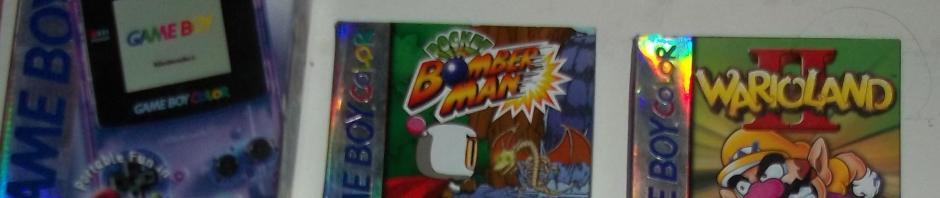
Before I begin, I want to make something clear. This series is a summation of others’ opinions as much as it is mine. I have not played all of these games, not even close. Considering how long I have been working on this 1998 series — it has been over a year now — I probably should have played more of these games than I have, but my work has mostly focused on looking up reviews and facts, not playing the games myself. For genres I am not that good at, like flight simulators for example, I think looking up professional reviews is going to lead to a better sense of a games’ quality than me trying it would unless I spent a great deal of time with a game, and I don’t think I could do that while also writing this. Of course I have played some of these games, and I will mention that when discussing them, but this is not something meant to be just about me. This is a history and press review article series more than it is one about my opinions. As a result of this I have tried to minimize my anti-Sony bias here. I will make no apologies for my strong dislike of smartphone games, though. I think that is deserved.
Additionally, considering the times today, this is important to say: I wrote every word of this series myself, as I have with all of my writing in the past. I do not like or use AI for anything other than once in a rare while looking at the AI overview on a web search. Human-made work is better than “AI”, which is quite a misnomer considering that it is not intelligent.
Anyway, yes, if you have been to my site within the past year, you have seen this before. This is a longer, enhanced version of the article I posted in late October 2025. I posted my two-part 1998 retrospective about eleven months ago now, and I know it’s been way too long since I posted anything on the site. However, I have been busy: for several months now I have been working on a huge update to the 1998 retrospective that more than doubles its length, adding a lot of detail that was missing from the first one, including coverage of many more games and best-of lists. There are three articles in the series now. The first is largely the same as the original version just with an added section mentioning the names of top games in many genres and subgenres and many other additions here and there. The article’s original text file size changed from 97KB to 164KB and counting, so a lot was added, but it is essentially a better version of the same article.
The second article is more changed, however, for it has been entirely reworked and reorganized. I now cover all subgenres, as named on GameFAQs, with more detail than before. Yes, it is a long list. Then the series concludes with a new third article that contains several different unrelated parts. This one includes the best-of lists section from the end of the original version of article two, but expanded out with lists from more sources and some commentary on some of them. The third article also includes a section on open-world games in 1998 that is an expanded version of content from the first two articles; I wanted to keep the whole piece somewhere, so it’s in article three. Additionally I put in a My Gaming Year in 1998 section that I wrote here, because why not?
This has been a huge project and it is much closer to complete now than it was in the first version from last October. However, there is always more to add. For instance, I could add the Mobygames critical average for all games that have one the first time I mention them; would that be helpful, for a more objective look at the ratings for each game? A few subgenres have these scores listed but not most of them. For anybody who does not know, Metacritic is useless here because it has very little coverage of anything from before the ’00s. Mobygames’ review database is incomplete, but it is the best one we have.
I originally wrote this with no images as usual, but then decided to add pictures… my own pictures. I am a bad, BAD photographer, and I’m just as bad at video. Learning to get better at those skills just is not something I have ever found interesting enough to attempt, which is one reason why this is an article and not a Youtube video series, heh. Despite this, I took pictures for these articles of games in my collection. The photos are scattered through this article. Some relate to the section below them while others don’t, but hopefully that is okay. I know that many of the pictures are not very good, but they are MY pictures, not just images I took from somewhere on the Internet, and I want this series that I have put so much effort into to be as much my work as is possible. It may not look it, but these pretty bad pictures were the product of several days of work; it was not easy. However, while the pictures are mine, linked videos are not mine. Linking videos of each major title, to show what they are like, is important, but I cannot film videos myself of all of these games and show them off competently, so videos from Youtube will have to do. For most games I used a video without someone talking over the gameplay, to focus just on the game. I am not responsible for anything said in these videos.
For sources, other than the many facts I just know by now, I mostly used Wikipedia, MobyGames, and GameFAQs for release date and factual reference, with Youtube for gameplay videos. When necessary I searched elsewhere on the internet for the information I needed. When it comes to facts, I will state them and not link a source for unless one is particularly important. I will certainly link and mention the names of all articles I discuss in these articles. Some additional references will be at the end of article three.
Lastly, I am not sure whether I should take the original version of the articles down or not. For now I think I will leave them, but edit in a link to the updated versions and change the table of contents to only link the updated ones. Because of how long I have been working on this for, I know I repeat myself sometimes, when I write similar things and then want to keep all of them. Sorry about that.
Table of Contents
- Introduction
- Categories: The Types of Electronic Gaming Platforms, Then and Now
- The Eras of Gaming
- Change Happens, but What is Lost?
- The Peak Years
- 1982: Gaming’s First Peak Year
- The Gaming World of 1998 – Platforms, Hardware, and Sprites versus Polygons
- On the Previous Generation Game Consoles In 1998
- The Current Platforms of 1998: The Year’s Primary Focus
- New Gaming Hardware of 1998
- 1998’s Best Games
- Other Peak Games
- Genre Strengths and Weaknesses of 1998
- The Weaknesses of the Electronic Games of 1998
- What Happened Next?
- Is There a Modern 1982 or 1998?
- How Will 1998’s Memory Last? Or, PC Gamer’s 2025 Best Games Ever List
- Conclusion: On why 1998 is the Greatest Year in Gaming
- Addendum: The Dead and Dying Platforms of 1998
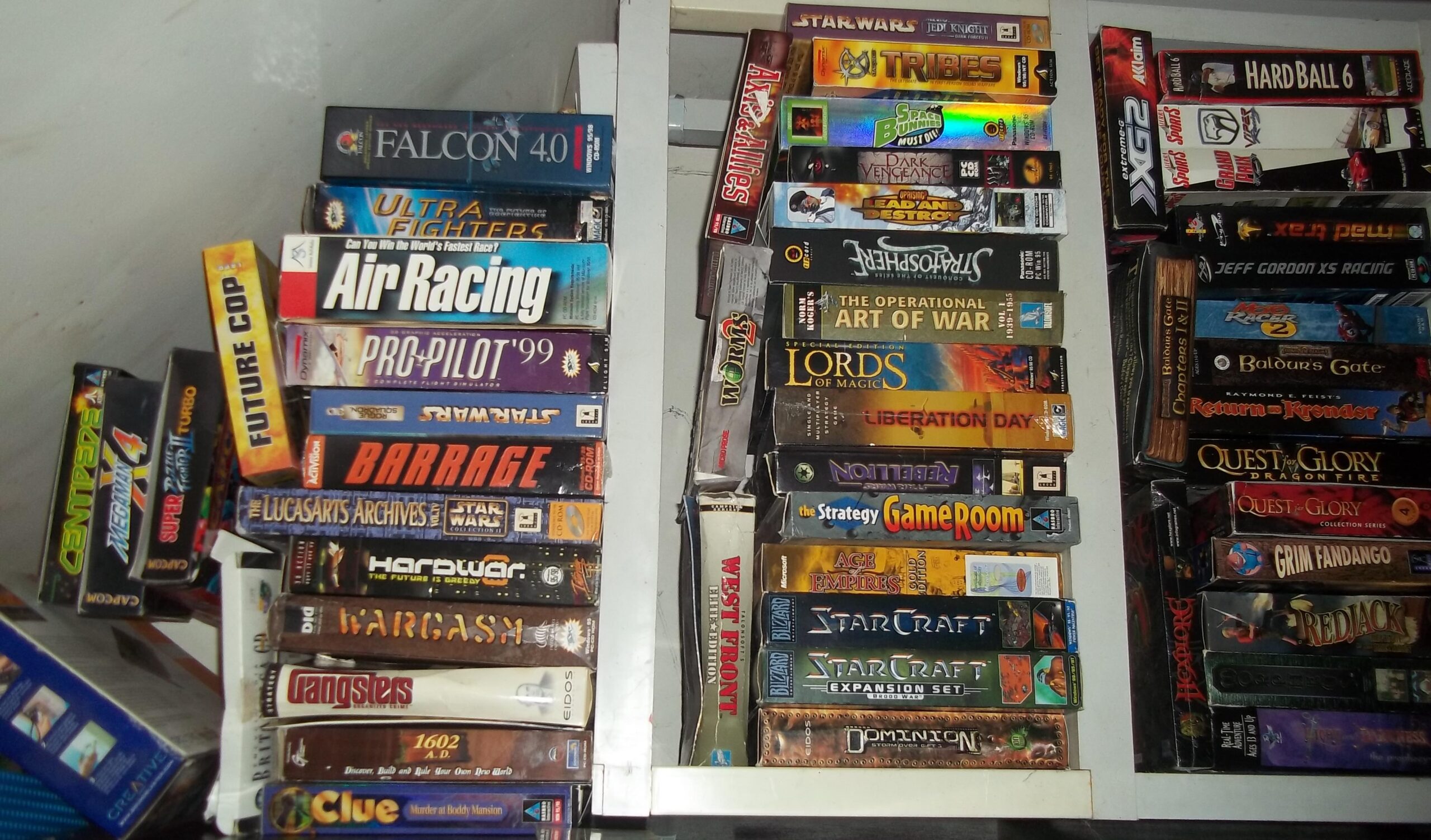
Almost all of my boxed PC games from 1998 are in this picture. I love these huge boxes, they look amazing! Note that a few titles are later collections of games from ’98, a few are bundles with games from ’97 and their expansions from ’98, and a few are ports of console games that released on console in previous years.
Introduction
1998 was twenty-eight years ago now, which is quite a while. At that time, here in America, Bill Clinton was the American President, in his second term, with a presidency rocked by the Monica Lewinsky sex scandal which was the years’ biggest news story, though Clinton would retain his popularity; gas was under a dollar a gallon, which is $2.07 in 2026 dollars considering inflation; World War II nostalgia was perhaps at its peak; the New York Yankees won the World Series, beginning a threepeat that frustrated Red Sox fans like me; and Michael Jordan won his final NBA championship. Personally, at the beginning of the year I was midway through my freshman year of high school. At home we had a good modern 233Mhz Pentium PC and I had an original Game Boy to game on. It was also the year of one of my familys’ last big summer trips, a more than three week long trip to the UK. And, it was an amazing year for computer and video games. In fact, it was the best year for games, and it’s not just me saying it, it is most people. But why, specifically, do they say this? This question has consumed me for some time now, and this article series is my answer.
What is greatness? Thinking about it, I think that I would agree with those who say that the core of it is contrast. This idea is not my invention, but I fully agree with the concept. Greatness stands out because of the difference between the best times, or the most successful people, and the average or bad. When times are good and everything is fine, greatness can be harder to discern. It is easy to take how good things are for granted and not realize just what a special time it is. But when times get harder, discerning the great from the mediocre or awful becomes more clear.
This will be an article about videogames, but to start with a historical analogy I saw mentioned online, Alexander the Great isn’t great just because he was a prince who inherited a nation with the strongest army in the world. He was great because he did the greatest of things with that opportunity. Almost all people would fail in that place, or at best be average, but he wasn’t and became a legend for it. I am mediocre at best at most things, but I am decent at writing (I should do it more often, huh?) and historical knowledge, as well as a few other things (building Lego sets by following the instructions, for instance). But anyway, we really see Alexander’s greatness if we contrast him with other people who inherited great empires. How many of them managed things in an acceptably average way? Plenty, but generally not the memorable ones. How many squandered it, losing empires with their incompetence or evil? Some, such as Caligula or the English King John. How many were brilliant successes, leading their nation to glory? Very, very few. Anyone can inherit the building blocks of great things, but the greatest do amazing things with those blocks that others don’t even think of.
But unfortunately, the good times never last for as long as we would like. Time moves along cruelly quickly. Alexander died young and his empire rapidly crumbled. The ’empire’ of videogames is not a perfect analogy for this, as it was never united before falling to internal wars as the Macedonian empire did after Alexander and it is unlikely to completely cease to exist unless we have a general civilizational collapse, but that is probably over-analyzing the comparison. In both cases, many people looked back later on, after the great events, and said, we did great things. Why did we let it go? I think this is a solid analogy for today. Between getting older and looking at the seeming decline of the videogame industry, it has led me to look back at better times and say, what made that time special? And what happened after?
I must note, I’m not a financial analyst. Most of what I say I do think is backed up by facts, but don’t expect charts and numbers here. I have looked at some articles that do have them, though, and I think they are saying the same basic message I am. It isn’t just me noticing that the games industry of the mid 2020s seems to be in trouble, it is a common refrain among people analyzing the industry. Nintendo and Valve seem to be doing well, and, well, that’s about it. Everybody else — Microsoft, Sony, Epic, et al — is in trouble, and they are reacting to their troubles by trying to gouge as much money as they possibly can out of their users in ways that have gotten so overt that people are starting to notice, and complain about it. And then we have AI… ugh.
But to return to analogies, how about we look at a more recent example, the state of American democracy today. I would like to think that now that our democracy is under such severe threat from Trump and his fascist allies that some people may look back and recognize just how amazing the existence of American democracy has been, that at its best moments America is the shining city on the hill, the first nation in the world governed by and for its people. Unfortunately, we are far from that hilltop today, and we are reminded daily in the news of how humiliatingly far we have fallen from it thanks to our President and his supporters. I love America though and hope it can be saved. Regardless, to any who disagree with my politics, I will not return to this subject in this article. I just had to say something.
Going back a bit, around the turn of the 20th century, the way the film The Matrix treated the year 2000 as the peak of humanity seemed silly, something just chosen because that was the current day then. Of course, I’m sure that was exactly why it was chosen, but… it kind of was true, wasn’t it. We actually kind of were at a peak that we now have fallen off of. A lot of the problems the world has now, including escalating global warming, rising fascism, microplastics and related health crises, and more, had started well before 2000, but at that point things hadn’t started to visibly break down yet. Now, however, many world systems are collapsing. (As an aside, I’m not a big The Matrix fan. I saw the original movie once and reasonably enjoyed it, and saw and The Animatrix also, but wasn’t interested enough to watch any of the other sequels and still haven’t seen them. I have never played any of the games either. It just does seem that it happened to be right about our civilization’s peak, or so it seems today.)
When you are on the peak of the mountain, everything seems great… but if you move, and time is always moving forward whether we like it or not, the only way to go from there on foot is down. To that point everything was uphill, but unless you are on a high ridgeline, a descent is in your near future. That is happening to our world this milennium, and it happened to gaming at around that same time as well, though to less disastrous consequences overall.
But I should get to the point: Why is 1998 nearly universally acclaimed as gaming’s best year? I think that the core of it is because multiple incredibly important events happened at the same time, and they all stand out because of major changes in the industry that happened during and after 1998 which radically changed gaming. In the same year, 3d console games fully found their way with using the new technology of polygons well; the arcade business was still in good shape, before its collapse a few years later; and the PC business saw its best games ever before starting to fail the next year. It was near the end of the period that lasted from the ’70s to the end of the ’90s where those three platforms, PC, console, and arcade, dominated electronic gaming, and all three saw all-timers release… only for two to collapse within years. Once arcade and PC games had started falling off that mountain the slide just picked up speed year after year. Consoles would benefit from the collapse of the other major branches of gaming, but today even console game is struggling due to sales flatlining while development costs go ever upwards.
So, all of these things happened at the same time, and then things changed. The kinds of games being made changed, the kinds of platforms changed, everything changed. Some of that change was good, and some of it was bad. Change goes both ways, but either way it leads to people who liked how things were before to think back on the time they remember being best, and that time is the late ’90s. But before one just blames this on nostalgia, while that is a factor, it isn’t just that. The people praising top games of ’98 are not only the people old enough to have played them when they first released; younger people can also appreciate them. How hard that is depends on the game, some are easy to pick up while others take adjustment and still others are hard to learn to play, but even that last category isn’t AS tough to get used to as games were just a few years earlier. Game design was not what it is today, but it was worlds more advanced than it had been even just five years earlier. The games of ’98 are mostly easier to go back to than similarly complex games of the early ’90s are, and their designs are more familiar. Sure, they are different from what we see today and some games are janky messes, but on the whole, change had reached the point of perfecting the design philosophies of their time in a way not possible before, and in a way not attempted today due to changing tastes.
But to return to my earlier point, the key to why ’98 is remembered as the best year is because of it being the perfect confluence of events. Without so many things all happening at the same time, technology and game design and everything else all hitting a happening at once, you probably would not see the year reach the heights of popularity that it has. With only the great PC games but not the console ones, for instance, the year definitely wouldn’t have the mythological status that it has; a lot of people today sadly do not play old computer games as they do old console games. But, all of those things did happen in the same year, and so 1998 stuck in peoples’ memories as no other year before or since has. One of the major eras of gaming was ending, and 1998 showed its games at their peak, just before everything changed.

This awful-as-usual photo is of some of the better console games from 1998 in my collection. I apologize for the flash in the center making BattleTanx (N64) invisible.
Categories: The Types of Electronic Gaming Platforms, Then and Now
The basic breakdown in gaming from the ’70s to late ’90s was this: there were several different types of game platforms. These types still exist today, with some changes. First I will discuss how each category was in the 20th century, then discuss the 21st century second. I will try to give some reasons beyond just the specific games themselves why fans of each branch of gaming that I just described might look back to ’98.
Something important to remember about the types below is that before the 21st century, a lot of games stayed exclusive to their format. Computer games rarely were ported to consoles. It happened once in a while, but it was uncommon, only for the most popular games. Arcade games sometimes got home ports on computers or consoles, these ports were more common than PC to console ports or vice versa, but it was never a guarantee. Console games occasionally got computer ports, but it was quite infrequent, again mostly only for the most successful games. Now, up until the early to mid ’90s many computer games got released on multiple different computer formats, it is true. Also, sometimes a successful console game would get ported to other consoles or would release on several systems at the same time. As an aside, this was much more common for Western console games than Japanese ones; if a Japanese game was multiplatform it was more likely to be a late port of a successful games to other formats, instead of releasing simultaneously for multiple systems as Western studios were more likely to do. But there are of course exceptions to this in both directions.
Arcade Games
Then: Arcade games focus on fast action. During this period arcade games had significantly better graphics than anything on a home platform, but the games need to be something fast and fun, and that will get the player to keep spending money at a steady rate into the machine. In this way good arcade game design has some similarities with modern mobile design — if the player isn’t spending money, isn’t being coerced into it somehow by the game, then the publisher won’t be making money. However, at least in an arcade you always got something for your money, even if it was just seconds of gameplay. You would not be spending money on some random chance of maybe getting something new.
Now: The situation for arcade games is much, MUCH today than at any point in the 20th century. Arcade games do not have graphics better than home platform games anymore, and haven’t since the ’00s. Very few arcade games have been made in the past decade or two, and most of the ones that do don’t get home ports. There are some arcade-inspired games, such as the fighting game genre which in the ’00s shifted from an arcade focus to a console focus, though, so some of the old arcade design ethos survived. Most fighting game fans seem to prefer newer titles over older ones, but the classics remain popular. Things are similar with the shmup fan community, except shmups are usually made on a budget. On another note, mobile smartphone gaming has taken the old arcade game design mantra of ‘design your game paced to keep the money flowing’ to heart, but with very different kinds of games that are much more exploitative of their players.
Computer Games
Then: Computers cost more than consoles and have faster processors, but until the later ’90s did not have dedicated graphics hardware to make console-style graphics possible. As a result of this computers dominated in strategy games, simulations, flight games, and other kinds of games which benefit from having a mouse and keyboard and fast processor, but struggled at platformers, shmups, and other fast action games like that compared to consoles. Computer games were dominant among post-1984 crash Western game developers. There were a few console game publishers and developers in the West, but the vast majority of studios, and most of the best talent, worked on computer games. Only a very few of those computer games ever released on consoles. Meanwhile, in Japan computer games were a small market mostly dominated by a few genres like computer RPGs and visual novels.
Now: Reasons for gamers to think about the PC games of ’98 should be clear: it was probably the last year of clear PC dominance of Western game development, before the rocky interim years and console focus of the ’00s began. As many readers know the PC would eventually have a renaissance that started in the late ’00s and continues to head upwards every year, but even today PC-only games are not what they were in the ’90s. PC games today sell far more copies than they did back then, by many times, but compared to the top AAA(A) games they are made at relatively low to medium budgets, and you can tell. Most PC-only games are either very low budget indie games or are complex strategy or simulation titles that don’t control well with a gamepad and aren’t big enough budget titles for someone to port them to console anyway. The PC gamer of today may prefer modern games over older ones, but in some cases that’s probably because they haven’t played enough older ones in genres they like. Either way the case for ’98 should be easy.
Console Games
Then: Console games, or TV console games as I sometimes call them to differentiate TV console from handheld ones, during this period focused on faster action than computer games. Slower-paced games existed on consoles as well, of course, but they did not have instant advantages over computer games like the more action-focused games did. Consoles are designed to display game graphics as quickly as possible, while computers are not, so faster-paced action and shooting games were better on consoles. The difference was often substantial. However, American game developers mostly focused on computer games between 1984 and 2000, and European studios were always primarily focused on computers. The pre-crash console industry was huge both in the US and Japan, but after the crash the American console publisher and developer market mostly dissolved, leaving Japan dominant in the field. There were a few great Western console developers and publishers during this era, but it was a distinct few compared to the many on computers. Even so, there were great Western console games in ’98, just far fewer than the great computer games. Japan, however, was at the top of its game in quality, and was almost entirely focused on console game development.
Now: TV console games had a very good decade in the ’00s, and dominated the electronic gaming conversation all decade long. However, over the time since then cracks have appeared in their edifice, as hardware sales stagnate while budgets go ever upwards. The problems caused by this are getting worse every year. Sure, I can fully understand why people would prefer the console games of the ’10s and ’20s over the ’90s. Game design has changed a lot since then in top console genres like third-person action games, and many people like the way the modern game plays as it has for the past fifteen or so years. However, when a single game takes five or ten years to finish, when studios are struggling so badly to make enough money back to fund development, when so many games blur together because interface and systems development has decided on certain design standards you see in game after game after game… well, what about the time when that process was just hitting its key moment of development, before everything became so similar, but after things progressed far enough along for the way games play to be largely recognizable to someone going back to that game today without experience in retro games? What about 1998, the year when many of the most recognized classics ever released?
Handheld Games
Then: Handhelds were portable video game consoles, with similar concepts to the TV systems but made to be portable. This often led to different design philosophies, with more shorter-form games or titles with good save systems perfect for a commute or break. The handhelds of the ’70s to ’90s were often single-game electronic platforms, not actual full platforms. The first successful full platform handhelds released in 1989. After that, handhelds were basically the same as consoles, except portable. This market was a subset of the console market mostly dominated by easier or shorter-form games that work well in a portable setting. As with console games it was heavily dominated by Japanese studios. Western handheld games were mostly cheap budget titles, dominated by licensed or puzzle titles.
Now: Today, the dedicated handheld console is a thing of the past. Starting in the ’00s this market would shrink, and that shrinkage would destroy it in the ’10s. There are no actual dedicated handhelds, anymore, only dual-purpose machines and the massive, but gameplay-vapid, world of cellphone games and their omnipresent gatcha mechanics and absence of gameplay worth caring about. It is very sad stuff. Cellphone games are a race to the bottom dominated by “games” that are effectively digital gambling. The gameplay is generally much simpler and less developed than the monetary currency systems designed to get players to spend money in the game. It is highly predatory design. There are some good mobile phone games, such as puzzle games and the like, but those were good on dedicated handhelds before them as well. People who want portable games that aren’t cellphone timewasters or drivel play on dual-purpose console or PC machine markets instead, such as the Nintendo Switch or Steam Deck. Here you play regular console or PC games, aided by suspend systems that allow you to pick up your game later when you suspend the system. Fans of games designed to for portable play and quality design will probably prefer the decades from the ’90s to the ’10s. 1998 may or may not have been the best year ever for handheld games, but it was a good one across multiple platforms.
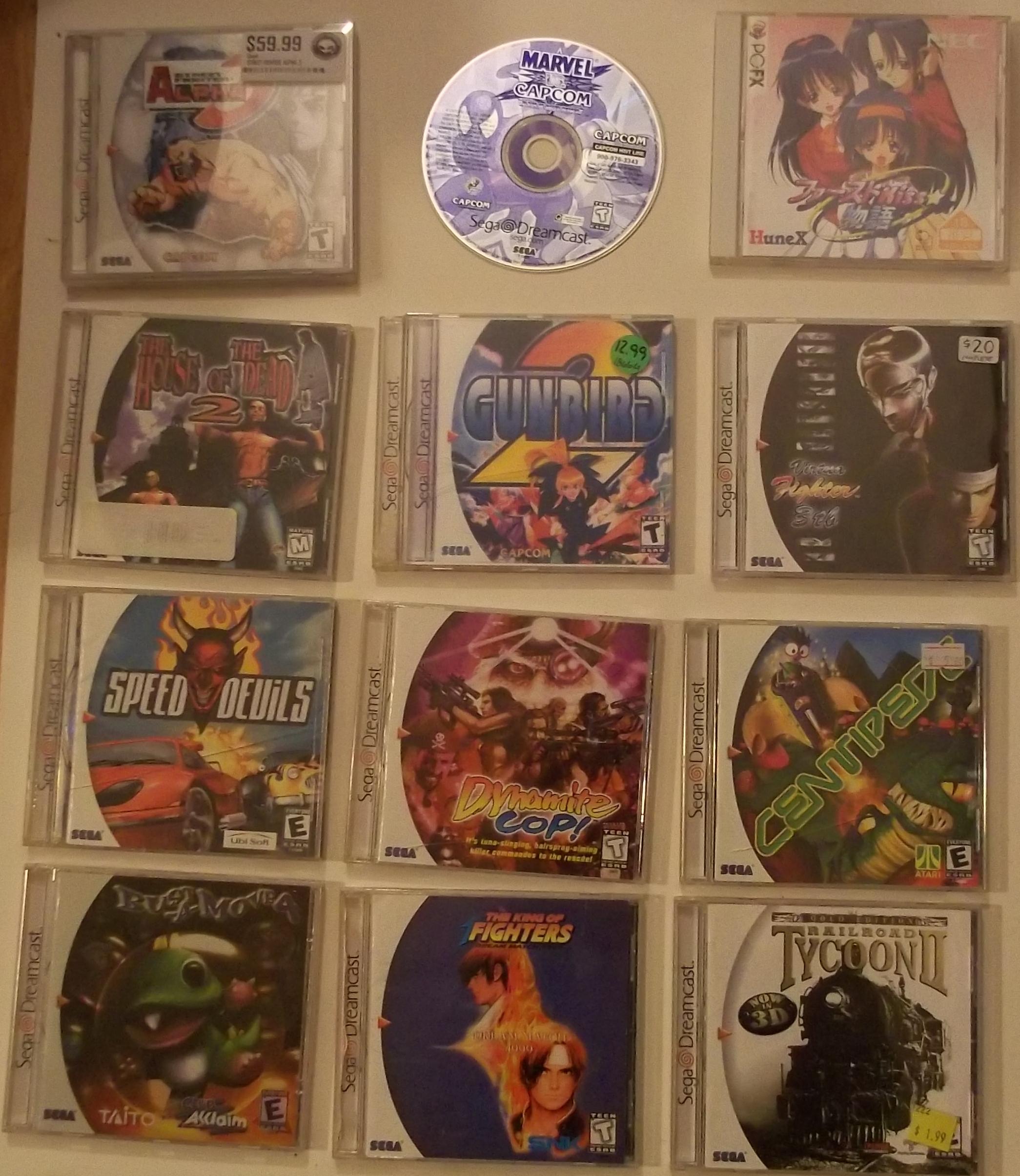
This image includes seven later Dreamcast ports of arcade games from 1998 (note that The King of Fighters Dream Match 1999 is the US title for the DC version of The King of Fighters ’98), three later Dreamcast ports of PC games from 1998 (Speed Devils/Busters, Railroad Tycoon II, Centipede), a 1998 Dreamcast port of a 1996 arcade game (Virtua Fighter 3tb), and, randomly, my one 1998 PC-FX game (upper right). I believe it was the last release for the system.
The Eras of Gaming
Time passes, and as it does things, as I have said, change. Assumptions about what the ideal kind of game change, game design ethoses change, the kinds of games being made change, the platforms change. Again, this change can be good, neutral, or bad, but regardless of that, us people interested in history try to break things down into periods based on the available technology of the time and game design expectations.
And so, the history of video game consoles can be broken up into generations based on grouping systems which were available at the same time together into a generation. There are some controversies over the boundaries, but regardless of that, there have been nine console generations since the industry’s founding in 1972. Ten, if you call the new Switch 2 a next-generation platform, but I don’t think anyone would; it’s just a late 9th generation one, I would say. Anyway, thinking about it, I think we can break gaming up into three or four eras, each separated by a transition.
The first era is the platforms of the 1960s to the early ’80s, up to the crash of the American market in 1983 — the ‘Atari’ era. This era set the four kinds of electronic gaming in stone, and we have seen variations on these four ever since; more on those soon. Following this was a transition, with the crash. The second era goes from 1985 to 1998, and covers the peak of the industry for people my age and a little younger — the ‘Nintendo’ or ‘PC golden age’ era. These first two eras are different, but similar. Despite the shifts in platforms, I think that there is a clear continuity between them of game design styles. The real major break came around the turn of the millennium. Again there was continuity between the eras, but most of the industry today is much more like the industry of the early ’00s than it is the industry of the late ’90s; the differences are stark. At some point this century games start feeling modern; change has slowed down in both tech and game design. As a result, a game from 2016 feels fundamentally similar to a game from today in 2026, but a game from 1998 feels like something from a totally different universe than one from 1988.
So, 1998 marks a major point of games industry change. Following it was another period of transition, which I would say lasted from 1998 until the later ’00s. It was probably long enough to call it an era of its own, the third era. This is the ‘early modern’ period, perhaps, of TV console dominance at the expense of other platforms. Following this, at some point in the mid or later ’00s, the fourth, modern era began. This new way would dominate through the ’10s. However, this decade, that era has begun to break down, as the same cost and time problems which ended the second era now are affecting the whole industry. And so, we probably are in a third transition now, but what the next era will be we do not know yet. Perhaps it is the resurgence of the PC as the dominant platform? Things may be trending that way, but it remains to be seen.
For the first two of those eras, in the last year before things started to turn, many of the best, most defining games of their era and style released. I do not think that has happened for the third era; perhaps development times are just too long this century for one year to hold that many relevant releases.
The story of electronic gaming is one of constant change. Technology evolves rapidly, the number of transistors on a chip doubled every year for many decades as per ‘Moore’s Law’, the guideline Intel tried to stick to, and electronic games react to that change by always having more power available than older platforms did. More power leads to more opportunities to do more with your game, but it also leads to more challenges, as game development takes longer over time and the number of people required to make a game increases steadily as well. Development of a ‘AAA’ game in the ’70s took one or two people a few months. Today, a ‘AAA’ game costs hundreds of millions of dollars, as hundreds or thousands of people work for years, sometimes as long as a decade, on their game before it finally releases. Are these costs sustainable? Sometimes, sometimes not. Sometimes, adaptations happen and the industry continues to grow. Other times, costs go above revenues, and major change happens as a result.
Yes, sometimes storms brew in the game development mountains. We live in a capitalist society, and that is fine; I am liberal but no Communist, those kinds of societal controls do not work. Stifling human ingenuity and not rewarding greatness hurts society. However, our capitalist system does require something, and that is money. In order to fund the production of a game, a studio or their publisher need to put down a lot of money up front, hoping to make that money back on sales of the game later. Movie studios have similarly front-laden costs, which is why we ended up with so few major studios; companies need to be large in order to withstand the costs of a big project failing to make back the money spent on it.
In game development, during each era things seemed great for a while, only for the eventual correction to send some out of the industry. That happened in the first era up until the crash, as a huge number of American studios entered the industry in ’81 and ’82 only for most to shut down or move to computers just a few years later. After that, the second era, defined by Western computer games and Japanese console games, lasted up until 1998. Up to the late ’90s, sales were always enough to keep this system working for all branches of gaming. But how long could the ‘numbers always go up’ system keep working? At what point would costs go above revenues, and something would need to drastically change in order for studios to survive, if they could at all?
Well, for computer gaming in North America, its first home region as this is where almost all platforms of the first era were created, that crossover point was reached in 1998. That year is when computer games started to descend off of that mountain, forever altering the industry. The decline would take five to ten years to bottom out, but once the decline began it would not be reversed for many years. As a result 1998 is the key year, the last days of PC gaming’s golden age. Sure 1997 and 1999 also had fantastic libraries, but ’97’s best look up at ’98, while in ’99 you could start to see the changes in the industry as console games gained a larger place in Western game studios’ libraries. PC Gamer (US) Magazine saw its thickest issues ever in late 1997, with only slight declines each of the next few years before it became very visibly thinner by 2001. This fits with ’98 being the peak for releases, but not profits. PC-focused game development would be sustained much longer in Europe than the US, as fewer people there had consoles. Still, even there over time in the ’00s and ’10s many studios would branch out into releasing more games on consoles.
And for arcade games, that descent off the mountain came just a year or two later. In America the peak of arcades was the early ’80s, but the early ’90s had a second peak. After that things slowly went downhill until in ’99 or ’00 all major players abandoned arcade game development. In Japan arcades lasted much longer due to the dense population, and indeed they still have a place there, but even there, over the course of the “early modern” period, arcades lost their place of dominance in the industry. By the mid ’00s arcades were no longer a place for highly expensive experiences that would get ported to home platforms; instead those games started on consoles. After this arcades became something more familiar to what they are today, a place for crane games, arcade-only experiences like racing games with fancy seat setups, and the like.
Meanwhile, console games benefited from the decline of their competitors. Developers in other fields saw the higher sales of console games and said, we want in on that! And for a good fifteen years, despite some troubles, things for the industry overall were good… until the 2020s, when rising development times and costs led to new troubles for the industry. Today console install bases have flatlined, while costs continue going nowhere but up. This is clearly not a good trend line, and developers are coping by branching out and ending “buy my platform to play my games” exclusivity in favor of releasing PC versions of most games, Nintendo excepted. And this is why the PC is, as I said, today in the best place it’s been in decades: it’s an omnipresent platform that anyone either watching other people play games on the internet on platforms like Youtube or Twitch knows about. I think that there is still a place for consoles and I hope that they continue existing, but there is no denying the way things are going. Even the AI-driven RAM and storage price explosion of the past year has not really changed this, because consoles are being hit just as hard as computers are and computers have more general use.
Change Happens, but What is Lost?
Now, you might be thinking, this has been a long article, but you’ve only infrequently been discussing your theoretical main subject, 1998! Well, I think that the full history of gaming is key to understanding why 1998 is so beloved. Without understanding the eras, that 1998 saw perhaps the most important dividing line in the industry’s’ history, I don’t think people will properly understand why 1998 is remembered as it is.
I know I have said most of this already in this article, but I want to repeat myself because it is important. I mentioned capitalism earlier, and that games cost money to develop. This requires enough money coming in to keep making the games as they had been up to that point. Sales of each game needed to either be better than the sales of the last game, or prices had to go up. As Moore’s Law progressed over time and chips got denser and denser in transistors development team sizes needed to increase steadily, and the length of time to make a game slowly went up from weeks to months to years. Thanks to this, every year games got more expensive to make than they were the previous year. This process has continued steadily from electronic gaming’s founding to today.
Change happens steadily over time, with formats and eras overlapping; it is not like a prince like Alexander inheriting the throne and suddenly changing policies, but like a steady flow of change, like a river… but along that flow certain points stick out. In the late ’90s, as I said, an era began to end. A very strong set of rapids hit the industry as costs got too high for game companies, and particularly Western computer game companies, to continue affording to make games as they had before. The solution was to go multiplatform, to stop making most games for computers only or console only but instead to make games for all formats. This new reality slowly phased in over about a decade, from the late ’90s to late ’00s, it was not immediate, and again it happened in the US first, and Europe later.
Once the transition was done, however, the PC market as we had known it was gone. I wrote a long forum thread in about 2010 mourning the death of PC gaming. I never posted it on my site, but I probably should for historical reasons. It’s partially right and partially wrong but I think it is a look at an important moment in time. Fortunately, things would not stay down forever; PC gaming would be resurrected digitally some years later on a smaller, more boutique lower-budget scale, and that is fantastic, but a modern equivalent of the old heights may never be reached again.
The Peak Years
List wars are somewhat tricky because you can make a list of games from any year after the later ’70s that contains many all-time greats. Even so, reminding people of the games that were released has at least some relevance, I think.
As I have said, I think electronic gaming can be separated into two to four major eras.
- The first is the 1960s to 1983, the early days of computers and electronic gaming, mostly from American developers, with Japan making important contributions starting from the late ’70s as well.
- The second is 1984 to 1998, the period where North American studios mostly focused on PC game development while Japan focused on consoles and European developers mostly made computer games that often only released in Europe.
- The third is 1998 to 2009 or so, the intermediary period where consoles were dominant worldwide, though Europe had more of a lasting PC scene than the US, where developers almost entirely switched over to consoles apart from MMOs.
- The last is the current one, from about 2010 to today in 2026. This era is marked with the PC recovering somewhat, the rise of smartphones, and most games finally releasing worldwide almost all of the time for the first time in history.
That fourth era may be in the process of ending, but as it is current we don’t know where the dividing line will fall. I would like to discuss each of the first two mountain-peak years here and look at which games made that year stand out so much and showed developers mastering the art of development for their era of gaming. For the two newer eras I am having a much harder time seeing one particular standout peak year, most of those kinds of games just aren’t ones I know as much about outside of Nintendo and some PC games. I would like to have clear years here for each era but I just don’t know, sorry. So, here I will cover 1982 in brief before moving on to the main topic, 1998.
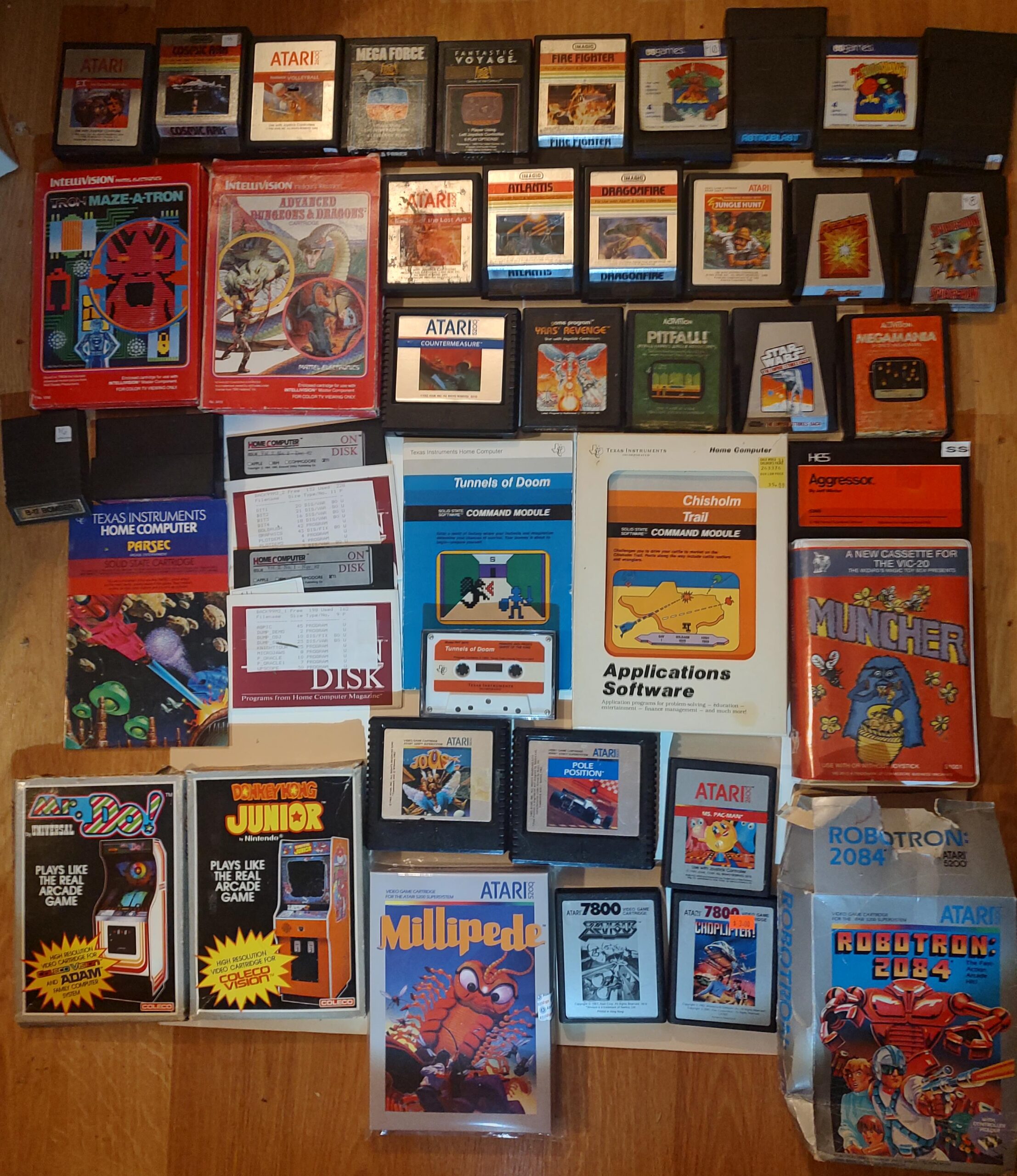
A selection of games I have from 1982. Top row: some of the piles of stuff releasing that year on the Atari 2600 that helped cause the crash. Next rows: Some of the better console games. Third row: Some computer games for TI-99/4A and Commodore VIC-20. Bottom row: Later home ports of arcade games from 1982, there to represent the originals. Note, Choplifter is a computer game from the Apple II, but sadly I don’t have any Apple II games from ’82 so this later Atari 7800 port will have to do. I apologize for the upper right of the image being blurry, but this is the best shot I’ve managed after quite a few tries.
1982: Gaming’s First Peak Year
As I said, 1982 was the peak year because just after that the industry started to crash, but that year many all-time classics released. I am not going to get into the causes of the American market crash, that is beyond the scope of this article. In the US, arcades were the number one place for gaming. At home, the Atari 2600 was by far the lead gaming platform. That year two new consoles released, the Atari 5200 (a North America-exclusive machine) and Colecovision. The Colecovision would be particularly significant due to it inspiring Nintendo to enter the video game industry. Meanwhile, the rise of home computers was noticed by most everyone, and every console maker had plans to branch out into computer-console hybrids. One very noteworthy computer released as well, the Commodore 64, which was to sell many millions in the US and especially Europe.
In Japan, few people had a home console or computer yet, but arcades were very popular and they had a booming arcade game development industry. The next year would be when the first popular home consoles released in Japan, from Nintendo and Sega. Meanwhile in Europe consoles never were especially popular until the PlayStation 1, and Europe never had much of an arcade game development business based there though arcades with American and Japanese games did exist, but in ’82 the rise of home computers in Europe started with the release of the ZX Spectrum. Cheaply made games for home microcomputers would dominate the European game development industry into the early ’90s.
When I think of the top games of the pre-crash and crash era — that is, 1972-1984, primarily — for American games I think of, for arcade and console games, Pong, Combat, Breakout, Asteroids, Missile Command, Defender, Joust, Robotron 2084, Centipede, Pitfall, Ms. Pac-Man, and perhaps Tempest and Yar’s Revenge. On the computer side, Zork I, Wizardry, Ultima, The Oregon Trail, Lode Runner, Rogue, Miner 2049er, and Adventure (Colossal Cave) are probably the key titles. For Japanese games, and these are all arcade games because Japan’s console market didn’t get started until after America’s and few had a computer at home there then, Space Invaders, Space Panic, Pac-Man, Donkey Kong / Donkey Kong Jr., Galaxian / Galaga, and Xevious are probably the key titles.
As for Europe, its gaming market was slower to develop. By the late ’70s there were a few European games, but Europe never really got much of an arcade game development scene, just home computer games. but I am not too well versed in older European games, almost none of them released here other than the one developer I need to mention, Jeff Minter. He released one of his most popular early titles in ’82, Gridrunner (for A8, VIC-20, and Spectrum), and it did release in the US. His ’83 game Hovver Bovver is also noteworthy. Otherwise, as I said, the ZX Spectrum and C64 both released in ’82. One of the most popular early Spectrum games was ’83’s Manic Miner, a title inspired by Miner 2049er. I don’t think any games for either one were nearly as noteworthy as the arcade and American computer games I’ve mentioned above, but a British person’s input would be needed to get a better answer to that question.
Of those, which released in 1982? Combining regions, Ms. Pac-Man, Donkey Kong Jr., Yar’s Revenge, Xevious, Wizardry II, Ultima II, Zork III, Pitfall, Millipede, Joust, Robotron 2084, Gridrunner, Miner 2049er, Microsoft Flight Simulator (the first one), and more. Yeah, it’s a very good lineup, a bunch of games that built on and improved on pre-existing formulas, before everything began to change — you see this with the Pac-Man, Wizardry, Donkey Kong, Zork, and Ultima sequels. Meanwhile, Pitfall, Robotron 2084, and Xevious are games which would prove to be very important and influential, bringing new ideas that would be copied many times over the decades. Personally I don’t like Xevious all that much but cannot deny its influence, all three are among their respective genres’ most important early titles. Miner 2049er is somewhat forgotten today, but at the time had a massive impact. Pitfall is more famous today, but it’s Miner 2049er that most of the major Western platformers of ’83 would be inspired by — Manic Miner, Jumpman, Lode Runner, and more all clearly are based off of this game. And last but not least, Yar’s Revenge is one of the most popular games on that era’s most successful gaming platform. 1982 is no match for 1998 but it is worth mentioning here for sure as the peak year of its era.
However, in the US in particular, that massive explosion of game releases was a problem. Yes, many interesting games were releasing, but so were many uninteresting ones. 1982 is the year when the total number of games releasing absolutely exploded into an unsustainable bubble. At this point there was no way for a hardware maker to make money off of third party game sales, and all games had to be released physically in a box, so the ensuing glut of forgettable, very low-budget shovelware games was not just slop you can ignore on the Steam storefront page, but an increasingly large number of boxes sitting on store shelves and not selling. Within a year this would help take down the industry here.
As I said previously, Japanese console games and American (and sometimes European) computer games would fill in the void. Of the years from 1983 to 1997, the most popular year overall is surely 1994, which was a pretty good year — it was the year of Star Wars: TIE Fighter, Super Metroid, Sonic 3 & Knuckles, Tempest 2000, Daytona USA, Donkey Kong Country, Final Fantasy VI (III in the US), EarthBound (SNES, JP release), Warcraft: Orcs and Humans, Super Mario Land 3: Wario Land, Donkey Kong (’94), King’s Quest VII: The Princeless Bride, System Shock, Contra: Hard Corps, the first Saturn port of Virtua Fighter, Tekken, Ridge Racer, Under a Killing Moon, Magic Carpet, Mega Man X2, Puyo Puyo 2, Monster World IV, Doom II, Virtua Racing Deluxe, and many more. That is a pretty amazing lineup and it’s easy to understand why so many people rank it highly. As great as that year was, however, many genres continued to improve after that, and would keep doing so through the ’90s, and the technology of 3d gaming was still very early so polygonal 3d efforts in ’94 were rough compared to what you saw just a few years later. So, let us skip to the next peak year before an era ended, 1998.
The Gaming World of 1998 – Platforms, Hardware, and Sprites versus Polygons
But anyway, I should return to the main point, 1998. And when discussing any year in gaming, the most important thing for people looking back from the future is, what games released that year, and for what platforms? The events that happened that year also matter, but when looking back it is the lasting products that matter the most. But regardless, I probably should discuss the events of the year first, for any who do not know them.
In 1998, arcades, consoles, computers, and handhelds were all popular. Cellphone games existed but were still extremely simplistic and not played much yet, thankfully. Smartphones were yet to rot out peoples’ ability to concentrate on tasks. Some people still played on older consoles, but many were switching over to the current generation by this point. Personally we had a modern PC, a Pentium 233 the family had gotten in mid 1997, several older PCs, I had a Game Boy entering ’98, and would get a Game Boy Color and a 3d accelerator card for the modern PC late that year.
One thing that 1998 does well is that the games of ’98 have a good balance of types of games. Not only is virtually every genre represented with high quality titles, though that is very much true, but also you see both sprite-based 2d games and polygonal 3d games represented well, in a way that would not last. People today may not understand, as this bias faded out in the 2010s, but starting in the mid ’90s, sprite-based 2d gaming began to be stigmatized. Polygonal 3d graphics were the new thing, and they were what people wanted. Across most platforms gamers preferred polygonal 3d games, but the transition to 3d had not completed yet in 1998. The two-dimensional, hand-drawn or computer-rendered, game was in one of its last years of significant relevance in ’98. However, in ’98 that stigma had not fully driven 2d games out of existence; that would get much closer to occurring a few years later. Instead, in ’98, many noteworthy 2d games released on just about every format. Some genres, such as strategy and building simulation games, were still primarily 2d on all platforms.
Over the next few years, however, one genre after another would go 3d. For strategy games, 1999’s Warzone 2100 (PC, 1999) showed that you could make a good polygonal 3d real-time strategy title. Age of Empires II (PC, 2000) that same year is a beautiful 2d game, but its developers’ next game Age of Mythology (PC, 2003) would be polygonal, as would Blizzard’s with Warcraft III (PC, 2002). In fighting games, after 2001 the 2d fighter declined rapidly in favor of 2.5d and 3d ones. In platformers, ’98 is one of the last years for a long time where significant 2d, not polygonal titles in the genre released on non-handheld platforms. After ’98, the 2d platformer receded to something for handhelds or, later, indie developers only. In RPGs, Baldur’s Gate’s engine would be used to make beautiful 2d RPGs until 2002, but after that D&D RPGs went polygonal with Neverwinter Nights (PC, 2003). And so it continued.
The 2d game never entirely went away, but for a while in the ’00s it seemed like it was about to, once handheld games finally started to go 3d in the mid ’00s at a time when indie games were still a tiny part of the market and almost nothing on TV consoles was 2d. That trend would change eventually, but in 1998 things were not as bad as you might think for a year deep into the ‘3d is the only way’ era. No, the preference of 2d or 3d depended on which genre someone was interested in. 3d was used for the kinds of games that benefited from it the most, like first-person games, racing games, or vehicular titles, and 2d from the games that benefited from it. As an RTS fan, I remained deeply skeptical about polygonal 3d RTSes until 2001’s Conquest: Frontier Wars (PC, 2001) convinced me that maybe it could work. Even after that, though, 3d had limitations compared to 2d. I have always thought that Starcraft has better graphics than Warcraft III. Those chunky polygons look kind of ugly compared to sprites.
Overall, with respect to polygons versus sprites, I think that the games of ’98 were a much more varied assortment than what we saw in the ’00s. There were fewer 2d sprite-based games than any year before, proportionally, but more than we would see in any year for more than a decade. 1998 had balance.
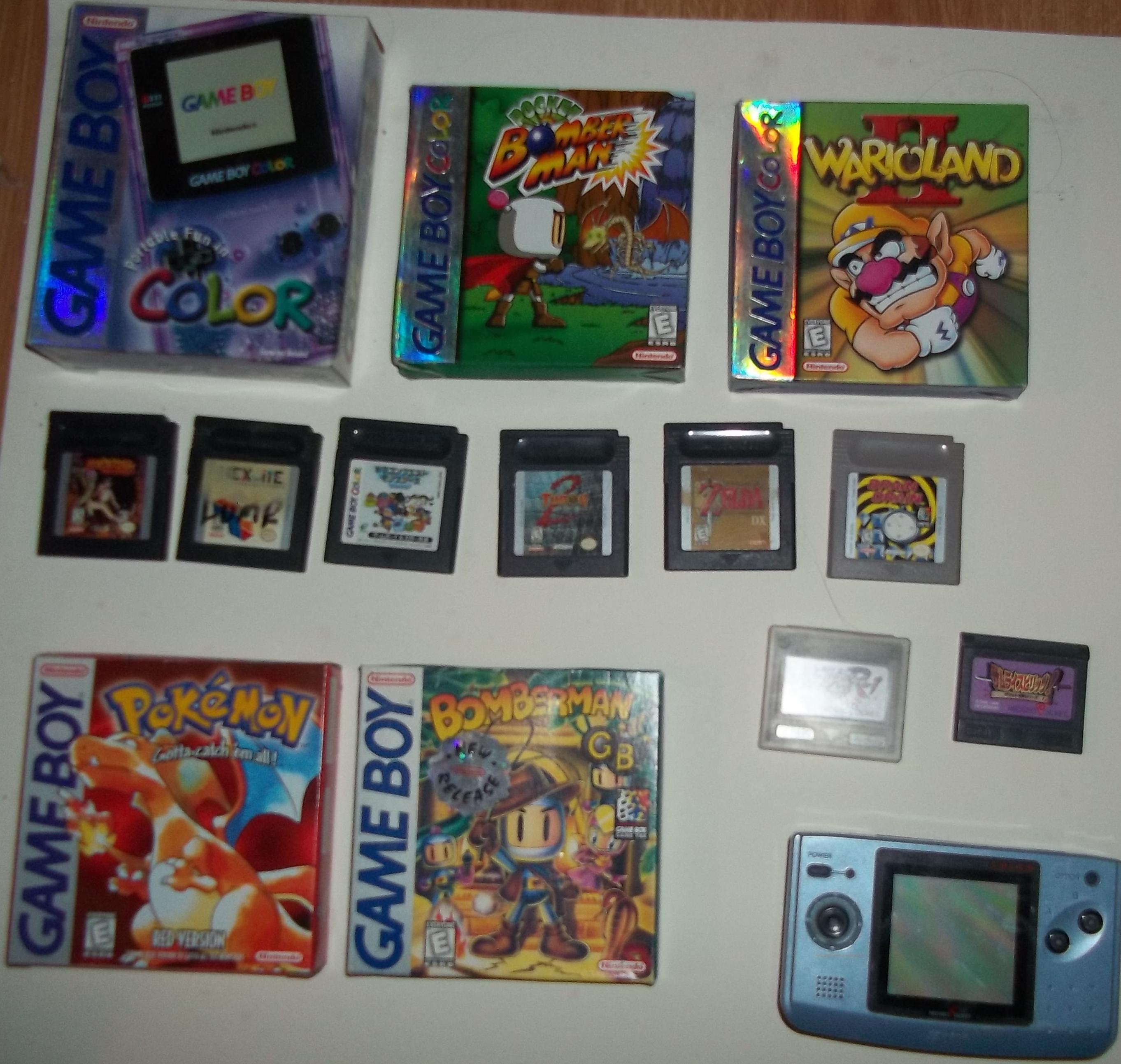
These are some Game Boy, Game Boy Color, and Neo Geo Pocket games that released in 1998. Please note that the Neo Geo Pocket Color, first released in 1999, is pictured for effect; I do not have a B&W Neo Geo Pocket, unfortunately, and wanted to include one for anyone unaware of what the system the NGP games go in looks like — the NGP and NGPC look very similar. The flash is over The King of Fighters R-1 for NGP. I am sorry for not including James Bond 007; I do have that game but can’t find the cartridge. Also note that the two GB games on the bottom first released in Japan in previous years but didn’t release here until 1998.
On The Previous Generation Game Consoles in 1998
Now I am going to discuss each significant gaming platform available in 1998 in brief, starting with older platforms and then moving on to newer ones.
Despite 2d games still having a fading place in the market at the time, in 1998 the 4th Generation console systems were fading out. The Game Boy had a good year particularly marked by Pokemon’s Western release along with a lot of other games releasing on the platform because of how Pokemon revitalized it after several down years in the mid ’90s. Even so, the release of the Game Boy Color at the end of the year finally marked the beginning of the end for that venerable platform. Original Game Boy compatible games would release until 2001 or 2002, depending on region, but ’98 was the last year where almost all handheld games were B&W GB compatible. However, things were worse on the 4th gen TV console front — in 1998, in North America, the Super Nintendo (SNES) and Sega Genesis were on their last legs and the TurboGrafx CD was long dead. Both SNES and Genesis saw their last North American release in 1998… Frogger. It is a straight port of the then over 15 year old arcade game. And that’s it for the year. Uh, yeah. It is fine but not exactly a thrilling end to either one of those amazing consoles.
Elsewhere, TecToy of Brazil was still supporting the Genesis a bit in that country. In either 1997 or 1998 — it is unclear because an internal TecToy document claims the release was in April 1997 and the cart says 1997 on it, but the first Brazilian article about the game’s release is from September 1998 — TecToy released their internally developed version of Duke Nukem 3D for the Sega MegaDrive (Genesis). This game is flawed but quite interesting even if it’s not the best on a quality standpoint, and while it wasn’t TecToy’s last game for the system it was their last that wasn’t a minigame collection; they would release a couple of those over the next few years. I’m not sure which year the game actually released in but if we take the most commonly stated date online, 1998, to be correct despite that I lean towards believing the date a game says on it as the most likely year of release, it’s a fascinating thing to see release as one of the system’s last games.
Meanwhile, in Japan the Genesis (Megadrive) was long dead and the PC Engine CD (TurboGrafx CD) nearly gone with zero releases in ’98, but the SNES (Super Famicom) was still alive, and it had some quality game releases too — Super Famicom Wars, Rockman & Forte, Wrecking Crew ’98, and a few more. Also, Kirby Star Stacker’s SNES version released this year, albeit as a download service-only release; the physical cartridge version released in ’99. But even there, looking at those games, while it is fun, Rockman & Forte is probably the weakest of the five SNES Mega Man platformers. Wrecking Crew ’98 might actually be the best SNES game of the year, it’s a decent puzzle-platformer. If it’s not that it’d be Kirby Star Stacker, a nice SNES edition of the Game Boy puzzler. It’s a really fun but easy game, a good intro to block-dropping puzzle games. However, most would rather have the 1999 cart release than a Nintendo Power (JP download service) flash-cart version. Super Famicom Wars is fine but nowhere near Advance Wars’ greatness, and the other games of ’98 were few and far between.
SNK’s Neo-Geo had released in 1990 and was known for spectacular sprite art. Its graphics hit a new peak in 1998 with The Last Blade 2, which is one of the system’s best looking games ever, though due to the system’s exclusively sprite-based nature some people were starting to ignore it in favor of polygon graphics. Regardless, if we want to count the Neo-Geo as a console, it had a very good year in ’98, with some of its best games ever on both arcade (MVS) and home (AES or CD) formats — The King of Fighters ’98, Blazing Star, The Last Blade 2, Metal Slug 2, and more. The Neo-Geo had some great arcade exclusives as well, such as Battle Flip Shot and Shock Troopers 2nd Squad. However, as great as the games were their impact was largely in the arcade, as few people bought the very expensive home cartridge releases. The system would last until 2004 despite that though, selling to a small niche audience.
The thin libraries most of the 4th gen TV consoles received in ’98 make sense given that the year was at the very end of the lives of all systems of the generation, but looked at impartially, 1998 has a weaker 4th gen TV console lineup than any year since the generation started. This is a minor negative for the year. This was the year of one of the most beloved generations fading out… though it was not gone yet, not quite.

These are all PlayStation games released somewhere or other in 1998. Some of these are ports of arcade games from 1997 or ports of other older games but most first released in ’98. If you can’t make it out, the flash is over HardBall ’99. The top two rows are the most popular titles, of the ones I have of course. No, I don’t have Gran Turismo or Grand Theft Auto even if you want to count those 1997 titles.
The Current Platforms of 1998: The Year’s Primary Focus
But few developers or gamers still focused on older platforms. What about the current ones, the platforms most were playing games on?
The number one console in sales and userbase was the Sony PlayStation. Sony’s console has solid 2d and 3d capabilities. It has shortcomings on both fronts, with limited RAM for 2d games and lots of polygon jittering and popping in 3d games, but both are good enough to do and can look good in the right hands. It had released in 1994 in Japan and ’95 in the West, and despite low expectations from a lot of people used to big electronics companies flopping in gaming, the system took off and would end up dominating the industry. In the 2020s Sony is still number one. Decisions previous leaders Sega and Nintendo made helped make Sony’s victory easier, but Sony also made some good choices, most notably in the PS1 (also known as the PSX)’s easy development compared to its peers and powerful and yet affordable to manufacture hardware. Nobody else that generation in the console business managed to do all of those things as Sony did, a fact which helped Sony’s victory greatly. The PS1 was easier to develop for than the competition and was nearly as powerful. Sony also paid developers for exclusivity on some key titles such as Tomb Raider 2 (PS1/PC, 1997), helping boost their platform. Sony also focused on the European market in a way nobody had done before, exploding that market’s sales from maybe 8 or 9 million combined SNES and Genesis systems the previous generation to over 40 million PS1s. The PS1 has a mixture of 2d and 3d games, though Sony at times restricted the release of 2d games in the US. The big new release of the year was Metal Gear Solid (PS1), a huge hit title which began one of the most popular franchises of the next several decades. The Western release of hit racing game Gran Turismo (PS1, ’97 JP) was also quite significant. Among the many other particularly noteworthy Playstation exclusives are R-Type Delta, Xenogears, Spyro the Dragon, Crash Bandicoot: WARPED, Tenchu: Stealth Assassins, and more.
The second place console was the powerful Nintendo 64, the most powerful console of its generation. It sold well in the US, selling a similar number of consoles to the SNES in North America, over 20 million, but struggled elsewhere. The N64 was one of several consoles released over the years which sold about two thirds of their worldwide sales total in North America. The Sega Genesis the previous generation is another, and the Nintendo Gamecube the next generation was a third. The Nintendo 64 started out selling very well in the US, but sales slowed by mid ’97. By ’98 it was clear that the N64 wasn’t going to match the Playstation in sales, but it was selling well enough in the US to get strong software support from developers wanting to make games for the most powerful console hardware. The Nintendo 64 had the best 3d performance of all consoles of its generation and most of its games are 3d. It had a strong release library in ’98. The N64 also benefited from Nintendo being the best developer in the world and releasing some of the best all-time classics for it. Some of the most important of those released in 1998, most notably The Legend of Zelda: Ocarina of Time (N64), Banjo-Kazooie (N64; XONE later) and F-Zero X (N64). Other noteworthy titles include Turok 2: Seeds of Evil (N64/PC), Star Wars: Rogue Squadron (N64/PC), 1080 Degrees Snowboarding (N64), Mario Party (N64), and more.
And in third place, the Sega Saturn was in its death throes. The Saturn has great 2d hardware and okay 3d hardware, but by 1998 it had been fatally undermined and was effectively dead by the end of the year. In the US, Sega of America CEO Bernie Stolar had essentially killed his own console back in mid ’97 when he famously said “the Saturn is not our future” at E3 1997, despite Sega’s next console not being ready for Western release for two and a half years as of the time he said it. Sega followed this up by cutting back significantly on Saturn advertising and cutting down the number of copies of each game they produced. Meanwhile, Sega was spending heavily on development of its upcoming Dreamcast console. Cash-poor Sega could not survive these losses for long; they had never had as much money as Sony or Nintendo, and by ’98 things were getting bad. The company only had a few years left before being forced out of hardware. So, while the Saturn had some of the best games ever release on it in 1998, the games either didn’t release in the US or released in minimal quantities. It’s very sad stuff. Remember, there was almost no digital distribution back then on consoles. Games could only sell what was produced. The Saturn was in much better shape in Japan, where the system had started off quite well, but even there things were getting worse. Sony had sealed up the victory the previous year with the release of Final Fantasy VII (PS1, 1997) and the announcement that Dragon Quest VII (PS1, 2000) would be a Playstation exclusive, and the Saturn would end up a very distant second. Despite the financial situation looking hopeless, Sega gave the console market one last try: at the end of the year, Sega released their new console, the Dreamcast, initially in Japan only. More on that in the next section. Noteworthy Saturn games from ’98 include Panzer Dragoon Saga, Shining Force III’s US release (JP ’97), Burning Rangers, and released in Japan only Shining Force III Scenario 2, Shining Force III Scenario 3, Radiant Silvergun, and more.
Portable gaming in the ’90s centered around dedicated handheld consoles, and in this field Nintendo was absolutely dominant. The Game Boy was still the primary handheld on the market. It had had some down years in the mid ’90s, but in ’98 things were looking up. The massive hit game Pokemon Red / Green / Blue had revitalized the handheld market, first in Japan after its release in ’96, then in ’98 in the US as well, and Europe was soon to see the same. Some noteworthy B&W GB releases from ’98 on the Game Boy include Wario Land II (GB), the Game Boy Camera (GB), and James Bond 007 (GB). There were other Game Boy games in ’98, but most were less significant. Nintendo dominated the handheld market and its past competitors were gone; Sega had given up on handhelds back in ’97, when the last Game Gear games released, and the Atari Lynx had faded out in ’95. Meanwhile, thanks to Pokemon the Game Boy was at a new peak of popularity. Capitalizing on that, Nintendo finally released a new handheld in late ’98, the Game Boy Color. It was a dated but functional design, fully backwards compatible with the original. Some new Japanese rivals were entering the ring, however, SNK and Bandai. SNK’s released first, with the Neo Geo Pocket which released in Japan in late ’98. The Bandai WonderSwan and a quick color update of the NGP, the SNK Neo-Geo Pocket Color, would follow in 1999. I will discuss the NGP and GBC in the next section. Both have interesting games on them, but neither one was much of a threat to Nintendo’s dominance. Both are also black and white, looking dated in that way compared to the GBC, though SNK would release a color revision of its handheld less than six months later. And last and very much least, Tiger Electronics’ second and final handheld, the Game.com, had released in mid 1997 and 1998 was midway through its short life, which ended in ’99. The system had 21 total games, with 11 in ’97, 6 in ’98, and 4 in ’99. The Game.com is unfortunately probably best known for its black and white, abysmally blurry screen, which is one of the worst for blur of any handheld. Tiger got the licenses for a lot of major titles and then made the ports themselves, usually to poor results. The Game.com doesn’t have any games known for actually being good other than perhaps pack-in Lights Out (1997). The best ’98 Game.com release surely is Resident Evil 2 (Game.com), a somewhat playable port of the Playstation game with all of the story removed. Fighters Megamix (Game.com) is probably second; it looks slow but semi-playable. On the other hand Sonic Jam (Game.com) is known for being one of the worst and least playable games ever made.
Meanwhile, cell phones, the future of portable gaming, continued developing. Cellphones had progressed enough by ’98 to now have a small black and white screen and simple sound effects, so games were possible. The first hit cellphone game released in 1998: Nokia’s Snake (Nokia 6110 Cellphone). It was the first time a game came packed in with a cellphone. This take on a classic early arcade game ended up being played by hundreds of millions of people, but while fun it is a black and white game with simple sound and gameplay. Cellphones would lag far behind dedicated handhelds in gaming into the late ’00s, when smartphones released and rapidly changed the world dramatically in ways both good and bad.
On the PC front, the PC, with Windows as its operating system and Intel or Intel-compatible x86 processors as its CPUs, had finally become the primary computer platform worldwide in the mid ’90s. In the US the PC became the lead platform back in the mid ’80s, but it wasn’t until the mid ’90s that Japan and Europe finally went to Wintel instead of their previous preferred platforms like the Amiga (it’s actually American, I know), NEC PC-98, or ZX Spectrum. PCs had fast CPUs which could be measured in hundreds of megahertz, hard drives large enough to install plenty of games to, and more. And with the explosion of the 3d accelerator card market in 1996 and later, PCs had graphics better than any console, if you had the cash to buy a good new 3d graphics card for your PC. Yes, computers were expensive, but prices had come down significantly over the course of the decade and many people who could not have afforded a computer back at the beginning of the ’90s now found machines available for low enough prices that people in lower income brackets were getting modern PCs in the later ’90s. All kinds of games were made for PCs, including ports of some console and arcade games, 2d games, 3d games, and everything else. However, game sales weren’t increasing by as much as development costs were and most PC games sold much less than console games did, so despite the massive increase in hardware sales, the PC game industry was in trouble. I can’t even begin to list all of the important PC games of ’98, but the top of the top tier includes Half-Life, Baldur’s Gate, StarCraft, Grim Fandango, and Falcon 4.0.
As for Apple and its Macintosh computer line, the company had been in bad shape through most of the ’90s. The problems had gotten worse and worse, but 1998 began their turnaround with the release of the iMac computer. These cute-looking computers proved very popular, and Apple was saved to go on to release the iPhone and be the incredibly wealthy corporation they are now. However, while very popular, the iMac isn’t much of a gaming machine. There were some games on Mac, but not many. I won’t always be mentioning here which games of ’98 have Mac versions, sorry classic Mac fans. Blizzard supported the Mac better than most, though; Diablo and Starcraft both got eventual Mac releases, though SC didn’t release on Mac until ’99. In 1998 I don’t think the Mac had any particularly noteworthy exclusives other than free indie game Nanosaur (Mac; PC later).
In the arcades, arcades were still reasonably popular across all regions. The industry had signs of trouble, particularly in the US, but for the moment arcade games were still releasing regularly. The most powerful arcade board that year was the Sega Model 3 board that powered Daytona USA 2: Battle on the Edge (ARC). Fighting games and shmups also had very good years in arcades, with releases like Street Fighter Alpha 3 (ARC) and ESP.ra-de (ARC). New gaming hardware had a quite good year as well.
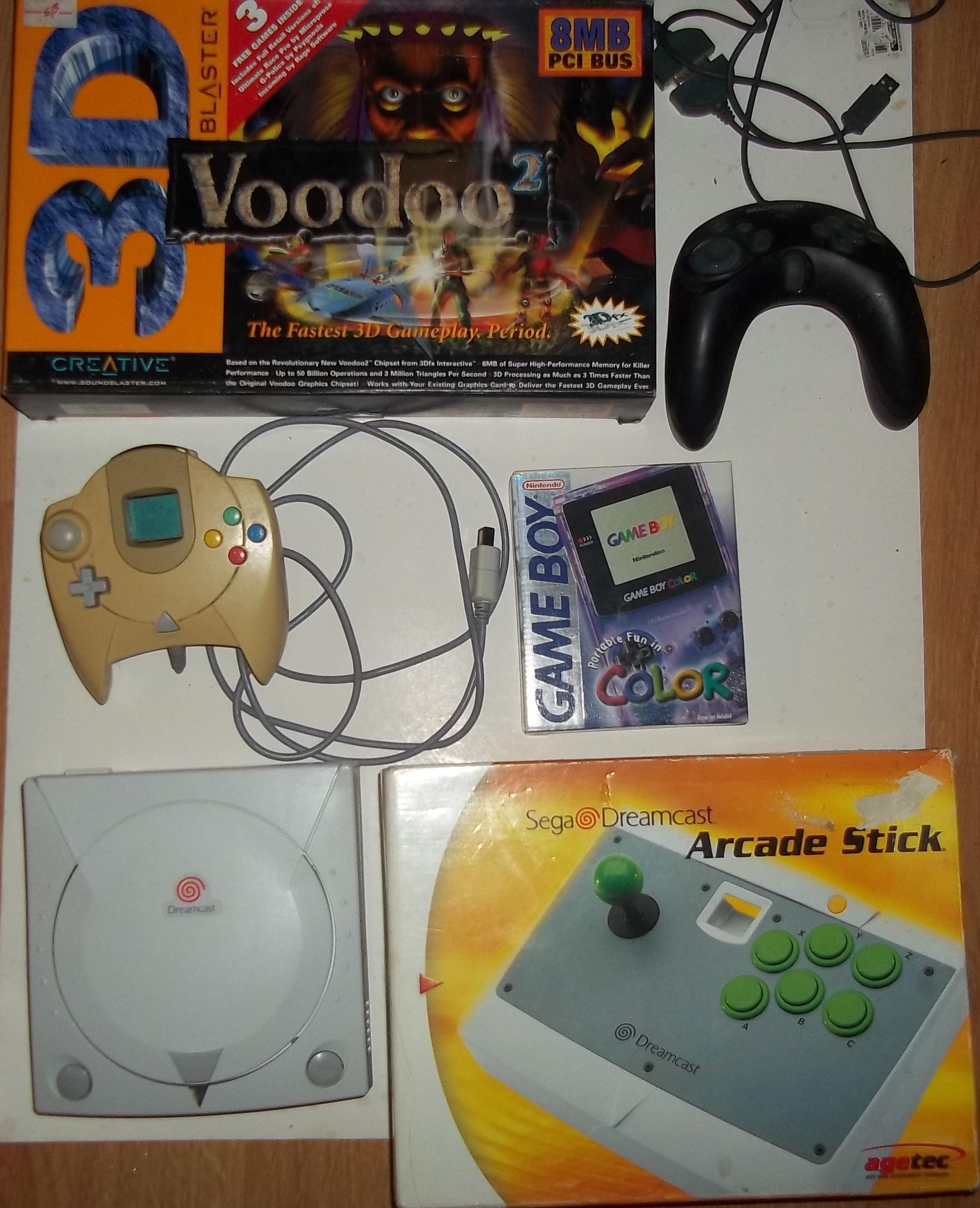
Gaming hardware released in 1998, with some PC hardware on top. That gamepad is the Microsoft Sidewinder Freestyle Pro; it has a motion sensor for tilt controls. Note that the Dreamcast and DC arcade stick pictured are the 1999 American ones, not the Japanese models released in 1998, but it’s the same system.
New Gaming Hardware of 1998
In hardware, 1998 was a pretty great, and significant, year. The ’90s were a time of extreme improvements in technology every year, a time when in a decade similarly-priced computers got at least 75 times more powerful. That is unimaginable today. Every year brought crazy new advancements in gaming technology. It was an exciting, but expensive, time to be a gamer.
I mentioned most of these earlier, but here are going to focus on the gaming hardware only. On the PC side, while the consumer had many options for 3d graphics cards, most of them at least partially incompatible, 3dfx was the best one by far, and they had an amazing new card this year. The 3dfx Voodoo2 graphics card released in ’98. While the original Voodoo from several years earlier is probably the most important graphics card release ever, the Voodoo2 was a hugely big deal. However, 3dfx’s rival NVidia had a great card that year also, the Riva TNT, and in some ways it was just as good as a Voodoo2, apart from it not supporting the 3dfx-exclusive Glide graphics mode that so many games of that era looked best with. In retrospect, it was all downhill for 3dfx after this, as NVidia pushed tech, releasing a new card every six months. This would bury 3dfx and their one year or more per card cycle. ’99’s Voodoo3 was a good card, but later that same year NVidia released the GeForce 256 and just kept going from there, and combined with other 3dfx mistakes they were done soon after, shut down and with their rights bought by ascendant NVidia. It’s such a shame, because 3dfx cards were special! The Voodoo2, particularly, was an unbelievable thing. It was a massive upgrade over any consumer 3d graphics card available before and was significantly more powerful than any console of the day. I got a Voodoo2 in late ’98 and absolutely loved it. I have been using NVidia cards since the GeForce 256, but I will never love an NVidia card like I did that Voodoo.
Also, this is technically software, but Windows 98 released this year. This evolution of Windows 95 significantly improved a lot of things and made development easier. Most probably would still pick it as their favorite of the three Win9x releases. This is relevant for gaming because a great many games eventually moved to supporting not Win9x in general, but Win98 or above only.
On the console side, three new platforms released and one accessory, though two only released in Japan at this point. First, the addon. The Nintendo 64 Expansion Pak released late in 1998, supported at launch by a handful of games such as Star Wars Rogue Squadron and Turok 2: Seeds of Evil. This 4MB RAMBUS RDRAM upgrade doubles the system memory in the console, allowing games to store a lot more data than they could before. It allowed for higher resolutions or denser areas with more things going on. Only a few games require the Expansion Pak, but a good number support it.
The next few platforms are handhelds. In the fall, the Nintendo Game Boy Color released nationwide. This release, shortly following on Pokemon’s North American release a few months earlier, absolutely exploded in sales due to the phenomenon that was Pokemon. Sure, Pokemon was not a color game and ran just fine on an original Game Boy, but the GBC was cheap and millions of kids wanted Pokemon, and many of them got a GBC to play it on. I had little interest in Pokemon myself, but did get a GBC for Christmas along with one game, Pocket Bomberman, a colorized version of a B&W GB game that had released the year before in Japan. The GBC is underpowered, being basically an original Game Boy with twice the clock speed, but it’s got a very high quality game library. The GBC would have a short 2 1/2 year primary life, but still it got a lot of impressive games while it lasted. Its big launch titles were Tetris DX and The Legend of Zelda: Link’s Awakening DX, two enhanced versions of popular black & white GB games. In Japan, Pokemon Yellow and Pokemon Trading Card Game both released on GBC in ’98 as well. They would release in the West later.
The other two systems only released in Japan, both late in the year: the Sega Dreamcast and SNK Neo-Geo Pocket. The latter never released outside of Japan, as less than six months later SNK upgraded it to the Neo-Geo Pocket Color; that colorized model is the one released internationally. The NGPC is in many ways the best handheld of its era, with the best-feeling buttons and best action and fighting games of any handheld of that time or before. The original NGP is similar to the color model, but doesn’t have, well, color, or compatibility with a lot of the later titles. I don’t have a NGP because there is little reason to get one for anyone who has a NGPC, but still, SNK’s entry into the handheld market may have been doomed but it was fun while it lasted. The few B&W-only games play just as well as the color ones, and many games are also B&W compatible along with Color. The NGP had nine game releases in late ’98, most of them good. Most were overlooked in favor of their color sequels, but games like The King of Fighters R-1, Samurai Shodown! Pocket Fighting Series, and Puzzle Link are great. Despite significantly better graphics than the Game Boy Color in terms of sprites and movement, the absence of color was a big issue. Fortunately SNK realized the problem quickly and had the Neo Geo Pocket Color out only five months later, in March 1999. Bandai’s B&W WonderSwan released at about that time but would not have a color update for several years.
Lastly for handhelds, the aforementioned Nokia 6110 cellphone released in 1998. It was the first cellphone to come bundled with a game, the ‘new’ release Snake.
And last but definitely not least, Sega released their last console, the Dreamcast, in November. There is a lot in common between the NGP/C and DC, as both were released by struggling companies on their last legs, had amazing games release for them, then died tragically young, leaving fans remembering them and wishing for more ever since. The Dreamcast didn’t release internationally until September 1999, and the initial Japanese launch was of far too few systems to meet demand, but for those few people who got one, they saw the future: one of the most beautiful hardware designs ever; 480p progressive scan video output, the first time a console could output a signal above the resolution that a standard definition television can display; online connectivity, later on, once the modem (it was not packed in in Japan at first, unlike the West) and online games released; top tier graphics close to on par with what the Voodoo2 could do though at lower maximum resolutions than it could output; and, available in late 1998, Sonic the Hedgehog’s noteworthy return in his classic Sonic Adventure (DC; JP release, US ’99). Sonic Adventure’s level design would set the tone for the rest of the Sonic series going forward and is a pretty important moment in 3d platforming. The Dreamcast is fascinating because it both the beginning and the end. It is the very last console designed with accurate ports of arcade games being central to its design ethos. It is the last console where those arcade ports were significantly important. But at the same time, as I said above, it was the first console of a new generation, and brought new advances in graphical output and online connectivity. I’m not sure if any other console so perfectly captures the ethoses of two different eras of gaming at the same time as the Dreamcast does. It really is both the last retro console and the first modern one.

This is what I own physical copies of for the games in this tier. I apologize for not owning a boxed copy of Half-Life, I only have it digitally. Getting one is high on my list now. This image will be replaced with one that also has my Ocarina of Time box in it once I get it from storage. My launch Starcraft box is sadly missing, so a later copy from ’99 or ’00 is in this picture instead. All I have left of my launch copy is the jewelcase and manual. Remember that Pokemon released in Japan in ’96. (Also I do have the box for Ocarina of Time.)
So, that is it for hardware. Now, let us focus on the games on these platforms and others. What were some of the key games that make this year stand out over any others?
1998’s Best Games
It is hard to even know where to begin for 1998. The full list will be in part two of this series. The best place to start, though, is at the top. These are the primary reasons why 1998 is such a famous year for games. Here are my picks for the top highlights of 1998’s game library. Each game title is a video link. I try to use a real hardware video whenever possible.
– The Legend of Zelda: Ocarina of Time (N64) – The most popular ‘best game ever’ on most lists, Nintendo’s all-time action-adventure classic is my favorite console game ever as well. I wrote an opinion summary about this game years ago, look it up. This epic adventure is an incomparable masterpiece which defined 3d game combat with its lock-on mechanic and has some of the best dungeon and puzzle design of any game. The story is decently good, too, with an interesting theme of time, how quickly time passes, and the sadness we feel when we see how quickly time has gone by… but while the story is interesting and mostly well done, and it’s one of the series’ best stories, it is the gameplay that is the core of why this game is so highly regarded. Nintendo has always, correctly, been a gameplay-first company, and this game shows the brilliance of that focus as much as anything has. Compared to every 3d game released before it, movement and combat in Ocarina are orders of magnitude better. It is still a fun, great game which controls well. From the controls to the world to the dungeons to the music and towns and everything else, this game is just about perfect. The sense of atmosphere in Ocarina is unmatched. There had been nothing even remotely at Ocarina’s level before its release, and it still stands as one of gamings’ greatest works after all these years. This game deservedly has its place as the game with the highest review average ever. If you look up the list Game of the Year award winners from ’98, almost every console award that wasn’t for a Sony-only publication went to Ocarina of Time.
– Starcraft: Brood War (PC) – My favorite game ever, Blizzard’s real-time strategy game Starcraft is an exceptionally brilliant game. This sci-fi RTS is kind of Southern Hicks in Space meets Warhammer 40,000. It is both funny and hopelessly dark and depressing, sometimes at the same time, and it’s a brilliant combination that works perfectly. The soundtrack is one of the greatest ever, as well; the Terran themes particularly are truly exceptional. The single player campaign is epic and very well written, something I would not say about anything Blizzard made after Warcraft III. It is one of the best single player campaigns ever, but it is here not just for that, but also for its online multiplayer. Played through Blizzard’s Battle.net system, the online play has been there since launch and it’s still being played by thousands of people today, in both amateur and professional divisions. The pro scene is centered in South Korea, and they are impressively good at the game. I still play Starcraft regularly online. Am I any good? No. But I play anyway because it is amazing. Starcraft is one of the most challenging competitive games ever designed, but it is that near-infinite skill ceiling that is part of what makes it so brilliant. The very well done balance that keeps the game vaguely fair despite no balance patches since 2001 is also genius. Starcraft is still without question the greatest thing ever produced in the history of gaming, and it isn’t close. In gameplay, control, design, story, visuals, music, and everything else, Starcraft is the greatest. If we were sending something out into space to show other civilizations our greatest achievements, the one I would pick for electronic gaming is Starcraft. Oh, and Starcraft fan modders invented the tower defense genre, as well, so Starcraft is responsible for that fantastically fun game style.
As an aside about the video, while usually I go with pure gameplay videos here I went with one of the last professional tournaments from before the release of Starcraft Remastered in 2017: the finals of the first season of the current main South Korean pro tournament, ASL, from 2016. If you wish to compare this ten year old video to the state of Starcraft Remastered today, the most recent of this twice a year tourney, ASL 22, finished this month, October 2026. That final is here: the video.
– Half-Life (PC) – Valve’s first game was the first title PC Gamer US ever gave a 98% score to. The game was a major hit that would set its developer up for success. This would later lead to developer Valve setting up what became PC gaming’s primary digital marketplace, Steam. The game itself is a pretty fantastic FPS loaded with interesting set-pieces and in-game scripted sequences. The games’ multiplayer was initially just standard deathmatch, outclassed by older titles like Quake, but given its massive success it should be unsurprising that modding the game became hugely popular. This led to Half-Life: Counter-Strike, released in 2000, a multiplayer team shooter addon for Half-Life which revolutionized first-person shooters and is one of the most enduringly popular games ever. The only real thing holding Half-Life back is that its sequel often gets mentioned in ‘best games ever’ lists instead of the first one. After all many lists like to only list one game per series, at least per era, and the second Half-Life usually gets the edge over the first, even though they scored equally high and the first probably won more awards — almost all major PC publications gave Half-Life their Game of the Year awards. The game won more than 50 awards. Despite Half-Life 2 outdoing it in most peoples’ eyes, the first Half-Life is still a very noteworthy and well made game. Half-Life isn’t a game I personally have as much of an attachment to as the two games above, but I certainly recognize its impact and like the game.
– The First US Releases of These Incredibly Important Titles Which Had Released in Japan or Europe in 1996 or 1997 Happened in 1998 Here: Pokemon Red & Blue (GB), Grand Theft Auto (PC/PS1), Gran Turismo (PS1). Pokemon’s influence particularly is incredibly massive and ongoing. It is 1998 when Pokemania hit the world, dramatically changing gaming forever. Pokemon remains one of gaming’s largest and most popular franchises to this day. Gran Turismo and GTA are also, obviously, extremely significant releases which would have major industry impact. GTA and its single open world would eventually change gaming once it went fully 3d with its third game in 2001, and Gran Turismo is Sony’s longest-lasting and most successful franchise and by far the most successful realistic racing franchise ever.
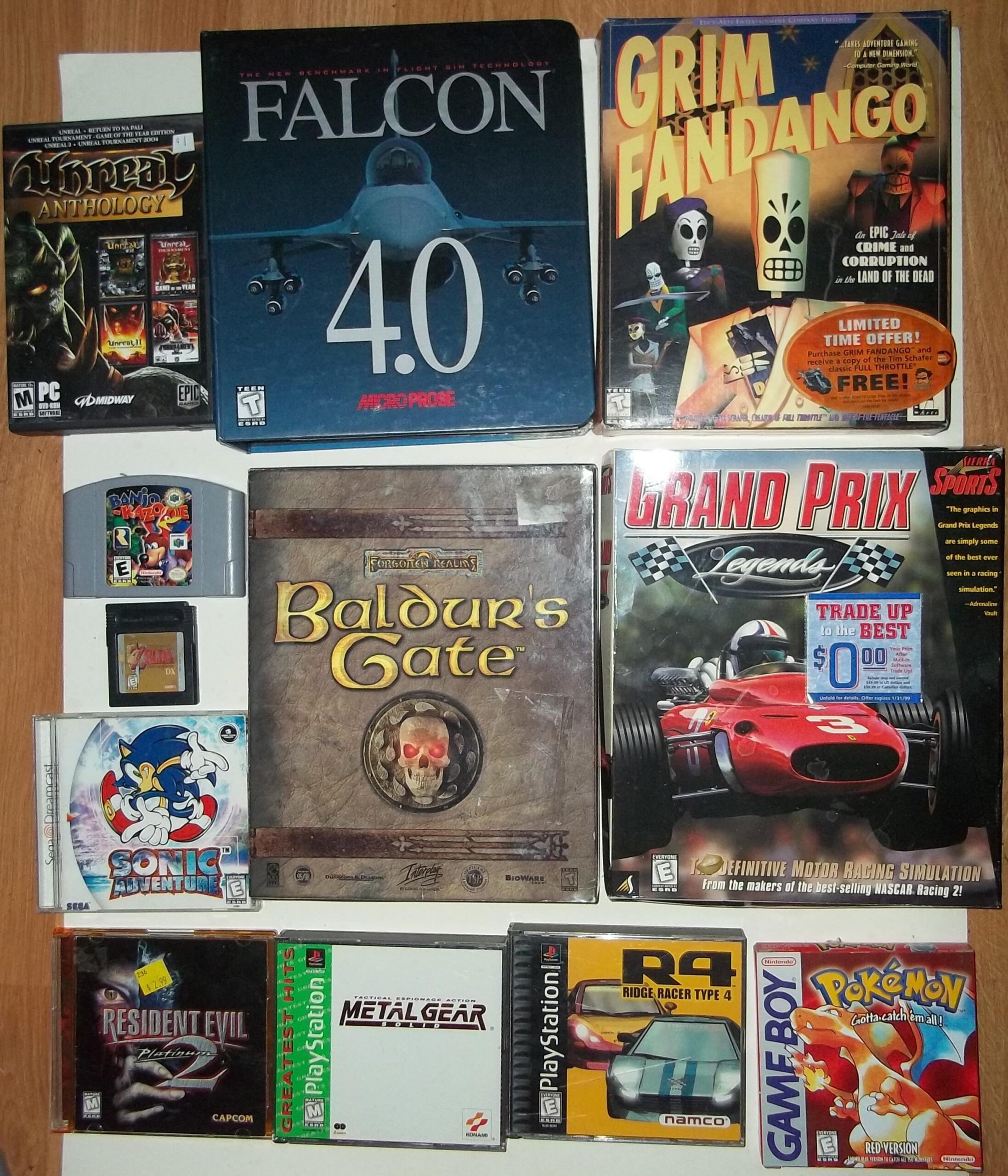
These are the games I own from this tier. I may have the box somewhere for Link’s Awakening DX but I’m not sure where it is in storage. Also note that a later Unreal collection is pictured, but it’s here only for the first game. Also remember that Pokemon released in Japan in 1996. Finally, I included the 1999 PC version of Resident Evil 2 in this image to represent the PlayStation game, since I don’t own the original. I thought that was closer to the original than the N64 port that I also have is. Finally, I may also have a Tetris DX cart somewhere but can’t find it.
Other Peak Games
These games are also some of the best games ever. Their fans would certainly put them in the above category. These games are selected not only for high review averages, but for being significant games which still have enduring relevance. There are more games that could also get paragraphs here, but I can’t cover everything in this article. The second article will cover a great many more games. I decided to put these games in order by their critical review average on MobyGames. Note that the games I put in the tier above would be mixed in this list by review average, with Ocarina in first of course, but I think for importance they deserve being put in a tier above. I will mention most but not all titles high on their list; some are not noteworthy enough for this list, review scores notwithstanding.
– Metal Gear Solid (PS1, later PC) – Hideo Kojima’s ultra-popular cinematic action game would become one of gaming’s most popular series for a while. I don’t like this game at all but have to admit its massive success and popularity. The stealth here is much simpler than Thief’s, with an overhead-isometric viewpoint most of the time and simple avoidance-based gameplay quite reminisent of the NES or MSX Metal Gear games, but it did advance things beyond them in stealth and particularly in action and boss-fights. Particularly, though, the games’ cinematic presentation, lengthy conversations and cutscenes, and increasingly crazy story made with a series of boss fights against weird characters made it an iconic hit.
– Resident Evil 2 (PS1) – One of the most popular survival horror games ever made, Resident Evil 2 is a two-disc masterpiece. This game takes the static camera and action/adventure of Alone in the Dark and the first Resident Evil and improves on it in every way, with a larger world, a more interesting story, great characters, better puzzles, and more. This is the definitive classic-style Resident Evil game; it was all downhill for the more adventure game-styled RE games after this, until in Resident Evil 4 (GC, 2004) they changed the genre to pure action.
– The Legend of Zelda: Link’s Awakening DX and Tetris DX (Game Boy Color, dual-mode GB/C games also Game Boy compatible) – The Game Boy Color launched with two first-party titles, but neither one was a new game. Instead, the launch titles were a pair of colorized re-releases of some of the most popular original Game Boy titles. Both are very good versions of some of the best games ever made, though whether the original or GBC versions are better depends on who you ask; the differences may be small, but some people do prefer the originals. Regardless, Tetris added color and battery save for high scores, but it also updated the rules a bit. Some prefer the simpler original version, others like this. Meanwhile, Zelda added color, a new dungeon, photos to find that you can print on the GB Printer, more hints in dungeons, and new costumes which give you a permananent damage or defense boost. Almost everybody seems to prefer the color version over the original, but personally I am a purist who prefers the B&W release. Either way though this is a great version of the best 2d Zelda game ever made.
– SoulCalibur (Arcade ver.) – The 1999 Dreamcast version of Namco’s seminal classic SoulCalibur is one of the best and most popular fighting games ever made. 1998’s Arcade version, however, isn’t on that level, because it is based on a PlayStation 1-based arcade board. As a result it has PS1-level graphics, far from the sharp visuals of the later DC version. However, the core gameplay is the same, and the few reviews that the arcade version of SoulCalibur have put it ranked very high indeed, and for good reason: this is one of the best 3d fighters ever. It’s a real shame that this series faded after SoulCalibur II, but at least we got two incredible games before that happened.
– Grim Fandango (PC) – This LucasArts adventure game is widely regarded, including by me, as being the greatest adventure game ever made. It has a very interesting and unique Mexican Day of the Dead theme. The story and puzzles are second to none, as you guide Manny Calavera on a moving adventure through the land of the dead. The game has a masterful balance between humor and serious themes. If it seemed like adventure games couldn’t get better after this… well, they couldn’t. The genre faded in popularity significantly almost immediately afterwards. Gamespot, then as now one of the biggest electronic gaming websites, actually gave the Best Game of 1998 award to Grim Fandango, making it one of the few places to not award Half-Life with the Best PC Game of ’98 moniker. The game did not sell very well but should have with how exceptionally well written and drawn and designed it is. Grim Fandango is a classic adventure game except you directly control main character Manny, instead of a cursor, so I remember playing it with a gamepad. Despite this it is pure graphic adventure goodness, and is all about story and figuring out complex inventory puzzles. It’s great stuff.
– International Superstar Soccer ’98 (N64) – Why is a sports game here? Well, by review average it has earned its place. This title is from Konami, a predecessor to the Winning Eleven series. The first International Superstar Soccer 64 (N64, 1997) is the number one highest reviewed soccer game of all time on Mobygames for any platform, with a 95% average. This game scores a few points lower and is at 7th in soccer games purely because it is less original than its predecessor, but it really is that game but a bit better. Konami’s 3d soccer games exploded out of the gate in quality; this game is still VERY highly regarded by genre fans. There was also a PS1 title in the series the same year from a different team that scored high but slightly lower than the N64 one, ISS Pro ’98 (PS1).
– Xenogears (PS1) – This Japanese RPG published by Square is one of the more important ones that isn’t a Final Fantasy or Dragon Quest game, as it not only started a long-running series that still exists and is now owned by Nintendo, the Xeno (Gears, Saga, Blade) games, but also is a beloved classic with what is perhaps the most highly regarded story ever in an RPG. Sure, there is also a game here, with a good combat system and all, but the story is the primary draw. Xenogears and its epic, tragic tale probably has the best story of any game of 1998. It is surely either this or Panzer Dragoon Saga, and this one is much more verbose and complex. ’98 may not have a new Final Fantasy or Dragon Quest game, but it has this and I am sure many RPG fans would say it is just as good a year for it. The soundtrack is absolutely top tier, as well. I particularly love the ending theme. The second half of the game simplifies down to having less exploration and more long story sequences, but the story is more than interesting enough to hold a great many peoples’ attention all the way through. The battle system is solidly fun as well, though, this isn’t only here for its story.
– Battlezone (1998) (PC) – For any who don’t know what this game is, it surely sounds like a confusing entry. Battlezone? The early ’80s arcade game? Surely it’s just another average update to a classic like Centipede (various systems, 1998) or Frogger (PS1/PC, 1997)? But no, it is not. This title is from a short-lived but interesting genre of first-person real-time strategy / action games, and of the games in that subgenre this is the best-reviewed one ever. This was an acclaimed, award-winning title. Set during the Cold War, the story is that the Americans and Soviets are fighting a secret war on the moon. You drive around in first person in your tank, building structures and units and also fighting for yourself. It may sound weird but once you get used to it it’s a great game. There would later be a console entry on the N64, Battlezone: Rise of the Black Dogs (N64, 1999) but it isn’t as good as the PC game.
– Unreal (PC) – Unreal, the game, is a good first person shooter. it is a single player game going through a classic, Quake-styled shooter campaign, and was id rival Epic’s entry into the FPS craze. The game wasn’t the best or more acclaimed game of the year, but it was a quality title. In the crowd of shooters released in ’98, Unreal did stand out in one respect though, its graphics. Unreal probably had the best graphics of any PC game released in 1998. Epic would leverage that graphics tech over the years to transition from being exclusively a game developer to a studio as focused on selling their Unreal Engine to game developers wanting a good 3d engine for their games as on making its own games. The Unreal Engine remains probably the most popular nonfree 3d engine to this day. This game is mostly on this category of the list for its graphics and engine, not so much its gameplay, though the game is good.
– Radiant Silvergun (Arcade/Saturn) (Japan-only release) – Developed by Treasure, a fan-favorite developer if there ever was one, this shmup (shoot ’em up) is many peoples’ pick for the best game ever in its genre. The Saturn Game of the Year awards not won by Panzer Dragoon Saga were won by this game. I prefer its Dreamcast sequel Ikaruga, myself, but RS’s influence cannot be denied. The graphics, gameplay, music, and controls are all masterfully done and brilliant; this game is legendary for good reasons. The game has a somewhat high learning curve due to having 6 different weapons that you can all use at the same time, each mapped to a different button, but it’s worth learning. In somewhat typical Treasure fashion the game centers around bossfights; it is not entirely a boss rush, but they are a large part of the game. Every one is unique and interesting. From its stunning art design its finely-tuned enemy patterns this game is one of the best. I know that I consider Ikaruga the best shmup ever, but I would never deny Radiant Silvergun its originality, popularity, reputation, or importance.
– Baldur’s Gate (PC) – This RPG from BioWare would define the PC RPG to me and many other people from its release on. Baldur’s Gate is a depiction of 2nd edition AD&D rules, adapted into a pauseable real-time engine, was done so brilliantly that I’d argue that it still is the best RPG game engine ever designed. The story is fine enough, it sets up the series well and is well written. When I went back to play the game again I was impressed at the subtle hints early on about things that wouldn’t fully realize until the second game. Even so, not everyone finds its initial focus on an iron quality crisis interesting. Additionally, the game is somewhat open-ended and has many large, fairly empty areas. Its sequel would have a much more linear structure with far fewer side areas to explore. Despite this the second game is longer than the first, but regardless, in Baldur’s Gate you have more out-of-the-way places to explore and many opportunities for combat. The combat here is the best ever in any RPG other than maybe Baldur’s Gate II (PC, 2000), depending on whether you prefer lower-level or higher-level D&D battles. Indeed, it’s the gameplay and strategic combat that really carry this game to the top. If you like fantasy RPGs or strategic battles Baldur’s Gate is one of the best games ever. Fortunately I care more about gameplay than story, and as far as gameplay goes in an RPG, Baldur’s Gate is second to none other than maybe its sequel. The second games’ high-level combat has great strategic depth and complexity and more focused zones with fewer side areas, but the first game is more innovative and I love its relative simplicity. It is easier to play than its sequel and is just as fun. It has some of the most memorable voice lines ever in a game, as well. “Ohh, I’m so tired…”
– Thief: The Dark Project (PC) – The first true stealth simulator and an early title in the immersive sim genre, this first-person masterpiece essentially invented the stealth game as we know it. 1998 is the key year in the stealth genre’s evolution, thanks to Thief, Metal Gear Solid, Tenchu, and Commandos, but of the four, in terms of gameplay Thief is the most important thanks to its highly interesting, detailed stealth modeling. Those other three are important but have fairly simple steath mechanics, but that is not the case here. You will need to watch guard patterns and your sound, pay attention to surfaces, and use your items carefully as you try to get your prizes. Developer Looking Glass was brilliantly talented at innovative first-person game design, as you see in System Shock, Thief, and more, and you see that here. They weren’t sure how well stealth-only gameplay would do with the public so there are also some missions where you have to fight undead in caves and such, levels where stealth is limited, but even so player character Garrett isn’t much of a fighter. Avoiding foes or taking them out from the shadows is usually the better approach if you wish to live. Later stealth games like Tom Clancy’s Splinter Cell or Dishonored would not exist without Thief. However, arguably none of them have sound-based stealth systems as well done as this seminal title.
– Links LS 1999 (PC) – The second most highly rated sports game of the year is a golf game from what was then the golf genres’ premeire series, Links. Developer Access Software would fade the next decade but at this point were still near the top of their game. Their signature digitized actor sprites in polygonal environments were starting to look a bit dated to some compared to polygon models, but this game still looks good with nice 3d environments.
– Panzer Dragoon Saga (Saturn) – This Japanese RPG from Sega is short, but in its length it is so interesting and unique that those who have played it still regard it as one of gaming’s greatest masterpieces. The development team were trying to make soemthing which went against the grain of what was popular in its genre while also making something amazing, and succeeded brilliantly. It’s an all-time great RPG which would be much more highly regarded if more people had played it. Panzer Dragoon Saga is a highly cinematic work following a largely linear path with a tragic but compelling story and interesting gameplay. The dragon-based turn-based battles are unique and quite interesting. The soundtrack is, typically for a Panzer Dragoon game, one of gaming’s best, and the art design is exceptional. The story of the games’ creation is also tragic, as the developer Team Andromeda overworked themselves for years to complete the game. At least one person died before it released. What they made, though, is an all-timer for the few who can afford to play it. It is truly depressing that there still has never been any kind of re-release of this exceptional work of genius. (Note, I would recommend playing this game over watching very far in to videos like the one I linked…)
– Banjo-Kazooie (N64) – This game was Rare’s first 3d platformer, and it was a very important title for the genre. This game would help define what 3d platformers would become: not just platforming-focused games where you do one objective at a time as you do in Mario 64, but item collection and combat-focused games that have a platform-jumping component but also have minigames, free exploration of large open spaces looking for things to collect, and more. This game started out as a completely different title for the Super Nintendo called Dream, but ended up like Mario 64 but with the ability to stay in the level as long as you want, collecting stuff and doing mini-missions. You unlock abilities as you go through the game. The game has a few rough points, most notably that in its Nintendo 64 release it doesn’t save your notes, the basic coin-style collectible, so it’s not worth getting any of them until you have all the powers. Some later re-releases fix this issue. Even so, BK is a fantastic game. It is not my personal favorite Rare 3d platformer, I’m sorry but I love Donkey Kong 64, but BK’s humor, visuals, level design, and general greatness are obvious to those who play it. The games’ influence and quality cannot be denied. No collectathon-style 3d platformer has been as popular as this one since its release; BK is surely still the leader in that field. It nails the balance between having a lot of things to collect, but not having so many that people get overwhelmed. It also controls well, has variety, and looks good for its hardware.
– R4: Ridge Racer Type-4 (PS1) – The fourth home console Ridge Racer game was the last one on the original PlayStation, and in a way it was the last hugely popular title in the series as well. The Ridge Racer series would continue on after this but it would never recapture its PS1 popularity, and of the PS1 games this one is by far the most popular with series fans. R4 is the first home console exclusive Ridge Racertitle, so it has a full single player campaign. Despite still having arcade-style controls for the most part the game goes for a realistic racing theme, with a somewhat drab color palette and realistic racing team theming. This game is where the series started changing from being fun arcade games to an arcade/simmish mix, though the controls here are still mostly arcade style. Despite that this is one of the better-looking PS1 games, and would be most peoples’ pick for best-looking Ridge Racer game of the generation for sure. I have always found this game good but somewhat boring to actually play but obviously a lot of people disagree with me about that. It is this high on the list for a reason.
– Sonic Adventure (Dreamcast; JP release) – I covered this game already above in the New Hardware section, but to reprise, Sonic Adventure redefined Sega’s mascot Sonic and started his second-best period. This ambitious game has a hub world city with levels that branch off from there, somewhat like Mario 64 (N64, 1996), but with levels that are largely linear paths focused on showing off Sonic’s speed instead of open zones to explore like Mario had.The result is a somewhat short main game, but there are five other playable characters alongside Sonic, each with shorter campaigns with unique gameplay. There is also a Tamagochi-inspired virtual life mode, the Chao Garden. There is some control and camera jank to be found here, but it’s a good game. I don’t think Sonic Adventure has Mario 64’s perfection but it is pretty good. I would argue that the last certainly great Sonic games were the two Sonic Adventure titles.
Personally, following PC Gamers’ lead, I have always drawn the most important dividing line in game review scores between 88% — a B+ score, a score high enough to get a PC Gamer Editor’s Choice award — from an 87% — a B, a very good game but not quite great. The above games all score at least an 88% with one exception, Sonic Adventure. I think it was important to include it. After all, review scores aren’t everything. No good best-ever list is a purely deterministic list in review score order, as tastes change over time, and some games are more important in retrospect than they were to reviewers at the time. These two games particularly stand out in that category.
– Falcon 4.0 (PC) – This flight combat simulation from Microprose is an uncompromising game which tries to be a fully realistic depiction of flying a F-16 fighter plane. It succeeds at that about as closely as a computer game could. The game came in a binder full of 700 pages of information about how to operate the plane. There is no HUD other than what there would be in the real plane, and everything works as close to real as is possible. No game since has matched its vision and uncompromising attention to realistic detail. And that’s not all; the game also has a full dynamic campaign, with a land war happening on the ground while you fly your missions, with a great number of vehicles on the ground doing their thing as you play. No other flight simulator has a campaign that is its equal — the campaign may be the thing that actually makes Falcon 4.0 stand out the most, if its exceptionally accurate flight modeling doesn’t. Flight simulators after this would not be made with this kind of budget. There are modern updates from the community for this game. The latest version is Falcon 4.38 BMS. BMS is almost certainly the most realistic flight simulation on the market, certainly for the F-16 but probably generally. Genre leader DCS is also complex but not quite as much as Falcon BMS. The graphics are pretty nice too, though of course they don’t compare to a modern game like DCS or Microsoft Flight Simulator 2020. (Note, the video in the title is from Falcon 4.0 1.08, not Falcon BMS, for a more authentic look. The trailer for the most recent version of BMS, 4.38 (2025), is here: the video.)
– Grand Prix Legends (PC) – The racing game counterpart to the above title, sort of, Sierra and Papyrus’s masterpiece GP Legends is an extremely realistic take on the 1966 Formula One season, with physics and design as accurate to the real thing as is possible. There is no HUD here, and no voice over a radio. It’s just you and the car, and a little board held out as you go through each lap telling you how many laps remain and how far ahead and behind the closest racers are. No game since matches its ambition and scope compared to the budgets of the time; generally even racing simulators want people to actually be able to easily enjoy the game. Papyrus wasn’t trying to do that here, they were trying for realism. They succeeded. Can you drive in a straight line and not crash? It won’t be easy. Despite being the pinnacle of the genre GPL didn’t get as many awards as you might expect, probably because of how difficult control is. Those who learned how to play it well love it, though. This game also has modern updates which make it look amazing. Even fans of other classic sim racers like Geoff Crammond’s Grand Prix admit that Grand Prix Legends is the best older sim racing game. I need to mention, the games’ developer Papyrus’s staff would later leave to found iRacing, the number one name in online simulation racing. iRacing is built on Papyrus’ engine, and they have a modern Grand Prix Legends mode in iRacing that is essentially a sequel to this classic with their modern engine and tracks. That is very cool. (This game also has an active modding community. With modern mods it looks like this: the video. The video maker talks a bit at the start of the video but not during gameplay.)
And more! There are so many important and noteworthy titles. The number one game I think should be on the list above is F-Zero X (N64), a 10/10 A+ game in my book. Wipeout 64 (N64) is only just barely behind it in greatness.
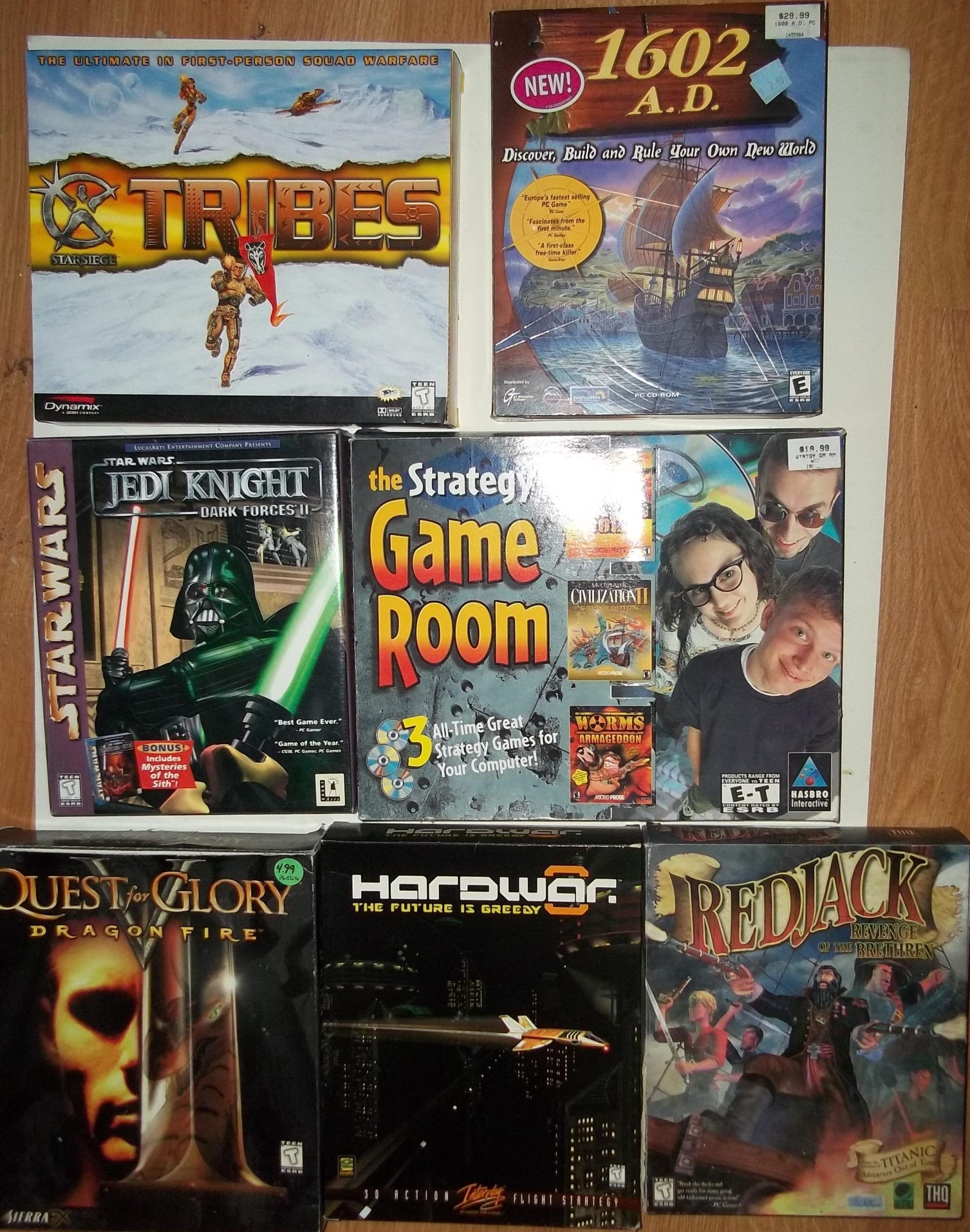
This is a selection of interesting PC games released in 1998 from my collection. See the first image in this article for the full boxed collection image. These are all good games but this is not a ‘best of the year’ list. Please note that the later Strategy Game Room collection is here for the upper two titles: MechCommander (under the flash) and Sid Meier’s Civilization II: Multiplayer Gold Edition. Worms Armageddon was a 1999 release. Lastly, Jedi Knight (PC, 1997) is here for its Mysteries of the Sith expansion, which was included in the box with the later rerelease that I own.
Other Selected Noteworthy Titles
I could continue with more paragraphs like those above. For example, I skipped some in between Banjo-Kazooie and Sonic Adventure. In that gap are Garou Densetsu Special (NG), World Cup 98 (various), Crash Bandicoot: Warped (PS1), FIFA ’99 (various), The King of Fighters ’98 (NG), Fallout 2 (PC), Dragon Warrior: Monsters (GB/C; JP release, US later), and Shining Force III: Scenario II (SAT; JP only). These all score 88 or 89%, and some of these are quite important games. Including user reviews Crash Bandicoot: Warped, the third and final platformer in this very popular PS1 series, is top ten, but the review average is slightly lower. Shining Force III: Scenario II might be considered the best game ever in its genre depending on who you ask. Fallout 2 is an ambitious open world classic.
And then in the same tier as Sonic Adventure at 87% you have these great titles: Street Fighter Alpha 3 (Arcade), Myth 2: Soulblighter (PC), Sakura Wars 2 (Saturn; JP only), Wing Commander Prophecy: Secret Ops (PC; expansion for Wing Commander Prophecy, from 1997), Dance Dance Revolution (Arcade), F-Zero X (N64). Now that is some incredible stuff! F-Zero X is one of my favorite games ever and a perfect ten in my eyes; Sakura Wars 2 was as big a hit as the Saturn had in Japan; SF Alpha 3 is the most popular Street Fighter game of its time; and DDR would help to create a new genre. Myth 2 is also popular among those who don’t want base building in their RTSes.
Additionally, a few edutainment games made this list, but I left them out above. They are all for PC — Star Wars: Droidworks, Pajama Sam 2, and ClueFinders: 3rd Grade Adventures.
There are more must-mention titles as well. These games may score slightly lower than the titles above in average, but many are also amazing classics. Some of these are some of my all-time favorites.
Console Games: Spyro the Dragon (PS1), Wario Land II (GB, GB/C), Super Tempo (SAT) (JP only), Stellar Assault SS (SAT, JP only), Colony Wars: Vengeance (PS1), Star Wars: Rogue Squadron (PC/N64), Rush 2: Extreme Racing USA (N64), Tenchu: Stealth Assassins (PS1), Shining Force III: Scenario II (SAT, JP only), Burning Rangers (SAT), Wipeout 64 (N64), 1080 Degrees Snowboarding (N64), The Need for Speed III: Hot Pursuit (PC/PS1), Moto Racer 2 (PC/PS1), Rockman & Forte [Mega Man & Bass] (SNES) (JP only), Turok 2: Seeds of Evil (N64/PC), R-Type Delta (PS1) (JP release), Shadow Tower (PS1) (JP release), Pokemon Yellow (GB/C; JP release), Extreme-G 2: XG2 (N64/PC), and the first home ports of previously released arcade games NFL Blitz (PS1/N64/PC), Tekken 3 (PS1), Mortal Kombat 4 (PS1/N64), and Virtua Fighter 3tb (DC, JP release). Etc, etc.
PC Games: Norm Koger’s The Operational Art of War, Volume I: 1939-1955, Jazz Jackrabbit 2, Worms 2, Quest for Glory V: Dragon Fire, The Need for Speed III: Hot Pursuit (PC/PS1), Moto Racer 2 (PC/PS1), Star Wars: Rogue Squadron 3D (PC/N64), Motocross Madness, Vangers, Star Wars: Jedi Knight – Mysteries of the Sith (Expansion Pack), Might & Magic VI: The Mandate of Heaven, Starsiege: Tribes, Descent: FreeSpace – The Great War, Tom Clancy’s Rainbow Six (also later on PS1/N64 in downgraded form), The Elder Scrolls Adventures: Redguard, Sanitarium, Caesar III, NFL Blitz (PS1/N64/PC), Delta Force, Driver’s Education ’98 and ’99, Lineage, Anno 1602 A.D., etc, etc.
Arcade Games: Radiant Silvergun, The Last Blade 2, Metal Slug 2, The King of Fighters ’98, Daytona USA 2: Battle on the Edge, Sega Rally 2, ESP.Ra-De, Blazing Star, Marvel vs. Capcom, Armed Police Batrider, The House of the Dead 2, Gauntlet Legends, Dance Dance Revolution, Spikeout, Dynamite Cop!, NFL Blitz ’99, HyperDrive, etc.
Mobile Games: Snake [Nokia 6110]
Any game from these three lists, and many more, could reasonably deserve a paragraph explaining its greatness or importance here, but this is long enough already so read part two for some of that.
Here’s a fun challenge: make a top 5 in some genre. Make it all games from 1998. How many games into the list can you get before someone reading the list, without the years mentioned, would realize what you are doing? I think it’s often quite far. I will have genre lists, with thoughts about many of the games, in the next article. There will be some overlap from this article but that’s okay, I’m sure some people will read only one part or the other.
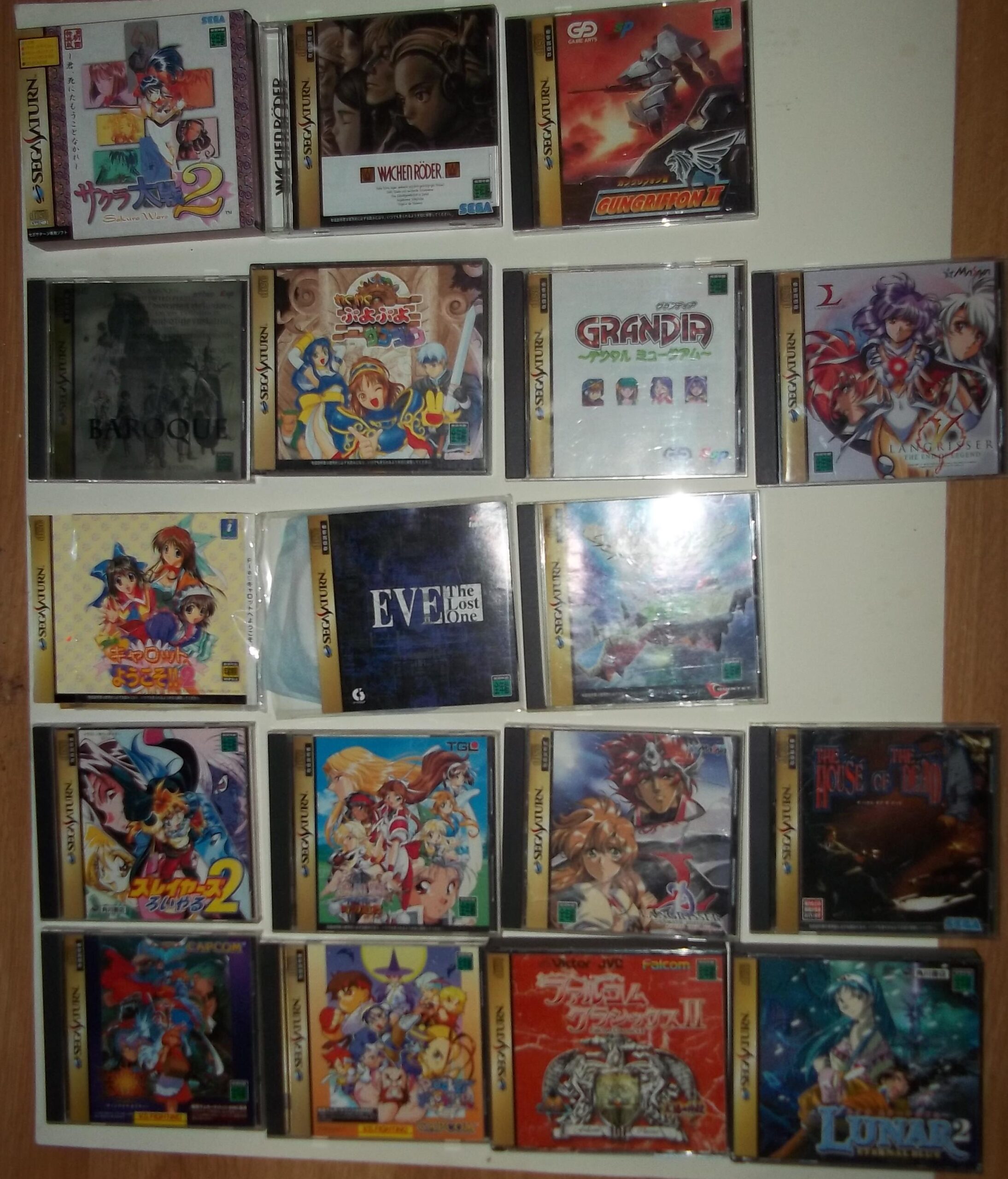
My 1998 Saturn games. I apologize for how awfully blurry this is; I will try again later. I also am sorry for not owning any of the quite expensive American 1998 releases, or Shining Force III Scenarios II or III either; I really should at least have those two! The bottom row are later Saturn ports or remakes of games released elsewhere in previous years. Lastly, the game under the flash is Solo Crisis. (As a note, Baroque looks odd because there are graphics engraved into the plastic of the front of the jewelcase, in addition to the manual art below.)
Genre Strengths and Weaknesses of 1998
Originally this section only outlined the weaknesses, but when making version 2 of this article I thought I should list genre strengths. I know that this section repeats content from earlier in this article, and is repeated a third time in the second article, but despite this I added this. I wrote several versions of this with longer descriptions, but removed that to add some of it to part two, because that is where that should go. Part two has the detailed looks at each genre. However, I decided to leave in this new section highlighting a key title or so for a bunch of significant genres and subgenres. This is broken up by my assessment of the state of the genre in 1998: new, rising, peaked, falling, or largely absent.
Please note, the sorting of the list below is based on how the state of each genre is versus other years, from early development towards past peak. The list is not organized by the absolute quality of the titles released in ’98. Basically the top and bottom of the list below are weak, while the middle is strong, like a bell curve.
“New” Kinds of Open World Games in Development
–Open-World Games (across genres) – While flight simulators and RPGs were in a good place in ’98 and often had open worlds as games in those genres always had, all other kinds of open-world games, from third-person action-adventures to sandbox crafting games to racing games, were just about to drastically change as the open world fad swept gaming starting just after ’98. Many games of ’98 have expansive levels, but few outside of RPG or flight games have true open worlds.
— Action-Adventure – The Legend of Zelda: Ocarina of Time (N64), kind of… if you call it open world. It isn’t really.
— Action-RPG – Shadow Tower (PS1) is a dungeon exploration game in a single dungeon.
— Driving Action – Vangers (PC) is bizarre and mostly open world.
— Action (Flight Action & Trading Sim) – Hardwar (PC) is a pretty interesting, if flawed, title.
— Racing (First-Person City Driving) – Driver’s Education ’98 (PC) and Driver’s Education ’99 (PC) – Before this there had been a few experiments in open-city driving, most notably Vette! (PC, 1989), but these are the first titles like that since. 1999’s Midtown Madness (PC, 1999) and Driver (PC/PS1, 1999) would be the next step.
— Massively Multiplayer Online RPG – Despite being ancient if you count MUDs, the graphical MMORPG was still early in its development in 1998. The ongoing beta tests for EverQuest (PC, 1999) are the star here, but only a few had access to them. Probably the best new, finished MMO of the year was Lineage (PC, Korea only until ’01), an overhead game, not third person. Between those two, and the Ultima Online expansion released in ’98, the genre was showing promise.
Genres New or Significantly Improved in 1998
– Music – Dance Dance Revolution (ARC) – There had been little like it before.
– Party – Mario Party (N64) – This popular genre started here.
– First Person Shooter (Modern Military Tactical) – Tom Clancy’s Rainbow Six (PC), Delta Force (PC) – This very popular subgenre barely existed before 1998.
– Action (Stealth) – Metal Gear Solid (PS1), Tenchu: Stealth Assassins (PS1) – The NES Metal Gear games existed, but these were a multi-generational leap over those.
– FPS (Stealth Simulation) – Thief: The Dark Project (PC) – This genre, a stealthy take on the emerging ‘immersive sim’ genre, was also brand new.
– Mobile Games – The first significant cellphone game released this year, Nokia’s Snake (Nokia 6110 Cellphone). It is one of the most popular simple arcade style games ever.
Genres Ascending Towards or Returning To Greatness
– Action-Adventure (Third Person) – The Legend of Zelda: Ocarina of Time (N64) remains this genre’s defining title.
– RPG (WRPG) – Baldur’s Gate (PC) ushered in a new golden age of PC RPGs. One could say it started the previous year with Fallout, but Baldur’s Gate was the bigger hit.
– First Person Shooter (Multiplayer Focused) – Starsiege: Tribes (PC), the later mods for Half-Life (PC). Quake III (1999) and Half-Life: Counter-Strike (2000) would complete this genre’s definition.
– Fighting (3D) – Bushido Blade 2 (PS1), Soul Calibur (Arcade). 3D fighting games weren’t quite at their peak yet in ’98, but they would reach that point the next year. The Dreamcast version of SoulCalibur the next year would complete this genre’s ascent.
– First Person Shooter (Linear Event-Based) – Half-Life (PC) – This is the game all titles in this subgenre since copy from.
– Action/Racing (Open World) – Vangers (PC), the US release of Grand Theft Auto (PS1/PC, EU 1997). Body Harvest (N64) is also notable here for advancing the GTA team’s skill at this genre, though it isn’t open-world, it has a linear level structure. 2001’s GTA III would complete this genre’s definition.
Genres In Their Peak Era, and Improving or Holding Steady
– Platformer (3D) Genre Strengths and Weaknesses of 1998- Banjo-Kazooie (N64), Sonic Adventure (DC, JP Release; US ’99) – Only the absence of 3d Mario possibly keeps this from being maybe the best lineup in the genre’s history.
– Racing (Simulation) – Grand Prix Legends (PC), US/EU release of Gran Turismo (PS1) – This is the definitive classic from the genre’s top studio.
– RPG (JRPG) – Xenogears (PS1) – This title would start one of the genre’s more popular franchises. It is also often regarded as having one of the best stories ever in an RPG.
– Fighting (2D) – Street Fighter Alpha 3 (ARC), The Last Blade 2 (NEO/ARC) – This genre declined after 2001, but in the form of 2.5d fighters it would return to glory years later.
– Racing (Futuristic) – F-Zero X (N64) – This genre would start declining by the mid ’00s, sadly. Here it was at its peak.
– Racing (Snowboarding) – 1080 Degrees Snowboarding (N64) – Extreme sports would fade in the later ’00s, but they were at their peak here.
– Puzzle (Blockdropping) – Tetris DX (GBC), Bust-A-Move 4 (ARC) – Puzzle games held steady.
– Simulation (Building) – SimCity 3000 (PC), Anno 1602 A.D. (PC), Caesar III (PC) – The Anno series began here, and still remains one of this genre’s most popular.
– Action-RPG – Star Ocean: The Second Story (PS1, JP release; US ’99) – This is probably the most popular Japanese RPG with action combat ever.
Genres In Their Peak Era, But Would Soon Decline
– Simulation (Flight Combat) – Falcon 4.0 (PC) – While combat flight simulators still exist, none since Falcon 4.0 have matched its ambition and budget for the time. This is perhaps the combat flight simulator’s best year ever.
– First Person Shooter (3DOF) – Forsaken (PC/PS1), Forsaken (N64), Barrage (PC) – This small subgenre would soon decline, after 1999’s Descent 3 (PC), as it and flight action games continued to merge together.
– Racing (Arcade-style) – R4: Ridge Racer Type 4 (PS1) – Perhaps this should be in the above category, but I do think that arcade-style home system racing games started declining at about the same time as arcade games themselves did, and before snowboarding or futuristic racers. In the ’00s they were replaced with tuner-style games, a category I never liked. Many will surely disagree but I think of those as different from classic arcade-style racers.
Genres Past Peak Popularity, but Still Supported with Quality
– Platformer (2D) – Wario Land II (GB), Rockman & Forte [Mega Man & Bass] (SNES, JP only) – The purely 2d platformer largely died out on home consoles and the PC after ’98 outside of indie and handheld games, but in ’98 it still had some.
– Shmup – Radiant Silvergun (ARC/SAT) – Shmups were largely dead in the West, but in Japan they still had a playerbase. This game started perhaps the genre’s greatest series.
– Adventure – Grim Fandango (PC) – The failure of this game and some others to sell would doom the North American adventure game business. Second: Sanitarium (PC).
– Simulation (Space Combat) – Descent: FreeSpace (PC) – This game is often mentioned as possibly the best space sim ever that isn’t a Star Wars game. (Yes, in ’98 this was its own genre, for those who don’t know.)
– Racing (Arcade) – Daytona USA 2: Battle on the Edge (ARC) – This should have been iconic classic was played by relatively few because of the high cost of the cabinet and absence of any home ports.
– Simulation (Tank) – M1 Tank Platoon 2 (PC) – This was probably the last significant tank-exclusive sim.
– FMV Games – While there still were plenty of games with live action video or digitized actors as sprites in the game, entirely FMV games had largely died out. The premiere true live action video FMV game of ’98 is surely the multi-disc title The X-Files: The Game (PC). As for games using digitized actors ingame and with some live-action video, the adventure games Black Dahlia (PC) and Tex Murphy: Overseer (PC) are probably the most notable. Tex Murphy developer Access Software’s Links golf series, the genre leader, was another popular one at the time with digitized people as the characters. The ’98 entry is Links LS 1999 Edition (PC).
– Beat ’em Ups – The traditional beat ’em up with an overhead or isometric camera was very weak at this point on home consoles, but a couple of Sega arcade games saved the genre from being in the next category down. Sega’s Dynamite Cop! (Arcade) and Spikeout (Arcade) are both good games. The console titles are much weaker. Lucifer Ring (PS1, JP only) or Crisis Beat (PS1, JP/EU only) are probably your best options. They are okay but obscure. However, Spikeout is something of a hybrid title; it’s a beat ’em up but also is a third-person behind the character beat ’em up, a field on a huge upswing at this point. If we count third person melee action games as beat ’em ups the genre would be higher on this list. I think most of them are.
Genres Relatively Weak in 1998
– Strategy (4X) – Star Wars: Rebellion (PC), Deadlock 2: Shrine Wars (PC) – These are two very dense micromanagement simulators, which are not most peoples’ favorite taste in 4X games. 1998 was before Europa Universalis revolutionized the systems-dense 4X game and did not have a title from the Civilization team; Alpha Centauri released in early 1999. Civilization II: Multiplayer Gold Edition (PC) did release in ’98 though; it is for the most part the best version of my favorite 4X game ever.
– Platform-Action (Metroidvania) – Ruruli ra Rura (PC-FX) and a port of Castlevania: Symphony of the Night (the Saturn port of the 1997 PS1 game) are all you get here. Weak indeed.
– Mech Sim (first/third person) – GunGriffon II (SAT, JP only) is good, but it’s the one and only mech sim of this type in ’98. The next year would see four major releases so the genre was still healthy, it just largely missed ’98.
– Strategy (Grand Strategy titles, games with both a world map and separate battle mode) – There was next to nothing in ’98 in this category. Star Wars: Rebellion (PC) is more of a 4X game, though it does have battles. Deadlock 2 is more of an economic sim. And lastly, Lords of Magic: Special Edition (PC) is an expanded re-release of a game from ’97. There were some good to great tactical strategy games in ’98, but not so much ones which also have a grand overworld layer.
Largely Absent in 1998
– Simulation (Underwater) – There were no submarine sims in ’98, and for underwater action games all you really had were Treasures of the Deep (PS1) and Fatal Abyss (PC), both quite average.
Genres Popular Now that Didn’t Exist Yet in 1998
– Action (Third-Person Soulslike) – This genre is basically Shadow Tower (PS1) x The Legend of Zelda: The Ocarina of Time (N64). It merges those two in a way not seen in ’98.
– Action-Adventure (Sandbox Third Person Crafting) – Minecraft-styled games really weren’t a thing yet at this point. What would even be closest, Ultima Online (PC, 1997) probably? It’s not the same thing. Alternately Lego Creator (PC) is a sandbox building game. It is 3d so you can view your creations close up.
– Adventure (Hidden Object) [for adults] – The hidden object game in ’98 was something for young children. Adventure games still were full adventure games, not hidden object games for adults with an adventure game-like story.
– Mobile Gatcha Games – And the world was a much better place for not having this garbage in it! Cellphones did exist in ’98, but not smartphones. Cellphone games were very simple. See Snake above.
As a note, microtransactions also did not exist yet and online, entirely digital game purchasing was extremely rare. The internet existed, on computers at least though not consoles yet for the most part, but paying for things online was quite difficult at this point. Most people still bought games in a store or by mail or phone order. On the PC free demos were common, though many people played them via paid magazine discs and not by downloading them because of the large file sizes and their very slow internet speeds, but legal online web stores were not really a thing yet. On the PC and occasionally on disc-based consoles successful games could get addons or expansions, which would be sold as a separate physical box you could buy.
And I’m sure more things could be added to this list of subgenres that didn’t exist yet; I am just trying to cover the most important ones in my view.
As the list above should show, 1998 had a very impressively deep game release library across many formats and in many genres. Not every single kind of game was represented, but a great many were. Again, see part two for a more complete list, with more titles and details for each of the above genres and more.
So, those are some of the games of 1998, showing many of the reasons why it is remembered so fondly as gaming’s best year ever. Go read part two now if you wish.
The Weaknesses of the Electronic Games of 1998
So, those are some of the best games of 1998, other noteworthy titles, and how many genres and subgenres were doing in 1998. However, it isn’t 1998 anymore (unfortunately), it is 2026. Looking at the games above from the lens of a gamer of today, some of the strengths and weaknesses are apparent. Some strengths: that the games of ’98 are some of the best ever; that many types of games had their best or some of their best games release that year; that it has games that, today, many people still consider the best ever made not only for their time but for all time; that many of the top genres of the 20th century were at or near their all-time peaks, including arcade games, arcadey racing games, flight simulators, tank sims, graphic adventure games, real-time strategy games, and others; and so much more.
On the other hand, there are also some downsides.
– Multiplayer: First, there is an issue with considering how to play multiplayer games. Console games were not online yet in 1998. There were significant multiplayer console and arcade games released in ’98, such as Mario Party (N64), most arcade games, and many more, but they are all designed for local multiplayer only. This is just fine if you have friends or relatives nearby, or an arcade in your area, to play local multiplayer games, but in these disconnected days where actual in-person contact is at an all-time low — and please note this is mostly a bad thing, but it is reality — it is harder than ever to actually play local multiplayer. Of course you can use emulators to play games designed for local multiplayer online, but that isn’t possible in the original design and is going to have a very small playerbase. On the PC side, online gaming was massive. Online PC games had only been much of a thing for a few years in ’98, but they exploded in popularity very quickly. However, while online games in many genres released, how many still have players today, or servers? Only the very most popular ones do, like Starcraft, and even there most players are playing the 2017 remaster and not the original. Even so, enough still do have at least some players; Half-Life surely does, among others such as Ultima Online or EverQuest if we kind of count them.
– Open World Games: And I’m sure more things could be added to this list of subgenres that didn’t exist yet; I am just trying to cover the most important ones in my view.Second, while a lot of genres were at a peak in 1998, there are some weaknesses in the library. Most notably, unless you want to count The Legend of Zelda: Ocarina of Time (N64), open world first or third person action games really weren’t much of a thing yet outside dungeon crawlers like Shadow Tower (PS1) or overhead driving games like Vangers (PC). You could consider this a positive if you wish, as open worlds have their downsides such as in greatly reducing designed encounters and puzzles in favor of generic randomness, but it cannot be denied that open world first and third person games are some of the most popular ones this century. However, the open worlds in games of 1998 are mostly those of the kinds of games that had open worlds in the 20th century: flight simulators, tank games, RPGs, adventure games, or the like, and not first or third person shooting and driving games as are the most popular now. Of the 20th century genres commonly with open worlds, only RPGs are still significantly popular. Fans of games like Skyrim (numerous platforms, 2011) or Grand Theft Auto V (numerous platforms, 2013) won’t find games on that caliber in ’98 with open worlds.
– More Game Genre Issues: Third, some popular kinds of games today did not exist yet in 1998. Ignoring mobile games, perhaps most notably, Soulslikes were not a thing yet and that genre would not be fully invented for a decade. The same goes for Minecraft. Cover-based third person shooters and battle royale games weren’t a thing yet in 1998 either. Third person melee combat or shooting games existed, but the multiplayer was just classic versus arenas and use of cover was just incidental, not central to the design. Additionally, while Metroidvanias existed, it was not a popular category in ’98. That genre is probably over-represented among sidescrollers today, but in ’98 it was unquestionably under-represented. When probably your best fully new game in the category is an obscure, graphically basic PC-FX game, Ruruli ra Rura (PC-FX), you know things were difficult for the genre. It wasn’t great for all of the popular genres of the day, either, as there was only one mech sim released in ’98, GunGriffon II (SAT), and only two 4X strategy games, neither of which are all-time greats, Star Wars: Rebellion (PC) and Deadlock II: Shrine Wars (PC). MMORPGs were also kind of in a lull, with Lineage (PC, Korea only) the most significant actual new, finished release of the year.
As an aside, most of these weak genres would see much better games release in 1999 — EverQuest (PC, 1999) for MMORPGs; four big mech sims including Armored Core 2 (PS1, 1999) and MechWarrior 3 (PC, 1999); the 4X game Sid Meier’s Alpha Centauri (PC, 1999), the number one choice for best 4X game ever, and Heroes of Might & Magic III (PC, 1999) as well; and the open-world driving games Driver (PC/PS1, 1999) and Midtown Madness (PC, 1999). The cover-based third person shooter was invented in ’99 as well, with WinBack (N64, 1999)’s release. Battle Royale and Soulslike games would have to wait many more years until their inventions, but the book Battle Royale was first published in Japan in 1999, and the 2000 movie adaptation of that book is where Battle Royale games get their name from. 1999 definitely isn’t gaming’s greatest year, in part because in far too many other genres and ways the year showed decline, such as the decline in PC gaming that was noticeable at the time and the decline of arcades worldwide, not to mention that Nintendo’s 1999 releases, while great, were not on par with Ocarina of Time, but it is interesting how most of 1998’s weaker genres were strong the next year. The big exception here is Metroidvanias, which were in no better shape in ’99 than ’98 and actually may have been in worse shape; I’m not sure if there are any at all worth mentioning.
– Graphics. Lastly, graphical quality is an important issue to mention. The graphics in games of 1998 hold up fairly well, all things considered. Resolutions had increased enough that real detail was possible, and more modern interfaces. More high-tech PC or arcade games of ’98 can natively run at higher resolutions than the previous norm of 320×240. However, while graphics were improving very rapidly at the time, all you need to do is compare the graphics of Starcraft (PC, 1998) to Starcraft Remastered (PC, 2017) or Half-Life to a modern FPS or its remaster Half-Life Source (PC, 2010s) to be reminded of how much lower polygon counts were in 3d games then, and how much lower the resolution in 2d games was as well. Of course, today people are past the ‘higher tech equals better’ mindset of people of the ’90s and lower-tech looks are quite in vogue, but even so, while there are major benefits to the tech of the time in terms of it allowing the rapid production of games in a way that is impossible in today’s ten year dev cycles days, the huge disparity in graphical fidelity between then and now is real and certainly something that will bother some people.
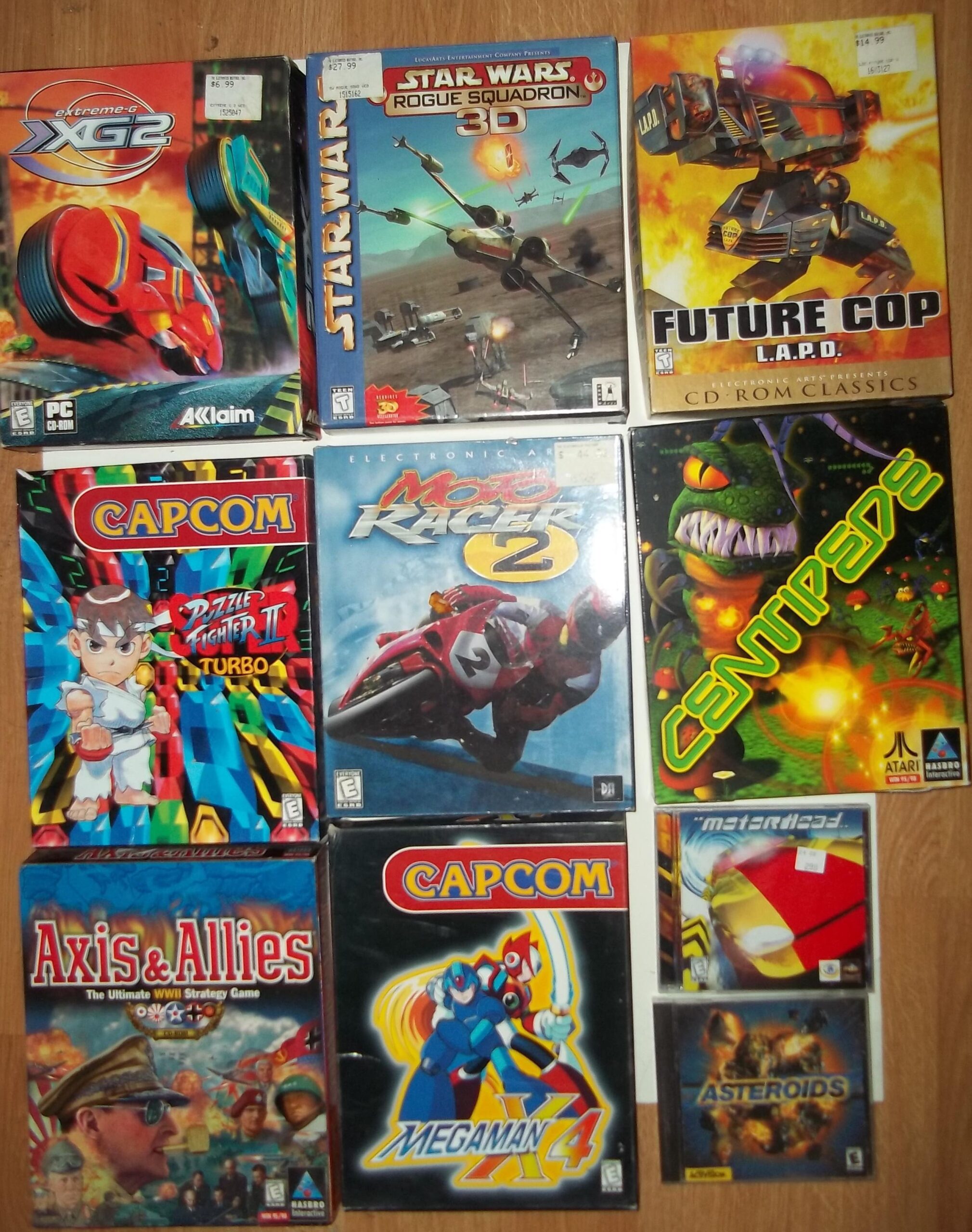
These are some 1998 PC games that are ports of console or board games. Most were also released on consoles in ’98, though Mega Man X4 and Super Puzzle Fighter II Turbo are ports of games from previous years. Axis & Allies is a 1998 conversion of a classic board game.
What Happened After 1998?
First, as I said earlier, the 2d game would rapidly decline after 1998. Between the mid ’90s and mid ’00s, developer after developer, genre after genre, abandoned 2d for 2.5d — that is, polygonal graphics with two-dimensional gameplay — or fully polygonal 3d engines, until almost nothing was left in 2d by the early ’00s other than handheld games and some indie titles or low budget PC wargames and RPGs. Adventure games, RPGs, building sims, real-time strategy, turn-based strategy, everything went polygonal. This transition made sense, as polygons are much easier to animate and cheaper to develop, and with high enough fidelity models can look pretty good, but for a while it led to games that I have always thought looked worse than their 2d predecessors. For instance, compare Warcraft III to Starcraft or Warcraft II; Age of Empires III or Age of Mythology to Age of Empires II; Neverwinter Nights to Icewind Dale II; The King of Fighters XIV or newer to any before that; SimCity 3000 to SimCity 4; or many other examples. Polygons and sprites both should have their place in gaming. In 1998 that was still the case, for a moment.
Despite the beginnings of decline, for the next two years after ’98, things were still pretty good for American PC game releases. There were signs of trouble, but despite that a lot of amazing PC games released in ’99 and ’00. After that, however, the number per year dropped off significantly, as the market cooled and increasing numbers of developers moved over to focusing on console games each year. ’98 is the consensus greatest year, but ’99 and ’00 were also pretty great. Personally I would probably put them below ’96 and ’97, and maybe also ’95, but that whole period was the peak of the American PC game business. All of those years saw incredible games release. After that the decline was rapid, but even past that the ’00s still had the occasional great game releasing, particularly if you liked FPSes or MMOs. Homebrew indie PC game development also picked up in the mid ’00s as more and more people got online and online payment became more possible, and provided a welcome relief from the usual AAA fare of the day.
On the arcade side, the decline was more rapid; after ’00 American arcades crashed hard. In other regions arcades lasted longer, of course, and there are still arcades in Japan in a way that there aren’t in the US, but even in Japan the decline of arcade-first games was very rapid after 1998. By 2002, you already saw many fewer significant arcade games from both the US and Japan. Arcades in Japan would survive by refocusing onto things like crane games and photo cabinets, alongside a few actual games here and there such as dancing games. That kind of arcade is very different from one full of regular electronic games as older arcades were.
I would like to go back a bit and describe some of those signs of trouble in the North American games industry in 1999, though. First, Sierra, one of the largest and most important PC studios of the ’80s and ’90s, collapsed, and most staff were fired in February ’99. Sierra had been in decline for several years, due to external and internal reasons, but for their staff the end came that February. At the corporate level, a major cause of this was their new owner (as of 1996), CUC/Cendant. First, divisions in the merged company led to both Davidson and Sierra’s founders leaving. When comparing the two studios, though, Blizzard was lean, together, with it, making games people wanted to buy, and organized, while Sierra was large, disorganized, and struggling to come up with software the market still wanted. Then, worse, it was revealed that Cendant was involved with a major financial scam, and invented hundreds of millions of dollars of “revenues”. This scandal broke in mid ’98, significantly damaging the company and eventually leading to several people serving over a decade in prison. As a side effect of the financial scam being revealed, Cendant sold off its gaming division in November ’98 to French company Havas (Vivendi) for a billion dollars, half that what it had paid for the two companies just a few years earlier. Havas took the axe to Sierra just months later, while Blizzard was unaffected as they continued to work on their still years-away Warcraft projects. Why? Blizzard was more profitable and organized, Sierra wasn’t. In 2000, Sierra and fellow adventure game company Lucasarts both released their last adventure games ever. After that both abandoned that genre. PC adventure games mostly stopped being made in the US after that, moving over to Europe as I said previously. Sources: For more on the tragic collapse of Sierra, see https://www.vice.com/en/article/inside-story-sierra-online-death-cuc-cendant-fraud/ and https://www.filfre.net/2025/04/the-end-of-sierra-as-we-knew-it-part-2-the-scandal/.
Second, later in ’99, Williams Electronics left the arcade business by shutting down their pinball division. Chicago-based Williams had been the number one name in pinball for decades, so this was a significant move showing the rapid decline of the American arcade business. Williams would switch over to a focus entirely on casino gambling machines, a business where their successor company is still successful. In June 2001, Midway Games, the largest American arcade game publisher and a company closely tied to Williams for a long time, followed Williams out of the arcade business. After that, all that was left for American arcade companies were some smaller ones such as Stern for pinball and Raw Thrills for arcade games, a company set up in the early ’00s by former Midway staff. Midway would last another decade, but eventually it would go bankrupt in 2010, the company declining from being a top five third party to bankrupt over that time due to being unable to manage the transition from arcade-focused studio to home console studio well enough. Midway’s remains would be bought by Warner Bros., and its only surviving studio is the one that makes the Mortal Kombat games, now home console exclusives.
And third, in 2001, Microsoft, the company that makes the operating systems PCs run on and a significant publisher of PC games between 1995 and 2000, released their first videogame console, the Xbox, and shifted over their primary development focus over to console games. You might think that they would have released everything also on PC, but for a long time they did not. Instead they only focused strongly on Xbox, with PC as an afterthought for a long time. And they pushed other developers to follow them and release their games on Xbox, and other consoles, as well. American developers responded both to Microsoft and to the market forces pushing consoles over PCs, that despite the PC’s huge install base console games sold better than PC games did due to everyone who bought a console being a gamer, and American games became much more console-focused. The genre that remaining PC developers focused on were primarily massively-multiplayer online RPGs. MMOs remained a key genre for developers, the genre was almost entirely focused on the PC, and many American studios worked on them. The genre would fade as all do, but it remains a significant genre today.
First-person shooters of course were also hugely popular, but unlike MMOs they would not stay PC-dominant. Some shooters released on both PC and console and others consoles only, with only a few staying focused on the PC, such as simmish ARMA. Over the course of the ’00s, the change in platform led to changes in game design as well. Compare the first Tom Clancy’s Rainbow Six to Rainbow Six: Vegas for a good example of this; the first was PC-first with the console ports as an afterthought, the other the other way around, and it showed both times. FPSes went towards more streamlined, linear designs with a lot of cinematic moments, less exploration, fewer key or switch hunts, and only letting the player hold a very limited numbers of weapons at a time. Level design-wise this was perhaps happening anyway — Half-Life, the FPS genre’s biggest hit of ’98 by far, shows a move towards this direction, as opposed to the huge, exploration-based levels of many earlier shooters — but the change accelerated on consoles. The change in weapons was caused by the success of 2001’s Xbox hit Halo and its two weapons at a time limit. I have never liked that system myself, but it was the way the genre went.
PC games collapsed at retail in the ’00s as well, in multiple ways. First, boxes dramatically shrank in size, and then second, they disappeared alltogether. As my photos should show, PC game boxes in the ’90s were huge, and often are amazing looking. ’80s and ’90s PC game boxes are some of the best game boxes that exist! There was something of a PC game box war, as games tried to get attention with larger and larger boxes or weird shapes, such as the trapezoid boxes of Eidos games for example. Right after the turn of the millenium, Wal-Mart had had enough, and decided that they would only sell PC games in a new smaller box size about the size of a thick DVD case. The industry rapidly switched over to these boxes, and within just a few years the huge boxes of 2000 had devolved to much less interesting looking little boxes by 2002 or 2003, or just DVD cases or thick DVD cases in many instances. I find it much less interesting to collect these smaller boxes, their smaller size makes them much less memorable to look at. Following this, over the course of the ’00s and early ’10s, PC gaming would move almost entire digital. PC gaming is now almost entirely digital distribution only, for both good and ill. At least there is competition between storefronts so the PC does not have as bad problems with this as consoles and their walled gardens do, but even so there are downsides to the PC no longer having a retail presence. Physical products are nice and allow for much more ownership of games than digital does.
Consoles did not go through a similar retail collapse when PCs did and maintained similar box sizes, but in the 2020s console retail finally started to collapse and be replaced iwth digital as well. This results in a worse situation for consumers than it does on the PC, however, due to consoles having no alternative to the one allowed shop with its higher fees for publishers than PC shops have. Right now there is a lot of controversy over Sony’s plan to stop making discs, and I of course would strongly prefer physical products to continue to exist, but given that digital is better for companies’ bottom lines as there is much less overhead and people can’t sell the product later so there is no resale market, I understand why they are all-in on killing physical games. They may or may not succeed, we will see.
Meanwhile, in Japan, Sega left the console market in 2002 thanks to the failure of every platform they had released since their hit system the Genesis and their own poor financial management. Sony and Nintendo continued on, with Sony in a dominant position due to convincing many developers to move over to its platform in the mid ’90s away from Nintendo, either because of lower development and game production charges, because studios wanted the larger space of a CD while Nintendo went with smaller cartridges, or because of Sony paying certain developers to not release Sega versions of some games. Sega was a smaller company than its competitors, though, and was never good at making a profit, so the end result was probably sadly inevitable all along regardless of the details along the way. Sega leaving home consoles was another change that happened early during the early modern era.
As for Sony, the console leader, they did one important thing for the industry. As mentioned previously, Sony won the home console race particularly thanks to their success at finally figuring out how to succeed in the previously smallish European console market. The Sony PlayStation probably sold more than all consoles had in that region in the previous few generations all combined. Europe would remain Sony-dominant to this day on the console front. As far as game development goes Europe finally entering the console market in a big way would have a delayed impact, as European studios continued being more focused on PC games than console ones through the ’00s and to some extent still are today, but it is a very important event.
As for Nintendo, they would go up and down over the years, down in the early ’00s, then up significantly, then down, then up again. Currently, they are doing quite well. Nintendo and Sony are both profitable companies today, somewhat at the expense of Microsoft’s fading console hopes, but Sony is doing that while making more of their games also on PC and in a few cases even Xbox in order to boost revenues, while Nintendo is sticking to true exclusivity to only their own consoles. For the two main console makers the main problem with the console business today isn’t revenues, it is that the install base size has stalled and is not increasing, while development costs go up every year and development time continues to increase. As a result of this developers keep trying to figure out new ways to extract more and more money out of gamers. For third place Microsoft the issue is revenues, as the Xbox business has never been profitable. Microsoft subsidiaries Activision and Minecraft are profitable, but not really the actual console business.
The Industry Today: Is There a Modern 1982 or 1998? Or, Best Year Ever Lists
The higher sales of console games allowed the industry to succeed with a console focus for the ’00s and ’10s, but as mentioned, now, in the 2020s, we are seeing costs get too high for console game development as well. On consoles I would say that it is this current decade where the late ’90s to late ’00s PC game crisis is now hitting all of gaming: costs are too high. Development times are too long. The size of the console market is no longer expanding, it is static. With a static userbase and ever-increasing costs, the problems for publishers are escalating, and probably will eventually become impossible. I don’t know what the end result of this will be, but I think most will agree that it is happening. Here is an example of a recent article about the gaming industry’s troubles: https://www.wired.com/story/2024-was-the-year-the-bottom-fell-out-of-the-games-industry/
Is there a modern peak year, the analog of 1998 or for the pre-crash era probably 1982, a year where we see the conclusion of a process of refinement lead to a year loaded with all-time-great hits that show both why their era was so amazing and what knowledgeable developers could do with that technology? I don’t really think that there is. Games take so long to develop now that I’m not sure that one single year could possibly hold so many key titles as it used to. Regardless of that, though, the cost inflection point either has already been passed again, or will be soon. We cannot simultaneously have a situation where hardware sales are flat and costs are increasing, that is not tenable. And yet, that is the industry today. Who knows, maybe Playstation/Nintendo/PC will be enough to keep the AAA(A) industry going, even if Xbox declines. We will see.
However, as time passes, as I have said I do think it gets harder and harder for any one year to compete with the best years of the past simply because of how long game development takes now. It seems likely that we are now in a period of decline and that the peak has already been passed, in terms of business. Making things worse for modern years, successful games often stay in development indefinitely with new content additions being released for the same base game for year after year. Between these two factors, finding a single year with a library matching those of the years in the ’90s is not likely. Huge numbers of games release every year, but the most significant ones don’t all release in the same year. They take too long to make. Many articles describe the problems of the industry today, covering signs of decline. For example see the article I linked earlier describing how the industry as a whole shrank in ’24 for the first time in a very long time and how over 10,000 game developers have been fired in each of the last few years. On top of that studios are shut down even more often than ever now, and exploitative monetization practices are only increasing ever more year on year, and more. Things are not healthy in video game land. However, electronic gaming is a massive industry now. Even if it is declining, it is still absolutely huge and many developers are working on making games. Many good games release every year.
But, which 21st century years are the most acclaimed? When it comes to lists of the best years in gaming history, 1998 of course always finishes near the top of the list. All other ’90s years also make fairly regular appearances. The years this century that I consistently see high on the lists are 2001, 2004, 2007, 2011, 2013, 2015, 2017, and 2023. Of them 2004 finished in first place on multiple lists. I cannot agree with this at all; it’s an alright year, mostly thanks to the Guild Wars betas (PC) for me, but Nintendo had a somewhat forgettable year and the PC was weak. Yeah, sure, Half-Life 2 (PC/Xbox), Grand Theft Auto: San Andreas (Xbox/PS2), and World of Warcraft (PC) released that year, among others, but… eh. Oh, and apparently 2003, followed by 2004, are the years with the most high-scoring review averages on Metacritic. Of the mentioned years ’04, ’07, and ’17 consistently score the highest, I would say. All three make sense when you look at their release lists, and given that I did get back in to modern gaming in 2017 after more than a decade away from it that one rings at least somewhat true for me as a good year, even if my Game of the Year, Starcraft Remastered (PC), probably didn’t show up on many GOTY lists due to it being a PC-only classic remake.

But, a lot of gamers today don’t move from game to game as often as people used to. Instead, people play a handful of games that don’t really have endings, at least not in the probably-online modes that they are playing them in, indefinitely. Rocket League (PC/console, 2015), for example, may have released over a decade ago, but is still a popular game with regular updates and many players. I must admit, since getting back into modern games in ’17 this has been me as well. I have not spent a lot of time extensively playing single player games like I did before. Instead, I play the multiplayer-focused games which are currently in my rotation, alongside handheld puzzle games. These games include, in no particular order, Splatoon (Wii U), Super Mario Maker 2 (Switch), Mario Kart World (Switch 2), Dead or Alive 6 (Xbox One/Series), Diablo IV (Xbox Series), GeoGuessr (PC), and Starcraft Remastered (PC). Playing online knockout tour in Mario Kart World has been my particular obsession for more than a year now. The year a game released in always matters, though it probably matters less if it is a constantly-updated game. Games like that, titles like Fortnite, Minecraft, GeoGuessr or Rocket League to name a few, are in ongoing development, not only games that released years ago. Of course standalone games are still made, a great many of them in fact, but a lot of the most popular games are as much an ongoing platform as they are a standalone game… unless, like Call of Duty or Madden, it is a series which technically is made up of different games, it’s just that one releases every year and fans are expected to buy the new title each year and switch over to it.
So, even if 2023 is the best year for gaming so far this decade according to lists, how much focus do its games get today when compared to the endless games most people are spending more of their time with? Of course there have always been games that are played for years — Starcraft released in ’98 after all and still is played professionally today — but the percentage of gamers playing games forever now is much higher.
Additionally, one last thought: the number of modern games that don’t exist anymore is high, and gets higher every year. This is a particular issue with mobile games, a field of transient games that are usually online-only and get shut down all the time after fairly short periods of time. PC and console games also are sometimes online-only and sometimes do get shut down without any offline patch releasing to allow people to keep playing the game. Sony’s Concord (PC/PS5, 2024) is a recent example of this; after a poor start it infamously got shut down very soon after launch. Even if someone loves a recently released game today and would like to go back to it in a decade, will they be able to, or will it be shut down and permanently unplayable? There is a disturbingly high chance of the answer being no. Even Nintendo shuts games down permanently; two of their four mobile smartphone games are now gone forever, with Mario Kart Tour (iOS/Android) being the most recent casualty. It is much, much harder to convince people in the future about the greatness of games that it is impossible for them to ever play, than ones they can at least try for themselves and decide on their opinions on.
Overall, though, the answers for the best gaming years of the 21st century so far seem to be 2004, 2007, and 2017, in some order. It is October 2026 now and nothing from the past almost a decade now matches up to those three years, though 2023 gets closest thanks to releases like Baldur’s Gate III (PC/PS5/XSX/etc).
Links to some best year ever lists: PC Gamer – Top 5 (2018); Nintendo Life – Top 4 / Poll (2023); IGN – Top 7 (2012); Games Radar – Top 10 (2006), Top 7 (2013); GameSpot – Top 5 (2014); GameFAQs user vote contest (2016); and some more recent ones from random other sites of unknown quality: Den of Geek (2024); GameRant (2024); The Gamer (2024); Goonhammer (2023; tabletop gaming also, not only electronic). To spoil the results, 1998 is in the top two or so in all of these lists, excepting ones which are in chronological order. I was not selecting only lists where 1998 finished well, it is just too well known for its greatness to not make it to near the top of such lists.
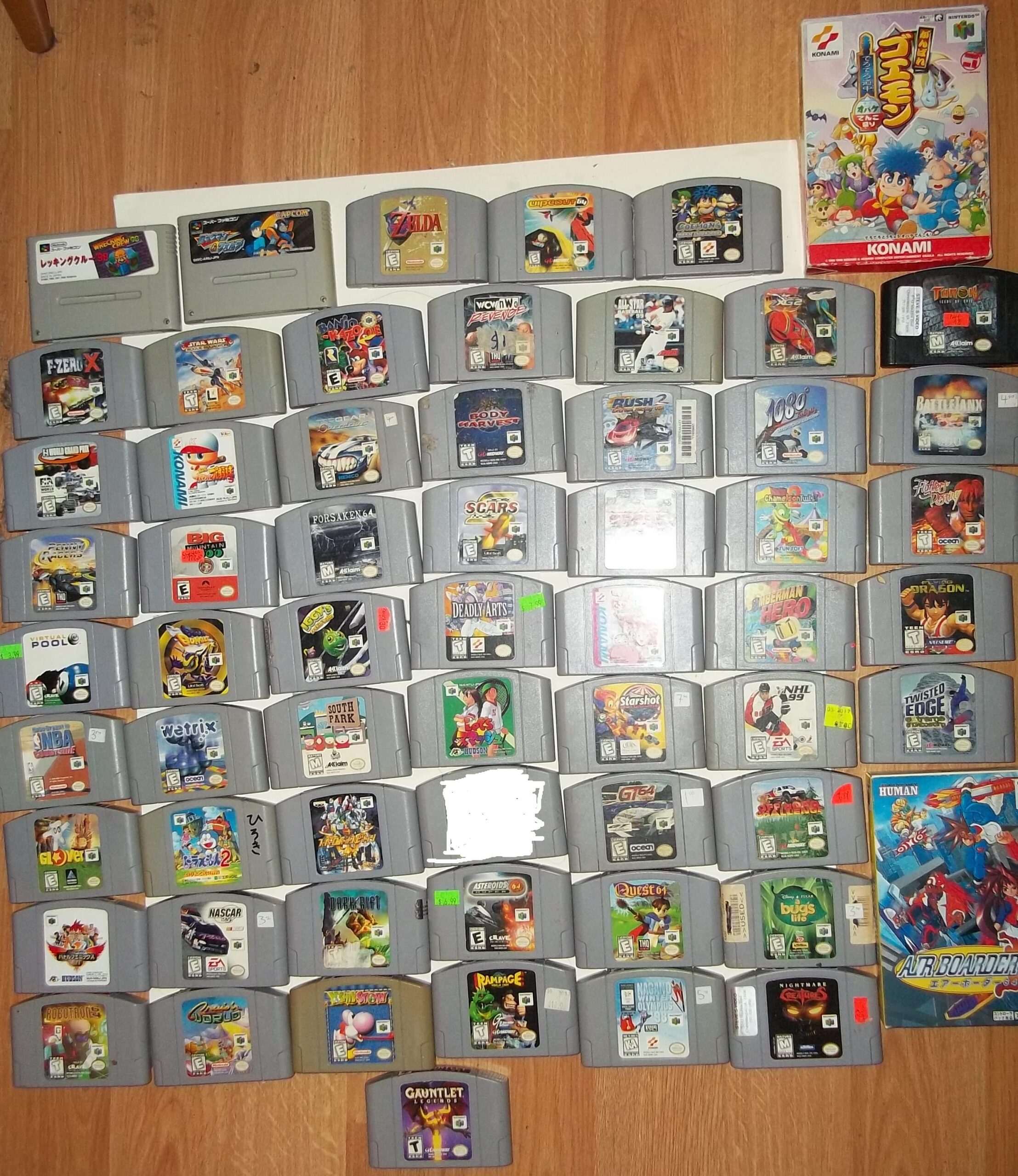
Nintendo 64 and Super Famicom games that I have from 1998 (minus one that is from 1997 and I erased afterwards, heh). Some of these released in arcades or in Japan in 1997 but ’98 here, such as Yoshi’s Story and the other games on the bottom full row. Gauntlet Legends for N64 is a 1999 release, here to represent the fantastic 1998 arcade game. Sadly I do not own any arcade boards. I do have boxes for some of these games, though not most of them. (“Oh, I’ll use a white background. Nice and easy. Oh but I don’t want to stick to actually the number that fit so oh well I’ll just go over the edges and make the whole effort pointless and … post it anyway?” I think I am justified when I say I am bad at photos and video.)
How Will 1998’s Memory Last?
Or, PC Gamer’s 2025 Best Games Ever List
The lists of the previous category may make it appear like 1998 is unquestioned in its place at the top and always will be, but that is not the case. Memory is a tricky thing; what things are remembered, and which are not, is hard to predict. Some things are rapidly forgotten. Some last while the people involved are alive, but fade afterwards. And some, particularly ones important to a nation or religious group’s story about itself, endure in memory for centuries or millennia. Many younger gamers today weren’t born yet in 1998, and naturally people have the most nostalgia for things they remember. As a result of this, nostalgia for the games of the ’00s to early ’10s is high right now among younger adult gamers. Sure, I didn’t think much of a lot of that era — recall that I mostly quit modern gaming for retro games from 2005 to 2016 — but lots of gamers younger than me disagree, as lists like those best year ever lists show. If 1998 is relying on nostalgia for its place at the top of the list of gaming’s best years, its days there are numbered. Right now, admittedly, 1998 is remembered the strongest by those of us old enough to have been playing games then. Fortunately though, its place does not entirely rely on nostalgia, but on key advancements in game design and on being the peak of a very important era in gaming. So, even if younger gamers do not fully realize the full scope of all the reasons why 1998 was so important, they surely know at least a few of its games. The Legend of Zelda: The Ocarina of Time is surely 1998’s peak shining light in terms of enduring popularity, probably followed by still-popular RTS Starcraft, which is still one of South Korea’s top games. However, most people only focus on the one thing from 1998 that interests them, and not the full picture of the year. In these articles I am trying to provide more context for why it was such an important year, why it rightfully deserves its place as gaming’s greatest year, and, hopefully, why it will keep its place in the future.
Here is an example of the lack of attention to the importance of 1998’s games that you see from even the gaming media these days. I started gaming in the early ’90s on the PC, but that PC gaming industry is mostly gone now, and has been for a long time. The ’00s collapse was nearly total. Despite that, PC-focused gamers are still around, and some mostly play newer games. PC Gamer’s current editors are clearly such people, largely uninterested in older games, no matter their importance and enduring quality.
For example, to focus on the thing that has been lost that is closest to me from my younger years, PC gaming as it was before the early ’00s collapse, look at this, PC Gamer’s latest, 2025 list of their current staff’s 100 favorite PC games: https://www.pcgamer.com/games/the-top-100-pc-games-2025/ I will post the full list of all the games by the year they were created in the second article; it just doesn’t fit well in this one. I recommend skimming through their article regardless, it’s interesting to look at. Only one game on the list is from before 1998, 1993’s Doom. PC Gamer US did choose Doom (PC, 1993) as the best game ever in their very first list back in 1994. PCG did not have Best Games Ever lists in ’95 or ’96, but in their next list, in May 1997, chose Star Wars: TIE Fighter (PC, 1994) as number one, with Doom in second. I’d have put it second behind Civilization II, but it is a fantastic choice indeed. It is also an interesting choice, being a several year old game; these lists always have recency bias, but in ’97 they picked a three year old game for first. I repurchased the PCG US issues with their ’97, ’98, and ’99 Best Games Ever lists, since sadly I lost most of my original PCG issues in a move back in the mid 2000s and in 2025 when writing the first version of this article could not find scans of those three articles online. I went into more detail about those three articles in a separate article on this site that I posted some months back. But anyway, looking at PC Gamer’s 2025 list of the 100 best PC games ever, they went for a heavily modern game-focused list. Somehow TIE Fighter doesn’t make this list at all, and almost no older PC games do. Only one flight game is on their latest list, Microsoft Flight Simulator 2020. 1994, 1995, 1996, and 1997 somehow all have zero games on this list each despite being the peak of PC gaming’s golden era.
PC Gamer US’s Number 1 titles from the October 1998 and November 1999 Best Games Ever lists, Star Wars: Jedi Knight – Dark Forces II and Half-Life respectively, don’t make the 2025 list either, somehow, though both should have. (As an aside, I remembered correctly what the #1 titles in the ’97 and ’99 issues were, but forgot that JKII won in ’98. Seeing that in the issue was a nice surprise! What an exceptional game.) Instead, the next newest game on the 2025 list after Doom is 1998’s Thief: The Dark Project. It’s an interesting and understandable inclusion, as the game is the origin of the stealth genre as a serious enterprise. Multiple newer stealth games make the list and Thief is where realistic stealth games started. None of 1998’s other top hits make the list though, shamefully. This is a significant mistake. From 1999 appear three games, Planescape: Torment, Alpha Centauri, and listed as its 2025 remaster System Shock 2. I entirely agree with all three of these, they are all-time greats. 2000 gets three games also: Deus Ex, Diablo II (Remastered), and Baldur’s Gate II (Remastered). All have modern updates, but the originals are pretty similar. Again all three of these are richly deserved. I don’t like this list much, but I do agree that including Diablo II is the right representative of its genre. I like and play Diablo IV, but II is better. And with 2000 you reach the end of the time of the PC being high on the mountain; it had started falling down the cliff at increasing speed after that, with only MMOs and European studios surviving.
And you see this decline reflected on the list. Somehow they still have games listed for almost every year after ’00, unlike the better years of the ’90s, probably exclusively because of recency bias, but you can see the decline of PC gaming in the ’00s on that list. The list goes from 3 games a year in both ’99 and ’00 to just one or zero every year from ’01 to ’10, other than ’04, when three games make the list (one of those a console port), and ’06, when it’s two freeware titles/mods representing the year. After that things slowly start getting back to a better state thanks to the growth and development of Steam, as much as anything, along with slowly increasing levels of developer interest as console audience sizes stall out, and the number of titles increases.
There are several notable things about PCG’s article. First, again, it is very heavily modern game-centric, far beyond any sense in my opinion. I strongly disagree with the overall ‘the last ten years are where most of the best PC games released’ take of those who made that list. I also strongly disagree with the genre variety, which is very heavy on console games and RPGs and very light on the other genres traditionally strong on the PC — simulators, turn-based, realtime, or wargame strategy games, first person shooters, graphic adventure games, and such. A PC gaming top 100 list which contains a game originally released only on console, Final Fantasy X, but not even one single real-time strategy game or even MOBA is kind of a joke of a list, I’m sorry. Yes, other kinds of strategy games are on the list, but still, it’s inexcusable. Genres like those mostly appear on the list very sparsely, and wargames are entirely excluded. Most of the classic hits in those genres are left off entirely. I think that proves this point: things change. Tastes change. The memory of 1998 will last, but it will fade over time to being ‘that year of the peak games of its time, a style of game the average gamer today is mostly not interested in revisiting’.
It’s sad to say this but, don’t we already see this happening with things like that PC Gamer list? Yes, some games of 1998 have dedicated fanbases, and not entirely of people old enough to remember the original releases; plenty of people playing Falcon 4.38 BMS or Starcraft Remastered, to name a few still with active fan communities, weren’t born yet in 1998. But a dedicated small fanbase is a different from general market recognition. You see this perhaps the most strongly in the wargame genre. Wargames are military strategy simulations, and are usually turn-based. They vary in complexity from approachable to very complicated, and were a major genre on PCs through the ’80s and ’90s. The genre faded in importance around the turn of the century, but unlike flight or racing simulators, because they can be easily made with simple graphics, wargames did not retreat to just a couple of titles. The wargame genre has been active all along, releasing new games every year. If you look up a modern ‘best wargames’ list, most of the games are modern titles that nobody outside of that niche have heard of. The top wargames of the ’90s, from entry-level basic ones like Panzer General (PC/etc, 1994) to the top serious wargame of the decade, probably 1998’s Norm Koger’s The Operational Art of War, Volume I (PC), probably don’t make the list, despite being probably better known in general than the newer games released after that genre declined in popularity. Wargames get so much less attention than they used to, so even when a game is great at what it does most people never even hear of them. The same thing happened to the wargaming board game genre, which similarly has declined somewhat in popularity from its Tastes change over time. This was reflected in the pages of PC Gamer US, which had a wargaming-specific column that ran for at least a decade from the mid ’90s into the mid or later ’00s, The Desktop General. They did not have columns for every genre! That showed wargaming’s importance. And now the same publication today can’t be bothered to put even one game in that genre on their top 100? And no, I don’t think FTL, Dwarf Fortress, Crusader Kings 3, or Total War Warhammer 3, all modern games which make the list, count. Those are complex strategy or simulation games, yes, but not wargames. Of those Total War’s battles are the closest to a wargame, but are on the simple end of the genre. How the mighty have fallen.
So, while the PC is on the upswing today as consoles stall out, it is a new PC that is resurgent. The old top genres are mostly still as niche as they have been for most of the past 25 years. Instead, the new PC is a mixture of some classically PC games with a lot of console-first titles. Most people probably do mostly play newer games, as you see reflected in that list, and a lot of people playing on PCs now are indeed playing games designed for consoles first but also released on PC to help sell more copies. That is probably a reasonable list for what a lot of mainstream PC gamers are playing today. It is much more RPG-heavy than some peoples’ lists would be, but is a reasonable picture of peoples’ interests. It is, however, a bad list for representing the best PC games ever overall.
So, the resurgence of the PC won’t, I think, help bring the memory of 1998’s PC games back, any more than the resurgence of specialty arcades like Dave & Buster’s or Round 1 haven’t really helped make big budget, top of the graphics heap arcade games a thing again either. The platforms still exist but in a new form for the new world. The new world of the PC is a mixture of the old PC and a console. The world of gaming is less separated and more merged together. We are no longer in a world where PC gamers play traditionally PC games and console gamers play traditionally console games, not all platforms have all kinds of games. Even popular mobile games often have PC versions. That doesn’t make their content any different. Today’s PC is a much broader platform than it was in the ’90s. It is a platform for people who want to play all kinds of games other than first party Nintendo content.
There are always new lists of the best games ever, you can find innumerable lists across the internet. I am focusing on this list because I think it is somewhat representative of gaming today. Another noteworthy list released in late 2025, this time an IGN and Nintendo Life collaboration about their top 100 favorite games released on Nintendo platforms. The article is here: https://www.ign.com/articles/the-100-best-nintendo-games-of-all-time I could complain at length about some aspects of this list, most notably how much I dislike their top two games — and I really do, I’m sorry to the games’ many fans — but when contrasted to PC Gamer’s top 100, IGN’s appears reasonable. The Legend of Zelda: Ocarina of Time finishes sixth, a high spot. Is that high enough for me, no, but it is a reasonably high finish for a beloved classic. The top ten also includes quite a few other classic games as well: Tetris, Super Mario World, Chrono Trigger, and The Legend of Zelda: A Link to the Past are all in the top 10. I counted, 31 of their top 100 are games from the ’80s or ’90s. That is a dramatically higher percentage than PC Gamer’s, even though I would say both have equally many great classics to remember. Nintendo journalists seem to be doing a better job of remembering their platforms’ greatest past games than PC journalists are.
Nintendo gamers remember past titles better than anyone else as well, as anyone who watches the older game resale market knows — there’s usually a sizable price increase for a Nintendo format version of a game than one for another format. Whether this is good or bad depends on your opinion, but it is certainly true. Nintendo’s top hits need less remembering since they are less forgotten. Older PC games, in contrast, are clearly forgotten too much these days. Their prices are much lower on the resale market, and the number of people talking about them is quite small compared to the crowds discussing Nintendo. I love both, but hope at some point that changes on the PC side.
And as for Sony, the stereotype of Sony fans are people who mostly want to play modern games and spend less time interested in older games. You saw this for example when, during the mini-consoles craze of a few years ago, the PlayStation Mini was a disastrous failure, while Nintendo’s NES and SNES Mini consoles sold well. Still, when IGN made what is their most recent Top 100 Playstation Games list, in December 2024, they included 19 games from the ’90s on the list, a pretty solid number considering that Sony has about eleven fewer years of console hardware to cover than Nintendo. They were clearly trying to represent older titles on their list; I am sure many PlayStation fans today would include fewer older games than that. IGN did a better job than PC Gamer in representing older titles, for sure. https://www.ign.com/articles/the-100-best-playstation-games-of-all-time
Some books and movies I have from 1998. These are all things from ’98 except that the two episodes of Voyager on the pictured tape are from earlier in season 4, from fall ’97. As all other Voyager tapes I have are from the first couple of seasons, this one will have to do.
Was 1998 Special for Any Other Forms of Media?
In short, no, not really. Maybe anime but that’s it; certainly not books, movies, or music. Events happened in 1998, both good and bad, but most of the factors making 1998 so special in computer and video games are things specific only to electronic gaming. You can make a list of the best years for any form of popular media — music, movies, books, board games, toys, what have you. Books have been around for a long time, so it makes sense that choosing any one best year would be impossibly difficult. There are many lists of the best books, but not, as far as I can find, lists ranking years. Regardless, there were great books in ’98 but it wasn’t a particularly special year for books. The eighth book in the Wheel of Time series released that year; it is a good book in my favorite book series of the time, but it’s probably not the best one of them. Also that year the second Harry Potter book released, though I have never read any of those books, alongside the second A Song of Ice and Fire book, Stardust from Neil Gaiman, the Redwall book Marlfox, and more. One of my favorite fantasy series, David Eddings’ Beldariad/Malloreon, ended this year as well with the background history text The Rivan Codex. There were, as always, plenty of books in every genre; I am just focusing on fantasy and sci-fi here as I mostly read those and history books. In history I haven’t read it but Tom Brokaw’s The Greatest Generation is noteworthy for popularizing that term for the generation who won World War II.
Music and movies do have more in common with games, though, as each has changes over time to mention as technology improved. And yet, 1998 was not a major standout year for either one. Neither match games in the extremeness of the difference between technology over time — you can watch any movie the same, while games often require specialized hardware to run correctly — but they have changed. Movies added sound, color, and computer rendering. Music added new instruments such as the electric guitar and synthesizer. And such. But 1998, in particular, isn’t special in those other forms of media. It was just a year, one remembered fondly by people at the perfect teenage age to remember the year well but not something that has stuck in the public conciousness long term in most mediums. Things released in 1998. The biggest movie of the year was Saving Private Ryan. I’m sure it’s good but I’ve never seen it; I’ve never been all that interested in fictional stories about the modern day, I prefer real history. Another fictionalized version of real history is seen in Elizabeth, about the first British Queen Elizabeth. Disney released Mulan and A Bug’s Life that year. The Big Lebowski is an enduring pop-culture hit. Armageddon and Deep Impact also were quite successful simple action movies. I am sure that some music I’ve heard of released in 1998, though I couldn’t name any of it; I don’t follow music. I do love a lot of the game soundtracks of 1998, though, especially Starcraft (PC), The Legend of Zelda: Ocarina of Time (N64), and Extreme-G 2 (PC version).
But anyway, returning to popular music and film, I looked at several lists of the best years ever in music and movies, and 1998 wasn’t on any of them. This doesn’t surprise me, because again, while nostalgia helps anything, 1998 isn’t remembered as gaming’s best year just because of nostalgia. It is remembered that way because of a confluence of factors specific to gaming that make it memorable. The one medium where you see 1998 appear in best-of lists is anime. 1998 was a pretty good year in anime, with some of the fields’ all-time greats, headed by two series at the top of the list: my favorite anime ever, the brilliant examination of the modern connected internet world, Serial Experiments Lain and probably the most popular TV anime ever, Cowboy Bebop. I am not usually a horror fan but I did really like Vampire Princess Miyu, which aired in the ’97-’98 year. 1998 was also just before the explosion of visual novel-based animes that started with 1999’s To Heart, so some like it for that as well. Hayao Miyazaki’s 1997 masterpiece Princess Mononoke and the Pokemon cartoon both came to the West in 1998 as well. This is about when anime started becoming something us Westerners had heard of beyond a tiny niche. I wouldn’t get interested myself in anime until 2002, but I do remember hearing about it some in the late ’90s in a way I hadn’t before. Regardless, I am sure that some of the feelings for the animes of ’98 is nostalgia but some is also because of technology, as computers had advanced far enough to make computer-aided drawing easier. 1998 shows up on lists of the best years in anime, though it’s not always at the top of the list.
As for American TV shows, yet again, it was a year, one with good and bad shows. One of my favorite TV shows, Star Trek: Voyager, was still airing, in seasons 4 and 5, so that’s nice. Probably the most noteworthy thing in TV that year though was that Seinfeld ended in ’98. I’m not almost ever a fan of sitcoms but it is one of the most popular ones of those ever. Some popular new TV shows airing their first seasons in ’98 include Will & Grace, Sex and the City, and Charmed. In more gaming-related news, X-Play started airing on cable that year as GameSpot TV, though I wasn’t able to watch until several years later as we did not have cable at home. Also there was a Winter Olympics that January, which was held in Nagano, Japan. It was on CBS instead of NBC, rarely, so it was one of the very few Olympics of recent decades aired without that iconic John Williams NBC Olympics theme. It was a good year for TV but the best ever? Probably not.
Overall, for people who aren’t gamers, 1998 was probably just a year, one people old enough to remember it may think back on fondly given how the world seems to have devolved since then in many ways, or maybe not, for those who like things about today better such as improved rights for some minority groups. It surely depends from person to person. Only in games is it clearly exceptionally special, regardless of when one was born. The gameplay and interface design advances of 1998 are not something comparable to anything in other forms of media.
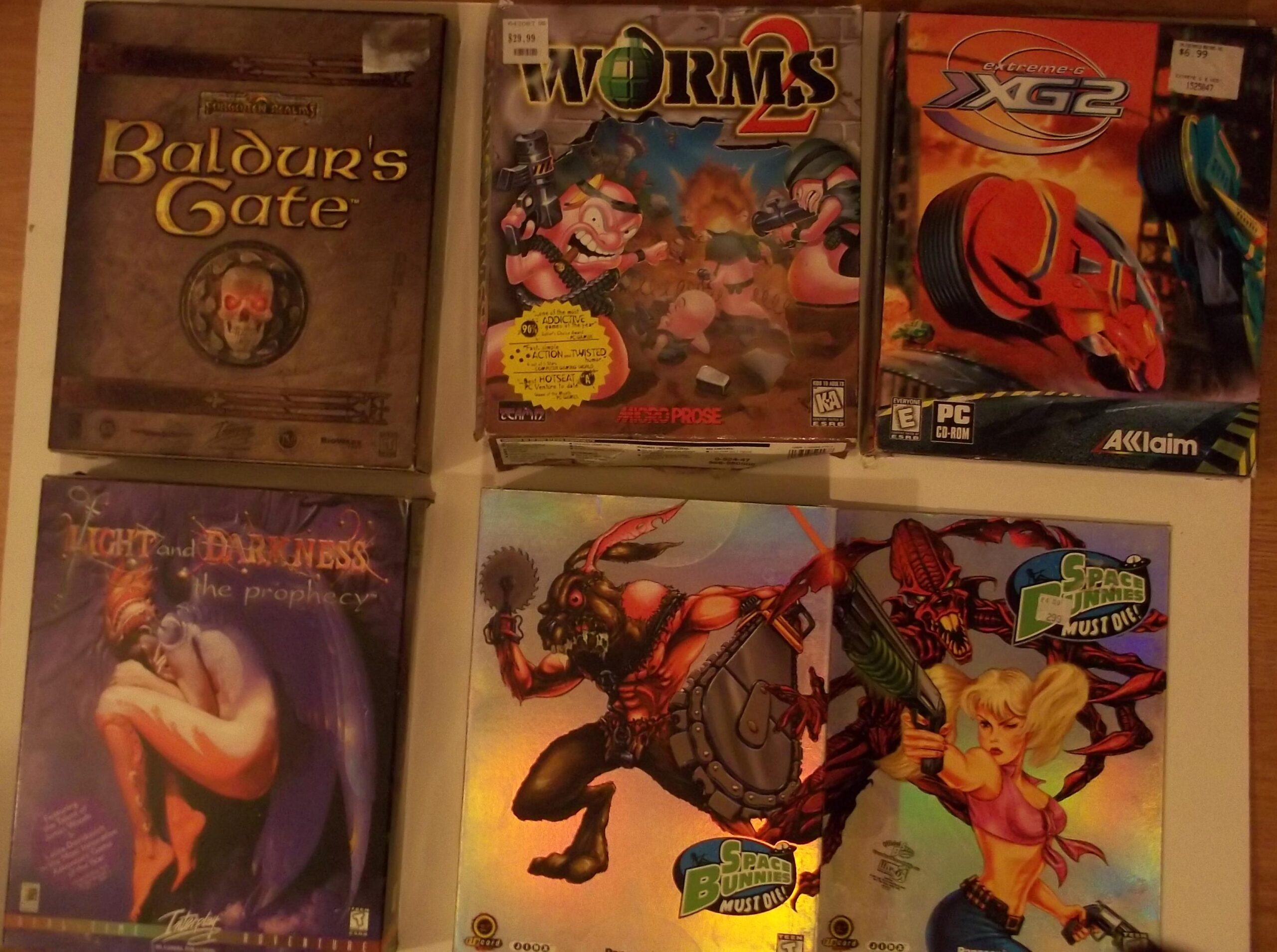
These PC games from ’98 particularly stand out to me for having fantastic boxart. Note that Space Bunnies Must Die’s art continues from the back to the front, which is why the flap is folded open backwards in the photo. I love shiny silver boxes like that, they look amazing in person! Worms 2’s transparent plastic window with an inset image behind it is also very cool, though like Space Bunnies it doesn’t entirely show on camera. As a note, the K-A rating changed to E in 1998, and most ’98 games use the new E rating. Worms 2 must be one of the later boxes to use the old rating style. Of Light and Darkness’s weird art design shines through on its cover in a picture, though, and XG2’s cover has always been a favorite of mine… but I think Baldur’s Gate is probably my overall number one for the year in the boxart award. That is a just incredible box. It does have a flap on the front with information inside, as well.
Conclusion: On why 1998 is the Greatest Year in Gaming
1998’s greatness is widely recognized. As we have seen, most lists of how great the games of each year are put 1998 in first place, or at worst second to the author’s favorite year if it isn’t 1998. However, while writing this I have realized that I think a lot of people miss exactly WHY that year reached the peak that it did. People recognize the great games from 1998 in the subset of electronic gaming that they pay attention to, but may not know about the underlying industry changes that led gaming on a new path shortly afterwards. Without understanding of that portion of the story, about how the industry changed so dramatically immediately afterwards, people miss one of the key reasons behind 1998 standing out so much. The kinds of games we saw in 1998, particularly on the PC and arcade sides, did not continue to be made for much longer, and never were again at the budget and general market attention levels that they were after sometime between 1998 and 2000, depending on platform. The world was changing and budgets were no longer large enough to fund PC-only game development or big-budget arcade games, so the kinds of games studios made changed to focus almost entirely on console games instead of splitting between all three pillars of the old system.
That coincidence is, again, the key, I think, of why 1998 is gaming’s greatest year. In the same year, console developers finally figured out 3d to a greater extent than before and some of the best console games ever released; the PC market peaked in the US and, after releasing some of the greatest games ever, began its decade-long slide into near irrelevance (before recovering somewhat after that); and arcades only had a year or two of life left in them, leading to some great titles in that field as well. There would never be another year where all three pillars of the 1970s to ’90s gaming industry would all be in as good shape as they were in ’98.
But again, I know I focus on it because I was a PC-focused gamer in the ’90s, but 1998 isn’t only great because of it being the mountaintop of PC gaming after which decline would be rapid. It is also great because at the same time, console gaming also had some of its greatest and most important games release, and arcades had one of their last great years, all at the same time. Developers finally started to understand how to make 3d game control work better, and many genres had new best ever releases. The collective knowledge of more than fifteen years of post-crash game development experience combined to make 1998 the perfect storm across all formats electronic games released on, a time when budgets allowed for anything possible with the day’s technology and developers with enough knowledge to actually start executing on that in a way they could not before. ’96, ’97, ’99, and ’00 also saw some of that peak, but all years around 1998 have more drawbacks to their release list libraries than ’98 does.
To repeat my main point here, all of these factors had to occur at the same time for 1998 to be remembered as the greatest. This coincidence, or alignment, is central to why the year is so universally beloved. If it was only the best year in classic PC gaming but just an average console year, I have no doubt that 1998 would rank much, much lower on ‘best of’ lists; a lot of people only play console games, not PC ones. The same is true if it was only a peak arcade game year. But all three things did both happen at the same time, and so gaming’s greatest year entered the history books. I hope that it can keep that spot in the future, even as those of us who were there playing games at the time get older. I think that at minimum it has achieved enough fame to remain on the list of gaming’s best years going forward. Every year has good games released in it, and advances in the medium of electronic entertainment, but no one year anymore contains as high a volume of both high quality titles and advances key to the development of electronic games. Games today take too long to develop for, and too many popular games stay in development forever as never-ending online-connected games, for such things to all come together in any one single year. Younger gamers should spend some serious time with the top games of 1998, to better understand the industry and an era of gaming at its peak.
In the next article, list wars! The second part of this 1998 retrospective will be a long list of many of the major games of 1998, broken down by genre and subgenre. I like lists. I hope some of you do as well. The list is basically done and will post soon.

This image is of my PC-FX and Sega Master System, two consoles which saw their last new game release anywhere in 1998. The PC-FX has a very charming mini PC tower look but a game library I mostly strongly dislike. The card on top of the SMS is my only Sega SG-1000 game, Ninja Princess. It doesn’t work in a SMS so it’s just there for display. Note that this is an American SMS, but they will run European cartridges, albeit at 60hz. Also, the PC-FX is on the floor because it has VERY short controller cords and a custom controller plug so controller extension cables are not an option.
Addendum: The Dead and Dying Platforms of 1998
I wasn’t sure what to do with this section, as it doesn’t quite fit in the article above but I want to include it, so I tacked it on at the end as an addendum. In 1998, the Windows 9x PC, Macintosh, Game Boy (Color), Sony PlayStation, and Nintendo 64 were ongoing platforms and doing fine. The Dreamcast, Neo Geo Pocket, and Game Boy Color released. But what about the other systems still on the market in 1998, the ones nearing their ends? It was the end of an era for both NEC and Atari, among others, as both had consoles see their last official releases this year. Computer platforms were not spared either.
Video game consoles sure do have short lives, don’t they. They are born with so much hope and promise, only for them to be old an dying somewhere around, on average, five years later. Console lifespans vary between one and about twelve years on the lower and upper ends. You barely get to know them and they are already on the way out! Fortunately, homebrew developers have brought many of these systems back to life, so they can get the fuller lifespans that they deserve. How much homebrew support a system gets varies depending on several factors, including how easy it is to release unlicensed games on the system and how large the fan community is for the platform, but it is always fantastic to see when it happens.
Consoles Which Saw Their Last Official Relase in 1998 (In Some Region)
DIED (North America) / DYING (World): Super Nintendo and Sega Genesis. First, as I said elsewhere, in the US the Super Nintendo and Sega Genesis both had their last game release in 1998. Both did have game releases in other regions after this year, though, with the SNES in Japan and the Genesis in Brazil, so they were not dead worldwide quite yet. However, they did both die in North America this year. This is well worth mentioning. The SNES would last until 2000 in Japan, and the Genesis until 2002 in Brazil, with new games.
DIED: NEC PC-FX – This much-maligned system, though, did die in 1998. NEC’s last console, which was only ever released in Japan, focused on anime FMV and visual novels, to the expense of anything else. It has near-zero 3d capabilities and lacking sprite manipulation power compared to the other consoles of its generation,– it can’t scale sprites, only do Mode 7 style effects — but can do nice video. It bombed hard, but got over 3 1/2 years of support anyway, ending in April ’98. So yeah, the PC-FX died this year, little-mourned. If you look at the release list you will see that ’98 brought the system four visual novels, a nongame compilation, an RPG, and a 2d platformer action-adventure game. That last one is probably the most interesting, Ruruli ra Rura. Its graphics are very simplistic and the combat is extremely basic, but the animated cutscenes are nice. Despite the very dated visuals I’d like to get a copy, though it’s pretty expensive.
DIED*: Atari Jaguar – The Atari Jaguar, released in late 1993, had been discontinued back in early 1996, when Atari sold itself to a hard drive manufacturer. However, some games continued to release from Telegames, a company who liked to release, via mail or online order only, finished but unpublished games for certain failed consoles, most notably the Colecovision, Jaguar, and Lynx. The Telegames Jaguar games released between ’96 and ’98. The last of those was Worms, a port of the first Worms computer game from several years earlier, releasing the same year as Worms 2 (PC), a game which dramatically improved Worms’ graphics and gameplay. Yeah, this looks quite dated in comparison. Still, it’s something. The next year, Atari would change ownership, being sold to Hasbro. Hasbro made the platform open source in 1999, setting the Jag off for its very successful life as one of the most popular homebrew platforms. The first homebrew game released that year.
DIED: Sega Master System – The Sega Master System had an odd life. First released in Japan in 1985, it was only just releasing in the market in which it would last the longest, Brazil, in 1989, the year in which its last game released in Sega’s home region of Japan. The ssystem saw its last cartridge release in the US in ’91 and in Europe in ’96, the SMS saw its last cartridge release, in aforementioned Brazil. Now, you might be thinking, but haven’t I heard that the Master System never died in Brazil and is still on the market, with new models still available from Brazilian distributor TecToy? Well, that is kind of true, TecToy does still sell Master System and Genesis (Megadrive) systems, but they stopped releasing new cartridge games in ’98 for the SMS and ’02 for the Genesis. Their 21st century models of both systems are standalone boxes with built-in games and no cartridge port. As the definition of video game console requires for it to have interchangeable games, either physically or digitally, as a real video game console the Master System died in ’98.
DIED (US) / DYING (JP) – Sega Saturn – The Saturn saw its final US releases in 1998. Sega abandoned the system in the spring, and the last third party released late that year. In Japan, Sega ended first-party support at the end of 1998 as well. In Japan the system did have a full year of support, but that would not continue into ’99. Third parties did release a small number of games in 1999 and early 2000 in Japan only, so the system wasn’t quite dead, but with no first party support or international releases the writing was on the wall.
Consoles in Limbo – The Dying or Reborn
“DEAD”: Sega Game Gear – As I said, the Game Gear was effectively dead at this point, and had no game releases. Sega had released their last games for it in ’97 and dropped it then. However, it would be resussitated for a short revival from Majesco in 2000, and one new game was released then, the GG version of Super Battletank, so perhaps I should mention it here.
ALMOST DEAD: NEC PC Engine CD (TurboGrafx-16 CD) – This aging system had died in the US back in ’94, but in Japan it was still kind of clinging to its last moments of life. There were no games released for the PCECD in ’98, but there was one last release in ’99, horror adventure game Dead of the Brain 1 & 2, so technically it wasn’t dead yet.
DYING (EU): Philips CD-i – The CD-i, a system with some similarities to the PC-FX in that it is very good at video playback but struggles at traditional videogames, but released in 1991, years before the PC-FX, so it is more impressive from a tech front than that system, had died out in the US in 1994-1995. In Europe, or rather in Philips’ home country of the Netherlands, however, the CD-i lasted several more years. The system’s last good year there was 1997, but a couple of titles released for the CD-i in 1998, one of them a full game. It would see one final release in ’99, which is also a game, when the system finally died, so in ’98 it was on its last legs in the Netherlands. Of those two last games, though, the one from ’99 also released on PC, while the game from ’98, the FMV rollercoaster shooter The Lost Ride, is a CD-i exclusive, so 1998 was the last year with an exclusive game release on CD-i.
Beginning its life as an UNDEAD: Atari Lynx – The Atari Lynx had seen its final retail releases back in 1995. That year was when its official life ended. There were a few licensed but mail or online order only titles from Telegames released in ’97 and ’99, but they would not stay long term. No, the Lynx is here because 1998 seems to be the first year that unlicensed, post-discontinuation homebrew Lynx released. In ’98, unlicensed indie publisher Songbird Productions released its first Lynx cartridge, a music toolkit called SFX. Telegames also released one unlicensed title, S.I.M.I.S.. Songbird is still the largest homebrew Atari Lynx publisher today so this is an important moment. They also publish Jaguar games but would not start doing so until a bit later than ’98.
What about homebrew on other older, discontinued or almost gone consoles? 1998 was before most consoles had much of a homebrew scene. The Atari 2600, which had been officially discontinued back in 1991, did have several homebrew releases in ’98, though. Some ROM hacks for the NES existed as well.
Dying Computers
DIED: NEC PC-98 – That’s right, NEC didn’t have one platform with its last game releases in 1998, it actually had two. The NEC PC-98 line of computers had been the most dominant computer format in Japan in the ’80s and up to the mid ’90s, but the release of Windows 95 basically ended NEC’s hold on the Japanese market. In 1997 NEC admitted defeat and switched from making its own proprietary computers to making PC clones with Windows 95. The early ones also supported a classic PC-98 mode, but Win95 was the main feature, and the few Japanese computer game developers mostly switched over to Windows eventually. However, some homebrew developers continued releasing games for the PC-98 into 1998. Checking Mobygames and Wikipedia, both list that the last year any games released for the PC-98 was 1998, so if that is accurate it was the end of the line for the format. After that Japanese PC games were on Windows 95. The most famous by far of the small handful of PC-98 games from ’98 are the fourth and fifth Touhou games, Lotus Land Story and Mystic Square. The series had started the previous year, when Zun released the first three. Both are really good-looking bullet-hell shmups. It’s easy to see why the series would become so legendary. After them the developer, Zun, would take four years off before moving the series over to Windows 9x.
The death of the PC-98 is quite significant since it was the last non-Windows/Intel gaming computer format surviving, following the deaths of the Amiga, Atari ST, FM Towns, Spectrum, IBM OS/2, and other minor ones in the years previously. With its departure, only Windows, its never-gaming-focused rival of sorts Apple Macintosh, and the alternate PC operating system Linux were left. And of those three, even today, only one is a serious gaming platform: Windows. I’m sorry for Linux fans, but anyone with Steam can see how few games have Linux versions available. Linux gamers rely heavily on Windows emulation to play most games. Fortunately Linux does have good Windows game emulation through a program called Wine.
DYING: Microsoft MS-DOS – After the release of Windows 95 in fall of 1995, MS-DOS, the previous primary gaming platform for PC games for the previous 14 years, was doomed. MS-DOS had survived during the Windows 3.1 and earlier era because Win3 and earlier have much higher overhead and limited advantages over DOS, so a game that wanted to get the most out of its hardware had to be a DOS game. Windows 3 just used up too much system resources. Windows 95 was a revolution because it finally made Windows a great gaming platform, and it eventually made running games a lot easier, too. The number of games releasing for DOS steadily decreased in each year after 1995, from almost all major titles in ’95, to most games in ’96, to a small number of titles in ’97, to very few in ’98. But after 1998, DOS largely disappeared as a platform for retail computer games. Small homebrew indie developers continued making mostly freeware DOS games here and there after that, so the platform never entirely disappeared in that sense, and collections or re-releases or expansions of or for DOS games released after 1998, but if you want retail PC games, for DOS, ’98 was almost the end of the line. In ’98, of the games I have mentioned in this article series, The Elder Scrolls: Redguard and Descent to Undermountain are actually DOS games. One more DOS game I have not mentioned is Redneck Rampage Rides Again. There are five or six other more minor DOS games from ’98 as well, some of them European-exclusive titles. There would be two final retail PC games running on DOS in ’99, one of which got a US release — WWII GI. The other is a European exclusive called Horde: The Northern Wind, an RTS from Russia. Thanks to this thread on VOGONS for doing the research: https://www.vogons.org/viewtopic.php?t=100191 though I went through the list on MobyGames myself as well and agree with that thread’s conclusions, those are the last retail DOS games. So, DOS as a retail gaming platform wasn’t quite dead yet in 1998, but it was very close, and the end would come the next year.
How does this number of dead or dying platforms compare to the previous peak year of 1982? Well, 1982 was not a big year for anyone getting out of the industry. That time, the pile of dead platforms would be in ’83 and ’84. Those years did have a lot of platforms going away, though, surely more in total than ’98 considering just how many little-selling console and computer platforms existed at that time. But there, the peak year for game releases was before this contraction, not at the same time as it. Also, of course every time a new generation starts eventually the platforms from the previous generation end support, and that is some of what you see here, but a year where not only several of the consoles of that year’s most recent generation were dying out but also most of the platforms of the generation before that and also multiple computer formats, all fading out at the same time? 1998 was, indeed, a major transition point, a time when things were changing significantly in the game industry. Change can be good or bad. The changes ongoing in 1998 were both, depending on what platform you favor or what kinds of gaming you prefer.