Atomic Runner (Genesis) Review

  • Title: Atomic Runner
  • Developer and Publisher: Data East
  • Released: 1992
  • Platform: Sega Genesis / MegaDrive

Atomic Runner, also known as Chelnov in Japan, is a very good Data East game from 1992.  This Genesis version is a remake of a four or five year older arcade game, much improved versus the arcade original.  The game plays like a run & gun game, except it’s auto-scrolling, which makes it feel unique.  There are a variety of weapons and powerups to collect, lots of enemies to kill, jumps to make, some short alternate routes, challenging bosses, and more.  The game is a memorizer for sure, and the main challenge is in learning what to do at each moment.  Enemies will appear in exactly the same places each time, though many will then fire at where you are, so the game isn’t 100% identical every time.  There aren’t many levels, but it’s really good while it lasts.

The story of the game was completely changed from the arcade original, where evidently Chelnov (that’s the name of the main character in any version) was transformed into a superhero by a nuclear explosion (and this was right after Chernobyl, obvious reference…), and had to beat the badguys or something.  That’s gone on the Genesis.  Instead, your character Chelnov becomes the Atomic Runner after an alien force attacks Earth.  Supposedly they once inhabited the earth, and now are back to reclaim it from the nasty humans.  You, of course, will have to stop them.  Anyway, your family were scientists, and the aliens attack your house early in the invasion.  Chelnov’s sister is kidnapped and father mortally wounded.  Your father’s dying words are that he knew this would happen and that he had been preparing for this by readying the Atomic Runner suit, so go and save the world, Chelnov!  … Except Chelnov almost immediately gets captured and tortured, until finally he snaps and acquires his powers.  So, you start the game by breaking out of an alien facility.  Go and defeat the aliens and save your sister!  So yeah, very generic plot.  At least there are cutscenes at the beginning and end of the game, though, so this isn’t one of those games with one-line endings or something like that, it’s a substantial ending that makes the effort beating the game requires more worthwhile.

“Go, Atomic Runner!  I will not fail.  No enemy can put a stop to justice!”  Yes, the story is entertaining. 🙂

Overall, this game is very good.  It has good graphics, great art design, and great music, and the gameplay is great as well, and the unique auto-scrolling run & gun design is great.  That makes it play somewhat differently from just about anything else.  The weapons are varied and are all pretty cool, the game is well balanced and well designed, there’s a good variety of enemies and obstacles… yes, I really liked this game.   The graphics are very nice looking and your character is really well animated — Chelnov runs extremely smoothly, you don’t see that often on the Genesis.  The enemy sprites don’t animate as much as Chelnov, but all look good, and the bosses are particularly impressive, with giant Chinese dragons, animated statues, and more.  The style, which is a mixture of ancient cultures and futuristic high-tech areas, is interesting and gives the game a great look.  And the music… it’s great, catchy stuff.  Really good work.

The controls are interesting.  You can fire right and left and jump.  Enemies come from both directions, so get used to firing both ways.  Also, you cannot move backwards on the screen except for in boss fights — otherwise, you can only move forwards or stop where you are, until you hit the back end and start being forced forwards of course.  This means that you should never shoot enemies holding powerups who are behind you if you want to get the powerup, because you will not be able to go back and get it; wait until they’re in front.  This design is a little annoying at times, but it works well enough and does help keep the game original.  Also, when you are jumping, if you land on top of an enemy you’ll bounce off and do damage, instead of dying.  This is a key mechanic.  However, be sure that you’re jumping!  If an enemy hits you from below while you’re on the ground, you’ll die.  Your boots only provide invulnerability when you’re not touching the ground, evidently, for whatever reason.  This DEFINITELY can be frustrating, when you try to jump on an enemy under the floor but just miss and they come up under you and kill you… jumping on enemies can be a little hairy, but you’ve got to do it.  This is the only controls-related complaint I have with the game.  Jumping on enemies mostly works fine, but could have been done a little better.

However, it is important to mention that you cannot control how high you jump in this game. Every time you press jump you will jump the full height of your jump, so you can’t strategically choose to jump but not high enough to hit something above you, etc. This means you have to carefully plan when you’re going to jump, because you will always jump full height.

Also, you can fire either straight forwards or diagonally up. You fire diagonally by holding up while shooting. If you hold left or right while jumping, however, you will do a spin jump and fire in all directions while you’re in the air; this is annoying and unhelpful as often as it is helpful, but it’s important to remember. Holding up or down while firing will not do the spin, so remember to let go of forward when jumping if you want to continue to fire diagonally while you jump; if you jump while holding diagonal up, you’ll spin instead of continuing to shoot as you are. I’ve died a few too many times because of accidental spins, though other times they are helpful (It is good to have something at least that hits all directions, I just wish it wasn’t so easy to accidentally do them when you don’t want to).

As with most shmups and run & guns, you die in one hit.  There’s no shield.  When you die, you get sent back to the last checkpoint.  Fortunately the game has many checkpoints, so you don’t usually lose much progress.  Game over also just sends you back to the last checkpoint, though there are limited continues; you can set how many, from 3 to 15, in the options menu.  There are also difficulty settings and various control options.  I recommend, and use, control option C-1, where A fires left, B jumps, and C fires right.  The default controls have C switching direction and A firing, but the game is easier and works better with this Forgotten Worlds/Sidearms control style.

The designers even gave players a break.  Instead of sticking with the merciless difficulty that it could have, after you’ve died at a single checkpoint four or five times or so in a row, the first powerup you see after that checkpoint will change from whatever it is into a full-power one, so that you can try it with full weapon power.  This is incredibly helpful and makes a massive difference in reducing frustration, particularly at the harder bosses.  Otherwise, after you die once often bosses would become incredibly hard, having to pick away at them with weak weapons… instead, just die a few more times and you’ll have full power for the fight.  This game is quite challenging as it is, it’s great that the designers gave players a little break like this.

The final boss’ last two forms (it has three) were definitely tricky, and held me up for a few weeks — I got to the final boss a week or two ago, but got frustrated at dying there repeatedly (you have limited continues and no saving), and I quit for a while.  Well, I picked the game up again today, and beat it on my first try!  Okay, I used a bunch of continues, but I didn’t run out and have to start over, I beat the game first.  Pretty awesome, I thought I’d gotten a terrible start but as I went along I got better and remembered the game more and more… I really like this game, I’d never heard about it but it’s pretty cool.

There’s really only one major negative: It’s short.  Hard, but short.  There aren’t many levels, only seven or so, and once you start to learn them you can get through them fairly quickly.  The main part of the challenge is simply in learning things, so once you’ve done that it’s mostly just about trying to do it faster… it’s so much fun while it lasts, though, that I don’t mind.

Other than the short length and the aforementioned issue with jumping on enemies (that sometimes you miss and die instead of bouncing on the enemy as you were trying to), the only other possible negative really is that the graphics are a little small (very good looking, but the sprites are on the small side, not that I mind much), and that the backgrounds in a few levels are so gaudy and impressive that sometimes I can lose track of the enemies and bullets.  This is particularly true in the gold and jade Chinese-ish level.  It looks amazing, but sometimes the enemies can be hard to see… or maybe it’s just that the backgrounds are so awesome looking that they distract me. 🙂  Either way, it’s something you get used to.

Overall, though, those are minor compared to how great the good elements of this game are.  Atomic Runner, aka Chelnov, is a very good game, and I like this one a lot.  This game is not well known, but it should be.  Try it, you might like it.  Anyone who likes run & gun games or shmups should definitely give this a play.  This is probably one of the best unknown Genesis games I’ve played, it immediately addicted me.


90% (A-).

Here’s a video.  The set goes through all the levels, but I chose the middle one because these levels are pretty awesome.  http://www.youtube.com/watch?v=NrufeCuAnBU&p=CB54D660220DA892

Posted in Classic Games, Full Reviews, Genesis, Reviews | Tagged , , , , , , | Leave a comment

Tiger Road (TurboGrafx-16) Review

  • Title: Tiger Road
  • Arcade original by Capcom (released 1987)
  • TG16 port by Victor Interactive (released 1990)
  • Platform: TurboGrafx-16

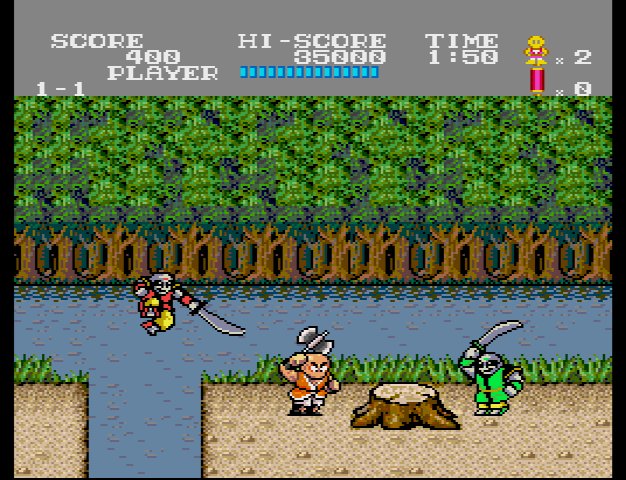
Tiger Road is a 1987 Capcom arcade game ported by Victor to the TG16 in 1990.  I got the game less than a week ago, and beat it yesterday.  That didn’t take too long… The game is one of the only platformers on HuCard on the Turbografx with backup memory save support, if you have a TurboBooster Plus or TurboGrafx CD drive (or any variety of Duo), which is awesome.

In the game, you play as a monk warrior fighting your way across what I assume is China, trying to defeat the evil king who has kidnapped the children.  You fight all kinds of Chinese monsters like Chinese zombies and dragons, and Japanese ones as well like Ninjas.  There are three different weapons, all with two upgrade levels, and a fourth you can unlock later in the game.  It’s frustrating and hard, but I like it.  The game gets a lot of mediocre to poor reviews, but really, I think that it’s a pretty good game.  I must admit, though, I made use of the backup save feature for saving and infinite continues.  I don’t know that I’d ever beat this game “legit”, with no saving and with the 5 continue limit you have if you’re not using a system with saving, but, well, the option for saving and infinite continues is there, with that addon hardware, and I have a Turbo CD, so I’m definitely going to make use of it!  It continues you from the stage section you’re at, so you never have to replay a stage part that you’ve beaten unless you want to challenge yourself with the non-saving version of the game and really want to memorize everything, though with how the enemies spawn infinitely, this isn’t a 100% memorizer like R-Type or Jim Power, you will have to use luck and skill as well as memorization to finish this game.

I mean, Tiger Road is HARD. It’s as hard as you’d expect for a Capcom arcade game from that era, considering that they also made games like Ghosts & Goblins.  Some things feel Ninja Gaiden-esque, except this game is older.  It’s got knockback, which always seems to hit you into a pit, infinitely spawning enemies driving you crazy, enemies attacking from all directions, frustrating bosses which can absorb a large number of hits, and more… it’s a tough game. Fun, but tough.

The game has good graphics for a midlife TG16 HuCard game, with the bright, vivid colors you expect from games on the system. I like the music as well; it is repetitive, and the sound effects are mediocre at best, but the music works well and isn’t too bad. It’s fittingly Chinese in style and fits the game’s atmosphere well. There are also bonus minigames between levels, which are simple but a nice diversion (the ‘defeat the monks’ one particularly, the other minigame is kind of easy to beat with the turbo switch on, and in this game turbo will probably be on on the attack button the whole time you’re playing).  Even though he is on a quest, our hero is still in training to the Ancient Master.

The weapons are a mace, a spear, and an axe.  The axe is the default weapon, but you collect the others via red powerup boxes.  Other powerup boxes are yellow, but those won’t contain weapons.  (On that note, don’t pick up the yellow “health” powerups!  They actually cause you to lose health.  Only grab the blue or red ones.)  Another powerup upgrades the power of your weapon, and if you succeed at enough end-of-level minigames, the Ancient Master will give you a new, more powerful weapon, the tiger shot.  You’ll lose this once your health gets too low (until you die and come back, or get a health powerup), but still, it’s a great weapon, and a strong incentive to beat the minigames.

There are only five levels, but each is broken up into many parts, and each level is longer than the last.  The last level is pretty long and has multiple bosses, including some returning from the earlier levels.  Visuals and enemies do repeat, but there’s enough variety of environments and enemies to keep the game interesting, I think, and it all looks pretty nice.  Bosses are a bit annoying though, as I said; each has as many hit points as you do, except you take a lot of damage when hit, while they usually take just one HP per hit, so you will need to hit them many times before they’ll die, while avoiding taking much damage.  The boss fights can get a little long, and the first few are easy too — not a good combination.  Still, the later bosses provide a definite challenge.

Overall, it’s a good game.  It is fun and challenging and kept me coming back until I finished it, despite great frustration in a few of the later areas.  It’s a simple game, like most TG16 HuCard platformers, and it deserves its reputation for high difficulty, but it is good overall, particularly for anyone with a system that can save.  The save feature is really awesome to have, in my opinion.  I really do prefer to be able to save in games, and far too many 16-bit platformers not on the SNES didn’t have saving… Oh, and it doesn’t just save your progress (it autosaves at the Game Over screen, so wait for that if you want to save), but it saves your top four high scores, too!  Pretty cool, high score save is VERY rare on the TG16.

I give it a 80%.  It’s good, but not great; the game is a little short, and replay value is somewhat limited, unless you want to try to play it with only five continues and no save.  Also while the graphics are good they probably could have been even better, and the sound effects definitely are a little weak.  Also, of course, while it is fun, the game also gets very frustrating at times.  However, I do like the game, and it was worth getting.

Posted in Full Reviews, Reviews, TurboGrafx-16 | Tagged , , , , , , , | Leave a comment

BattleTanx (N64) Review

Title: BattleTanx
Developed and Published by 3DO
Released: December 1998
Platform: Nintendo 64

BattleTanx is the first game in a short series of tank action games by 3DO.  The series consists of BattleTanx for the N64, BattleTanx: Global Assault for the N64, BattleTanx: Global Assault for the Playstation (a port, but different enough to be listed as its own game), and BattleTanx for the Game Boy Color; while 3DO did make a few more tank games after this, before going bankrupt, even though the gameplay stayed similar they started a new series, consisting of World Destruction League (WDL) ThunderTanks (PS1 and PS2) and WDL WarJetz (PS2).  The BattleTanx games are great single and multiplayer third person tank combat games full of explosions and destruction.  I first played BattleTanx in BattleTanx: Global Assault for the N64, which I bought, and loved, back in 2000.  As a result, this review will frequently compare this game to its sequel that I know so well; I can’t help it.

The backstory for BattleTanx is that recently, there was a plague that killed 99.9% of all women on Earth.  In the aftermath, the government collapsed, cities were nuked, and roving tank gangs now rule America.  Everybody who matters has a tank, and spends all of their free time driving around in it shooting at stuff.  Basically, it’s the perfect setup for a destruction-themed series! 🙂

Just like BattleTanx: Global Assault, the first Battletanx is quite short and easy — I started it yesterday, and finished it today just a few hours of gameplay later.  Still, also just like the sequel, it’s a great game.  The incredibly fun shooting and destroying action is just as great here as it is in the sequel — while I’ve owned the second game for 10 years, I’d never played the first one until now.   BattleTanx’s graphics aren’t amazing, but they are good enough.  The fog is a bit distracting, and you can shoot farther than you can see — and can be hit by enemies out in the fog — things which do not happen often in the second game, but are constant issues here.  Still, you can see arrow markers on enemies farther out than you can see, so their fire should not be a complete surprise.  Also the draw distance isn’t terrible, it’s just closer than the second game, or many later N64 games for that matter.  This is clearly a first effort.  Still, overall the game looks reasonably nice.  There is a good variety of environments, lots of different buildings to blow up, nice destruction animations and explosions, and more.  There are also, of course, the many enemy tanks and turrets to destroy.  Blowing up buildings, running over cars, and flattening fences and lightposts with the game’s variety of weapons and powerups is endlessly entertaining.

The levels are well designed, with many hidden areas full of items (and turrets) and good, if straightforward and often somewhat gridlike, building layouts.  The levels in this game aren’t as unique and varied as Global Assault levels, but still they are more than fun enough to drive around in and destroy for this game to more than stand on its own.   You can’t just drive from your base to the enemies, you’ll have lots of walls, destructible obstacles, minefields, and other hazards to deal with along the way.  There are no terrain variations in this game, it’s all flat (Global Assault is similar, but at least does have underground tunnels to go through; this doesn’t have that, it’s just flat).  As always it’s also silly how those little cement barricades can completely stop a tank, if they’re not the destructible ones.  Oh well, they have to create level layouts somehow, it wouldn’t be as challenging if you could just destroy everything.  Still, even though it makes perfect sense, in these games I do find myself sometimes wishing that I could blow everything up.  It’s annoying that some buildings can’t be destroyed, blowing stuff up is fun.  🙂  Overall, the game may be short, but it’s so much fun along the way that I don’t care.

The music does a good job of keeping up the tempo too.  It’s good stuff, similar to Global Assault’s soundtrack.  It’s kind of rock-like so it isn’t my favorite kind of music, but for a game like this it works perfectly.

The story is told through cutscenes with comic book style artwork, with occasional in-engine scenes as well for scenes of tanks driving around. It looks pretty good, and I really like the style and presentation of the cutscenes. Global Assault used the same setup for its story, and one reason why I had wanted to play this game was to see the first part of the story. It’s a pretty simple tale of Griffin, your character, going on a journey across post-apocalyptic America with his tank army to get his wife back (she’s one of the lucky few women who survived the plague), but it works well enough for a simple, arcadey game like this.  There’s enough story to keep you going, mostly about the various tank gangs you cross paths with during your travels, and it works.  The sequel does have a better story, though, with actual drama and plot twists, which you won’t find here.  I do like the presentation of the cutscenes though, even if the actual story is fairly generic.

Where Battletanx does lack compared to Global Assault, however, is in variety.  There are only three types of tanks in this game, and you only control one main one and one secondary one in the campaign; you can’t use the MotoTank.  All enemies you fight will either be those three kinds of tanks or turrets, of which there are three or so variations.  You fight a LOT of turrets in this game, definitely gets a little old… the sequel adds so many more types of tanks, it feels like a much more varied game.

Interestingly, most of the weapons from the second game were already in the first one; the second game adds a few more weapon types, but this game does at least have a wide variety of familiar weapons to choose from, from the guided missiles to the Swarmers, Gun Buddies, Invisibility, Health, Laser, Grenades, and even the Nuke. You lose all weapons you had when you die, though, and most powerups do not regenerate, so be careful when you collect them, you don’t want to get everything, die, and then be stuck having to use just your main gun for the rest of the level… it’s easy to do that.

In addition to the lacking variety of tanks (and all those turrets), the campaign also essentially only has two stage types, plus occasional bonus levels.  All non bonus stages are either straightforward “get to the end of this path” levels, or BattleLord stages where you must capture all of the enemies’ QueenLords and bring them back to your base.  The second game has much, much more level variety, with various mission objectives and more.  It’s obviously something they put quite a bit of work into with that game, I think; I mean, this game is great fun, but it really is noticeable how much less gameplay variety this has.  It really is all BattleLord (BattleTanx’s variant of Capture the Flag) stages and long, narrow levels you must get to the end of.  Still, even if it’s lacking variety, it’s a lot of fun. BattleLord is a fantastic mode that is always fun (that was always by far the best multiplayer mode in Global Assault!), and “get to the end of the level” stuff is classic.  I do like the bonus stages too, where you control a Goliath tank on a rail and see how many waves of enemy tanks you can withstand; you’ll get bonus lives if you survive longer.

Oh, and there’s no 2 player co-op campaign, like the second game has.  While the game does support four player multiplayer, it’s versus only, with four modes.  The most notable of course is BattleLord mode.  You don’t have as many options as the second game, in modes, and there are only eight maps in this game in multiplayer (the sequel has more), but you can play with computers controlling any of the four spots in multiplayer, and the game is great fun.  The BattleTanx games are some of the best multiplayer games on the N64, in my opinion, and that is no small statement, considering the great wealth of outstanding multiplayer games on the system.

Overall, short and easy, yes, and somewhat lacking in variety, but Battletanx is a great game. 85%.

Oh, and for anyone wondering, I am of course referring to the N64 version of Global Assault when I talk about it; there was a later Playstation port of the game, but the N64 original is definitely the better game.  The PSX port is 2 player only, first, so it loses the great 4 player multiplayer that is one of the best features of both N64 games. It also has smaller areas than the N64 games, so the levels are less interesting to explore.  They try to make up for this by adding more stages, but it’s not enough.  It was presumably a technical limitation — you can only fit stages so large into the PSX’s small amount of RAM — but it’s one of those things that show off the advantages of carts, and the superiority of the N64 games.  Still, if all you have is a Playstation, PSX BGTA is decent.  Worth playing for series fans for the prerendered CG cutscenes and different levels, though in both cases the N64 versions are superior — I like the N64 comic book style art cutscenes better than the prerendered PSX ones, and the PSX version may have different levels, but as I’ve said they’re not as good.  Oh, and the game has CD audio music, of course, but even though it’s quite solid, I think I like the N64 games’ music better.  Still though, BTGA for the PSX isn’t terrible. Maybe I’ll get around to finishing it sometime soon, I am interested to see what they did with the ending.  Also, decent graphics for the system.

Posted in Classic Games, Full Reviews, Nintendo 64, Reviews | Tagged , , , , , | Leave a comment

Etrian Odyssey 3: The Drowned City (DS) First Impressions

  • Etrian Odyssey 3: The Drowned City
  • Developed and published by Atlus
  • Released September 21, 2010

Etrian Odyssey 3: The Drowned City was released a few weeks ago, and as a fan of the first game I was quite interested.  I finally caved yesterday and bought it.  I played a lot of the first game after getting it shortly after its release in 2007, but for some stupid reason never got EO2.  I really, really should have, I love this series and definitely regret not playing the second one… I’ll have to get it sometime, but its price is going nowhere but up.

Etrian Odyssey was designed as a return to the style of 1980s first person dungeon crawling RPGs, and aside from a complete lack of real puzzles, it did a great job of it.  EO3 is very similar to the first game in that regard, as far as I can tell.  A few new features to make things a little easier have been added, but not too many; for the most part this is still classic dungeon crawling, and still great.  I find the lack of puzzles sad, and unfortunate, but even so what’s here is more than good enough to be captivating for a very long time.

I was a little unsure if I wanted to get EO3 now or wait a little while before getting it, but remembering that I said that about EO2 and then never bought it helped push me towards getting it.  Then when I saw a copy in a local store new, with the artbook (which was a preorder bonus from participating retailers bonus; evidently this local chain is a participating retailer. 🙂 ), I knew I had to get it.

It took all of two minutes into the game when I knew I’d made a good decision, and made me really wonder again why I ever didn’t get the second game… I love the EO games, and now that I’m back into it I realized I’d been missing it.  This one’s classic EO, but with some new features as well.  I’m still quite early in the game so I can’t say too much, but I like some of the new stuff — the sailing portion is cool, for instance.  Evidently the stratums are longer this time, and there are only 25 floors, which is a little disappointing; EO1 had six stratums, each 5 floors long (30 total).  The last was a bonus, postgame-content stratum, so it also had 25 main floors, but I haven’t heard of a bonus stratum this time.  They did add the sea part to add some stuff, but that’s different, you don’t play that like a dungeon.  I like the sea part — the movement range system, exploration of the oceans, etc. is quite fun — but it’s not a replacement for a bonus stratum, if indeed there isn’t one.  Well, we’ll see, I know there is bonus postgame content for sure at least (read: really hard optional bosses).  I know that either way the game will have a ridiculous amount of content, and that like the first one I’ll probably never finish most of it, as too much of it requires a lot of grinding.  I like the game as long as I can keep going, but in EO1 for instance the postgame part really was ridiculous grinding-wise if you didn’t have exactly the right party (respecing your entire party/replacing party members with new people you now have to level up to max to exactly the party needed for the insanely difficult special bosses, specifically).  EO2 was even worse, from what I’ve heard, if you wanted to optionally get above level 70 (the first game’s max).  EO3 sounds like it’s sort of in between, getting to level 99 isn’t quite as insane, but it still does require getting through the postgame bosses.

Anyway, the EO games are just so much fun.  Party creation is great, with all-new classes and artwork this time to mix things up; EO2 brought back all the old classes with a few new additions, but this time it’s all new.  12 classes total, 2 hidden.  EO1 had 9 classes at the start, 2 more hidden; EO2 had 14 total, 3 new, but I’m not sure if they were hidden.  There is also an alternate color sets for all the portraits this time, too, which is pretty cool, more options.  You then explore the dungeon, map it out as you go, fight FOE bosses, farm resources, do quests, figure out the mystery of the dungeon (will it be another surprise somewhat bad ending like the first two games had?  At this point though it wouldn’t really be a surprise anymore would it…), and more.  It’s great classic dungeon crawling fun.  There’s lots of challenge, some grinding (some optional, some not as much), hard bosses, normal enemies that you will have to think to fight, so there’s no autopilot here, and more.

This time though as I’ve said you also can go to sea, so you travel the seas, explore, find islands, fish, and do other stuff.  You can only travel as far as the food you purchased before setting off will let you go, so you have a movement range.  It’s an interesting system, putting a little realism into the sea exploration while also making it so that you can’t just go anywhere right from the start.  Each voyage costs money too, so you’d better make it in the dungeon, or use some voyages for fishing to make back the cash.

Overall, I’m very early in the game, but I’m definitely loving it so far.  Anyone who likes EO should pick it up, preferably with the artbook if you can find a copy with it (Amazon’s copies still come with the artbook for instance, I believe).  The artbook has full-sized pages, so it’s not some tiny little DS case sized thing.  It is only 60 pages long so it definitely isn’t comprehensive, and I do find it disappointing that there isn’t more in it — I’d love to have seen more of the prelim sketches of characters and their equipment, art for all of the stratums in EOs 1 and 2 and not just some of them, the EO2 art for the EO1 classes (while all 11 original classes returned in EO2, and their costumes are the same, they were redrawn in new poses for the second game.  None of this art is in the book, only the art for the new classes.), and more, for a short-ish artbook it’s pretty cool, and it was definitely worth getting.

http://sq3.atlusnet.jp/special/sp_blogparts.html
The above link is to a neat little image creator, so you can show what characters are in your party and which costumes you’re using for each.  Unfortunately it doesn’t work on this site, as far as I can tell, but for forums and such it’s a neat little extra.  Too bad the US site doesn’t have a version of it.  The menus are in Japanese, but in the created image class names are in English, so it’s easy to figure out which is which. Some class names are different (in the US the Warrior was changed to the Gladiator, and the Beast King to the Wilding), but that’s minor.

My starting party is a Gladiator, Monk, and Princess in the front row, and a Zodiac and Wilding in the back row. I created a bunch more characters though, so when I have to switch to some others — and in an EO game that’s an inevitability — they’re ready.

Overall, get this game if you have any interest at all in classic, dungeon crawling RPGs. Get all three of the EO games, in fact.  They’re very good.

Posted in First Impressions, Modern Games, Nintendo DS | Tagged , , , , , | Leave a comment

Abadox: The Deadly Inner War (NES) Review

  • Game: Abadox
  • Developer: Natsume
  • Publisher: Natsume (Japan), Milton Bradley (USA)
  • Year: 1987 (Japan), 1990 (USA)
  • Platform: Nintendo Entertainment System

Abadox Magazine Ad: http://www.neshq.com/media/mag/abadox01.jpg

First — TURN ON YOUR AUTOFIRE! Seriously, it’s pretty much necessary in this game. Otherwise you’ve got to mash the button, fast, for most of the time you’re playing, and that’s just not fun. Save yourself the hassle, and the potential finger-strain, and just use your NES Advantage and turn on autofire at max speed.

Abadox: The Deadly Inner War is a shmup for the NES, as the title says, that was made by Natsume.  It was published in 1989 in Japan and 1990 in the US.  You are a warrior of some type sent to rescue the kidnapped princess from a giant living alien planet.  You fly into the planet-sized alien and spend the entire game traveling through its insides.  The game has six levels, which alternate between horizontal and vertical scrolling.  From that description it should be clear that the game was inspired by Life Force, and indeed games like Life Force, Gradius, and R-Type were clear inspirations for Abadox, but the game goes beyond just being a clone and does do its own thing. Abadox isn’t a game that I heard of when the NES was current.  I first played it a couple of years ago.  I heard that it was unique visually, but really hard, and that made me want to try it.  I almost immediately liked the game, and decided to beat it.  After a while, I did.  Now, though, I own the NES cart version of the game myself, after finding it in a local store two days ago.  I played the game immediately, and finished it within a day.  While I like shmups, I’m not great at them, particularly the newer bullet-hell style of shmup.  I’m absolutely HORRIBLE at bullet-hell games.  Abadox, though, is an older style of shmup, and while the game is hard, it’s not impossible, and it’s a kind of hard I can deal with.  I mean, I have beaten it twice now, if both times with a turbo-fire button (this time that NES Advantage joystick I mentioned).  I wouldn’t do that if it was impossible or no fun.  Yes, it was good enough to easily be worth playing more than once.  While indeed it is quite hard, the game isn’t overly long; when I beat the game, it only took a few hours to finish.  The first time it did take longer, as I would expect.  There are only six two part levels, but when you don’t have it memorized, it will take quite a while to finish, even with the infinite continues that the game gives you.  The infinite continues give you the time to learn it, if you have patience.

Abadox, you see, is a memorization-style shooter, in the R-Type school.  THe game obviously was heavily influenced by R-Type and, to a lesser but still significant degree, Gradius and Life Force.  However, Abadox is not as hard as either of those games.  It may have a reputation for extreme difficulty, just like R-Type, but some of its design decisions, the infinite continues most notably, greatly lessen the challenge level.  It is still very hard, but R-Type is harder.  R-Type is a great, great game, unquestionably one of the all-time classic shmups, but it’s so, so hard that I find that sometimes it stops being fun.  Gradius 1 for the NES is far harder than Abadox as well I would say, thanks at least in part to that game having no continues at all — die a few times and you start from the beginning again.  Abadox, in comparison, is challenging, but fun most of the time, and the infinite continues are a key help.  In these games you play, die or barely avoid dying as traps are sprung at you and enemy waves fly in, try again, get a little farther, die again, and repeat.  As a result of Abadox’s very, very memorization-heavy design and that I still remembered some of what to do from my first time playing it, when I played it yesterday it didn’t take quite as long to finish as the last time.  I noticed that there were times where, despite not really remembering the stages before seeing them again, I just instinctively went straight into the places I remembered were safe as I progressed… kind of cool.

Abadox is a visually interesting game, with a weird biological graphical theme that looks really cool and is artistically quite nice for the NES.  Even if the game was obviously inspired by Life Force in both graphics and some gameplay elements, the game does a fantastic job.  The the creepy nature of the graphics goes beyond anything in Life Force and is even more consistent to its theme and cool looking than that game is, I think.  The graphics are very detailed and look fantastic.  The amount of detail put in to every sprite and background is quite impressive and somehow reminds me of some of the more detailed, dark spritework on the NES like NES Batman or something.  Things in the background pulse and move, giant hands come out of the walls, bulbs shoot huge beams, and more — you get a real sense that this place is alive.  The creepy, very well done graphics really stand out and are a real part of why the game is such a great game. The music isn’t quite as great as the graphics, but it’s good enough, and is catchy and easy to listen to through the whole game, even though it repeats a lot in each stage.  I like the music.  It isn’t the best thing about the game, but it is good.

The game is extremely difficult, but isn’t that long at only six levels (each with two parts, with a miniboss at the middle and a final boss at the end). The only “checkpoint” in each level is after the midboss, so in effect there are 12 stages. Three levels are top-down, and three side-scrolling. Though both are tough, I find the topdown levels harder. There seem to be more pop-up surprise enemies that attack with little warning in the top-down levels, while in the side-scrolling levels I seem to have a bit better sense of what’s coming at me — and the more warning you have the better chance you have of getting through.  I found the top-down level 2 much harder than the side-scrolling level 3, and top-down level 6 harder than side-scrolling level 5.  Level 5 is the hardest of the side-scrolling stages, as you would expect, though, and it is challenging, so this only goes so far, but still, for me at least I really noticed this.  I like the side-scrolling stages better, too, and find them more fun.  But in general I do like horizontal shmups more than vertical ones, so that’s not too surprising; I like the horizontal levels better in Life Force too, for example, and Axelay on the SNES as well (though the perspective in the vert stages in that game is really cool).  But anyway, back to Abadox.

Abadox has powerups which appear when you destroy one specific enemy type, a blue ship.  Powerups are not that common, so don’t expect a constant stream of powerups coming at you, Gradius-style.  You won’t get it.  This makes getting the ones that there are even more important, if you aren’t at full power.  Also they drop specific powers, so it’s not user-selectable like Gradius.  The powerups include a speed up, rotating shield, invincibility that blocks one hit (I think), powerful straight laser, three-way shot, and five-way shot.  Each is symbolized by a letter, so if you take the time you will eventually learn which is which, or you can just get them all (except maybe to stop collecting speed at some point).  Powerups are rare enough in this game that that can be a good strategy, I think.  The game is much, much easier when your ship is powered up, and in the classic Gradius fashion you really want to avoid dying because of how hard it is to start over with nothing but the peashooter.  Whenever I die once, I’m almost sure to die quite a few more times before getting through the section, even though with full power it wouldn’t have been anywhere near as hard.  But that is how this style of shmup goes, and it makes for a fun challenge as each time you try to do better and survive longer without dying.  The stakes here aren’t as high as in the first three Gradius games, because you do have infinite continues, but still it’s a design that I like a lot, and it works very well here.   The overall goal is simple:  Try not to die.  As you play, try to memorize everything you can so that when you do die, you have a slightly better chance of getting through the next time.  Then learn what patterns of movement and shooting are required for you to get as many powerups as possible in the stage you’re in. They sometimes can be tricky to get.

One key factor makes things a lot easier than they otherwise would be: You have infinite continues, as I have said. Really, this is why I was able to beat it so quickly (or at all perhaps). You don’t have to restart the whole thing after a couple of deaths, you can just keep trying until you get it right. This really is a key to why I’d call the game not quite as hard as it sometimes seems to get a reputation for being — yeah it’s hard, but you have infinite continues! You don’t need to replay level 2 (level 2-2 is very, very hard if you die in it and have to start from the beginning of 2-2 with just the peashooter) fifty times just because you keep dying in level 5 or 6. With a game with levels this hard, which will kill you so many times until you memorize exactly where you should be at every instant, that is a huge, huge thing.  The game is challenging, but manageable.

As an example from my recent playthrough of the game, after dying midway through my first attempt at level 2-2, I think the level took me an hour to beat.  I found it one of the hardest stages in the game, in fact, going by how long it took. Levels 5 and 6 probably are harder overall, but by that point I was more used to the game again I think… but also, level 2-2 is very cruel — there are NO weapon upgrades in the whole stage. There’s just a shield, rotating guard thing, and speedup… no weapon upgrades at all. It makes the stage inordinately difficult; even one basic weapon upgrade would make a tremendous difference… but instead it’s just really frustrating.  Oh well, I got past it eventually and went on to beat the game.

Level 6 really is an awesome stage, full of all kinds of interesting challenges.  This game just keeps ramping things up, and I wish it was longer or it had sequels so that I could see more of this design.  Each level throws new challenges at you, and you have to learn how to respond.  For instance in level 6 you learn to not hold down fire all the time, because there are enemies that aren’t too threatening (they just combine and fly off the screen, just learn where to be to avoid the combining parts) if you don’t hit them, but become serious nuisances if you do destroy any of their parts — then all the other parts start flying right at you, and it’ll take some good flying to avoid getting destroyed.  It’s tricky and you will only consistently get past it with memorization, but I think that they’re some of the more interesting enemies in the game — it’s not the kind of thing you see too often in these games.

Oh, the bosses are oddly easy compared to the levels. I don’t think I died more than two or three times at most of them. A few are a bit harder, but most have multiple blind spots where you can just stay in one space and fire, and wait until the enemy dies; the others generally only require very simple back and forth movements to beat. Only a few are more complex. I’m not complaining though, because with levels as hard as this game’s are, it’s nice to have a bit of a break — and with how when you die at a boss you go all the way back to the beginning of the area (either the beginning of the level or to right after the miniboss, depending on if you’d beaten the first part or not), I don’t mind this, really. Having to replay the levels even more times would impact the fun factor, I think. Still, compared to how hard the levels are, it is a bit odd. Eh, whatever, it’s fun. The bosses are often huge and pretty impressive, so they certainly do visually impress. They just go down easier than you might think. This is true all the way to the final boss, the last boss has only one form and it’s not that much harder than any bosses before. At least the ending is decent, if simple. You rescued the princess and escaped, congratulations. (On that note, stage 7, the escape, is a fun one… not hard, but a great touch. These things became common later on, but in 1989 or 1990 when this game came out I don’t know how common these stages were… it’s not hard, but it is fun. 🙂 )

Overall, I really like this game.  It reminds me of games like Gradius and R-Type, both of which I like a lot.  Gradius particularly is probably my favorite shmup series, and R-Type’s got to be up there.  Abadox feels somewhat like those games, but it is also different enough that it is definitely its own game — this isn’t just a Life Force clone, despite the similar theme.  Abadox is a very good shooter, and anyone who wants a challenge that will really reward you as you learn the game and what do do at each point would to well to play it. It really is a fantastic game. Don’t let what I say about the difficulty stop people from trying it, it’s really worth playing, in my opinion. I think it’s an incredibly fun game, and it’s got to be one of my favorite NES shmups. Konami’s shmups are my favorites on the NES, but this is one of the best of the rest.  I’d give Abadox a pretty good score, it deserves it.


88%

Videos:

Intro: http://www.youtube.com/watch?v=H6aUh9yzBIo

Some gameplay: http://www.youtube.com/watch?v=1uJnpR2gXQM

Finally, about the magazine ad posted at the top of this post.  That’s the original US magazine ad for the game.  The scan is from NESHQ: http://www.neshq.com/media/mag/ It’s pretty good stuff, and depicts the game well.  The Abadox logo, with the name partially turning into a dripping blood or red stuff of some kind, is creepy and awesome looking, just like the game as a whole.

Oh, on that note, one odd thing is that I can’t quite tell if ingame you’re supposed to be a flying person in a suit or a spaceship… sometimes it looks like the one, sometimes the other… could they not decide or something, and both ended up in the game, or am I just not doing a good job of understanding the graphics? 🙂

link to my original post

Posted in Classic Games, Full Reviews, NES, Reviews | Tagged , , , , , | 1 Comment

What was the Downfall of the Golden Age of Retail Computer Gaming? An Attempted Analysis

(Please note: I am finally posting this 2010 article on the site now, in June 2026.  This is an article I have both wanted to post here ever since I wrote it, and didn’t want to without significant additional work.  Considering how well it ties in to my 1998 articles, though, I think I really should put it here.  I posted it with the posting date it was originally written, but I have added to it for this reposting on my site.  I added some things to the article in order to try to improve it and clarify the point.  If you want to read the original version of the article, I link the original forum version near the end.  That is not updated since 2010.)

Table of Contents

  • Opening Notes
  • On the Downfall of ’90s North American Computer Gaming
  • The Rise and Fall of Genres
  • The Collapse of PC Retail
  • Hardware Issues
  • On Digital Distribution as the Solution
  • Conclusion
  • 2026 Addendum: Looking Back at the Article Above
  • Where Are Things Going Now?

Opening Notes

Before I begin, a few disclaimers.  To be clear, despite the title of this article, I do not believe that PC gaming now is awful, or dead.  There are still many good PC games in development, in fact.  But when you look at the American and Western European development scenes, it is incontestable that PC gaming does not have the same place that it did ten or fifteen years ago.  Note the regions I am focusing on — that is very important to remember.  What I am trying to go through here are possible reasons why it happened, beyond just “it is explained by changing tastes” or something like that.  Yes, I know that PC games are still being made, but they are mostly indie games or console ports.  Things are lesser than they were.

Last, yes, I miss PC gaming as it was in the ’90s.  That should become immediately very obvious.  I have a lot of nostalgia for PC games of that era.  But again, I do think PC gaming is still great, and I don’t dislike console gaming — I love lots of console games, and spend just as much time playing console games as I do PC.  I like both… which is why I’m so sad to see one of those fading away so much.  PC games are not unique once they have merged into console games, and become more like them than like what makes them what they are.

On the Downfall of ’90s North American Computer Gaming

History is very important to me and I have studied it extensively, which is probably why I thought it best to start with an early history of PC gaming, before I got into my attempts at explaining the reasons behind what happened to it in the last decade.  Even there though the historical perspective is an important part of it I think.  Also, as I say at the end, I don’t really consider this “complete”, due to all the things I’m sure I’m not thinking of, over-emphasizing, or what have you.  That’s why the title is “an attempted analysis”, not “an analysis”.

Electronic gaming was invented in the US. From 1946 to the early 1980s, all of the major advances in electronic gaming happened here. Everyone else was playing catchup. The first PC game was American, from 1962. The first arcade game American, from 1972. The first videogame console American, from 1972. And then the first significantly successful console American, from 1977. But in the late ’70s and early ’80s, though there were many American companies making videogames, none of them thought of videogames alone as the answer. They all thought that the actual goal was a hybrid computer-console system, or perhaps just a computer alone, and that the consoles were just a transition or a hook to get people into their “real” business, the computers.  Computers were serious pieces of equipment with real uses, after all, not just games machines.  They were wrong that that was what people wanted, but they didn’t know that.  And so, before the crash we saw things like Coleco’s Adam computer addon, the Intellivision computer addon, the Atari 5200 being a consolized Atari 400/800 computer essentially, and more.  Even the Japanese got into the act — Sega’s first console, the SG-1000, had a computer addon for instance.

Then, in 1983-84, the Western console industry crashed. It would be famously “brought back” by Nintendo in 1985-86, but in fact gaming never went away — because those computers didn’t crash. The IBM PC, Apple II, Amiga, Atari ST, Commodore 64, and more, all had significant market shares and large games markets through the ’80s and into the early ’90s (Only the PC would get beyond that, in the early ’90s all the competitors except for Mac died off). So the standard story, that Nintendo saved gaming, isn’t precisely true… console gaming crashed, but the then-smaller computer gaming market never crashed and never died off.  This is obviously important — as a result of this American development changed focus to the PC, a fact which continued to be true for a long time afterwards.  Europe, a place where consoles were not significantly successful until the mid ’90s, started out mostly making computer games.  Of course some Western studios made console games, but they were a decided minority, and in many cases their games were not as good.  This was a reality which would only very slowly change.

So, while there were a relative few great NES games from Western developers, but there were LOTS of great PC games during that era.  Adventure games (text, graphical, and FMV-based), RPGs, platformers, strategy games, space sims, wargames, military vehicular sims, later on FPSes, and more… there were a huge variety of titles on the PC through the third, fourth, and fifth console generations, and a lot of the games had big budgets for the time, certainly comparable and almost certainly above the budgets of your average probably junky Western-developed console game then.

So, the ’80s were really good for PC gaming. In the ’90s consoles continued to grow in popularity, but despite that, PC gaming stayed successful through the decade. Now, here’s an important point — PC games did not sell like console games. That is, console games are now and always have been heavily front-loaded — the majority of sales happen in the first week. PC games just weren’t like that. You would release a game with the expectation that it would be on the shelves for years and sell slowly over that period of time, and that is exactly what happened. Back in the early or mid ’90s you could go into any Software ETC and see large numbers of games that came out years ago there on the shelves being sold new. People play PC games for longer on average than console games because they often have much more content thanks to things like level editors, online/modem multiplayer, etc., and they do not always buy them right when they came out.

Europe was even more focused on PC games over console games than the US. In the second half of the ’80s and the early ’90s, most people gaming in Europe did it on computers such as the Commodore 64, Atari ST, Amiga, ZX Spectrum, and Amstrad CPC. While in Western Europe eventually consoles became quite popular starting with the PlayStation 1, PC games are still much more popular in Germany and some other Western European countries than they are in the US.  Also, in Eastern Europe most gaming is still done on PC. That is why so many PC games these days come from Eastern Europe.  Europe has always been one of the major strongholds of PC gaming.

It was only Japan where consoles always dominated…

But wait, even in Japan there were PCs in the ’80s, with a stronger gaming scene than they had in the ’90s and beyond. The NEC PC-8801, NEC PC-9801, MSX I and II, FM Towns, and Sharp X68000 all had real markets back in the ’80s and into the early ’90s. The MSX particularly was very successful in Japan. It’s too bad that the PC didn’t keep that market going but instead almost everything went to consoles… but yes, for a while computer games did have some success in Japan.  It’s just that there that mostly died off in the early ’90s.  Perhaps it has something to do with the kinds of genres popular in the region, or how people play games, or something else, I’m not entirely certain.  I’m sure lots of factors are involved.  Now of course in Japan it’s basically mostly visual novels and dating sims, aside from doujin games and the occasional release from a Falcom or Koei.

Getting back to the US though, by the late ’90s computer game developers and publishers were getting bigger, but the market wasn’t growing enough to satisfy them, so they started looking more seriously at other markets.   PC games had been the main focus of North American game developers for 15 years by the end of the ’90s, but that ended there.  The problem was that revenues could not keep up with the steadily increasing budgets.  Game budgets were exploding, increasing significantly year upon year, an increase that has not slowed.  Developers, searching for a solution over the course of the years after 1998, steadily moved one after another to consoles.  The result of this ended the era of North American game developers putting their main focus on PC games.  The few remaining studios mostly switched to working on online RPGs or were tiny little indie teams making games on a strict budget.  In Europe PC game development survived longer, but over time even there PC-focused games declined in favor of console ones.   The decade of the ’00s was a rough one for PC gamers.  Late in the decade the decline seemed to slow thanks to the rise of digital distribution, but the situation is still bad.

But yes, after 1998 or so, company after company started moving towards consoles, lured by the large number of gamers and the promise of more immediate dollars than they were getting on the PC.  After all, again, console games always have been more front-loaded in sales than PC games are, and sell for higher prices day one.  I’m not sure how important a factor the day one sales aspect was, but surely it was one element pushing studios away from the PC.  Costs increasing faster than revenues was the primary driver away from the PC, but for some greed and a desire for greater profits certainly has to be seriously considered as a factor.  Once again, after all, companies exist to make money for their shareholders.

The Rise and Fall of Genres

The kinds of games being made changed dramatically in the ’00s as well.  The question that is hard to answer is,how much of that was natural change because of changing tastes in society and among gamers, and how much was because of the collapse of PC-focused development in favor of indie and console/PC hybrid titles?  This is an impossible question to answer definitively, as surely both elements were factors, but it is interesting to think about.

Through the ’90s, the popular genres were somewhat different from what they are now.  FPSes became more and more popular, but wargames, military sims, platformers, top-down action games, turnbased and realtime strategy games, graphic adventures, life sims, puzzle games, building sims (SimCity, etc), and more were all there to provide a massive amount of variety.  Over time adventure games did fade and FPSes and RTSes become more prominent, but the other genres did not entirely disappear until the ’00s, as PC gaming became more and more dominated by those few genres and most PC developers stopped being PC exclusive.  Puzzle games have survived in the casual sphere of course, as well; sometimes I forget it, but PC puzzle games are probably actually more popular now than they ever have been before.  Most other genres, particularly anything requring a budget, have not been so lucky of course.

One of the crucial developments happened in the mid ’90s when MMOs arrived on the scene in a big way after Ultima Online was released. The genre had always been around in the MUD form, but UO (and Meridian 59 before it, though that one was much less successful) was a new breed, a graphical, large-scale massively multiplayer online RPG. The game was a massive hit and is still operating today. EverQuest a few years later compounded that and the MMO craze was on. I do think that this had an important role in what happened to PC gaming — because in terms of raw dollars, PC games never actually decreased in income. It’s just that an increasingly large amount of that money, and gaming time, went into MMOs, with their monthly fees and massive timesinks. There was less and less room for other kinds of games to have much of a market.

Still, adventure games, space sims and wargames lasted past the early years of the MMORPG without entirely disappearing… but by 2001, all three were obviously on their last legs.  Adventure games survived as low-budget titles developed by small, often Eastern European developers.  Wargames are still quite popular, but they receded into a niche where nobody who doesn’t follow the genre even knows about their existence, a far cry from the genres’ general popularity in the 20th century.  The situation is worse for high-end space, flight, and military vehicular sims, genres which pretty much entirely disappeared, as without the big budgets that those games required nothing like the great ones of old could be made again.  Each genre has maybe one noteworthy title left, such as iRacing for racing simulations.  This is the situation today with those genres.  Non-MMO RPGs of course did not die off, as games like Neverwinter Nights 2 and Dragon Age show, but they did become much less common.  These were all side-effects of the shift of focus from PCs to consoles in so many Western video game developers and gamers.  If someone believed that the fading of those genres helped cause the shift it could be a cause as well as an effect, but I’m not certain which way that goes.

This returns me to the subject of changing tastes among gamers.  On both PCs and consoles of course over time tastes change, but in the past decade tastes for the majority seemed to head in an even more console-centric direction than it had been before.  Why was this?  I’d think some people would still want to try the more traditionally PC styles of games too, as well as relatively simpler console titles.  Perhaps they would if they still existed, but don’t because they don’t and make to with much simpler console games that are sort of “comparable”.  Or perhaps they just don’t know that they might like them because they’ve never tried, because people assume that no one wants to play those games anymore so few people make them and even less effort is put into marketing the things.  I really don’t know…  I will say, though, something like the recent IL-2 Sturmovik console game with both a sim and an arcade mode is a pretty good idea, for these times.  But why did it get to this point to begin with?

The Collapse of PC Retail

Another important factor, also monetarily related, is retail space.  Retailers like the console market, with its high turnover and quick sales, better in general.  They also disliked the large boxes that most PC games used because of how much space they took up, so in the early ’00s Wal-Mart forced smaller boxes on the PC gaming industry.  I would mark that as a major step towards the collapse of PC gaming as it had been, for without a larger box you cannot fit a large manual, as many extras like maps and quick-help cards, and sometimes even a real jewelcase in the box.  The losses of things such as jewelcases and thick manuals helped push the picture of PC games as losing what they had had and being ‘cheap’, I think.  Is it really a coincidence that this happened at the same time that PC gaming was starting to struggle in ways it had not before?  Perhaps it was just an effect, but I think it was probably a partial cause as well.  As the amount of space the PC game section of game stores took up decreased, sales decreased.  This spiraled, combining with all other factors, until eventually the PC section of game stores nearly ceased to exist.  The PC market moved almost towards a strong digital-distribution focus in the later ’00s, before most gamers were buying games exclusively digitally.  PC gaming never had a strong resale market, so the used section of a game store never had many computer games in it, reducing space even further as compared to consoles, where used sales are a huge part of the business.

Meanwhile, at the same time, the 6th generation of consoles (PS2, Xbox, GC, DC) simply were far too successful and popular to ignore, I guess.  As I said above, the PC developers were lured in, I believe, by both the narrowing PC market (thanks to MMOs and the huge success of specific strategy and FPS games that pushed smaller genres and developers out) and by increasing budgets, that made PC game development much more difficult on the scale it had previously existed on. You needed to sell a lot more units now in order to make money, so that new flight sim would cost more than ever to make without more return.  For some cases though as I said earlier I do think greed had a big part of it too, as they saw this big other market and wanted in.  And then after some moved over, more and more followed them and it snowballed into the situation we see today where PC games are mostly either console ports, MMOs, or Eastern European.  Apparently in Eastern Europe, game stores even still have physical PC game sections!  That would be nice to see.

Hardware Issues

One interesting case of change over time is Western developers’ reactions to the controlled nature of console systems versus the open nature of the PC.  I mean, computers are at their best when they are open and accessible.  There are also no licensing fees, no company that must certify that you are allowed to release a game on the platform.  On consoles there are rules and restrictions. Anyone can make a computer game, but that isn’t true on consoles. Back in the ’80s these rules turned off Western developers, who went to great lengths to try to avoid paying Nintendo and Sega’s licensing fees.  For more on this look up Atari/Tengen v. Nintendo, Accolade v. Sega, and the EA/Sega deal that got them on the Genesis — in all three cases the companies used their own technology to create carts that would work on those systems without a license. In EA’s case they used that as leverage to get lower licensing fees out of Sega.  American development on consoles increased in the SNES/Genesis period, as restrictions got a bit lighter, and then even more on the PSX and N64, as the fees and restrictions were again reduced, but still, it was a barrier.  However, now many companies actually seem to prefer that kind of environment, because the controlled nature allows THEM to be more controlling too, while on the PC they blame piracy for destroying their sales as if their own decisions haven’t had an even greater impact (see: Ubisoft).  Corporate cultures have obviously changed.  Perhaps the dollar signs overwhelmed their caution, or the reductions in fees and such were enough for them, or piracy really was that big of a problem… I’m not sure, though I do think that they overstate the amount of damage done to them by piracy; the evidence is that most people who pirate games would not have paid full price for them.  Most pirates either wouldn’t or couldn’t have paid for the games they downloaded.

Other than Eastern European games and multiplatform titles there are still a few games here and there being released for the PC, particularly in the MMORPG, RTS, and FPS genres, as well as longrunning series like Civilization.  The other major bright spot is casual PC gaming, which is now more successful than ever.  Facebook games, Popcap games, and more are doing very well.  However, that has not led to any rebirth of the hardcore, big-budget PC gaming market that is my focus here, so so far at least it is not a savior of serious PC games.  It’s good, and worth noting, but not the answer.

There is an important factor compounding this: many people who play those casual games are not people who could play hardcore PC games even if they wanted to.  Their computers, if desktops, probably have integrated graphics chips on the motherboards as their only video hardware, and if a laptop or, worse, netbook, have worse capabilities all around as a rule.  Nobody with a netbook as their computer could be playing games even if they wanted to.  On a laptop or low-end desktop, it’s unlikely unless they were already a gamer, and that creates a viscous circle where only people already gamers buy computers good enough to play games on.  Needless to say, that is not a good cycle to get into.  Hopefully someday there will be a solution to this, and cheaper computers will start actually including graphics chips good enough to play games on, but for how it’s a real issue.  Oh, and I also should mention cellphones, and that anyone using a phone as their major internet medium probably isn’t using their computer as often as they used to, and are playing some simple little games on their phone as well.  People only have so much time and spending more of it on cellphone timewasters reduces time for more substantial games.

So, you need to already be a gamer before you end up getting a computer good enough to play games, and that is of course a viscous cycle. Before integrated graphics took off, there was a short time where many more people had machines capable of playing at least midrange PC games.  Hopefully eventually something will be done about this problem, but for now it’s definitely a big one.  Such machines can probably easily play indie games, but likely not theoretical high-end PC-focused titles.

On Digital Distribution as the Solution

First, If it was still actually possible to find PC games in actual stores, like it used to be, we wouldn’t need to rely on online distribution for everything… some people would anyway, of course, but the choice would actually be there.  It isn’t really now — PC games are mostly digital only, with Valve’s Steam platform as the lead marketplace.  But, if Steam is the answer that is saving PC gaming, then why are most of the AAA games on it either multiplatform titles also available on consoles?  Sure, they are often a little better on PC, but are also on consoles, and which system was it designed for first and foremost?  Usually consoles.  Alternatively, they are probably European titles with midrange budgets, or are low-budget homebrew games, the modern equivalent to the shareware games of the early ’90s.  Steam as a service is just a distribution mechanism.  Look at what the actual GAMES on Steam are and you’d see that they prove my point entirely.

Yes, DD has done a good job of providing a place for games like those to be sold now that the retail market for PC games is so dead.  But that right there is part of the problem I think, that people have forgotten what it used to be like and think that DD is better than retail ever was… but I like physical media.  I don’t mind digital distribution, particularly for smaller titles, but when possible I prefer having a physical object.

So yes, for those small homebrew-style games DD is probably better than retail or the limited amounts of digital distribution possible in the early to mid ’90s ever was, but for almost anything with a budget, is it really better now?  For anyone who can remember, is Steam really better than, say, a Software ETC. or something in the early to mid ’90s? I don’t think so, myself.  Maybe part of that is that, again, I like owning physical copies of games, and part of it is that I don’t love Steam as much as some do, but I definitely don’t think so.  I have issues with Steam, but it is certainly infinitely superior to the terrible PC sections of Gamestops today.  Of course, that is in fact a part of the problem.

For, without retail you make it a lot harder for people to become interested in PC games in comparison to console games, which still have significant presence in stores. Unless there is some kind of hook from those now very popular casual games into DD services, how would those people even know where to look?  And also, without the pull of spur-of-the-moment sales of boxed games, will as many people try them as otherwise would?  Out of sight, out of mind, you know.  I know that Steam is growing, and other services (that are simpler but possibly not as annoying as Steam in a lot of ways) like Direct2Drive, Good Old Games, Impulse, etc. are too, but still, I just don’t see how you ever get over that hurdle.  There’s a big market for whom boxed games are just the better way to reach them, I think.  The death of buying boxed PC games among the hardcore hurts the industry in some important ways — those people looking at the PC section of their Gamestop now see a small, pathetic selection of titles, and dismiss PC gaming immediately as a result.  How would they ever even know that there’s a much better selection than that out there, only they’re mostly only available digitally?

The success of Valve’s own games definitely pushes Steam and helps with this, but still, it is an issue.  Plus, I at least do not see the death of the box as a good thing!

That is not to take away from the accomplishment of making it so much easier for people to access shareware-tier games than it ever has been before. That’s fantastic.  I love a lot of games like that.  But for people like me who do like owning boxed games, or for the much larger market I just described, having boxed PC games continue to fade just isn’t something that I can see as an improvement — even if it does come with the continued growth of DD services.  That growth helps a lot, without them the situation would be indescribably worse than it is, and do do very good things like give people anywhere access to games which they might not otherwise have, but I just don’t think that they’re the whole answer.  Arguably, their growth is actually helping to cause part of the problem.

So, nothing I just said here really disproves my article’s validity.  As I said DD has just sort of replaced a piece of the old ’90s retail boxed market with online sales.  It has done that at the cost of removing those boxes from the sight of people who might have otherwise got interested in PC gaming and making PC game sections in stores look weak.  And it has absolutely not reversed the decade-long trend of North American and Western European developers abandoning PC development in droves.  Perhaps it has staunched the pain a bit, if you believe that people buying on Steam would not be buying boxed copies of those games if that was how they were only available, but it has absolutely not reversed the trend, either in total releases or in budgets of those very few exclusive releases left.

Because remember, I’m not just talking about the number of games, but the number of big-budget games.  So we have more Facebook games now.  Yes, that’s nice.  But when are we getting Falcon 5.0, FreeSpace 3, or Grand Prix Legends 2, to give some examples, at budgets and studios that would get products as amazing as the old ones but with today’s technology?  Never, right?  And that is my point here.

Conclusion

So, things seem bad, with Steam and other digital distribution platforms as the only hope for PC gaming’s resurrection into relevance again.  We’re not at a worst-case-scenario yet, however.  I’m a huge Blizzard fan and am looking forward to Starcraft II as much as anyone.  But looking at the big picture, across all genres, it is very clear that unless all you care about are RTSes, MMOs, and FPSes, PC gaming is a shadow of what it was.

So, overall, I don’t know the complete answer.  There were obviously a lot of factors involved in why PC gaming declined particularly in North America, though, and I was trying to work through them here.  I’m sure I got some and missed others entirely.  I’m just trying to think of things that were probably factors. The things I’m talking about were probably all involved, to some degree or another. I’d like to hear thoughts and opinions though, because all this is still very rough and incomplete.  I think I’m getting a little closer now, but still, I do not have a complete picture of what happened and why.

Oh yeah, as an aside, of course, now that budget problem has hit them again, and worse.  Now even PS360PC development doesn’t always make their money back, and game development costs just keep skyrocketing upwards… what do they do now? 🙂  Where does gaming go from here?  Those ever-increasing costs aren’t going down…

2026 Addendum: Looking Back at the Article Above

Well, this article was an interesting one to reread, 16 years later.  I originally posted this article on NeoGAF as a thread, here: https://www.neogaf.com/threads/what-was-the-downfall-of-computer-gaming-an-attempted-analysis.390128/  It caused some controversy, five pages much of which is people arguing against me.  Looking back at it it is somewhat surprising how many people didn’t seem to realize that PC gaming had dramatically changed in the ’00s, that most developers had left the PC behind to go make multiplatform games instead of PC-only games, that big budget retail titles and smaller indie games are very different things in budget and scale, and so much more.  The people saying that Telltale games are just as good as Lucasarts or Sierra titles are particularly amusing, I was being nice in the thread and not really pushing back too hard against that but that just is not true, and I think that with time more people looking back would agree with me on that one.  Telltale’s games were simpler, primarily focused on conversations and not things like item puzzles, after all.

Why did I never post this article on this site until now?  Well, one was that I wanted to follow up on some of the comments by finding more facts to back up the article above instead of the more opinion-based article that I wrote… but it’s been fifteen years and unless the 1998 articles covered that gap, I still haven’t done it.  I think that this article pairs well as a prequel slash sequel to the 1998 articles, though, so I have long wanted to post it on the site and finally decided to do it.

Also, I have long thought that the major weakness of this article is the section near the end about digital distribution and Steam being worse than ’90s style shelves full of big box PC games were.  After all, I wrote that in 2010, right as PC digital distribution really started to seriously take off, and it’s been only up from there.  That section is a serious time capsule; I do love physical media, but I’m not sure if my point about digital discoverability being worse is true.  That is certainly true on cellphones, but Steam and such have decent discoverability.  Is it as good as physical was?  In some ways no, in some yes.  I do still like physical media, it leads to more ownership than digital downloads do and the boxes look nice on a shelf.

Anyway, regardless of my opinions there, physical media on the console side has declined dramatically over the last decade.  Today, console game physical media space in stores is nearing the position that PC games were in the early ’00s, with small and shrinking floor space being taken over by other things.  Consoles are going mostly digital as well, which is a problem given that, unlike the PC, they are walled gardens where you have zero ability to find any competitive pricing on games.  Even with how dominant Steam is today, it isn’t the only game in town and there is still competition for PC game marketplaces in a way that does not exist on consoles.

Where Are Things Going Now?

Also, that last point I make in the conclusion’s borderline prescient, huh.  Where does gaming go from here, as console game development costs keep increasing, in a world where the last decade has seen console sales stall?  For a while the PC seemed like it was going to be the future again, but then hardware prices started skyrocketing over the last year or two “thanks” to AI, and now suddenly all home computing is in danger.  Are we heading towards a streaming-only future?  That would be worst case scenario, we need to do everything possible to make sure it doesn’t happen.

Regardless of the future, what happened to ’90s North American PC gaming?  First, the passage of time changed things, as it always does.  The genres that were popular then mostly fell in popularity in favor of others, as genres like flight sims, RTSes, and wargames fell in popularity while others like MOBAs, Soulslikes, and Metroidvanias rose.  The kinds of games changed, towards simpler games on the AAA end.  The number of games being made steadily increased, towards a probably unsustainable number in much of the last decade.  I am nostalgic for the games of the ’90s, so while I like modern games also I miss that time.  This is purely subjective, but the change in developer focus isn’t, and nor is the move towards consolization.  Ones’ opinion ON consolization, and simplification, is opinion, but that it has and is happening, and what changes that has brought to the industry, cannot be.  Even when we got throwbacks, such as the first Dragon Age, their sequels consolize things.

In fact, that move towards consolization is not over.  In my original article I mention Guild Wars, one of my favorite games ever.  It got a deeply disappointing sequel in the 2010s, but it was at least still a PC game, with design inspired by World of Warcraft.  Finally, this year, developer ArenaNet announced a third game in the series.  Guild Wars 3… promising that it will release on PlayStation 5 alongside the PC and that it will have faster, more action-focused design.  This article was written to mourn exactly that kind of announcement.  Thinking of Guild Wars 3 is surely what inspired me to finally post this article on this site instead of leaving it just as a very old forum post.  I expect little from Guild Wars 3; I’ll stick to the first one, which is still one of the best games ever made.

Posted in Articles, Classic Games, Modern Games, PC, PC | Tagged , , , | Leave a comment

TinStar (SNES) Review

(Review written 8/31/2009, and finally posted here set to that date in June 2026.  This is another game I covered in a Game Opinion Summary, in this case in 2013, but I think that this review is more detailed and probably better than that one so it’s nice I finally posted it.)

If you want to see some video of the game, here’s a link to the first video of a set that goes through most or perhaps all of the game. This is of the first stage. http://www.youtube.com/watch?v=cNos77KnE8w

(Note – you get the screen to scroll up like that on the bottle shooting stages by waiting 10 seconds before firing at the bottle(s). Otherwise by default the screen will just stay at the bottom and you won’t get that large secret point bonus.)

Here’s my impressions/review:

Title: TinStar
Developer: Software Creations
Publisher: Nintendo of America
Released: in 1994 on the SNES in the US only (not released in other regions)

Tin Star is a light-gun game on the Super Nintendo. It is really a quite fun game, and definitely is very under-appreciated.  It was developed by Software Creations (a British developer) and published by Nintendo (NOA particularly), and is single player only, unfortunately.  It supports gamepad, mouse, or Super Scope; I played with the mouse, because it’s vastly superior to pad in this kind of game.

The graphics are great and music good, definitely high-end SNES stuff. Parallax, great cartoony art designs, robot cowboys (all the characters are robots!)… It’s got a plot too, with cutscenes between every stage, telling the often-funny story.  The main character, Tin Star, is a heroic sheriff, trying to defeat the dastardly villains who want to take over the helpless town.  They try to run him out of town, con people into throwing him out as sheriff, break villains out from jail, and more… a few times I thought that maybe there was a bit too much text, but you can skip cutscenes by pressing both mouse buttons together, so you don’t have to watch them if you’ve seen them before or don’t want to.  The game is broken into seven stages, one for each day from Monday to Sunday.  The game actually has SAVING, and you can save between each stage section (usually).  There are three save slots. It costs money (points) to save, though, so if you want a good high score you might not want to save every time you can… but if you don’t and then die, you’ll be sent back farther. So it’s got a good balance there for people trying to get a good high score, between saving more and getting more points.

The actual gameplay is consistently fun, with lots of variety for a light gun game. There are ‘keep hitting up the bottle’ minigames before each day.  The stages involve shooting bad guys, but there are a variety of settings; some do repeat later in the game, but there are always new ones as well.  The stages, and bosses, start out easy but get harder as you progress. In some you just see the target on the screen and shoot enemies (while protecting a building, say; you aren’t being attacked in these stages, you just need to keep the enemies from succeeding at their task), in others you actually see Tin Star on the screen as he runs around through the stage.  You can’t control him, but it definitely adds something to actually see your character going around, and also makes it so that instead of just having to stop anything from hitting the screen, you have to keep things from hitting Tin Star. It works very well.  There are canteen health ups to shoot as well, to recover some health… don’t miss them!  At the end of each day you play a minigame-like boss fight in the form of a duel.  In this you have to wait for the ‘bullets’ icon to appear on screen, click on it, and then click on the enemy before they fire.  You’ll have to hit each enemy six or eight times to win.  It starts out very easy, but by the end you need split-second timing and very good aim to not get hit… this game would be so much harder without the mouse!

Because there are no FAQs, figuring out how to get a good score can be tricky… I found a couple of things though.  One is the target on the bottle shooting stages, mentioned above. The other would be the “Special Bonus” you can get on each stage, which lets you play another minigame at the end.  Evidently you get this by beating a level without collecting any health-up canteens.  That’d be a definite challenge in some parts of the game…

In addition, the game has three endings, depending on how much money you had at the end.  You need a lot of money to get anything better than the bad ending though (750,000 for the medium ending, 1,000,000 for the good one), and that’s not going to happen the first time you play.  The best score I got during this play was 160,000 I believe.  I saved every time I could, and your score resets each time you die and load your last save of course.  Given that the game does have battery save, it probably will save the top 10 high scores, as well as those three save files, so there is reason to try to get better scores in addition to this.

There are some flaws, however.  The game isn’t that long — I started and finished it today, and it only took a couple of hours at most.  And other than trying on Hard or trying for a higher score (and different ending), there isn’t much reason to play it again, and as I said at the beginning there is no multiplayer.  Most light gun games are short, though, so that just comes with the genre pretty much; this one is no worse than average, and has much more gameplay variety and plot than most.  Also it’d probably be a little frustrating at times without the mouse, as with most light-gun games.  Those are the main problems with the game.  Still, the good points more than outweigh them.  The graphics are great, with a great cartoony style, multiple background layers, and plenty of variety. The music is good ‘wild west’ style stuff and works well.  The saving is unexpected in a light-gun game and is a fantastic addition.  And finally, it’s very cheap and not particularly well known. All in all I’d definitely recommend that anyone who sees a copy for a few bucks should pick it up. Tin Star, if it is thought of at all, seems to be remembered as ‘that other Wild-West-with-robots game, behind Wild Guns’, but while Wild Guns is definitely a fantastic game, I think that that’s selling Tin Star a little short. It’s a great game on its own right. It’s perhaps one of Software Creations’ better games. Though my favorite game published by them will probably always be Hexxagon, this one is pretty impressive for something I didn’t have high expectations for.

Gameplay – 9/10
Graphics – 9/10
Sound – 8/10
Single Player – 8/10
Multi Player – N/A
Other/Value – 8/10

Overall: 88% (not an average). Tin Star is a game many more Super Nintendo owners should play, and is definitely one of the system’s better light-gun games.

Posted in Classic Games, Full Reviews, Reviews, SNES | Tagged , , , | Leave a comment

Quest for Glory Series Appreciation

(This is another of my articles from before 2010 that I thought needed a significant rework in order to post here, but I never did that.  Now in June 2026 I decided to post it largely unedited from the original.  Hopefully this does an at least okay job of representing one of my nostalgic favorite series.)

There was a thread that was spent some time discussing this series recently (http://www.neogaf.com/forum/showthread.php?t=274725), so I decided to finish my Quest for Glory Series Appreciation thread I started a few months ago.  I think it was worth it.

Sierra’s Quest for Glory series is one of the greatest RPG serieses of all time.  The series was developed by Sierra and designed by Corey and Lori Cole.  The series’ basic concept was to mix a classic Sierra adventure game with a somewhat action-styled RPG. The first four games games all run on heavily modified standard Sierra interpreter engines, while the fifth game has its own engine.  As a result, the games have plenty of Sierra adventure game style inventory puzzles, long conversations with a variety of characters with whom you have a great variety of things to talk about, and other traditional adventure game elements, as well as fighting enemies, using magic, building up your stats, equipping weapons and armor, checking the time, eating food, sleeping at night, and more.  This mixture of RPG and adventure game elements makes the games unique and interesting.  The series’ uniqueness goes beyond that, however, as that list suggests.  You also can import your hero from one game to the next, as when you finish one of the first four Quest for Glory games, the game offers to make a special ‘finished save’ that you can then import into the next game in the series.  This way you can truly take your hero through his whole adventure.  As much as it was inspired by other games, the Quest for Glory series is unlike any other.

There are five Quest for Glory games, though there are two versions of the first title.  Originally there were only going to be four games, but as they wanted to extend the series, after Trial By Fire a new chapter was added in the middle, Wages of War.

Quest for Glory: So You Want To Be A Hero (DOS EGA) – 1989 (aka Hero’s Quest: So You Want To Be A Hero), text-box command input.

Quest for Glory II: Trial By Fire (DOS EGA) – 1990, text-box command input.

Quest for Glory: So You Want To Be A Hero (DOS VGA) – 1992, remake with better graphics and a fully graphical interface.

Quest for Glory III: Wages of War (DOS VGA) – 1992, same interface as QFGI VGA.

Quest for Glory IV: Shadows of Darkness (DOS & Win3.1 VGA) – 1993 on floppy disk, 1994 on CD, same interface as the previous two games.

Quest for Glory V: Dragon Fire (Win9x) – 1998, has new game engine, 3d character models with drawn backgrounds, and more.

Settings: The settings of the games are unique and varied.  Each game is set in one specific area that you stay in.  You do not travel the world each time and save it over and over from various random ancient evils bent on destroying the world.  Instead, the stories involve more traditional fantasy and fairy-tale themes, twisted with the Coles’ unique sense of humor.

The first game, Quest for Glory: So You Want To Be A Hero, is set in a small German town and its surrounding forest.  Baba Yaga, the old fairy tale villain, also makes an appearance.  QFGII: Trial by Fire is set in the Arabian desert (inhabited by cat people as well as by humans), focusing on two cities (and their ancient rivalry) and the desert between them.  In QFGIII: Wages of War, the hero travels to an African-style location, starting in a city (run by intelligent lion-people) and then moving to the savannah and then lastly the jungle.  QFGIV: Shadows of Darkness is set in an Eastern European-themed location, and returns to the original game’s style of focusing exclusively on one small town and the forests surrounding it.  Fitting with its more serious, horror-style theme, you meet vampires and other undead.  QFGV: Dragon Fire, the final game, has a Greek Islands setting, so characters from Greek myth make an appearance.  There is a main island with a central city and some other islands around it that you also visit.  Many characters from every game in the series return here, to make an appearance at the end of the adventure.  In all of the titles, the various influences that helped shape the series, from traditional fairy tales to classic RPG elements, the occasional anachronism, and more, somehow all fit in together perfectly.   In each place you help the people of the region in question and become a hero of that land.  The focus of each quest is just on the problems of that area, though. There are also major themes tying the games all together, however.  These vary from evil forces that tie some games together in overarching plots that take several games to unravel to recurring characters both good and evil.  Every title can be played, and enjoyed, on its own, thanks to the largely independent stories each game tells, but anyone who follows the series will quickly see that the games are also closely tied together.  Overall, this design works very well, allowing for both a series of interesting stories in varied places and a continuing story of the adventures of the hero and his various friends and opponents. This is a better design than your average JRPG, where you travel to every country in the world for two hours each in your quest to save the world from whatever the new ultimate evil is.  I’m perfectly happy just saving one nation at a time… 🙂  This design allows you to get to know the characters in each area better, and through that, you care for them more and are likely more motivated to want to save them than in your average “tour the world in twenty days” RPG. Every character is interesting and unique, and it shows in character designs, art, and speech.  This greatly helps with your immersion into the world, and keeps you interested in meeting all of the other characters you will run across in the future in the series.  But this is better suited for the later story section.

Gameplay: Initially, you pick your class, Warrior, Magic-User, or Thief, and then set your stats.  Later in the series there is a fourth class you can switch to if you do certain quests, the Paladin, if you do specific quests (enough good deeds) in certain games and then choose to change class.  You can never create a Paladin naturally from the start screen; instead, it must be imported from a previous game.  Classes are truly different, and your choice, as well as which additional skills you have, will greatly affect many aspects of the games, from how often you fight to how you solve the puzzles to class-specific things such as the Thieves’ Guild or Mages’ Game.  Instead of having a traditional levelling system, the Quest for Glory series uses skill stats.  There are many skills, each with its own stat, in categories including strength, throwing, climbing, magic power, dodging, parry, and many more.  You have a limited number of points to add to the starting defaults, and these settings are vitally important because you can only improve stats that you start with points in.  Any stat that you put a starting value into (in QFG1, for instance, it takes 15 points to add the default minimum 5 to a skill that the class you chose starts with zero in) you can improve with effort, but ones that are zero cannot be improved.  Many skills overlap, so you only need one — so magic can often replace throwing or climbing, parry, dodge, and block are somewhat mutually exclusive, etc.  This allows you to design your character the way you want.  The real key to the system, though, is that skills improve with use.  Run around more to improve your running skill.  Sneak around to improve stealth.  Fight things to improve strength.  Try to climb a tree to improve climbing.  As you do things, your skills slowly increase silently in the background.  This does mean that at times you will have to repeatedly attempt something (repeatedly trying to climb a tree until your skill in climbing is good enough to do it reliably, for instance), but that’s not so bad.  It doesn’t take long for skills to go up, and because they go up steadily instead of just jumping hugely at random points as they would with a level system, it’s rewarding.

The only major restriction in character creation is graphical: the only character you can play, in any of the five games, is the default one, a blond young European-looking man who is a recent graduate of the Famous Adventurer’s Correspondence School and who wants to be a hero.  You name him, as there is no default name (though in strategy guide screenshots and such he is called Devon Aidendale, that isn’t his official name, just the name they used there.), but there aren’t alternate playable characters.  This is kind of too bad, but everything else more than makes up for it.  It’s also worth noting here that the original design for QFG5 had two other playable characters, but having to rush the game to finish it in time for release, and then the closure of the studio and cancellation of the expansion pack, left them to only be playable in a in a pre-release demo, not in the final game.

Within each game, the majority of the time you spend your time exploring, wandering around from place to place, picking up items, talking with people (always making sure to ask everything you can!), and solving puzzles of both the dialog and inventory object kinds.  You don’t need to do everything in order to complete each game; instead, only a few basic quests are required, while many other things are optional.  While adventuring in the wilderness, you will run across monsters sometimes, which you can choose to either fight or try to run away from.  The games have a day-night system, and night is MUCH more dangerous than day.  In fact, it is often a very bad idea to be out at night.  Towns shut their gates at night, shops close, and many people go home (disappear) until the next morning.  You also need to sleep regularly, or you will get tired.  If you are stuck out at night, your best hope is to go to the safe place.  Most QFG games have a safe place in the wilderness where you can go and rest without any fears of being attacked by the strong night-dwelling monsters you would face if you tried  to rest in the wilderness at night.  This is one of many reasons why having a map of the overworld is vital for the first and fourth games; the worlds are confusing and most screens look very similar, and there is no ingame map, so downloading or making one is necessary.  Fortunately, the overworlds are small, so this is not a great task.  There is also no ingame questlog or chatlog, though, so in any of the first four games, though, don’t take a break from the game for too long!  You’ll completely forget what you’re supposed to be doing and probably spend a long time aimlessly wandering before you remember what it was.  You also need to eat to avoid starvation, so always keep a store of food in your inventory.  Food is cheap though, so this isn’t a major issue, it just builds realism.  Your ultimate goal in each game, as I said earlier, is to solve that area’s problems, escalating from relatively simple things in the first game to a great challenge in the last.

Combat: The series changes combat systems multiple times, but all of them are simple and action-focused.  In the first four games, enemies are visible in the gameworld, but when you run into them you go into a separate battle screen.  In the first three games, this battle screen is a simple screen with the hero and monster facing eachother, with your view facing the monster as the hero’s is.  You can’t move, but can try to block with your shield, or alternately dodge or parry the enemy attacks either left or right.  Your goal is to avoid enemy attacks until their guard is down, when you hit them with your dagger, sword, or spell.  It is a simple system, but it works well enough considering the infrequency of combat. If you face multiple enemies, such as a band of goblins or brigands, they simply line up and you fight them one after another.  The battle system evolves slightly from game to game, but the basics are the same.

In QFG4, however, an all-new battle system was introduced, and it is the best one in the series.  This time the battles are side-scrolling fights between you and your enemy.  There are two combat modes, one more actionish and one a bit more strategic.  You can move back and forth, jump, block, dodge, parry, attack with your weapon and use magic, all while appreciating the nice graphics and style of the battle mode.  Battles still are not complex, but they’re great fun.  The new perspective and faster-paced battles help the series a lot.  Battle frequency is about the same here as in the first three games — that is, rare.  The focus of the game is on adventuring, not battle.  You can always go out and fight something if you want, but through the first four games, it is never the entire point.  The combat systems reflect that.

QFG5, coming some years after the fourth one, is even more different from the earlier titles.  The game in general feels a bit more “RPG” than “RPG-Adventure”, though it is still a Quest for Glory game.  Combat is simplistic — there is no separate battle screen time.  Instead, you do simple Diablo-style “click on the enemies a lot to kill them”.  There is a block button as well as attack, and magic of course, with a sizable spell list because of how each game adds a few new spells on top of the previous games’ library while bringing back all of the old ones, but the combat in the fifth game is still pretty lacking, and is less fun than combat in previous games.  Even with QFG5’s stronger RPG feel, though, the puzzles are still the focus of the game, not the combat.  There is more required combat than past games, though, and that difference does make itself felt, but there are still many puzzles to solve.

Puzzles: The Quest for Glory games are graphic adventures as well as RPGs, so in addition to the combat of a standard RPG, the games also have many puzzles.  While they do have many of the Sierra-style adventure game puzzles you’d expect them to have, the Quest for Glory games do not just follow that straight formula.  As I said earlier, puzzles have multiple solutions depending on your class, skills, and equipment.  Generally, when puzzles have multiple solutions, there are three ways to solve problems, through might (Fighter type), wits (Thief type), or magic (Mage type).  Fighters might solve a puzzle by simply fighting the guard, while a thief might try to sneak past and a mage might use magic to do either one of the above.

The puzzles are great, and and are often very well designed.  Having multiple ways to solve the puzzles, depending on what your class is, is a great, and fairly original, idea.  For another example, while the wizard gets a ring down from a tree with the Fetch spell, the warrior or thief build their climbing or throwing skills and get the ring down that way.  There are also segments that require quick thinking, quickly figuring out how to get through the situation you find yourself in.  Also, for once, unlike in any other Sierra adventure game, the fact that in some cases doing the wrong thing can kill you actually makes sense.  This is an RPG after all!  Some things should be dangerous.  The QFG games do not have the cruel, random deaths of many other Sierra adventure games.  When something kills you, it’s pretty obvious beforehand that that is something you shouldn’t have been doing.

Story and writing:  The story and writing in the QFG games is exceptional.  Corey and Lori Cole did a very good job with the story throughout the series.  The sense of humor is great and shows through frequently; from the frequently humorous environmental descriptions that you get by clicking on things to many of the unique characters, they can be very funny games. They have a serious side too though, of course, and when they are they do it just as well as they do serious.  The fourth and fifth ones have voice acting as well, and that voice acting is very good quality.  Don’t bother with the floppy disk version of QFG4; the voices of the CD version made that version entirely obsolete.  To further improve the sense of immersion and truly make you feel like you are the hero, Quest for Glory uses an interesting way of presenting conversation text: instead of either having your character directly speak and putting words in your character’s mouth that will harm your personal image of what kind of person the hero is, or simply not having the hero speak at all, the game has the narrator describe what you are saying in a way that asks your question without actually putting it in specific words.  As a result, in QFGIV and V, the narrator says those parts describing what you are saying, not some voice actor playing “You”.  It’s a great system that works well.  Of course, the great writing helps too.

Finally, Quest for Glory also has a point system, like the Sierra adventure games it shares an engine with.  You need to find everything and do every optional quest to get a perfect score.  Each game has one real ending, but because of the varying quests depending on class and the optional elements, that doesn’t mean that they play through the same way each time or that on your first playthrough you’re going to get it all.  Here, the last game is again different; there is one ending, with variations depending on character pairings (for your character alone or with several possible partners, as in QFG5 you can marry one of three women in the final game, all characters from the series).  It’s the end of the series though, so that ending makes sense.  The hero is an important person now, and your quest is over.

The first and fourth Quest for Glory games are my favorites.  The first one was the only one I had for a long time, and it has great nostalgia value for me, but the fourth one was simply incredible and I eventually decided that it was just as good as the first one.  I didn’t play QFG2 much, though, because the second game is only available in the old-style EGA engine with text input (QFG1 was originally that way, but then there was a VGA remake using the KQ5-style engine, which is the one we had), and in a game this complex I don’t find that fun.  Trying to go through long, complicated conversation trees without specific lists of the words you can ask about?  That’s no fun!  I need to know what I can ask… Anyway, 1-VGA, 3, and 4 use that classic VGA Sierra engine.  Of the three, QFG3 isn’t quite as good as the others — it’s good, but is a bit more linear, there isn’t much for thieves to do thieving-wise, the general design is a bit weaker than the remake or the fourth game.  Still, QFG3 is it’s kind of rare in being an RPG that actually uses an African setting, and it is still a great game.  QFG5 uses its own engine and looks a lot more like an RPG — a less adventure-style interface (though there is a Look function still), the screen scrolls instead of you moving between static screens, you fight in the overworld (and areas are as a result larger in scale), etc.  It’s usually considered the weakest game in the series, though it does provide for a good, solid ending to the series at the end.  Even so, I’d rank it last.  I’m happy that it exists — after QFGIV Sierra was initially not planning on making the final game, until pressure from fans (or so it is said) convinced them to finally do it several years later — but it’s too bad that it couldn’t quite match up to the great Shadows of Darkness.

Pictures (QFG1 VGA)

(insert screenshots here sometime)


Videos:

QFG1 EGA: http://www.youtube.com/watch?v=e7hZ4xNljsY

this one’s also interesting: http://www.youtube.com/watch?v=ygvltlx4F7A

QFGII: http://www.youtube.com/watch?v=4wvolcoLbV0

QFG1 VGA: http://www.youtube.com/watch?v=7Uo3piMlbVg

QFGIII Intro: http://www.youtube.com/watch?v=dfjMR4GrvaA

Trailer for QFGIV: http://www.youtube.com/watch?v=siA3GgCgGUY

Some of the awesome voice acting and script (watch this!): http://www.youtube.com/watch?v=J111SeaPReM

QFGV Intro: http://www.youtube.com/watch?v=2LQGNs4LKNI

The original NeoGAF thread version of this article is here: https://www.neogaf.com/threads/quest-for-glory-series-appreciation-thread.284772/

Posted in Articles, Classic Games, PC | Tagged , , , , , | Leave a comment

Turrican: Remembering One of the Great Action Series

(Please note: I am posting this old article of mine in June 2026.  I wrote this in January 2008, so the posting date was set to that date.  Ever since I created this site in 2010 I thought about adding to this article and posting it here, since I love this series, but I never did… so now I decided to post it with only light editing, and maybe add to it later.  Yes, I do that sometimes, editing old articles on this site.  Sorry if you don’t like that, heh.)

The Turrican series was for a time one of the great action/platformer game serieses, being made up of five unique titles.  While different games and ports in the series have been made by a variety of different developers, the original concept, and first two games, were designed by Manfred Trenz, while the later three games were developed by Factor 5, back when they were still in Germany and were developing Amiga games.  Taking inspirations from many other tiles, Trenz combined them into a new product that was unique.  Factor 5 then took the games and ported them to Amiga, adding in the great soundtracks that are one of the serieses best-known features.  They then proceeded to make three Turrican games of their own that were similar to, but different from, the original two games.

The Games (intros)

Turrican 1 – Computer Systems: Commodore 64 (by Manfred Trenz, original creator, as part of Rainbow Arts), Amiga (port, by Factor 5, published by Rainbow Arts), IBM PC (DOS), Amstrad CPC, and Atari ST (published by Rainbow Arts).  The Commodore 64 version had a US release, but the other computer releases were all released only in Europe.  Console Systems: Genesis, Turbografx-16, and Game Boy (console ports developed by The Code Monkeys (GB and TG16) and Accolade (Genesis) and published by Accolade (or more specifically, Accolade’s Ballistic label); all are based on the Amiga version and were released in the US.)  The Game Boy version is horrible. 🙂

—

This is the first game. It is a solid game, but tough.  The huge, open-ended level designs are interesting, but there are a lot of pits you fall into because you often can’t see where you are going – blind jumps are a serious problem in this game.  As a note, the GB version has the same view distance as the other versions; everything is just REALLY REALLY SMALL.  There are also limited lives and continues for a pretty long and difficult game.  The Amiga version has great music, but the C64 original has no ingame music.  Just managing to make a game of this scope run on the C64 surely pushed the system to the limit, so it’s understandable.  It is impressive how much it accomplishes on that limited hardware.  Of the console versions the Genesis version is the only one that is complete — the TG16 and Game Boy versions are missing a quarter of the levels.  The game plays similarly on TG16 and Genesis, it’s the content amount that separates them.

The console versions got bad reviews, but aren’t as bad as the reviews suggest.  The Genesis version is definitely the best of them, but even it didn’t get good reviews, that’s for sure. I can understand why the reviews were low, it’s a frustrating and very hard game.  Still, I’d say that it isn’t actually bad, just hard, and annoying in some ways.  Some of those ways include: a convoluted control scheme particularly on computers where up is jump, many blind jumps, way too little health that drains fast, no hit stun so if an enemy is hitting you you take damage and die very quickly, limited continues and no saving in a long game).  The graphics are mediocre to poor, but it is impressive for a C64 game, with such huge levels to explore.  The music is pretty good, though not as good as later titles.  Of course, on the GB it’s quite limited.  I will say more on each game later in the post, particularly the controls.  This game also has no story outside of the manual.  Essentially, it’s you versus the Machine.  Good luck!

Turrican 2 – Computer Systems: Commodore 64 (original version, by Manfred Trenz/Rainbow Arts; this game is PAL only and will not run on an NTSC C64), Amiga (port, by Factor 5, published by Rainbow Arts), Amstrad CPC (by Rainbow Arts).  All Europe only. Console Systems: As Universal Soldier, released on the Genesis and Game Boy, and also planned for SNES.  The SNES version was canceled before release, but a beta rom is available.  Developed/Published by Accolade (Ballistic label).

—

I haven’t played Turrican 2’s computer versions.  I’d like to, but Amiga emulation just is too much of a pain to be worth it.  When compared to the Sega Genesis version I have played, the computer versions have an opening and ending cutscene and better quality music.  It also has three shmup levels instead of the three new platformer levels that version adds.

Universal Soldier: The game is almost identical to Turrican 2 apart from graphics; the only gameplay change was the removal of the story (it’s totally gone and not replaced with anything, there is no plot in this game) and three shmup-style stages and the addition of three new normal sidescrolling stages.  They are just as good levels as any level in the original game design-wise, but their themes, a jungle, car junkyard, etc, don’t fit at all with Turrican… the graphical changes to the character and enemies look pretty stupid too.  Still, it IS a good game, even if graphical design wise it’s totally weird… the music, fortunately, is unchanged and awesome. 🙂

The graphics are decent but not great, though at least they’re better than the first game, even despite the stupid theme.  Music is exceptional.  Levels are every bit as big as the first games’ are, but they improve the level design and visual distance this time so you don’t usually feel like you’re constantly jumping into the abyss just hoping that there’s a platform there for you to land on.  This game really is dramatically improved over the first one for this reason alone.  For this reason I found traversing the game much more fun here than in Turrican 1. Oh yes, and the Sega Genesis version of Universal Soldier is the only game in the series with saving — it has password save with a password for each level.

Super Turrican – NES (UK/parts of Europe only) (by Manfred Trenz/Rainbow Arts, published by Imagineer)

—

No, not that Super Turrican, this is a different one.  As a note, in the rest of this article, “Super Turrican” refers to Factor 5’s SNES game, not this NES game.  This title was made entirely by Manfred Trenz for the NES.  It’s quite unknown because it was only released in Europe and, I think, not in large quantities.  It is a 1993 Europe-only NES game, and it’s not common.  I doubt they made all that many copies.  It basically is a remake of the first two games, combining some levels from each of them with some new ones.  The result is an even longer, even more difficult game than its predecessors.  As it’s not Factor 5 music, though, and Chris Huelsbeck was not involved but instead Manfred Trenz made the music himself since his C64 originals has no ingame music, the soundtrack’s not nearly as good as the other console titles or the Amiga versions of the original two titles.  Even so, this is a good game worth a look.  It’s brutal though.  Play it in PAL/50hz if you can, the added speed of NTSC/60hz makes this game even harder.

Mega Turrican – Amiga (as Turrican 3, released in Europe only), Genesis (by Factor 5, published by Data East in the US and Sony Imagesoft in Europe)

—

This was Factor 5’s first original game in the series.  The graphics are like ten times better than either of the first two games.  The series already had awesome music, but it’s even better here.  In comparison to the much more open first two, here the levels are mostly linear, though a few have a bit of exploration.  There is no saving again and limited lives and continues is back (just like both Super Turricans), but with shorter, much more easily navigated stages, it doesn’t matter as much.  This is a game that can be beaten with some practice.  It has opening and ending cutscenes, though the art quality is … questionable. 😀  The intro is amazingly good anyway, probably thanks to the exceptional music. I did a review of the game a while ago.  This is probably my favorite game in the series, it feels a bit more complete than Super Turrican.  You actually fight The Machine in this one, for instance, but not the SNES game.  Still, the Rope item in this game is somewhat janky to use.

Super Turrican – SNES (by Factor 5, published by Seika in the US, Hudson in Europe, and Tonkin House in Japan)

—

This game is oh so awesome!  Super Turrican is one of the best action games ever!  This game has even better graphics and sound than the Genesis game, a nice freeze ray instead of the annoying rope in Mega Turrican, awesome levels, some exploration elements, … this is a REALLY good game.  It might be my favorite one in the series, in fact. The plot’s no better than Mega Turrican’s, but who cares.  Yes, I called both the best game in the series.  They both deserve it.  Both are top 10 games on their respective consoles.

Super Turrican 2 – SNES (by Factor 5, published by Ocean in the US)

—

This game has the best graphics of the series, but is almost totally linear.  This game really shows how Factor 5 were graphical geniuses, though, it uses some of the more impressive visual effects seen on the SNES, and with no slowdown.  As a result of that, early computer Turrican fans don’t like this one as much; it is the most console-inspired of the Turrican games.  However, the action is so well done that this is a really fantastic game!  A bit more openness in some levels would be nice, as you see in Mega Turrican or Super Turrican 1, but this more consistently exciting visual spectacle of a game.   Those graphics sure are amazing!  The explosions look great, the game displays lots of sprites on screen, it uses scaling and rotating, the works, it’s all there and looking great.  The music is utterly fantastic too of course.  It’s also got more cutscenes than the other games, and a bit more plot development too.  This is an outstanding 4th-gen action game that should be mentioned up there with the greats of the genre.  Only released in the US I believe, and in somewhat limited quantities.

Here I should also mention R2: Rendering Ranger, a SNES (Japan release only other than a 2010s homebrew rerelease in the US) title by Manfred Trenz that was his one 16-bit console game.  He spent years on it and again made it all by himself pretty much, but sadly only managed to get it published in Japan, and in very small quantities… it’s a sad story.  Legitimate copies are extremely expensive on EBay and such services.  That’s too bad, because it’s a really, really good game.  The graphics are fantastic and are among the SNES’s best.  Its graphics are great, with prerendered sprite art combined with great backgrounds.  It pushes lots of sprites on screen with virtually no slowdown anywhere in the game, and looks great doing it — for a SNES game, this is an amazing feat!  And it does it without any extra chips helping it along, too.  It really shows how good a programmer Trenz is/was.  The game also has both sidescrolling action levels and shmup levels, just like the C64/Amiga versions of Turrican II.  Incredible stuff.  Unless you play the (illegal) ROM or it’s released on VC, though, its rarity and over-$100-on-ebay price puts it well out of reach of most.  I don’t like R2 quite as much as the Super Turrican games, but it is certainly good.

Anyway, back to the Turrican series.

 Controls.  The Turrican games have good, tight controls, but the game feel is quite different between the two Manfred Trenz games and the three Factor 5-only ones.  The first two games are harder to get used to, with somewhat complex controls and some definite Eurojank.  Factor 5’s games feel better.

The worst, control-wise, is Turrican 1.  To show you what I mean I’ll just list the controls of the GB version… which are actually better than the original computer version controls in a way, because you actually have a jump button in addition to up jumping.

Left/Right: Move left/right

Up: Jump

Down: Duck

A: Jump (yes, also)

B: fire in the direction you are facing

Hold B: aimable range-limited beam attack (you can’t move while doing this)

Down + A: switch to Ball mode.  Once in ball form you don’t need to keep holding a button; just jump when you want to get out of it.

Down + B: Upon button combo tap, fire from ducking position. Hold down while tapping B to fire continuously from a ducking position.

Hold Down + B: drop Mine (blows up after a short time, hurting things on screen)

Select: switch special weapon between Line and Grenade.  These are limited in number; you start with three of each.  While selected icon flashes (between them or normal fire).  Press fire to use special weapon.  You then return to normal shots.

Start: Pause

Do you see what I mean?  It is probably too many functions for this many buttons.

The original C64/Amiga versions were the same, except those computers only had 1-button joysticks, so Ball mode and Mine were on one keyboard key (hold down+button for bomb) and Grenade and Pause on other keyboard keys while fire was the joystick button and up jumped.  It is odd that they kept up for jump in the home console versions of both of the first two Turrican games, but it’s there as an option even though it’s awful.  The home versions are all on systems with just four buttons and a dpad, and add a jump button, which makes their controls even more complicated than they already were.  The Genesis version is the best of the home ports, and is the only one that actually has all the levels of the original computer versions in it – again, a quarter of the levels are missing from the GB and TG16 versions.  The controls are no better, though; they’re the same as the Game Boy version, but with C taking the place of Select.  Universal Soldier is the same.

Factor 5 changed things here as well as in every other category once they got total control of the series.  Mega Turrican, which adds the new grappling hook on C, has 6-button controller support so that X/Y/Z use a line.  It also has autofire for the normal gun, as the rope, which replaced a aimable gun, has its own button.  The Super Turrican games, of course, are on 8-button controllers, so even though Super Turrican 2 has fire, jump, megabomb, freeze ray, and grappling hook buttons, it all fits (note that Super Turrican 1 is the same, just without the grappling hook; it only needs four buttons.  Both have autofire for the normal gun and the other things each on their own button.). 🙂  The Factor 5 games control quite well.

Level designs in Turrican and Turrican 2/Universal Soldier are absolutely HUGE, and you often don’t have any idea which way to go.  You may know that the goal is to reach the right end of the screen, but you never know exactly what route will bring you there.  In this, along with series mainstay ball mode, they were inspired by mixing Metroid and Contra and then adding new stuff on top.  There are lots of hidden items and stuff to collect.  Turrican 1 is kind of annoying design-wise, though, because you often seem to have to make blind jumps, as you frequently are near the edge of the screen (having to jump down or forward into who knows what…) and the screen view isn’t very far… and there are bottomless pits to fall in and spikes which, of course, drain your health really fast.  As I said earlier Turrican 2/Universal Soldier has similar level designs, but with much less frustration thanks to better controls and almost always being able to see where it is exactly you are jumping to.  There’s still a lot of exploration, but it’s more fun with less frustration.  That your health bar goes down slower and that you have passwords in the Genesis version helps a lot too.

Mega Turrican and both Super Turricans are much more linear, with each game having fewer giant exploration stages than the one before it until Super Turrican 2 is almost entirely linear.  This does allow them to tighten up the set-piece action scenes, though, so it’s not all bad.  For fans of more Contra-styled action setpiece games, these titles are some of the best!  Mega Turrican and the Super Turrican games have some really, really awesome action scenes, with tough jumping puzzles, a wide variety of enemies, plenty of secret areas to find, gems and lives to collect, awesome bosses and minibosses like giant flying fist machines, towers, laser turrets, falling rocks, and so much more.  It’s all done very well.  There are also some enemies you can damage by jumping on, and bouncing off of, vital for getting to some secrets in Super Turrican.  Even the water stages are awesome, particularly in Mega Turrican, which allows you to swim underwater in one level.  It doesn’t get much better than this.  Weapon variety and effects are also awesome, as I will soon detail.

Health System: As previously mentioned, in Turrican 1 and 2, while you have a healthbar there is no sound played, knockback, or hit-flash/invincibility when you are hit; your healthbar simply starts draining, and when it runs out you die, so you need to be looking at it often… your health drains very quickly.  Turrican 2 is the same, though your health lasts slightly longer in the second game than the first one.  From Mega Turrican on through both Super Turrican games, Factor 5 improved things immensely.  They switch to more normal health systems with hitpoints and with flash when you’re hit, momentary invincibility, etc.

Weapons

Ball mode is what it sounds: a Metroid-style ball mode.  You roll around in a ball.  While in ball form you’re invincible and damage enemies just by running into them.  In Turrican 1 you can use it three times per stage, but can stay in it as long as you want each time; you are just limited to where you can roll to, because jumping knocks you out of ball form and you don’t bounce up when you attack like bomb-jumping in Metroid.  Turrican 2 has unlimited ball mode use.  Mega/Super Turrican  have a meter on the screen (you can see Mega Turrican’s below the health bar) which limits how long you can use it in each level.  From Turrican 2 on you have bombs instead of normal shots when in ball mode, but they still never bounce you up bomb-jumping style.  However they do it though, ball mode is always awesomely fun.

Normal Weapons

Turrican 1 and 2/US have two types of normal shot, while Mega Turrican and Super Turrican 2 each add one more while keeping the old ones.  The details of how the shot looks vary between games, but the basics are the same.  Remember, you cannot shoot diagonally, just right, left, and right or left while ducking.  Weapons like the rebound or mini homing missiles (extra powerup) help alleviate this, however.

– Multi/Spread Shot – as it sounds.   This is in all five games in the series.

– Laser – straight laser attacks. This is also in all five games.

– Rebound/Bounce – These are some kind of attack that bounces along the ground.  This one varies more between games than the other two.  Mega Turrican, Super Turrican, and Super Turrican 2 each have a variation of the rebound gun. The ST2 one in particular is really useful as it bounces along walls or platforms, so you can hit enemies above or below you and stuff sometimes.  For instance you can use it to shoot down a hole before you have to jump down, if the walls are configured right.

– Flamethrower – This is as it sounds.  It is in Super Turrican 2 only.  This is a very fun weapon, but there’s no autofire.  It burns for a while, but you then have to press it again to start the flames again.

Special Weapons and Abilities (Line and Megabomb are two variations on the same theme, so no game has both):

Extra Weapons

–  Mini-Missiles — These are small homing missiles that supplement your main gun.  Present in Mega Turrican and both Super Turricans.

Special Gun

– Beam Attack — Hold down fire for a separate beam laser with a short range which you can aim in any direction.  This powerful weapon is incredibly useful, though you can’t move while using it.  This is in: Turrican 1, Turrican 2/Universal Soldier.

– Freeze Ray — This is similar to the beam attack, but instead of hurting enemies you freeze them; you can then shoot them with your normal gun.  This is in: Super Turrican, Super Turrican 2.

Rope or Grappling Hook

– Rope: This item, which you have instead of an aimable beam attack or freeze ray in Mega Turrican, allows you to attach to surfaces.  It’s like a grappling hook, but when you press the button you then have to aim where you want to fire it; it will then attach you to a rope connected to that point which you can swing around on.  The Rope, though, is kind of hard to get used to, but allows you to attach to a surface, swing around, etc.  It takes time to aim and fire the weapon, so you cannot swing on this like you can swing on Bionic Commando’s grappling hook; it’s for single attachments and jumps only. In Mega Turrican only.

–Grappling Hook: This item, only in Super Turrican 2, is much more Bionic Commando-like: tapping R will send it out diagonally upwards (you cannot aim it this time; it just goes out diagonally up and forward) and attach you to a wall or celing if it runs into it.  You can slowly go up one just by tapping the button as each time it’ll unhook you, jump up a tiny bit, and rehook you.  This also allows you to swing across gaps on the celing, attach to bosses, etc.  It looks awesome, too, as Turrican’s sprite rotates as you swing on stuff… in Super Turrican 2 only (which is the only game with both a aimable ray item and a grappling hook item).

Superbomb Types

– Line — this is like a megabomb, but instead of just hitting everyone it creates these two giant lines that shoot out from you, one left and one right.  They damage or kill everything they run into on screen. This is found in Turrican 1, Turrican 2/Universal Soldier, and Super Turrican.

– Megabomb — Hit everyone on screen in a big, flashy explosion.  Found in Mega Turrican and Super Turrican 2.

Conclusion

In conclusion, despite their differences, all five Turrican games are very good games.  In my opinion the three original Factor 5 games are better than the first two, but the first two are really good too thanks to their different style.  Universal Soldier IS a good game; it’s only bad in comparison to the Amiga version, and that one isn’t exactly accessible to most.  I’m quite happy with it, overall.  I actually really liked Universal Soldier, it’s great.  The password save system helps it tremendously compared to the first game, the graphics are better, the level designs better, and the music better too.  If you have access to an Amiga don’t even think about it, as that version is far superior, but if you do not, it is a decent alternative.  As for the first game… play it enough to get used to it and you might like it, but there’s a sizable learning curve here.

However, Factor 5’s three games should be great to any action, action-platformer, or run ‘n gun gamer audience.  The awesome graphics and sound first catch your interest and make you keep wanting to move forward and see the next area, but the fantastic level designs and action holds it.  It is very difficult to just say which one of the three is the best… I’m not sure if I can.  All three are just so, so good.  Super and Mega Turricans are both clearly the best Turrican game.  Go play them, now!

Some videos:

Turrican II (Amiga)

http://www.youtube.com/watch?v=JYamOeQWLNg

Mega Turrican (Genesis) intro

http://www.youtube.com/watch?v=2CJFpvkYYk8

Super Turrican 2 (SNES) gameplay

http://www.youtube.com/watch?v=qxPESQyOeEo

The original Neogaf thread version of this article can be found here: https://www.neogaf.com/threads/turrican-remembering-one-of-the-great-action-series.228909/

Posted in Amiga, Articles, Classic Games, Commodore 64, Genesis, PC | Tagged , , , , , , | Leave a comment

Mega Turrican Review (Sega Genesis)

(June 2026: This is an old review that I sadly forgot about, and somehow never posted years ago when I was posting most of my old reviews on this site.  And so, I am posting it now, back-dating the post listing to when it was originally written in 2007. This review is shorter and less detailed than the Opinion Summary about this game I wrote in 2015, so I understand why I never posted it, but for completeness’s sake here it is.)

Mega Turrican is one of the Genesis’ best shooting games.

Title: Mega Turrican (aka Turrican 3)
Developer: Factor 5

Release Date: 1993
Platform: Sega Genesis, Amiga

Mega Turrican is an amazingly good run-and-gun shooting game from Factor 5. Fresh off of porting the two original Commodore 64 versions of the first two Turrican games to the Amiga (and in the process adding the great Chris Huelsbeck soundtracks that helped make the games so famous), Factor 5 began development on third Turrican game, this time for the first time wholly their own creation. The result was the amazing Mega Turrican, released first on Genesis and then later ported to Amiga as Turrican 3. It was the last of three ‘Turrican’ games on the Genesis, ‘Universal Soldier’ being an altered version of Turrican 2, and it is perhaps the best.

Sound and music: Perhaps the greatest achievements in Mega Turrican are in the fields of graphics and sound. Factor 5, always great programmers in those categories, do typically amazing work in Mega Turrican. The game’s introduction music is some of the best ever seen on the Genesis and the soundtrack just gets better from there — the level 1 theme is perhaps even better than the intro music! This soundtrack is easily one of the best on the Genesis and is perhaps the best, period. Factor 5’s Chris Huelsbeck is one of the best musicians in the industry, and, like most of Factor 5’s games, this game benefits from it. 10/10.

Graphics: As with the audio, Factor 5 does an amazing job with Mega Turrican’s graphics. The game is colorful when it should be, within the constraints of the Genesis’ limited color pallet, and impresses with very detailed backgrounds, well designed enemies, some great parallax scrolling and very cool fire, weapon, and explosion effects. As far as Genesis cart games go, it doesn’t get much better than this… simply beautiful work. There are very few Genesis games that can truly say they look as good as this one, and it’s a total package — every element of the graphics is done incredibly well. 10/10

Gameplay: In a perhaps welcome change from Turrican 1, or games like Gunstar Heroes or Contra: Hard Corps for that matter, Mega Turrican isn’t overly difficult. In Turrican you have a health bar, so you are not worried about being hit by one single bullet. Harder difficulty levels increase the amount of damage you take per hit and reduce the number of continues you get. The game has four worlds which can be broken up into 12 to 15 levels, depending on how you count them, but many of the levels within each world are connected, separated just by a miniboss fight or a drop down a hole. Quite unlike the first two Turrican games, Mega Turrican is largely linear. Even though sometimes platform jumping or shooting is required to get there, and there are many hidden secrets to find, the main path is clear. This, and not the original huge, nonlinear stages of Turrican 1 and 2, is the formula that Factor 5 would stick with with its final two Turrican games, Super Turrican and Super Turrican 2 on the SNES. While in a way it’s nice because it greatly reduces the frustration and the amount of time it takes to complete levels, and makes it sure that you won’t miss anything interesting (secret areas aside), it is kind of disappointing because exploring the massive levels was one of the best parts of the first two Turrican games. As it is though, Mega Turrican is a very well constructed shooting game with great levels… so great, in fact, that the end seems to come far too soon. Reaching the end, my thought was ‘So soon? But the game’s just getting started…’, and perhaps that’s a good thing because it shows how well done the game truly is — the action never lets up and never gets boring, and searching for the many secrets in an attempt to get all of the extra lives and crystals in each stage is great fun — at the end of each world your totals are displayed, including how many crystals and lives you missed. This feature, new to the series here but replicated in the Super Turrican games, definitely adds replay value, for it makes you want to go back and find everything. Still, I have to mark it down for losing the interesting nonlinear stage designs of the first two games. 9/10

Controls/Game Design (Single Player): The game controls very well. If you die it’s your fault, not the controls. The game is best with a six button pad — the top three buttons activate your megabomb (this is mapped to pressing fire while ducking with a 3-button controller. How this game works on a one-button Amiga joystick is beyond me…), while A, B, and C jump, shoot, and use the grappling whip, another new addition to the series. The series’ three main weapons, a spreadshot, a bouncing shot, and a straight laser, are here and looking better than ever thanks to the great graphics. The bombs here are full-screen explosions, not power lines like in the previous games. The (Samus-like) ball form, entered with B while ducking, returns, though this time you have a meter which drains as you stay in ball form [in the first game, you could go into ball form three times per level, but each time could stay in it as long as you wanted; in game two ball form use was unlimited; the Super Turrican games used meters similar to this one’s). The grappling hook, the new addition and replacing the freeze ray, is somewhat underused. It feels like an addition that they didn’t quite know what to do with and most of the time you won’t touch that button except for getting over specific pits or for finding some secrets. It also takes a little time to get used to; Bionic Commando this is not. When the rappling hook returned, in Super Turrican 2, it was done much better. They improved with practice I guess. 8/10.

Multiplayer: N/A. One player only.

Conclusion: Despite a few flaws, Mega Turrican is one of the best games of its kind on the Genesis. While it is easier than Vectorman 1 or 2 or Contra Hard Corps or Gunstar Heroes on Normal difficulty, for those who want a challenge Hard mode, with no continues, fewer hits before you die, and a higher difficulty level is waiting. The game is not easy, however; you do have limited lives and continues, so you will have to restart the game multiple times as you learn the parts farther in, as with almost any game of the period. You probably won’t care, though, with a game as good as this one. In fact, you’ll probably want to start right up again from the beginning so that you can experience the game again. It’s that good.

Graphics: 10/10
Sound and music: 10/10
Gameplay: 9/10
Controls: 8/10
Multiplayer: N/A

Overall (not an average): 96%, an A grade. One of the Genesis’ best.

Posted in Classic Games, Full Reviews, Genesis, Reviews | Tagged , , , , | Leave a comment