My Favorite Games, Circa 2004

I’m working on several new articles, but in the meantime, this one is a fairly amusing old list of mine.  I used to have this published on my old website I had on Geocities that nobody probably ever read.  I originally made the site in 2001, and updated it every once in a rare while through the decade.  The lists below were last updated in October 2004.  I cover all of the gaming platforms I had at the time, the PC, Nintendo 64, Gamecube, Game Boy / Game Boy Color (combined only), and Game Boy Advance.  I had only gotten the GBA in summer 2003 and could only infrequently get games back in college, so I didn’t have many games for it a bit over a year later, so it is only a top 5 instead of 10 or more.

Looking at these lists now, they’re mostly pretty good, but I would now add some titles I didn’t have back then of course in each platform list, and would shift some of the orders around.  A few games definitely shouldn’t be on this list, too, most obviously Sword of Mana for the GBA, that game is mediocre at best!  I must have gotten it recently and was trying to convince myself that it was a good remake of the awesome classic Final Fantasy Adventure… which, sadly, it isn’t.  Gradius Galaxies for the GBA is also ranked too high.  Otherwise though, most all of these games are still among my favorites.  Once I decide I really like a game, it’s very hard to get me to change my mind on it. 🙂


Overall Best Games, All Platforms

1. Starcraft w/ Brood War (PC – Win9x or better)
2. Warcraft III: Reign of Chaos (PC – Win9x or better)
3. The Legend of Zelda: Ocarina of Time (N64
4. TIE Fighter 95 (PC – Win95) or CD-ROM Edition (PC – DOS)
5. Civilization II Multiplayer Gold Edition (W/ Fantastic Worlds disc for music) (PC – Win3.1 or better)
6. Planescape: Torment (PC – Win9x or better)
7. Eternal Darkness (GC)
8. Jedi Knight w/ Mysteries of the Sith (PC – Win9x or better) 
9. Super Mario 64 (N64)
10. Baldur’s Gate II: Shadows of Amn w/ Throne of Bhaal (PC – Win9x or better)
11. Grim Fandango (PC – Win9x or better)
12. The Legend of Zelda – Link’s Awakening (GB)
13. F-Zero GX (GC)
14. Warcraft II w/ Beyond the Dark Portal or Battle.net Edition (PC – DOS or Win9x or better)
15. San Francisco Rush 2049 (N64)

Best PC Games

1. Starcraft w/ Brood War (Win9x or better)
2. Warcraft III: Reign of Chaos w/ The Frozen Throne (Win9x or better)
3. TIE Fighter 95 (Win9x or better) or CD-ROM Collection (DOS)
4. Civilization II Gold Multiplayer Edition  (with Fantastic Worlds for all music) (Win9x or better)  5. Planescape: Torment (Win9x or better)
6. Jedi Knight w/ Mysteries of the Sith (Win9x or better)
7. Grim Fandango (Win95)
8. Baldur’s Gate II: Shadows of Amn w/ Throne of Bhaal (Win9x or better)
9. Medieval: Total War (Win9x or better)
10. Warcraft II: Tides of Darkness W/ Beyond the Dark Portal (DOS) or Battle.net Edition (Win9x or better)
11. The Longest Journey (Win9x or better)
12. Disciples II: Dark Prophecy (Win9x or better)
13. Conquest: Frontier Wars (Win9x or better)
14. POD (Win9x or better)
15. Heroes of Might & Magic II w/ The Price of Loyalty (DOS/Win9x or better)

Best Nintendo 64 Games

1. The Legend of Zelda: Ocarina of Time
2. Super Mario 64
3. The Legend of Zelda: Majora’s Mask
4. F-Zero X
5. San Francisco Rush 2049
6. Ogre Battle 64
7. Wipeout 64
8. Goemon’s Great Adventure
9. Perfect Dark
10. Jet Force Gemini
11. Blast Corps
12. Excitebike 64
13. Donkey Kong 64
14. Super Smash Brothers

Best Game Boy and/or Game Boy Color Games

1. The Legend of Zelda: Link’s Awakening (GB) or DX (GB/C)
2. Kirby’s Dream Land 2 (GB)
3. Super Mario Land 3: Wario Land (GB)
4. Super Mario Bros. Deluxe (GBC)
5. Gradius: The Interstellar Assault (GB)
6. Final Fantasy Adventure (GB)
7. Donkey Kong [’94] (GB)
8. Micro Machines V3 (GBC)
9. Warlocked (GBC)
10. Heroes of Might & Magic II (GBC)
11. Kirby Tilt ‘n’ Tumble (GBC)
12. Micro Machines (GB)

Best Gamecube Game

1. Eternal Darkness
2. Metroid Prime
3. Skies of Arcadia Legends
4. Mega Man Anniversary Collection
5. The Legend of Zelda: The Wind Waker
6. F-Zero GX
7. Super Mario Sunshine
8. Rogue Leader: Rogue Squadron II

9. Super Smash Bros. Melee
10. SNK Vs Capcom 2 – EO

Best Game Boy Advance Games

1. Fire Emblem
2. The Legend of Zelda – A Link to the Past / Four Swords
3. Advance Wars 2 – Black Hole Rising
4. Gradius Galaxies
5. Sword of Mana


Posted in Classic Games, Game Boy, Game Boy Advance, Game Boy Color, Gamecube, Lists, Modern Games, Nintendo 64 | Tagged , , , , , , , , , | Leave a comment

Review: W-Ring: The Double Rings (TG16) – A Good but Obscure Shmup

  • Platform: TurboGrafx-16 / PC Engine (Japan Only Release)
  • Year: 1990
  • Publisher/Developer: Naxat Soft
  • Single Player Only


Cover

The cover art is pretty nice.


Introduction

W-Ring is a great shmup for the Turbografx from Naxat Soft, one of the stronger third-party supporters of the platform on both card and CD.  I’ve liked this game since the first time I played it, but I went back to the game recently and finished it this time (pretty much) on the highest difficulty setting.  As I will explain, this was quite a task; Normal is quite easy to beat once you’ve learned the game, but Hard is an entirely different story.

This game is a horizontal scrolling shmup released during that genre’s peak which lasted from the mid ’80s to early ’90s.  The game was clearly inspired by Gradius, but isn’t just a straight clone of that series.  W-Ring has normal weapon pickups, instead of the Gradius powerup system, and has a narrow shield ring around your ship that can protect you from some hits from above and below. You also can, as in many TG16 shmups, change your ship’s speed with the press of a button between three speeds, instead of needing to use powerups for that as you do in Gradius.  Also unlike classic Gradius games, you have infinite continues in W-Ring, which definitely makes the game a bit more approachable.  Dodging bullets is much less predictable here than in Gradius or R-Type, though, an issue which is my biggest problem with the game, particularly in Expert mode; the lower difficulty settings are fairly easy and disguise how frustrating the shield and bullet-dodging mechanics can be when the game gets hard.  This means the game should be playable by players of almost any skill level; just choose the appropriate difficulty setting for you.

For the plot, I’m not sure what the story is in this game, there isn’t really one in the game itself and while I don’t have the case or manual for this game, only the HuCard, even if I did it’d be in Japanese so it probably wouldn’t be too helpful.  I can say that the game is set in the Solar System.  I presume that you are defending the Earth from evil aliens who have set up camp in the outer solar system. The game does have an English-language name for each stage — Stage one is Saturn, 2 is Uranus, 3 Neptune, 4 Pluto, 5 Main Gate, 6 Death Hole, and 7 (if you count it as a level) Stage X.  If not for those names you’d never guess where the stages are set, though — they don’t have much of anything in common with their supposed settings.  They are just fairly standard stage settings for shmups of the day.  I’m fine with that, though.  Each of the seven stages looks different, and there is a good degree of variety in the game as well, with nice gameplay variety from stage to stage, great graphics and music, lots of enemy types, interesting bosses, secret alternate versions of most or all stages for you to try to find, and more.  The game does have some issues, which I will cover below, but for the most part it’s a pretty good game.

Stage 1 Gameplay

Flying through level 1. Note the ring around your ship and the rocky green and brown visage of … Jupiter?

Basic Design – Weapons and Your Shield

For weapons in this game, your basic gun shoots a gun ahead and bombs angle down.  One enemy type drops weapon powerups which replace your default armament.  The powerups alternate between five colored weapons.  If you collect several of the same color powerup in a row without getting hit, you will power it up several times.  However, it’s important to note that if you get hit you lose your weapon powerup and go back to the normal gun, so don’t get hit if you want to stay powered up.  Getting hit without a weapon powerup will kill you of course.  And just like in Gradius (well, the ’80s Gradius games at least) or R-Type, when you die you go back to the last checkpoint, you don’t continue right where you died. There are infinite continues as I said, but only from the beginnings of levels 1 through 6, not from the last checkpoint in a stage.  The final stage isn’t a continue point either, it sends you back to the start of level 6, but much more on that later.

There are also alternate versions of those weapons if you are in a stage with a hidden “?” weapon-modifier item to find.  The five weapons are colored blue, green (both straight lasers), pink (spread shot), red (shield-orbs), and orange (missiles).  Each weapon is potentially useful in different situations, though some are maybe a bit too similar –I’m not sure why the game really needs both blue and green.  Still, there is nice variety here, particularly with those hidden “?”-mark alternate weapon variations.  These secret powerups will appear if you shoot in the right places.  One of the most interesting weapons is the alternate version of the red shield-orbs weapon.  Normally, this ‘weapon’ just gives you the normal gun but with a trail of round shields which follow your ship, ship protecting you from enemies and doing some damage if you maneuver them onto an enemy.  It’s too close-range to be useful most of the time.  But with a secret “?” powerup, this weapon is great!  Now it shoots out a constant stream of balls which bounce off of any walls in the stage, taking out bullets and enemies along the way!  This is very useful in stage 6, particularly.

A key mechanic surely inspired by R-Type is that shield-ring.  Bullets which hit it will bounce off and can hurt enemies.  Bullets are very small, fast, and can blend in to the backgrounds, however.  Trying to bounce bullets off of your shield ring can be a 50/50 thing sometimes — the shield-ring is very narrow, it’s not large like in R-Type or R-Type Leo, and you NEED to deflect bullets with it at times, particularly in stage 6 of Expert mode, the games’ hard mode.  W-Ring does have good, accurate controls, but it’s not as consistently predictable as those other games are and that is an issue.  This game can feel unfair at times.  In Gradius or R-Type, with tight controls and clear graphics, when you die it is your fault.  To beat those games, next time learn the levels better and don’t mess up.  In W-Ring, though, sometimes it feels like I did nothing wrong, but just got unlucky.  Even so, with only seven levels, infinite continues, and forgiving lower difficulty levels, W-Ring isn’t anywhere near as hard as Gradius or R-Type.  It’s only in Expert difficulty where the issues I just discussed help make the game a serious challenge, and even there Gradius and R-Type are probably even harder, but also more innovative and more fun.  Overall, while it is pretty good, W-Ring isn’t quite as great as the Gradius games are.  Gradius is my favorite shmup series, though, so that is a very high standard.  W-Ring is a very good game that I like a lot.

shot 2

Game over already? Whoever played this on Gamefaqs for these shots wasn’t very good. Do note the ship in the upper right, though — that’s the type of ship that drops powerups.

Graphics and Music

In addition to playing great, W-Ring also looks and sounds great.  This game is one of the better-looking, and better-sounding, HuCard shmups for the TG16/PCE!  Every stage looks good, and the background environments are very well animated for a 4th-gen console game.  Most levels have animation in both the stage background and also on the platforms and other areas you can’t fly over on the screen.  From the flowing water in stage 3 to the giant spinning mechanical wheels and moving lights in stage 6, every stage background is interesting.  The game looks better than you might expect a HuCard shmup would look, and that animation is cool.  Those two levels probably are the two best-looking ones in the game, but every stage looks very good.  The game also can throw lots of enemies and bullets on screen with no slowdown to speak of, which is reasonably impressive.  Sometimes, particularly in Expert mode, the screen can be loaded with stuff.  The lack of slowdown does make the game harder, and the bullets sometimes are too hard to see versus the background colors, but still, it’s a nice technical accomplishment to see so much stuff on screen running so well.  The game doesn’t have any parallax scrolling, as usual on the console, but the animated water on stage 3 has a slightly fake-parallax look to it.  The graphics in this game are good enough, though, that for once I don’t mind the absence of parallax.

Aurally, W-Ring has a really fantastic soundtrack!  This game sounds very, very good.  I’m very far from an audiophile so I can’t really explain why in detail, but I love chiptune and early CD console game music, and the electronic music soundtrack here is richer than usual on this platform.  Every level has different music of course, and each boss as well, but all of the hidden special stages (see below) have unique music too, surprisingly enough.  It’s very cool, and encourages exploration to find all of them and hear all of the great music!  The normal stage 3 theme might be my favorite track, but there are lots of good music tracks as you go through the game.  The good graphics and sound definitely add something to this game.  This game really sounds fantastic.  If you want to hear all the music watch both videos at the end of this post, one for the regular stages and one for the special stages.

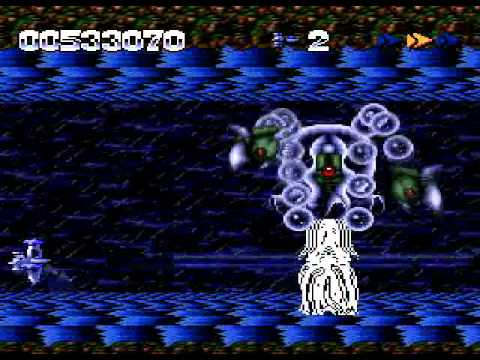
level 3

The boss of level 3, the water level. The moving blue ‘waves’ along the platform edges look very cool. (Image from Youtube.)

Level Designs – Graphics and Gameplay

The level themes are not original, though., just well designed and interesting.  I like the designs, and the game has a great and very well thought out difficulty curve, but there’s noting too original in the level settings and such.  Stage 1, Jupiter, has grassy rock platforms with alien ships scattered around.  The stage is several screens high and is a good starting point for the game.  Stage 2, Uranus, is a brown stage that looks like something straight out of the movie Alien, with the usual alien heads, dripping fluids, and such.  Again the stage is two screens tall.  Alien clearly made a huge impression on games, seeing how everything from Contra to W-Ring copy its style.  Stage 3, Neptune, is the water level, because Neptune is blue so it’s got water on it, right? :p  As I said that water looks great. Stage 4, Pluto, is another base, this time a research lab with biological cell and robot enemies and a green circuit-board-like background.  There is some animation on the circuits on the platforms.   Stage 5, Main Gate, is the fast stage, so you have to set the speed to max and try to learn the layout.  This stage is another all-metal base.

Stage 6, Death Hole, has a similar theme to the last stage, but with some pretty cool machinery around the stage as I said earlier, and some animation in the main background  behind your ship as well.  I love the large spinning wheels of lights, they look pretty cool.  Also, things have slowed down; you are now nearing the final stretch, and have a narrow pathway to make your way through, the titular ‘Death Hole’ I guess. While earlier stages often give you a screen or two of vertical space to move up and down, this level varies between half a screen and very narrow passages, so you are very constrained and there often isn’t much room to avoid the enemies.  This level is tough!  And last, Stage X plays over an animating wavy red screen.  The background looks great, but it can be very distracting.  This stage is short but the enemies are tough, the background crazy, and the boss hard.  And if you get a game over here, you learn one of this games’ crueler tricks: if you get a game over on stage 7, you go back all the way to the beginning of stage 6; Stage X doesn’t count for continues.  This makes the game so much more difficult than it needed to be, when you try to play the game in Hard mode!  I wish Stage X was a continue point.  Ah well.  What’s here is mostly quite good.

There is one last thing to mention here, those alternate stages.  As with the ?-mark alternate weapon powerups, alternate stages are accessed with hidden “EX” icons which you have to shoot to see.  If you touch the secret warp point, you’ll go into an alternate version of the level in question. These levels are generally shorter than the regular stages, but can be harder — the speed stage is even faster for example, in alternate mode.  Interestingly, the color palette changes in the alternate version of each level, so the water level has red water instead of blue if you’re in the secret variant version.  It’s cool stuff.  It’s more fun to try to find them for yourself, but if you want to be spoiled watch the video at the end of this post which shows ways to get into all the special stages.  Many do have multiple entry points so there are other ways to enter some special stages, but still it might be handy.  I found almost all of them myself without that video, only perhaps missing the one in, oddly, stage 1.  That explains why I never have been able to can’t find a special stage in level 6 — there apparently isn’t one.  Too bad.  Stage X doesn’t have one either, but I never thought it would with its short length and focused design.

screenshot

The level 4 boss, from the computer/bio-research stage. (Screenshot from Youtube.)

Difficulty and Expert Mode

I beat this game on Normal several years back; it may seem challenging at first, but even I don’t have too much trouble with it anymore and I’m far from great at this genre.  A month or two ago, though, I played the game again for the first time in a while, and started the game on Normal difficulty.  I found it surprisingly easy — on my very first try, I beat the whole game without getting a game over!  There were a few hairy moments in level 6, but I got through and beat the game.  That’s impressive stuff for me, I haven’t 1-credit-cleared many shooters, for sure.  So I was feeling good… and then it looped over into Expert (Hard) mode, after the short endgame sequence.  Everything changed; Expert is an entirely different story! As easy as the game is on Normal, it’s BRUTALLY hard on Expert. I got my first game over early in stage 1, and it took a fair number of tries at each of the first five stages to get past each one.  I was working my way through Expert mode at a reasonable pace, though.  In addition to wanting to complete this great game on its more challenging setting, I also I wanted to see if the game has a different ending on Expert difficulty versus Normal — nobody online had mentiond if there is one, and there are no gameplay videos of Expert mode online.  And then I hit stage 6, and a brick wall of bullets and enemies.

You see, stage 6 plus X in Expert mode is INCREDIBLY difficult.  Again, there is no continue point at the last stage, 7 aka “Stage X”, so you have to go back to the start of stage 6 upon game over, had me frustrated for hours as I kept trying, and failing, to beat the game.  This stage-and-a-half of game is super, super hard on Expert. I did beat it, finally… sort of: I ended up having to use a cheatcode to win because I just couldn’t quite manage it otherwise.  I came very close once to beating the game without the cheat, though, in my time trying, but more on that soon.  I spent more hours trying to beat stages 6+X than I did level 9 of Zero Wing for the Turbo CD, to compare it to another tricky shmup I played recently, and to less avail.  Stage 6 is so narrow and confined that sometimes there is nowhere to go to avoid bullets, and there are SO many enemies on screen all shooting at you! Not getting hit is near-impossible at times, even with the best weapon for the stage, the Red + ? weapon that sends bouncy spheres around the screen forwards and back.

In all my tries, I defeated the final boss twice, once without the cheatcode and once quite a few hours later with it. See, that first time, I beat the final boss, but somehow died moments later. I don’t know how, I should have been safe with the boss dead. Killing me after beating the game was incredibly cheap, and I never managed to get that far again, frustratingly.  Perhaps the worst was a time I got to Stage X with four lives left, only to waste all of them and reach the boss on my last life since Stage X is really hard unless you have weapon powerups when you reach it, which I didn’t because I’d messed up at the Stage 6 boss and got hit. Eventually I gave up and turned off the game… then looked the game up on the PC Engine FX forums and found a cheatcode. If you go into the sound test and start playing music tracks 7, 9, 3, and 10 (in that order), you get an additional pair of sphere-shields rotating around your ship. You’re not invincible, but this help was enough to get me through Expert mode on this second attempt, though it did take more than a few tries to get past level 6+X even with the help. I’ll count it as a win.

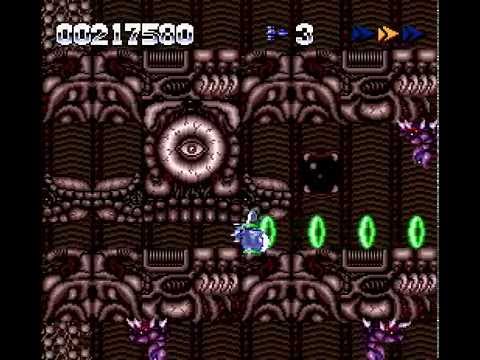
shot 4

Level 2 looks like something straight out of Alien. (Screenshot from Youtube.)

Conclusion

So, W-Ring is a great game, but the difficulty level is a bit unbalanced.  I do love W-Ring, more than many people seem to, but still, the stratospheric jump in challenge between the rest of the game and Expert mode is a bit much.  This is a very easy game on Normal, and even EASIER on Easy… and a near-impossible nightmare of frustration on Hard (“Expert”). And in Expert, the last level (6 and X combined) is exponentially harder than any other stage in the game. A smoother difficulty curve would be much better than what you see in this game; it doesn’t need to be much easier, just not have as massive a gulf between the rest of the game and this.  Just having a checkpoint in Level X so that if you get game over you start from there might have done the trick, really.  It’s too bad they didn’t do that.

My other main issue with the game is that I never really felt like I could just get through with pure memorization — I felt like there is a random element to the hit detection in this game, more so than a highly-precise game like R-Type or Zero Wing has.  It’s very hard to tell when a bullet was going to hit my ship versus and when it was going to harmlessly bounce off the shields, and the bullets are fast, small, and SERIOUSLY blend in to the background too, particularly in level 6. So, I often just had to take my chances, and this often resulted in getting hit. And in a level where taking even one hit is doom because you lose your weapon when you get hit and weapon powerups in lv. 6 are far apart, so you’ll get hit again and die, that is a problem. I still like this game, but I wish the bullets were easier to see and it was clearer about whether something is going to hit the ship or the shield ring. The game has great graphics and music, with impressively animating backgrounds and lots of color and variety, but the hard-to-see bullets are its one visual flaw.

Finally… why is the title “The Double Rings” when that shield around your ship is a single ring? There are some things constructed out of two rings, such as the red-weapon balls or that twin rotating shield from the cheat, but I don’t know if it’s meant to refer to any of those things, the single ring around your ship is the most obvious thing. It’s a weird title. I wonder if the manual explains it… but I don’t have the manual, just a loose card for this game, and it’d be in Japanese anyway of course.  Someone on PC Engine FX has speculated that the cheatcode’s added double shield explains it and the “double rings” refer to those, but I’m not so sure; each of those balls is made up of two rings itself, so that adds up to well over two rings, between teh two of them and that single ring around your ship.  So it’s a bit of a mystery.  Regardless, though, W-Ring is a very good game I highly recommend.  The game has flaws, but it also has strengths, and overall I quite like it even if it’s not Gradius or R-Type precise.   With great graphics and music, varied levels, and plenty of challenge, I give W-Ring: The Double Rings an A-.  It’s good.

Video

https://www.youtube.com/watch?v=BBepfrMRizk – This is a longplay video of Normal difficulty.  The player does not enter any of the hidden alternate versions of stages in this run.

https://www.youtube.com/watch?v=D3L0YjNhYNY – In this longplay the same player as above enters all of the special hidden stages.  Note that many of them do have multiple entry points so this doesn’t show every way to get into the special stages, but it definitely is a nice help for anyone who doesn’t want to have to find them the hard way by just shooting at stuff or lucking into one.

Posted in Classic Games, Full Reviews, Reviews, TurboGrafx-16 | Tagged , , , , | Leave a comment

List: Looney Tunes Games

Looney Tunes is my favorite cartoon series ever.  No other cartoon, Western or Eastern, matches its brilliance.  And because of its lasting popularity, there have been many Looney Tunes games over the years.  This list should include all of them.  Looney Tunes games are actually often decent, usually avoiding being the terrible licensed games you might expect.  There are some bad ones, but most are at least decent, and some, most notably Sunsoft’s Game Boy Looney Tunes games, are great!  Looney Tunes for the Game Boy is the first Looney Tunes game I remember playing, and it’s still lots of fun even if it is short and easy.  The other Sunsoft B&W GB games (Taz, Speedy, Daffy) are also very good.  Of the rest of the Looney Tunes games, Desert Demolition for the Genesis, the two 3d platformers (Lost in Time and Time Busters), Speedy Gonzales: Los Gatos Banditos, Taz in Escape from Mars, Porky Pig’s Haunted Holiday, and Looney Tunes Space Race are also good.  The worst I have played might be Space Jam; I don’t know how they messed up Looney Tunes basketball with the NBA Jam engine, but somehow they managed it.  I haven’t played some other widely-panned titles like Back in Action or Loons, though.  But regardless, Looney Tunes games are often worth a look, check them out!

There is also a Looney Tunes games list on Wikipedia: https://en.wikipedia.org/wiki/List_of_Looney_Tunes_video_games.  I checked it while fixing my old list here up for posting.  The only games I was missing were: Bugs Bunny (2600), The Bugs Bunny Hare-Brained Adventure (PC), Galactic Taz Ball (DS), Looney Tunes Dash (iOS/Android), Looney Tunes Monster Match (BlackBerry), and Looney Tunes Galactic Sports (Vita).  I added them from that list; the rest of the games I found myself, including a few Wikipedia missed.  That list is missing a few games, and doesn’t try to list all the playable characters in each game, so I think mine has a place too.  Trying to figure out what all the playable characters are in every game took some time!  I should mention that I do not count Tiny Toon Adventures games here as Looney Tunes games; that is its own series.

Notes: The list is sorted into two major parts, first for games starring only a single Looney Tunes character, and second for multi-character games.  Games are sorted from oldest to newest within each category, and categories are sorted by number, from most to least — so the characters or groups of characters with the most games are listed first.  For games where I can’t find any info on who all the playable characters are, I made my best guess for where they should go in the list.

Note that even if the names are the same, every separate entry is an entirely different game — multiplatform games are listed with one title and the platforms afterwards.  Handheld Looney Tunes games are often similar to the console games, but they are mostly not ports, most are original titles.  Also, for each game I list the name, the platforms it was released on (in parenthesis), and lastly the games’ genre.  Most Looney Tunes games are platformers, but not all of them.

Finally, the two Looney Tunes Collector games are a bit tricky — Bugs and Marvin are the main characters of the two games, but each one also has 10-14 other playable characters.  Are they multi-character games?  Mostly… but unlike the multi-character games in that section, these two games have one character as a clear lead, so they aren’t quite like them.  So, I listed them in both categories.  Also, the biggest unanswered question here is, what are these games’ full character rosters?  I spent some time searching and watching videos, but can’t find a list of all playable characters in each game, and sadly I don’t have them myself; though they look pretty interesting, somehow they just weren’t on my radar.  I’ll need to change that!  But for now, I don’t know exactly who is unlockable in these games.  Otherwise, the only other games missing full character lists are some mobile and edutainment titles — Monster Match (if there are unlockable characters), Home Tweet Home, and Cosmic Capers.

Edit, Nov. 2018: I incorrectly listed the Game Gear and Master System versions of Taz-Mania as being the same game, but they very much are not, the two are entirely different.  That’s nice, because the SMS game looks like fun, quite unlike the mess that is the GG game…

One Playable Character Only (or as the clear lead)

Bugs Bunny

  • [Unreleased Title] Bugs Bunny (2600) – Arcade Action – Though cancelled, the rom of this game is available on the internet so it can be played (or else I probably wouldn’t list it).
  • The Bugs Bunny Crazy Castle (GB/NES/FDS) (character is Mickey Mouse in original
  • Japanese version) (US only on NES, JP only on FDS) – Puzzle-Platformer (2D)
  • Bugs Bunny Birthday Blowout (NES) – Platformer (2D)
  • The Bugs Bunny Hare-Brained Adventure (PC) – Platformer (2D)
  • Bugs Bunny Crazy Castle 2 (GB) – Puzzle-Platformer (2D)
  • Bugs Bunny Rabbit Rampage (SNES) – Platformer (2D)
  • Bugs Bunny in Double Trouble (GG) – Platformer (2D)
  • Bugs Bunny in Double Trouble (Genesis) – Platformer (2D)
  • Bugs Bunny: Lost in Time (PSX/PC) – Platformer (3D)
  • Bugs Bunny: Crazy Castle 3 (GB/GBC Dual-Mode) – Puzzle-Platformer (2D)
  • Looney Tunes Collector: Alert! (GBC) – Action-RPG (Topdown) – Bugs and 14 other characters are playable in this game as you unlock them during the game, but Bugs is the main character and the one the story centers around.
  • Bugs Bunny Crazy Castle 4 (GBC) – Puzzle-Platformer (2D)
  • Bugs Bunny Rabbit Rescue (BlackBerry mobile phone & GSM Java-compatible mobile phones) – Adventure

Taz the Tasmanian Devil

  • Taz (2600) – Arcade Action (2D)
  • Taz-Mania (Genesis) – Platformer (2D)
  • Taz-Mania (GG) – Platformer (2D)
  • Taz-Mania (SMS) – Platformer (2D)
  • Taz-Mania (SNES) – Autoscrolling Platform-Action (behind-the-character 3D)
  • Taz-Mania (GB) – Platformer (2D)
  • Taz in Escape from Mars (Genesis) – Platformer (2D)
  • Taz in Escape from Mars (GG/SMS) (Brazil only on SMS) – Platformer (2D)
  • Taz-Mania 2 (GB) – Platformer (2D)
  • Looney Tunes: Taz Express (N64) (Europe-only release) – Platformer (3D)
  • Taz Wanted (GC/PS2/Xbox/PC) – Platformer (3D)
  • Galactic Taz Ball (DS) – Platformer (Topdown 3D)

Daffy Duck

  • Daffy Duck, P.I. – The Case Of Missing Letters (PC)  – Edutainment (2D)
  • Daffy Duck: The Marvin Missions (SNES) – Platformer (2D)
  • Daffy Duck in Hollywood (SMS/GG) (SMS EU only, GG EU/SA only) – Platformer (2D)
  • Daffy Duck in Hollywood (Genesis) (EU only) – Platformer (2D)
  • Daffy Duck: The Marvin Missions (GB) – Platformer (2D)
  • Daffy Duck: Fowl Play (GB/GBC Dual-Mode) – Platformer (2D)
  • Duck Dodgers Starring Daffy Duck (N64) – Platformer (3D)
  • Looney Tunes: Duck Amuck (DS) – Minigame Collection

Speedy Gonzales

  • Speedy Gonzales (GB) – Platformer (2D)
  • Cheese Cat-Astrophe Starring Speedy Gonzales (Genesis) (Europe only release) – Platformer (2D)
  • Cheese Cat-Astrophe Starring Speedy Gonzales (SMS/GG) (Europe only release on SMS, US only on GG) – Platformer (2D)
  • Speedy Gonzales: Los Gatos Banditos (SNES) – Platformer (2D)
  • Speedy Gonzales: Aztec Adventure (GB/GBC Dual-Mode) – Platformer (2D)

Road Runner

  • Road Runner (Arcade/Atari 2600/Amstrad CPC/Atari ST/Commodore 64/PC (DOS), ZX Spectrum, NES) – Arcade Action-Platform (Topdown)
  • Road Runner and Wile E. Coyote (Amstrad CPC/Commodore 64) (Hi-Tec Software title, sometimes called just “Road Runner”) – Single-Screen Platformer (2D)
  • Road Runner’s Death Valley Rally (SNES) – Platformer (2D)
  • Desert Speedtrap Starring Road Runner and Wile E. Coyote (GG/SMS) (EU/SA only on SMS) – Platformer (2D)

Sylvester the Cat

  • Sylvester & Tweety in Cagey Capers (Genesis) – Platformer (2D)
  • Looney Tunes: Twouble! (GB/GBC Dual-Mode) – Platformer (2D) & Action-Adventure (Isometric)

Porky Pig

  • Porky Pig’s Haunted Holiday (SNES) – Platformer (2D)

Marvin the Martian

  • Looney Tunes Collector: Marvin Strikes Back! (GBC) – Action-RPG (Topdown) – Marvin and 15 or more other characters are playable in this game as you unlock them during the game, but Marvin is the main character and the one the story centers around.

Tweety

  • Tweety’s High-Flying Adventure (GBC) – Platformer (2D)

Ralph Wolf

  • Looney Tunes Sheep Raider (PSX/PC) (“Looney Tunes: Sheep, Dog ‘n’ Wolf” in Europe) (PC version Europe only?) – Puzzle-Platformer (3D)

Multi Character Games

Bugs Bunny and Lola Bunny

  • Looney Tunes: Carrot Crazy (GB/GBC dual-mode)

Bugs Bunny and Taz the Tasmanian Devil

  • Bugs Bunny & Taz: Time Busters (PSX/PC)

Bugs Bunny and Daffy Duck

  • Looney Tunes: Back in Action (GBA)
  • Looney Tunes: Back in Action (PS2/GC)

Road Runner and Wile E. Coyote

  • Desert Demolition Starring Road Runner and Wile E. Coyote (Genesis)

Bugs Bunny, Daffy Duck, Porky Pig

  • Looney Tunes: By A Hare (Arcade)

Bugs Bunny, Taz the Tazmanian Devil, Daffy Duck, Sylvester

  • Loons: The Fight for Fame (Xbox) – Beat ’em up-style Fighting (3D)

Bugs Bunny, Daffy Duck, Tweety Bird, Porky Pig (and maybe more unlockable?  I don’t know)

  • Looney Tunes Monster Match (BlackBerry & Java Touch mobile phones) – Puzzle

Bugs Bunny, Taz the Tasmanian Devil, Porky Pig, Daffy Duck, Speedy Gonzales, Tweety

  • Looney Tunes (GB) (later re-released as a GB/GBC Dual-Mode game)

Sylvester, Bugs Bunny, Daffy Duck, Yosemite Sam, Marc Antony, Porky Pork

  • Tweety & The Magic Gems (GBA) – Minigame Collection

Bugs Bunny, Daffy Duck, Wile E. Coyote, Porky Pig, Yosemite Sam, Taz

  • Looney Tunes Galactic Sports (Vita) (Europe-only release) – Sports Minigame Collection

Bugs Bunny, Road Runner, Tweety Bird, Daffy Duck, Taz, Speedy Gonzales [Taz and Speedy have 1 Episode each, the others 3 each.]

  • Looney Tunes Dash! (iOS / Android mobile phones) – Platformer – Endless Runner (3D into-the-screen)

Bugs Bunny, Taz the Tazmanian Devil, Foghorn Leghorn, Daffy Duck, Marvin the Martian, Gossamer

  • Looney Tunes: ACME Arsenal (PS2/Wii/Xbox 360) – Third-Person Action (3D)

Bugs Bunny, Daffy Duck, Yosemite Sam, Elmer Fudd, Wile E. Coyote, Sylvester, Porky Pig, Marvin the Martian (last two must be unlocked)

  • Looney Tunes: Space Race (DC/PS2)

Bugs Bunny, Lola Bunny, Daffy Duck, Wile E. Coyote, Foghorn Leghorn, Yosemite Sam, Marvin the Martian, Taz the Tasmanian Devil (latter four must be unlocked)

  • Looney Tunes Racing (GBC)

Bugs Bunny, Daffy Duck, Marvin the Martian, Sylvester, Yosemite Sam, Tasmanian Devil, Wile E. Coyote, Elmer Fudd

  • Looney Tunes B-Ball (SNES) – Sports (Basketball)

Road Runner (Game 1); Bugs Bunny, Daffy Duck, Foghorn Leghorn, Tweety Bird, Porky Pig, Sylvester (Game 2)

  • Looney Tunes Double Pack – Dizzy Driving & ACME Antics (GBA) (ACME Antics: Road Runner.  Dizzy Driving: Bugs Bunny, Daffy Duck, Foghorn Leghorn, Tweety Bird, Porky Pig, Sylvester) – ACME Antics: Running Action (2D); Dizzy Driving: Racing (Topdown 2D).  Note that these games are not sold separately so I count them as one.

Bugs Bunny, Daffy Duck, Wile E. Coyote, Sylvester the Cat, Elmer Fudd, Yosemite Sam, Marvin the Martian, Porky Pig, Instant Martian King

  • Looney Tunes: Space Race (DC/PS2)

Bugs Bunny, Daffy Duck, Witch Hazel, Elmer Fudd, Sylvester, Foghorn Leghorn, MOT, Tweety Bird, Pepe Le Peu, and 6 more characters (who?)

  • Looney Tunes Collector: Alert! (GBC) – Action-RPG (Topdown)

Marvin the Martian, K-9, Speedy Gonzales, Road Runner, Papa Bear, Elmer Fudd, Marc Antony, Lola Bunny, Bugs Bunny, Daffy Duck, and more (who?)

  • Looney Tunes Collector: Marvin Strikes Back! (GBC) – Action-RPG (Topdown)

Bugs Bunny, Taz the Tazmanian Devil, Lola Bunny, Daffy Duck, Wile E. Coyote, Marvin the Martian, (unlockable characters beyond this) Porky Pig, Sylvester, Granny, Duck Dodgers, Gossamer, Rocky, Pepe Le Peu, Genie, Hector, Yosemite Sam, Evil Scientist

  • Looney Tunes Racing (PSX) – Racing (Kart, 3D)

Michael Jordan (digitized human, not a Looney Toon obviously :p), Bugs Bunny, Taz the Tazmanian Devil, Lola Bunny, Sylvester, Wile E. Coyote, Foghorn Leghorn, Elmer Fudd, Yosemite Sam, Daffy Duck, Pepe Le Pew, Porky Pig, and the Monstar rivals from the movie:  Nawt, Bang, Blanko, Bupkus, Pound.

  • Space Jam (PSX, SAT, PC) – Sports (Basketball – NBA Jam-engine 2d isometric) & Minigames (misc. 2d)

Unknown beyond Marvin the Martian and Bugs Bunny (but there are surely quite a few)

  • Looney Tunes Cosmic Capers Animated Jigsaws (PC) – Jigsaw Puzzles (each one is of a Looney Tunes scene.  I do not know which characters specifically appear, beyond Bugs Bunny and Marvin the Martian.)

Misc. Looney Tunes Art Creation Tools

  • ACME Animation Factory (SNES) – Art
  • Home Tweet Home: Interactive Coloring Book (PC) – Jigsaw Puzzle (Tweety theme)
  • Looney Tunes PhotoFun (PC) – Art
  • Looney Tunes: Cartoon Conductor (DS) – Art
Posted in Atari 2600, Classic Games, Dreamcast, Game Boy, Game Boy Advance, Game Boy Color, Game Gear, Gamecube, Genesis, Lists, NES, Nintendo 64, Nintendo Wii, PC, PlayStation, PlayStation 2, Saturn, Sega Master System, SNES, Xbox, Xbox 360 | Tagged , | 2 Comments

Opinion List: My Favorite Console (TV or Handheld System) Games By Platform (lists for each system) & A list of how much I like each console relative to the others I own

This post is a purely opinion-based list of my favorite games for each of the consoles I own.  This is only a console list — I will do a PC list separately because it’d be too hard to do them all at once, and computers really are different from consoles.  It includes top 5 lists for systems I have few games for, top 10 lists for systems I have a medium amount for, top 15 lists for systems I have a lot of games for, and a top 20 for a few combined lists (GB+GBC, for example). Top 1 list for the 32XCD. :p

Please note that all of these lists are just my thinking at the moment, they aren’t set in stone at all!  Some of the top titles are definitely my favorites for their consoles, but below that lists like these can always change.

This is different from my last favorite-games-by-platform list because it includes all titles, not just exclusives, and a full list for each platform instead of only one game for each.  It’s a much longer list, that’s for sure!  I also tried to get the games in the best order I can for how much I like each title.  The Honorable Mention sections are, for the most part, in order from best to least best (they’re all good games here, so “worst” doesn’t seem like the right word…), so they are organized and aren’t just random lists.

This post has three major parts — first this introduction section with this, the notes, and a list of how much I like each console relative to the others I have; second the handhelds section of the list; and third the TV consoles section of the list.  Within each of the latter two sections, consoles are organized in mostly chronological order from oldest to newest, excepting only the GB line which I group together to make the list flow better.  I don’t attempt an overall “my favorite console games I own” list, but maybe I will add one at some point; I’ll make a post about it if I do.  That is a lot harder than making single-platform lists.

Notes:

A * before the number marks a game that I’d give a 10/10 if grading easily (that is, if not using a PC Gamer-style tough grading scale where no game gets a perfect score).  No game is perfect, but these are better than the rest.

For most platforms I limit the honorable mentions list to titles I’d give at least an 8.5/10 to by the above standard, but for some platforms with fewer games, such as the Sega CD, I go a bit lower than that.

And finally, I usually don’t count Virtual Console-style re-releases for the main lists, though I may mention a few in the Honorable Mentions — straight emulated ports like those should count mainly for their original console.  I make exceptions for titles which are changed during the port, such as the new English translation of Monster World IV on the Wii (& other platforms), or Gamecube Ocarina of Time with its new addition, Master Quest.

Ranking my Consoles, favorite to least favorite.

Note that This is purely opinion-based here!  Also, all systems from #1 to #20 I like; it’s only the bottom six that I don’t like as much, though they have plenty of great games of course.

1. Nintendo 64, N64
2. (tie) Super Nintendo, SNES
2. (tie) Sega Genesis, Gen (with Sega CD, SCD & Sega 32X, 32X)
3. Nintendo DS, DS
4. Game Boy, GB
5. TurboGrafx-16, TG16 (with Turbo CD, TCD)
6. Gamecube, GC
7. Dreamcast, DC
8. NES
9. Wii
10. Odyssey 2, O2
11. Game Boy Advance, GBA
12. Atari 5200, 5200
13. Xbox 360, X360
14. Saturn, SS
15. Nintendo 3DS, 3DS
16. Atari 2600, 2600
17. Xbox
18. Neo Geo Pocket Color
19. Virtual Boy, VB
20. Game Boy Color, GBC
21. PlayStation Portable, PSP
22. Sega Master System, SMS
23. PlayStation, PSX, PS1
24. Game Gear, GG
25. Atari 7800, 7800
26. PlayStation 2, PS2

HANDHELDS

Note – for the Game Boy / GB Color line, I broke this up into four categories — first a combined GB+GBC list, then the original GB grey cart games only, then dual-mode black cart GB/GBC titles, then GBC only (clear cart) titles.  It’s messy, but necessary.

Game Boy & GB Color Combined List

*1. The Legend of Zelda: Link’s Awakening (GB) (just edging out Link’s Awakening DX (GBC))
*2. Super Mario Land 3: Wario Land (GB
*3. The Legend of Zelda: Oracle of Ages (GBC)
*4. Donkey Kong [’94] (GB)
*5. Kirby’s Dream Land 2 (GB)
*6. Gradius: The Interstellar Assault (GB)
*7. Hexcite (GB/C)
8. Super Mario Bros. Deluxe (GBC)
9. Bionic Commando: Elite Forces (GBC)
10. Mole Mania (GB)
11. The Legend of Zelda: Oracle of Seasons (GBC)
12. Final Fantasy Adventure (GB)
13. Kirby’s Pinball Land (GB)
14. (tie) Mega Man IV (GB)
14. (tie) Mega Man V (GB)
15. Survival Kids (GB/C)
16. Micro Machines (GB)
17. Donkey Kong Country (GBC)
18. Montezuma’s Return (GB/C)
19. Pokemon Puzzle Challenge (GBC)
20. Kirby’s Star Stacker (GB)

Honorable Mentions (the 10 games that are in the GB, GB/C, and GBC lists below but don’t make the top 20): Wave Race (GB), Bionic Commando (GB), WarLocked (GBC), Gargoyle’s Quest (GB), Tetris DX (GBC), Top Gear Pocket 2 (GBC), 3-D Ultra Pinball: Thrillride (GBC)

Game Boy (GB) – B&W-only games

*1. The Legend of Zelda: Link’s Awakening
*2. Super Mario Land 3: Wario Land
*3. Kirby’s Dream Land 2
*4. Donkey Kong [’94]
*5. Gradius: The Interstellar Assault
6. Mole Mania
7. Final Fantasy Adventure
8. Kirby’s Pinball Land
9. (tie) Mega Man IV
9. (tie) Mega Man V
10. Micro Machines
11. Super Mario Land 2: Six Golden Coins
12. Wave Race
13. Kirby’s Star Stacker
14. Bionic Commando (1992)
15. Gargoyle’s Quest

Honorable Mentions: Tetris, Parodius Da! (JP Only Release), Mega Man in Dr. Wily’s Revenge, Mega Man III, Kirby’s Block Ball, Kirby’s Dream Land, Kirby’s Star Stacker, Super Mario Land, Quarth, Wario Land II, Looney Tunes, Montezuma’s Return, Wave Race, Aerostar, Quarth, Bomberman GB, Speedy Gonzales, Looney Tunes, Taz-Mania, Daffy Duck: The Marvin Missions, Out of Gas, Amazing Penguin, Operation C, Alleyway, Lazlo’s Leap, Bionic Commando (1992), Vattle Giuce (JP Only Release), Parodius Da! (JP Only Release), Mega Man III, Turrican, Teenage Mutant Ninja Turtles 2: Back from the Sewers, Super Mario Land, Castlevania II: Belmont’s Revenge, Ninja Gaiden Shadow, Wario Blast: Featuring Bomberman!, Kid Icarus: Of Myths and Monsters, Rod Land (JP Only Release), Tetris Attack, Donkey Kong Land 3

Game Boy / Game Boy Color Dual-Mode Games

*1. The Legend of Zelda: Link’s Awakening DX
*2. Hexcite
3. Survival Kids
4. Montezuma’s Return
5. Tetris DX

Honorable Mentions: Conker’s Pocket Tales, Shanghai Pocket, Ghosts ‘N Goblins, Wario Land II, Looney Tunes, R-Type DX

Game Boy Color (GBC) – GBC Only Games

*1. The Legend of Zelda: Oracle of Ages
2. Super Mario Bros. Deluxe
3. Bionic Commando: Elite Forces
4. The Legend of Zelda: Oracle of Seasons
5. Donkey Kong Country
6. Pokemon Puzzle Challenge
7. WarLocked
8. Kirby Tilt ‘n’ Tumble
9. Top Gear Pocket 2
10. 3-D Ultra Pinball: Thrillride

Honorable Mentions: Toki Tori, Wario Land 3, Micro Machines V3, Lufia: The Legend Returns, Driver, Dragon Warrior III, Wendy: Every Witch Way, Top Gear Pocket, Frogger 2, Harry Potter and the Sorcerer’s Stone, Harry Potter and the Chamber of Secrets

Game Gear, GG

1. Bust-A-Move
2. Sonic the Hedgehog
3. Crystal Warriors
4. Super Columns
5. Royal Stone (JP Only Release)
6. Ristar
7. Gunstar Heroes (JP Only Release)
8. Psychic World
9. Columns
10. Tails’ Sky Patrol

Honorable Mentions: Pac-Man, Fray: Shuugyouhen (JP Only Release), Donald Duck: The Lucky Dime Caper, Outrun, Poker Face Paul’s Solitaire, Sonic Spinball, Putt & Putter: Miniature Golf, Ms. Pac-Man, GG Aleste II (JP/EU Only Release; JP Version), Sylvan Tale (JP Only Release)

Virtual Boy, VB

1. Virtual Boy Wario Land
2. Vertical Force
3. 3-D Tetris
4. Mario’s Tennis
5. Galactic Pinball

Honorable Mentions: Mario Clash, Telero Boxer, Red Alarm, V-Tetris (JP Only Release)

NeoGeo Pocket Color, NGPC & Neo-Geo Pocket, NGP
(combined because I only have a NGPC, so I don’t know how the dual-mode games would play in B&W.)

*1. The Last Blade
*2. Metal Slug: First Mission
3. SNK vs. Capcom: Match of the Millenium
4. Picture Puzzle
5. The King of Fighters R-2

Honorable Mentions: Sonic the Hedgehog: Pocket Adventure, Metal Slug: Second Mission, Crush Roller, Samurai Shodown! Pocket Fighting Series (JP version; JP/EU only release), The King of Fighters R-1 (B&W-only game) (JP version; JP/EU only release)

Game Boy Advance, GBA

1. Fire Emblem
2. Digidrive (JP Only Release; has Western release on DSiWare)
3. Fire Emblem: The Sacred Stones
4. Summon Night: Swordcraft Story
5. Riviera: The Promised Land
6. Fire Emblem: Fuuin no Tsurugi (JP Only Release)
7. Super Puzzle Fighter II Turbo
8. Kururin Paradise (JP Only Release)
9. Advance Wars 2: Black Hole Rising
10. Golden Sun
11. Gunstar Super Heroes
12. The Legend of Zelda: A Link to the Past w/ Four Swords
13. Summon Night: Sworcraft Story 2
14. Metroid: Zero Mission
15. Wario Land 4

Honorable Mentions: Super Mario Advance, Castlevania: Circle of the Moon, Summon Night: Hajimari no Ishi (JP Only Release), Shining Soul II, Rayman 3, Mario vs. Donkey Kong, The Legend of Zelda: The Minish Cap, Kirby: Nightmare in Dream Land, The King of Fighters EX2: Howling Blood, Golden Sun: The Lost Age, Final Fantasy V Advance, The Mysterious Murasame Castle (Famicom Mini; JP Only Release), Shining Soul, Mega Man & Bass, Konami Krazy Racers, Karnaaj Rally, Racing Gears Advance, Wario Ware Twisted!, Medal of Honor: Infiltrator, Kirby and the Amazing Mirror, Top Gear Rally, Polarium Advance, Metroid Fusion, Gradius Galaxies, Sabre Wulf, The Legend of Zelda (Classic NES Series), Lady Sia

Nintendo DS, NDS

*1. Picross 3D
2. Picross DS
3. Etrian Odyssey III: The Drowned City
4. Advance Wars: Dual Strike
5. Planet Puzzle League
6. Knights in the Nightmare
7. Castlevania: Portrait of Ruin
8. Mario vs. Donkey Kong: Mini-Land Mayhem
9. Tetris DS
10. Etrian Odyssey
11. Desktop Tower Defense
12. Professor Layton and the Curious Village
13. Puzzle Quest: Galactix
14. Castlevania: Order of Ecclesia
15. Mega Man ZX Advent

Honorable Mentions: Phantasy Star 0 [Zero], Professor Layton and the Diabolical Box, Magnetica, Mario Kart DS, Mega Man ZX, Metroid Prime: Hunters, The Legend of Zelda: Spirit Tracks, Dragon Quest IX, Touch Detective, Touch Detective 2 1/2, Speed Racer: The Videogame, TrackMania Turbo: Build to Race, The Legend of Kage 2, Mega Man ZX, Meteos, Etrian Odyssey II: Heroes of Lagaard, pac’n Roll, Trace Memory, Might & Magic: Clash of Heroes, The Legend of Zelda: The Phantom Hourglass, Kirby Super Star Ultra, Kirby Mass Attack, Custom Robo Arena, Advance Wars: Days of Ruin, New Super Mario Bros., Yoshi’s Island DS, Super Speed Machines, Pokemon Ranger, Space Invaders Extreme 2, Orcs & Elves, Mazes of Fate Lunar: Dragon Song, Kirby Canvass Curse, Heroes of Mana, Geometry Wars: Galaxies, Bust-A-Move DFS, 7th Dragon (JP Only Release)

PlayStation Portable, PSP

1. Growlanser IV: Wayfarer of Time
2. Knights in the Nightmare
3. Castlevania: The Dracula X Chronicles
4. Every Extend Extra
5. Class of Heroes II
6. Class of Heroes
7. Ys Seven
8. WipEout Pulse
9. Hot Shots Tennis: Get a Grip
10. Daxter
11. Gurumin: A Monstrous Adventure
12. Lemmings
13. Ys I & II Chronicles
14. WipEout Pure
15. Gradius Collection

Honorable Mentions: Outrun 2006: Coast 2 Coast, Sid Meier’s Pirates!, PixelJunk Monsters Deluxe, Dissidia [012] Final Fantasy, Mega Man Powered Up, Gungnir, Capcom Puzzle World, Untold Legends: Brotherhood of the Blade, Super Collapse 3, N+, BlazBlue: Calamity Trigger Portable, BlazBlue: Continuum Shift II

Nintendo 3DS, 3DS
(my newest system, so only a top 5 for this one.)

1. Fire Emblem Awakening
2. The Legend of Zelda: A Link Between Worlds
3. Etrian Odyssey IV: Legends of the Titan
4. Mario Kart 7
5. Tetris Axis

Honorable Mentions: Super Mario 3D Land, Sonic: Lost World, Crosswords Plus

TV CONSOLES

Atari 2600, 2600

1. Warlords
2. Kaboom
3. Megamania
4. Buck Rogers: Planet of Zoom!
5. Enduro
6. Moon Patrol
7. Space Invaders
8. Solaris
9. Indy 500
10. Amidar

Honorable Mentions: Dodger Cars (Dodge ’em), Dragonfire, Commando Raid, Pheonix, Demon Attack, Moonsweeper, Kangaroo, Turmoil, Atlantis, Secret Quest, Dragonfire, Star Trek: Strategic Operations Simulator, Spider Fighter, Sprintmaster

Odyssey2/Videopac, O2
(different from my original O2 list because I have more games now.  I’m listing a top 10 despite having a small library for this system because this system has a lot of great games, I can’t pick just five.)

1. UFO!
2. Turtles
3. Quest for the Rings
4. K.C. Munchkin!
5. K.C.’s Krazy Chase!
6. Blockout! Breakdown!
7. P.T. Barnum’s Acrobats!
8. Freedom Fighters!
9. Alien Invaders – Plus!
10. Speedway!

Honorable Mentions: Pick Axe Pete!, Out of this World!, S.I.D. The Spellbinder!, Alpine Skiing!

Atari 5200, 5200
(only a top 5 because I have few games for this system)

1. Defender
2. Galaxian
3. Pole Position
4. Super Cobra
5. Popeye

Honorable Mentions: Dig-Dug, Astro Chase, Centipede, Missile Command, Star Raiders, Moon Patrol

Atari 7800, 7800
(only a top 5 because I have few games for this system.)

1. Galaga
2. Pole Position II
3. Desert Falcon
4. Centipede
5. Asteroids

Honorable Mentions: Robotron 2084, Food Fight, Ms. Pac-Man, Joust, Xevious

NES

*1. Super Mario Bros.
2. Mega Man 4
3. Super Mario Bros. 2
4. Super Mario Bros. 3
5. Kirby’s Adventure
6. Battletoads
7. “Ironman” Ivan Stewart’s Super Off-Road
8. Startropics
9. Rolling Thunder
10. Metal Storm
11. Mega Man 2
12. The Guardian Legend
13. Faxanadu
14. Gradius
15. Teenage Mutant Ninja Turtles III: The Manhattan Project

Honorable Mentions: Ninja Gaiden II: The Dark Sword of Chaos, The Legend of Zelda, DuckTales, Zoda’s Revenge: StarTropics II, Salamander (JP version of Life Force; better than the US release), Super Spy Hunter, Starship Hector, Gauntlet, Faria, Conquest of the Crystal Palace, Abadox, The Adventures of Lolo 2, Life Force (the US version), Iron Tank, Crystalis, Bionic Commando, To the Earth, Rollergames, Ninja Gaiden, Jackal, Gargoyle’s Quest II: The Demon Darkness, Donkey Kong Classics, Contra, Castlevanai Bubble Bobble, The Adventures of Lolo, Double Dragon II: The Revenge, Vindicators, Guerilla War, Bucky O’Hare, Zelda II: The Adventure of Link, Xexyz, Teenage Mutant Ninja Turtles II: The Arcade Game, P.O.W., Magical Taruruuto-kun: Fantastic World (JP Only Release), Little Nemo: The Dream Master, Blaster Master, Archon, Ninja Jajamaru: Ginga Daisakusen (JP Only Release), Journey to Silius, Layla (JP Only Release), Kabuki Quantum Fighter, Gyruss, Dr. Mario, Chip ‘N Dale: Rescue Rangers

Master System, SMS

1. Zaxxon 3-D (in 3D mode, with the SegaScope 3D Glasses)
2. The Ninja
3. Ys: The Vanished Omens
4. Choplifter!
5. Rastan
6. Rambo: First Blood Part II
7. Kenseiden
8. Power Strike (aka Aleste)
9. Global Defense
10. Shinobi

Honorable Mentions: Shooting Gallery, Shanghai, Action Fighter, Golvellius: Valley of Doom, Missile Command 3-D

Combined TG16 & TCD List

1. Gradius II: Gofer no Yabou (JP Only Release) (TCD)
2. Nexzr Special: Summer Carnival ’93 (JP Only Release) (TCD)
3. Blazing Lazers (TG16)
4. Ginga Fukei Densetsu Sapphire (JP Only Release) (TCD)
5. Alzadick: Summer Carnival ’92 (JP Only Release) (TCD)
6. Castlevania X: Rondo of Blood (JP Only Release) (TCD)
7. Bomberman ’93 (TG16)
8. R-Type (TG16)
9. Monster Lair (TCD)
10. Bonk’s Revenge (TG16)
11. Zero Wing (JP Only Release) (TCD)
12. Bomberman ’94 (JP Only Release) (TG16)
13. Victory Run (TG16)
14. Super Darius II (JP Only Release) (TCD)
15. Valkyrie no Densetsu (TG16)
16. Bonk’s Adventure (TG16)
17. Gradius (JP Only Release) (TG16)
18. Bikkuriman World (JP Only Release) [Wonder Boy in Monster Land] (TG16)
19. W-Ring: The Double Rings (JP Only Release) (TG16)
20. Aero Blasters (TG16)

Honorable Mentions (the 10 TG16 and TCD games that are in the numbered lists below but don’t make the top 20 here): Avenger (JP Only Release) (TCD), Down Load (TG16), Splash Lake (TCD), Metal Stoker (TG16), Hyperdyne Sidearms (TG16), Shanghai II (JP Only Release), Puyo Puyo CD (JP Only Release), Ys Books I & II, Seirei Senshi Spriggan (JP Only Release), Alien Crush (TG16)

TurboGrafx-16, TG16

1. Blazing Lazers
2. Bomberman ’93
3. R-Type
4. Bomberman ’94 (JP Only Release)
5. Bonk’s Revenge
6. Victory Run
6. Bonk’s Adventure
7. Valkyrie no Densetsu (JP Only Release)
8. Gradius (JP Only Release)
9. Bikkuriman World (JP Only Release) [Wonder Boy in Monster Land]
10. W-Ring: The Double Rings (JP Only Release)
11. Aero Blasters
12. Down Load (JP Only Release)
13. Hyperdyne Sidearms
14. Metal Stoker: Neo Hardboiled Shooting (JP Only Release)
15. Kyukyoku Tiger (JP Only Release) [Twin Cobra]

Honorable Mentions: Kaizou Chounin Shubininman (JP Only Release), Final Soldier (JP Only Release), Cyber Core, Gomola Speed (JP Only Release), Son Son II (JP Only Release), Neutopia, Kiki Kaikai (JP Only Release), Tiger Road, Super Star Soldier, Street Fighter II’: Champion Edition (JP Only Release), Momotarou Katsugeki (JP Only Release), Keith Courage in Alpha Zones, F1 Circus ’91 (JP Only Release), Dungeon Explorer, Armed Formation F (JP Only Release), Moto Roader, Final Blaster (JP Only Release), Doraemon: Meikyuu Daisakusen (JP version of Cratermaze, slightly different), Shockman

TurboGrafx-CD, TCD

1. Gradius II: Gofer no Yabou (JP Only Release)
2. Nexzr Special: Summer Carnival ’93 (JP Only Release)
3. Ginga Fukei Densetsu Sapphire (JP Only Release)
4. Alzadick: Summer Carnival ’92 (JP Only Release)
5. Castlevania X: Rondo of Blood (JP Only Release)
6. Monster Lair
7. Zero Wing (JP Only Release)
8. Super Darius II (JP Only Release)
9. World Heroes 2 (JP Only Release)
10. Avenger (JP Only Release)
11. Splash Lake
12. Shanghai II (JP Only Release)
13. Puyo Puyo CD (JP Only Release)
14. Ys I & II
15. Spriggan (JP Only Release)

Honorable Mentions: Blood Gear (JP Only Release), Sylphia (JP Only Release), Efera & Jiliora: The Emblem from Darkness (JP Only Release), The Legend of Xanadu II (JP Only Release), Brandish (JP Only Release), Cosmic Fantasy 2, Super Darius (JP Only Release), Minesweeper (JP Only Release), Magicoal (JP Only Release), Last Alert, Ultra Box (I have vols 2, 3, 4, and 6) (JP Only Release), L-Dis (JP Only Release), Langrisser: Hikari no Matsuei (JP Only Release), Daisenpuu Custom (JP Only Release), Xak III (JP Only Release), Ys IV (JP Only Release)

Genesis plus Sega CD plus 32X (all combined)

*1. Sonic 3 & Knuckles (I’m going to count this as one game.)
*2. Sonic the Hedgehog 2
3. Lunar 2: Eternal Blue (SCD)
4. Sonic the Hedgehog
5. Mega Turrican
6. Outrun 2019
7. Space Harrier (32X)
8. Aladdin
9. Silpheed (SCD)
10. The Adventures of Batman & Robin
11. Landstalker: The Treasures of King Nole
12. Streets of Rage 2
13. Lightening Force
14. Shadow Dancer: The Secret of Shinobi
15. Sonic CD (SCD)
16. Ranger-X
17. Contra: Hard Corps
18. Vectorman
19. Golden Axe
20. Robo Aleste (SCD)

Honorable Mentions (the 10 games that are in the Genesis, SCD, and 32X lists but don’t make the top 20): V.R.: Virtua Racing Deluxe (32X), Popful Mail (SCD), Ecco the Dolphin (SCD), NBA Jam T.E. (32X), The Adventures of Batman & Robin (SCD), SoulStar (SCD), Dark Wizard (SCD), Flink (SCD), After Burner (32X).  Note that 34 Genesis games not listed here are as good or better than any of these ten games, but those games can’t fit in to my Genesis top 15 so they’re only in the Genesis Honorable Mentions list.

Genesis, Gen (Genesis Only)

*1. Sonic 3 & Knuckles
*2. Sonic the Hedgehog 2
3. Sonic the Hedgehog
4. Mega Turrican
5. Outrun 2019
6. Aladdin
7. Adventures of Batman & Robin
8. Landstalker: The Treasures of King Nole
9. Streets of Rage 2
10. Lightening Force
11. Shadow Dancer: The Secret of Shinobi
12. Ranger-X
13. Contra: Hard Corps
14. Vectorman
15. Golden Axe

Honorable Mentions: Alisia Dragoon, Monster World IV (JP Only Release), Eliminate Down (JP Only Release), Hardball III, Rocket Knight Adventures, Wonder Boy in Monster World, Universal Soldier, The Lost Vikings, Rolling Thunder 2, Eliminate Down, Golden Axe II, Truxton, Gauntlet IV, Warsong, Phelios, Micro Machines, Viewpoint, Blades of Vengeance, Comix Zone, Street Fighter II: Special Champion Edition, Sub-Terrania, Beyond Oasis, Roadblasters, Warsong, The Lost Vikings, Crusader of Centy, Zombies Ate my Neighbors, World of Illusion, Viewpoint, Vectorman 2, Target Earth, Gleylancer (JP Only Release), Dynamite Headdy, Cool Spot, Atomic Runner, Arcus Odyssey, Technoclash, Shinobi III, The Ooze, NBA Jam, El Viento, Samurai Shodown, Rolling Thunder 3, Ristar, MERCS, Ghouls ‘n Ghosts, Bio-Hazard Battle, Trouble Shooter, Red Zone, The Lost World: Jurassic Park, Fatal Rewind, Sonic 3D Blast, Boogerman, Burning Force, Desert Demolition starring Road Runner and Wile E. Coyote, Fire Shark, Greendog: The Beached Surfer Dude, Gunstar Heroes, Shining Force II

Super NES, SNES

*1. Super Mario World
2. F-Zero
3. Donkey Kong Country 3: Dixie’s Double Trouble
4. Super Turrican
5. Gradius III
5. Super Metroid
6. Illusion of Gaia
7. Donkey Kong Country 2: Diddy’s Kong Quest
8. Super Street Fighter II: The New Challengers
9. Firepower 2000
10. Donkey Kong Country
11. Space Megaforce
12. The Legend of Zelda: A Link to the Past
13. Kirby’s Dream Course
14. Yoshi’s Island: Super Mario World 2
15. Top Gear

Honorable Mentions : Doom, BlaZeon, Sunset Riders, Super Castlevania IV, Uniracers, Super Mario All-Stars, Super Bonk, Rockman & Forte (JP Only Release), Mega Man X, Jim Power: The Lost Dimension in 3D, Super Star Wars: Return of the Jedi, Street Racer, U.N. Squadron, Suoul Blazer, Tetris Attack, Teenage Mutant Ninja Turtles IV: Turtles in Time, Super Star Wars: The Empire Strikes Back, Super Nova [Darius Force], Operation: Logic Bomb, NBA Jam: Tournament Edition, Gun Force: Battle Fire Engulfed Terror Island, Final Fight 3, Ganbare Goemon 2: Kiteretsu Shogun Magginesu! (JP Only Release), Battle Cars, Axelay, ActRaiser, Top Gear II, Super Tetris 3 (JP Only Release), Seiken Densetsu III (JP Only Release), Spectre, Mohawk and Headphone Jack, Hyper Zone, Goof Troop, Top Gear 3000, World Heroes 2, Choplifter III, Wing Commander: The Secret Missions, The Twisted Tales of Spike McFang, Secret of Mana, Pop’n Twinbee (JP Only Release), Pilotwings, MechWarrior 3050, Magic Sword, Indiana Jones’ Greatest Adventures, Gods, First Samurai, The Block Kuzushi (JP Only Release), Arkanoid: Doh it Again, Ganbare Goemon [4]: Kirakira Douchuu — Boku ga Dancer ni natta Riyuu (JP Only Release), Fire Emblem: Mystery of the Emblem (JP Only Release)

Sega CD, SCD

1. Lunar 2: Eternal Blue
2. Silpheed
3. Sonic CD
4. Robo Aleste
5. Popful Mail
6. Ecco the Dolphin
7. The Adventures of Batman & Robin
8. SoulStar
9. Dark Wizard
10. Flink

Honorable Mentions: Lords of Thunder, Star Wars: Rebel Assault, Wirehead, Ground Zero Texas, Android Assault, Mickey Mania, Battlecorps, Night Striker (JP only release), Sol-Feace, Lunar: The Silver Star, Shining Force CD, Mortal Kombat, Ecco 2: The Tides of Time, Snatcher

Sega 32X, 32X
This is only a top 5 because I have few games for this system.

1. Space Harrier
2. Shadow Squadron
3. V.R.: Virtua Racing Deluxe
4. NBA Jam TE
5. After Burner

Honorable Mentions: Kolibri, Star Wars Arcade, Zaxxon’s Motherbase 2000, Tempo, Metal Head, Mortal Kombat 2, Star Trek Starfleet Academy Starship Bridge Simulator

Sega 32X CD, 32XCD

1. Fahrenheit (the worst game in this entire post; but I wish 32XCD Soviet Strike actually was out there or it’d be that!  And Wirehead 32XCD should have been finished, too.)

Saturn, SS

1. Panzer Dragoon
2. Panzer Dragoon II: Zwei
3. WipEout
4. Vampire Saviour: The Lord of Vampire (JP Only Release)
5. Daytona USA: Circuit Edition (JP Only Release)
6. Assault Suit Leynos 2 (JP Only Release)
7. NBA Jam: Tournament Edition
8. NiGHTS into dreams…
9. V.R.: Virtua Racing
10. Daytona USA
11. Magical Drop II (JP Only Release)
12. Night Warriors: DarkStalkers’ Revenge
13. Star Fighter
14. Soukyugurentai Otokuyo (JP Only Release)
15. Tokimeki Memorial Taisen Puzzle Dama (JP Only Release)

Honorable Mentions: Bug!, Galactic Attack, Steamgear Mash (JP Only Release), Soviet Strike, SEGA Rally Championship, Mega Man 8, MechWarrior 2: Arcade Combat Edition, Grandia (JP Only Release), Dead or Alive (JP Only Release), Willy Wombat (JP Only Release), Sonic Wings Special (JP Only Release), Mass Destruction, Magical School Lunar! (JP Only Release), CrimeWave, Bulk Slash (JP Only Release), Solo Crisis (JP Only Release), Puyo Puyo Sun (JP Only Release), Lunacy, Hang-On GP, Fighting Vipers, Puyo Puyo Tsuu (JP Only Release), Last Gladiators: Digital Pinball, Bust-A-Move 2: Arcade Edition, Bug Too!, Arcade’s Greatest Hits: The Atari Collection 1, Detana Twinbee Yahho! Deluxe Pack (JP Only Release), Parodius Deluxe Pack (JP Only Release)

PlayStation, PSX, PS1
This order is different from the list I posted several years ago in the PS1 list, but these lists aren’t meant to be set forever, so that’s fine.

1. Threads of Fate
2. Star Ocean: The Second Story
3. Tempest X3
4. Wipeout 3
5. Rollcage
6. Darkstalkers 3
7. Wipeout XL
8. Warhawk
9. Strikers 1945 (II)
10. Croc: Legend of the Gobbos
11. Lunar: Silver Star Story Complete
12. Evil Zone
13. Red Asphalt
14. Grandia
15. Tenchu: Stealth Assassins

Honorable Mentions: Alundra, Motor Toon Grand Prix, Persona 2: Eternal Punishment, Steel Reign, Gradius Gaiden (JP only release), PuchiCarat (JP only release), Sled Storm, Need for Speed: High Stakes, Space Hulk: Vengeance of the Blood Angels, Megatudo 2096 (JP only release), Egg (JP only release), Bushido Blade 2, Dead or Alive, Rage Racer, Sea-Doo HydroCross, Heart of Darkness, Road Rash 3D, MDK, Wild ARMs, Croc 2, Brave Fencer Musashi, Driver, Driver 2, Vandal Hearts, Rush Hour, Pac-Man World, Ghost in the Shell

Nintendo 64, N64

*1. The Legend of Zelda: Ocarina of Time
*2. Super Mario 64 / Super Mario 64: Rumble Pak Edition (JP Only Release)
*3. San Francisco Rush 2049
*4. F-Zero X
5. Wipeout 64
6. Paper Mario
7. Goemon’s Great Adventure
8. Donkey Kong 64
9. Perfect Dark
10. Ogre Battle 64
11. Excitebike 64
12. Blast Corps
13. Wave Race 64
14. Jet Force Gemini
15.
Mario Kart 64

Honorable Mentions: Bust-A-Move ’99, Turok 3: Shadow of Obliviion, Shadowgate 64: Trials of the FOur Towers, San Francisco Rush: Extreme Racing, Doom 64, Custom Robo (JP Only Release), Banjo-Tooie, Susume! Taisen Puzzle Dama (JP Only Release), Gauntlet Legends, Forsaken 64, Bomberman 64 (2001, JP; JP Only Release), Worms Armageddon, Star Wars: Rogue Squadron, Top Gear Rally, Sin and Punishment: Successor to the Earth (JP Only Release), Resident Evil 2, NFL Blitz 2000, The New Tetris, Mysterious Dungeon: Shiren the Wanderer 2 (JP Only Release),  Mischief Makers, Micro Machines 64 Turbo, Dr. Mario 64, Custom Robo V2 (JP Only Release), Conker’s Bad Fur Day, Banjo-Kazooie, Turok: Dinosaur Hunter, Top Gear Hyper-Bike, Tetrisphere, Star Wars: Battle for Naboo, Shadow Man, Lode Runner 3D, The Legend of Zelda: Majora’s Mask, Extreme-G 2, Wertrix, Turok 2: Seeds of Evil, Super Smash Bros., Star Fox 64, Space Station Silicon Valley, Rush 2: Extreme Racing USA, Pilotwings 64, Mickey’s Speedway USA, Indiana Jones and the Infernal Machine, California Speed, Big Mountain 2000, 007: The World Is Not Enough, WinBack: Covert Operations, Turok: Rage Wars, Top Gear OVerdrive, NBA Hang Time, Fighter’s Destiny, Castlevania: Legacy of Darkness, BattleTanx: Global Assault, Snowboard Kids 2, SD Hiryu no Ken Densetsu (JP Only Release), Rocket: Robot on Wheels, Pokemon Puzzle League, Monaco Grand Prix, Mega Man 64, Fighter Destiny 2, Diddy Kong Racing, All-Star Baseball ’99

Dreamcast

*1. Skies of Arcadia
2. Ikaruga (JP Only Release)
3. Rayman 2: The Great Escape
4. San Francisco Rush 2049
5. Street Fighter III: Double Impact & SFIII: Third Strike
6. Project Justice
7. Under Defeat (JP Only Release)
8. Jet Grind Radio
9. Soulcalibur
10. Crazy Taxi
11. Dead or Alive 2 Limited Edition (JP Only Release; this has more content than the earlier US version.)
12. Tennis 2K2
13. Grandia II
14. 4 Wheel Thunder
15. Sonic Adventure 2

Honorable Mentions: GunLord, Bangai-O, Giga Wing 2, Virtua Tennis, San Francisco Rush 2049, Toy Commander, Unreal Tournament, Quake III, The King of Fighters ’99 Evolution, Re-Volt, Vampire Chronicle for Matching Service (JP Only Release), Super Puzzle Fighter II X For Matching Service (JP Only Release), Phantasy Star Online ver. 1.0, Grandia II, Red Dog, Bust-A-Move 4, Ecco the Dolphin: Defender of the Future, Sonic Adventure, Rune Jade (JP Only Release), Border Down (JP Only Release), Trizeal (JP Only Release), Frogger 2: Swampy’s Revenge, Zombie Revenge, Puyo Puyo Fever (JP Only Release), Suzuki Alstare Extreme Racing, Crazy Taxi 2, Daytona USA (2001), House of the Dead 2, Sturmwind (Homebrew Release), Get!! Colonies (JP Only Release), Dynamite Cop, Capcom vs. SNK 2, Draconus: Cult of the Wyrm, TimeStalkers, Power Stone 2, The King of Fighters: Dream Match 1999, Fur Fighters, MSR: Metropolis Street Racer, Dynamite Cop!, Capcom vs. SNK: Millenium Fight 2000, Capcom vs. SNK 2 (JP Only Release), Street Fighter Alpha 3, Blue Stinger, Armada, Sakura Wars: Hanagumi Taisen Columns 2 (JP Only Release, Bang! Gunship Elite, Puyo Puyo 4: Puyo Puyo~n (JP Only Release), Centipede, 18-Wheeler: American Pro Trucker

PlayStation 2, PS2

1. Outrun 2006: Coast 2 Coast
2. Metal Slug Anthology
3. Maximo: Ghosts to Glory
4. Gradius V
5. Final Fantasy XII
6. The King of Fighters ’02/’03
7. The King of Fighters XI
8. Jak and Daxter: The Precursor Legacy
9. Champions of Norrath: Realms of EverQuest
10. Dragon Quest VIII: Journey of the Cursed King
11. Unlimited SaGa
12. WipEout Fusion
13. Rogue Galaxy
14. Shining Force Neo
15. Okami

Honorable Mentions: Primal, The King of Fighters 2006, Kinetica, Grand Theft Auto III, Chaos Wars, Soulcalibur III, Kya: Dark Lineage, Samurai Shodown Anthology, The King of Fighters ’98: Ultimate Match, Ys VI: The Ark of Napishtim, Jet X2O, Tribes: Aerial Assault, Stuntman, Nightshade, World Heroes Anthology, Haven: Call of the King, Sly Cooper and the Thevius Raccoonus, Gradius III and IV, Dark Cloud, Tenchu: Fatal Shadows, Taito Legends 2, Champions: Return to Arms, Xenosaga Episode I: Der Wille zur Macht, Tenchu: Wrath of Heaven, Stella Deus: The Gate of Eternity, Shadow Hearts, The Mark of Kri

GameCube, GCN

*1. Eternal Darkness: Sanity’s Requiem
*2. The Legend of Zelda: Ocarina of Time / Master Quest (listed because MQ was new)
3. Metroid Prime
4. The Legend of Zelda: Twilight Princess
5. Skies of Arcadia Legends
6. XGRA: Extreme-G Racing Association
7. Fire Emblem: Path of Radiance]
8. The Legned of Zelda: The Wind Waker
9. F-Zero GX
10. Star Wars: Rogue Squadron II: Rogue Leader
11. Wario Ware Inc.: Mega Party Games
12. Capcom vs SNK 2: EO
13. Gauntlet: Dark Legacy
14. Soulcalibur II
15. Super Mario Sunshine

Honorable Mentions: Paper Mario: The Thousand Year Door, Custom Robo: Battle Revolution, Defender, Donkey Kong Jungle Beat, Geist, The Legend of Zelda: Four Swords Adventures, Lost Kingdoms, Mario Kart Double Dash, Mega Man Anniversary Collection, P.N.03, Ikaruga, Metal Arms: Glitch in the System, Midway Arcade Treasures, Mystic Heroes, Beach Spikers, Star Wars Rogue Squadron III: Rebel Strike, Sonic Adventure 2 Battle, SpyHunter, Tales of Symphonia, SSX 3, Super Monkey Ball, Wave Race: Blue Storm, XG3: Extreme-G Racing, Phantasy Star Online Episode III: C.A.R.D. Revolution, Turok: Evolution, Super Smash Bros. Melee, Battalion Wars, Final Fantasy Crystal Chronicles, SpyHunter, Wario World, Phantasy Star Online Episodes I & II Plus, Mega Man X Collection, 1080 Degrees Avalanche, Resident Evil Zero, Donkey Kong: Jungle Beat, Zapper: One Wicked Cricket, Super Monkey Ball, Mega Man X: Command Mission, Lego Drome Racers, Billy Hatcher and the Giant Egg

Xbox

*1. Panzer Dragoon Orta
2. Quantum Redshift
3. Dead or Alive Ultimate
4. OutRun2
5. Crimson Skies: High Road to Revenge
6. GUNVALKYRIE
7. Burnout 3: Takedown
8. Enclave
9. I-Ninja
10. Hunter: The Reckoning
11. Oddworld: Stranger’s Wrath
12. Dead or Alive 3
13. Yager
14. Sphinx and the Cursed Mummy
15. Jet Set Radio Future

Honorable Mentions: Otogi: Myth of Demons, Sonic Mega Collection Plus, Street Fighter Anniversary Collection, SSX Tricky, RalliSport Challenge 2, Vexx, Turok Evolution, MechAssault, Halo: Combat Evolved, Guilty Gear X2 #Reload, Sonic Riders, Top Spin Tennis, SSX On Tour, NBA Ballers, The Lord of the Rings: The Two Towers, Blinx: The Time Sweeper, Unreal Championship, Whiteout, Sudeki, Tecmo Classic Arcade, Red Dead Revlver, Mortal Kombat: Armageddon, Malice, The King of Fighters NeoWave, Hunter: The Recknoning – Redeemer, The Bard’s Tale, Arctic THudner, Tenchu: Return from Darkness, Star Wars: Obi-Wan, Metal Slug 3, Black, Fable: The Lost Chapters, House of the Dead III, Freaky Fliers

Xbox 360, X360

1. Hydro Thunder Hurricane (XBLA)
2. The King of Fighters XIII
3. Kameo: Elements of Power
4. Daytona USA (XBLA)
5. Dead or Alive 4
6. Banjo-Kazooie: Nuts & Bolts
7. Dragon’s Dogma: Dark Arisen
8. Dead or Alive 5 Ultimate
9. Fatal Inertia
10. Dust: An Elysian Tale (XBLA)

Honorable Mentions: Stuntman: Ignition, Pure, Virtua Fighter 5 Online, The King of Fighters XII, Too Human, Catherine, BlazBlue: Calamity Trigger, Jetpac Refueled (XBLA), D&D: Chronicles of Mystara (XBLA), Moon Diver (XBLA), SSX, Blue Dragon, Venetica, BattleBlock Theater (XBLA), Rocket Knight (XBLA), Motocross Madness (XBLA), Defense Grid: The Awakening (XBLA), Dishonored, Crackdown

Wii

1. Super Mario Galaxy
2. The Legend of Zelda: Skyward Sword
3. Super Paper Mario
4. Kirby’s Return to Dream Land
5. Metroid Prime Trilogy
6. Xenoblade Chronicles
7. Mario Kart Wii
8. Fire Emblem: Radiant Dawn
9. Kirby’s Dream Collection: Special Edition
10. Donkey Kong Country Returns
11. Sin & Punishment: Star Successor
12. Monster World IV (Virtual Console – Sega Genesis – listed because the official translation of this previously JP-only title is new)
13. Final Fantasy Crystal Chronicles: My Life as a Darklord (WiiWare)
14. Mega Man 9 (WiiWare)
15. Gradius ReBirth (WiiWare)

Honorable Mentions: Mega Man 10 (WiiWare), Wii Sports Resort, Super Smash Bros. Brawl, Kirby’s Epic Yarn, Speed Racer: The Videogame, Spectrobes: Origins, Overlord: Dark Legend, Need for Speed: The Run, de Blob, NyxQuest: Kindred Spirits (WiiWare), Archer Maclean’s Speed Zone, NBA Jam, Geometry Wars: Galaxies, Excitebots: Trick Racing, FAST Racing League (WiiWare), TrackMania: Build to Race, Sonic and the Secret Rings, Klonoa, Shiren the Wanderer [3], Vampire Crystals, Wario Land: Shake It!, SSX Blur, Disney Epic Mickey, Excite Truck, Heavenly Guardian, Muramasa: The Demon Blade, New Super Mario Bros. Wii, Cruis’n, Tales of Symphonia: Dawn of the New World, Octomania, NiGHTS: Journey of Dreams, The Conduit, New Play Control! Pikmin, New Play Control! Pikmin 2, Naruto: Clash of Ninja Revolution, Naruto: Clash of Ninja Revolution 2, The Last Story, Dragon Quest Swords: The Masked Queen and the Tower of Mirrors, Jett Rocket (WiiWare), Eduardo the Samurai Toaster (WiiWare)

Of the very few other Wii Virtual Console games I have, Castlevania Dracula X: Rondo of Blood (from the Turbo CD) and Sin & Punishment: Successor to the Earth (from the N64) are also fantastic, as good as many games in the Wii top 15.

Posted in 32X, Atari 2600, Atari 5200, Atari 7800, Classic Games, Dreamcast, Game Boy, Game Boy Advance, Game Boy Color, Game Gear, Gamecube, Genesis, Lists, Modern Games, NES, Nintendo 64, Nintendo DS, Nintendo Wii, Odyssey 2, PlayStation, PlayStation 2, Playstation Portable, Saturn, Sega CD, Sega Master System, SNES, Turbo CD, TurboGrafx-16, Virtual Boy, Xbox | Tagged , , | 2 Comments

Updates made to Gauntlet Legends / Dark Legacy Version Comparison List

https://blackfalcongames.net/?p=62

The three tables at the end of the post now actually work and are nice images of the actual tables, and a few fixes were made to the list of platforms each game is available on at the top.  The latter is because of an old message from a member of the Digital Press forums that I finally implemented, and the former is because while I was checking the post I noticed the tables were missing or broken, so I fixed the issue.  They look better now than ever!

Posted in Updates | Tagged , , , | Leave a comment

Atari 5200 Game Opinion Summaries – Unpopular or no, I like this system!

Table of Contents
Background & My Thoughts on Getting the System
System History
The Controller

Astro Chase
Berzerk
Centipede
Defender
Dig-Dug
Galaxian
Joust
Missile Command
Kangaroo
Pac-Man
Pengo
Pole Position
Popeye
Qix
Space Invaders
Star Raiders
Super Breakout
Super Cobra

Background & My Thoughts on Getting the System

The Atari 5200 is really interesting and kind of good. I grew up playing PC and Nintendo games, not Atari, so the 5200 isn’t a console I knew much about as a kid. Once I did hear about it, it interested me because of its short lifespan, small library, and poor reputation; this made me want to try it to see if it was better than people said, as such things often are in this industry. So, in the ’00s I played a lot of emulated games, and one thing I tried were the 5200 and 7800. I probably played 5200 games more than 7800 games, interestingly enough. I liked the games, I just wasn’t sure what I’d think of the very-unpopular controller. That’s the big thing most people dislike about this system, after all. So, the first Atari system I got was a 7800, which I got in early 2013. At the time I kind of wanted the 5200, but that wasn’t available locally then while the 7800 was, so I got one. It’s a good system and playing 2600 and 7800 games was interesting and often fun, but sadly that console mostly stopped working in early to mid 2014 — its power button died. I really, really need to get it fixed, but haven’t.

Instead, in early August this year, I got a 5200… and I like it for sure. One thing I’ve noticed about the 5200 is that while the library is small, it’s really high quality! Most of the 17 games I own are good, only a few are only average, and none are bad. All of the games are fun to play to some degree. Of course, almost all of the games I have are conversions of popular arcade games, so that does make sense — they are working from quality source material. And that is one issue with this system, its library mostly consists of ports. There aren’t many 5200-exclusive games, in fact there are very, very few. That is too bad, but at least the games it did get are mostly good, and often have some differences versus other versions of the games. The 5200 isn’t powerful enough to do perfect ports of early ’80s arcade games, so 5200 games are at least somewhat unique, and no 5200 game is available on any modern platform — while Atari and Activision have done collections and re-releases of many of their 2600 and 7800 games, 5200 games have not been re-released, unfortunately. This is a pretty nice system which I love to have. I have played the 5200 at least some every day since I bought it in early August, and am still having a lot of fun with the system. Even though it has some flaws, overall I definitely like the 5200 and it’s great I finally have one.

System History

The Atari 5200 released in November 1982. It was a part of a new wave of consoles that released that year, which I consider to be the beginning of the third generation though most disagree. See my article on that issue for more on my thoughts on the issue of the ‘missing’ console generation of 1982-1984. This new wave of systems came two and a half years after the Mattel Intellivision’s release in late 1979. It is, essentially, consolized Atari 400 or 800-line 8-bit computer. Instead of designing an all-new console for their second home system, Atari decided to instead base it off of their already-existing computer line released in 1979. This meant that the hardware wasn’t entirely up-to-date. Computers are more powerful than consoles, in general, so the system is competitive with other consoles of the day, but it could have been a lot more powerful than it is. This can really be highlighted by pointing out that the much more powerful NES released in Japan in June 1983, only eight months after the 5200 did in the US. While the 5200 is within the same generation as the NES power-wise, it’s far behind it within that generation. The 5200’s main competition was the Colecovision, released in August 1982. The Colecovision sold much better than the 5200 and has about twice as many games released officially in the ’80s, 120-plus on Coleco versus only 60-something for the 5200. Nintendo took notice of the Colecovision, and supposedly designed the NES to be better than that console. This paid off when Sega decided to put the hardware behind the Colecovision in their first console, the Sega SG-1000; it released the same day as the Famicom (the NES’s Japaense name), but is far less powerful because the Colecovision and 5200 were probably a bit dated by the time of their release. Versus the Colecovision, SG-1000, or NES, the 5200 has very different looking graphics. All three of those systems have sprite-based displays, with mostly tile-based screens with sprites on them. On the 5200, though, graphics are much more pixelated and blocky, in that signature Atari style you see on the 2600, 5200, and 7800. The 7800 does have better sprites than the 5200, but it still mostly lags behind the NES in such things. It’s not a bad look, just different. You get used to it.

Design-wise, the Atari 5200 is a very large system. The system has a large space on the back that lets you store two controllers in the system itself, an unnecessary feature that makes the box larger than it needs to be. Atari was thinking of releasing a “5100” system which would have been smaller and removed the controller storage space, but it was not released. Design-wise, the 5200 is clearly the system that the Atari 2600 Jr. and the Atari 7800 both copied, because the 5200 and 7800 have nearly identical design stylings, apart from the 5200’s somewhat larger size. There are two 5200 models. The first has four controller ports and an external box with both power and automatic RF-switch components; the second model, only two controller ports and standard power and manual-RF switch ports. I have a model two; they are more reliable, but I do wish I had four controller ports. There is also an Atari 2600 adapter for the 5200, which works on all 2-port models but only certain 4-port ones. I tried to get one of these, but sadly it doesn’t work right — it’s got the CRAZIEST graphical glitching on screen. Too bad, I really would like to play 2600 games again. The cartridges are similarly a bit bigger, and like Western NES carts are mostly filled with air, with only a small circuit board in a larger case. They do look nice, though, so I don’t mind the large size. As with all consoles before the NES, you cannot save in 5200 games, and instead will just have to film the screen or write down your high scores on paper, if you want any record of your accomplishments. As almost all games are score-based games, keeping a high-score book is a good idea for classic console gaming, and I do do that.

Of course, no discussion of the 5200 is complete without discussing the great videogame crash of 1983-1984. In spring 1983, not long after the 5200’s release, videogame sales began to drop. There were many causes of this, but one major one was that the licensing model of console gaming did not exist yet, so third-party games made the first party absolutely nothing, and they had no control over them. In 1982 a huge number of third-party studios started up, and they flooded the market with mediocre and derivitive games. Many failed to sell. The first parties helped fill shelves too, by making games for their competition; if you can’t make money off of third-party games for your system, at least make money off of people who bought the other machines, the thinking was. So, there are Coleco games on the 2600 and Intellivision, Atari games on the TI-99/4A, Intellivision, and Colecovision, and Mattel games on the 2600. Interestingly, few arcade developers made their own home ports at this point, so numerous arcade games by a wide variety of developers were converted over to consoles by Atari, Parker Bros., Coleco, and some others. Some arcade companies did eventually make their own games, Sega did start releasing their own 2600 and 5200 games after initially licensing some out to Coleco, but most were not done by the original developers. So, in the list below I always list the original developer of arcade games not made by their publisher. This hurt Atari later on though, as on the Jaguar for instance they couldn’t just release new Pac-Man or Berzerk games — those games were not originally Atari properties.

Another problem that helped cause the crash was that Warner Bros., Atari’s corporate parent since the late ’70s, didn’t understand that new consoles would be needed, so even after the 5200 released, they continued to focus as much or more on the 2600 than they did their new system. The 5200 versions of games also on the 2600 are generally much better, but they didn’t get nearly the attention they needed, and the system badly needed exclusives, which it has almost none of. These issues confused gamers and delayed a transition to new hardware that needed to happen. Also, the industry was still quite young, so stores were not as used to videogames as they would later become and many thought that they were a fad which was starting to pass, so they ditched them at bargain-basement prices; consumers either stuck with their old systems or moved over to computers as the console industry faded; and sales began to crash. As the panic spread, record profits quickly turned into record losses for many companies. A lot of those studios founded in 1982 didn’t last two years before being shut down by their owners or corporate parents — CBS Video Games, Fox Games of the Century, US Games (a division of Quaker Oats), Parker Bros., and more stopped making games for years after 1984. Activision, the first third-party studio, did survive, but they were one of the few. Parker Bros. and Activision were the Atari 5200’s two strongest third-party supporters, I should add — Activision released 13 5200 games, and Parker Bros. eight. Most are ports, but they include some pretty good games. Atari’s first-party 5200 games are often pretty good too, as I have found out.

But just having good games wasn’t enough, and as sales dropped, Atari’s clueless owner, Warner Bros., decided to get out. After supporting the system well from release in Nov. ’82 until the end of 1983, Atari drastically cut back on 5200 support the next year. Almost all 5200 games planned for 1984 were cancelled. Some have leaked to the fans and been released as free downloads for those with flash carts or homebrew cartridges of the games, but others just vanished. The only 5200 game released by Atari in 1984 was Choplifter. Third parties did release games that year, so the 1984 release list isn’t too bad thanks mostly to Activision and Parker Bros., but the system was killed off far too early. Even worse, Atari bought up the rights to a new system designed by GCC (the designers of the massive hit game Ms. Pac-Man), which they dubbed the Atari 7800, and decided to release it in 1984, not even two years after they had just released a console! That’s just insane stuff, as bad a move as the worst of ’90s Sega mistakes. Killing a console that quickly and replacing it with a new one is NOT the way to get consumers to want to stick with your company, they will instead start to mistrust you! But after a test market of the system, it was put off because instead WB sold the console and computer side of Atari to Jack Tramiel. WB did keep the arcade side of Atari, though, which was dubbed Atari Games. Atari Games would become a semi-independent company partially or fully under WB’s control until being bought by Midway in 1996. Most of Atari’s game developers stayed with the arcade division, though, and Jack Tramiel didn’t hire on many of Atari Consumer’s employees, so when he finally did release the 7800 in 1986 it had an incredibly thin game library. In its four-year-plus lifespan, the 7800 only managed about as many game releases as there are on the 5200 even though its lifespan was, for the most part, twice as long.

There is one exception to that short lifespan issue, though — Jack Tramiel discovered that they had warehouses full of Atari 5200 games and software when he bought the company, including three completed and packaged but not-released titles. He decided to sell it off at a discount, and it sold fairly well. The three new games, Gremlins (1986) and two Lucasarts titles, Rescue on Fractalus and Ballblazer (1986 or 1987, it’s not clear), were nice additions to the system’s library. I definitely want Fractalus, that looks like a pretty interesting game. I think that the good sales the 5200 had at this point help show that Atari made a mistake by deciding to abandon the system so quickly in 1984. Yes, the games industry was collapsing, but giving up on their console only helped it go down even faster.  I always say that game companies need to either not release a system at all, or support it for a full life.  If Atari was going to release the 5200, they needed to stick with it.  Release a better controller and smaller system model, for example, and actual exclusive games.  It’s really too bad it got dumped so fast; if it wasn’t a good idea they should have released something better instead.  The hardware is a bit dated so that might have been a good option, but it’s not too bad and does allow for some pretty good games.  At least homebrew developers have helped fill in the gaps in the system’s library by porting dozens of Atari 8-bit computer games over to the 5200, though! They have at least doubled the size of the 5200’s library over the past decade-plus. I’ll definitely need to get a flash cart at some point so I can play them all. That’s the current state of the system — mostly ignored, but occasionally a new Atari 8-bit port releases. There are also three original homebrew titles for the system that I know of that have been released on carts; this is far, far fewer homebrew games than other classic systems have, but at least there are all those 8-bit ports to give it a good volume of homebrew content even if almost none of it is new.

The Controller

So, yes, I do think that the controller is decent; once I put together a working controller I was pretty happy with it. It isn’t the most comfortable controller, admittedly, but it works well. The controllers are fragile, I had to buy two of them to have the parts to put together one good one, but if you get a good controller they’re fine. The 5200 controller is very innovative in some ways. It was the first controller with a pause button, as far as I know, and that’s a FANTASTIC addition! None of the other classic consoles let you pause your game, so that you can on the 5200 is really great. The system also has an analog joystick, two buttons (doubled on each side, but that’s just for left or right handed play, they aren’t different buttons on each side), and a 12-key keypad. The Intellivision popularized keypads on console controllers, and the Colecovision and Atari 5200 both copied the concept of a vertically-oriented controller with the stick/pad on top, keypad below, and buttons on the sides. The problem is that this design is not comfortable or good for your hands over long play sessions. And that is an issue with the 5200, after an hour or two of play it does get uncomfortable. Still, 5200 games are short, so I don’t mind this too much. The side buttons are often accused of being mushy, and this is true, but I think they’re fine, so long as they work well as mine do. And as for the stick, it’s analog and doesn’t entirely auto-center. It’s fantastic for analog games which make use of the analog nature of the stick, as some games do, but games which just use it as a big digital stick can have some response issues, I do admit.

Perhaps the biggest complaint about the controller, though, is that the stick doesn’t auto-center. I didn’t entirely understand what this means until I used the controller; I thought that maybe the stick would just stay where you left it, but that isn’t entirely true. Really, the stick partially autocenters, but not entirely. So, the issue is that the only centering this stick has is a rubber thing around the stick. This moves the stick back towards the center, but won’t spring it back to center when you let go of the stick as a good joystick should do. Atari really cheaped out with the stick design, and that’s really unfortunate because it hurt the console. The 5200 would have done better with a better controller, I think; it has other problems of course, but this is one of them. Still, I do think that the criticism the controller receives is overdone. The controller isn’t that bad, really! Games which do use analog really benefit from the stick, and some games play better with this controller than they would with any of the digital-only controllers which almost all consoles over the decade after this would use. I think that the 5200 controller was a good idea, and love the Start, Pause, and even Reset buttons that are right on the controller — it really is a huge improvement over other systems which either don’t have those buttons or, like the later Atari 7800 or Sega SG-1000 and Master System, put them on the system itself. The 5200 did it first and better. Even the NES doesn’t have a reset button on the controller! It’s quite handy, particularly for classic arcade games like these. I don’t like the keypad nearly as much, but you don’t need to use it much in games; most games use only the stick and side buttons. It works okay in the few games that do require you to use the keypad.

Favorite Games
5. Popeye
4. Super Cobra
3. Pole Position
2. Galaxian
1. Defender
Honorable Mentions: Dig-Dug, Astro Chase, Centipede, Missile Command, Star Raiders
Notes for the List Below
  • analog control required means that the game actually makes use of the Atari 5200’s analog joystick, so you have proportional control in some way. I thought this was worth mentioning for anyone who hates the controller and wants to use some adapter instead; these games won’t work well with non-5200 controllers.
    -two buttons required mark games that actually use both of the side buttons on the 5200 controller. Most games only need one button, but some use two. Non-5200 controllers will only have one button on them that you can use.
  • Keypad required means that the game actually uses the keypad ingame during play, and not only to select options. Almost all 5200 games use some keypad keys to switch game modes, select the number of players, and the like, but only a few actually have you using the keys during play.
  • Trackball supported marks games that advertise support for the Atari 5200 trackball controller. I don’t have one yet, but I’d really like to get a 5200 trackball, it sounds great.
  • When I talk about the other platforms these games are available on, excepting the Atari 8-bit (400/800) computer line, the other versions of the games here are not the same as these versions. No Atari 5200 game is available for legal digital download on any modern system, so if you want to play real 5200 games you need to either emulate or buy the real system.

Game Opinion Summaries – 18 total


Astro Chase – 1 player. Astro Chase is a pretty interesting space shooter game. This game is interesting for several reasons — it’s one of only two computer conversions I have for 5200; the other 15 games I have are all arcade ports. Parker Brothers released this port of an Atari 8-bit game by First Star Software in 1983. Astro Chase has good presentation, with nice graphics, an actual musical soundtrack, and little cutscenes after every four waves or so. The gameplay is good, but could be a bit better, though. The main drawbacks are repetition, control issues, and a low difficulty level for too long. In the game, you play as a flying saucer protecting the earth from waves of missiles. If even one missile reaches the planet, it blows up, game over. You can’t actually win, so Earth’s demise is inevitable; very few games of this era have endings, unless the game is very short. That’s too bad, but the gameplay is fun once you get used to it, even if it could be better. The play area has the earth in the center and a field of asteroids and planets around it. You have maybe a nine-screen area to fly around in, approximately; there are some barriers preventing you from flying any further into space. The play area doesn’t expand as you get farther, what you see is what you get. The planet and asteroid obstacles are probably randomly are-located for every level, though, so there is variety to the level designs. The gameplay is just basic shooting, though. As you fly around there are two types of targets, missiles and enemy ships. Missiles can’t hurt you, but you must shoot them all down before they hit the Earth. They are small, and can be hard to hit because of the controls — you have only eight-direction movement and firing in this game, not full analog control, unfortunately. Full analog aiming and movement would have really helped this game. The second enemy type are various kinds of enemy ships which are trying to kill you; these can’t hurt the Earth, but will shoot or ram you if they can. Each wave in the game works the same way. You start near the Earth, and fly around looking for missiles to shoot at while avoiding or shooting down the endless waves of enemy shops that attack you while you do so. It’s fun for a while but gets repetitive. Still, I do like the game.

Visually, the game looks nice for the time, but as with a lot of games on this system there is only limited color variety. All planets, asteroids, and such are purple; your ship is one color; and each enemy type is a single color as well. I do like the soundtrack, it’s one of the better ones in a 5200 game I have; few of Atari’s 5200 games have full soundtracks. The controls are the thing that holds this game back, though. You move with the stick, in only eight directions, and while holding the lower button can fire. While holding the button you will autofire, and the stick will now aim your shots, while your ship continues moving in whichever direction it was moving before you hit the button. So, it’s a limited sort of twinstick mode, but it doesn’t work nearly as well as a real one because you can’t actually control your movements while aiming, you just fly along in a straight line. It is amusing to see your ship bounce off of everything as it does, though. When you hit things you lose energy, but you have so much of it that it won’t run out anytime soon. You won’t be getting game over soon either, because Astro Chase gives you a lot of extra lives! If you’re decent at the game a game can last a good while. The game does let you choose your starting wave at the beginning, though, which is a nice option. I would like to see all of the little cutscenes, I haven’t gotten them all yet. Overall, Astro Chase is a good but not great game. It’s perhaps not quite as good as I was hoping after seeing the nice visuals, but it is a decently fun game, if you luck into finding a cheap copy as I did. Still, it is great to see a 5200 game that clearly is “next-gen” compared to the system’s numerous enhanced Atari 2600 ports, and isn’t available on that older platform. The sound and graphics are good as well, and the gameplay decent. Analog aiming, a better difficulty curve, and an ending would be great features to add to this game, but it’s fairly good as it is. Despite my criticisms, this is a pretty good game for sure. Atari 8-bit computer port not available on any other console.

Berzerk – 2 player alternating. Berzerk, from Atari, released in 1982 and is a port of an arcade top-down shooting action game by Stern, much better known now for its pinball tables. I covered the Atari 2600 version of this game previously, in my 2600/7800 thread, but now I have the 5200 version as well. Berzerk on the 5200 is a lot like the 2600 version, but with better graphics, some voice samples, and gameplay more accurate to the arcade game. As with the 2600 version, though, while I do like this game, I don’t love it; in games like this the limitations of this kind of very basic design really stand out to me. Berzerk appears to be a maze game, but it really isn’t. This game is made up of an infinite number of randomly-designed static screens. You play as the one human, trying futilely to escape from a robot army. You move with the stick, and fire by hitting the button while pointing the stick in the direction you want to shoot. 8-direction firing (with two sticks or something) would be awesome in this kind of game, as it is the controls feel a bit limiting. The controls are a bit slow thanks to the 5200’s joystick, but do work. The walls are electrified and kill any human or robot who touches them, and enemies will all shoot at you as well, and move towards your position. The game has a top-down perspective, and each room has a different wall layout. The grid isn’t too small, though, so you don’t have any complex mazes to navigate, just a couple of walls here and there. There are also exits on all four sides of the screen, unless one has been locked as they sometimes are; then you need to use a different exit. Your goal is to get as many points as you can before you die, and you get points from killing robots (or luring them to their doom by getting them to bump into walls) and from point bonuses you get after leaving a screen. If you take too long on a screen, the killer smilie face Evil Otto will appear and start chasing you. He is pretty much invincible, so get off the screen when the voice sample announcing his presence plays. This game can’t play voice samples during gameplay, so the game will always pause when one plays, or play them between stages. Still, this is the only 5200 game I have with voices, and it’s great that it has them at all. I wish more 5200 games used voices, but I imagine it took up a lot of cart space for the tiny amounts they had for these games. And that latter issue is my other, main issue with this game — it feels like there is no point to this game! You can’t escape the robots; there is no real maze, only an endless number of always-new random rooms (so if you go back through a door you just go to a new random room, not the last place you were); and your only real goal is to play for points. I do enjoy score-attack play sometimes, it’s fun enough in Galaxian for instance, but in Berzerk I’m left wanting more. At a minimum, actual mazes to work through that then loop endlessly once completed would have been a huge improvement over the endless succession of random rooms you have here. Still, Berzerk is a classic for a reason, and the game does play well. This version of the game is not was good as the arcade original thanks to not-quite-as-good graphics and slower controls, but it is still a solid game that’s fun for a while and shows off the system’s voice capabilities nicely. Arcade port also on the Atari 2600 and Vectrex. There is also a sequel, Frenzy, released exclusively on Colecovision and arcades.

Centipede – 2 player alternating, analog control required, Trackball supported. 1982’s Centipede is a port of one of Atari’s most popular arcade hits. It is yet another shooter, this time a static-screen shooter. You can move around a box on the bottom of the screen, and shoot up at centipedes, spiders, mushrooms, and more. Centipede has been released on innumerable platforms over the years, so there is no particular reason to get this version, but if you do it is a good version, particularly if you have the trackball; sadly, I don’t have one yet, though I do want one. Comparing this version to the Atari 7800 version of Centipede, the main question is, do you want minutely better graphics and some neat simultaneous multiplayer modes (the 7800 version, since it has those while the 5200 is alternating only), or do you want better controls (the 5200 version, since the 7800 is digital only)? Or just get both as I have, and have both options available when you want them, that works too. 😛 For single player modes the two versions are the same — both are Centipede, with four difficulty settings and graphics that aren’t quite up to the arcade games’ standard. Visually the two versions look very similar, but spiders look slightly better on the 7800, as they use two colors instead of one, so I guess it has a tiny visual edge. Your ship, the centipede segments, and the mushrooms look slightly different on each system, but are about equivalent artistically. The 5200 version stretches the game to fullscreen while the 7800 runs in a border to maintain a more arcadelike look I guess, but really they’re about the same visually. In terms of sound, as usual the 5200 sounds better, thanks to its superior sound chip. This game doesn’t have music, only sound effects and such, but they do sound nice.

Gameplay is fast and frenetic. The analog stick gives good analog control over your ship, and you have analog speed control as well — you move at several speeds depending on how far you push the stick. The centipedes are your main target, but watch out for the spiders, they get tough to avoid very quickly! Some centipede segments drop new mushrooms when they die, filling up the screen. You need to keep shooting to clear out those mushrooms, they can’t hurt you but will redirect the centipedes, hastening their trip down the screen. Each time you kill all parts of a centipede the screen’s colors change. In addition to centipede parts and spiders, there are also a couple of other enemies that appear once in a while, including one type which drop down the screen and another that move across the upper part of the screen, giving you a point bonus if you can hit them. Centipede is a difficult game, and games are often short, but definitely has a strong “just one more game” factor that can keep you playing for a lot longer than you initially meant to. It’s a great classic and I definitely like it, this version of Centipede is pretty good! Sure, Centipede is on dozens of platforms, but I think this one was worth getting. It’s surely even better with the trackball. Arcade port, also available (in slightly different forms) on dozens of platforms.


Defender – 2 player alternating, two buttons plus keypad required, Trackball supported. Defender for the 5200 is Atari’s version of the Williams arcade side-scrolling shmup of the same name. An absolute work of genius, the original arcade version of Defender released in 1980 and is one of the greatest games ever made. Eugene Jarvis’s first game might be his best! Robotron 2084 and Smash T.V. are also fantastic, but I like Defender even more. And fortunately, Atari did a fantastic job with this port of the game. Light-years better and more accurate than the mediocre 2600 “Defender” game, Defender for the 5200 is fantastic and one of the best games on the system. The graphics and sound are very close to the arcade game, the controls are great, and gameplay is about as good as it gets. Really the only flaw with 5200 Defender is that it’s easier than the arcade game. This game is challenging, but it’s not quite the crushing challenge of the arcade game, particularly on lower difficulty settings. I have always loved Defender, with its simple but very stylish graphics, droning sound effects, and monumental challenge. So, it didn’t take long to fall in love with this version! The game may be easier to control and play than the arcade game, but it’s still amazing.

In Defender, you try to save humans from an alien armada. Of course, as in most games of this era the game is an endless game you can’t win, and are instead just playing for score. I prefer being able to beat games, but good endless score games can be lots of fun too, and this is one of the best. This is a scrolling spaceship shooter, or shmup. Each level is a horizontal looping stage, so if you keep going in either direction you will go endlessly through the stage. There is a map of most of the level on the top of the screen, and the play window below. The map shows nearby enemy Lander and human locations, and where you are, so it’s vital. You move up and down with the Y-axis on the stick, move with the X-axis (but remember that the ship will have to reverse directions before you can go the other way, so you can’t just shoot at things on both sides of you without a delay), fire with the lower button, bomb with the upper one, and warp by hitting any keypad button. The arcade game had only buttons with no stick for movement, so control here is a bit easier I think. Gameplay is fast and furious, and at times the screen is filled with enemies. I have always liked the very cool white line graphic that Defender uses for your shots, and it looks great here. 5200 Defender is lower-resolution and blockier than the arcade game, but otherwise looks fantastic and is a great representation of the game. All of the enemies are here, from the landers trying to capture the humans, to the tougher enemies that home in on you if a lander captures a human, to the small UFOs, block things, and more that try to kill you. You do get extra lives, but between the many enemies and their bullets, you’ll die eventually. If all humans are killed, the ground blows up and you have to fight some tough battles in space before continuing on a new land area, as in the arcade game. Defender is a frenetic game where you fly back and forth, blasting away at enemies as you try to save the humans from the landers. The engine, shot, and droning intro sounds are just like the arcade game, and gameplay is as close as you could get on hardware of this era. Overall, Atari 5200 Defender is one of the better versions I have played of one of the best space shooters of all time. It is easier than the arcade game even on the hardest setting, but it is still a hard game that will take a long time to master, and sometimes it’s nice to play a slightly easier version of Defender. An arcade port, versions of Defender are available on many platforms old and new.

Dig-Dug – 2 player alternating.  Dig-Dug is one of several Atari ports of popular Namco arcade games that Atari ported to the 5200; others I have include Pac-Man, Galaxian, and Pole Position.  The game is a sort of top-down and sort of side-scrolling action game.  The game is set underground, and you dig tunnels as you move.  You play as a guy with a pump, and inflate monsters until they pop as a way of killing them.  You have to kill all the monsters on each screen to progress, though when they’re down to only one left it will try to run away.  There are also rocks scattered around which you can try to get to fall on enemies.  If you drop 2 rocks on a stage, a bonus item will appear for extra points, so get them.  You can chase it down for more points, or let it go.  It’s a simple but well-made game.  I don’t have great memories of Dig-Dug, but I bought it anyway because it’s a 5200 game and the price was reasonable.  Previously I thought the game was okay, but not as good as its clone (of sorts) Mr. Do.  Mr. Do is like Dig-Dug, but with improved gameplay variety; it’s a pretty fun game.  Dig-Dug, though, doesn’t have anything to it beyond just doing the same thing over and over.  You go around the screen, kill the monsters, and repeat.  However, I found myself having fun this time!  I’m sure the 7800 version that I also have is just as good, so I’m not sure why I like this more than when I last played that version a year or so ago, but I do.  Dig-Dug was one of the bigger surprises here, I wasn’t expecting too much but I actually find it pretty fun.

Visually, Dig-Dug looks a lot like the later 7800 version.  The game has good graphics which look like the arcade game, though as always they are lower resolution and don’t quite match the arcade games’ sprite detail.  Still, the game looks good, and is a bit more colorful than many 5200 games seem to be, which is nice.  The 7800 version does look a bit better, as it has multi-colored sprites instead of one-color sprites like on the 5200, but this version looks good despite that.  The sound is very accurate to the arcade machine as well, both in the music that plays during the game and in the ingame sound effects.  The audio is better than in the 7800 version for sure, the music plays more and both music and sound effects are better.  The gameplay is as good as any version of this game, too.  The game controls well, and you can move around and fire easily.  I had no issues controlling Dig-Dug.  This game requires a bit of strategy, because as you move around the screen digging those tunnels you have to think about where you want the tunnels to connect.  Monsters can travel through the rock, but only can walk normally along their starter tunnel areas or in the tunnels you dig.  You also move faster while in a dug tunnel than while digging, sort of like Pac-Man while he’s eating dots versus when moving faster in a cleared corridor.   Still, this is for the most part a fairly simple arcade shooter.  The pump mechanic is weird, as few other videogame characters use such a weapon and you have to repeatedly tap the button in order to kill an enemy, but it does work.  The gameplay is simple, repetitive, and fun, and I’ve played this game more than I thought I would as I try to get farther in the game.  There are only two enemy types in this game, but there are at least some new dirt colors as you progress to mix things up a bit, that’s nice.  Overall, Dig-Dug is a pretty good game that I definitely like.  I do still like Mr. Do and its added variety more, but Dig-Dug is a good, simple arcade shooter with a little bit of a thinking side, and it’s good fun stuff.  Thanks to the better audio I think I’d rather play this version than the 7800 one.  Arcade port, other versions of Dig-Dug are on probably dozens of platforms.


Galaxian – 2 player alternating, analog control required, Trackball supported. Galaxian, another 1982 release from Atari, is a port of Namco’s arcade single-screen shmup that is probably more famous as the predecessor to the all-time classic Galaga. I have always liked Galaga a lot, as I said in my Atari 7800 list, but Galaxian is a game I have mostly overlooked in favor of its more famous sequel. Well, playing this version of the game now, Galaxian is a pretty great game too! And this 5200 version of the game is fantastic, as well. 5200 Galaxian has great graphics, very good controls, eleven difficulty levels to choose from, and great, classic static-screen-shooter gameplay. As in most games of this kind, gameplay is simple: you move left and right with the stick, and fire up with the lower button. Only one of your shots can be on the screen at a time, so try to get used to the aiming, it is important. You will autofire by holding the button down, but with only one shot at once on screen I find it often better to press the button to shoot, so you can aim better. In Galaxian there is a formation of enemies at the top of the screen, and some regularly dive down at you from their places above. The key to scoring points in Galaxian is that you get more points for hitting diving enemies than enemies in formation at the top. In this version, unlike the arcade game, there is actually a different sound effect for hitting diving enemies than ones in formation, which helps encourage you to try your best to shoot at the diving enemies, not just to wipe out the barely-moving formations. I really like this. The sound effects as enemies dive down at you are also great stuff and add to the game. Like most 5200 games this game doesn’t have music, but it does have great sounds.

The other major addition to this 5200 version of Galaga is pretty nice: analog movement controls! Unlike the digital arcade game, here you have two movement speeds, so you will move faster if you press the stick harder, and slower if you don’t move it as far. It’s a great feature that helps you dodge through the forests of fire that can fill the screen in this game. Maybe digital controls would be better, but I think 5200 Galaxian controls pretty well, this game is great fun to play. Galaxian is a nice-looking game, with a great starfield background and enemies of several colors. The yellow enemies are the boss enemies, brown are their guards, and the others are the normal enemy ships. You get more points for killing yellow enemies if they dive down with guards and you take out the guards first and then the boss enemy — you get only 150 points for a solo diving yellow boss, but a full 800 for if you kill two guards and then the boss enemy they dove at you with, all in one pass. Figuring out the timing to hit enemies is tricky, but this game rewards practice. The numerous difficulty levels are nice as well, as they scale up from tough to crazy-walls-of-bullets hard. On that one though, 5200 Galaxian does have one flaw: lots of slowdown! When a lot is going on on screen, Galaxian will slow down significantly. I don’t know if the hardware really can’t do better than this or if this is just a symptom of an early title for the system, but it is unfortunate. Otherwise though, this is a great static-screen shmup. I had never really played much Galaxian before getting this game, but I sure will be in the future! It’s too bad that the 5200 didn’t get a version of Galaga, to see what it could do compared to the great 7800 version of the game, but this is also a pretty good game. It’s more traditional and Space Invaders-styled than Galaga is, but it’s also a fantastic game. The 5200 version of the game looks, sounds, and plays great, and is one of the bigger surprises here for me. Arcade port; the arcade version is available on numerous platforms, but this version is 5200-only.

Joust – 2 player simultaneous. Joust, from Atari, is a conversion of the Williams arcade game. I have never loved Joust all that much, so I got this expecting to not like it that much, and unfortunately, that is accurate. Joust has an awesome story, but the gameplay is a bit frustrating. Joust is a side-view arcade action game. You are a jousting knight riding a flying ostrich, and have to defeat other jousting knights. So yeah, the story is awesome, but that gameplay… I don’t know, it’s a good game, but ever since I first played Joust as a kid I haven’t liked it that much. Nintendo’s Joust clone Balloon Fight might be slightly better. Still, Joust is at least an okay game, but that’s about it. The stick moves you left and right, and the lower button flaps your bird’s wings, making you ‘jump’ higher into the air. The 5200 version of this game is good, but not the best version of Joust; I don’t mind the 5200 controller, but it’s not ideal for this game. Flap control is essential in this game, and the fire button, while decent, isn’t the best. A bigger issue than the controller is the game itself, though — Joust is an INCREDIBLY floaty game. It’s very hard to go where you want to in the air because you’re floating all over. That’s not just this version, that’s Joust in general and it’s always been one of my biggest problems with the game. Balloon Fight has tighter, better controls.

Joust is a combat game. You defeat an enemy by hitting them from a higher altitude, so the higher lance wins when two sprites collide. Good luck, you’ll need it. This is a single-screen arcade game, so on each screen you need to defeat all the enemy knights. Defeated enemies turn into eggs, which then fall down to earth. If they land in lava they burn up, but if they land on the ground you’ll need to walk over them to defeat them and get points or the enemy will respawn. There is only one basic stage, but as you progress sometimes some platforms will vanish, giving the game some variety. There are also several different enemy types. Still, Joust has little variety, every stage is similar. Of course that is how most games of this era work, but I don’t have quite as much fun playing this game as I do many of the other 5200 games I have. Every attempt I make at playing Joust ends with me frustrated at the controls, and I never have been able to stick with it long enough to get good; I’d rather play a game I like more instead. Still, this is a fine port of the game and looks and plays well. The graphics look a lot like the arcade game, the sound is good, and it controls like Joust, for people who like how this game controls. Arcade port, also available on dozens of other consoles.

Kangaroo – 2 player alternating. Kangaroo is another arcade port by Atari, this time of a game they published themselves in the arcades, though Atari may not have developed the arcade version. Kangaroo is a Donkey Kong clone single-screen platformer. It’s a decent game with badly flawed controls. You play as a mother kangaroo, and have to reach your joey (your kidnapped baby kangaroo) in order to beat each screen. As in Donkey Kong, there are four screens in the game, each harder than the last. Your enemies in this game are a legion of monkeys who are dead-set on stopping you. They climb up and down the sides of the screen and sometimes come onto the platforms, and throw things at the kangaroo that you’ll have to duck under or jump over. You can attack them with your punch attack, used with the lower button. There are pickups along the way for points, and if you hit the bell more will appear that you can go back for if you wish for a higher score but some added risk. You need to be perfect with your jumps between platforms here too, because falling even a single pixel means immediate death, which is kind of annoying. Kangaroo is a hard game, and I haven’t yet beaten all four screens though I have reached screen four. Kangaroo is also on the Atari 2600, and I have that version. I like that this version has four screens, that one only has three. Visually Kangaroo looks okay, but certainly doesn’t push the 5200. This version is a step over the 2600 version and everything looks much clearer, but it’s still only an average-looking game. As fopr sound, there is a song that plays before you start, but as with most 5200 games, there isn’t ingame music most of the time. A little tune does play when you hit the bell, though. The audio is decent, but seriously, more 5200 games should have had soundtracks, the audio chip can handle it!

The biggest issue with this game, though, are the controls. The controls have not been improved over the 2600, and thanks to this joystick might be even worse here. On the 2600, up for jump was a sad necessity, you punch with the button and there is no second button to jump with on that controller. The 5200 does have two buttons, though… but you still must use up to jump! It’s horrible, and kind of ruins the game. Getting used to the jumping in this game will take some serious practice. You need to push the stick in the direction you need to go in, then diagonal forward in that direction, then back down or you’ll keep jumping and maybe jump into some hole up ahead. It’s clumsy and doesn’t work well. Why in the world couldn’t they have let you use one of the buttons to jump with, the game would be pretty good if they had done that! As it is though, Kangaroo is an okay game with a big learning curve. Because you need to recenter this stick after each move, you really need to pay attention to every move in this game, and make sure to move the stick back to center after each jump or duck. It does work, but better controls, that is a jump button, would have helped a lot. I have started to get more used to the game with some practice, though, so it is playable. The stages have some nice variety; I like the stage with the tower of monkeys you can knock down if you wish, that’s fun stuff. Still, overall, Kangaroo is only average thanks to average visuals and the awful jumping controls. Still, as one of the few officially-released platformers on the 5200, it’s worth getting if you have the system. As flawed as it is, as a platformer fan I do like that I have this game, it can be a fun challenge. Arcade port, also on Atari 2600.

Missile Command – 2 player alternating, analog control required, Trackball supported. Missile Command was one of Atari’s biggest arcade hits of the early ’80s, so they made sure to port the game over to the 5200. This is an endless missile-defense game with a side-view single-screen view. You have six cities to protect from missiles, planes, little homing triangles of doom, and more. You move a cursor around the screen, and each press of the lower button fires off a missile from your centrally-located silo. The arcade version had three silos, each with a button, but this version has only one, like the 2600 version. It’d have been nice to see two, at least, one for each main button on the controller. Fired missiles explode once they hit the point you targeted, and your goal is to destroy the falling enemy warheads in those explosions. These missiles will also blow up in the air, maybe causing chain reactions. The missiles come in waves, and after each wave your score is tallied. You have a limited number of missiles per wave, and get a replacement city each 10,000 points, which the game will remember if you have all six intact. Missile Command is a simple game, but extremely difficult! This is one of those brilliant classics, perfectly designed to be fun for a minute but to take many hours to master.

This 5200 version of the game may have worse graphics and simpler gameplay than the arcade original, but thanks to the analog stick in the controller it does have pretty good controls. The 5200 joystick makes a pretty solid trackball or spinner replacement, as this game, Centipede, and Super Breakout all show. I imagine the controls are even better with the 5200 trackball, but they work pretty well with the standard controller too! This game controls great and is a lot of fun to play. Sure, the graphics definitely could be better; 5200 Missile Command looks better than the 2600 game, but this system can do a lot more than this. And while the sound is decent, it’s nothing great. But with great controls and constant action, 5200 Missile Command is a very good game despite its simplified design and lacking presentation. Missile Command is one of Atari’s great classics, and even without the trackball this is a fantastic version of the game. Missile Command does get very hard very quickly, but it’s supposed to be that way. This is a game about a nuclear war. You are doomed and can’t win, just like it would be in a real nuclear war, something which felt much more likely when this game was released during the Cold War than it does today. Each game ends with a pretty nice THE END screen, on a red background, which then starts blowing up. With gameplay this great, though, you’ll want to try again right away for sure! Missile Command is great, one of the upper tier of 5200 games I have in terms of fun factor. Arcade conversion; the arcade version has been ported to innumerable consoles, though this specific version is 5200-exclusive.

Pac-Man – 2 player alternating. Another Atari port of a Namco classic, Pac-Man for the 5200 is a pretty good port of one of the most popular arcade games of all time. While I don’t hate the Atari 2600 version of Pac-Man as much as many people do, this version is worlds better as it actually looks and plays a lot like the real thing, something that cannot be said for that game. Pac-Man, the most popular maze game, is a pretty good game but has never been one of my favorite classic arcade games; it’s a great game, but while I do like it and think it’s a fun game, I’ve never gotten hooked by Pac-Man enough to want to get good at it; it’s something I’ll have some fun with for a few minutes here and there, but don’t love enough to take too seriously. So, while this version of Pac-Man is great technically, and plays fairly well though it does have some control issues, it’s not one of my most-played 5200 games because I don’t love this game as much as some of the others I have for the system.

Still, I can’t deny Pac-Man’s greatness, or its importance. I guess I just prefer a bit more complexity in a game like this, either through more complex game systems and more variety, as you see in Turtles for the Odyssey 2 (and arcades); that game is very obscure, but fantastic. Pac-Man is a simpler game. You are a yellow circle with a mouth and eyeball, and have to eat all of the dots in each level’s single-screen maze. Four enemies called ghosts chase you around the maze, trying to kill you. Near the four corners are power pills, time-limited super-dots which let you eat the ghosts instead. Everything works here just like it does in the arcade game. The stage is identical every time, but as you get farther the enemies get faster and bonus item types change. There are also several in-between-level skits to see. It’s nice that they kept those in this version of the game. Visually, the game looks like a slightly downgraded version of the arcade game. Everything looks similar to the original, but as with most 5200 games, the resolution is lower, objects blockier, and colors duller than in the arcade game. Still, for a 1982 console game this looks fairly good. It doesn’t quite match up to the NES version of Pac-Man visually, but it’s close and plays just as well. Other than the screen resolution and detail, the biggest difference between the two is that the NES version attempts to replicate the arcade games’ vertical monitor and has a sidebar, while the lower-rez 5200 version is full-screen. This makes the maze a bit different looking, but it’s still clearly the Pac-Man maze, and the gameplay is the same. For sound, it’s a decent approximation of arcade Pac-Man’s sound effects.

There is one issue with 5200 Pac-Man, though, and that is the controls. Games with analog controls work great on this controller, but digital games are more hit-or-miss. Some control well, like Defender, but in Pac-Man, the stick definitely takes some getting used to. Because the stick is loose and has a lot of throw, you need to move the stick a good ways to make each move. You’ll need to get used to moving the stick to the direction you want before the turn in order to make corners. I still sometimes miss a turn I wanted to do. Also be sure to move the stick back to center, to avoid unwanted extra turns. I may mostly like the 5200 controller, but it isn’t as good for Pac-Man as it is for many other games. Still, the game is entirely playable, and once you get used to the stick the game plays fine. Overall, Pac-Man is a very good game, but probably isn’t one of the best 5200 games. Still, this game probably should have been the original 5200 pack-in game, not Super Breakout — it’s a good port of one of the most popular games of the time. Arcade port; other ports of the arcade game are available on many, many platforms.


Pengo – 2 player alternating, Trackball supported. Pengo, a 1983 Atari release, is a port of the arcade game by Sega. Pengo is the game that Hopper on the TI-99/4A is a clone of, for anyone who read my TI list. Versus Hopper, 5200 Pengo has more variety but perhaps slightly worse graphics. Pengo is an okay top-down arcade action game with some strategic, or perhaps puzzle, elements. You are a penguin, and have to crush your enemies by shoving blocks at them. This is a tile-based game, so you move from space to space with each push of the stick. Each level has a random assortment of blocks scattered around the screen, and you can push them by walking into them. If the block runs into some enemies before hitting a wall, you’ll kill the enemy. A level ends after a certain amount of time or if you kill all, or all but one, of the enemies. As in Dig-Dug, when only one enemy is left it’ll try to run off. Catching them is harder here than in that game, though, because you have to rely on boxes being positioned in the right places in order to kill enemies, so they often escape on me. That’s okay. You get a point bonus after each level based on how fast you finished the stage and how many enemies you took out. There are a few more gameplay elements, such as a bonus if you line up the three special-looking indestructible blocks in a row, but those are the essentials. It may sound simple, but Pengo is a decent game which requires more strategy than most arcade action games do. If you just randomly push blocks around you will quickly run out of usable blocks and the enemies will get you, so think carefully before pushing blocks! Enemies will destroy blocks as they run into them, so if both sides are wiping out blocks too soon you’ll be left with nothing. Also some blocks will turn into enemies; these flash with an enemy at the start, so if you can remember which they are, you'[ll get a point bonus for destroying those blocks before the enemy comes out of it. While definitely not one of Sega’s best early arcade games, Pengo has some nice strategy and is a fun game. I like games which make you think, and this game does do that.

Visually, Pengo looks okay. The game has decent graphics, though it’s not great looking. Your penguin looks like a penguin, and the enemies like other creatures. As with most all 5200 games the game is low-rez and pixelated; 5200 graphics really look different from the sharp-sprites look of the Colecovision or NES. I don’t mind, that’s just how it is. The game could use more color, a common problem in 5200 games; most everything is monochromatic. Still, the blocks and enemies look different. The sounds are fairly basic stuff, just sound effects here with no ingame music, as usual on this system, or for arcade games of the day. The game does control well; I’ve never had an issue with the controls, the stick works fine here. As with many 5200 games, this game is light on options; there are some difficulty settings, and the usual two player alternating mode, and that’s it. Still, Pengo is above average at least, for sure. This somewhat puzzley strategy of thinking about which blocks to push, and when, is fun, and it’s always satisfying when you crush multiple enemies with a single shove. The playfield isn’t too large, so even with only a few enemies danger is always nearby. Catching that last enemy when it runs is difficult, but you move on either way. I like the time bonus for finishing a stage fast, it rewards better play. However, Pengo does get repetitive and a bit boring after a while; as with most games of this era the game does only one thing, and it can get old eventually. Overall, Pengo is above average but not great. Because of somewhat more complex gameplay this is probably better than Hopper on the TI, but the game is a bit slow for an action game, and isn’t as great as the great puzzle games, either. Still, Pengo’s worth a play, at least. Arcade port, Pengo is also available on the Atari 2600, and, in Japan and Europe only, the Game Gear. I have the Japanese Game Gear version, it’s the same basic game but has better graphics than on the 5200. There are also various old computer ports of the game. Pengo has few sequels, but there is a Japan-only Genesis game and a modern widescreen remake that only released in Japan (arcade/Xbox 360).


Pole Position – 1 player, analog control and two buttons required, Trackball supported. Pole Position for the 5200, from Atari, is a racing game, and a port of the Namco arcade game of the same name. This is a ‘linescroll’ style racing game that gives you a sense of motion by moving objects towards the screen. Pole Position for the 5200 has very blocky graphics, only one track, the game ends after a single race, and teh game is five minutes long, beginning to end, on the default setting. It’s only maybe twice that long on the hardest mode, if you can beat it. However, despite the seriously lacking amount of content here, Pole Position for the 5200 is a great game! Sure, it badly needs more, but thanks to fantastic controls and smooth gameplay, 5200 Pole Position plays so well that the flaws are somewhat mitigated. Indeed, the key to 5200 Pole Position’s greatness are those controls. This game shows off the 5200 controller better than almost any other I have! The analog joystick gives you extremely smooth control of your car; the not-entirely-autocentering stick works great in a driving game, you don’t want the wheel to immediately spring back to center the moment you let go of it; and the two buttons give you independent controls for gas and brake. The controls work great, and with a little practice I was weaving between cars with only a few crashes. The analog controls here really show how unfortunate it is that there aren’t any racing games with analog controls on the NES, SMS, TG16, SNES, Genesis, and such — digital controls cannot match analog precision in a driving game! However, the great controls do help make this game even shorter, as they help you move through traffic more easily than you probably could with a digital stick. How much durability does a game that is this easy to finish really have? Sure it’s really fun, and you can make it harder with the higher difficulties and longer races, but that only adds so much. Pole Position has four difficulty settings, but all that really affects is the number of cars that will be on the track and how much time you start with. You can also change the number of laps of the race from one to eight. An eight-lap race on the highest setting is a challenge, you’ll need to never hit anyone to finish it. Still, the track itself is too easy; this game really needs more challenging courses! Also, you aren’t racing against the other cars here, really; this is a score-based game. As fun as it is, in a racing game I want more than just to play for score.

Visually the game is smooth, but all objects are super blocky. Cars look like lumpy blocks of pixels, and roadside signs have no text, they are just rectangles on a pole. The actual car sprites of 7800 Pole Position II look better, but you do get used to this game, and the simple look has a certain charm to it for sure. I kind of like the look of these lumps of pixels. The sound is good, with a nice rendition of the opening theme first, and well-done engine sounds for your and the other cars during the race. It’d have been nice to have a full ingame soundtrack, but the engine sounds do give you a good idea of where the other cars are.

In Pole Position, you start out with a qualifying lap. You have plenty of time for this lap, so just try to finish fast enough to place in the top eight. If you don’t finish in the top eight you will keep going, but the timer won’t refill and you don’t have time for a second lap, so just reset the game and try again. To reset, hit Pause, then hit Reset. Some 5200 games reset by just hitting Reset, while others require you to pause first; this is in the latter camp. If you finish in the top eight, it’s on to the main race, a one to eight lap race lap race on the games’ only track, Fuji. This is a somewhat easy circuit with only one tight turn. Apart from that one turn, the main challenge in this game are the other cars, not the course itself. Later linescroll racing games like this do a much better job of actually having challenging courses, but this game doesn’t have it. The four difficulties each have a name, and oddly the default one, difficulty 2, is called the “Malibu Grand Prix” for some silly reason, though this is obviously in Japan thanks to the mountains in the background. The higher settings are the Namco and Atari Grand Prix, and the lower one Practice mode. In the main race, your time is quite limited. If you want to finish all four laps, even on the default difficulty you’ll need to crash one time at most, maybe two if you otherwise race really well. On the top setting, anything more than a one-lap race really will require no crashes. Any more than that and it’s over, you’ll run out of time, game over. After each completed lap you get more time, just barely enough to get around the track again if you don’t make any mistakes. So, skill is required to finish the game, but it’s not too hard to do thanks to the smooth controls. At the end, whether you finished the race or not, your score is tallied. Remember, there are no real other racers in this game, they are just obstacles. You get points for how many cars you passed, how much time was left on the clock when you finished, and such. Overall, Pole Position is a pretty good game that is a lot of fun to play. This is the only racing game released for the 5200 during its active life, but at least it’s a great one! I do find it quite unfortunate that the game has only one track, but at least there are a few difficulty settings to add a little more life to the game. Still, this is a very short game. Even so, Pole Position for the 5200 is one of the best 5200 games I’ve played yet! The TV ad for this 5200 version of the game, the one with the Pole Position song in it, is also absolutely incredible, one of the best videogame TV ads ever! Look it up. Pole Position is available on numerous consoles both old and new, on its own on older systems or in Namco collections on newer ones. This version is a bit different from the arcade game, though, and is only found on the 5200. The game also has a sequel, Pole Position II, which has four tracks instead of just one, a needed improvement. The Atari 7800 version of that game has better graphics than this game, and more content, but the superior controls of the 5200 version are a big point in its favor; the 7800, of course, has only a digital control stick, not analog. The 5200 game has better sound as well, of course.


Popeye – 1 player. Popeye, a 1983 Parker Bros. release, is a port of a Nintendo arcade game. Of Nintendo’s arcade sidescrollers of the time, for some reason the 5200 got Popeye and Mario Bros., but not either Donkey Kong game. I haven’t played Popeye much at all before, so I was interested to try this game. As with those other games, Popeye is a side-scrolling game, but in Popeye you cannot jump, which makes this game play quite differently from Donkey Kong or Mario Bros. I definitely prefer to be able to jump, so I don’t think this game is quite as good as DK is, but it is a good game that has been mostly forgotten, and hasn’t seen re-release since the NES version probably because of licensing, since this is a licensed game. The story is that Shigeru Miyamoto liked Popeye and wanted to make a Popeye game, but couldn’t get the license so he made Donkey Kong. Well, after its success, they got the license, and this game is the result. Popeye is a classic cartoon, so it’s interesting to see Nintendo make a game based on it.

So, considering that this is sort of a followup to Donkey Kong, why does it play so differently? I was hoping for a game that played like Donkey Kong, but this game isn’t that. Instead, your goal is to pick up items which slowly fall down the screen. You play as Popeye, of course, and have to collect the various things Olive Oyl is dropping from the top, while avoiding Bluto, who runs around chasing you, and objects the Sea Hag throws from the sides of the screen. The lower button punches, and the stick moves. If you punch the things the Sea Hag throws they won’t hurt you, but don’t bother trying to punch Bluto, it won’t work. There are flat horizontal platforms to walk on, and ladders and staircases that connect the platforms. There are some gaps in platforms in some stages which Bluto can get over but you can’t, but you can walk around one edge of the screen to go to the other side (unless the Sea Hag is in the way) while Bluto can’t do that. There’s also a bounce pad in one stage (helped out by Wimpy) and a moving platform on the third stage, but the level designs are mostly fairly simple. For offense, if you get a rare spinach can you can knock out Bluto for a bit, and on the first screen if you punch the thing in the top level you can knock him out for a moment if the falling object hits him, but mostly you just have to avoid Bluto. The game has four single-screen stages, like DK and DK Jr., and loops endlessly after you finish all four screens. Levels in this game take quite a while to finish — you need to collect between 18 and 24 items per stage, and they only slowly drop down the screen one to three at a time. The slow pace is one of this game’s bigger problems, while Popeye is fun it can get boring because of how long the levels take. Bluto isn’t too hard to stay away from, but sometime he’ll get you, and avoiding him while also hitting the things the Sea Hag throws at you can be tricky. It’s often easier to try to get to another floor, instead of timing punches to take out lines of thrown stuff.

Visually, Popeye looks decent. This version does not look as good as the arcade or NES versions of the game, but it does look better than some other ports, and most of the sprites are recognizable as who they are supposed to be, though they’re a lot more pixelated than in the arcade or NES versions. All three screens from the arcade game are present, but the arcade version’s little intro and ending sequences sadly have been removed. The NES version doesn’t have the full intro or ending either, but does have a bit more than this version does. It would have been nice to see them, they add a bit to the game. The soundtrack did make it though, thankfully, and it’s a good rendition of the soundtrack from the arcade game. Overall, I like Popeye. It’s a classic Nintendo sidescroller that I hadn’t played much before, and it’s fun to play it now. This 5200 version of the game is pretty good and plays great, with solid controls and reasonably good graphics. The gameplay is a bit too slow-paced, and the absence of jumping is missed, so this game definitely isn’t a classic on par with Donkey Kong, but still Popeye is a good game well worth playing. Arcade port, also on a bunch of classic platforms of the early ’80s. There hasn’t been a new release of the game since the NES version, though.

Qix – 1 player, two buttons required. Qix is another 1983 Atari port of a popular arcade game, this one originally by Taito. Qix was a very unique game at the time, but because it was quite popular the game inspired a genre of similar titles that have released over the years. That’s really my issue with Qix; sort of like Tempest, as good as the original game is, I think that later games in the genre are better than the original. Still though, this is a pretty good game. So, in Qix you play as a little indicator mark, which moves around the edge of a square screen. If you hold down a button you will be able to move into the middle of the field, and if you then get back to the edge you will section off that part of the field, making your line into the new border of the screen. Your goal is to cover at least 65% of each screen in order to move on. Three enemies are trying to stop you: the Qix, a buzzing line which bounces around in the middle of the screen; little Sparx which move around the edge of the screen and will kill you if they touch you; and other sparx which start chasing you if you move out on a line into the screen and then stop moving — this requires you to not just stop in the middle of the screen while on a line, though the Qix itself also encourages you to keep moving, because if the Qix crosses your line before it you have connected again to the side, you lose a life. One button moves you quickly, and the other button moves you slowly. You get more points for a box made moving slowly the whole time than a box where you moved faster at any point. You get five lives per game.

It’s a great concept, and the game plays very well and is a lot of fun to play. However, the genre did improve after the original Qix. Later Qix-style games took the sectioning-off-the-screen concept to reveal a picture as you fill in boxes of the screen; this was particularly popular for ’90s Japanese arcade games with scantily clad women in them, but other games have less risque images to reveal. In this one, though, you just color in boxes. This genre is a bit better with pictures, not just colored boxes and a flat black background. Qix’s official followup Ultimate Qix (aka Volfied, for arcade, TG16, Genesis, and PS1) is better than this game, for example. Another issue with this game is that the screen resolution is pretty low, so the area you’re filling in is smaller than the arcade game or many later similar titles. The Qix is also a super-pixelated line, or two lines, once you have to face two at once. This game looks fine for a 1983 console game, but definitely isn’t one of the better-looking Qix-style games. The game also has few options, basically you just play the game. Still though, the core gameplay is good, so this is an above-average, high-quality game for sure. This isn’t one of my favorite 5200 games, but it is a good one. Arcade port also available on lots of platforms, though this specific version is as always 5200-exclusive.

Space Invaders – 2 player alternating. Released some time after the very popular 2600 version of the popular Taito classic arcade static-screen shooter, Atari’s 5200 version of Space Invaders is good, but not as good as the arcade or maybe even 2600 versions of the game. The main issue is, perhaps in order to make the game clearly distinct from the 2600 version, Atari made some significant changes to this version of Space Invaders which, overall, make it not quite as good as the original game. It does make it clearly a different game — 5200 Space Invaders is an original game, not an arcade port — but it’s not a better game. Versus the 2600 version, the graphics are better, but there are far fewer gameplay modes and the game is not as well balanced, and compared to other 5200 shooters like Galaxians or Astro Chase, Space Invaders looks very dated in both graphics and gameplay. As with the arcade game, in Space Invaders for the 5200 you control a ship on the bottom of the screen and have to shoot all of the aliens in each wave before they reach the ground. This is an endless game, so you can’t win, but instead play to see how high a score you can get. The game has 12 different modes, but it’s just a difficulty setting with 12 options; unlike the 70+ varied modes of 2600 Space Invaders, there is only one basic game here, no crazier variations like the ones in 2600 Space Invaders with invisible aliens and such. That’s really too bad, this game shouldn’t have fewer features than its last-gen predecessor!

Visually, Space Invaders looks only okay. Enemies are the usual 5200 somewhat monochromatic two-similar-colors-each designs color-wise, but do animate nicely as they move. The initial waves make sounds as they descend down the screen, but starting from wave 7 or so the next enemy type makes no sound other than a noise when they descend to the next layer closer to you; this makes these levels very quiet, apart from your shots. More sound would have been good, so many silent levels is unfortunate. Particularly in these waves, which there are a lot of, this game is too quiet. I do like the animating enemies, and some of them are nice bright colors, but overall the game looks and sounds somewhat primitive. The huge sprites don’t exactly show much of what the 5200 can do, and the background is just a flat black hue with nothing interesting going on, unlike, say, Galaxian. It’s kind of amazing that both this game and that one released within months of eachother, because otherwise I’d guess that that one is a much newer game because of its better graphics. Space Invaders does have a lot less slowdown than Galaxian, but that doesn’t nearly make up for the deficit.

Fortunately, the game is fun even if it’s not the best looking game, but it is flawed. The basic concept of Space Invaders is the same as usual, shoot the waves of enemies which move back and forth in formation, trying to kill all of them before one reaches the ground. If enemy shots hit you you lose a life, or if an enemy reaches the ground it’s an instant game over. Unlike other Space Invaders games, though, enemies in this game are huge, and take up much more of the screen than they would in other Space Invaders games. They also do not start in a screen-filling formation, but instead they fly in from the left side of the screen, one row at a time. They always enter from the left, never any other direction; that’s a missed opportunity to add at least a little more variety to this game. Because of this design, every wave starts with you on the left side of the screen, shooting up at the entering enemies. This makes the game easier, but the large size of the sprites somewhat compensates — enemies will move down the screen quite quickly once they are fully on screen because of how big those sprites are. Taking out the side columns of enemies is key. Also, the shields work differently from other Space Invaders games. This time bullets only do a one-pixel block of damage exactly where the shot it, and nothing more. This makes the shield last a lot longer than before. However, the shield doesn’t get repaired between waves. Instead, only every seven waves or so will you get new shields. Again this is different from the original game, but not as good — I much prefer the nicer-looking damage seen in the arcade games’ shields. Still, the basic gameplay is great, and the game does control well. You move left and right with the stick, and fire with the button. Holding the button down will autofire, but only one shot can be on screen at once. The controls work very well, and the game is quite fun to play. But as a Space Invaders game, it’s a bit disappointing. There definitely are worse Space Invaders games out there, but there are better as well, including the 2600 version. That version is more impressive for its system, and the huge selection of modes adds something to that game that this version doesn’t have. Still, if you have a 5200, pick up Space Invaders because it’s cheap and fun. Don’t search out the console just for this game, though. 5200 exclusive, but other versions of Space Invaders are on many platforms, both arcade and console.

Star Raiders – 1 player, analog control plus keypad required. Atari’s 1983 Star Raiders is a port of an Atari 8-bit computer game by Atari. Yes, a computer port from Atari, not an arcade port. And as you might expect from a computer game, Star Raiders is much more complex than most games on this system. This game is a 3d space flight combat game. You explore a section of the galaxy, destroying enemies, docking with starbases, and traveling around from place to place, until you have destroyed all the baddies and saved the day. If you play this game make sure to get the manual! You’ll need it, there is a lot to learn. I like that you can actually beat this game and that it’s not endless, it makes it feel a bit different from most 5200 games. This is a free-roaming game — you can go to any point on the map at any time, it’s not on a railed path. This game uses every keypad key, and has two functions on every key in fact, with the star and pound keys as modifiers to select speed mode or functions mode. In speed mode the 0 to 9 speeds change your speed. In the other mode, you have keypad keys to turn on and off the shields, targeting computer, and such; to look behind you; to use the map, which you must do before a warp or to see where the enemies are gathering; and to hyperwarp. Select a space on the map then warp to go there, or just warp randomly if you are in trouble. Ship control is nice and is analog, but the game only uses one of the side buttons, to fire your missiles. There are multiple difficulty levels available that add more and tougher enemies each time. In higher settings warping is tougher too, as you will have to keep on course with the stick while warping. You also have to pay much more attention to your ship’s energy meter in higher difficulties. Combat controls are much simpler than the relatively complex flight controls, though.

Star Raiders is a pretty interesting game, but it does have some issues. First, the graphics aren’t great and this game has the worst slowdown I have seen on the system. You have a first-person view in your cockpit, and never see your own ship. As usual on this system, the graphics are very pixelated, but do have a nice style to them. I like the starfield you fly through in this game, and it really is full 3d space even if everything is conveniently mostly in a 2d grid, but the enemy ships look very basic and simple, and your starbases don’t look much better. And when you kill an enemy they explode into a cloud of pixels, and the framerate nearly stops! It’s kind of crazy how slow the game gets during explosions. I really hope it’s a misguided intentional effect, because the 5200 has to be able to manage better than that… it’s kind of painful, and makes hitting other enemies during battle difficult at times. Aurally the game is fairly basic, with the usual engine and explosion noises. It sounds good enough, but a soundtrack would have been great; there are few of those in games from Atari on this system, I have noticed.

My other issues with the game are in the gameplay. Star Raiders is a good game for its time, but space combat in this game is a bit too simplistic. There seems to be no benefit to flying around during combat, it makes the most sense to just warp to a space with enemies in it, shoot at them while sitting there with your shield on, and then move on. Of course, things get harder in the higher settings where you can’t just use the shield all the time, but I had some issues getting the keypad controls to respond during combat — sometimes my ship wouldn’t start moving while fighting, I don’t know. I don’t think it’s the controller. Regardless, even if you are moving, you don’t dogfight in this game. The enemies just fly around, you try to center the targeting reticule in the lower right-hand corner on the enemy, and then fire when it’s lined up. For a game with as complex a universe to fly around as this game has, I was expecting a much better combat system, not something that’s basically the same as 2600 games like Star Raiders or Solaris. Solaris has more graphical variety than this game, too. I know that is a newer game than this one, but it is running on the 2600. 2600 Star Raiders does at least have a better starfield, as Solaris just has static white does in the background while 5200 Star Raiders has moving ‘stars’ that give you a better sense of flying through space. I just wish that the combat had more to it than lining up a reticule and firing a few times.

Still, even if combat is too simple, the game is fun to play, and the difficulty curve from easier difficulties to harder goes up nicely. Flying around is fun, and I like that you have full control over your speed, where you’re going, camera views, ship systems, and more. The map is great and very helpful. Overall Star Raiders is a good game and does a nice job of showing off some of the things the 5200 can do, but the horrible slowdown when enemies explode and the simplistic combat hold it back somewhat. I do like it though. Atari 8-bit computer port; there is also an Atari 2600 version, but it is much more simplistic and stripped-down. Solaris for the 2600 is the better 2600 game in this style.

Super Breakout – 1-4 player alternating, analog control required, Trackball supported. Super Breakout is a port of Atari’s second version of Breakout, the classic bounce-the-ball-off-the-blocks game. Breakout is an incredibly influential game which helped great a popular genre that I like, but as I said in my 2600/7800 thread, the original Breakout has aged badly in several ways. Unfortunately, this game is basically the same as the 2600 game I discussed there, just with better graphics. Super Breakout was the original pack-in game with the Atari 5200, and while it does do a good job of showing off the advantages of an analog controller as the analog controls with the stick work great, in terms of graphics and gameplay this is very definitely last-gen. As for sound, there are sound effects when the ball hits something and that’s about it; very basic audio here too. It’s not exactly the great show of the new system’s power that you would want from a pack-in game. This version does look a bit better than the 2600 version, but it’s still a very basic-looking game, with just a wall of blocks, a paddle or two, and a ball or three. The game has about five modes, each slightly different but all the same in concept: destroy a wall of bricks. One has a normal classic wall, one has one that slowly moves towards you, one gives you two paddles and two balls, and the last has two balls inside the wall that you can break out and use once they escape.

The concept may be simple, but Super Breakout is a crushingly difficult game. I haven’t yet finished one screen of Breakout in any of the modes, it’s that hard. Two things make this game hard, but the worst one is the same major flaw that ruins the 2600 games — you can only destroy one block each time the ball hits the wall of bricks. If the ball touches another brick after destroying the one it first hit, it’ll just pass through it unaffected. This atrocious design decision makes the game nightmarishly hard and ruins the fun factor! I love later, better Breakout-style games like Warlords or the great Arkanoid, but this game is a pain due to the one-block-per-time rule. At least Blockout!/Brickdown! on the Odyssey 2 lets the ball destroy bricks it goes through on the way back down, even if it doesn’t bounce off of them. This game needed to at least do that, but no, it doesn’t. The other thing that makes Breakout so difficult is that while at first the game is quite playable and fun, once you get a ways into the wall the ball will speed up, and then once the ball hits the top of the screen the paddle size gets cut in half. Keeping up with the fast ball with a half-sized paddle is quite hard even with controls as good as this game has! You do get five balls per game, but I always lose them quickly once the wall gets broken down a bit. This game is fun to play despite the high frustration factor, and I do like the controls and gameplay before your paddle gets shrunken down and I’m sure I will continue trying to get through a screen of 5200 Super Breakout, but overall I’d rather play a later, better Breakout-style game. Oh — the 3 or 4 player alternating mode requires a 4-port system. Only this game and some homebrew titles support more than two players, I believe. Breakout is too slow-paced and difficult to be one of the greats in the genre it created; it’s a classic that later titles improved on. Arcade port, other ports of the arcade game are on lots of systems over the years.


Super Cobra – 1 player. Super Cobra is another 1983 Parker Bros. release, this time a port of a Konami arcade game. Super Cobra is effectively the sequel to Konami’s first scrolling shmup, Scramble. Today Scramble is probably better known, but in the early ’80s it was Super Cobra that was ported to many platforms, while for some reason Scramble’s only ’80s home port was to the sadly unpopular Vectrex. I hadn’t really played Super Cobra before getting this game, but I was hoping it would be good because Konami’s Gradius series is my favorite shmup series, I love those games! Super Cobra is very different from Gradius, but it is also a horizontal shmup, and a good one. Super Cobra looks fairly nice, with well-designed areas, plenty of content for a game of this time, and several different enemies to face. Your ship definitely looks like a helicopter, too. The game doesn’t have a great variety of enemies or background art objects, but what it does have is well designed. I like the look of the game, it’s simple but works. For sound there is no music, unlike the other two 5200 Parker Bros. games I have, but it does have nice sound effects for your weapons and helicopter.

In Super Cobra you fly a helicopter on a mission to destroy the enemies and pick up a crate at the end. When you fire you fire both bombs and bullets. only a few bullets, and only two bombs, can be on screen at once, so while the game has autofire you often don’t want to use it. Learning the angle the bombs drop at, so you can hit ground targets, is tricky and takes some practice. The game is broken up into eleven levels per loop, each made up of two parts. When you die you start from the last beginning or midpoint of the level you’re in. There are no difficulty settings in this game, but it is more than challenging enough to challenge just about anyone, particularly if you want to try to play well — you get infinite continues in this game, so just finishing the game is only moderately challenging, but if you want a good score it’ll be a SERIOUS challenge. This is a hard game loaded with lots of enemies, missiles, and very narrow tunnels to make your way through. Fortunately the controls are as responsive as you’ll get from this controller — when you die, it was your fault. Sure, the game is cheap and can be borderline unfair, but if you’ve learned the game, when you die you messed up somehow. For enemies, the missiles from Scramble return, and are a danger, but this time the enemy turrets are the toughest foes. They only fire at a single angle, but it is the same exact angle that your bombs drop at so they can be tough to kill without being killed yourself. There are also several types of flying enemies that you face on occasion. The game has no bosses, unfortunately, but what’s here is good. As a sort of final boss replacement, there is that final, and super-difficult, challenge where you have to try to pick up that red box in order to beat the final stage, that took me many, MANY tries to succeed at. You need to be perfect to get it out of there without you, or it, dying. At least it lets you keep trying from the start of that section until you get it right.

On that note, there are several things that make Super Cobra’s controls unique, and challenging. First, you can only move up to about halfway forwards on the screen, and second, you cannot move backwards on the screen, only move forwards or hold in place. Also, upwards or downwards movements are somewhat diagonally angled because of the screen scrolling, not straight up or down. This means that when you move forward you need to be sure that you should be moving forwards — if you move forward in some places you will die if this doesn’t leave you enough room to move up or down to avoid some obstacle just in front of you. Learning the stages is key — when can you go up or down, when should you just hold the fire button and when should you carefully target certain enemies, etc. I had fun learning each level, even if I died a whole lot along the way. If you wanted to beat this game without using continues it would be a very difficult challenge! I don’t know if I’ll manage that, but I certainly will be playing this game more. Super Cobra is a great game and I like it a lot, it’s one of my favorite 5200 games so far for sure. Arcade port, also available on the Odyssey 2 (Europe only), Colecovision, Atari 2600, Intellivision, Adventurevision, MSX, Atari 8-bit computer, and Sord M5. It’s probably in some Konami collections as well.

Posted in Atari 5200, Classic Games, Game Opinion Summaries, Reviews | Tagged , , | Leave a comment

Pendulous (PC, 1992-1995) Shareware Version 2.4 Review – A Great Simple Strategy Game

This is a new review for a game I’ve liked for a long time.  It’s not usually something to play for hours and hours at once, but is great fora game here and there.  The basic graphics don’t matter, the great gameplay holds up fantastically!

2019 Edit: This review has been slightly edited to finally include mention of the full game, which the original creator released for free after finding this review, and to cover an emulator I learned about recently that makes running 16-bit applications in 64-bit Windows easy.  A few spelling errors were also corrected.  The rest of the review has been left as it is.

Game Info

  • Title: Pendulous, or alternately High Command
  • Released: First version 1.0 released 1992; Final version 2.4 released 1995
  • Platform: PC (Windows 3.1 and above 16-bit application)
  • Developer: Kamyan Software (Ken Carlino)

Introduction

Pendulous is a turn-based strategy game for the PC released in the mid ’90s that was developed by a pretty much unknown team called Kamyan Software. Kamyan Software only made a couple of games, but with how good this one is it’d have been nice to see more from them. The game apparently was originally released as High Command, but changed to Pendulous with the first patch, and that is the name I have always known it as. It was originally a Windows 3.1 game, but works on any modern 32-bit Windows OS as well. I don’t know about 64-bit compatibility, I haven’t tried it. The game is a simple game, with only one unit type, but it is also deep thanks to the supply system. Pendulous is a lot of fun to play, and it’s a game that I keep coming back to again and again to play a game of here and there. Sadly I only have the shareware version, but the final shareware version is quite full-featured, so that’s not so bad. I’d love to have the full version, but sadly I didn’t buy it back then and finding it now seems to be impossible. Too bad. The final shareware version does have nag screens asking you to pay for a game that you now can’t pay for even if you wanted to, but they don’t detract much from the game. I have played two different shareware versions of the game, one earlier and the other newer. I will mostly be talking about the newer one here because it has a lot more features — the first shareware version doesn’t let you save user maps, among other things!  It was so incredible when, in the early 2000s, I found that there was a newer shareware version that adds in that feature, it added years and years of life into the game. Pendulous really is a very good game, and I’ve wanted to review it for a while because it is quite obscure but deserves to be much better-known.  Pendulous is great, play it!

Later Edit: In a comment to this article, the original creator of the game decided to release the final registered version of the game for free on his website, which was pretty amazing news. Thank you very much!  See the link in the comment below for the game.  My pack of levels and AI linked at the bottom of this post is a nice compliment for the full game, or make your own maps yourself.

Start - Random

Early in the game in a Random map. I am playing as Green. Note that this is in the replay viewer so the whole map is visible; while playing the actual game, Random mode has fog of war fully on.


The Basics

First I will mention the modes, features, and graphical tiles that make up this game, and talk about the graphics and sound as well.

Modes and Features

Pendulous is a turn-based strategy game with some wargame elements, so your goal in each game is to defeat your enemies and conquer the map. The game has a few modes and lots of options within each one. You can play a normal game on a pre-created map, play a three player game on a random map with a neutral AI opponent holding much of the map, create your own map, or edit the AI settings and save a custom AI. Technically the random-map mode is just a normal map called Random, but it’s a very special normal map unlike the ones you make yourself, so it definitely deserves to be listed separately.  There is no campaign, at least in the shareware, only single maps. That’s fine, this kind of game works great with each game self-contained.

Pendulous is a turn-based strategy game for two to four factions per game. There is no diplomacy in this game, only combat — you win by defeating all other factions by conquering all of their cities, or by having the most points when the turn limit is reached… and you get points by holding territory and cities. Cities are really the heart of the game, the supply system works from them. You also eliminate opponents by conquering all of their cities.   Game length varies, but games rarely take too long; games over half an hour long are on the long side.  How long a game takes will depend on the size of the map, the number of turns allowed, and how long it takes someone to win. Games can be short or moderate length, but Pendulous matches won’t go on for hours.  You can save a game in progress, but games are short enough that I usually just play a full game in one sitting. The game has no online play support, but does support up to four player local alternating multiplayer, or one player against up to three computers, depending on how many factions the map supports.  After selecting your map you choose whether a human or computer will control each faction, and then which AI each computer will run.

Overall, considering the modes available, the customization options in the editors are great, I really like them!  The map and AI editors add a huge amount to the game.  Between the built-in map, Random maps, and maps I make myself, I play the maps I made myself the most often, but random maps are a nice change from the usual.  They can be easy or hard depending on layout and starting positions.  I wish that I had the registered version so I could see what other maps the original creator made, but this shareware version is great as it is.

Terrain types

This image is a cutout of the types of ground you can lay down in the map editor, to show all of them together. The top row selects the player, the bottom the four types of terrain.

Tiles and Units

Ground – Normal ground. Armies can be placed here. How difficult enemy-held normal ground is to capture will depend on how many allied and enemy units are touching that space. Pendulous does not have mountains or anything like that, so normal ground represents all earth that doesn’t have armies or cities on it.

Ground with an army on it – This is normal ground, but with a unit placed on it. It will be harder to capture than normal ground without units on it. It’s important to note that you can only place armies on normal ground, not on cities or water. Armies do not have multiple hit points, health bars, or the like — if they lose a battle (or go out of supply for too long) they will be destroyed. Only one army can ever be on one space at any one time, you cannot stack troops.

City – Cities are the most important things in this game. You win a game of Pendulous by capturing all enemy cities; this is the only win condition. You cannot place a unit on a city, so the best way to defend them is to surround them with troops. Once a faction has lost all their cities they are eliminated, so protect them! Supply also radiates out from cities, so watch out. I will explain the supply system below, but essentially you must always control a path from a city to your troops.

Water – Water is an obstacle, you cannot move onto it or take control of it. If water-crossings have been turned on, any player with a city touching the water (make sure to place these in your map if you want water crossings to work) can then attack any other space in the body of water that that city touches. Remember supply, though! An attack at a distant place must take a city on turn one or else it will fail.

And that’s it, those are the only types of terrain in Pendulous.   They really are all that the game needs; the game has plenty of depth in its gameplay strategically, it does not need more complex map options.

Graphics

The game looks like it was originally World War II-themed, but there are six different tilesets available to change the visual look of the game. I prefer the basic Original style, which was the only graphical look available in the earlier shareware version of this game I first played.  Original is the tileset seen in most of the screenshots in this review.  The other types look kind of ugly or are a bit harder to see territory in. Most of the other themes have larger squares than Original, which means you can see less map in the same amount of space, and also don’t fully color in squares with the owner’s color but instead just have a border for the owner’s color with a standard color in the middle, which makes telling what your territory is a bit more difficult.  Also, the “better” graphics in the alternate tilesets look even more dated than the basic one, really — this game is from the mid ’90s and looks it, and those alternate tilesets really make this stand out while Original has a more timelessly simple look. I recommend sticking with the classic tileset, and not using the ships, tanks, or other options. The game looks okay for a low-budget shareware game from its time, but it is definitely the gameplay that makes this game so fun to this day, not the dated and mediocre visuals.

Sound

The only sounds you will hear in this game are a generic ‘Attack’ sound when an army attacks another one, and a generic ‘placed unit’ sound when an army is put down on the map. That is it.  There are different sounds for each graphical tileset, though, appropriate for the theme; that’s a nice touch. Any other audio you’ll have to provide yourself, but that’s fine, I usually just play without music, but it’s easy enough to turn some music on, or a Youtube video, or what have you, while playing Pendulous. I don’t mind the nearly-nonexistent audio, the game is fine as it is. Now, on to the details of how the game plays.

During the game

Mid-game during the game from the first image above. I have eliminated Grey and now are fighting Red on two fronts.

Gameplay

There are three main gameplay elements to explain: Supply, placing and moving armies, and combat. I will explain each now, with some gameplay strategy suggestions in each section as well. After that I will cover other important subjects, including the AI and strategies against it, how you win each game, and customization options the game has.

Supply

The supply system is the core of Pendulous. Supply radiates out of your cities to all spaces that you control, in any of the eight directions from each space. There is no limit to the amount of supply a single city will provide, or degradation over distance or anything like that, you just need all land and armies always connected to at least one city at all times. If enemies cut off some of your land and troops from all of your cities, or capture all of your cities in an area, after that turn ends the cut-off armies and ground turn dark. These troops and spaces now are helpless, and any enemy who attacks them will automatically win every time and take the space. In addition, after the affected player’s next turn, all units on dark spaces will be lost and the tiles will become blank spaces. You can lose whole large blocks of armies this way if things go badly, which can be very difficult or impossible to recover from if you are in a bad situation. I love the supply system in this game, it makes the game a lot more interesting than it would be if you just placed armies around and attacked territory.

Placing and Moving Armies

At the beginning of each turn, each player gets a number of resources and reinforcement armies, with the number of each you get depending on the game settings for armies and resources per turn and city.  Every turn, each player gets to do two things: first place any new armies they have gotten, and then move current armies. Remember, there may only ever be one army on any one space, and you can’t put armies on cities, so they will spread out all over the map in a hurry during games of Pendulous. On the first turn of each game armies may only be placed on your own territory, but after that you can attack both with new and current armies. You have a limited number of moves each turn, in addition to the limited number of armies you get each turn, so you need to carefully consider what you want to do. You can end a turn whenever you want from the menu. Unused moves and troops carry over from one turn to the next, and as I said earlier the maximum amount of troops and armies you can have at any one time depends on the settings chosen by the map creator in the editor.

In addition to placing armies, you can also move armies that you previously placed on the map. If you click on an army of yours, instead of empty ground, you will pick up the army on that space. This will use up one move, though. This army then goes into your army queue, for use in attacks or placing on empty ground you control, so moving an army from one space to another uses up two moves, one to pick it up and the second to put it down.  You often have more resources than armies, but in maps which give you more resources than armies, which is how the built-in maps and some of the maps I’ve made work, this is even more true so you really need to consider how to use your troops — having more resources than troops encourages offense to the point of stripping your defenses bare.  But if you don’t attack, the enemy will… A delicate balance between the two is required.

Combat and Basic Strategy

Combat in Pendulous is simple as expected, but has depth to it. Yes, there is only one unit type, the basic army, and units die in one hit, but because only one army can be on any one space at a time, because you have limited units and moves in your queue each turn, and because of the support and attack-chance systems, you need to carefully consider each attack. Before attacking, a percentage displayed on the screen shows how likely victory is if you attack that space. Once you have clicked on an enemy-controlled space while you still have armies and moves left, an attack begins.  Whether it succeeds or fails depends on a percentage chance, the Success rating seen in the right bar on the screenshots, but multiple factors affect that win-chance percent. First, if you have armies touching the space you are attacking, your chance of winning goes up. If the enemy has units touching that space, the chance goes down. Cities will similarly affect these values, though not as much as armies do I think. This means that lines of troops support each other and make breaking through the line more difficult than it is for scattered groups of troops.  However, as mentioned previously, you often need to use those defensive lines for attacks, so it’s important to carefully consider which troops to leave and which you can remove.  The unit effectiveness rating for each side present will also raise or lower your chance of winning if the sides have been set at anything other than the default 100%, as well. And importantly, each time you attack a space your chance of winning the next time goes up by a couple of percentage points.

So, if you have a lot of armies to burn, you will eventually probably win even in low-percentage attacks, but that is pretty bad strategy. It is almost always better to first set up a better by getting multiple troops on tiles touching the enemy, so as to raise your chances of success.  Chip away  at their formation on any corners of their block of armies, instead of just attacking right into the middle of a line.  Attacking over water is best done away from a city and with a good supply of armies and resources, because you won’t have any bonuses because of adjoining troops so winning that first tile can be tough. And the difficulties don’t end there with over-water attacks — you will need to take a city that turn, or else those troops will turn black after your turn ends because they are not in supply and the land will immediately be retaken by the enemy.

And that’s basically it as far as gameplay systems go.  The game is simple and yet complex, as the best strategy board games are.  It is a fascinating and great strategy game that few people played but many more should.

AI and AI Strategy

I have only ever played this game against the AI, not human opponents. There are three default AIs that come with the game, plus I’ve tried to modify some to make them a bit better. The AI is restricted to the same rules as the player, so if you turn on the fog of war options it WILL affect the AI too, it won’t cheat. That’s fantastic.  In games with fog of war, each AI opponent can only see what their vision should allow, they do not share info or look at the whole map to win.  I do love this, but it has one downside — when Fog of War is on, the AI can be pretty bad at finding cities.  It just haven’t managed to find a setting aggressive enough to do the amount of scouting for cities that you need to do when the map starts covered.  Outside of that, I have made the AI tougher and a bit better, but I’m not good enough at this kind of thing to really maximize AI difficulty, I don’t think.  Maybe some issues cannot be fixed, but others probably could if someone better at getting the most out of those AI-editor options tried, so I’d love to see that.

Each of the three built-in AIs has its own characteristics — the Berzerk AI will attack deep into enemy territory without regard for protecting its own, Explorer will explore the map a lot, and Balance will do a better job of defense than Berzerk, balancing offense and defense. Berzerk might be the toughest of them, because there is no more dangerous situation in this game than when an enemy breaks through your lines, when you have a row of troops on your border but not armies surrounding your cities behind because of the usually-low maximum-armies-allowed limits, and start taking over city after city in what used to be safe territory. You can try this yourself as well, of course, though I generally prefer for a more cautious style that better protects my cities. Games of Pendulous can be over in a handful of turns, or if the map allows it they can take 50 or rarely even a hundred turns of back and forth attacks before finally either someone wins or you hit the turn limit. There’s nothing like the tense feeling when you’ve been backed into a corner and make a breakthrough, conquering a bunch of enemy cities while other factions fight each other elsewhere, though, or when you slowly march up a map conquering all in your way!

Victory!

I won! The whole map is mine. I even found that little island hiding in the corner through some tedious pixel-hunting (remember, fog of war hides such places).

Victory

Games of Pendulous only formally end once the turn limit is reached, they won’t end once one faction has conquered the whole map. Effectively, though, once I’ve conquered it all the game is over, so instead of hitting ‘end turn’ a hundred times if I won 100 turns into a 200-turn game, I’ll just end the match there. I do wish that the game would end automatically after you conquer everything. The issue is, I’d rather have games end by conquest and not by running out of turns, but setting high turn counts means the games will probably never formally end. Ah well, though, this works. When a game does formally end, the winner is the one with the highest score. You get points based on the amount of territory you control, with more points for cities than just empty tiles. At the end of each turn a tally screen shows the current rankings, unless you disable it in the menu, so you know approximately how everyone is doing at the end of each turn.

Replays

Pendulous automatically keeps track of what has happened during each game, and after a game ends or you end it, you can watch a replay of the whole game. You can also save replays when you want. It’s quite fun to, at the end of a match, watch the game unfold through its replay. It’s a great feature to have. I’d recommend turning on the minimap while watching replays, it’s nice to watch it change colors as the game progresses.

AI Editor

The AI editor. You’ve got a lot of settings to change!

Customization

Again, one thing I really like about Pendulous is the customization. In the map editor, you can significantly affect how the game will play for each faction on that map through the options. You can set the number of turns, whether Fog of War (black covering the map until it has been revealed) is on, whether you can see all troops on revealed parts of the map or only on spaces touching your own, how effective each sides’ armies are (that is, you can make a sides’ troops less likely to win battles), you can change the number of armies per city and per turn each different player gets (so one player can get more troops than another for the same amount of territory), whether you can attack across water or not, and more.

It’s fantastic that you can change all these settings, because messing with the number of turns, army strengths, number of armies and resources you get for each city and turn, and such have a huge impact on how each different map plays. I like making uneven maps where one faction has more territory but weaker armies, or one has more resources per turn but another gets more units per city, for example. Mixing things up makes things pretty interesting.

As for the AI editor, in that editor you get a whole bunch of slider bars to mess with, to try to make the AI easier or harder, adjust their aggressive versus defensive instincts, and more. I’ve tried to make a tougher AI since once you’ve gotten good at it the game is a bit easy, but I’d love to see someone better at this try, mine are harder than the defaults but not by enough.

Custom Map

This is a custom map I made. Notice the uneven settings — different army effectiveness ratings, different number of resources, etc. It’s surely not balanced, but I don’t mind, that makes it interesting!


Performance

This game runs flawlessly in any 16-bit or 32-bit version of Windows, from Windows 3.1 to 10.  However, as Pendulous is a 16-bit Windows 1.1 game, it will not run natively in 64-bit versions of Windows.  For a long time this problem had me stuck, and I had to either use an older computer or a virtual machine or DOSBox Windows 3.1 install to play this game.  However, in 2019 I finally found the solution.  It’s a little program called OTVDM, or also known as WINEVDM. Wine is the main Windows emulator for Linux.  This program is basically a little Wine-based emulator for 64 bit versions of Windows 10 that ties in to 64-bit Windows’ ability to recognize 16-bit applications, and makes them work through the emulator instead. When properly installed it’s seamless, so you can just run 16-bit applications like normal. Not every program works, but most do, Pendulous included. It’s awesome stuff, and being able to easily play this game again is fantastic.

It can be found here: https://github.com/otya128/winevdm

Conclusion

Overall, I like this game a lot. Pendulous is a simple game — there are only four different terrain types, three if you don’t count armies as terrain. All you do is just place armies, try to take territory, and aim for the victory, there is little variety there. The simplicity makes the game easy to learn, but the great design and the challenge keep me coming back year after year. I’ve played a lot of this game over the years, and made dozens of maps, and I’m sure I will continue to play it in the future. The supply system keeps the game interesting, as battles over cities often get heated; the percent system behind battles ensures that you use strategy when you attack if you want to win without losing lots of your armies that you also will need to protect your territory; and the limits on units and moves each turn force you to use strategic thinking. Playing Pendulous is a constant balance between offense and defense, between pushing forward and using your troops to attack and holding those troops back to protect your cities and territory. It’s a brilliant game, one of the better unheralded strategy games I have played, and I love it. This is one of the best options around for a desktop-based simple strategy game to play perhaps while you are also doing something else so you don’t want to launch some full-screen application. Pendulous is great fun, play it! I give the game an A-.  The 2.4 shareware version easily deserves that score, and now that I have finally played the registered version I can say that the full version does as well.  With no nag screens and a few more scenarios it is better than the shareware, but only by a little; my favorite maps in this game have usually been the ones I make myself, not the pre-made ones in the game.  Regardless, Pendulous is a fantastic game any strategy game fan should play.

Links

My Pendulous Maps – This is a link to a small 10KB Zip file collection of 16 old maps of mine, two AIs I made, and the three built-in maps Random, Counter, and R_Front, for anyone missing those default maps.  To use, just unzip the files into the Pendulous directory, that’s it.  The game doesn’t use subfolders.  The map Counter doesn’t come with the version linked below, so you’ll need that one at least.  It was only included with the first shareware version I played back in the ’90s. The shareware version downloadable from the links below only comes with R_Front and Random for maps, so do download this pack, and then make better maps of your own.  I hope more people play this game and share some maps too, I’d love to play others’ creations.

http://www.pixarra.com/pendulous.html – Or, as of several months after this article was originally written, download the full game from the creator’s website, since he has released it for free.

https://github.com/otya128/winevdm  – And lastly, again here is the link to the 16-bit Windows emulator for 64-bit versions of Windows 10.  It’s not hard to install and works very well and seamlessly.

http://web.archive.org/web/20060410080858/http://mujweb.atlas.cz/Zabava/Titans/Pendulous.htm – This is a great webpage that reviews the game and gives some nice strategy suggestions. The original page is dead now, but thankfully web.archive.org made a record of it so the page can still be read. Note that the “full game” link there is the shareware version 2.4.

http://www.s2company.com/file_cache2.php?fcat=A** – This page has a short one-paragraph review of the game at the top, and links a download for the version 2.4 shareware version of the game as well.

http://www.mobygames.com/company/kamyan-software – Mobygames has a little bit more information about Kamyan Software. Note that the game is listed as “High Command” in their database. They have very little information about the game itself on the site.

Posted in Classic Games, Full Reviews, PC, Reviews | Tagged , , , | 5 Comments

Nintendo 64 Game Opinion Summaries Addition: 26 new summaries

So, after a comment asking for more of these for the N64, I decided to do an update to my N64 list, covering the 26 games I have bought since the last update in late 2013.  There are 26 new game summaries. 25 are games I bought since the last update in late 2013, and one is a game I overlooked somehow before, Off-Road Challenge. 17 of these games are Japanese import titles, and only 9 US releases, so this is an import-heavy list. I have only actually beaten a couple of these games, so this is as much first-impressions as it is reviews, as usual for Game Opinion Summaries — I cover everything I have. I know they’re kind of long for “short-ish” summaries, but there’s quite a bit to say about each game.

As always, I list the number of players the game supports, save type, and any supported accessories after the title, and other platforms the game is available on at the end of the review. Most of these games are N64-exclusive titles, though, so few of them have other platform listings.

Table of Contents

64 Trump Collection: Alice to Waku Waku Trump World (J)
Baku Bomberman 2 (J) [Bomberman 64: The Second Attack]
Bomberman 64 (J) [2001]
Custom Robo V2 (J)
Doraemon 2: Nobita to Hikari no Shinden (J)
F1 Pole Position 64
Gex 3: Deep Cover Gecko
Goemon Mononoke Sugoroku (J)
Jinsei Game 64 (J)
Jikkyo Powerful Pro Baseball 5 (J)
Let’s Smash (J)
Ms. Pac-Man Maze Madness
Mysterious Dungeon: Shiren the Wanderer 2 (J)
Nuclear Strike 64
Off-Road Challenge
Puyo Puyo Sun 64 (J)
Rat Attack
Super Mario 64: Rumble Pak Edition (J)
Super Robot Spirits (J)
Super Robot Taisen 64 (J) [aka Super Robot Wars 64]
Superman
Susume! Taisen Puzzle Dama (J)
Uchhannanchan no Honoo no Challenger: Denryuu IraIra Bou (J) [Irritating Stick]
Wave Race 64: Rumble Pak Edition (J)
WinBack: Covert Operations
World Driver Championship

The Summaries


64 Trump Collection: Alice to Waku Waku Trump World (J) [aka Alice’s WakuWaku Trump World 64] – 1 player, saves to cartridge. This is a card game collection with 13 different card games all on one cart. In addition to being able to play any of the games individually, the main mode is a story mode, where you play as Alice from Alice in Wonderland and face off against various characters from the story, one card game at a time. As with those games or Yoshi’s Story, the game has a storybook look to it, with paper-cutout sprite characters in 3d environments. Matches take place in a variety of nice 3d environments, each one one page of the storybook you are playing through made into a full 3d environment. The game has great graphics that remind me a lot of Paper Mario or Dr. Mario 64’s cutscenes, but this game actually released several years before either of those.

Of course, the story and game instructions are all entirely in Japanese, which makes playing the game a little harder for those who can’t read the language. I highly recommend getting a complete copy of the game, because the manual has additional instructions for each game, and mentions English-language names for each cardgame, which is very helpful; ingame it’s all Japanese script. The cardgames in the manual are organized in the order you will play them in the story mode, which is also quite helpful. In order, using the names as listed in the manual first followed by names the games are better-known as in parenthesis, the card games here are Shinkeisuijyaku (aka Concentration), Babanuki (aka Old Maid), Shichinarabe (aka Sevens), Speed, Doubt, Page One (a Japanese card game), Daihugo (aka Daifugo or Daihinmin; another Japanese cardgame), Seven Bridge, Poker (video poker, I think it is), Blackjack, Klondike [classic Solitaire; wrongly spelled as “Chrondike” in the manual), Freecell (“Freesell”, the manual says), and Dobon (an Uno-ish Japanese cardgame).

So, the games are definitely an interesting mix with a good amount of variety, as far as card games go. Quite a few of the games were unfamiliar to me, but I eventually figured out the rules of each one. The ingame text explaining possible winning hand scores and such in Poker and Blackjack is, for some reason, English, unlike most of the rest of the text, so that’s nice. Still, there is a definite language barrier, particularly for the games I wasn’t familiar with. The game does have one other issue, other than the language barrier: 64 Trump Collection is single player only. That’s an understandable problem, because card games rely on each person not being able to see the others’ cards, but it’s still unfortunate, this kind of thing is the most fun played against others. Still, this game was a nice surprise. I got it randomly because it was really cheap, and it ended up being pretty good. The visuals are particularly nice, and the gameplay is good. For a card-game collection 64 Trump Collection is better than most, it’s not just Solitaire, Poker, and/or Blackjack like most card-game videogames are. Recommended, if you find it for a good price.


Baku Bomberman 2 (J) [aka Bomberman 64: The Second Attack] – 4 player simultaneous (in battle mode only), saves to cartridge. Baku Bomberman 2, released in the US as Bomberman 64: The Second Attack, is the sequel to 1997’s Bomberman 64, which in Japan was known as Baku Bomberman. This is an okay game that disappointed me. But first, why get the import version of a US release? Well, as with Mario Party 3, the import was cheap, while US copies are quite expensive. There is a story in this game that I can’t understand, but the gameplay is not too complex, so it’s quite playable in Japanese. Baku Bomberman 2 changes things from its relatively popular predecessor. While Bomberman 64 was more of an attempt at a 3d platform/adventure Bomberman game, with large worlds to explore, missions for gold cards which are the games’ version of Mario 64 stars, a very unique multiplayer mode with 3d arenas and round explosions instead of the usual Bomberman cross-shaped-lines explosion, and more, it was one of a kind. This game, sadly, is not more of the same. Bomberman 64 does have some flaws — it’s too hard near the end, you don’t have a jump button, and teh graphics are mediocre at best, to name a few things — but it is a good game overall, and I really liked the attempt to make a larger 3d adventure game out of Bomberman. Sadly, Hudson never attempted it again. While there are a couple of 2d Bomberman adventure-styled games, in Bomberman Quest (GBC) and Bomberman Tournament (GBA), Bomberman 64 (1997) is the only such game on any console. I really wish they had made more, but maybe Hudson just couldn’t afford it or something. Bomberman 64 was followed up by the 3d platformer Bomberman Hero, which is fun but very different from standard Bomberman.

This game came next, and it’s probably less interesting than either of its predecessors, sadly. It’s much more linear and just doesn’t feel as interesting to play as either Bomberman 64 or Hero. This game mostly just plays as a sequence of rooms. Enter a room, viewed from a side-isometric angle, kill the enemies, figure out the puzzles for how to proceed, and continue. While explosions are still round in single player, the multiplayer sadly ditches them in favor of classic cross-shaped explosions. Along the way you collect a variety of Pokemon-styled creatures that Hudson as putting in Bomberman games at the time; they are also in several GBC/GBA Bomberman games. This game is 3d, but the side view limits things when compared to Bomberman 64, and it’s not a full-on platformer like Hero. It’s an okay game, but my interest in it fades quickly, apart from a few fun moments here and there; I’d much rather play a more interesting game. Sadly, Bomberman games after this one wouldn’t improve things — the last two 3d-world Bomberman games, Generation and Jetters (for GC/PS2), are even worse than this game. Hudson was great in the ’90s, but after two initial interesting efforts couldn’t figure out how to improve on their ideas for 3d Bomberman, and it shows. This game retreats on many things from the first game, but isn’t classic 2d Bomberman either. It feels generic, as you run around, blow things up, and progress. The multiplayer is similarly okay, but disappointing. Returning from Bomberman 64 are the 3d arenas, but they now have cross-shaped explosions instead of round ones, making hitting people a bit harder. I do like that the 3d arenas are back though, the two Bomberman 64 games are the only two games ever in the series with anything like them; Generation/Jetters ditch them entirely for 2d-style multiplayer. Classic Bomberman multiplayer is pretty good, probably better overall from that in Bomberman 64, but I like having the option to try something different. It’s too bad that they abandoned this style in favor of only 2d multiplayer, after this game. Overall though, Bomberman 64: The Second Attack is an average game. It’s decent and can be fun at times, but for the price the US version goes for I can’t recommend it. Maybe do pick up the import if you see a cheap copy of it though (and modify your system to play Japanese games).


Bomberman 64 (J) [2001] – 4 player simultaneous, saves to cartridge. Bomberman 64, the Japanese game, is the fifth and final Bomberman game on the N64, and, releasing in December 2001, the last N64 game released in Japan. Unlike its predecessors on the platform, this game is entirely 2d, and uses no polygons at all, just sprites. This game is a collection of several ‘minigames’, I guess it might be best to say. That is, there are several modes, none of them as full-featured as Bomberman games that focus on that mode are. It’s a cool collection, but I do find the sparse featuresets within each mode disappointing. The visuals are mostly nice, though; it’s solid classic 2d Bomberman and looks good.

The first mode is classic Bomberman, single-player. In this mode, you go through a series of branching levels. Gameplay is classic Bomberman, with a square grid, with posts and then breakable blocks around them that your bombs will destroy. Your goal in each stage is to kill all of the enemies walking around. Many stages do scroll, so they aren’t just one screen. The gameplay is great and is plenty of fun. I like the visuals too; Bomberman games changed their art styles regularly, and this is probably one of the better-looking ones. I like the look a lot more than the SNES games, certainly. The music is good happy stuff, too. The problem here is that it’s over far too soon. There are only maybe seven to ten stages per game, so the playtime is very short; most classic 2d Bomberman games have at lest 25 levels. The game does have replay value because of the branching paths, though; you can see different stages each time for a while. Still, it’s short and easy to finish. When you win, the game gives you your finishing time, and saves the top times in the records section of the menu. Each stage looks different, and the visual variety is nice. Still, I’d have rather seen a longer game, this is really short. It’s not hard to finish a run through the mode in half an hour. At least it’s quite fun and nice-looking while it lasts, though!

There is also a classic Bomberman multiplayer mode. You’ve got a variety of stages to play on, but all are similar traditional grids; there are no weird stages like those in Bomberman 64 (US) in this game. Of course it’s also four players max, as opposed to the five in the Turbografx games or eight in Saturn Bomberman. Still, it’s a great classic Bomberman multiplayer mode.

Next is a stripped-down version of Panic Bomber. Panic Bomber is the Bomberman puzzle game, and it’s basically a Tetris knockoff. As in Tetris blocks drop down a well-shaped field, and you have to place them. Making it different are the bomb blocks, which can only be destroyed by lit bombs. This gives the game an element of Puzzle Fighter’s crash gems to it. This isn’t nearly as great as that game, though. Panic Bomber is a decent puzzle game, but it’s not one of my favorites; it’s a bit too hard to destroy the bombs, sometimes. Another issue is that this version is very simplistic visually, and has no modes. All you can do is single matches against either an AI opponent or other humans. It does have support for up to four player splitscreen, but the Turbo CD and SNES (both Japan-only releases; why Nintendo brought over the Virtual Boy version in 1995 for a US release but not also the SNES one I have no idea) have five player splitscreen, so that’s nothing new, and those games have actual single-player story modes which this does not have. There are no choices for backgrounds either in this version, just one very plain one. SO yeah, Panic Bomber here is okay, but not as good as I was hoping.

Last but probably not least, there is a Bomberman Land-styled minigame collection. Bomberman Land was a series of minigame Bomberman titles that lasted from the late ’90s to late ’00s, starting on the PS1. None of the early titles in the series released outside of Japan, but we did get some of the later ones on the DS, Wii, and PSP. In this version, you play as Bomberman and wander around an amusement park. Each ‘ride’ is a minigame. There are maybe ten or fifteen of them here, far fewer than there would be in a dedicated Bomberman Land game, but it is the only Bomberman Land-style game on the N64, so there is that. The main issue here is that some games do have a bit of a language barrier because the instructions are in Japanese, but fortunately none of them are too complex, and I figured them out. Wandering around the little park is also fun, though it’d be better if I knew what the people are saying of course (language barrier…). This is the only mode with much of any Japanese text, but it does have a good amount of it. Still, I like having this. It’s a fun little minigame collection. The full Bomberman Land games are better, but they don’t come with as many other modes as this game; they’re usually just that and usually also classic Bomberman multiplayer and that’s it.

Overall, Bomberman 64 (2001, Japan) is a good game, but I was hoping for more. This game has a reputation for being ‘the 2d N64 Bomberman game’, and it is that, but it’s also a collection of games, none of which are as full-featured as similar games on other platforms. It is nice that it compiles all of them together, and on a platform that doesn’t have other versions of any of the games present here, though. The visuals are also nice, or at least they are everywhere other than the somewhat plain-looking Panic Bomber, and the music is good. It’s worth getting for series fans or if you find it affordably.


Custom Robo V2 (J) – 4 player, but only 2 player simultaneous (2 v 2 with only 1 active at any one time) in multiplayer mode, saves to cartridge. This game is the second in a great series of 3d robot fighting game action-RPGs. The series kind of feels like a much better version of Virtual-On, with RPG elements. It’s set in a future world where people solve many conflicts with matches fought in little arenas by tiny robots they control. I covered the first game previously, but now also have the sequel. Custom Robo V2 is the second Custom Robo game, and the last one on the N64. As with the first game, it did not see a Western release because Nintendo of America was stupid and didn’t think that these great games would sell. We DEFINITELY should have seen at least one of them! We did eventually get the GC and DS games, but the first three should have had US releases as well, to help fill in some of those N64 software droughts. Gameplay-wise, Custom Robo V2 is very, very similar to the first game. Gameplay is just as great as before, and again running around in the arenas fighting feels fantastic. The graphics have been slightly improved, but the framerate is just as high, which is very important for a game like this. It’s absolutely key to the greatness of Custom Robo that even the N64 games run fast and smooth! The new arenas aren’t too different fro the old ones, though. Each game has new arenas to fight in, but all are fairly similar in being small-ish squares with various walls and such in them. The combat system is, as always, centered around three weapon types, a gun type you shoot, a bomb type you launch at an angle, and a slower rocket or mine type. You can also do damage with your running charge move. The game controls great, and there are a lot of different weapons to try out. Of course the names are all in Japanese, but it’s fun enough to try the various ones regardless of language.

However, apart from the new story, which you won’t understand anyway unless you speak Japanese, four player 2v2 tag-team multiplayer mode, and additional robot parts and arenas to fight in, it’s basically the same thing as the first game. The controls are the same (good, but the same), the types of weapons are the same, and the story is similar though new. The limitations on the 4 player mode are particularly disappointing. One of the most fun things in Custom Robo for Gamecube are the four-player matches, and I’d have loved to see them on the N64 as well! Maybe the hardware just can’t handle it, but still it’d have been great to see, four robots going around at the same time makes things more exciting than just two. Otherwise, this feels almost like an expansion pak, it really is more of the same. In the story mode, as with all five Custom Robo games, you play as a generic anime guy, they never let you play as a different kind of character. This is a different guy from the one in the first game, so it is a new story. As with the first game, your boy hero starts out just learning about Custom Robo, but eventually will go on to do greater things with his tiny little fighting robot. You are the hero after all! As far as a language barrier here goes, Custom Robo games are sort of RPGs so I don’t understand the story, but the games have simple and linear structures, so regardless of language you can’t get lost or confused for too long, you’ll figure out where to go quickly. Again the game starts out in school, as with the first game; in this series, the GC title is the only one to break away from the school-centric story concept so common to anime. Overall, Custom Robo V2 is a great game, but it’s so similar to the first game that I don’t know if having both of them is really necessary. Definitely get at lest one, though! And both, if you love this kind of game.


Doraemon 2: Nobita to Hikari no Shinden (J) – 1 player, saves to cartridge. This game is a sequel to the first N64 Doraemon game. Of course, as in all Doraemon games, you play as Doraemon the robot cat, the popular childrens’ manga and anime character. Doraemon 2 is a more ambitious game than the first one, which I covered previously, but for the non-Japanese speaker it probably isn’t a better game. While the first N64 Doraemon game is a fairly basic 3d platformer with some adventure elements in the overworld, this time the game is a 3d platform/adventure game. The game has a sizable world to explore, better graphics than the first game, people to talk to and (overlong) cutscenes, and plenty of puzzles of both the inventory and jumping varieties. The camera is pulled overhead so the view distance is limited, but you can go to first person by hitting R, though you can’t move in first-person mode. When you go to first person you see that there is no fog, you can see to the horizon. That’s nice, but the environments are average at best for the N64, and probably aren’t even that. The game looks okay, nothing more. Doraemon 2 has good controls and multiple playable characters, as you will sometimes play as the children instead of Doraemon. One important thing to know about Doraemon 2 is that it isn’t an action game; you do explore a world, but there are no enemies wandering around it. The few enemies I’ve seen are ones you “fight” with inventory puzzles, not action combat. In the game you mostly wander around, find items and try to figure out where to use them, talk to people, and jump around. You often need specific items to progress. The game does have a day-night cycle, and you gradually lose health at night because the children are scared, so you’ll need to find your way to a savepoint and rest when night comes. That’s a nice, touch, is one of the few ways I’ve found so far to actually run out of health in this game. A combat element, like most other Doraemon games have, might have been good, but it does work as an adventure/platform game. Maybe there’s something later? As far as I am though there isn’t any combat command, you don’t shoot by hitting a button or something. So maybe not.

Because of the more ambitious design Doraemon 2 is probably a better game than its predecessor, but it also has a much higher language barrier; figuring out what to do in this game is tough right from the beginning! The far too long cutscenes are even more boring when you can’t read the text, either. Some bits are voiced, but there are a lot of text boxes. The game uses no kanji though, appropriate for the young audience the game is for. But for non-Japanese speakers, there is very little on the internet to help you figure out how to play the game — there are a couple of videos of the beginning of the game, but that’s all I found, and it’s not helpful for long. This is a problem in a puzzle-heavy game like this one, figuring out what to do is frustrating. I haven’t gotten all this far in this game, it’s hard to keep playing when I have no idea what to do. One tricky bit early on involved having to find some items, one of which was hidden on a buildings’ roof, somewhere I didn’t think to look. People who can read Japanese will get more out of this game for sure, but I was a bit disappointed that it wasn’t more of a 3d platformer. There is platforming in this game, but exploring the world gets boring when I’m just walking around in circles because I don’t know what my objective is. Just trying to interact with everything and using every item everywhere gets old after a while. And while the game looks decent, and they improved things over the fairly basic-looking first N64 Doraemon game, this isn’t a great-looking game for sure; the N64 can do much better than you see here. Still, Doraemon 2 is at average overall, anyway. I probably wouldn’t recommend it to people unless they really like the series or can read Japanese, though. There is also a third game, which is supposed to be somewhat similar in design to this one.


F1 Pole Position 64 – 1 player, saves to controller pak (70 pages required). F1 Pole Position 64 is a poorly-regarded racing game developed by Human Entertainment and improved for Western release by Ubisoft. This is a simple and arcadey F1 game, without the depth, complexity, challenge, or quality of an F1 World Grand Prix or Monaco Grand Prix. It is also the one and only racing game on the Nintendo 64 that does not have a multiplayer mode. On any other console single-player-only racing games are quite common, but not this one, so its absence here really stands out. Still, the game is better than I was expecting for something that seems to score between 4 and 6 out of 10. This definitely isn’t a good game, but there is some amusement to be found here if you like simple and straightforward racing games instead of sims. F1 Pole Position 64 has been improved over the original Japanese version, Human Grand Prix. According to IGN’s review, Ubisoft added the official F1 license, all 16 tracks from the F1 season in ’97, 22 real F1 drivers to race as with their real car designs, and all the branding and advertising from the real thing. They also improved the draw distance, apparently. However, the graphics are still bland and mediocre, and there is still some popup. This game has a fairly low polygon count, with very simple environments that lack detail. The textures, particularly of the omnipresent ad banners, are fairly good, though, they look quite clear. They’re all for real companies, and presumably came along with the F1 license. 16 cars are in each race, and the game can put at least most of them on screen at once, which is good. The framerate is also solid and doesn’t drop, though with graphics this simple I’d hope it would be. Audio, however, is poor — the music is weak, and car engine noise annoying and whiney.

Gameplay-wise, F1 Pole Position 64 is easy to learn. Just turn at the corners and brake when near a sharper turn, that’s about it. The game defaults to Easy AI difficulty, no car damage, and automatic transmission, so simplicity is the goal. You can turn up those settings if you want. There are also car settings to modify, so there is a bit of sim here. It’s nothing too complex, but the settings affect how your car handles, so they do matter. You can also pit in during races, to replace tires and fill up on gas. The game doesn’t have much in the way of good physics, things just bounce off eachother in a basic fashion. I found this game much easier than most other 3d F1 games; I finished 5th in my first race, and in races after that, except for one race where I managed to take too much damage with damage turned on (there isn’t a good indicator I could see that I was in danger, annoyingly), I finished well in every race, on Easy, without needing any great skill. It’s fun to be able to just play the game and do okay, and I’m sure turning up the difficulty would make the game harder, though people who want that probably should just play F1 World Grand Prix. The problem is though, this is still an F1 game, so races in the season mode are 10 laps long, and you need to do qualifying before that if you want to start anywhere other than last. That’s all a bit boring. There is no music ingame either, as usual in F1 games, and the bland gameplay isn’t exciting. It’s not too hard, but it’s not too fun either, doesn’t look great, controls only okay and not beyond that, and sounds kind of bad. Combine that with the absence of multiplayer, and F1 Pole Position 64 isn’t very good. All you can do here is play a season, single race, or time-trial, all as one of the 22 real drivers, there is no custom racer option, on the games’ 16 real-world tracks. The problem with this game is that those wanting a good F1 sim won’t play this because it’s a simpler, arcadey game, while those who want arcade-style racing games will play more fun games like F-Zero X, Excitebike 64, Rush, or what have you. This is in a boring middle ground along with stuff like Automobili Lamborghini, but maybe worse than that game. If you want a fun, arcadey open-world racing game on the N64, I recommend getting Indy Racing 2000; it’s good. Probably skip this game unless it sounds like fun to you. Still, it IS not quite as bad as I thought it would be, so there is that.


Gex 3: Deep Cover Gecko – 1 player, saves to controller pak (1 block per file). Gex 3 is the third and last console Gex game, one of the many platformer series with a Sonic-style “cool” animal mascot. Gex’s character may be Sonic-inspired, though, but the gameplay is different. The basic concept of Gex is that he’s a TV-watching-obsessed gecko. So, each world in each Gex game is inspired by some type of TV show. The first game is a quality 2d platformer, but the sequels are 3d platformers. I covered Gex 2 in my PS1 Game Opinion Summaries list, but to recap, both games have very similar designs. The games have Mario 64-style hubs, with themed worlds branching out from there. Each world is themed after a type of movie or TV show, of course. This time, the first world is a snow level. Fortunately, the game is okay. Gex 3 is a nice improvement over Gex 2, which I didn’t like very much. It is a similar game, but the graphics, gameplay, level designs, and objectives are all better. Gex 3 is only a bit above average, but Gex 2 doesn’t reach average quality, so the improvement is welcome. The first level in this game is a lot more fun to play and explore than any level I saw in Gex 2. You’ve got a bunch of stuff to find, missions to attempt, and more, as in most 3d platformers of the era. Unfortunately, the controls hold the game back a bit. Even though you use the analog stick, you don’t really have true analog control here — instead, you can only move in eight or so directions. Apparently they did not fix the movement to account for having an analog stick on the N64, which is a problem in a genre all about moving around in 3d. Still, Gex 3 for N64 is a much better port than Gex 64, the N64 port of Enter the Gecko, was, by all accounts; I haven’t played Gex 64, but it’s supposed to be not very good, with a short draw distance, poor graphics, and more. The draw distance in this game is a lot better, and the graphics are improved all around. Graphically this game is no match for the better N64 3d platformers, but at least it looks decent, and even nice at times. The gameplay is about on that level as well. Overall Gex 3 isn’t great, but it is a decent, slightly above-average game. After Gex 2 I was expecting worse. Also on PS1; this is a port of the PS1 original.


Goemon Mononoke Sugoroku (J) – 4 player alternating, saves to cartridge, Transfer Pak compatible (links to the GBC version of the game). Ganbare Goemon: Mononoke Sugoroku is a Goemon-themed board game with RPG elements which Konami released only in Japan in late 1999. There is also a Game Boy Color version of the game, though I haven’t played it. I love the Goemon series, so I decided to finally get the last of the three N64 games, even if it is just a boardgame. The game has fantastic boxart with clay-style art of the characters and some of the monsters in the game. It’s really nice. After playing the game though, it’s not too hard to see why we didn’t get this game; the game is decent, but it’s just a boardgame, not a more full console experience. Digital boardgames like this often seemed to be more popular in Japan than the West. Fortunately, even though the game is entirely in Japanese, it’s fairly easy to understand with a little bit of practice. The “Mononoke” in the title refers to monsters, and this game is all about fighting monsters, here seen in the form of the cards in a boardgame-RPG. There are still a few things I don’t get, but most of the gameplay makes sense. First you choose a board, which there are only a couple of, and a character. All four of the standard Goemon characters are playable, and some others are unlockable. This game introduced a new costume for Yae; she now has a short kimono, instead of pants. I think I like the original costume more, but this is fine. The other three characters, Goemon, Ebisumaru, and Sasuke, look the same as ever. All characters are 2d sprites in this game, not polygon models like the previous two N64 Goemon games. They’re fairly well done, and the game is well-polished visually for what is here, but the budget here clearly is a lot lower than its predecessors. The music is still fantastic as usual in the series, though. I love the Goemon series’ classic-Japanese-style music. Still, I really wish Konami had made a third full-scale N64 Goemon game, instead of the not-great overly-serious 3d action-adventure game on the PS2 in 2000 and then those two mediocre PS1 2.5d platformers they tossed out in 2001… too bad. This is a good game, but some more variety and choice would have been nice. Each board has a circular path on it, so there are no branches, choices about where you go, or anything — you just travel around in a circle endlessly until someone wins. That’s a bit disappointing, some more interesting board maps would have been great.

Your goal in each game is to defeat your opponent or opponents. As in an RPG, each character has a health meter, and you lose health when you lose battles. To protect yourself, you can summon monsters and place them on spaces. Monsters take the form of cards, so when you land on a space you can only play the monster cards you actually have. There are also other kinds of cards, for direct attacks, healing, and such. You can equip cards on monsters, or use them on yourself. Cards with the sword icon can be equipped before a fight for a stat boost, while other cards can be used during a fight. Each turn you’ll get some new cards. Battles are simple, you or a monster you summon fight against the opponent and/or their monster. Each monster has an attack, defense, and health rating, and the attacker goes first. Damage is attack minus defense, and the defender attacks back if they survived. The battle system is super simplistic, but at least it’s not just Rock-Paper-Scissors such as Dokapon Kingdom for Wii, I don’t like that game much because of how random the battle system is. If a monster is killed extra damage is applied to that monsters’ player character, so you want to avoid losing monsters if you can. You want to avoid landing on enemy monster spaces, while hoping that the opponent(s) land on your monsters. Of course, a lot of this is random since die-rolls determine movement. I like the monster card art, some of it’s pretty nice. In addition to card boosts, you can also move monsters around from one space to spaces nearby. You can even move them onto enemy monster spaces and attack them, which can be helpful. The more skill-based RPG side to the game makes this game different from something like Monopoly where once you’ve built hotels and such on a space they’re stuck there forever; in this game you can move your “buildings” (monsters) around. Some spaces also have special functions such as healing you or your monsters, and you get money for each time you make a circuit around the board. For the most part though it’s not too complex of a game, centering around choosing good places for your monsters to be, powering them up, and hoping that luck is on your side. Overall it’s a good game, but winning requires a lot of luck; I do prefer more skill-based games. More boards, and more complex board layouts, would also have been very nice. Still, Goemon Mononoke Sugoroku is a fun thing to have and play once in a while, and is well worth it for series or digital boardgame-RPG fans. That box looks great, too. Also available on Game Boy Color; I’m not sure how similar that version is.


Jikkyo Powerful Pro Baseball 5 (J) – 2 player simultaneous, saves to cartridge. Powerful Pro Baseball, or Pawapuro, was for a long time one of Konami’s more popular franchises in Japan. This series of super-deformed baseball games were well known for having challenging and deep gameplay beneath their cute graphical exterior, and this one is no exception. I haven’t played this game as much as maybe I should for this, but it’s not my favorite kind of baseball game. The game is an interesting hybrid of classic and modern baseball game design. On the one hand the game has a top-down, somewhat zoomed-in field view like that of most 3rd or 4th-gen baseball games, but on the other hand it has a fairly modern pitching/batting cursor interface. This is the second of five N64 Pawapuro games; only two games in the series have a US release, both MLB-themed games on the PS2/Wii. The game has all 12 teams and stadiums, and all the real players, from the Japan League circa 1998. There are a lot of features, modes, and options, and it’s all in Japanese so for the non-speaker just figuring out how to do anything beyond a basic single match is a bit overwhelming. There are single matches (1p vs. cpu, 1p vs. 2p, or cpu vs. cpu), an options menu just for single matches; a character-raising mode where you train up a young player, adventure game-style (I haven’t played this much because of the language barrier, but it’s a series staple and is interesting); season mode; the ability to save a game in progress; and more. I’m not sure what all of the main menu options do, they’re all in Japanese and there is no English-language help out there for these games. The game has okay to good graphics, each field does look different and the players are big-headed and cute. Arenas are 3d, with sprite-based characters. The sound design is even better. There is a quite excitable announcer, and lots of crowd noise and chanting too. I like the sound design here, it adds to the game.

The gameplay is tough as well — you’ll lose, badly, for a while until you figure out how to play decently. That is common in baseball games, though, because pitching and batting are very hard things to do, the hardest things people commonly do in sports. Pitching and batting just use A and the stick/pad. Presuming that you turn on analog control, which is recommended (seriously, why is d-pad only even an option?), for batting you move a batting cursor around with the stick. The pitcher has no indicator, but instead the ball goes where you are pointing the stick. For some reason, maybe it’s an option I don’t know about or maybe it’s to be realistic, but left and right are reversed, so to throw to the right side of the plate you have to hold the stick left. Admittedly when pitching you do throw from the left to go right, and vice versa, but still, it’s weird and not great. I do like the idea of holding the stick in the place you want the ball to go and then just hitting a button to pitch, though, it works well. My problem with pitching so far is that if there are any alternate pitches I can’t figure out how to throw them, so it’s always just one pitch type, which is annoying — how do I throw offspeed, curveballs, sliders, etc., instead of just straight pitches? Once the ball has been thrown, an indicator appears showing approximately where it’s headed, and the batter has a split second to move the cursor there and swing. As with pitching, there’s just one button, no choice of normal or harder swing as some baseball games have. Getting your timing right is hard, as it should be. Overall the pitching/batting interface is alright, but could use some more features, unless I’m missing something under the big language barrier.

For fielding, though, I don’t like it as much. I’ve never liked this style of top-down field view, and this game is no exception. I much prefer actually being able to see the field, so that I don’t have to guess where to move my fielder. They do have an indicator pointing towards who you are controlling off screen, but it’s not nearly as good as actually seeing the player. I know I say this every time about baseball games, but give me the Hardball series’ perspective every time, over this stuff! And with 3d graphics, I know you could do something better than this basic overhead view. I’m sure some people would like the game because of this, but I feel the opposite, it makes the game harder and less fun. Honestly, I don’t think I’ll be playing this game enough to get good; the overhead perspective isn’t great, and unless I’m missing something I really miss having alternate pitch types, compared to other baseball games. Batting works well, pitching is okay, the graphics are okay and sound is good, and there are a lot of modes and options, but I’d rather play something with more pitching options and better fielding. English-language menus would be a plus too, of course, for a game loaded with menus like this one is. For me, Pawapuro 5 is okay but not great.


Jinsei Game 64 (J) [The Game of Life 64] – 4 player alternating, saves to cartridge. Made by Takara, Jinsei Game 64 is one of two Japanese Nintendo 64 versions of the boardgame The Game of Life. For some reason, The Game of Life is a very, very popular boardgame in Japan. I’m not sure why; I do remember playing the game as a kid, but never thought it was THAT great, and haven’t played the board game in quite some time. I don’t think we own it anymore. I got this N64 version despite that because, well, I am trying to eventually get all non-sports N64 games, so I had to get it sometime. Honestly though, this might not have been worth getting; even though they do add some features to try to make this more than just a digital boardgame, it’s boring and not much fun. In addition to the board game there are also eight minigames here, but they’re mostly kind of bad. There is also a significant language barrier that is a real issue due to the choices you have to make during the game. The game would be a bit better if I could read the text, but at times it’s tough to play in Japanese, if you care about what choices you make during the game.

There are a good number of modes available in Jinsei Game 64. You can play a normal game, play a game on a variety of different alternate boards, modify the order of things on a custom board, create a custom character to play the game with with a good number of options for hair, clothes, and such, and play the minigames outside of the main game. You can play with any mix of up to four human or AI characters, and the AI is reasobly challenging. By default, in the main mode you play a minigame each time characters land on the same space. All eight are for four players. You play them fairly often in the game, though, they aren’t very good, and there are only eight of them, so this isn’t as great an option as it sounds. While on the board the graphics are 3d, and each different board looks nicely different. The graphics aren’t great, but at least they put some effort in to the game. The minigames are just basic 2d stuff, though, and don’t look as good. Some require skill, but too many are just pure luck; really, if you’re going to add minigames to your digital boardgame, don’t make them just pure chance! There are also anime-esque 2d scenes for the life decisions, choices where you try to romance someone of the opposite sex, build your career, and such. I like the art style, it’s stylized and kind of cute-looking.

In the main game, minigames aside, as in the boardgame on each turn you move via a spinner. Once you land on a space a menu opens and you have five options, all in Japanese. The top is to move, others are for various stats and such. Depending on where you land, you may play a minigame, make some of those life choice, or just end your turn. Your choices will change your character’s stats, which affect how successful you will be, so as I said the language barrier is a real problem. The other main problem here is that I find The Game of Life kind of boring in any form; Jinsei Game 64 is okay, but I haven’t finished a game of this yet not only because of the language barrier, but also because the game gets tedious fast. The mostly-bad minigames are also a disappointment. It might be better in multiplayer, but… just play the boardgame, or some better game. I do like the boxart, though, it’s nice and represents the games’ art style well.


Let’s Smash (J) [also released in Europe as Centre Court Tennis, but I have the Japanese version because of how hard it is to play European N64 games on a US system] – 4 player simultaneous, saves to controller pak (7 pages per character file). Let’s Smash is a tennis game from Hudson. This is an okay but flawed game thanks to difficult controls. Let’s Smash has a lot of features and okay to good graphics, but the timing for hitting the ball is quite tight. Otherwise the controls are fine, and you have the usual options — regular hit or lob, on separate buttons — but that ball timing is a problem. It took a while before I managed to win a match because of how hard it is to get used to hitting back the ball. It’s particularly bad when you use the default single-screen view and are on the upper half of the screen. The very tight timing reminds me of Namco’s World Court Tennis for the Turbografx. Indeed, it would be very much like that interesting but frustrating nearly-impossible-once-you-leave-the-bottom-half-of-the-screen game if not for one major addition, different camera angles (on the C buttons). The game got a lot more playable once I figured out how to switch to the third-person-behind-the-character camera, which gives you a close-in view behind your character sort of like that in Mario Tennis for the Virtual Boy. It’s much, much easier to hit the ball from there than the default classic-style overhead camera. Of course, though, if you want to play the game in multiplayer you’ll have to get used to that camera… or just play Mario’s Tennis for the N64, that might be the better option. That game doesn’t have this issue, hitting the ball is easy in that game. If you do play it multiplayer, be prepared for it to take more than a few matches before everyone manages to figure out the correct timing for hitting the ball. The AI is quite tough as well, and can be hard to defeat. Visually Let’s Smash looks okay, but, like most Hudson N64 games, it doesn’t look great. Hudson never managed to master N64 graphics like Nintendo, Rare, Acclaim, or such did. This game shows improvement over early Hudson N64 games like Bomberman 64, but still looks only average. The characters look fine and the arenas decent, and the framerate is thankfully good, but nothing looks great for the system, the N64 can do better, an does in games like Mario’s Tennis.

For options, Let’s Smash has quite a few. First, you can play Tournaments. There are four options here, based on the four major championships in pro tennis, the British, French, American, and Australian Opens. This game doesn’t have any official licenses, so don’t expect any real players, but there are 16 players to choose from, half male and half female, and the ball bounces differently on clay, hard, or grass courts. There is a different arena for each open, and you try to go through a single-elimination tournament to make it to the top. You can choose in the options how many games each match should last. Next, you can do a single match on any court. Next, you can create your own tennis pro, a very cool option. You can choose gender and clothing, and unlike many games (but like in the PSP Hot Shots Tennis game) it isn’t gender-restricted, so you can have male characters wear ‘female’ tennis outfits. Nice option. You can also choose the hairstyle and color, face, skin color, clothing, and stats (made difficult by the language barrier, all stat names are in Japanese; I just guessed and chose middle settings. I sure wish it was easier to play European N64 games on US systems!). You start with only one set of tennis clothes that you choose, but character creation mode isn’t just about creating characters you can play as in tournaments, though you can do that. No, you can also train in some minigames, or play matches against AI opponents. The minigames aren’t as elaborate as those in Sega’s great Virtua Tennis, but they are challenging and can be fun. There is one where you try to target specific points on the ground, one where you try to bounce the ball off some targets as many times as you can, and two more. Each has different difficulty levels.

The main draw for this mode, though, is playing as your custom characters against AI opponents. In these single matches, you can play on a variety of real or fantasy courts in matches where you get a clothing piece from the winner if you win, or lose one if you lose. So yeah, it’s like gambling, except that you can just turn off the game if you’re losing and don’t need to lose anything, if you have remembered to save recently of course. It’s nice to see your clothing options grow as you win matches, though actually winning is, of course, difficult. The courses, outside of the four stadiums for the major opens, include a grassy field, a lava pit, an ice level (with penguins who get in your way as obstacles, and you can hit them to the other side of the court with your racket to make them bother the other person), an urban court, a somewhat wild west-themed desert, and more. I find the ones with obstacles the most interesting; there’s nothing like that in the main tournaments! There is also a different announcer for each arena, or, for some reason, no announcer in the ice arena. Overall, Let’s Smash is a decent to good game. It gave me a very poor first impression thanks to the games’ overly-difficult controls, but after some practice I started liking the game more. Still, compared to Virtua Tennis on Dreamcast or Mario Tennis for N64, this game isn’t nearly as good thanks to the difficult controls and only average graphics. Hot Shots Tennis for PSP also probably does the custom character thing better, as it has a full ‘RPG-styled’ mode. This game has character-building, but it’s not a full RPG as you don’t explore a world, talk to people, and the like, you just choose options from menus and play matches. Still, despite its flaws, Let’s Smash was definitely worth getting. It’s okay.


Ms. Pac-Man Maze Madness – 4 player simultaneous (in battle mode), saves to controller pak (8 blocks). Ms. Pac-Man Maze Madness is one of Namco’s only games for the N64. This game and Namco Museum are the only games Namco itself made for the N64; Ridge Racer 64 was a first-party Nintendo title, by NST. 5th-gen Namco were, sadly, huge Sony supporters, but at least we on the N64 did get this quality title. After the success of Pac-Man World for the Playstation, Namco decided to make a Ms. Pac-Man game. This isn’t a full 3d platformer like that game is, though; instead, it’s more of a classic-styled, overhead-view action/puzzle title. This game is a polygonal 3d game, but almost feels “2.5” in that you mostly just move around on a flat grid. You can travel between upper and lower areas and the like, but it all plays from a pulled-back viewpoint. This gives it a much more traditional feel than the side-view isometric 3d platforming of Pac-Man world, though it’s also a lot more approachable than the frustrating isometric platforming that game is loaded with. Between the two, I probably do have more fun with this one, but both are worth a try. I wish the N^4 had gotten a version of Pac-Man World as well, too bad.

The story here is forgettable; you, as Ms. Pac-Man, have to travel through time, thanks to a machine made by Professor Pac, to rescue the princess or something stupid like that. The time-travel mechanic allows each level to have a different theme, so you go through ancient Egypt first and progress from there. Your goal is always to just reach the end of the stage, but enemies, puzzles, and many dots to collect lie along the way. Levels are linear mazes, so you progress through a level, instead of just running around one big maze as in the original Pac-Man games. Ms. Pac-Man Maze Madness is definitely on the easy side, but it’s fun despite that. The puzzle elements add something to the game, as you do sometimes have to figure out how to get to some dots, by pushing blocks, using jump-cannon things which toss you to another point in the level, and more. Enemies are also a threat, unless you kill them with a Power Pellet. Figuring out how to progress usually isn’t too hard, but the game does get more challenging as you go along, and the adventure is plenty of fun. You can also unlock harder time-trial versions of the levels after you beat them, and can play the original Ms. Pac-Man arcade game as well. There are also three multiplayer modes, though I haven’t played them yet. This is a fun little game; I wish it was harder, but otherwise it’s good classic gaming fun. This is a multiplatform game also available on PS1 and Dreamcast. The three versions look very similar, with the expected graphical differences — the DC version looks the best, N64 in the middle, and PS1 the worst. I also have the DC version and it probably is a bit better than this one, but the N64 version is more than good enough to be worth getting.


Mysterious Dungeon: Shiren the Wanderer 2 (J)
– 1 player, saves to cartridge. Shiren the Wanderer 2 is one of Chunsoft’s many roguelikes that they have released over the past 20-plus years. I’m not a big fan of the genre, but got this one anyway because it’s interesting and is on the N64. I’m having issues with this game (how do you save???), but that’s probably just me; anyone who can read Japanese certainly won’t have a problem. Once the first Shiren for SNES was a success Chunsoft obviously knew they’d hit on a popular formula, and the company continues to make fairly similar games to this day. As with most of their earlier roguelikes, Shiren 2 is a Japan-only release. The game has good graphics, good gameplay, and lots to do. It’s a great title, and I’m really not sure why it isn’t better-known outside of Japan. There are very few mentions of this game and isn’t even one single FAQ out there in English for this game, which is a real shame! One is badly needed. Just some basic thing explaining how the menus work would be fantastic, and something for item names would be even better, either in FAQ or translation-patch form. But if you stick with the game despite the language barrier, it’s great classic Chunsoft Mysterious Dungeon roguelike fun. As usual you play as Shiren, the mysterious wanderer of the title. He is an adventurer in a fantasy version of traditional Japan, and is trying to help out a town beset by monsters.

As always in Mysterious Dungeon games, Shiren 2 plays from an overhead perspective, and when in dungeons the game is turn-based and you move on a grid. The game has sprite-based characters in 3d environments, and the look works well.

Visually Shiren 2 looks pretty good. The art style is somewhat rounded and cute, and I like the look of the sprites. The polygonal environments look good to great as well, this game has good art design. This is a good-looking N64 game. The music is similarly good and fits the traditional Japanese theme quite well. Combat works just like most any other Mysterious Dungeon game. When you move or attack so do the enemies, but they can’t move otherwise. You can move one space at a time with the d-pad, or use fast movement with the analog stick or by holding B or Z. The fast movement is very useful. On each floor of the dungeons in the game your goal is to find the exit while collecting as much stuff as you can (while dealing with your tight inventory limit, you can only hold about 20 items), but the enemies will make that difficult to say the least; it may be easier than its SNES predecessor, but this is a hard game, probably harder than the third game, for Wii, is; Shiren 2 doesn’t have any more forgiving modes. While you stay alive it can be fun enough, but then you die an lose all your equipped items and level, as is common in this genre; you only keep things if you beat the dungeon and put them in storage. Ouch! Honestly I’ve never liked this kind of harsh design, I prefer having a game where you don’t have to continually redo things you have done before just because you died farther in to the game. Yes, I’ve mostly skipped over the wave of roguelikes the game industry has made in recent years. Add on top of that that probably because of the language barrier I still can’t figure out how to actually save a game, and yeah, this game is a bit hard to play. Another key game design element makes that worse — your main task in this game is to build a castle so that the locals in the town you’re in can protect themselves from the hordes of monsters. That’s cool, it’s nice to have a task beyond just killing stuff and gaining levels, but you need to collect certain items for the castle, and better items will hold up better against monster attacks that apparently happen later in the game. This whole system is obviously somewhat impenetrable if you don’t know the language. So, overall, Shiren the Wanderer 2 is a good-looking game which is fun to play, but the language barrier is significant and a real issue.

To be clear, If I could actually save my progress in this game, I’d say that it’s a pretty good game for its genre. It definitely seems fun, and isn’t as hard as the first game for SNES. So please someone, tell me what I’m doing wrong… the only menu options that quit seem to either (for one option) quit without saving, or (for the other) restart the game from the beginning. I don’t see anyone to talk to to save, either. So yeah, what’s going on here? I want to be able to play this game, and “play it all in one sitting” is not a good answer.


Nuclear Strike 64 – 1 player, saves to controller pak, Expansion Pak supported (for higher resolution graphics). Nuclear Strike 64 is the N64 version of the fifth and sort-of-final Strike game from EA. While the previous game, Soviet Strike, didn’t release on Nintendo platforms, this one returned the series to Nintendo. There’s sort of a sixth, but only if you count Future Cop LAPD as a Strike game — it started out as one, but changed to an original title during development. I’d call it a new game, so this is the last game in EA’s topdown-style flight combat sim series which was quite popular particularly on the Genesis and SNES. I have never have been a fan of this series, but I got Soviet Strike, the 4th game, for Saturn a few years ago and was surprised to find it kind of fun for a while, the series’ usual too-high difficulty level aside. So, I thought that maybe I’d like this one too… but I don’t know. It’s still a Strike game, and as with all the Strike games, it’s too slow and boring to be a good action flight game, but too action-oriented to be a good sim. But also, on the N64, the live-action-video cutscenes of the original PC/PS1 game are gone. Without the super-cheesy live-action-video FMV the game loses something. Gameplay-wise, the main changes in Nuclear Strike compared to its predecessor are that you now have a variety of tanks and a hovercraft you will control at times during the game, the graphics are better, and there’s an improved on-screen compass/map telling you where you need to head. That arrow is helpful, it does indeed reduce time spent on the map as the back of the box claims, but the full-screen map is still essential. And visually, the N64 version certainly looks better than the PS1 version thanks to 3d that doesn’t fall apart whenever anything moves. The textures are a bit blurry as usual, but the game looks nice. Still, that cheesy FMV is good stuff. As for the gameplay, the core gameplay is the same as usual for this series. It’s still very hard and kind of boring. This game plays a lot like the previous one, but maybe with a closer-in camera. The game still plays on a flat plane, so you cannot move up or down, only around at a set level over the ground. You can shoot bullets and missiles and lower a winch to pick things up. You are not only fighting the many enemies in this game, though. Fuel and ammo are both very limited, and unless you are careful, use your weapons well, and know where the pickups are, you won’t finish the mission. There are a nice variety of objectives along the way, but they usually boil down to destroying or protecting things. You also need to be on the lookout for fuel and ammo to pick up, of course. It’s okay, but I get frustrated when I lose far into a mission; saving is limited, and I lose interest before getting good enough to beat a mission. Each game generally has only four or so missions, or maps, each made up of a series of objectives scattered around the level. Four is more than enough in games as hard as the Strike games are, and Nuclear Strike is no exception. Even though I did kind of like Soviet Strike, I still have not yet ever beaten a full mission in a Strike game, I believe; I did get most of the way through Future Cop LAPD, but that plays quite differently. Overall Nuclear Strike 64 is a good game that just isn’t really for me. Also on PC and PS1; the best version is surely the PC version, but between PS1 and N64, you have to choose between better graphics and probably also controls (N64) or cheesy FMV (PS1).


Off-Road Challenge (actually already had but forgot to cover) – 2 player simultaneous, saves to controller pak. Off-Road Challenge is a point-to-point racing game from Midway. The game is an arcade port of a Midway arcade game, developed by Avalanche Studios. They didn’t do a very good job, sadly. The game runs in the Cruis’n USA engine and visually looks sort of like that series. This game is a part of the Off-Road franchise, the third (or fourth if you include the Track Pack as a game) game in a series that began with the all-time classic early ’90s arcade game “Ironman” Ivan Stewart’s Super Off-Road. I absolutely love the original Super Off-Road and always have, but this game, sadly, isn’t nearly as good; of the six point-to-point Midway racers on the N64, this one is the one I have played least. Off-Road Challenge is pretty much just a mediocre spinoff of Cruis’n, with off-road pickup trucks instead of cars, desert-only environments, only six tracks, 3d truck graphics, ugly graphics with a sometimes-poor framerate, and a far higher difficulty level. Returning from previous Off-Road games are turbo boosts and boost powerups to refill your boost. These powerups are small and a lot harder to pick up than they were in the original Super Off-Road, and yet you really need them to be competitive. The skiddy controls don’t help here, either. I don’t think I’ve ever actually finished first in a race in this game; it’s frustratingly hard right from the start, and then gets harder.

Indeed, one major issue with this game, along with the visuals and sound, is that it is way too hard! The handling is average skiddy stuff, you slide around a lot. So, memorization is key, to learn when to turn on the courses to avoid the many obstacles littering each course and to try to stay on the road. The tracks are curvy and difficult, and I do like the bumpy, obstacle-filled track designs, but I don’t like how hard getting the powerups is or the super-difficult AI. Still, moments like dodging a rock knocked over by a falling UFO or learning the correct route to avoid pitfalls in the track are kind of nice. However, perhaps because of the 3d vehicles, there are only eight racers in each race, only four trucks to choose from, and only six tracks in the game. That’s a lot less of all three of things than you’ll find in any Cruis’n game, and the tracks are no longer than Cruis’n tracks, so there isn’t much variety here. Between races, as usual in the series there’s also an upgrade system where you can upgrade your truck between races with your winnings. The championship mode saves your truck upgrades, so in order to compete later on you really need to have done well earlier in the game, so don’t settle for 4th in that first circuit even though finishing harder is hard. YOu need to finish in 3rd in each race in the second circuit, and do even better than that later on, so mastering the tracks is essential. I haven’t done it, sadly. The dune buggy is fastest, so it might be the best of the four vehicles available, but between the AI, the controls, and the rest, the game doesn’t feel fairly designed. The AI usually just beats me, even when I do better time-wise… argh. I wouldn’t be surprised if the AI cheats.

Visually, the graphics are below average, with some VERY large super-blurry textures, a sometimes-iffy framerate, and distance fade-in. Midway can, and did, do so much better than this! I know the tracks are full of bumps and hills, but still, this game looks worse than the first SF Rush game on N64, but actually released after it. The music is forgettable rock, and fails to loop after finishing the first time, so many races will end in silence. Not good. There are a lot of much, much better, and better-looking, N64 racing games than this. There’s not much here to make me want to spend the hours it would take to actually finish this very difficult game. There are few modes, too. You can do a single race, a circuit where you go through all the tracks, and that’s it. You won’t find modified versions of the tracks here, unlike Cruis’n World or Exotica, and all other Midway N64 point-to-point racers have many more tracks than this game. Overall, Off-Road Challenge is disappointing. This is a downgraded port of an average arcade game, and even I can’t entirely defend it, and I find the Cruis’n series fun. The game has no new ideas, some design issues, looks ugly and sounds bad, and I get tired of always losing. Instead of playing this game more and beating it, I’d rather play a better game. Off-Road Challenge is below average. Really, stick to the original classic Super Off-Road. Or for a similar 3d game, the best polygonal ‘Off-Road”-style racing game from Midway doesn’t actually doesn’t have the franchise name on it — it’s 4-Wheel Challenge for the Dreamcast. That’s a great game, a bit like this one but better. That game is also very tough, but that’s the kind of hard that keeps me coming back! I wish this game was like that too, but it isn’t. Arcade port (but N64-exclusive at home).


Puyo Puyo Sun 64 (J) – 2 player simultaneous, saves to cartridge. This game is a puzzle game in the popular and long-running Puyo Puyo series, then made by Compile — this game is from before Compile shut down and Sega bought the rights to the franchise. Puyo Puyo is a match-four block-dropping puzzle game. The “blocks” here are called Puyos, and they’re cute little bloblike things. They drop in pairs only; for those familiar with Sega’s Puyo games, Compile’s always have the puyos drop only in pairs. The larger shapes first appear in Sega’s first Puyo game, Puyo Puyo Fever from 2004. When you match four of the same color they are destroyed. Because you have to match four instead of the usual three, Puyo Puyo is a bit slower-paced and more strategic than some other games of this type. It’s not as complex as Puzzle Fighter/Baku Baku though, because you just need to match four, instead of use separate objects to destroy the blocks. I like Puzzle Fighter more than Puyo Puyo, because I like the added element of the crash gems versus just match-three or match-four play, but Puyo Puyo is a classic series and the games are usually quite fun. Puyo Puyo is also a very hard game — victory centers around setting up good combos, but setting up long combos while puyos drop at a breakneck pace, as they eventually will, is very hard! Puyo Puyo games are always tough, and this one is no exception. It’s a good, challenging game, and getting good at Puyo Puyo will take practice. You need to learn how to form at least basic combos to succeed. I’m not great at it, but can at least get through story mode. Visually, as usual in this genre, the game is entirely 2d.

In the arcade story mode you play as Arle as usual, the series heroine, on her latest quest in Compile’s silly anime-styled fantasy world of the Puyo Puyo puzzle series and Madou Monogatari RPG series, both of which star Arle. The art design is cutely amusing as usual, the monsters never look too threatening. Of course though, all troubles are solved by puzzle games, not actual battles, though Arle is a magician and her attack sounds when you set off good combos are various spells of hers from the RPGs. The music here is good, but nto as good as the CD versions of the game thanks to having to downgrade it for a cart. For modes and options, the game has a few, but not as many as I’d like. There is the vs. story mode, an endless mode, single-match play for vs. cpu or vs. human games, and that’s about it. There are also difficulty settings and such in the options. Puyo Puyo Sun 64 is a pretty straight port of the third Puyo Puyo game, Puyo Puyo Sun, to the N64. I also have the earlier Saturn release of this game, and there are no significant differences between the two releases, unfortunately, other than the downgraded music. Some other puzzle games added features to their N64 versions, but not this one. Overall, Puyo Puyo Sun is a fun classic puzzler. It looks decent, is a lot of fun to play, and will last quite a while with the series’ usual high difficulty level. However, there is no reason to get this version of the game over the PS1 or Saturn versions, since it’s the same exact thing but with worse music. The games’ sequel, Puyo Puyo~n Party (Puyo Puyo 4, N64 version) is probably better, as it at least has a four-player splitscreen mode, something this game sadly does not have. However, that game does also have a better Dreamcast port (which I have), while here, music aside, the N64 version of Puyo Puyo 3 is as good as any. Arcade port also available on PS1, Saturn, and Game Boy Color.


Rat Attack – 4 player simultaneous, saves to controller pak (1 block), Expansion Pak supported (for higher resolution graphics). Rat Attack is a very simple and basic game, reminiscent of a classic arcade game. It’s decent and can be fun. It’s nothing really special, but I don’t know that it deserves review scores as low as it mostly got. This game isn’t really bad, just very simple. The game is polygonal 3d. Each level in Rat Attack is a single screen, viewed from an overhead perspective. You play as a cat, or up to four cats at once in the co-op multiplayer mode, and have to capture all of the evil rats on each stage which are trying to destroy everything in sight. There are six cats to choose from, with two more unlockable if you do well. The game is a somewhat frantic and fast-paced game where you run around hitting rats, trapping them, and bringing them to the dropoff point. You can jump with B, attack to stun rats with Z, and open a trap by holding A and moving to open the rectangle. ‘Traps’ aren’t some object that drops; you automatically catch any rat which is inside the trap when you let go of A. Obviously it’s easiest to capture stunned rats. Caught rats must then be brought to that dropoff point cat-symbol circle. If a rat touches you before you get there, you drop any rats you are carrying, which will happen. The controls are good, but your cat can be small on the screen, so sometimes I lost track of where I was in all the chaos. Level designs are nicely varied, and include multi-leveled arenas, stage hazards such as moving lawnmowers, warp circles that teleport you between points in the stage, and more. While the graphics are simple, I do like the varied level designs. You need to capture a set number of rats in each level before they destroy everything destructible in the stage, and while trying to avoid dying because you only get three lives per level and each level is made up of quite a few stages, and you cannot save between stages, only after levels. With the limited lives, fast enemies, and often crowded screen, this game gets hard quickly and will last a decent while. Oh, and you get points for everything you do, if you want to play for score. The multiplayer mode is a versus mode, not co-op through story mode, sadly, but it’s still pretty fun, as you compete to catch as many rats as possible (and whack on the other cats, of course). Rat Attack is a simple but challenging and entertaining classic arcade-style game that I, at least, think is fun. It’s average stuff, but entertaining. Also on Playstation. The PS1 version actually does also support four players in multiplayer mode, interestingly.


Super Mario 64: Rumble Pak Edition (J) – 1 player, saves to cartridge. This is one of two early N64 games that Nintendo re-released with rumble pak support added, along with Wave Race 64. Mario 64 is, of course, one of the greatest videogames ever made. The very definition of an all-time classic, Mario 64 redefined platform gaming and improved the genre in gameplay, controls, and graphics. It released before the rumble pak, though, so eventually Nintendo decided to release a version with rumble… and then only released it in Japan, annoyingly. I got this because it seemed interesting, but while Mario 64 with rumble is of course still a great, great classic, and the game is perhaps a bit better with rumble, it doesn’t add a huge amount to the game. Mario 64 rumble edition is great fun, and the rumble is nice, but it’s hardly essential. The other issue with this game is that it’s in Japanese, so all of the star descriptions are in Japanese. So, unless you know the game really well or use a guide while playing, remembering what to do for each star is difficult. Is it worth that hassle anyway to replay one of the greatest games ever, again, just with controller rumble this time? Maybe, but I haven’t gotten too far into this. Still, it’s absolutely worth picking up if you’re buying import N64 games, no question. It IS Mario 64 with an exclusive extra feature, after all. The original version is also available on Wii Virtual Console and has a Nintendo DS remake, but I don’t know if any other version has rumble, as far as I know they don’t.


Super Robot Spirits (J) – 2 player simultaneous, saves to cartridge. Super Robot Spirits is a very mediocre 3d fighting game from Banpresto. Similar to the Super Robot Taisen strategy game series, Super Robot Spirits uses mechas (giant robots) from a variety of different franchises and mixes them all together, here in a fighting game instead of the usual strategy gameplay. After playing this game, though, it’s not hard to see why that is a long-running series while this is a one-off title, it’s not that good. Super Robot Spirits is not terrible, but it definitely isn’t good either. The game has eight regular characters to choose from plus a couple of unlockable bosses. All eight starting characters are male; the only female one is unlockable, and I didn’t have the patience to play a game this bland long enough to unlock them. As in most 3d fighters that generation, the d-pad moves and jumps, while buttons move you into or out of the screen. The face buttons attack; you only have a couple of buttons, because this game isn’t too complex. Each character does have a bunch of moves, though, and they are not listed in the game, so having the manual is recommended — all moves are listed in the manual. There is also a FAQ on GameFAQs though, for those who don’t have the manual. I wasn’t hoping for too much from this game, because it’s a licensed game and Banpresto made very few N64 games, but even so it was worse than I was hoping. SRS is a slow and ugly game. It has one interesting feature, that the robots can fly, but it doesn’t add much to the game. The gameplay, graphics, framerate, game speed, controls, nothing about this game is very good. There isn’t much of a story either, in any language. The robots are from famous giant-robot shows, but for me that doesn’t matter much, I don’t care too much about giant-robot animes; I played this for the game, not the licenses. Unfortunately, if there is a reason to pplay this game, the gameplay isn’t it.

The problem is, while SRS does not totally fail as a game, it is badly dated and there isn’t much of any reason to play it now. I think that a lot of 5th-generation 3d fighting games have aged badly, and this game is no exception. Most 5th-gen 3d fighters play slowly, with dated controls, iffy framerates and/or slow gameplay holding them back badly when compared to the smooth, polished gameplay of 3d fighters from the Dreamcast on. Super Robot Spirits is a slow game with lumbering mech characters. Matches take a long time, and many moves seem to do little damage. The graphics are kind of ugly, and stages don’t look like much, backgrounds are incredibly bland. SRS’s combination of poor, dull-looking graphics and slow gameplay combine to show that the developers of SRS clearly didn’t know how to program well for the N64. You don’t have full 3d movement in this game either — you can only move forwards, backwards, jump, and fly (with buttons), there aren’t buttons to move into or out of the screen. The game plays on a flat 2d plane, the 3d is just window-dressing. That’s okay, but the subpar gameplay isn’t. Don’t expect any kind of nice combo system here either, it doesn’t have complexities like that. This is just a basic, simple 5th-gen 3d fighter, that’s all. There are the usual modes — ‘story’, versus, training, survival, options, a small roster of characters, and nothing much to make me want to play the game again after finishing it once. Overall, Super Robot Spirits is a very generic and uninteresting below-average 3d fighting game. Sure, it’s very much a product of its time, but there are at least some 5th-gen 3d fighting games which are good, including a few on N64. While far from the worst, this game is no Criticom or War Gods-level debacle, SRS isn’t among them. It is interesting that the only Super Robot-franchise 1-on-1 fighting game I know of is an N64 exclusive, I just wish it was a better game.


Super Robot Taisen 64 (J) [Super Robot Wars 64] – 1 player, saves to cartridge. Super Robot Wars 64 is a 2d turn-based strategy game, and is a part of the long-running Super Robot Wars series of turn-based tactical strategy games about giant robots fighting eachother. For the basic concept think Fire Emblem but with robots, not as extreme a challenge, and not quite as great gameplay. The series started back in 1991 and has seen releases as recently as 2013, so it’s an ongoing series. Only three games have released outside of Japan, though, all titles with only original characters because the licensing issues are apparently a nightmare for the rest of the games; getting the rights to use the many different series represented here would cost more than it’s worth, unfortunately. So, as with most SRW games, this one released only in Japan. SRW64 is a common kind of game on other platforms, but on the N64, because Fire Emblem 64 was never released, this game is the only turn-based strategy game of this style on the system. The game plays well, with good graphics and sound. The 2d graphics look great, the game has a nice anime style. Licensed characters look like they should from the shows they come from, and original characters have a consistent anime style. There are also nice 2d battle animations whenever robots attack eachother. The game shows, for any doubters, that the N64 can do this kind of 2d look great, when developers wanted to. This game has four different playable characters, each of which take a somewhat different path through the game, so you’d need to play it four times to see every mission. That’s cool. The four characters are two male and two female characters, so you’ve got some good variety there genderwise. Each character also has a rival who they will see regularly through the game. You can rename your character and rival at the start if you wish. As with all SRW games, the game has an extensive story, with text-heavy cutscenes between every mission. Even in the English-language games, the amount of story gets a bit tedious since it’s not anything special; it’s just generic giant-robot-anime-inspired stuff. I doubt this game is any different, though of course it is all in Japanese so I can’t be certain.

As with the cutscenes, the gameplay is very reminiscent of Fire Emblem. Once you get into a mission, you see the map, with your robots and your enemies placed around it on a square grid. You’ve got to kill the enemies, and sometimes also do other tasks such as reach a certain point. You can also sometimes talk to enemies by moving a certain character next to them to talk to them and maybe persuade them to leave or join your side. Fortunately there’s a pretty good guide on Game FAQs that covers the mission objectives for almost all missions in the game, all but one or two characters’ exclusive missions are there. Definitely read it as you play if you don’t know Japanese. The gameplay and controls are fairly straightforward for anyone who has played games like this before; all menu options are in Japanese, but it’s mostly not too hard to figure out. You can move, attack with a variety of weapons, look at each robot’s stats, and such, and once attacked can choose to counter-attack or defend. The game starts out quite easy, so there is time to learn the controls. It’ll get harder as you progress, for sure, and the game is long — there are a total of 123 missions, though again each character will not play all of them so you only see all of those missions if you play the game four times. It looks like even a single playthrough would take a good while. SRW games aren’t the hardest tactical strategy games, though, so between the long length, constant cutscenes to click through, and often only moderately challenging (if that) missions, I have gotten bored of these games sometimes. Still, the game does get tougher eventually, and it’s all very well made. The game looks and sounds good, is easy to play despite the language barrier (particularly with that guide, for helping out with recruiting optional characters especially!), and is pretty fun. I love that they made an N64 game like this, it’s good and well worth playing. It’s just too bad that Fire Emblem 64 was eventually cancelled and turned into a GBA game instead; Intelligent Systems struggled with the transition to 3d. SRW64 is not a replacement for that game, but it is a good, fun, nice-looking tactical strategy game with a lot of content and solid gameplay.


Superman – 1 player, saves to controller pak (1 block per file). One of the N64’s most infamous titles, last year I finally made myself buy Superman for the N64 (No, the correct tile is not “Superman 64”.). I haven’t gotten far in the game, but my opinion on this game is a bit different from most I’ve seen — I don’t really mind the flying-through-rings parts, it’s the other half of the game I can’t stand! Superman starts off with a bad story explaining how Superman has gone to a virtual world full of kryptonite fog, explaining why you aren’t invincible. While there is a large city in this game, you can’t usually just wander around it; instead, the game is linear. Infamously, you start out having to fly through rings. After I got used to the controls, I started to kind of enjoy this. It’s not great, but I like racing games, and the challenge of figuring out the route is entertaining. Superman’s flying controls are okay, it didn’t take long to figure them out. Unfortunately, this isn’t only a racing game, it’s also a terrible action-adventure game. During the flying segments, you have to do some quick challenges. The first one is that you have a very tight time limit to do things such as pick up cars before they hit people; you WILL fail at this multiple times before you figure out what to do. Then it’s back to the flying. That was mostly fun.

After that is when the game got really bad: the first full action-adventure level. Here, you have to wander around a facility, do some vaguely-defined tasks, figure out where to go, and struggle to not turn the system off mid-level because of how bad the level, mission/objective, and combat design are. Combat in Superman is absolutely no fun! You can punch and use your abilities such as heat-vision and such, but combat is extremely clunky and doesn’t work well. Also, I hate wandering around in a level not knowing what I should be doing or where to go, but that’s a huge problem in this game; the objectives are stated but not clearly, and you often have time limits making things much more challenging than they should be. Time limits are not okay in any kind of open-world game, I really dislike them in something like this. But this game is all about tight time limits, every level has one and they’re horrible. I lost patience in the game somewhere in the second or third level, so I haven’t gotten anywhere near th end of the game. Still, I think I saw how the game plays fairly well. Superman for N64 is not good, but how bad it is is hugely overstated — the flight controls aren’t nearly as bad as people say, and the flying-through-rings gameplay is kind of fun, for me at least! It’s too bad that nothing else here is good. Superman is a disappointment. This is far from the worst game ever, but I find everything in the game that isn’t flying through rings quite frustrating and annoying to play. There is also a cancelled PS1 version of the game, but I don’t think it is publicly available; I’ve only heard about it, nothing more. The PS1 version and a similarly unavailable N64 beta rom are both supposed to be better than the N64 game as it was shipped. Apparently the licensor of the Superman name required a lot of changes to be made to the game shortly before launch. There’s a video out there of N64 beta-version gameplay, the flying-through-rings half of the game is gone, and you can actually freely fly around the city from the start. The basic gameplay looks just as bad as it is in the final game, though, so I don’t think that I, at least, would like that version much, if any, more than the released one. The majority of people who hate flying through rings probably would, though.


Susume! Taisen Puzzle Dama (J) – 2 player simultaneous, saves to controller pak (5 pages). Susume! Taisen Puzzle Dama is the N64 version of this long-running match-three block-dropping puzzle game series of Konami’s. No Puzzledama game ever released outside of Japan except for maybe one cellphone game in the ’00s, but in Japan there were many releases over the years. I have a few, including this one on N64 and the Tokimeki Memorial Puzzledama version on Saturn. The game is basically like Puyo Puyo, but faster-paced thanks to only having to match three similar things to destroy them instead of four. Otherwise though, it’s pretty much Puyo Puyo mixed with a bit of Puzzle Fighter. This N64 version includes three games in one, including two variants of the main game, Puzzle Dama and Tokkaedama, and a top-down bowling game. Yes, really; I’m not sure why it’s bowling. The visuals in the two puzzle games are good enough for the genre. The game has anime-styled art design and is entirely 2d. As in Puzzle Fighter, chibi versions of the characters fight in the center of the screen during matches. The music is great, as expected from Konami — it’s catchy stuff! In Puzzledama mode, the main arcade mode is a versus mode where you play against a series of opponents. You choose one of a crazy cast of characters, drop spheres, and try to set up chains so that the dropping spheres fall into places where at least three are touching, so that you can get big combos. The more balls you destroy at once, the more garbage blocks you will send at your opponent. Garbage blocks turn into regular balls once a match has been made in an adjoining space. Combos are essential, because the game gets VERY fast and challenging later one. This is a hard game, and beating all the opponents will requires skill and luck once the blocks move at their fastest speed. I really like Puzzledama, it’s simple but lots of fun. Design-wise, this game is anime-styled. The weird cast in this version is amusing; each character is unique and odd, from the infant aliens to the idol guy to the beauty-loving schoolgirl. I do dislike how almost all of the female characters are younger while most of the male characters are adults, though; definitely some Japanese stereotypes going on there. The game has few options within each mode, just difficulty settings really for your AI opponent, though there is a 2-player versus mode. As in Puzzle Fighter, there is no endless puzzle mode, only vs. cpu or vs. human play. The game has difficulty settings and a few other options, but it’s tough on any of them. Puzzledama is a great, addictive game that’s fun for hours.

Tokkaedama mode looks similar, but has some key rule changes. Again it is a puzzle game about matching spheres, but this time you move a cursor around the screen, and the blocks rise up from below. With the cursor you can pick up the item in a space and then switch it with the object in the next space you select and then hit the button on. So, it’s more versatile than Puzzle League/Tetris Attack; instead of just swapping pairs next to eachother, you can swap anything on the screen. This may sound easy, but it’s not; as in Puzzledama, it gets hard fast. Opponents will absolutely swamp you in garbage blocks! It’s often tough to keep up, though I do think Puzzledama mode is harder. Tokkaedama mode is fun, and it is nice to be doing something different, but I do like Puzzledama more, and mostly play that mode. Oh, Tokkaedama has the same (lack of) modes and options as Puzzledama. The last mode is the random bowling game. This is multiplayer only, so either you play against another human or just alone, and is quite basic visually — there is no 3d bowling alley here, just a basic top-down 2d lane as you’d see in a SNES game or something. It’s not too bad for basic topdown 2d bowling stuff, but it’s too simple to actually hold my interest for more than a game or two, single player or multi. I don’t know why they included this here, but it’s forgettable. Fortunately, thogh, the greatness of Puzzledama mode more than makes up for everything else, and while Tokkaedama mode isn’t as good, it’s still good, and it is great that both are included in one — some earlier versions of this game sell the two separately, as is the case for the Tokimeki Memorial games on PS1 and Saturn. Overall I really like Susume! Taisen Puzzle Dama, it’s fast, frenetic, and really fun for anyone who likes this genre at all. The game is faster paced than Puyo Puyo, and simpler than Puzzle Fighter, so it may not be as strategic as those games, but it’s plenty fun and challenging despite that. I recommended it for sure. Arcade conversion collection also on Playstation; other Puzzledama games are available on many other consoles, including Saturn, mobile phones, and more.


Uchhannanchan no Honoo no Challenger: Denryuu IraIra Bou (J) [Irritating Stick] – 2 player simultaneous, saves to cartridge. IraIra Bou, or Irritating Stick as the US PS1 version of this game was called, is a Hudson game, and a slightly improved converstion of the arcade game of the same name. This game is fun… if you like extreme frustration. Irritating Stick is a maze game. Inspired by those carnival games where you have to move a stick through an electrified maze without touching the sides (and if you do you get a little shock!), you have to move a circle that represents the tubular electric stick through a series of mazes, without touching the walls. The later game KuruKuru Kururin is sort of like this, except that series innovated by having you control a spinning rotor, instead of just a dot. I love Kuru Kuru Kuruin, so I got this hoping for something somewhat similar, and I was not disappointed. Frustrated, but not disappointed. There are only six different maze-like levels in this version of the game, unfortunately, presumably the same as the mazes from the arcade game it is based on. The later Playstation 1 followup has a lot more, apparently, and a US release as well, but as an N64 fan I had to get this version. Even with only six somewhat short levels though, Irritating Stick is a very, very hard game that will take quite some time to master! Getting through the harder mazes is a serious challenge, you will need near-perfect precision. The game saves your best times for each level to the cart. While you play a Japanese guy yells at you as you fail. I don’t usually like game commentators who insult me, but it’s not as bad when I don’t understand the language… and in THIS kind of game, it’s appropriate. For options, there is just single player, two player versus, a high-scores table, and options. In either mode, you choose one of the six levels, then a stick type — basically difficulty, as they vary in size and movement sensitivity to make the game easier or harder — and then it’s off to the maze. The fourth stick, on the right of the selection screen, is ‘easy mode’ — you get three hits before you die instead of the usual one, but high scores won’t be saved and this game is all about playing for score, so it’s just for practice. The two player mode is the same as one player, but splitscreen.

Visually, Irritating Stick has a simple but nice-looking style. The game uses 3d graphics, but levels play on a 2d plane. Each of the levels starts with a flying overview of the maze, and then you’re off. Levels are made up of metallic-looking lines that form the rails you must stay in, on simple, mostly-black backgrounds. Each level has a numerous obstacles to find your way past. Some are static maze elements to work your way through, while others involve moving pistons, coils, or more. Levels do have checkpoints, but it’s still very hard because of the precision required. You have to not only memorize what to do to get past each obstacle, but perfectly execute your movements. A good N64 analog stick is highly recommended for this game! Broken ones won’t get you far. You can move faster by holding A or Z, though watch out because while moving fast it is easy to hit walls. If you do hit a wall, the controller rumbles (in an emulation of the electric shock of the original carnival games), presuming you’re using a rumble pack as you should be, and you’re sent back to the start or the last checkpoint. One nice feature is that the game will display a ghost of your best run while you make attempts at the level you’re currently playing, to try to help you play better. You can’t save this, though, and playing a different level will erase it. Still, it’s great for finding better routes. Overall, Irritating Stick is, as the name suggests, irritating. This home console version may not literally shock you with electricity, but it sure will shock you with its incredibly hard and frustrating gameplay! But that’s what I wanted, something like Kuru Kuru Kururin but simpler, and that’s exactly what this is. Really the only flaw with the game is that htere are only six levels in this version, while the later Playstation version has more, and the very cool feature of a random maze generator too. I’ve never played the PS1 version, but would like to get it. I really wish the N64 had the random maze option, but sadly it doesn’t. The US PS1 version apparently cuts out the Japanese commentator and replaces him with an English-speaking one not nearly as irritating, but for this game that’s probably bad, so maybe get the import. So, I like this game and definitely recommend it if you like this kind of game as I do… but the added features in the PS1 version do make that maybe the better purchase. The Japanese N64 version has better boxart than either region’s PS1 release, though! Arcade port, also available on Playstation (where it released a bit later and has more features).


Wave Race 64: Rumble Pak Edition (J) – 2 player simultaneous, saves to cartridge, saves to controller pak (lots of pages, for save backup). Wave Race 64 is one of the N64’s first titles from 1996. This is a re-release of the game with rumble pak support added. Otherwise, it’s identical to the original Japanese version of the game… but it’s awesome anyway, and is the best version of this great classic for sure! Wave Race 64 + Rumble is a great combination. This version of Wave Race 64 released later on, probably only in Japan, and I don’t know why Nintendo didn’t push this in the US. It may just be a re-release, but the addition of rumble support really does improve the game! Wave Race 64 without rumble is an all-time classic, one of the many exceptional racing games on the N64 and probably the best water racing game ever made. The one flaw of Wave Race 64 is that it’s a short game with only seven tracks, you’ll beat it in a few hours. That’s really the one thing holding this game back. This version of the game doesn’t fix that problem, but the addition of rumble does add to the experience of of bouncing on the waves. There probably is no better choice of a pre-rumble N64 game Nintendo could have added rumble to than Wave Race 64, the rumble as you bounce on the waves feels great. Do know that this is the Japanese version though, so the menus are all in Japanese. I found it helpful to play my US copy of the regular game beforehand, to remember what is what in the menus. Otherwise though, this is a great, great game. Wave Race 64 has some of the best wave physics ever, incredibly great track designs, good graphics particularly for the water (parts above-water have aged, admittedly), great controls, and more. Apart from the limited amount of content, there’s nothing much else negative to say about this awesome classic. If you get one of the two rumble-added re-releases, make it this one. The original non-rumble version is also available on Wii Virtual Console, but I don’t know if this one is, perhaps not.


WinBack: Covert Operations – 4 player simultaneous, saves to controller pak (9 pages). Made by Koei’s Omega Force team now mostly known for Dynasty Warriors games and such, WinBack: Covert Operations is a third-person cover-based shooter. The game was somewhat popular, and for the time was a pretty original concept. In 1999, a cover-based third-person-shooter on consoles was a new-ish idea! Now, of course, the concept is ANYTHING but new, and I’m sure modern shooter fans will take issue with the controls here. Even so, this is a decent to good game. I don’t like third-person-shooters that much, and had never played this game before last year, but when I finally did play it, though I didn’t expect to, I liked it. For modes, there is training, story, and versus. I haven’t played the multiplayer, but it’s probably okay but not as fun as something like Perfect Dark. The game has a fairly stereotypical spy-action-movie story, decent graphics, okay controls, some variety, and plenty of challenge. You play as Jean-Luc, a special agent out to save the world from an evil organization trying to take over the world with a hijacked space weapons satellite. Hmm, never heard that plot before. There are plenty of cutscenes along the way that tell the story. The gameplay is more original for the time than the story, though. In each level you explore the stage, kill the enemies, and solve some basic puzzles that generally involve shooting things or hitting switches to make things happen — to destroy security lasers, start moving platforms, and so on. The level designs are good, and I like that the game does require some thought and isn’t just a brainless shooter. You will have to look around for items and things to interact with.

The controls definitely take some getting used to. A attaches to cover when you are not in cover; Z ducks; C-left and C-right move the camera left and right; the analog stick moves Jean-Luc; B reloads; and holding R pops out of cover, brings up your gun, and aims at the enemy in the middle of the screen. While holding down R, pressing A will now fire your current weapon. C-up switches weapons, and C-down shows who you are currently targeting. When near an item or door a green box appears around it, and A will interact with it. You can change some of the control settings, but those are the defaults and they work, with practice. If you hold down R while not in cover, you will bring up your gun, so that you can shoot at things such as those laser-trap switches. Fortunately the main pistol has a laser sight and infinite ammo, making aiming easy. Alternate weapons such as the shotgun or machine gun do have limited ammo, and you can only hold a couple of clips at a time so you have to use them judiciously. You also have some special weapons such as dynamite, which you oftne have to use in specific places for missions. Of course, since this is a cover-based game, large blocks such as cargo boxes and waist-high walls abound, providing you with plenty of places to hide behind while you reload or choose which enemy to shoot at (by moving the camera, generally). The game has auto-targeting for your current target, so hitting them is easy. This game isn’t easy, though! I, at least, find it pretty hard; the enemies do a good amount of damage, and you can only save at the end of each of the somewhat long levels, there are no checkpoints during them. Still, it’s fun enough to keep me coming back and trying again. Everything in each level happens the same way each time, so memorization is key; you won’t get through levels on the first try, you need to learn the stages. Visually, the game looks okay, but isn’t one of the better-looking N64 games — areas are very boxy and closed-in, and there is fog in places in larger areas. Environment detail is also only decent, not great, and textures are similar. Still, the game looks okay. Overall Winback has definitely aged, but it’s probably worth a look. The game is fun, and it’s interesting to see a time not long ago when the now super-cliche cover-based third-person-shooter was a new idea. Also available on PS2 (the game was ported to PS2 some time after its original N64 release). I only have the original N64 version. There is also a sequel for PS2 and Xbox; I haven’t played it.


World Driver Championship – 2 player simultaneous, saves to controller pak (11 blocks per season file). Boss Games’ World Driver Championship is a fairly highly-regarded N64 racing game for several reasons. First, the game has some of the best technical graphics on the system; and second, it is the N64’s closest thing to the super-popular Sony series Gran Turismo. So, it’s a part-sim and part-arcade console racing game, with a decently realistic driving model but not hardcore sim features. The problem is, I have never liked this kind of semi-sim racing game; I much prefer my racing games to be more arcadey than this. I love racing games which are futuristic, kart, weapon-based, and such. So yes, WDC has a very impressively high polygon count, a good framerate, detailed car models, great textures on both the cars and tracks, about ten courses to race on, lots of championships to challenge, cars to unlock which all look similar to real cars, and more, but it just doesn’t interest me very much. Sure, the game looks very nice, the cars particularly, and plays smoothly and well, but this is one of those racing games where you have to take the turns well or you will very easily spin out, and a spinout probably means you will lose and have to redo the circuit. You cannot save after each race, you see, in championship mode, but only between circuits, and even IF you get a retry they are very limited. I wasn’t expecting to find this game very fun when I bought it, and I don’t. However, I was pleasantly surprised to find that I was able to do okay after some practice at the first few championships; I did finish in the top three, there. With practice I’m sure I could continue through the game, but I just don’t find this kind of game very fun! Real-life driving isn’t much fun at all, so I don’t know why a game which tries to be somewhat realistic should be a draw. It must be for some people, though, because Gran Turismo 1 and 2 are the two best selling games on the PS1 for some reason. I don’t have either one. If I REALLY wanted to play a racing sim, anyway, it’d be an actual sim, with things like car damage and serious handling modeling that you won’t find on console games like these, but only on PC games (and with a wheel, another thing I rarely use). I do wish this game had optional car damage, that would have been nice.

But anyway, I should discuss what I can about WDC. This game has only a few modes. There is single race, championship, a training mode where you just run around one track with no other options, the options menu, and that’s it. Some more modes would have been nice, though the championship mode will take some time to beat for sure, and there are multiple tiers of cars to get. The car library of only maybe a few dozen vehicles is also small compared to a Gran Turismo game, and the cars aren’t real licensed vehicles, but made-up ones that look similar to real cars. You can change some settings in the menu here, but they may not ‘stick’ once you get into a race, sometimes I had to change them again there. Once changed in-race (or in the championship menu) it does remember them, though. You can play either fullscreen (4:3) or a very, VERY letterboxed widescreen window. It’s really too bad that Boss didn’t support the Expansion Pak for a larger window in high-res mode, they really should have. This game released in ’99, well after the Expansion Pak was first made available. Top Gear Overdrive is a good example which shows how with the expansion pak you can increase the size of the high-res window in a racing game while not impacting performance much at all. Of course, Excitebike 64 is a counter-example, with a letterboxed high-res mode that has a lower resolution than low-res. The super-letterboxed high-res mode here runs fast though, so I’m sure Boss could have done a bigger window with the added RAM. Anyway, the graphics. They are indeed great, technically. Boss Games convinced Nintnedo to let them use custom microcode for this game, which means that it doesn’t have the same look as most N64 games do, it looks different. The polygon count is noticeably higher, but some other effects are off so the game has a bit more shimmering and such than most N64 games, I think. Also, while environments have good detail and great textures, the actual artistic design of the tracks is bland. The goal was clearly to be realistic, but realism to this degree just isn’t as interesting looking as something more fantastic, I think. The cars probably look better than the environments, though it all looks good. But with slippery controls that lead to frequent spinouts, a championship system which punishes you a lot for one mistake, and a semi-realistic design, overall I don’t like this game much more than I expected to. It is playable, and I can do okay at it with practice, but I just don’t find this kind of game interesting enough to keep playing. Just like real life driving, this kind of halfway-simmish driving game is not fun.

Posted in Classic Games, Game Opinion Summaries, Nintendo 64, Reviews | Tagged , , , | Leave a comment

A couple of updates to posted lists

I updated a few lists posted in the past, so here are the updates.

Update #1

First, an update to the Futuristic Racing Games: The Complete List list.   This list is, of course, always a work in progress.

7/31/2015 – Added Victory Lap (Arcade), an obscure Sega arcade racing game; Spectra 8bit Racing (for Windows Store – for Windows 8/10), PC, Mac, and Linux); PAM: Post Apocalyptic Mayhem (PC Digital Download); Distance (PC, Mac, and Linux) – the game is out, so it has been removed from ‘upcoming’, though an upcoming PS4 port has been added; Race the Sun (iOS, Android, and Wii U ports of this PC game have been added to Upcoming); FAST Racing Neo (Wii U) added to Upcoming; and Hot Wheels World Race (GBA) added — somehow I’d missed listing the GBA version.

I’m sure there are more games to add, but this is a start at updating this list; it’s been almost a year.  There aren’t many futuristic racing games anymore, but there are more to add I am sure.

Update #2

And second, an update has been added to TurboGrafx-16 & PC Engine (HuCard and CD) Save and Save Backup Unit Information & Incomplete Compatible Games List.  I played Brandish again recently, and found an interesting feature that I overlooked before.

MB128 games with a manager that allows you to view what files are saved to the MB128, but not necessarily to copy blocks back and forth from the system

J SCD

Brandish (Hit Run, choose Load, then choose the lower-left option from the six-option grid on the screen that appears [note: this screen only appears when a MB128 is connected.].  It’s in Japanese text, directly below Save.  This screen shows a list of the files saved to the MB128.  They don’t have file sizes because each one is 1 ‘block’, or 2KB.  Each memory backup (from, say, Emerald Dragon) or game save from a MB128-compatible game creates a file that takes up 1 space on the MB128.  Here you can see what’s on the unit, and delete files if you want.)

Posted in Classic Games, Game Boy Advance, Gamecube, Modern Games, PC, Turbo CD, TurboGrafx-16, Updates | Tagged , , , | Leave a comment

Zero Wing (TCD): My Levels 9 & 10 Strategy

This is a little followup article inspired by a comment I received about my recent Zero Wing review for the Turbografx-16 CD, wondering how I got past level 9 in this difficult game.  Here’s what I did.  This probably won’t be helpful for those who are great at shmups, but for the rest of us it may be.

Warning: Spoilers below!

While there are hard parts in this game through the first eight levels, the ninth level is the hardest by a wide margin.  It isn’t impossible, though, even for only average shmup players, as I am certainly not great at this genre, only okay; it’s just difficult and requires practice.

The most important key to beating level 9 is to have a run where you don’t die at all before reaching the final checkpoint, in the corridor that leads to the boss of the level.  If you die before this point, you’ll probably need to get get game over to get another shot because of how the level is designed.  That’s the key, stay alive through the level and get powerups.  You MUST get the laser, and the speed powerup is really good to have too, and the bomb makes the boss easier so that’s key unless you’re really good at this kind of game.

At the beginning of the stage, the first wave of enemies can be tricky if your ship isn’t powered up, so learn where they are.  Here the most important thing is to get the first two powerups.  You MUST kill the two powerup ships early in the level, and CANNOT die here, to be able to continue without a game over and retry.  You need the blue laser BEFORE reaching the first set of moving flamethrower enemies, because the flamethrower enemies are, as far as I can manage, impossible to beat with just the machine gun.  I died every single time I tried to get past one of the sets of flamethrowers without the laser, it just isn’t possible for someone with my level of skill.  This is the main reason I complain about the checkpoints in level 9 being unfair — many checkpoints set you too close to flamethrower sets to be able to get past them, because there often aren’t two powerups between where you start and the flamethrowers.  I spent quite a bit of time just killing myself, so as to get game over and one more try at the level from the beginning, because of the impossible checkpoints.  Fortunately game overs start you back from the beginning of the stage, giving you another try at the full level.  Whoever placed the checkpoints where they are in level 9 must hate the players, or something, because it’s quite cruel to have so many near-impossible checkpoints, starting from right at the beginning of the level.

The key to the flamethrower sections, which there are at least three of, is that you need to start shooting them with the laser pretty much as soon as they appear.  The flamethrowers need to die before they start moving, because they will follow you from behind and almost certainly kill you (unless you have the multiple speed powerups you don’t have unless you are quite good at this game!) if you fail to get them on approach.  As for the rest of the level, just kill or avoid all the enemies.  One wave comes from behind you soon after the second flamethrower section.  These enemies are tricky and require memorization to avoid.  I found that going all the way forward on the screen after that flamethrower section, then up to the top and back along the top of the screen as they fire, was the best approach.  Then I could kill them from behind.  Soon after that is the mid-boss.  It’s fairly easy, fortunately; just dodge the waves of fire by moving slowly across the screen from a central point while shoot at the ship, moving down to kill the little enemies along the ground once in a while.

Soon after the mid-boss comes the final stretch.  Fortunately, you’re past the flamethrower sections, there are no more from here on.  Watch out for the turrets here; only move forward to take them out when they’re not firing.  They got me several times when I wasn’t careful enough. There are two gates before the boss which take a lot of shots.  The final one can be tricky to take down if you have died t the level 9 boss or in the final corridor before reaching it, and only have the basic gun with the helpers from that one powerup in the final stretch.  If you only have the basic gun and not the laser, do NOT try to kill those last two engine things on that central block before the last gate; the peashooter takes a long time to kill the gate, so go around them over the top and start shooting that gate the first moment you can.  When I tried to take it out after killing the two engine things, I always died, the gate would not be destroyed before I ran into the gate as the screen scrolled.  At first I thought getting past that gate was impossible, but then I thought to try to go over the things… and it worked.  Under is a bad idea though, there’s a floor down there that will kill you. :p  Beating the boss with only the basic gun and helpers is possible, but it’ll be a LOT easier if you also have the bomb from one of the powerup ships before that final checkpoint, so do try to beat the boss on the first try, and don’t lose the bomb or let enemies set it off before reaching the boss!

So, the boss at last.  It’s a giant train-tank, and it is really hard to beat.  It takes up the whole right side of the screen, and has two homing-fireball launchers on the bottom, a laser gun in the middle, and a shuttle-launch point at the top. The hardest thing is avoiding the giant ‘shuttle’ ship or ships (I’m not sure if it’s one circling around or not, that might be the idea) it shoots at you throughout the fight — sadly enough, those things killed me the first time they launched, like, at least the first five times I reached the boss.  The shuttles move fast and are hard to dodge if you don’t have several speed powerups, as you cannot unless you haven’t died since previous levels, because level 9 has only one speed powerup in it.  Killing the shuttles is impossible, they have a lot of health.  Finally I watched a gameplay video, but it wasn’t too helpful, that guy had all the speed powerups so he could just avoid the shuttles in a way you can’t do without speed powerups.  I did get an idea for a plan based on the way the shuttle moved, though, and it worked.  The time I beat level 9 is when I finally managed to get to the boss with the bomb.  Having the bomb was very important!  Before that I kept dying while shooting the homing-fireball launchers.  You need to take them out first.  The bomb took them out quickly, and I got the laser easily after that.  Then I was able to get in close, because those shuttle things can’t easily hit you if you stay very close to the boss.  At this point only the shuttle can hurt you.  Shoot forward, hitting the shuttle when it appears. I moved back and in a small downwards circle each time the shuttle appeared, to make sure it wouldn’t hit me, and just kept up the pattern until it died.  It was very satisfying to watch that guy finally go down, after so many hours of effort on level 9!

To conclude, I’ll mention a bit about the final fight in level 10.  The level 10 boss is just as hard as the level 9 boss or harder, but there is no level in “level” 10, just a bossfight, so it shouldn’t be too hard to get past; I beat it in only a couple of tries.  The most important thing is to do your best to NOT shoot the mines, because each one splits into several fast-moving small red bullets when shot.  Some people can dodge that amount of fire, but I can’t, reliably.  Once I figured that out the boss went down quickly, it’s not a long fight.  Of course it helped that, as I described in the review, in the time I beat the game I got hit by a bullet after the enemy boss was defeated and exploited, but the game sent me to the final cutscene anyway instead of back to the beginning of the fight, but I’m sure I’d have won soon even without that; the bossfight that is level 10 is a fun fight, but it’s not nearly as hard as level 9.

So, that’s how I beat Zero Wing’s last two levels.  The level 9 strategy should mostly be useful for the arcade/Genesis game’s eighth level, also.  This is a great game, seriously under-rated for its high-quality and fun gameplay!  Play it.

Posted in Articles, Classic Games, Turbo CD | Tagged , , , , , | Leave a comment