List: 3rd and 4th Gen Multiplayer Shmups (And Related Genres — Run & Guns, etc.)

This list probably is not complete, but this is everything I know of right now.   Please tell me any that are missing!  Thanks.

Edited In Additions

12/10/2014: Horror Story (Turbo CD) (J only) – This is an autoscrolling side-scrolling run & gun platform-action game.  It has two player co-op.

12/12/2014: Cosmo Gang: The Video (SNES) (J only) – Galaga-style static-screen shmup from Namco with two player co-op.


This list is broken up into two parts.  First, I list all of the shmups, sorted by platform and release region.  Second, below the shmup list, I list all of the arena shooters, run & guns, rail shooters, and freeroam 3d shooters, again sorted by platform and release region.

Key

U means North America.  E means Europe or PAL-land (so it usually includes Australia).  J means Japan.

[Games with only alternating and not simultaneous multiplayer titles are marked with brackets] while the games with better multiplayer, that is simultaneous, do not have those brackets.

Totals

These will be listed from most to least, with games for addons included in each main system’s total.  The Turbografx plus Turbo CD and SuperGrafx has the most: 26 games on the list below with simultaneous two-player multiplayer, combining both shmups and the other genres, plus 4 games with alternating multiplayer (Only one is a SuperGrafx title, if that platform was to be listed separately; it would not change the order of this list.).  Second, the NES plus FDS has 16 with simultaneous multiplayer (one of which has 3 player multiplayer in its Japanese release), plus 9 with alternating-only multiplayer.  Tied with it, the SNES has a total of 19 games with simultaneous and 6 games with alternating multiplayer.  Following it, the Genesis plus Sega CD and 32X has 17 games with simultaneous multiplayer.  Farther down the list, the Sega Master System has 6 with simultaneous multiplayer, plus 2 with alternating only.  Next the Atari 7800 has 6, including one unreleased but available title.   Last, the Colecovision, Vectrex, Atari 5200, Sega SG-1000, and Phillips CD-i do not have any I know of, though there likely are some I am missing from this list.


List: 3rd and 4th Gen Multiplayer Shmups

The early 3rd gen (sometimes wrongly called “2nd” or “2.5” gen) consoles of 1982-1983 that aren’t the NES — that is, the Atari 5200, Colecovision, Vectrex, and Sega SG-1000, to name the major ones — do these systems have any at all?  I can’t find any so far.

NES

U

Silkworm


JU/JUE

Stinger (3 player in Japan, 2 player in US)
Life Force (UE) / Salamander (J)
S.C.A.T. (J title: Final Mission; E title: Action in New York)
Legendary Wings
[Seicross]
[Gradius]
[Image Fight]


E/JE

None


J

Twinbee
Twinbee 3
Crisis Force
[Gradius II: Gofer no Yabou]
[Insector X]
[Zunou Senkan Galg]

Atari 7800

Centipede (static screen)
Asteroids (static screen/arena)
Plutos (unreleased, but the rom leaked years ago)

Sega Master System

UE

[Cloud Master]


E

Super Space Invaders
[Scramble Spirits]


J

Satellite 7


Korea Only

Cyborg Z


SNES


JU/JUE

Firepower 2000 (Super SWIV)
Raiden Trad
Aero Fighters (JP title: Sonic Wings)
Darius Twin
Strike Gunner S.T.G.
Space Invaders: The Original Game (static screen) (multiplayer is competitive versus play, not co-op)
[Gradius III]
[R-Type III: The Third Lightning]


JE

Pop’n Twinbee
[Parodius: Non-Sense Fantasy]


J

Cosmo Gang: The Video (static screen)
[Gokujou Parodius]
[Jikkyou Oshaberi Parodius]

Turbografx-16

JU

Ordyne
Aero Blasters
[Psychosis]
[Fantasy Zone]


J

Salamander
Detana! Twinbee
Dragon Saber – The After Story of Dragon Spirit
1943 Kai
Burning Angels
Toilet Kids
Toy Shop Boys
[Gradius]


SuperGrafx


J

1941: Counter Attack

Turbo CD

Note: CD: Regular CD title. SCD: Super CD title. ACD: Arcade CD title.

JU

Buster Bros. (static shooter) (CD)
Forgotten Worlds (p2 plays as the option) (SCD)
Monster Lair (part shmup, part autoscrolling platform-shooter) (CD)


J

Hellfire S: The Another Story (CD)
Ginga Fukei Densetsu Sapphire (ACD)
Legion (CD)
Space Invaders: The Original Game (SCD) (static screen; multiplayer is competitive versus play, not co-op)
Psychic Storm (SCD)
Ai Cho Aniki (SCD)
Metamor Jupiter (SCD) (code unlocks a 3 player mode — others play as the options)
[Gradius II: Gofer no Yabou (SCD)]

Genesis

U/UE

Battle Squadron
Gadget Twins (U only)


JU/JUE

Bio Hazard Battle
Air Buster (JP title: Aero Blasters)
Forgotten Worlds
Vapor Trail (JP title: Kuuga: Operation Code – “Vapor Trail”


E/JE

Mega SWIV (E only)


J

Bio-Ship Paladin

Sega CD

None

32X (JUE)

Zaxxon’s Motherbase 2000 (multiplayer is competitive versus play, not co-op)

CD-i

None


Multiplayer [side-scrolling] Run & Guns, topdown run & gun-like action games, rail shooters, and freeroam 3d shooters on 3rd and 4th gen consoles

{each games’ genre is in these brackets}
[square brackets still mean alternating multiplayer]

NES

U

Contra Force {run & gun}


JUE

Contra {run & gun}
Super C {run & gun}
Ikari Warriors {topdown}
Ikari Warriors 2: Victory Road {topdown}
Ikari Warriors 3 {topdown / beat ’em up}
Guerilla War (JP: Guevara) {topdown}
Smash T.V. {arena}
[Front Line] {topdown}
[Seicross] {isometric}

Famicom Disk System (J only)

[Kiki Kaikai: Doutou-hen] {topdown}


SMS


UE

Rambo: First Blood Part II (J title: Ashura; E title: Secret Command) {topdown}
Time Soldiers {topdown}


E

Super Smash T.V. {arena}

7800

Commando {topdown}
Ikari Warriors {topdown}
Robotron 2084 {arena}


SNES


JU/JUE

Pocky & Rocky {topdown}
Pocky & Rocky 2 {topdown}
Sunset Riders {run & gun}
Contra 3: The Alien Wars {run & gun}
Soldiers of Fortune (E title: The Chaos Engine) {topdown}
Wild Guns {run & gun/lightgun}
GunForce {run & gun}
Nightmare Busters (homebrew release) {run & gun}
Super Smash T.V. {arena}
Total Carnage {topdown/arena}


J

[Galaxy Wars] {weird static-screen shmuplike where you control each missile you’re trying to hit the enemy ships with}
Deae Tonosama Appare Ichiban {topdown}

Genesis

UE

The Adventures of Batman & Robin {run & gun}


JUE

Contra: Hard Corps {run & gun}
Gunstar Heroes {run & gun}
Rolling Thunder 2 {sidescrolling shooter}
Soldiers of Fortune (E title: The Chaos Engine) {topdown}
Sunset Riders (different from the SNES game) {run & gun}
Super Smash T.V. {arena}

Sega CD (JUE)

SoulStar (P2 just controls a cursor, lightgun style) {rail/freeroam flight combat.}

32X (JUE)

Star Wars Arcade (P2 just controls a cursor, lightgun style) {rail/freeroam flight combat}

TurboGrafx-16

JU

Shockman (JP: Kaizou Ningen Shubibinman 2) {run & gun / sidescrolling action-platformer}

J

Kaizou Ningen Shubibinman {run & gun / sidescrolling action-platformer}

Turbo CD

J

Mystic Formula {topdown}
Galaxy Keiji Gayvan {run & gun}
Kaizou Ningen Shubibinman 3: Ikai no Princess {run & gun / sidescrolling action-platformer}
Horror Story {autoscrolling run & gun action-platformer}

Posted in 32X, Atari 7800, Genesis, Lists, NES, Sega CD, SNES | Tagged , , , , | 1 Comment

Genesis and Turbografx-16 Games with Analog Control Support

This list has two parts, first for the XE-1AP joystick and gamepad, and second for the Sega Mouse / Mega Mouse.


XE-1AP Games List

First, the XE-1AP analog joystick, and its gamepad counterpart, are very obscure Japan-only controllers.  They were released for a Japanese computer by a third party, but NEC and Sega supported them in some of their games despite this, and so did a few other third parties.  The XE-1AP gamepad is probably the first ever gamepad with a modern-style design with a small gamepad-sized analog stick on it; it was many years ahead of its time!  This is a short list of the games that support it.  I don’t currently have one of these, but I very, very much want one.  The US versions of these games should have analog support, but I’m not 100% certain, so I won’t list it as such below (I’ll do research on this.)

Sega Megadrive (Genesis) and addons

After Burner II (MD)
Ayrton Senna’s Super Monaco GP II (MD)
Musha Aleste (MD)
Fastest One (MD) (JP only release)
Galaxy Force II (MD)
Starblade (Mega CD)
After Burner III (Mega CD)
Night Striker (Mega CD) (JP only release)
Space Harrier (Super 32X)
After Burner Complete (Super 32X)

PC Engine (TurboGrafx-16) and addons

The PCE requires a XHE-3 MSX/MD to PCE pin adapter in order to connect the joystick to the system, because the controller ports are different.  Very few people have this setup, but a few games are improved by it!

Forgotten Worlds (Super CD)
After Burner II (PCE) (JP only release)
Outrun (PCE) (JP only release)
Operation Wolf (PCE) (JP only release)


Sega Genesis/Megadrive Sega Mouse Games List

Second, the Sega Genesis Sega Mouse (Japan) and Mega Mouse (US) work with the following games.  They are standard two or three button mice; the US one has three buttons, the Japanese one only two, so get the US one, it should work with all the games I would expect.


Genesis

Janou Touryumon (JP only release)
Lord Monarch: Tokoton Sentou Densetsu (JP only release)
Nobunaga no Yabou: Zenkokuban [Nobunaga’s Ambition: National Edition] (JP only release)
Marble Madness

Sega CD

Mansion of Hidden Souls
Eye of the Beholder
Rise of the Dragon
SimEarth
Switch: Panic!
Wararau Salesman (JP only release)
Might & Magic III
Shin Megami Tensei (JP only release)
Dungeon Master II: Skullkeep
The Secret of Monkey Island
Starblade
Urusei Yatsura: My Dear Friends (JP only release)

Posted in 32X, Classic Games, Genesis, Lists, Sega CD, Turbo CD, TurboGrafx-16 | Tagged , , , , | 1 Comment

List: My Favorite Game in Various Series

As I’ve mentioned before and anyone who has read my forum posts knows, I like making lists of gaming-related things.  I’ve posted the best and most useful ones of those already here — the futuristic racing games list, the save types list, and the TG16/CD multitap-games list.  I have lots more much less interesting lists, though, but since I did spend time putting them together over the years and it gives me something to post, I’m posting them.  There will also be the occasional review, because I have a few more of those to rewrite (they need a fair amount of work, though, the easy ones are done), but more of these for a while.  This one is a pure opinion piece, unlike most.

I am only considering games in each series I have played, of course.  I list subcategories for some series.

Mario overall  (& 3D) – Super Mario 64 (N64)
2D Mario – Super Mario World (SNES)
Zelda overall (& 3D) – Ocarina of Time (N64)
2D Zelda – Link’s Awakening (GB)
F-Zero overall (& polygonal) – F-Zero GX (GC)
sprite F-Zero – F-Zero (SNES)
Wipeout – Wipeout 64 (N64)
Mega Man overall (& Classic) – Mega Man 4 (NES)
Mega Man X – Mega Man X4 (PC/PS1/SAT)
Mega Man Zero and ZX – Mega Man ZX Advent (DS)
Mega Man RPGs – Mega Man X: Command Mission (GC/PS2)
Heroes of Might & Magic – Heroes of Might & Magic II (PC)
Wizardry – Wizardry VI: Bane of the Cosmic Forge (PC)
Quest for Glory – Quest for Glory I: So You Want To Be A Hero (though Quest for Glory IV: Shadows of Darkness is just about tied with it)
Star Wars (Overall & Space Sims) – TIE Fighter CD-ROM Collection (PC [DOS ver.])
Star Wars First or Third Person Shooters – Dark Forces II: Jedi Knight (and its expansion, Mysteries of the Sith; overall I think I have to rank the base JK1 higher than MotS, but the last few missions of MotS are so amazingly good…)
Star Wars Arcadey Flight Combat Games – Rogue Squadron II: Rogue Leader (GC)
Star Wars Platformers – Super Return of the Jedi (SNES; the GB version is also good)
Star Wars Strategy Games – Star Wars: Galactic Battlegrounds Saga (PC)
Star Wars Action/Beat ’em Up Games – Lego Star Wars Complete (Wii)
Ikaruga/Radiant Silvergun – Ikaruga (Arcade/DC ver.)
Strikers 1945 – Strikers 1945 II (Arcade/PS1/SAT)
Donpachi – Dodonpachi (Arcade ver.)
Monkey Island – The Curse of Monkey Island (PC)
Extreme-G – XGRA: Extreme-G Racing Association (GC/Xbox vers.)
Rush – San Francisco Rush 2049 (N64 ver.)
Wario Land – Wario Land: Super Mario Land 3 (GB)
Lolo – The Adventures of Lolo III (NES)
Ninja Gaiden – Ninja Gaiden II: The Dark Ship of Chaos (NES)
Startropics – Startropics (NES)
Soul Blazer – Illusion of Gaia (SNES)
Mana – Final Fantasy Adventure (GB)
Final Fantasy (franchise) – Final Fantasy Adventure (GB)
Final Fantasy (turnbased RPGs) – Final Fantasy XII (PS2)
Final Fantasy: Crystal Chronicles (franchise) – FFCC: My Life as a Darklord (Wii WiiWare)
Wave Race – Wave Race 64 (N64)
1080 – 1080 Avalanche (GC)
SSX – SSX 3 (GC/PS2/Xbox; have for GC)
Hardball – Hardball 3 (PC/Genesis; PC ver. is better)
Thunder – Hydro Thunder (Arcade/DC/PS1/N64; Arcade ver. is best)
Gradius – Gradius III (SNES ver.)
R-Type – R-Type (Arcade/TG16 vers.)
Advance Wars – Advance Wars Dual Strike (DS)
King of Fighters (series) – The King of Fighters XIII (PC/X360/PS3; played on PC)
King of Fighters (Neo-Geo) – The King of Fighters ’02 (Arcade/Neo-Geo)
King of Fighters (3D) – The King of Fighters 2006 (PS2)
Street Fighter – Street Fighter III: Third Strike (Arcade/DC/PS2/Xbox)
Last Blade – The Last Blade 2 (Arcade/Neo-Geo/DC/PS2)
Samurai Shodown – Samurai Shodown IV: Amakusa’s Revenge (Arcade/Neo-Geo ver.)
Dead or Alive – Dead or Alive 4 (X360)
Soul – Soul Calibur 2 (GC ver.)
Army Men – Army Men: Air Combat (N64 ver.)
Baldur’s Gate: Baldur’s Gate II: Shadows of Amn (PC)
Banjo – Banjo-Tooie (N64/X360)
Donkey Kong overall – Donkey Kong 64 (N64)
Donkey Kong Country series: Donkey Kong Country 3 (SNES)
Classic Donkey Kong – Donkey Kong Jr. (Arcade/NES)
Donkey Kong [’94]/Mario vs. Donkey Kong – Donkey Kong [’94] (GB)
Toshinden: Battle Arena Toshinden (Game Boy)
BattleTanx: BattleTanx: Global Assault (N64)
Dept. Heaven series: Riviera: The Promised Land (GBA ver.)
Castlevania (overall & Classic) : Super Castlevania IV (SNES)
3d Castlevania: Castlevania: Legacy of Darkness (N64)
Metroidvania: Castlevania: Portrait of Ruin (DS)
Bionic Commando: Bionic Commando: Elite Forces (GBC)
Shock (System/Bio) – System Shock 2 (PC)
Bomberman – Bomberman GB (US) aka Bomberman GB 2 (Japan) (GB)
2D Bomberman – Bomberman GB [US] (GB)
3D Bomberman: Bomberman 64 (N64)
Bubsy – Bubsy 3D (PS1) (yes really)
Burnout – Burnout 2: Point of Impact (GC/PS2/Xbox)
City Building Series – Caesar II (PC)
Cruis’n – Cruis’n Exotica (Arcade/N64)
Capcom vs. SNK – Capcom vs. SNK 2 (Arcade/PS2/Xbox/DC/GC; GC is my favorite version)
Castles: Castles – The Northern Campaign (expansion to the original Castles) (PC)
Starcraft – Starcraft w/ Brood War (PC)
Warcraft – Warcraft III (PC)
Age of Empires – Age of Empires II w/ The Conquerors (PC)
Supreme Commander – Supreme Commander Gold (PC)
Command & Conquer – C&C Red Alert 2 (w/ Yuri’s Revenge expansion) (PC)
Commander Keen – Keen III: Keen Must Die! (or the first trilogy, Commander Keen: Invasion of the Vorticons, if we count it as one game) (PC)
Contra – Contra: Hard Corps (Genesis)
Crazy Taxi – Crazy Taxi (DC ver.)
Panzer Dragoon – Panzer Dragoon Orta (Xbox)
Space Harrier – Space Harrier (Arcade/Saturn/Dreamcast/32X/WiiVC vers.)
Thief – Thief 2: The Metal Age (PC)
Tenchu – Tenchu: Stealth Assassins (PS1)
Sega Rally: Sega Rally Championship (Saturn)
Daytona – Daytona USA (Arcade, first Saturn ver., or X360/PS3 ver.)
Disciples – Disciples II: Dark Prophecy (PC)
Doom – Doom (PC/etc.; SNES is my favorite ’90s console version)
Wolfenstein – Return to Castle Wolfenstein (PC ver.)
Driver – Driver (PC/PS1)
Duke Nukem – Duke Nukem 2 (PC)
Annet series – El Viento (Genesis)
Excite series – Excitebike 64 (N64)
Final Fight – Final Fight 3 (SNES)
Fire Emblem – Fire Emblem [7] (GBA)
Frogger (series) – Frogger 2: Swampy’s Revenge (GBC)
Frogger (classic) Frogger (Arcade/etc.)
Frogger (modern) – Frogger 2: Swampy’s Revenge (GBC)
RayForce/etc. series – RayForce/Layer Section/Galactic Attack, whatever you call it
Castle of Shikigami – Castle of Shikigami III (Wii)
Metroid (franchise & 3D)- Metroid Prime 1 in the Metroid Prime Trilogy (Wii ver. for better aiming)
Metroid (2D) – Metroid: Zero Mission (GBA)
Tales – Tales of Symphonia (GC ver.)
Gauntlet (series & 3D) – Gauntlet: Dark Legacy (GC/Xbox vers.)
Gauntlet (classic) – Gauntlet (Arcade)
Goemon – Goemon’s Great Adventure (N64)
Lunar (series) – Lunar 2: Eternal Blue (Sega CD ver.)
Lunar 1 versions: Lunar: Silver Star Story Complete (PSX)
Grandia – Grandia (Saturn/PS1)
Guild Wars – Guild Wars: Prophecies (the original game) (PC)
Indiana Jones – Indiana Jones and the Fate of Atlantis (PC)
Shinobi – Shadow Dancer: The Secret of Shinobi (Genesis ver.)
King of the Monsters – King of the Monsters 2 (Arcade/NeoGeo/SNES ver.)
Kirby (series) – Kirby’s Dream Land 2 (GB)
Kirby spinoffs – Kirby’s Pinball Land (GB)
King’s Quest – King’s Quest VII: The Princeless Bride
___Stalker – Landstalker: The Treasure of King Nole
Lemmings – Lemmings (original) (PC ver.)
Thunder Force – Lightening Force: Quest for the Darkstar (Genesis)
Darius – Darius Gaiden (Arcade/Saturn/PS1; have on PS2 collection)
Raiden – Raiden (Arcade/etc.)
Lode Runner – Lode Runner 3D (N64)
Lords of the Realm/Magic – Lords of the Realm II
Civilization – Civilization II, w/ Conflicts in Civilization and Forgotten Worlds addon discs (PC)
Mario Kart -Mario Kart 64 (N64)
MDK – MDK 2 (PC ver.)
Maximo/Ghosts n Goblins – Maximo: Ghosts to Glory (PS2)
Battletech – MechWarrior 2 (PC)
Total War – Medieval: Total War (PC)
Turrican – Super Turrican (SNES)
Metal Slug – Metal Slug 3 (Arcade/Neo-Geo/etc.)
Micro Machines – Micro Machines 2: Turbo Tournament (PC ver.)
NBA Jam – NBA Jam T.E. (32X ver. is best; also on many platforms)
Neverwinter Nights – Neverwinter Nights 2: Mask of the Betrayer (expansion) (PC)
Darkstalkers – Darkstalkers 3 / Vampire Savior (Saturn ver.)
The Lost Vikings – The Lost Vikings (PC & Genesis vers.)
Outrun (series) – Outrun 2006: Coast 2 Coast (PS2/Xbox/PC/PSP)
The Longest Journey – The Longest Journey (PC)
Pac-Man (series)- Pac-Man (Arcade ver.)
3D Pac-Man – Ms. Pac-Man Maze Madness (DC/PS1/N64)
Paper Mario – Paper Mario (N64)
Phantasy Star – Phantasy Star Online: Blue Burst (PC)
Pokemon – Pokemon Puzzle League (N64)
Aleste – Super Aleste/Space Megaforce (SNES)
Puzzle Quest – Puzzle Quest: Galactrix (DS ver.)
Unreal – Unreal Tournament (PC ver.)
Hexen/Heretic (series) – Hexen 2 (PC)
Rayman (series) – Rayman 2: The Great Escape (DC/PS2/PC/N64)
Rayman (2D) – Rayman Legends (PC ver.)
Star Soldier – Soldier Blade (TG16)
Resident Evil – Resident Evil 2 (N64 ver.)
Rollcage – Rollcage Stage II/Death Track Racing (PC ver.)
Shadowgate – Shadowgate 64: Trials of the Four Towers (N64)
Silpheed/Sylpheed – Silpheed (Sega CD)
Gate/Lords of Thunder – Gate of Thunder (TCD)
SimCity – SimCity 2000 (PC ver.)
Sonic (Overall & 2D) – Sonic the Hedgehog 3 & Knuckles(Genesis) (Sonic the Hedgehog 2 is only just barely behind it)
3D Sonic – Sonic Adventure 2 (DC/GC vers.)
Sonic racing games – Sonic & All Stars Racing Transformed (PC ver.)
Star Fox – Star Fox 64 (N64)
Star Ocean – Star Ocean: The 2nd Story (PS1)
Star Trek licensed games – Star Trek: Voyager: Elite Force (and its Expansion Pack) (PC)
Summon Night (overall) – Summon Night: Swordcraft Story (GBA)
Summon Night (not Swordcraft Story games) – Summon Night Ex-Thesis (PS2)
Teenage Mutant Ninja Turtles – TMNT III:  The Manhattan Project (NES)
Tiny Toon Adventures (overall)- Tiny Toon Adventures: Wacky Sports Challenge (SNES)
Tiny Toon Adventures (platformers) – Tiny Toon Adventures 2 (NES)
Tomb Raider – Tomb Raider (Saturn ver.)
Top Gear (overall) – Top Gear (SNES)
Top Gear (polygonal 3D) – Top Gear Rally (N64)
Tribes – Tribes: Vengeance (PC) (also my favorite Irrational Games title)
Turok – Turok 3: Shadow of Oblivion (N64)
Mortal Kombat – Mortal Kombat II (Arcade/SNES/32X vers.)
Worms – Worms 2 (PC ver.)
Zork – Zork: Grand Inquisitor (PC)
Rygar – Rygar (NES)
Golden Axe – Golden Axe (Arcade/Genesis)
The Need for Speed – Need for Speed: High Stakes (PC ver.)
Half-Life – Half-Life 2 (PC ver.)
Wario Ware – Wario Ware Inc.: Mega Party Games (GC)
Chrono – Chrono Trigger (SNES/DS)
Picross (Nintendo) – Picross 3D (DS)
3-D Ultra (line of games) – 3-D Ultra Pinball: Lost Continent (PC)
7th Dragon – 7th Dragon (DS)
Etrian Odyssey – Etrian Odyssey III (DS)
Adventure Island – Super Adventure Island II (SNES)
Batman (franchise) – The Adventures of Batman & Robin (Genesis)
King’s Quest – King’s Quest VII: The Princeless Bride (PC)
Valkyrie (Namco) – The Legend of Valkyrie (Arcade/TG16)
Aladdin (franchise) – Aladdin (Genesis)
Alien Syndrome – Alien Syndrome (Wii/PSP game; Wii ver.)
Prince of Persia – Arabian Nights: Prince of Persia (DC)
Arkanoid – Arkanoid (Arcade)
Assault Suits – Target Earth (Genesis)
BattleTanx – BattleTanx: Global Assault (N64)
Wonder Boy / Monster World (overall) – Wonder Boy in Monster World / The Dynastic Hero (Genesis/TCD)
Wonder Boy or Monster Lair (ie non-Action-RPGs in the franchise) – Monster Lair (TCD ver.; also on Arcade, Genesis)
Bit Generations / ArtStyle (line) – Digidrive (GBA/DSiWare)
BlazBlue – BlazBlue: Continuum Shift II (PSP ver.)
Guilty Gear – Guilty Gear X2 #Reload (Xbox/PS2/PSP)
Bonk – Bonk’s Adventure (TG16)
Burnout – Burnout 2: Point of Impact (GC/PS2/Xbox)
Bust-A-Move – Bust-A-Move 3 / ’99 (Arcade/PS1/N64; N64 has the best version)
Dr. Brain – The Island of Dr. Brain (PC)
Centipede /Millipede – Centipede (Arcade, Atari 7800 vers.)
Choplifter – Choplifter (Arcade/SMS ver.)
Mickey Mouse (license) – Disney’s Epic Mickey (Wii)
Donald Duck (license) – Donald Duck: The Lucky Dime Caper (GG)
Dragon Quest/Warrior – Dragon Quest IX (DS)
Fatal Fury – Fatal Fury: Mark of the Wolves (Arcade/Neo-Geo/DC/etc.)
K.C.  – K.C. Munchkin (O2)
Gunstar Heroes – Gunstar Super Heroes (GBA)
Hot Wheels (license) – Hot Wheels: Stunt Track Challenge (PC ver.)
Jurassic Park (license) – Jurassic Park 2: The Chaos Continues (SNES)
Legend of Kage / Demon Sword – Legend of Kage 2 (DS)
Looney Tunes (license) – Looney Tunes (GB)
Magical Drop – Magical Drop 3 (Neo-Geo/PS1/Saturn)
Medal of Honor – Medal of Honor: Infiltrator (GBA)
Moto Racer – Moto Racer 2 (PC ver.)
Naruto (license) – Naruto: Clash of Ninja Revolution (Wii)
Oddworld – Oddworld: Stranger’s Wrath (Xbox)
Alabama Smith games – Arctic Adventure (PC)
Puyo Puyo (overall) – Puyo Puyo Fever (Arcade/DC ver.)
Puyo Puyo (by Compile) – Puyo Puyo CD (TCD)
Road Rash – Road Rash 3D (PS1)
Rolling Thunder – Rolling Thunder (Arcade/NES)
Columns – Sakura Wars: Hanagumi Taisen Columns 2 (DC)
Shanghai – Shanghai II (TCD)
NiGHTS – NiGHTS into dreams… (Saturn)
Mysterious Dungeon – Shiren the Wanderer [3] (Wii)
Tempest/Space Giraffe – Tempest 2000 (Jaguar)
Galaga/Galaxian – Galaga (Arcade or Atari 7800 vers.)
Space Invaders – Space Invaders (SNES)
Spider-Man (license) – Spider-Man and the X-Men in Arcade’s Revenge (Genesis/SNES/GG)
Tetris – Tetris DS (DS)
Blockout / 3D Tetris – 3D Tetris (VB)
Survival Kids / Lost in Blue – Survival Kids (GB/C)
Taz (license) – Taz-Mania (GB)
Tekken – Tekken 3 (PS1)
Test Drive – Test Drive 6 (DC ver.)
Toaplan Shmups – Truxton (Genesis) (2nd: Daisenpuu Custom (TCD))
Vectorman – Vectorman (Genesis)
Virtua Fighter – Virtua Fighter 5 Online (X360/PS3)
X-Men – X-Men (Arcade)
Yoshi (platformers) – Yoshi’s Island: Super Mario World 2 (SNES)
Ys – Ys: The Vanished Omens (SMS)

Posted in 32X, Classic Games, Dreamcast, Game Boy, Game Boy Advance, Game Boy Color, Game Gear, Gamecube, Genesis, Lists, Modern Games, NES, Nintendo 64, Nintendo DS, Nintendo Wii, Odyssey 2, PC, PC, PlayStation, PlayStation 2, Saturn, Sega CD, Sega Master System, SNES, Turbo CD, TurboGrafx-16, Virtual Boy, Xbox 360 | Tagged , , | Leave a comment

TI-99/4A: First Impressions & Game Summaries for my Newest Gaming Platform

Ugh, it’s been an awful week. Finally posting something. I just expanded this so at least I can post something. I have started on another major Game Opinion Summaries list, but that will take quite some time. I’ll try to keep semi-regular updates in the meantime.

—-
Table of Contents
—-

System Overview

TI 99/4A Cartridge Software Summaries
A-Maze-Ing
Adventure
Alpiner
The Attack
Blackjack/Poker
Blasto
Car Wars
Chisholm Trail
Early Learning Fun
Hangman
Hopper
Hunt the Wumpus
Munchman
Music Maker
Tombstone City: 21st Century
Parsec


—-
System Overview
—-

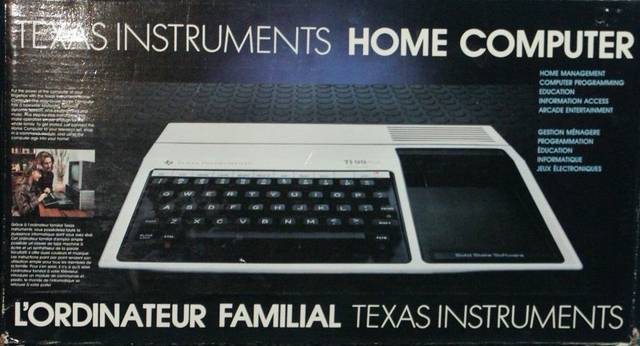
I got a new system last month, a TI 99/4A computer from the early ’80s. Actually, I got the computer unit itself several years ago, loose for $3 from Goodwill, but I didn’t have the cables to make it work, so it’s just been sitting in the basement. Well, I saw some TI 99/4A game carts locally recently, so I decided to get the stuff required to play the system; I’ve been wanting a new system recently without spending much, and this certainly does that! The base TI 99/4A is a cheap system, and I got a pretty good deal here on it too, that’s for sure. So far, I think that it’s okay, but not great. The computer is interesting, though. It’ll be better once I have a gamepad adapter so I don’t have to play games with the keyboard, too… :p Still haven’t gotten that yet. At least I can play games, even if the controls aren’t ideal. All of the games I have play on keyboard.

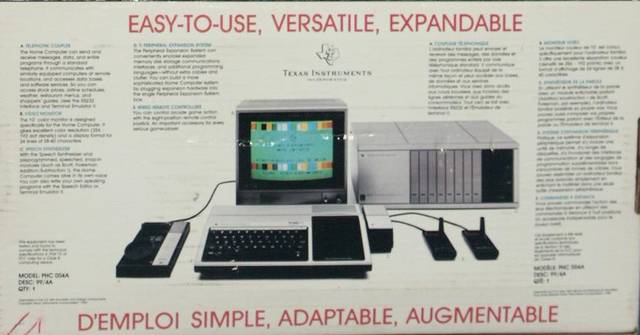
So, I got the system a while back, but to make it work, I bought a lot on Ebay last month for $22 including shipping that got me a power supply and RFU (both original; the brick is in the middle of the cord, not on the plug, which is great!), a game, and several replacement parts for the system that I don’t need now, but who knows, might someday. I also have the Speech Synthesizer Module, which I got locally as a part of a $10 pack of the speech unit and some games — yeah, it was a good deal! The Speech Synthesizer sells for a good $30 online, but I paid only $10 for that plus 12 carts, 9 of which are games. The system is a computer of course, so it has a bunch more accessories including a tape drive, floppy drive, etc., but for now I’m fine with just the base system. TI released most games on cartridges, anyway. The tapes and floppies are mostly for horrendously dated productivity software (both for the software and for saving data), and for text adventure games. I think there are a few non-text adventure games on tape or floppy, but most of the system’s small game library are on carts. The TI 99/4A only lasted from 1978 to 1983, and TI tried to limit third-party software releases through most of that time, so it has few games, or anything else. Some of what it has are interesting, though, as I said earlier. One reason for the paucity of software is that for most of this system’s life, TI strongly discouraged third-party software, unlike most computers; they wanted to publish everything themself. As a result, the system has a much smaller library than most computers of the time that lasted as long. Still, it has some good stuff for sure, games particularly. But facing tough competition, TI gave up on the industry and announced the system’s death in the second half of 1983, early in the crash, and discontinued it in early ’84; it was one of the oncoming crash’s first computer victims, taken out by the Commodore 64’s price war it seems, from what I’ve read.

The system itself is fairly well built. The system, power supply, RFU, speech synthesizer, and all 15 carts I have all worked perfectly on the first try! Very impressive, for stuff that probably has barely been touched in decades. The system is a bit beat up, and I really would like to have that joystick adapter (because the TI joysticks are apparently terrible, so I’d rather use the ones that let you use Atari/Sega [SMS/Genesis] controllers) because the keyboard, while nice and clicky, is NOT a good game control mechanism, but it works well, considering its age and where I got it! I was not expecting everything to work nearly so well… TI clearly had fairly good build quality. The system does have metal on it, and the cartridges have spring-loaded protectors over the board that goes into the system, so this does show. Maybe those protectors is why all of the games have worked first-try with no blowing or anything needed. The only issue I’ve had with the system so far is that sometimes some keyboard keys stop responding, but pressing around the keyboard fixes the problem, so it’s pretty minor. A joystick adapter would also get around this problem; I highly doubt I’ll ever do much non-gaming computing on this machine.

The RFU outputs via those two prongs that really old things have. I thought I’d need to buy a coax adapter, after testing it by taking apart my Odyssey 2’s RFU (which is the same, but came attached to a two-prong to coax adapter), but then I realized that the O2 RFU has side two-prong inputs, so instead I screwed the crazy-big TI99/4A RFU onto the side of it. Of course both are manual RFUs, but it works fine and my TV recognizes it, which is great. No problems like those I had with the Atari 7800. It’s weird to use a computer on a television, but I don’t have a setup where I could attach this to anything other than a TV, and don’t have a desk to do a proper computer setup for it, so it’ll have to do. I have to play it with the thing sitting on my lap, of course. It gets warm once it’s been on for a while, particularly on the righthand side of the system. It’d be nice to get joysticks, so I could just put it nearby (since menus and such require the keyboard). 🙂 Of course, if I ever get the floppy drive addons (either sidecars that plug into the side expansion port, or the large external expansion box which looks like a desktop computer), it’ll need to be on some kind of desk. They make the thing much larger. This will do for the basic system right now, though.

For games, all of the games below are cart only. I don’t have any boxes or manuals for anything. I will need to print some stuff out, because I REALLY need a listing of the system command codes — hitting several keyboard keys plus the number buttons does various commands, and I don’t know what they are because the command strips are missing. For those who know, I mean those paper or cardboard strips that you’d put above the numbers on the keyboard that show you what the hotkeys do; we had something like that for our first PC in the early ’90s, for Wordperfect. One other thing I’d like is an application, the expanded programming cart that lets you make Basic programs that play back speech samples from the speech synthesizer! It’d be nice to be able to do that, but the built-in TI Basic can’t do that, I think; it’s overly limited. The speech synthesizer is kind of cool, but all I can do with it right now is hear the speech in the two games I have that support it, Parsec and Alpiner.

A full setup, shown on the back of the box. I just have the base system with the Speech Synthesizer module (the small box plugged into the side of the computer), so far.

I have 15 TI 99/4A cartridges. I will talk about each one below.


TI 99/4A Cartridge Software Summaries


The Attack – This is the game that came with the $22 power supply, RFU, and parts bundle from ebay. It’s got good music, but the gameplay is slow and kind of boring. This is one of several top-down shooting games on a sort of grid. You have to kill all the enemies to beat each level. Enemies come in two sizes, small or large. Small enemies can’t hurt you, but if four combine they become a large enemy the size of four normal ones. The field is full of black squares with numbers on them, which turn into enemies once those numbers, which are timers, reduce to zero. You win a level once all large enemies and black timer blocks are gone from the screen. As with most shooting games on this system, the game is sort of grid-based. A tap of a direction changes direction, and then another press in that direction moves forward in that direction. You can also shoot, of course, and those are the controls. The game starts out VERY easy, but does eventually get trickier, though I imagine the keyboard controls hold me back too; the keyboard works okay for a slow-paced game, but once the action heats up… yeah, it’s not great. Also, I wish the music played during gameplay, it’s good. Probably there’s a system limitation that made playing music during play difficult. Overall, this is one of the weaker shooting games I have. It’s too slow-paced and too easy for too long. Still, there is some fun to be had once you get a ways into the game.

Next I’ll list the 12 carts I got in that cheap $10 package locally, along with the Speech Synthesizer. Yes, all of this plus that accessory was $10. The first three aren’t games, but I’ll list them anyway for completion’s sake.

Adventure – This isn’t a game; it’s a boot disc for text adventures. The cart allows you to boot any of the first twelve of the text adventures for this system by a guy called Scott Adams, which are available on tape and probably also floppy disk. Without one of those accessories, though, this cartridge is useless. Too bad.

Early Learning Fun – This “game” is for very young children. Anyone old enough to read this is outside of its age-range. There’s nothing here remotely worth touching for anyone over, like, age six. TI released a whole bunch of learning “games” for children, and this is the one I have. It’s probably aimed at about the youngest audience you could get to use a computer. This super-simple, incredibly dated visuals have definite charm, though! The simple but oh-so-early-’80s visuals, and beeping sound effects, combine to make this pretty amusing to “play” for a few minutes as you look at the various modes. There’s nothing here beyond that, though. There is almost no actual challenge; as hard as this game gets are some parts where you have to determine whether there are more of one type of item, or another very obviously different item, on screen, when there are only like 4 or 6 items on screen total! It’s … not hard. But the title is “EARLY Learning Fun”, so that’s okay.

Music Maker – This is a music creation application. You can compose music for the system’s decent built-in music chip, and save it to tape or floppy. Even if I had those addons, I’d probably never use this. I’m hopeless at music.

Games from this package:

A-Maze-Ing – Now we get to some more actual games! A-Maze-Ing is a maze game, as the name suggests. Real mazes to get through, that is, not Pac-Man dot eating. You play as a mouse in a maze, and your goal is to navigate the maze to the end. The game has a nice variety of options, including three maze sizes from small to decent-sized, one or two player simultaneous play, the option to have a few cats in the maze that will kill you if you run into them (so try to avoid being cornered!), invisible maze options if you want to make the game harder (the walls appear if you run into one), easy or harder cat AI settings, and obstacles in the maze. Yeah, there’s a nice featureset here for the time. Of course your only goal is to reach the end, so you win the game each time you get there that’s game over and you can then play again with the same or different settings, but it’s decent fun for a few minutes. I’ve always kind of liked mazes. There’s a LOT more to do in this game than there is, say, in the Atari 2600 maze game, Maze Craze! It’s faster-paced and more fun than Snail Maze on the Sega Master System, too. The mazes aren’t as large as Snail Mazes’ mazes, but that’s a good thing overall. A-Maze-Ing is very simple and straightforward in what it tries to do, but what it does it does as well as could be hoped for for the time.


Hopper
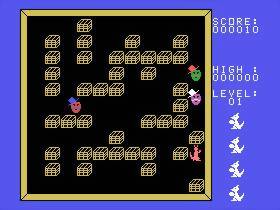
– This is a clone of Sega’s arcade game Pengo, with a few less features than arcade Pengo, but still pretty solid gameplay. You play as a kangaroo here, trying to escape from your human captors on a cargo ship. I don’t love Pengo, but this is a pretty good version of it. Pengo is a top-down action/puzzle game. You move around a screen full of boxes, trying to kill the three enemies on each level by pushing boxes at them. If you hit one with a box, they die. If they touch you, you lose a life. And that’s all there is to Hopper; some elements of Pengo, such as the enemies pushing/destroying blocks, don’t seem to be present here. It just gets harder mostly because of the increasing enemy speeds. Other than that, the main difference is graphical; Hopper is kangaroo-versus-humans, instead of Pengo’s penguin characters. Hopper is a decently fun little game, but I don’t know how long it’ll hold my interest. The game is mostly playable on the keyboard, though, which is nice… at the easier settings at least, that is. As usual, it’s tough to keep up once the speed increases. This game has no variety — just slide the boxes into the three enemies, and repeat until you lose — but it’s solidly done. This is apparently one of the later games for the system, from mid/late ’83, and it’s nice that I have it, it’s a solid and good game.

Alpiner (Speech Synthesizer supported) – Alpiner is a game based on the arcade game Crazy Climber, except with normal controls. In Crazy Climber, you have to use one stick to control one hand, and another for the other hand. It’s quite confusing. The Famicom (NES) version of Crazy Climber requires you to move one hand with controller one, and the other hand with controller two! Crazy. Alpiner’s controls are better — left, right, up, and down move you normally. That’s the only control here, there are no other buttons. This game has impressive graphics for the system, with very large sprites on screen. However, the gameplay is REALLY basic, too much so for me I think. You are a mountain climber, and are trying to get up six mountains. The mountains are named for some large real-life mountains, but in this game you’ll climb each one in seconds! Your sprite is HUGE, and obstacles are either large and very easily avoided, or are far too hard to see coming because you take up like a third of the screen’s width and height. The graphics are decently good, and the speech samples are amusing, but I don’t like the gameplay very much, it’s just too uneven between the excessively easy parts, and the obnoxiously difficult and random ones you run into about halfway through this very short game. Avoiding the falling rocks when you’re so large is a guessing game. This game could be worse, as it is playable, and occasionally amusing, but is kind of bad I think. The speech samples and graphics make it worth a try, though, it’s amusing stuff to see.


Hunt the Wumpus
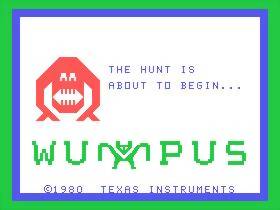
– Perhaps one of the better-known games for this computer, Hunt the Wumpus is a graphical remake of a text-based mainframe game. The game is a fantasy action-adventure puzzle game with three difficulty settings and a few other options as well. You are a hunter, with a single arrow, and have gone into the caves looking for the Wumpus, a fearsome monster. The game field is a single screen grid of round caves (rooms) and curving connecting passages. Orange circles in a room signify that the Wumpus is within two spaces of your location. If you run into the Wumpus, the Wumpus eats you of course. Green rooms have a pit next to them, so watch out. If you enter a room with a pit, you fall into the pit and die. Bats … not sure what those mean yet. Regarding the orange circles, only rooms count when counting to two, NOT curved connecting paths, so in the harder settings which have a lot of them this game gets QUITE tricky! You’ll need skill and luck to kill the Wumpus in the harder difficulties, because you never know for sure if a room or curving path is in front of you. Regardless, using these clues, you have to try to kill the Wumpus. You’ve got to guess where the Wumpus is, hope you don’t walk into it because that means death, and fire your arrow at the space where you think it is. If you’re right, you win. If you’re wrong, well, you had only one arrow and wasted it, so the Wumpus eats you. The game rules are simple, but once you get into it, this game is both challenging and pretty fun. The graphics are also simple, but have a great classic charm that has aged very well. The “you win” and “you die” animations are great as well, as is the menu music. On the easiest difficulty setting it is simple enough to kill the Wumpus, but try the harder modes and it’s a different story entirely! Unfortunately, as in some other games from the era, there is no progression here; just play single levels and see if you win or lose. The game does keep track of how many times you’ve won, gotten eaten by the Wumpus, or fell in a pit, though, which is nice. Of course it won’t save this; I don’t know if any cartridge games for this system support saving stuff to tape, but this one doesn’t. Still, it’s great to have a sense of how well you’ve been doing in your current session. Overall this is a good game, but it gets frustrating quickly on the harder settings — it’s just so hard to figure out once lots of curving paths have been added into the mix! This is a decent little game, but I can see it getting repetitive very quickly. Still, for such old game, it’s interesting — this was definitely trying new things, back when it released in about 1980! And it’s still fun for a little while, at least.

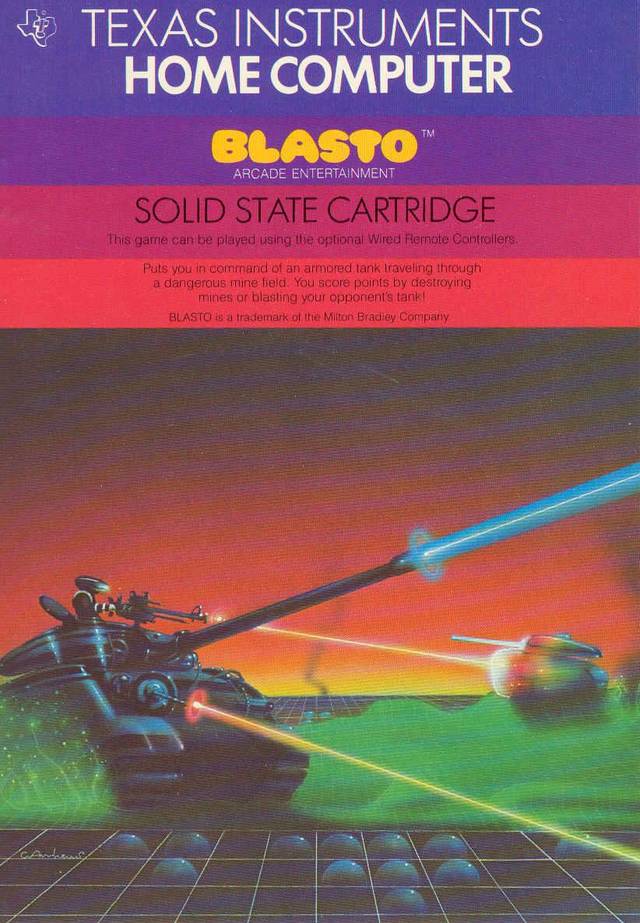
The game may not be great, but the box art looks pretty cool! Wish I had it.

Blasto – This is a puzzle/action game. You have to clear a field full of mines, using a tank. The game has several modes and options, including one or two player simultaneous play and three screen bomb densities, Few, Average, or Many. The game has a strict time limit as well. This is a very short, but tough, game! At anything above Few bombs, destroying all of them in time is hard, and I haven’t managed it yet. This game feels a bit like Combat but with mines. Squares on the field are either empty, normal blocks, or bombs. You can shoot in four directions, as always for the shooting games on this system. When you shoot a normal block it breaks, but if you shoot a bomb it explodes, destroying the eight spaces around it. So, destroying a mine will set off a chain that destroys all the mines around it. Try to think of the best path around the level so you get the mines as quickly as possible. This game is a bit too simplistic, though. Clearing the minefield is frustrating, and if you manage it that’s it; there is only one screen. That’s not enough, really. There is no AI opponent, unfortunately, but there is a decent two player versus mode, where you try to score the most points by shooting the other guy and clearing mines. It’s a nice feature. I’d REALLY want joysticks for this to work better, though, sharing a small keyboard is no fun. Overall, as a single player game Blasto isn’t that good, but the multiplayer is more interesting. It’s still an average at best game, though.

Blackjack/Poker – I haven’t played this beyond testing it to make sure it works, but I’ll probably play Blackjack sometime. I don’t like casino games generally, but blackjack is tolerable. This version is pretty basic, with single or multiplayer versions of both games. The graphics are bland.

Hangman – This is the only typing game I have (beyond Early Learning Fun), and it’s kind of entertaining! It’s too bad that this game doesn’t support the Speech Synthesizer, for a graphical version of the hangman game in TI’s Speak and Spell, but otherwise it’s decent stuff. On the note of the Speak & Spell, yes, I had one of those growing up! Great things. Hangman is okay as it is, though. You can either use the games’ built-in dictionary, or type words in yourself. You’ve got to choose the number of letters of each word you’ll be challenged with, from 4 to 9, before playing. You have 11 guesses to try to guess the word. With each miss, a piece of the scaffold and hanging guy is added. Of course, once you’ve missed 11 times, the hangman has fully been drawn in, Taps plays, and you’re dead. Try again. A bit grim for a kids game… but it does make you want to try again and get the word right next time! Anyway, overall, Hangman is an okay game. It’s basic, but okay. The simple graphics have some serious charm.

Note the difference between the descriptive text and the sprite art. The sprites show what the game is actually like. The text… uh, that has little to do with the actual game. :lol

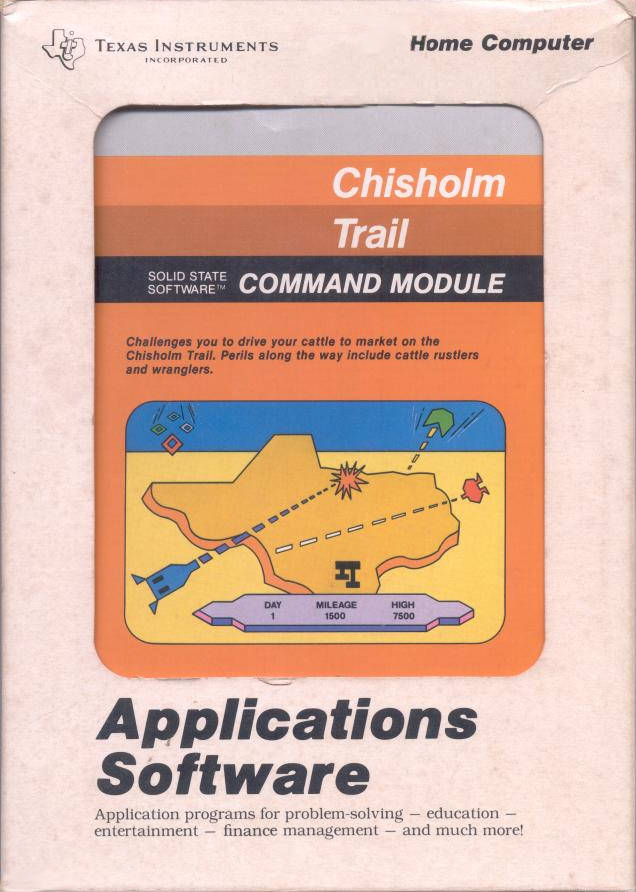
Chisholm Trail – This is another top-down grid shooting game. It sounds like a Wild West game, but looks like a shooter. Move around the grid, and destroy the enemies! The game has 9 difficulty options (starting points), but in any setting the game is HARD right from the start, and it’s fast-paced too — none of that slow stuff like The Attack or Tombstone City. I want a joystick for this one. The game seems pretty good, though. In the game, there are four colored enemies who shoot at you and spawn endlessly when killed, and black block enemies which are your actual targets and won’t attack you back. The colored enemies have different sprites as you progress, but the black ones always look the same. The black block enemies start from a ring in the center, so you can see how many are left. In order to complete each day, you need to destroy all 16 black block enemies on each stage. Making things worse, you have limited ammo, so the more you shoot at the colored guys, the more likely you’ll run out of ammo and have to lose a life, if you don’t lose them even before that first. There’s one last obstacle — when you kill a colored enemy, its starting-point entrance will shoot a laser blast at you if you’re lined up with it, so stay away from them and focus on the moving black blocks. Chisholm Trail is a grid-based game of course, but everything on this system seems to be, so that’s not exactly surprising. You do have free movement, but it’s all on a grid. Tap an arrow key to change direction, tap again in that direction to move a space. The Attack works the same way, and Tombstone City as well. This seems promising and could be a good game, but I can’t say for sure yet, need better controller. The game is fun, but I die so quickly! I haven’t managed to finish a level of this yet, sadly enough. The enemies are tough to avoid and move quickly, and shoot at you as well. The music theme is nice, but as with most games on this system, there’s no music ingame, only sound effects. Very few TI 99/4A games have in-game music, apparently… oh well. Overall Chisholm Trail is a decently fun game, but it’s very difficult. This might be the hardest of the TI 99/4A games that I have.

Where do you get game concepts like this? It’s so crazy!


Tombstone City
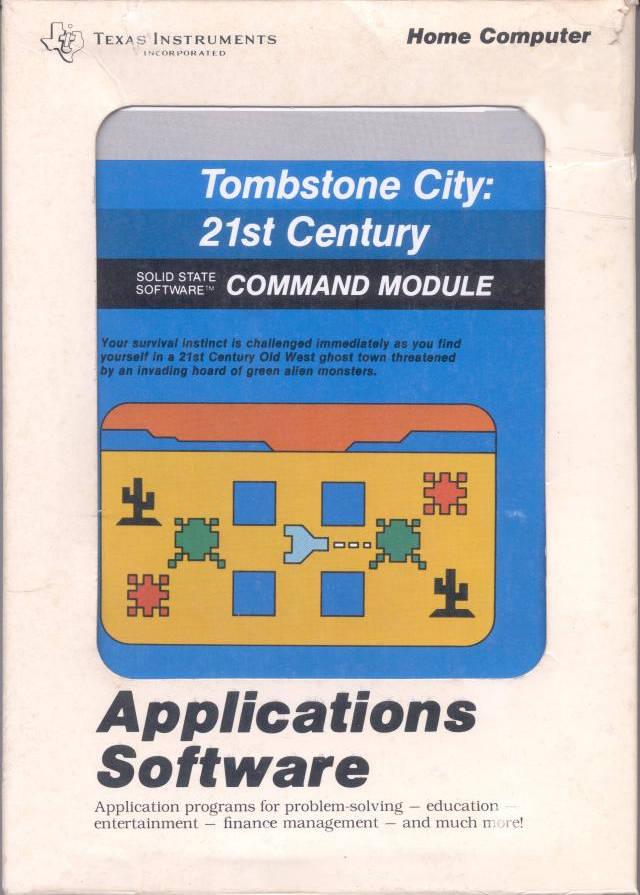
– The last of these top-down grid-based shooting games, Tombstone City is the most complex one. The titular city is in the center of the screen, and it’s a safe zone. It’s a small grid. Around this are hordes of aliens, because despite the wild-west theme, this is a sci-fi game really! Future wild west sci-fi, I guess? Your ship is called a “schooner”, but looks like a generic 2nd-gen space fighter. Heh. So, as in The Attack, the game has basic enemies which can’t hurt you, and a second enemy type which can. These threatening enemies are the same size as the regular ones, though, unlike The Attack’s oversized (4 tile) threat-enemies. They also move quickly, so watch out and try to line up your movements… or die, at higher speeds while playing on keyboard. :p Yeah, this game makes me want a joystick for sure. Threat enemies turn into cactuses when destroyed; the cactuses were originally tombstones, but it was changed for censorship reasons or something like that. Now here’s the trick to the game, which you must understand in order to get anywhere: in order to beat each level, you need to have all cactuses on screen be in a location where there are no other cacti in the eight spaces around them. If two cacti are touching they just sit there, but if three cacti are in contact, the three cacti vanish and a threat enemy spawns and goes after you immediately. There are also quite a few of the normal, non-threatening enemies on screen in each stage, and more may spawn, but threat enemies will mostly spawn only from places where two cacti are touching eachother. So, you’ve got to look for places with two cacti touching, and camp out around there trying to lure an enemy into a position where you can kill them while they’re touching them, to destroy them and spawn another enemy who you hopefully will kill in an open space. Once I got a little better, I started luring them into chains — making a set of three, getting a guy to spawn, and then using that enemy to destroy the next set of cacti. It’s satisfying when you get a bunch separated all at once. It’s an interesting concept, and once you get used to it, it’s fun. It definitely isn’t a simple game, though, unlike most 2nd-gen games, and it starts out slowly as well. Tombstone City speeds up as you go, though. My first impression on this game was ‘argh, I died’, but with a bit of practice, I’m starting to get better. This is a good game for sure.

These last three games I bought locally for $5 each, within a week of getting the system. It was pretty great that a local place had a few of the system’s better games for me to get right after I got the system!


Parsec
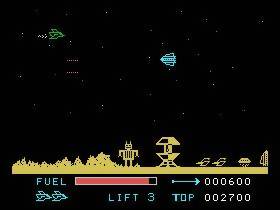
(Speech Synthesizer supported) – This game is one of the most popular games for the system. It supports the speech synthesizer, too, which is pretty cool; it uses it well. Parsec is a horizontal-scrolling shmup, and enemies come at you a few at a time. Unlike some shmups, your and the enemy’s laser shots are VERY fast — when you fire, an enemy in front of you across the screen will be hit almost instantly, and vice versa. You really need to watch out for their shots because of this! Also, your laser will keep firing if you hold down the fire button, but hold it down too long and you overheat and explode, so don’t do that. The fast enemy shots can be tricky to avoid too. This is an endless game, as games back then usually were. I believe that there are about 16 different types of enemies you have to face before the game loops and starts repeating. The difficulty gradually increases for a long time, though, so only the very best players will be able to play this indefinitely. I can’t get too far, but the great gameplay, decent graphics, and solid design make me want to keep trying. This is a tough but fun game, and I can definitely see why it’s so popular among TI-99/4A fans! The speech definitely adds something to the game too, and the action is fast and fun. It’s mostly playable on keyboard, too, provided that I don’t have to move forwards or back much, but you don’t need to do that often in this game. Still, I’d like to have a joystick for this, I’d probably do better. One issue I do have with the game is the ground — while this game scrolls, there are no actual obstacles to avoid, apart from the ground itself. Unlike, say, Scramble, there are never any barriers above ground level; it’s just the ground, with its endlessly-looping terrain of rocks and buildings, and the starfield above where you ac tually play the game. You can crash into the ground if you fly down to it, but it’s be better if the terrain had more variety, as it does in, say, Scamble or Vanguard. Too bad. The enemies will provide plenty of challenge, though. So far, for me the hardest enemy waves are the ones that come from both the back and the front at once. They’re quite hard to predict. Also, as in some shmups of the era such as Scramble, River Raid, and Zaxxon, the game has a fuel system. You use fuel by flying along, and recharge it in recharging tunnels which appear instead of the usual ground loop when you’re low on fuel. Getting into the tunnels can be tricky, so be very careful. I’ve crashed into the tunnels a few too many times… and they are also narrow, so you have little room to maneuver. Still, it’s a decent mechanic to have, and probably does add to the game. I like the shooting action more, though. The many types of enemies each attack a different way, and this game requires good reflexes. This game is visually simple, but everything from the time is. For a TI 99/4A game, it looks pretty nice. The sprites are small but well-detailed, and each different enemy type looks distinct. Overall, for its time this game looks and plays pretty well, and it’s more fun to play than I was expecting based on videos; this game is fun to play for sure. The speech quotes are also pretty cool. If you get Parsec, definitely also get a speech synthesizer!

Munchman – TI’s take on Pac-Man, Munchman is a blatant clone. The game has a few differences, to try to keep Atari from suing, but it’s Pac-Man alright, and a good variant of it too. This is a good game, one of the more fun ones I have for the system. It controls decently on keyboard, too; you just need to move, no fire button. Instead of eating dots, Munchman (despite the title) actually works more like Crush Roller or Amidar, visually — you’re trying to pass over all of the paths. As you move, a chain-like line is laid down behind you. Once the whole screen has been filled in, it’s off to the next, slightly harder, level. The maze is different from Pac-Man’s maze, it’s important to say, so this game isn’t a clone, it’s a similar game in the same genre. As in Pac-Man, there are four enemies trying to stop you. Unlike Pac-Man, though, each one starts from a different place. Munchman starts in the center of the screen, while the four enemies start in four squares around the center. They leave their little bases a few seconds after you start moving. Amusingly, the power pellets are TI logos. Yeah. One interesting game element that’s different from Pac-Man is that ghosts eaten while you are invincible stay dead until after the invincibility wears off. Each one you ate is sent back to its base, and will only leave it after you’re vulnerable again. So, avoid eating multiple TI powerups at once if you can, because it’ll really cut back on how many ghosts you can eat! In Pac-Man ghosts will respawn right after you eat them, which menas if you then grab another power pellet you’ll now be able to eat those. It’s different in Munchman. I don’t know if this way is better or worse, but it works. The graphics are simple but effective. This is a solid little game. It’s entirely unoriginal, but is a good variation on one of the generation’s greatest classics.

Car Wars – This game is TI’s port of Sega’s arcade game Head-On, released on the Atari 2600 as Dodge ’em (Atari) or Dodger Cars (Sears), and also remade years later on the Game Boy as Head-On (Japan) / Power Racer (US). The game is a maze game, and if it hadn’t released several years before Pac-Man, I’d think that it was a Pac-Man knockoff. Instead, it has to have been one of Pac-Man’s inspirations. The goal of the game is to get all of the dots on the screen. The screen is broken into four ring-shaped paths around a central block. This game is much less dynamic than Pac-Man, though. Unlike that game, you can’t move freely; all you can do is change your speed between slower and faster (hold the button down to go faster) and change lanes at the four intersection areas on the center top, bottom, left, and right of the screen. The enemy car moves as fast as you do, and if they run into it, you lose a life… and the dot field is fully replenished. That’s right, you need to grab every dot without dying in order to clear a level. As a result of this, this game is VERY hard! There’s only one enemy car at the start, or two later on, and you can actually win this game, there are a limited number of screens… but good luck with that. Even beating one screen is tough! The game controls fine on keyboard, but it’s just plain hard whatever the controller. This is a pretty good game, but it’s quite hard. It definitely has that “just one more time” addictive quality to it that a good arcade game should, though. I have the 2600 version and the improved Game Boy version, so I wasn’t sure if this would really be worth it, but the graphics are better on the TI, and the game controls just as well, so it was well worth the low price. Good game! On another note… I would REALLY like to know how this Sega arcade game ended up getting a Game Boy remake from Tecmo. What? It released after the Game Gear was available, too! How odd. Anyway though, Car Wars is a good version of this little-known, but probably influential, arcade classic.

And those are the games and other applications I have so far. The TI 99/4A is decently interesting, but the games are very mixed in quality. I don’t like this system as much as I do the Odyssey 2. Still, it was worth getting and I have a few good games for it.

Posted in Classic Games, First Impressions, Game Opinion Summaries, Reviews, TI 99/4A | Tagged , , , | Leave a comment

Pod 2: Speed Zone (DC) – The Tracks: Thoughts & Some Strategies

A few thoughts on the courses!  My favorite tracks are probably the two simple ones, Volcano and Oddrock.  Mines Web is my favorite of the more complex courses.  After that, Canyon would probably be next, followed by Bridge Ride, with K Zone in last.  They are all good courses, but some are better than others.

Warning: I also mention my strategies here for some points, so don’t read this if you don’t want to be spoiled at all.

Volcano – This is one of the tracks with a narrow road suspended over, as the name suggests, a lava field.  The track is fun, as all the tracks are, and straightforward in design; it’s easy to see why this is the first track that appears when you enter the track selection screen.  In the track, turbo over the giant opening jump at the start, or you might not make it!  The track has one major branch, a shortcut which starts shortly after that big opening jump (go to the right).  You can also enter this shortcut halfway, but that’s going to save much less time, if any at all.  I like this shortcut, it does seem to be shorter.  The computer will never take this shortcut.

Canyon -   Canyon is a solid, middle-tier track for this game.  As the name suggests, this track is in a canyon.  This isn’t the Canyon track from the original Pod, though, it’s entirely different, and probably not quite as cool.  Fortunately, it still is a good track, even if it doesn’t match the original games’ level.  Canyon starts out with a branch.  There’s a tunnel, or you can go over the hill.  The visuals in the tunnel are kind of nice.  After that, there are some signs telling you to go right, but if you go left and go through the narrow gap, there’s a shortcut.  I usually go this way.  Do avoid the monsters though, they can get in your way!  If you do the right, there are two paths, on the ground or up to a suspended road.  When all three paths meet, you go around some buildings, then there’s another branch (high or low!), and then the end (or next lap, more likely).

Bridge Ride – Bridge Ride is kind of like K-Zone (below), and like it, it’s not one of my favorites.  I do like it more than K-Zone, though.  Bridge Ride has several bridges, and also some jumps.  There’s a nice alternate route the computer will never use early on that avoids the circle and first jump; go left into a building, at that easy-to-miss intersection!  I think it’s shorter.  It also avoids the really annoying jog right in the track right after that jump I mentioned earlier; I find it really hard to actually make that turn, so I’d much rather take the shortcut, it’s quicker than going through the ravine you go through if you miss that turn to the bridge.  After that, there’s a branch in the track; this one the computers will use both of.  I usually go left, but both are fine.  I like the section after this — there’s a large plaza with several routes. The shortest is the one over the building, but you’ll need to boost to make the jump!  If you don’t have boost, take one of the other ways.

Mines Web  – This track has a multi-level network of routes.  At several points the track splits into two or three paths, and they repeatedly intersect.  It’s a pretty cool track with a nice design; I like all the branching paths!  Early on, there’s an alternate route to go up and get some powerups.  The computer won’t use it, but I’d recommend it if you need some health; otherwise, avoid, it’s not shorter.  There are more branches, but one key one splits three ways.  I like the center path at the three-way branch; take the sharp corner well to get ahead.  In the last branch, one trick is to go on the middle route and cut through the off-track area to avoid the long turn.  Winning this race in Hard was tough, that strategy helped a lot there!  This is a fun track to drive on.  Do watch out for the monsters, though; the hatchlings can get in the way at that sharp turn.

Oddrock – Oddrock is the other suspended-road track, along with Volcano.  This time it’s a rockier setting, though, no lava.  You need a was-online save file to play this track, but as I said, such a file is easy enough to find.  This track probably reminds me the most of the course in Pod 1’s intro, and it’s quite fun.  It’s not set in a city like the Pod intro is, but the suspended-path design is similar, as with Volcano.  (The first Pod has no such tracks, I don’t believe, oddly enough.)  It’s not one of the hardest tracks, though, perhaps surprisingly.  There are several shortcuts, including one across some platforms that cuts off a loop, and a hidden shortcut off the side at one point.  Take the first entrance to this, not the second more obvious one!  This is one of the better tracks.

K Zone – A decent track, this one isn’t one of my favorites.  This course is in an area with some large buildings and open space.  This track has several alternate paths, including one long one through the middle section of the track; take a left, instead of a right, when you hit that 90 degree turn facing a large building.  The other path is on the map, but the other cars will never take it.  It might be slightly shorter, but even if it isn’t, it does have some powerups on it that the computers won’t get to, which can help.  This shortcut is kind of interesting, but otherwise this track is somewhat average.  You go around an open area, up a ramp, back to the start, and then around again.  This might be my least favorite track, I’m not sure.  All six are good, though.  Maybe even great.

Posted in Dreamcast, Full Reviews, Modern Games, Reviews | Tagged , , , , | Leave a comment

Pod 2: Speed Zone (Dreamcast) Review

I first covered Pod 2 on a post on NeoGAF.  This new review is probably well over twice as long as the old one, and has a lot more new content than most of the other redone old reviews I’ve worked on in recent months, so it’s more new than old.  This is an interesting game, in both good and bad ways.

  • Title: Pod: SpeedZone (US), Pod 2: Multiplayer Online (EU)
  • Developer and Publisher: Ubisoft
  • Released: November 2000
  • Review Written: Original Thoughts, 2008; Updated & Rewritten Review, 10/30/2014.


First, a starting note: in order to access the Oddrock track or two of the cars, you needed to connect to the long-dead Pod online servers. The stuff is on the disc, but it’s locked. However, fortunately, there is a way around this: put a save file on your system that already has the track unlocked! I found one on the homebrew Dreamcast save files disc that I have. Look up Dreamcast save files discs, and burn one; it should have the file you need. Anyone seriously interested in Pod 2 really MUST do this, because playing this game without one of the tracks and two of the cars is horrible! The alternative is actually getting your DC online and getting the files from the internet, but that, of course, is much more challenging. Just burn a save-files disc. Don’t skip this step! Oddrock is a great track, and the two cars are pretty good as well.


At the starting line!

Introduction

The original Pod, for the PC, is one of my favorite racing games. When the sequel was announced as a Dreamcast-exclusive, though, I was disappointed; I wanted to play it on the PC, and didn’t have a Dreamcast. I didn’t get a DC until 2007, so I couldn’t play the game when it came out. The mediocre opinions most Pod fans had of the game greatly lessened my expectations, though, which made me care less.

After getting a DC, though, I finally did buy the game. Pod 2 has several names. In the US, its title is Pod: Speed Zone. In Europe, it’s Pod 2: Multiplayer Online. I’ll call the game “Pod 2” in this review, though I have the US version. The game was not developed by the same team that made the first Pod, and you can tell — this game is indeed a shadow of its predecessor, just like all the reviews said. It is a highly disappointing game, one of the more disappointing Dreamcast game for me. However, despite this, I find the game quite fun, and it’s probably one of my favorite Dreamcast racing games. How can it be both of these things? Well, it’s a very limited game, and is not even close to Pod’s level, but what is here is pretty fun if you like this style of futuristic racing game as I do.

Comparing Pod 1 and Pod 2, the only obvious similarity between the two games is that both have “Pod” in the title, are futuristic racing games, have some slightly similar art design styles, have some large tracks with branching paths and dead ends, have car damage of some kind (though the car damage systems are different), have two player splitscreen multiplayer, and had online play on servers that are now long-dead. On that last point, with Pod 1 at least you can still play the game multiplayer via IPX LAN or via direct-IP play, but Pod 2 is splitscreen-only, sadly. Beyond those few things, though, the sequel diverges greatly from its predecessor, to its detriment.

Pod 2 has a lot less to it than the first game did. First, Pod 2 has no circuit mode. The first Pod has many different ways to play the game — there is a championship mode, with either the original 16 tracks in preset order or your own custom championship of up to 16 races on any track; single-race mode; time-trial mode, extremely popular with a lot of Pod fans; split-screen multiplayer for two players; and online, LAN, or modem multiplayer for up to 8 players. Pod 2, however, has only single-race, time-trial, and split-screen multiplayer, though of course it originally also had online multiplayer as well. The loss of a main single-player championship mode is a big loss. Pod 2 doesn’t have an ending, either, unlike the first game. The game has a short introduction, and that’s it as far as the story is concerned. Disappointing! The severely limited content is one of Pod 2’s biggest problems, along with the low production values and lack of a PC version.


Racing. Nice sky!

Basics: Controls and Interface

Pod 2 is a fairly standard futuristic racing game. The game runs in a modified version of the Speed Devils engine, so it looks and plays as much like that game as it does Pod. The first Pod is a pure racing game; you only race, there are no weapons or turbo boosts. But perhaps because this is a console game, Pod 2 adds turbo boost and item systems. Unfortunately, both are clumsily done, as I will explain. The boost system works like that in Wipeout 3, F-Zero X, and others — boosting drains your health. The items are few and weak. The game does play well, though. Cars control quite well in this game, and each car really does feel different. However, I don’t think this game really controls like Pod. The Speed Devils roots do show here, I think. Pod 2 is sort of one part Pod, one part Speed Devils. I like Speed Busters, but Pod is a far better game. While Pod 2 has good controls, control is better overall in the first game, and is slightly different from how it is here. I do like how this plays, though, just less than the first game.

I also like the variety between the vehicles. The eight cars aren’t just palette-swaps, they control very different. Choose your car wisely on each track, because some cars are better on some tracks, and others on others. Cars have health in this game, and when you run out, it’s a very abrupt game over. Look out for the health refill pickups, they can be invaluable! They are by far the best of the pickups, in fact; the weapons are weak, and turbo boost is only sometimes helpful. Your shields (health) and turbo are based on meters on screen, so how much you have of each is limited.

On screen, the game shows your shields, boost meter, acceleration, a quite useful minimap, the three items you currently have, your lap times, position, and current lap number. That’s it; Pod 1 has far more screen displays. I know that as a console game everything has to be larger, but this is disappointing, as I will explain later.

Basics: Race Types

The game has only two modes, single race or multiplayer. This game would be so much better with circuit championships, such as those in the original version of Speed Devils/Busters! Single races have six cars in each race, down from eight in the original Pod. Pod 2’s graphics aren’t amazing, either; the DC should be able to handle eight cars for sure. Since the online mode is long-dead, the multiplayer is splitscreen-only. Fortunately the splitscreen mode exists; in Speed Devils Online Racing they didn’t bother with splitscreen support, for some stupid reason. It’s in this game, and it’s fun. I wish that the game had four player support, but two is better than nothing. Both Pod 2 and Speed Devils Online Racing were heavily focused on online play, which have money systems and more from what I’ve read; the single player is shoddy and limited in content. And then the online mode went dead, leaving not much here. The game does have some progression, though. When I first played the game in ’07 or so, I somehow missed that each of the six tracks has three races on it, and you unlock each of the later two by beating the first track. So, after playing the game again because I wanted to improve the review, I decided to win all of the races, and after some effort I accomplished this.

When you start playing Pod 2, there are two options on each track: a Normal race, or Time Trial. Time Trial is just you against the clock with no opponent. In Time Trial, you can save ghosts, but it has no other effect, playing it won’t unlock anything. Once you finish in first in each tracks’ Normal race, you unlock the Hard race. The Hard races are pretty tough, and some of these took me some time to beat! Beat each track on Hard, and you unlock the last mode, the elimination race. In this race, the player in last place gradually loses health, and once they run out they stop and are eliminated. There are NO powerups on the track in elimination races, so you really need to be careful! You don’t get anything for beating all six tracks’ elimination races, but I did it anyway because I wanted to beat the game. These races are about even in difficulty to the Hard races, and sometimes actually were easier. They were a nice break from the normal races, and definitely add something to the game.

Basics: Graphics and Sound

Graphically, Pod 2 looks okay, but somewhat average. While this game is a Dreamcast-exclusive title, it definitely does not do a great job of pushing the hardware. Pod 2 runs at 60fps, but that’s its only major graphical positive. The game clearly was made on a pretty low budget, I think. The game runs in the Speed Devils engine, but doesn’t seem to have been improved much at all over the visuals in the original Speed Busters, a PC game several years old by the time Pod 2 released in late 2000. Pod 2 looks okay, but should be better. The graphics work, but aren’t exactly some of the best graphics in a racing game on the DC. Like many DC games, it looks like it wouldn’t have been hard to put this game on the N64 or PSX too. Just cut the car model detail, downgrade the textures and framerate, and it probably would work. However, it is worth mentioning that Pod 2 does run at a solid 60fps, and in progressive-scan too — it is in those two features where it shows that it’s a next-gen game when compared to N64 and PS1 racing games, not its per-frame polygon count. Also, the car models are fairly detailed, and are more complex-looking than in many other games of its time. The car models are reasonably nice, and I like many of the designs. Even so, the graphics could definitely have been better. Also, for the most part the tracks do not have the character of the tracks from the original Pod, artistically. A few manage a nice look, but overall they look blander than Pod tracks do. The whole game is like that, though, of course.

There are a few points in the game which stand out and suggest that this game could have been more, though. Particularly cool is the transparent tunnel section in one track; this game needed more nice-looking graphical elements like that! Sadly, for the most part Pod 2 doesn’t even try. I like the tracks in this game for their designs, not for their great graphics, because they don’t have them. The low production values really show in the very weak turbo effect and the near-nonexistent weapon effects, for example. Cars which run out of health don’t even blow up either, they just stop moving and that’s it! Pathetic. As for the music, it’s techno, of course. I like techno, but this soundtrack is largely unremarkable, unlike Pod’s amazing, addictive soundtrack. This soundtrack is okay, but I forget it as soon as I stop playing, and don’t really want to track down a copy of the soundtrack to listen to on my PC, while Pod 1’s soundtrack is one of my most-played game soundtracks.

In a race.

Content: The Tracks: The Best Thing About The Game!

Pod 2 has only six tracks, a dramatic decrease from the 16 tracks Pod 1 had. It has no downloadable or add-on courses, either, while the first game had 20 more official downloadable tracks that were made available after its release. This is bad. However, on the positive side, the few tracks that the game does have are long and varied. The track designs are quite good. They feel different from the original game’s tracks, but they are very well designed and interesting, and all have multiple routes. This is the one thing that saves the game from complete irrelevance — the track designs are pretty good, and make the game interesting enough for me to want to play Pod 2 despite its numerous, crippling flaws. The game may have a lot of problems, but track designs are not among them. It’s obvious that a lot of attention went into the track designs, and all six are well designed, fun, and challenging. I really like all six of the tracks in this game. They are very well-designed.

In the original Pod, tracks were usually complex. The opening tracks started out simple, but the game quickly got complex, and the downloadable tracks particularly are often quite hard, with dead-ends that seem to be the route forward in some cases. Pod 2’s tracks split the difference between Pod’s simpler and harder courses. Pod 2’s tracks have many shortcuts and alternate routes, which is great. They’re not entirely straightforward. However, the tracks are never as challenging as the harder tracks in the first Pod, but that’s not all bad; the hardest Pod tracks are VERY frustrating, and I’m not sure if I actually like them. No, I don’t have much fun in tracks like Parking, and that’s not even Pod’s hardest track to memorize. So, having some complexity in the track designs, but without the extremely frustrating designs of the hardest tracks in the first game, is, overall, a good thing.

Pod 2’s six tracks come in two styles. Two of the tracks are narrow floating paths with walls or fences right on the sides of the road most of the time. The other four have larger, more open environments, with wider shoulders between the edge of the road and the walls.. Both types of tracks. Another thing I like is that the two narrow-path tracks, Volcano and Oddrock, remind me very much like the road type from the first Pod’s intro video. That’s awesome, because despite the intro, that type of track wasn’t actually present in the original game. That track is one of the best tracks in this game, too. However, all six tracks have similar futuristic-world themes; there are none with the interesting, varied craziness of some of Pod’s downloadable tracks. This is a natural casualty of this being a console game with just the base courses, though, since the more unique settings, such as the pirate track, were downloadable. Comparing the settings of the original 16 Pod tracks to Pod 2’s, they both have a solid amount of variety.

Of course, there is also a lot less of everything else as well, including tracks and cars. Again, Pod 2 has only 6 tracks. Even if the tracks are pretty good, there are so few of them! And I really miss the addon downloadable tracks the original game had and their interesting settings, too. I know that as a console game from the days before hard drives on consoles that was never going to happen, but a sequel, or improved PC port, with more content would have been great! it’s too bad it didn’t happen. I can’t help but count the addon tracks when I think about Pod’s courses, and their varied settings, such as the halloween track, the giant casino, or the beack are pretty cool. Even so, overall, the tracks are one of Pod 2’s main strengths. I really like all six of them, and they are a lot of fun to play. I’ve played this game for more time than you might think mostly because of how much fun the tracks are to race on.

Content: Cars and Story

Pod 2 has a lot fewer cars than the first game, too. There are only eight cars in Pod 2. Pod 1 also had only 8 cars originally, but Ubisoft released a full 44 downloadable addon cars for the game, while Pod 2, of course, has none. Yeah, that’s a huge downgrade in comaprison. Also, car designs in Pod 2 are compeltely different from the first game; this connects to the story. Pod 2’s concept is that the cars themselves are infected with the Pod virus, or something, and you have to race against them… why? I don’t know, the story doesn’t go anywhere and has no ending. The intro shows a virus, perhaps a version of the Pod virus from the first game, infecting a car. These alien-infected cars are what you drive. Then the game starts, and that’s all there is to the plot. So, instead of cars made from industrial parts and junked vehicles, as the base cars in the first game are, this time the cars look semi-organic. It’s kind of a cool look, but makes for completely different types of car designs from the original game. All eight cars are based on this one theme.

I mentioned the story in the last paragraph, but need to expand on that. What’s the story beyond that very basic, and worldless, car-infected-by-virus intro? Considering how the first game ended, this one is surely set on a new planet, which I guess has somehow been infected. But after that, what happens? Is this planet also doomed, or not? Unfortunately, the game doesn’t attempt to answer that. The first Pod has a pretty interesting ending, but no such luck this time; Pod 2 doesn’t have an ending. There is no closure in this story. There’s a bit of backstory in the manual, but that’s it.

As for car damage, it is, unsurprisingly, global only this time, and cars can be destroyed. In the original Pod, damage affected car performance, but cars were very hard to actually destroy, if you could at all. This time, though, damage has no impact on car performance, but instead just is a standard health bar. Once that shield meter runs out, you lose automatically. It’s nothing like the damage system in the first game. I actually really liked the sector-based damage option in Pod, where each of the six parts of your car took damage separately. There’s nothing like that this time.

Content: Weapons and Turbo

In the game, there are five kinds of pickups. The most useful are the shield and boost refill powerups. These do as they sound, and make sure to get the shield powerups if you’re touching walls much at all! These pickups are the only way to refill your health and boost; this game does not have standard shield-recharge areas on each course, unlike the original Pod which does have them. These refill items take effect instantly and cannot be stored.

The other three pickups you can actually keep are a turbo-boost, a mine, and a shockwave. You can hold three of these items, and can switch between them to use them in any order. The turbo is decent, it gives you a nice long turbo that doesn’t drain the meter. The mine and shockwave are much weaker, though. Neither one does much, if any, damage; instead they mostly just stun enemies. It’s a somewhat odd design decision. Considering how easy it is to die from just hitting the walls this is somewhat welcome, but it makes the weapons seem even weaker than they already did. The attack wave has its uses, but only in specific situations. This item will stun any cars close in front of you. It can be useful if someone passes you and you want them to get back behind you, or for knocking someone annoyingly fast back a bit if you close in. But really, most of the time neither weapons is needed, and I ignore the weapons more of then than I use them. Most of the time they are minimally useful. Why bother putting in weapons when they are so pathetic? The shield and boost recharge items are vital, though. You take damage every time you bump the walls, and need frequent recharges to survive; tracks do not have healing areas, the only way to heal is via pickups.

This track branches several ways!

Other Modes: Time Trial and Time Display Information

Now, anyone who knows Pod knows that timetrial mode, and best times, were one of the most popular things in the original game. Many people actually preferred comparing best times to actually playing online, I believe. I’ve always found races more interesting than time trials, but even so, what Pod 2 has for this category is horribly disappointing. You see, in the first game, your current total time, current lap time, and times compared to the cars ahead and behind you are all displayed on the screen. At the end of the race, you see a table showing the exact finishing times for all racers. Because the game is all about how well you drive, and has no items or powerups, times really do matter a lot.

Pod 2 messes this all up with its turbo-boost system, boost powerups, and very limited time information actually displayed on the screen. The effect of turbo should be obvious — this means that even if you take the same line on multiple laps, whether you have boost power left or not will have a huge impact on your time. There is a strategic element to this that I like, in saving boost for where it is needed, such as on hills, getting through rough terrain, and such, but it does mess with the purity of Pod’s racing. I’m kind of torn here, though; I love futuristic racing games, turbo boosts, weapons, and all. But if you’re going to have weapons, you need to do a competent job at it. This game fails at that, as I described above. The weapons here are pretty bad. I like the turbo button, but it wouldn’t be needed in a game with gameplay as great as the original Pod has; it’s only so nice here because of the general gameplay and design downgrade, I think. And of course, it makes accurate lap or race time comparisons much less even. Ah well.

I cannot defend the serious lack of time information in this game one bit, though. This time, the only time information you are shown during the race are your lap times. Total race time is NOT shown. In fact, your total race time isn’t even shown at the END of the race! All you see at the end is your best lap, and that’s it. Pathetic! How am I supposed to know exactly how well I did compared to the competition when it doesn’t bother telling me how they finished compared to me? Pod 2 also doesn’t save much, either. Other than the options menu choices, if you have the “online required” stuff unlocked, and whether you have unlocked the Hard and elimination races on each track, the only actual times saved are the top three race and lap times for each course. The problem is, the ONLY way you’ll ever see your race time is if you make this table… and even then, you’ll only know which one is your new time if you type in a different name each time! That’s right, unlike just about every other game ever, Pod 2 gives you no indication of which of the times on the table is your new one. It’s a somewhat unforgivable lapse. There are only three times on each table, sure, but it couldn’t have been hard!

Other Modes: Multiplayer (and more on the absence of better single player)

Because this is a console game, you had to connect to Ubisoft’s servers in order to play online. Of course, the servers were turned off a long time ago, so now the gmae cannot be played online. With Pod 1 you can play online today via LAN emulation or direct IP, but for a console game like this, the only way to play online after it was shut off was for people to have saved all the information the game sent to the server, and replicate what the server did based on that data. On the Dreamcast, this was only done for Phantasy Star Online, so Pod 2, and all other DC games which had online play, are now offline forever. Tragic! Of course, a PC port of this game could have fixed the whole problem… ah well.

As I said earlier, though, the game does have splitscreen, and two player splitscreen races of Pod 2 are pretty fun. This isn’t the best racing game, but it is a fun one well worth playing sometimes with friends who like arcadey racing games. Still, the absence of a fuller single player mode is really unfortunate. But with Speed Devils, even though Speed Devils Online Racing is unforgivably limited — it doesn’t even have splitscreen, much less any championships! — at least with that game, you can go back and play the original Speed Busters (PC), aka Speed Devils (Dreamcast); it has splitscreen and a full championship campaign. Pod 2 has no such equivalent. All it’s got are three races to beat on each track, and then you’re done. The worst thing about Pod 2 is how differently it plays versus the first game, but the extremely limited single player is second worst.

Beta version screenshot. The simpler interface design is almost better than the final one…

Overall

So, on the whole, Pod 2 is a failure. The game has limited content, questionable design decisions, shoddy production values, only a handful hours of play in single player, limited replay value thanks to the lacking time-display information and two player splitscreen only multiplayer, and more. It’s all Ubisoft’s fault, of course, for putting the game on a console while the fanbase for the original game was on PC, and for changing the game so much by having only a few tracks and cars. However… despite this, I like Pod 2! I really do. Pod 2 is a fun game, and I’ve come back to it again and again because of that fact. The tracks are few, but they are really well designed, interesting branching tracks. I love the shortcuts and alternate routes in each course. Try them all, they add great variety and some may be faster, I like the differences between the cars, too. The elimination races are a fun challenge as well. But despite how fun it is, the game really does have a lot of issues. The turbo boost is one controversial one. Its addition was and unnecessary attempt to attract console gamers. When boosting the increase in sense of speed barely exists in another sign of the low budget showing through, too. However, as a futuristic racing game fan I like fast games, so I don’t mind this as much as most Pod fans do. Still, it doesn’t really make the game any better. Clearly on the bad side are the missing story championship mode. Yes, it’s great that there are three races to win on each of the six tracks, and it was fun and challenging to win all the races, but for me, that’s no match for a good championship mode, and when the previous game had one, its absence is a big problem. The complete lack of an ending is also kind of annoying, and the limited number of tracks as well. Et cetera. I won’t repeat every flaw yet again, but they all hurt.

Even so, Pod 2: Speed Zone is a fun game that is absolutely worth playing for fans of arcadey or futuristic racing games. I like it despite itself. It really goes to show that good level designs can go a long, long way! Make some great tracks and you can have a good racing game, even if outside of that the game disappoints. I kind of wanted to like Pod 2, and do. In fact, wanting to play this game was a major factor in why I finally bought a Dreamcast in summer ’07 — Pod 2 is a DC exclusive, and despite hearing a lot about how poor it was, as such as huge fan of the original Pod, I simply had to play it sometime… and that meant getting a Dreamcast, so I did. 🙂 And once I did, I didn’t regret it. Pod 2 is a fun game to play for a while, as you explore the tracks and try to improve your times. Even if it’s only a fraction as great as the first Pod is, Pod 2 is de, but it is a good game. It’s just a very poor sequel to the amazing original game, and because of that it’s a serious disappointment even if it is probably one of my favorite DC racing games. I give it a B; non-fans probably would give it at least one grade level lower or maybe even less (the game got a Metacritic average of only 6.9), but… I can’t help it, as much as I hate Pod 2, I like it as well.

Videos

http://www.ign.com/videos/games/pod-speedzone-dc-14680 IGN has some videos. It’s on Youtube too, but most either look even worse than IGN’s, such as this one: https://www.youtube.com/watch?v=5SU-wP6Fac0 or have people talking over them: https://www.youtube.com/watch?v=i2gbgVTH_q4 .

Posted in Dreamcast, Full Reviews, Modern Games, Reviews | Tagged , , , , , , | Leave a comment

List: Multitap Supporting Games – Turbografx-16 & Turbo CD

Sorry for the delay, I’ve been so busy updating, fixing up, and adding more detail to my spreadsheet of games I own to get some new, or old, review posted/updated.  So, here’s a nice list!  This should be complete, and it’s very useful now, since PCECP has sadly disappeared.  Here’s hoping the site comes back!

Turbografx/PC Engine games require a TurboTap multitap for any simultaneous multiplayer modes — the system has only one controller port.  The multitap supports up to five players.  So, this list includes all TG16/PCE & TCD/PCECD games with multiplayer support.

The main list is broken up into two parts, for HuCard games first and CD games second.  After that is a second list of only the shmups, for people who only care about those games and not the rest.

Sources:
http://www.pcenginefx.com/forums/index.php?topic=1834.0 (registration required)
http://www.pcecp.com/ (dead site; hopefully someone fixes it, it’s needed!)

HuCard Games

Format:  Includes standard HuCards and SuperGrafx games; SuperGrafx first, then games released in the US, then Japan only titles.

Incorrect Listing in Database – No Multiplayer

Psychosis (incorrectly listed as 1,2 player in the database)

One Player, but with a multitap you can play with one of the other controllers

(JU)
Pac-Land

Alternating Multiplayer (Two Player) (unless noted, the players alternate on one controller) (“1,2” player on PCECP)

(J) (SuperGrafx)
Madou-Ou Granzort
(JU)
Devil’s Crush (players do use different controllers, so multitap is required)
Fantasy Zone (incorrectly listed as 1-2 player in the database)
Legend of Hero Tonma
Ninja Spirit (players do use different controllers, so multitap is required)
(J)
Gradius
Parodius Da! (incorrectly listed as 1-2 player in the database)
Toy Shop Boys (incorrectly listed as 1-2 player in the database)

Two Player Simultaneous (“1-2” player)

(J) (SuperGrafx)
1941: Counter Attack
(U)
Andre Panza Kick Boxing (incorrectly listed as “2” player (only) in the database)
Yo’Bro
(JU)
Aero Blasters
Ballistix
Bonk 3 – Bonk’s Big Adventure
Cadash (incorrectly listed as “2” player (only) in the database)
Chew-Man-Fu
Champions Forever Boxing
Double Dungeons
Falcon (TurboExpress Link ONLY!)
Final Lap Twin
Military Madness
Ordyne
Parasol Stars: The Story of Bubble Bobble III
Shockman
Super Volleyball
Takin’ it to the Hoop
World Class Baseball
(J)
15-in-1 Mega Collection
1943 Kai
5-in-1 Famicom Collection
Bullfight Ring No Haja
Burning Angels
Columns (TurboExpress Link ONLY for multiplayer!)
Cyber Dodgeball
Detana! Twinbee
Don Doko Don
Downtown Nekketsu Monogatari (NES: River City Ransom)
Dragon Saber – The After Story of Dragon Spirit
Fighting Run
Fire Pro Wrestling – Second Bout
Fire Pro Wrestling 3 – Legend Bout
Hani on the Road
Honou No Toukyuu-ji Dozzi Danpei
Juuouki (Altered Beast) (the CD version is one player only, but the cart is two player)
Kaizou Ningen Shubibinman
Kickball
Kore Ga Pro Yakyuu ’89
Kore Ga Pro Yakyuu ’90
Monster Pro Wrestling
Naxat Stadium
Nekketsu Koukou Dodge Ball Bu: PC Bangaihen (NES/NeoGeo/etc: Super Dodge Ball)
Operation Wolf
Power Eleven
Power League
Power League All Star Gold HuCard
Power League II
Pro Yakyuu World Stadium
Puzzle Boy (also supports TurboExpress Link) (database incorrectly lists it as 1 player or link only, but it supports 1 or 2 players and link)
Racing Spirits
Ryukyu
Salamander
Shogi Shodan Icchokusen
Shogi Shoshinsha Muyo
Spin Pair (also supports TurboExpress Link)
Street Fighter II’: Champion Edition
Strip Fighter II
Toilet Kids
Tsuppari Ozuma Heiseiban
Zero 4 Champ

Three Player

(JU)
Power Golf
(J)
F1 Triple Battle

Four Player

(JU)
Davis Cup Tennis
Hit the Ice
Jack Nicklaus Turbo Golf
Sonic Spike Volleyball
World Court Tennis
(J)
21 Emon
Break In
Champion Wrestler
F1 Circus (1 player only for races I think; the multiplayer is some odd mode)
FInal Match Tennis
Fire Pro Wrestling
Formation Soccer Human Cup ’90
Formation Soccer On J League
J League Greatest Eleven
Naxat Open
Nekketsu Koukou Dodge Ball-Bu PC Soccer-hen (NES: Nintendo World Cup)
Power League ’93
Power League III
Power League 4
Power League 5
Power Tennis
Pro Tennis World Tour
Pro Yakyuu World Stadium ’91
Super Momotarou Densetsu
Winning Shot
World Beach Volleyball
World Jockey

Five Player

(JU)
Battle Royale
Bomberman (also supports TurboExpress Link)
Bomberman ’93 (also supports TurboExpress Link)
Dungeon Explorer
King of Casino
Moto Roader
TV Sports Basketball
TV Sports Hockey
TV Sports Football
World Sports Competition
(J)
Appare! Gateball
Battle Lode Runner
Bomberman ’94
Moto Roader II
Super Momotarou Densetsu II
You-You Jinsei

2-5 player (no single player support)

(J)
Bomberman ’93 Special
Bomberman Users Battle

CD Games

Format: Includes CD-ROM2, Super CD-ROM2, and Arcade CD-ROM2 titles; each section is separated by the type of CD games are.

Two Player

(U) (Super CD)
Bonk 3 Bonk’s Big Adventure CD
John Madden Duo CD Football
(JU) (CD)
Buster Bros.
Fighting Street
Monster Lair
Splash Lake
Vasteel
(JU) (Super CD)
Forgotten Worlds (via code only, p2 is the floating orb)
Godzilla
(J) (CD)
Efera & Jiliora – The Emblem from Darkness
Hellfire S – The Another Story
Kaizou Ningen Shubibinman 3 Makai no Princess
Legion
Pro Yakyuu, The
Quiz Donosama No Yabou
Rom Rom Stadium
(J) (Super CD)
Advanced V.G.
Ai Cho Aniki
Ane-san
Aoki Ookami to Shiroki Mejika
Asuka 120% Maxima Burning Fight
Bonanza Brothers
Cardangels
CD Battle Hikari No Yuushatachi
Chiki Chiki Boys
Double Dragon II: The Revenge
Downtown Nekketsu Monogatari
Faceball
Faceball, Sample disc of
Flash Hiders
Galaxy Deka Gayvan
Kakutou Haou Densetsu Algunos
Kick Boxing (The)
Lemmings
Magicoal
Martial Champions
Mystic Formula
Neo Nectaris
Pop’n Magic
Pro Yakyuu Super (The)
Pro Yakyuu Super ’94 (The)
Psychic Storm
Puyo Puyo CD
Puyo Puyo CD Tsuu
Rainbow Islands
Shogi Database Giyuu
Space Invaders The Original Game
Tecmo World Cup Super Soccer
Travel Epuru
(J) (Arcade Card Supported, CD/Super Card Required (better with Arcade Card))
Wrestling Angels Double Impact
(J) (Arcade Card Required)
Art of Fighting
Battlefield ’94 In Super Battle Dream
Fatal Fury 2
Fatal Fury Special
Ginga Fukei Densetsu Sapphire
Kabuki Itouryodan
Mad Stalker Full Metal Force
World Heroes II

Three Player

(J) (CD)
Sankokushi Eiketsu Tenka Ni Nozomu
(J) (Super CD)
Go! Go! Birdie Chance
Metamor Jupiter (players 2 and 3 can control the helper bit things, I believe; it may require a code)

Four Player

(JU) (CD)
Jack Nicklaus Turbo Golf
(J) (CD)
Color Wars
Sugoroku ’92 Nari Tore Narigari Trendy
Super Albatross
(J) (Super CD)
Davis Cup Tennis (The)
Deden No Den (sometimes called Denden no Den, and incorrectly listed as “2” player in the database)
Downtown Nekketsu Soreyuke Daiundoukai
Dragon Half
Human Sports Festival
Motteke Tamago
Police Connection
Power Golf 2 – Golfer
Zero i Tore Nariagari
Zero 4 Champ II
(J) (Arcade Card Supported, Super CD Required (better with Arcade Card))
Formation Soccer ’95
J. League Tremendous Soccer ’94

Five Player

(JU) (Super CD)
Dungeon Explorer II
(J) (CD)
Dekoboko Densetsu: Hashiru Wagamanma
IQ PANIC
Quiz Avenue
Quiz Avenue II
Quiz Caravan Cult Q
Quiz Marugoto The World
Quiz Marugoto The World 2 Time Machine Ni Onegai!
Shanghai III: Dragon’s Eye
(J) (Super CD)
Bomberman – Panic Bomber
Moto Roader MC
Police Connection
Quiz Avenue III
Quiz no Hoshi
The Davis Cup Tennis
The TV Show
Zero 4 Champ

2-5 player (no single player support)

(J) (Super CD)
Bomberman ’94 Taikenban

1-8 Player Alternating (NOT simultaneous)

(J) (Super CD)
Nobunaga No Yabou Bushou Fuu Roku
Nobunaga No Yabou Zenkokuban
Sangokushi III

SHMUPS ONLY LIST

Notes: All titles in this section of the list are also listed above, but because many people care the most about the shmups on this system, I also made a shmups-only version of the TG16/CD multitap-games list.  Here it is. 🙂

HuCard

JP SuperGrafx

1941: Counter Attack

US+JP

Aero Blasters
Fantasy Zone (alternating multiplayer only)
Ordyne
Psychosis (alternating multiplayer only)

JP Only

1943 Kai
Detana!! Twinbee
Dragon Saber – The After Story of Dragon Spirit
Gradius (alternating multiplayer only)
Parodius Da! (alternating multiplayer only)
Salamander
Toilet Kids
Toy Shop Boys (alternating multiplayer only)


CD (Arcade CD, Super CD, or CD noted)

US+JP

Buster Bros. (CD) (static shooter)
Forgotten Worlds (Super CD) (2 player mode is via code only, p2 is the floating orb)
Monster Lair (CD) (part shmup, part autoscrolling sidescrolling action game)

JP Only

Ai Cho Aniki (Super CD)
Ginga Fukei Densetsu Sapphire (Arcade CD)
Hellfire S: The Another Story (CD)
Legion (CD)
Metamor Jupiter (Super CD, Three Player) (players 2 and 3 can control the helper bit things, I believe; it may require a code)
Psychic Storm (Super CD)
Space Invaders The Original Game (Super CD) (static shooter)

As far as run & guns go, I think that Mystic Formula (Super CD) might be the only one with multiplayer… and it’s not exactly loved.  Seems to be considered average at best.

Posted in Classic Games, Lists, Turbo CD, TurboGrafx-16 | Tagged , , , , , , | Leave a comment

Speed Racer (Wii) Review – Fast and Fun Futuristic Racing

This review combines a few posts I made back in 2011 about this game into a review.  So, the article is part new and part old.  Speed Racer for the Wii/PS2 is a very fun futuristic racing game.  It’s great fun stuff, I recommend it!  Yes, I know the screenshots are not great quality.  They’re as good as I could quickly find online.

  • Title: Speed Racer
  • Platform: Wii (also available on PS2)
  • Developer: Sidhe Interactive
  • Publisher: US/EU:  Warner Brothers Interactive Entertainment; Japan: Activision
  • Released: 2008 in all major regions (US, EU, and JP)
  • Review Written: Original posts 2011, review put together 10/21/2014
jeuxvideo

It’s a fast and colorful game.

INTRODUCTION AND GAME MODES

Speed Racer is a futuristic racing game based on the mid ’00s CG movie.  Like the movie, this game is under-rated and actually is pretty good, even if not enough people know it.  Watch the modern Speed Racer movie, it’s good stuff!  As for the game though, this game does not use the plot of either the movie or the original classic anime series.  Instead, this is a simple and fun straightforward racing game with no real story.  That is fine with me, that’s all a racing game like this needs.

The game is fun to play, blazing fast, has a great visual style and nice graphics, even if they aren’t the best on a technical level.  On the track, as in the film, tracks are all very colorful, narrow airborne strips of road.  The controls are standard motion-based Wii driving controls; they work fairly well, but do have a couple of issues; more later.  The game is shiny-looking, fast, and fun to play.  Speed is definitely the name of the game here!  The cars in Speed Racer are fast, and you have turbo boosts that make you go even faster.  When going fast enough the graphics warp in a very cool visual effect.  But in terms of gameplay Speed Racer is a simple game, and the selection of options is simple.  There is single race, a circuit championship that is the main game, two player splitscreen, and options; that’s about it.  There are several different race types, as well, including normal races, long Endurance races, and more.  The game has a decent variety of tracks, a good number of cars to choose from, and presents plenty of challenge.

However, Speed Racer does have some downsides as well.  The major ones are that it is kind of short, has only five environments with three track variants each plus a reverse options, and is a very simplistic game and lacks depth.  Also, there are almost no new ideas here — almost everything in this game comes from F-Zero, Mario Kart, Extreme-G, Wipeout, and other major racing games like this.  However, even if there are only five track environments, the variants are significantly different, and reverse mode adds a lot as well; the amount of contents is reasonable.  And even if the game is simple, it’s also fun.  The frustrating catchup-centric AI is harder to excuse away, though, and the simplistic gameplay may not be for everyone.

On that note, the only element of memorization in this game is learning boost strip locations. That is important, but it doesn’t even begin to compare to the depth and complex challenge of games like F-Zero or Wipeout, and yes, it is simplistic compared to XGRA too. This is a flaw; I like some depth in these games and miss it here.  Speed Racer is fun to play anyway, but it would be better with more depth. I sometimes have felt that I shouldn’t be liking the game because of how simplistic it is, but it’s so much fun that I can’t help it, apart from that frustrating AI.  Yes, I do really like this game, but at times the AI can really be aggravating.  It’s fortunate that the game looks so nice and is so simple, easy, and fun to play, because otherwise I’d have quit in frustration already I think.  But it is indeed fun, so I didn’t.

jeuxvideo

Max Boost!

GRAPHICS AND SOUND

Graphically, the game is high-speed and has flashy visual design.  The graphics are very colorful and bright, and have lots of style!  The game uses a lot of bright, shiny colors, bright oranges and greens and blues all over… it’s got a great look to it.The visual look helps keep me coming back despite the frustration.  I really like the games’ art design; futuristic racing games rarely try to do tracks as bright and colorful as these are.  Dark and dour is much more common in this genre than bright and shiny, but this game breaks that mold.  In terms of technical achievement, though, the game is nothing special; they later made a PS2 port of this game, and I can see how it could be done.  Speed Racer doesn’t push the Wii to its limits.  It does look fairly nice, though.  The game sounds good as well.  The game has a reasonably good techno music soundtrack that keeps the tempo up.  There aren’t enough music tracks, so it repeats a lot, but what’s there is good.

I do have one issue with the audio, though: the voices.  While racing, the other racers say something to you with a voice quote, with giant on-screen portraits, every single time you pass them, attack them, get attacked, and more.  It’s all far too often!  A few voice insults here and there, as you see in XGRA, are great and add to the TV or movie feel, but this is kind of broken, the quips are constant!  It gets incredibly annoying very, VERY quickly. Fortunately, in the options menu you CAN turn off the portraits, and voices have their own slider in the sound menu, so you can turn off voices by setting the volume for that low without affecting music or sound effects. That is good, and that is exactly what I’ve done — turned off portraits, and turned voice volume quite low so I can barely hear it.  Again, if they were infrenquent, as they are in XGRA, it’d be fine, but they’re not, they are incessant and very annoying.  Really I’d have preferred an option to keep them, but make them much less frequent, but lacking that, at least you can turn it off.

On the track, as in the film tracks are all very colorful, narrow airborne strips of road.  As for depth, the only element of memorization in this game is learning boost strip locations. That is important, but it doesn’t even begin to compare to F-Zero or Wipeout, and yes, it looks simplistic compared to XGRA too. This is a flaw, I like some depth in these games and miss it here. It’s fun to play anyway, but it would be better with depth. I sometimes have felt that I shouldn’t be liking the game because of how simplistic it is, but it’s so much fun that I can’t help it… apart from the frustrating, catchup-style AI.  Yes, I do really like this game, but at times the AI can really be aggravating.  It’s fortunate that the game looks so nice and is so simple, easy, and fun to play, because otherwise I’d have quit in frustration already I think.  But it is indeed fun, so I didn’t.

jeuxvideo

You can disable the rider head popups.

CONTROLS, AI, AND GAMEPLAY

Returning to the good elements of the game, the game has good controls, for the most part — I like the motion controls for racing games, they work well.  As usual on the Wii, you hold the Wiimote sideways, and tilt to turn.  In a simple game like this, it mostly works fine.   The game has F-Zero X/GX-inspired attacks as well, and they work great with motion controls.  There’s a slam (move the Wiimote sideways quickly, as anyone who has played those F-Zero games should expect), a spin (turn the Wiimote in a circle), and a jump (move the Wiimote upwards).  The first two of those obviously come straight from F-Zero.  Speed Racer is a good game, but it really is lacking in new ideas, and depth as well.  The only problem I have with the controls is when you get stopped against a wall.  It definitely has the feel that the game is designed for you always to be moving forward, and doesn’t really know what to do when you’re stopped against a wall and need to turn back into the race.  It takes an incredibly long time to turn, the speed of the turn is just agonizingly slow.  If not for the catchup, one stop of this type would finish you for the race… but saying “this one bad design decision makes this other bad design decision a little less annoying” isn’t exactly strong praise. Still, as long as you are going forward, the controls work well, and the motion-based attacks are great fun.  I have no problem with motion controls when they’re done well, and they are here.

So, in the game, you zoom along through these airborne paths, trying to avoid enemies and make it through the tracks.  When you have enough turbo, boost!  Using a boost uses one level of the boost meter in the lower right corner of the screen.  You can use boost one block at a time, but saving it up for a long boost late in the race can be a good idea as well.  At max boost, as the screenshot above shows, the colors change.  It looks really cool, particularly combined with how fast you’re going!  Most curves in this game are not hard to get around; there are some obstacles on the tracks you will need to learn, but not too many.  As I said earlier, the main memorization element here is just trying to learn the boost strip locations, not memorize the turns.  The tracks were clearly designed with motion controls in mind, which helps keep them fun despite the slightly inaccurate nature of tilt-to-turn.

Perhaps your toughest obstacle in Speed Racer doesn’t come from the course, though; perhaps the thing that is most frustrating about this game is the opponent AI.  In order to keep the game exciting, the developers made it so that computer-controlled vehicles are almost always all in a tight group, battling eachother.  This means that the game has crazy amounts of catchup, as the computers always keep close together, right behind you all the time.  When you, or anyone else, are destroyed, the car is reset on the track after a short delay.  It’s not much of a punishment, not in a game with as much catchup as this one has.  Computer cars cheat ridiculously to catch up and pass you.  You can never, ever get ahead and get a lead, the whole pack will be right on your tail at all times.

I hate this Mario Kart style catchup/”always on your back”-based AI, and it has no place in a futuristic racing game.  It isn’t enough to entirely ruin the game, but it does make it very frustrating when you lose a race because of one mistake, or enemy attack, late in the race.  This is actually kind of odd, because design-wise this is a simple, easy to pick up, and straightforward game. The designers obviously were trying to make a game with mass-market appeal, because the game has so much less depth and complexity to its design than any F-Zero, Wipeout, or Extreme-G game, to name just a few… but at the same time, the AI they put in to make the game exciting also makes it very annoying at times. This is definitely a double-edged sword, for any market.  The simple gameplay will draw people in, but will they stay through the frustration?  They should, but I don’t know if they did.

In single player series races, the game has a Rival and Ally system.  Unfortunately, it’s a pretty pointless system, really.  Rivals supposedly attack you more, and Allies won’t attack you and supposedly attack your Rivals, in certain races anyway. Rivals are preset for each character — each one of the racers has specific rivals, and one or two preset allies. However while you can’t add more rivals, you can add more allies. Before each race you’ll get alliance requests which you can accept if you want, to reduce the number of people attacking you. However, try to avoid attacking Allies because it’ll punish you a little, and when you attack an ally you automatically become un-allied.  Really the whole system could have been removed without it mattering much at all, it wasn’t implemented that amazingly well.  It never felt, to me, like the rivals or allies really mattered.  However, the system is there, and might be a little bit of a help once in a while.

The AI issues are always present, though.  It is very common for the computer to keep running up behind you and attack you from the rear at the last second, dropping you back then places moments before the end of the race.  When this happens, as it will far too often, you have no choice but to start the entire eight minute race over again.  I do not like the Endurance races for this reason, they are too long for a game like this where luck matters as much as skill does.  Other than that though, I quite like it.  The game is fun enough to be well worth playing despite the occasional annoyances.  The rest of the time, it’s a shiny, fast-paced thrillride!

jeuxvideo

Tube section!

CONCLUSION

Overall, Speed Racer is definitely flawed, but is a good game. It’s fast, pretty, and fun to play.  I am a definite fan of the genre, and think that futuristic cars going hundreds of miles an hour on roads twisting through the sky full of bright neon colors is way cooler and more conceptually interesting than any modern-day car racing game, thematically, but that doesn’t mean all futuristic racing games are good; they definitely aren’t.  This one is good, though, despite my complaints.  This is a game you need to play to understand, I think.  This kind of game is best understood through experience!  But yes, I do like Speed Racer quite a bit.  It is one of the better racing games on the Wii, no question.  It’s fast, usually fun, looks nice, plays well, and makes good use of some of the strengths of the Wii with its solid motion driving controls.  I wish that they’d put in more normal AI and maybe had a little more depth, but oh well; what is here is mostly fun.  Speed Racer is a good game and gets a solid B score.


There is also a PS2 version of the game, which came out months after the Wii one and evidently changed some stuff.  I have not played that version myself, though, so I can’t say much about it.  I still mean to get it sometime.

VIDEOS


This video is of someone using an always-full-turbo cheat. Go to 2:05 to see full 4-level turbo boost mode, it changes the colors and looks pretty awesome.

Posted in Full Reviews, Modern Games, Nintendo Wii, Reviews | Tagged , , , , | Leave a comment

Game Opinion Summaries: Sega 32X & 32X CD

Introduction

I started this list in 2010, and continued it in 2013, updating it with some thoughts on the games I’d gotten since making the original list.  Now I’m posting it here too, with one more review and some expanded thoughts for most of the games.  Even though the list is now longer than the old version, this is still by far my shortest of these Game Opinion Summaries lists; I have few games for the system, there aren’t many to get, and I didn’t write as much in 2010 in these lists as I would now. I expanded some of the reviews out, but others are still pretty short. But it’s the small collection, and small library, that are the main reasons, and also the main things that push people to not buy a 32X — the system has very few games for it. There are good reasons to get one anyway, though.

US box


System Overview

The 32X is the second, and final, major addon to the Sega Genesis. The Genesis is Sega’s best and most successful console, but its addons were not as popular, the 32X particularly. The last, and most powerful, 4th-gen video game console, the 32X was released in late 1994, and was a complete disaster. Perhaps one of Sega’s worst ideas ever, the 32X helped ruin Sega’s reputation when they abandoned it in favor of the Saturn only barely over six months after its release. The system only lasted 13 months, and has about 40 games total, a quite small library. However, despite this, Sega released some pretty good first-party titles on the system, and for the Sega, or Sega Genesis, fan, it’s almost a must-have, really. It is worse overall than the Sega CD, but actually might have more good action games from Sega itself than the SCD does.

The original idea for what became the 32X came from Sega of Japan, who wanted to make a Genesis that allowed for more colors than the Genesis’s too-limited palette. Sega of America heard about it and convinced them to instead work together on a more powerful addon that did not only add more colors, but also some fairly powerful processors as well. Contrary to some beliefs, the 32X actually was designed in probably one of the last moments where Sega of America and Sega of Japan were actually working together. Their divisions would soon help ruin them, but neither side realized how bad an idea a second, short-lifespan addon would be. Sega thought that the 32X would be a somewhat short-lived system that would last for a couple of years for people who wanted next-gen power but didn’t want to buy the expensive next-gen consoles yet. However, at $180 at launch, the 32X was somewhat pricey too, and it didn’t even initially come with a packin game. Generally, Sega believed that it was better to charge people once for an expensive addon than to put enhancement chips into every cartridge, as Nintendo was doing with the Super FX; only one Genesis game uses an enhancement chip. Unfortunately for Sega, Nintendo, while perhaps charging consumers more overall, proved to have the more successful strategy; consumers look first at the sticker price, rather than the total cost, and Sega’s addons were expensive. Nintendo made a point of saying how Donkey Kong Country didn’t need an addon to have “next-gen” graphics, and this was a winning argument to many people.

Interviews on Sega-16 (see Joe Miller’s, for example) have also said that the 32X was also supposed to help ease developers into dual-CPU development, because like the Saturn, the 32X has two processors. However, the 32X actually released shortly AFTER the Saturn first launched in Japan, so it was probably of limited use at best as a stepping stool for dual-CPU development. And anyway, even on Saturn, many developers never used the second processor, The 32X also has some enhanced audio capabilities that were virtually never used in its games. Graphically, 2d 32X games can look like Genesis games with more colors, but games which use its dual processors for polygonal 3d or sprite scaling and rotation show off what the 32X can really do. 32X 3d and sprite manipulation are easily the best of the generation! It’s all done in software, though; the 32X CPUs are just CPUs, and don’t have hardware polygon or sprite manipulation features for whatever reason. It all needed to be programmed in. In its short lifespan games did not max out the system’s capabilities. Of course, given that the 32X released after most of the 5th gen consoles, it should be expected to be powerful. It is.

Overall, despite its problems, I’m glad to have a 32X, and like some of the games. The colorful graphics of 32X games are great compared to the Genesis and Sega CD’s often dithered, color-poor visuals, and some of the polygonal and scaling-sprite games are good as well, and would be far worse on any other 4th gen platform, if they could be done at all. However, when thinking about the system, I can’t avoid the fact that it never should have been released. Releasing and then abandoning the system badly hurt Sega’s reputation in the US, and I don’t think they ever fully recovered from it. Sega made many mistakes between 1994 and 2000 that forced them out of the industry as a first party, but the 32X episode is near the top of the list. Sega (of Japan, particularly) abandoned the Sega CD a bit too soon, and scaled back Genesis support while it was still very successful in the US and Europe, while also releasing this new addon that they gave up on after only six months. Sega needed to either never release the 32X, or to support it solidly for a couple of years. What they did was the worst option by far, compared to either of those. I know Sega had stretched itself too thin in 1995 (they were supporting far too many consoles at once!), but abandoning the 32X, and the Genesis and Sega CD too, hurt Sega more than it helped it, because the decision hurt Sega’s standing with gamers, and also failed to get many people outside of Japan to buy Saturns.

Ah well, though, the 32X does exist, and that means that these games exist. And you need a 32X to play quite a few of them legally, too — Sega has never re-released any 32X games anywhere, not even in emulated collections, Virtual Console, or anything. That’s unfortunate, but owning an actual 32X might be worth it.

Favorite Games

1. Space Harrier
2. Shadow Squadron
3. V.R.: Virtua Racing Deluxe
4. Star Wars Arcade
5. Zaxxon’s Motherbase 2000

Worst Game: Supreme Warrior

Changelog

2010 – List first posted online.
2011 – Knuckles Chaotix, Motocross Championship, and Virtua Fighter reviews added.
2013 – Cosmic Carnage, Star Trek Starfleet Academy Starship Bridge Simulator, Zaxxon’s Motherbase 2000, Slam City featuring Scottie Pippen (32X CD) reviews added.
2014 – Shadow Squadron review added, and I also reread and expanded most of the previous reviews, so they’re all at least somewhat better now.  I also wrote the new System Overview section and added at the beginning.
Notes

Table of Contents

Sega 32X Cartridges:

After Burner
Cosmic Carnage
Doom
Knuckles Chaotix
Metal Head
Mortal Kombat II
Motocross Championship
Shadow Squadron
Space Harrier
Star Trek Starfleet Academy Starship Bridge Simulator
Star Wars Arcade
Tempo
Virtua Racing Deluxe
Virtua Fighter
Zaxxon’s Motherbase 2000

Sega 32X CD Titles:

Fahrenheit (32XCD) (game is CD + 32XCD two-in-one)
Slam City with Scottie Pippen
Supreme Warrior

—-
Summaries: Cartridge Titles
—-

Notes: I list the cart games first, and 32X CD games second. 32X CD games require both the 32X and the Sega CD; there are only five or six games ever released for the format, and all are enhanced Sega CD FMV games. I have 15 carts and 3 CD games. Review formatting is the same as in all of my Game Opinion Summary-series lists.

Additionally, for 32X CD titles, “has saving (to system only)” means that the game does support saving to the Sega CD’s internal memory, but does not support saving directly to a Sega CD Backup RAM Cart. Unfortunately, all three of my 32X CD games are like this. Support the Backup RAM Cart, come on! The internal save memory is tiny!


After Burner

One player, no saving, 6-button controller support.  This is a good port of the arcade classic scaler-style rail shooter, the first good port of the game.  It does run at a lower framerate than the arcade game and is a little blockier, but it looks and plays great.  Now that there are perfect ports on the Saturn, Dreamcast, and PS2 this one doesn’t matter as much as it did when it came out, but still, it’s a very good port and it’s great to have — the Genesis scaler games were almost all awful.  As for the game itself, I do find After Burner to be somewhat annoying.  It’s just too random, you get hit by missiles that you couldn’t even see coming far too often.  I did manage to beat the game on Easy (when you get game over in this version you get sent well back, though, so the game is beatable.  The game is challenging, but fun more often than it is frustrating.  One reason to get this version over the later ports is that most newer versions of After Burner just have infinite continues from the stage you’re on, but on the 32X you have to go back to the last of the few checkpoint stages when you get a game over.  This makes the game harder and increases the replay value.  Still, the deaths are just too random for me to beat it on Normal.  I like Space Harrier more, in that game deaths are clearly your own fault, unlike After Burner.  Even so, overall After Burner Complete for the 32X is fast, smooth, and great looking.  It’s a very fun game, and despite the frustration factor because of how hard the missiles often are to dodge, the great sense of speed, constant action, and great graphics keep this game fun.  It’s too bad they didn’t make a 32X scaler racing game like Power Drive, Outrun, Turbo Outrun, or Outrunners, it’d have been just fantastic to have…  why only two rail shooters, and none of the racing games?  Both of the rail shooters are amazing, they should have continued this series!  Also, on a 6-button controller, you can use the Z button as a fire button.  That’s awesome, it’s kind of like a trigger. But beyond that, you want a 6 button controller for this game, it makes controlling your speed much easier.  After Burner is available on many platforms, but this was the best home version available at the time of its release.  Newer ports like the Saturn and Dreamcast versions are better, though.


Cosmic Carnage

Two player simultaneous, no saving, 6-button controller support.  Cosmic Carnage is a 2d fighting game from Sega.  This clearly wasn’t from one of Sega’s better teams, though, as Cosmic Carnage is a poor game.  This is a 2d side-view fighting game, but it makes use of the 32X hardware with scaling limbs galore.  Almost every time either fighter attacks, their arm or leg flies around in scaled ‘3d’, in order to show off the 32X’s sprite-scaling powers.  However, the gameplay of this somewhat Mortal Kombat-esque futuristic alien fighter’s not any good, and I’ve still only rarely played it.  This is a simple button-mashing-heavy fighting game.  Too simple.  I like that you can choose the light, medium, or heavy armor, customizing your character’s speed, defense, and look, and that armor pieces can be knocked off too, but the game doesn’t have anything else going for it unfortunately.  The fighting is kind of simplistic and lacks depth, controls are not great, and character designs are weird and also not great either.  Cosmic Carnage has a few fans, but I’m very much on the other side on this one.  32X exclusive.


Doom

One player, no saving, 6-button controller support.  32X Doom looks decent graphically and has a fairly smooth framerate, but features-wise is quite disappointing.  I like the SNES version, but this one… yes, the graphics are better than on the SNES, but some other things are seriously lacking.  First, 32X Doom has the fewest levels of any released version of Doom — it only has 17 levels.  The original PC game had 27.  The Jaguar version, which the 32X version is a port of, had 24, two of which were new, so it had 22 levels that were modified, geometry-reduced versions of the PC levels and two new ones.  The 32X version drops the whole third episode, all five levels of it, so it ends at the end of what would be episode 2 on the PC and SNES.  SNES Doom had 22 levels, though the five levels removed from that version are completely different from the five removed on the Jaguar and its ports — play both versions and you play all the PC version levels. In comparison to the Jaguar, the SNES version actually uses almost unmodified versions of the original levels, which is one reason I like it.  The PC game is from 1993, the Jaguar and 32X versions in 1994, the SNES and Playstation in 1995, the 3DO in 1996, the Saturn in 1997, and the GBA in 2001; except for the SNES, all of these console ports are conversions of the Jaguar version.  SNES Doom also has a fantastic soundtrack — the developers did a great job making SNES versions of the music.  On the 32X however, music is one of the game’s greatest weaknesses, While it does at least have music, unlike games like Jaguar Doom or Doom 64 which only have atmospheric sounds, the 32X version’s music is so pathetically awful in comparison to the PC or SNES music that it’s really sad and makes a big negative impact on the game.  The controls are as good as you can do on a 6-button Genesis controller, but the SNES does have better controls due to the shoulder buttons for strafing; normally I prefer the 6-button Genesis controller to the SNES controller, but in this case the shoulder buttons do make a difference.  Still, it works on a 6-button Genesis pad (not so much on 3 buttons though, but that’s common in 32X games).

So yes, the resolution is higher than SNES Doom, the visuals clearer, and the framerate better, but the levels are less accurate, the music is much worse, and the game isn’t a straight port of the PC game like SNES Doom is — Jaguar Doom and all its ports drop the level map between stages, the episode breakdown (so it’s just one “episode”), the between-episode story texts, and more, all things the SNES has.  Both versions only have a single facing for enemies, so they are always facing you and can’t turn and shoot at eachother and things like that, for space reasons on the carts. In 32X Doom you just have a level select at the main menu — you can start from any of the 15 main levels, flat out. The only ones you’ll have to work for are the two hidden levels.  SNES Doom had a somewhat annoying episode select system, and also had no saving, but the 32X’s solution is kind of lame really. The biggest problem, though, is definitely the lack of levels. Why is Episode III completely missing from this version?  It’s pretty sad, and really hurts the game a lot.  With the last third of the game this might be good, despite the terrible music.  Without it, it’s unacceptably broken.  Even so, 32X Doom does have two or three levels in it that are not in SNES Doom, which is nice, and the smooth gameplay is fun.  Also this cart is extremely common and cheap, probably the second most common 32X game after Star Wars Arcade, so most people with a 32X will probably end up with a copy at some point. It’s worth a try, even if it is disappointing — but don’t expect anything from the music!  Of the two 4th-gen console versions, though, more people seem to prefer this 32X version, but I definitely like the SNES version more.  On many platforms – PC, Mac, Saturn, SNES, PS1, GBA, Jaguar, 3DO, PS3 PSN, 360 XBLA, Xbox, and more.


Chaotix Bonus Stage

Knuckles Chaotix Bonus Stage

Knuckles Chaotix

Two player simultaneous, on-cart saving.  One of the most prominent games on the 32X, Knuckles Chaotix is a tough game to review, really.  On the one hand, Chaotix is a very disappointing game thanks to its barren and unfinished-feeling level designs.  But on the other hand, it has some of the most fun bonus stages in any Sonic game!  But first, the bad.  Levels in Chaotix are pitfall-free and enemy-light, and you will only very rarely actually die in a level in this game.  This is a somewhat slow-paced game, and has a full 25 stages, with 5 worlds of 5 levels each, so it’s longer than other classic Sonic games, and less fun.  To make things worse, you play through each group of levels in random order, so there isn’t much of a difficulty curve between the five worlds, only between the levels within each world.  You start with the five level 1 stages in the randomizer, and as you beat levels later ones replace the completed levels.  So, you will bounce around in difficulty based on random chance, and there are a full five long levels at each difficulty tier.  If the game was actually fun and even remotely challenging at the beginning this might work, but it is neither, unfortunately.  No game this easy and empty should have actually shipped!  How could you actually publish a game where many levels take 5-10 minutes to get through, but in all that time the only actual challenges that can damage you are a couple of very easy enemies and maybe a spike trap or two somewhere?  It’s ridiculous!  Also, Chaotix is mostly an entirely 2d game.  The bonus stages are polygonal 3d tubes, and look and play great, but in the main game, it’s very Genesis-like, but with more colors and occasional sprite scaling.  The main game probably could have been done on Genesis, with some cuts.

Central to Knuckles Chaotix are its unique controls, but they definitely take getting used to.  Perhaps the levels were designed as they are in order to make the controls less frustrating, but if so, perhaps they should have changed the controls too, as well as the level designs.  Chaotix is a much slower paced game than the 16-bit Sonic games due to the unique two-characters-connected design; at all times in the game, two characters are tied together by a bungie ring thing.  The game can be played co-op, but probably actually is more fun alone.  You control one, and drag the other around as an AI-controlled ally, though you can swap at will.  Having to constantly drag around the other character is the main thing which slows down this game.  You do have some abilities, though.  In addition to normal jumping, you can charge up and go flying around the screen in a direction you initially control.  This can be fun, and occasionally is useful in puzzles as well, though not often enough.  Also, far too often this just slows down the game even more.  You will often have to charge one of the characters for a few seconds just to get up a ramp.  All this really slows down the pace compared to the Genesis Sonic games, so levels will take quite a while to get through even if they probably aren’t actually longer than Genesis Sonic levels in actual size.  Another very poor decision is that you cannot select your partner, only the first player; your partner is randomized, just like the levels are.  You can try to get the partner you want, but it will take luck, and level selection is completely random.   The flat, and low, difficulty curve is the worst thing about this game.  It’s not all bad, though.  Enough 16-bit Sonic is in this game for it to be fun for a little while, and it certainly does look nice in that Genesis Sonic way.  Once you get used to the controls, flinging yourself around on the spring that connects your two characters can be pretty cool.  You really can toss yourself around, and exploring the levels is fun even if the challenge is quite lacking.  By far the best thing about the game, though, are those polygonal 3d bonus stages.  You run down a tube, collecting chaos emeralds and avoiding obstacles.  It’s a bit like a very early railed tube 3d platformer!  These levels are just awesome, and almost are worth playing the game just to see.  They should have made an entire game of just the bonus stages, and abandoned Chaotix’s main game for the batch of flawed ideas that it is.  Overall I do think Knuckles Chaotix’s negatives outweigh the positives, but the game’s not a total loss, and it is original and unique; I don’t know of any other games with the two-characters-connected design of Knuckles Chaotix.  32X exclusive.


Metal Head

One player, no saving, 6-button controller support.  Metal Head is a textured, 3d first person mech shooting game.  This is a simple game, but it is reasonably good for the time.  You walk around in a mech shooting enemies.  Each level is a mazelike web of streets, and you have to kill all the badguys and save the day with a variety of weapons.  The graphics are maybe the most impressive thing about this game — it is the only US-released 32X game with textured polygons, and is one of only two on the platform.  This game is well worth getting just to show off that the 32X can indeed do textured 3d!  However, while impressive for the system, the graphics definitely have aged a lot, and the gameplay is really only average. You walk around, shoot enemy vehicles, walk more, shoot more, and that’s about it.  Your walking speed is slow, but there is a run button to speed you around more quickly.  You do have mission objectives to accomplish in each stage, so you sometimes have to do something other than shoot, but usually the missions just involve going somewhere and killing the enemies along the way.  Still, it’s something.  The game can be a challenge, too; enemies quickly get tough, and there are a lot of them.  In the rectangular and somewhat mazelike levels, you travel on streets and corridors between the buildings, walls, or what have you that form the maze.  The on-screen minimap makes it easy to navigate.  I consider a good map to be pretty important to many kinds of gamers, and Metal Head’s is good.  It is great that it has a map, it makes it more fun than it would be otherwise.  Beyond that, do remember that run button.  Also, this is one of many 32X games that benefits greatly from the 6 button controller, and uses the buttons well.  You don’t want to play this on a 3 button controller if you have a choice.  Overall, Metal Head is okay, but not great.  It’s fun for a while, but has little depth or variety, and is quite dated.  Still, it’s cheap and decently fun, so get it if you have a 32X.  32X exclusive.


Mortal Kombat II

Two player, no saving, 6-button controller support.  MKII is a good game, and is my favorite game in the Mortal Kombat series.  This is a fine version of the game, on its own.  However, it’s just not that improved from the Genesis, and it’s debatable as to whether it’s even as good as SNES MKII.  And because of that, it is a little disappointing — people got the 32X for a sort of next-gen experience, but the games that didn’t use polygons often struggled to look much better than Genesis games, greater color use aside.  That was particularly true for games like this one that are quick ports of Genesis titles.  The developers of 32X MKII did add some things — there are more colors used in the characters than on the Genesis, there’s more blood in the backgrounds,  and a few more things, so this is the superior version of the game compared to the Genesis, but somehow, I’d expect more.  Still, MKII for the 32X is a fine version of a classic arcade fighting game, so it’s well worth having, particularly if you don’t have the Genesis or SNES versions of the game.  I’ve never liked actually playing Mortal Kombat games all that much, and am quite terrible at all of them, MKII included, but MKII has always been my favorite game in the series, and still is.  When I got the 32X I definitely wanted this, and it’s great to have it.  Also on many systems, including the Arcade, PC, Saturn, PS1 (Japan only), SNES, Genesis, Master System (Brazil only), Game Gear, and Game Boy.


Motocross Championship

Two player simultaneous, password save.  Motocross Championship is one of the three racing games on 32X. Unfortunately, while Virtua Racing Deluxe is an incredible game, the other two aren’t nearly as good.  Motocross Championship isn’t the worst game ever, but it’s not great.  The game is a subpar, repetitive game that few people truly like. I wasn’t expecting to like this, and I don’t really, but I really do like it more than I thought I would. Indeed, I was a bit pleasantly surprised with Motocross Championship; while the game is boring, it’s not nearly as bad as I was expecting.  Motocross Championship has sprite-based characters in 3d-ish tracks.  This game sort of feels like a semi-3d attempt at a linescroll game, because the tracks smoothly curve, and do not really seem to exist as a real 3d course like a true 3d track would.  I do like linescroll racing games, though, so that’s okay, and the obstacles are much bumpier than they would be in any 2d linescroll game.  The graphics are blocky, but do look okay.  Loaded with sprite scaling, this game could never run on the Genesis.  The game shows its age for sure, but for a 1995 game it’s not terrible, just a bit subpar.  The game’s also kind of fun, in a simple and repetitive way — all you need to do in the game is drive forward, make the turns, avoid obstacles that make you spin out, attack other drivers, and win.  It’s an easy game, as long as you don’t mess up; make a mistake and you will quickly fall behind, but learn the courses — this won’t take long — and you’ll do well without too much effort, in the easy difficulty at least. Obviously, it gets harder in the harder settings, but I’m not sure if the game is fun enough to be worth it. Still, for a simple, straightforward motocross racing game, there are plenty of worse options out there than Motocross Championship. Just don’t expect much depth or complexity, it doesn’t have it. It’s mindless, but I find it entertaining, even if it isn’t very good objectively.  Give it a try, you might be surprised too.  32X exclusive.


Shadow Squadron

Two player simultaneous, no saving, 6-button controller supported.  Shadow Squadron is Sega’s own attempt at a 3d space game, and sort of feels like a better followup to Star Wars Arcade (below).  Easily one of the best games on the 32X, Shadow Squadron is an absolute must-play for 32X owners!  The game really has only one negative, and that’s that it is a very short game, and doesn’t save.  Instead of having the long campaign that is standard to flight combat games, in Shadow Squadron you have a short but challenging series of missions to get through with limited continues.  Yes, this game is very arcadey in design, as expected from Sega.  Also, you have only one main weapon this game.  You’ve got a laser… and that’s about it, really.  Despite this, because of the various functions of the ship, a 6-button controller is very highly recommended!  This game would NOT be much fun without one.  The gameplay is great, though, so this issue really doesn’t matter much.  Shadow Squadron has good graphics, great controls, and great gameplay.  Graphically, as in Star Wars Arcade, the game is made up of shaded polygons.  Ships can be large, which is pretty cool.  Even better is that you can destroy everything!  Shoot at any enemy enough and they’ll blow up.  Enemy capital ships have many gun emplacements and sections to destroy separately, too.  Destroying enemy ships piece by piece is very satisfying and fun.  Perhaps the best thing about Shadow Squadron compared to Star Wars Arcade, though, are the controls.  While in that other game your ship controls like a barely-mobile flying brick, in Shadow Squadron it feels like you’re in a real fighter.  You can move around in 3d space with ease, flying around wherever you want.  It’s nothing like Star Wars Arcade’s incredibly restrictive nearly-railed flight that barely lets you move up and down in space.  Shadow Squadron is a challenging game, too.  It may be short, but this game can be tough, and you do have those limited continues!  And anyway, any game this incredibly fun has great replay value.  Anyone with any interest at all in flight combat games MUST play Shadow Squadron, as should anyone wanting to see one of the more impressive games on the 32X.  Never mind the 32X element, though; this game would be a lot of fun on any platform.  With good graphics, controls, and gameplay, Shadow Squadron has it all!  Very highly recommended.   32X exclusive.


Space Harrier

One player, no saving.  Space Harrier is a true classic, and one of my favorite rail shooters ever.  Space Harrier is a really cool, very Sega game with crazy environments and enemies, great ’80s Sega art design, fast and smooth gameplay, and rock-solid design.  In this game, when you die, and you will die a LOT, it’s your fault; you just need to be better next time.  With practice, those obstacles, and bullets can all be avoided.  Like After Burner, Space Harrier is a mid ’80s scaler game which finally got its first good home port on the 32X.  However, like After Burner, Space Harrier is also a game which isn’t arcade-perfect on 32X, but does have arcade-perfect releases on Saturn, Dreamcast, PS2, and Wii.  The Wii Virtual Arcade version even has motion-control aiming, which is awesome.  This 32X version is still really great, though.  It looks fantastic and plays really well; I’ve spent more time playing Space Harrier on the 32X than on any other platform.  This is a beautiful, and very addictive, game!  Also, like After Burner 32X, the game does make itself worth playing for fans because of the tough continue system.  Both games use a limited continue system where, when you get a game over, you can only continue from two or three points in the game, so you must beat six to eight levels without getting game over.  This is VERY challenging.  None of the later home ports of the games work like this, so it makes the 32X versions both harder and well worth a try.  And 32X Space Harrier is great, a near-perfect port of the game.  This really is a fantastic game, with a lot of levels, a difficulty level that is very high but is doable as you memorize the levels, bright, colorful visuals, that great art design, and more.  Space Harrier is a great game that is a lot of fun to play.  It’s hard, but worth it as you zoom along the color-filled stages, shooting a wide variety of crazy creatures and avoiding obstacles.  Just get used to hitting that fire button a lot, you’ll need to mash A (or B, or C, they all do the same thing) as fast as you can pretty much the whole time you’re playing. :)  This is my favorite 32X game.  It took a lot of practice, but I finally beat the game earlier this year!  It’s tough, but so, so worth it.  Outstanding title.  Also on Arcades, PC, Famicom, TG16, various other computers, Saturn, Dreamcast, etc.


Star Trek Starfleet Academy Starship Bridge Simulator

Two player simultaneous, password save, 6-button controller support.  Star Trek Starfleet Academy Starship Bridge Simulator is a version of Interplay’s first 3d Star Trek space flight sim.  No, not the later PC game Starfleet Academy, their little-known SNES one of this same title.  As the title suggests, you play as a Starfleet cadet, and the game takes place entirely in the Starfleet Academy’s training simulators.  It’s kind of odd that you never actually fight real battles in this game, but overall the concept works well enough.  It certainly gives the designers a good excuse for the constant combat, despite Star Trek’s somewhat less violent universe (most of the time) versus, for instance, Star Wars.  And yes, that JJ Abrams Trek ignores this is one reason I dislike those movies, but that’s another question.  This 32X version of the SNES original entirely redoes and enhances the graphics, and adds a few other features too.  In addition to the improved graphics, for instance, a pool (billiards) minigame has been added in the academy, accessible from the menus between missions.  It’s actually pretty fun; Interplay was good at making pool games, as their great Virtual Pool series showed.  The SNES version doesn’t have anything like that, and it’s a good, fun extra.  In-game, the SNES version was also a  polygonal game, as this one is, but the polygon models definitely look much better on the 32X.  Unfortunately everything is much darker than it was on SNES, so it can be harder to see things.  Increase the brightness on your TV or something, if you want to be able to see; I had trouble completing the first mission at first because I couldn’t see the buoys.

Apart from that though, this is a pretty good simple space combat game somewhat in the vein of Wing Commander.  Interplay’s Star Trek flight games never were all that complex, as even the later PC-only Starfleet Academy and Klingon Academy titles had simple, Wing Commander-esque gameplay, and this game is no different.  It’s somewhat disappointing that Interplay never tried to make a Star Trek answer to Totally Games’s exceptional Star Wars space sims, but still, for consoles in the mid ’90s, this is a solid effort.  While the combat system is simple, there is a bit more to this than Wing Commander outside of combat.  The game does have some variety, so you aren’t just shooting things all the time, appropriately enough for a Star Trek game.  The starship has various systems you control via menus connected to the various bridge stations.  These allow you to change radar ranges, hail other ships, change engine and weapon power, and more.  The game will take some getting used to, so take time to learn how the various stations work.  One key is the radar — set the radar mode for the one most appropriate for the current engagement.  While you’re not fighting all the time, combat is the main focus of the game, as you’d expect from a videogame, and having the right radar range for each engagement is vital if you want to see where the enemy is on the radar map.  Long-range radar will be utterly useless at finding things right nearby, for instance — this tripped me up for a while in the first mission, until I figured out how to switch modes.  Overall, though, this is a good, and quite under-rated, game.  It will take a bit of time to learn, but this isn’t a full sim, so stick with it and you will get the hang of it.  Combat itself is quite simple stuff, and the additional bridge systems add a nice level of depth.  The gameplay and missions are pretty good.  The game has a two-player splitscreen versus mode, too.  Each player chooses a ship, and then you fly around and try to shoot eachother down!  There is no bridge command element here, just fly around and shoot the other guy.  It’s great that there is a two player versus mode, because neither of Sega’s space flight combat games have that — they only do co-op stuff where player two just has a second cursor and that’s it.  Overall, Star Trek Starfleet Academy: Starship Bridge Simulator is a decently good game.  It’s not perfect, but try it out.   Enhanced SNES port.


Star Wars Arcade

Two player simultaneous, no saving.  Star Wars Arcade was a 32X launch title in the US, and it was the primary system-seller that system had in its first holiday season in 1994.  The game sold very well, almost 1:1 with the system in the US in holiday 1994.  As a result, it’s very common and cheap.  This is fortunate, because despite some flaws, Star Wars Arcade is a great game well worth getting.  I loved Star Wars, and this is Star Wars, playable in 3d!  Star Wars Arcade is an expanded port of the Sega arcade game of the same name, and is a 3d, shaded-polygon space flight combat game.  In addition to the original arcade game, there is also a mostly-new, and longer, Original mode available as well, so there are two missions to try to complete.  The additional content is welcome, because this would otherwise be a very short game with even less variety.  You control an X-Wing (single player) or a Y-Wing (2 player co-op, one player flies and the other shoots), destroying TIE Fighters, going over the Death Star surface, going through the Death Star trench and blowing it up, and more.  In TIE fighter missions, you have to shoot down a set number of TIEs within a tight time limit.  This can be difficult, but that’s as it should be.  Trench-run missions have you trying to get to the end.  These missions I like less.  There are several missions of each type, so the game has a little variety, even if most of the game is similar gameplay just in different settings as you progress… if you progress.  This is a hard game!  Despite that it’s a lot of fun.  However, it’s not perfect.  There are two major flaws in the game.  First, turning is very slow and stiff, and you have extremely limited up-down movement — for the most part you just turn left or right and fire.  It feels almost like you’re on a flat plane, not in space.  This is a little disappointing, space fighters do not handle like this.  The later 32X title Shadow Squadron had a vastly improved 3d flight system which did allow for full, acrobatic 3d flight, but Star Wars Arcade doesn’t have that at all, sadly.  Second, the trench missions are incredibly hard and frustrating.  To date, I haven’t managed to get through either the trench or “flying through the Super Star Destroyer’s superstructure” missions yet; the framerate seems lower, and the controls just are not good for flying through tight spaces like those.  I love this game despite its faults, but I wish that I could beat these missions!  It’s annoying.  They are some of the few places that the 32X really has framerate issues in games.  Despite the issues, though, Star Wars Arcade is a great game.  The Star Wars theme is great, with the classic music and setting, and the gameplay, through annoying at times, is mostly good.  Overall I like the game despite its flaws.  Arcade port, 32X exclusive on home consoles.


Tempo

One player, has password save.  Tempo is a Sega, 32X exclusive 2d platformer from the creator of Bonk that was published by Sega.  This is a very, VERY ’90s game where you play as an anthropomorphic bug who has to save the day from some evil villain guy, naturally.  You don’t have to rescue the girl at least, though; she helps you out once in a while, when you get an invincibility powerup.  The game has a “funky” theme which dates it even more.  It is a good, but not great game overall.  The game is a conventional 2d platformer in gameplay and design.  It’s a bit too slow-paced and simple, but is otherwise solid.  However, but as with many 2d 32X games, doesn’t really look like something that HAD to be on 32X.  The game does have cool-looking animated spinning and bouncing backgrounds, and more colors on screen than the Genesis can do, but otherwise, it’s pretty much a Genesis game.  Tempo has varied, colorful levels and settings for Tempo and his girlfriend to explore.  I’m not sure if the “funky” theme is painful or amusing, but it’s one or the other, for sure.  For gameplay, this is an average platformer; explore around the levels, jump on enemies, and find your way to the exit.  Unfortunately, Tempo is slow-paced compared to many other platformers, Sonic particularly, so don’t expect to be blazing around in this game; instead, you need to take your time and explore to find the many secrets and hidden items in each level.  Sadly the game does not have a save chip on the cart, so you need to write down passwords, which is pretty lame for a first party release.  Oh come on Sega, why were you so cheap?  At least it has the passwords; many Genesis games have no saving at all; but still, this should have had on-cart saving.  Overall Tempo is a decent platformer, worth considering. It’s not a great game, and I do think it’s a little disappointing as the game can get boring a bit too quickly and I don’t like the rap-ish musical theme much at all, but it’s alright.  It would be more fun with a faster pace, but is one of the better 32X platformers despite that.  Its sequel, Super Tempo on the Saturn is better than the first game.  It’s too bad that that game was Japan-only and is very expensive.  There’s also a Tempo Game Gear game, but it’s an incredibly simplistic and brain-dead easy kids’ game.  The 32X game is better than that one; see my review of that game for more on it.  32X exclusive.


Virtua Racing Deluxe

Two player simultaneous, no saving (US/EU), has on-cart saving (JP).  Virtua Racing Deluxe is a great polygonal 3d racing game, and one of the best games on the system.  The game uses shaded polygons and has a nice, stylistic look.  32X V.R. Deluxe is a vast improvement over the Genesis version, with more tracks, more cars, and much better graphics.  The game has five tracks, two of which are new and 32X exclusive (that’s right, they do not return in the Saturn or PS2 versions of the game), and three cars, two of which are new, and again don’t return in exactly the same form.  The game is very fun to play and challenging, and it does have a two player splitscreen mode too.  The framerate is solidly playable, the graphics look nice, it’s really fun.  The framerate is usually solid, but does drop a bit at certain points, particularly in the two new tracks.  Still, it’s entirely playable by any standard.  V.R. Deluxe is a great game.  All five tracks and all three car types are great.  The three cars handle quite differently, so playing the game with all three is rewarding — you have to relearn each track with each one.  That’s important in a game with content as limited as it is in this game.

On that note, content is the main downside to V.R. Deluxe.  The game doesn’t have any circuit or championship modes, only single races against the AI or a second player in two-player splitscreen.  Even worse, the American and European US and EU versions of the game do not save anything!  This was a terrible decision, to say the least.  This means that there’s little reason to play the game for any reason other than what you can invent in your head, because nothing is saved and all you can do is play single races, setting best times which will vanish when you turn the system off.  The Japanese version does have a save chip in it and will save your times, but it’s region-locked so you’ll need a modded Genesis, or a Japanese Megadrive, to play it.  Argh.  If/when I get such a setup I’ll definitely get a Japanese copy of the game, because it’d be fantastic to play a version of this game with saving!  That would make this game much better.  As it is it’s an outstanding game, but with that it’d be really great.  Still, this is my second favorite 32X game after Space Harrier.  The controls are as good as d-pad racing game controls will get, the graphics are great, and the gameplay’s even better.  Just get a modded system and import the Japanese version, or otherwise write down those times.  V.R. Deluxe is fantastic and one of the best games on the 32X.  Other versions of Virtua Racing, each with somewhat different feature sets and tracks, are on the Arcade, Genesis, Saturn, and PlayStation II.  Of the home ports, only the Genesis has just the arcade content; the 32X, Saturn, and PS2 each have exclusive tracks and modes not present in the other two.  The 32X version is the most popular one, though I do also like the unpopular Saturn version.


Virtua Fighter

Two player simultaneous, no saving, has 6-button controller support.  Virtua Fighter is a solid port of the popular Sega arcade title of the same name.  This game was Sega of Japan’s last first-party title for the 32X, and they went out with a port of one of their most popular games of the time.  I’ve never liked the first two Virtua Fighter games very much, though.  I find them boring, limited because movement is only 2d since there is no 3d movement, and dated.  The only 3d movement in this game are shifts done by certain attacks, a system I quite dislike; let me just move around my opponent already!  I didn’t have any interest in the Virtua Fighter games in the ’90s, and my interest is even lower now.  VF4 and VF5 are okay, if a bit boring, but the first two games have not aged well, in my opinion.  Also, I’ve always preferred the more over-the-top style of games like Street Fighter, so the more realistic style of Virtua Fighter doesn’t attract me either.  I miss fireballs and such, here…:)  As far as Virtua Fighter goes, though, this is a decently good port.  This version is often compared to the first Saturn version, and it does compare decently to that release, even besting it in a few ways, but in fact this 32X version released after the Remix version for Saturn — this released in the second half of 1995, and was in fact Sega of Japan’s only internally-developed 32X release in the second half of the year.  Yeah, they abandoned the 32X quickly.  Still though, Sega did know a popular one to go out on, and Virtua Fighter for 32X did well, considering the state the 32X was in when it released.  The graphics are good, first.  The resolution is lower than on Saturn, but it’s quite playable, and the framerate is fine.  The game speed and playability are about the same as ever, so it holds up there compared to the other versions.  The graphics are a little weaker, but still, it looks good.  My main complaint is that this game doesn’t support saving, so your scores and such aren’t saved unless you write them down.  All of the other versions of VF1 have saving, so that is unfortunate.  Oh, this is a 3-button game of course, but it supports the 6-button controller for a mode where you use A, Y, and Z for the controls, to mimic a layout more like the shape of the arcade cabinet’s buttons.  Overall, Virtua Fighter is a fine version of a game I find slow, boring, and incredibly dated.  It can be amusing for a short while, though, anyway, and it is a good show of the hardware.  Also on Arcades, Saturn, PC, and PS2 (Japan only).


Zaxxon’s Motherbase 2000

Two player simultaneous (versus only), no saving.  Zaxxon’s Motherbase 2000, titled Motherbase in Europe and Parasquad in Japan, is an isometric 2.5d shmup that plays like Viewpoint with an enemy-takeover feature.  BlaZeon on the SNES, from a few years before this game, also had an enemy takeover ability.  Unlike that game, though, in Zaxxon’s Motherbase 2000 you can take over most enemy ships, not only specific ones.  Graphically, this game has polygonal ships flying over pre-rendered 2d backgrounds.  Just like in Zaxxon or Viewpoint, the game plays at an isometric angle.  However, this game is 2d in gameplay.  Even though Zaxxon was put in the title for the US release, apart from the isometric viewpoint and general genre, this game is nothing like Zaxxon.  Zaxxon was a 3d game, most notably, with height as well as depth; Motherbase, however, is played on a 2d plane.  I’m okay with that, myself.  I really love both Zaxxon and Viewpoint, so I was hoping to like this game, and I do!  Really, this is a pretty good shmup.  Motherbase is an oft-criticized game, but I think that it is better than the criticism suggests.  While this is certainly not one of the best shmups ever, it is a good game that shmup fans should try.  Motherbase may be the second-best of the 32X’s two shmups, behind Kolibri, but it’s not nearly as bad as you sometimes hear.  Motherbase is a challenging game, loaded with enemies, obstacles, and waves of bullets to dodge.  The enemy takeover mechanic keeps things interesting, and trying out the different enemies can be quite fun.  The game has multiplayer, too, though it’s a somewhat odd versus mode, instead of the usual co-op.  Still, it’s worth a try.  The game does have issues, though, such as some slowdown, and those polygon ships do stand out from the prerendered backgrounds; you can tell that it’s not an entirely 3d game.  The game is also very, very difficult — getting even a few levels into this game is a real accomplishment, and you have limited continues, unlike the Genesis version of Viewpoint (on Easy).  Also, some people might dislike how long the levels are, though I don’t mind, as long as I stay alive that is.  Overall, however, Motherbase is a good game that I come back to.  The enemy-takeover mechanic is a good one and works well; it’s fun to take over the various enemies and use their weapons.  The game is hard but somewhat fair, too, as memorization will pay off richly.  The waves of enemy fire, particularly in boss fights, can be borderline unfair sometimes, but you can get through them with practice.  Overall, I like Motherbase.  It’s a good shooter.  This game is particularly recommended for Viewpoint fans!  32X exclusive.


Summaries: 32X CD Titles

Fahrenheit (32X CD version)

One player, has saving (to system only).  Fahrenheit is a live-action video FMV game which includes both Sega Cd and 32XCD versions in the box. The 32XCD version has much better video quality and many more colors in the video, as you’d expect. The six 32XCD games are all FMV titles that use the 32X for better video, and it makes a real difference — the Sega CD’s tight color limit was a big problem, and the difference is huge. As for the games though, they’re still live-action-video FMV games, so don’t expect much.  Of my three 32X  CD games this is the best one, but it is a very frustrating game I have never managed to stick with for long. In Fahrenheit you are a firefighter going into burning buildings, trying to find people to rescue and dangerous objects to remove. You have a time limit based on your air supply, and lose air when you trigger dangers or gain it when you rescue people. The game is first person, and you go between screens with the arrows then look around and choose what to interact with. Now, as I said, some things will damage you, while others will help you.  Sometimes you should be able to guess which things you should interact with and which you should avoid because in a fire they are dangerous, but other times it’s pretty much just chance and memorization that might get you through.  It’s kind of frustrating and random, the game involves a lot of memorization. The levels are mazes which are pretty confusing to navigate.  The later levels are huge and extremely complex, but even the first, simple level can be a little confusing because of the first-person perspective and how it can be hard to remember exactly what is in each direction at all times.  There are maps of all three stages in the manual, and looking at them in the pictures makes it seem like they should be easy to get through, but in the actual game it’s very difficult and frustrating!  This game is very, very memorization-heavy in where you should be going, as well as what you should be interacting with (or not) on each screen.  The second and third levels increase in size on the higher difficulty settings, so at least they do make it a little easier to deal with if you play on Easy.  Despite the frustration though, for an FMV game, Fahrenheit’s not bad. Hard, but not bad.  Also on Sega CD; both are included in the case.


Slam City with Scottie Pippen

One player, has saving (to system only).  Slam City is an FMV basketball game from Digital Pictures.  This game comes on four CDs, but it’s four CDs of awful gameplay.  Slam City does look nice; the 32X CD’s color is great, this is a huge improvement visually over regular Sega CD games!  However, while Slam City is more playable than Supreme Warrior (below), it’s also a bad game and is not worth your time unless you’re looking for some great examples of how unplayable and lacking in fun FMV games really were.  In the game, you can move your player around the court.  Unlike Supreme Warrior, you do actually have control over your movement in this game, which is great.  Actions are somewhat limited by the FMV, though — you can’t just play basketball, of course, it’s puzzle and memorization-centric as usual from Digital Pictures FMV games.  Your opponent is a video clip in the background, sort of like Supreme Warrior.  The challenge is that trying to figure out when you should shoot, block, or move around is incredibly hard.  You need to memorize what buttons work with the opponent in each state, pretty much.  Don’t bother shooting unless the right enemy animation is playing in the background, learn to block when they’re showing signs of making a shot, and such.  It’s very frustrating and feels nothing like actual basketball, or a normal sports game either.  After a few minutes of this FMV “basketball” and I pretty much had enough.  This is a bad, bad game, but at least it’s not quite as awful as the next game…  Also on Sega CD.


Supreme Warrior

One player, has saving (to system only), has 6-button controller support.  Supreme Warrior is an utterly abysmal, atrocious two-CD FMV fighting game from Digital Pictures that’s so bad that even by the incredibly low standards of Sega CD FMV games, it’s a bad game.  The high-quality colorful video of the 32X CD gives the game a good first impression, but as soon as the actual gameplay starts and what the game actually is is revealed, that quickly fades away.  Supreme Warrior is, as the name might suggest, a fighting game.  The game is a first person fighting game where your opponent moves around in front of you while you try to use your attacks to hit them.  You cannot move yourself, only watch the enemy move around, and try to memorize when they are vulnerable to one of your attacks, and when to block one of their attacks.  It’s miserably annoying to actually play.  If you do want to play it have a six button controller, the game uses all six face buttons and is even less playable without one.  You’ve got a block and various different kinds of attacks.  Reading the manual is absolutely essential to learning how to play the game.  The moves are not listed in the game and you must know them well, so read the commands in the manual and practice them if you want to get anywhere, because the enemies are brutal.  Honestly, I haven’t beaten the first fight yet, and I don’t know if I ever will.  The learning curve to figuring out how to not lose is high, and the game is so incredibly unfun that it doesn’t give me any kind of a reason to want to even consider spending that time.  It’s a very frustrating game where the enemy moves around in front of you doing stuff while you press buttons trying to figure out what in the world you’re supposed to be doing… and supposedly, even if you do figure it out, it’s still not fun.  Don’t bother with this game, it’s very, very bad.  This is one of the worst games I own for the Genesis or any of its addons.  Also on Sega CD, PC, and 3DO.
Posted in 32X, Classic Games, Game Opinion Summaries, Genesis, Lists, Reviews, Sega CD | Tagged , , , , , , | Leave a comment

Mickey’s Speedway USA (N64) Review – A Fun Kart Racer from Rare

This review is from late 2010/early 2011.  I added a few things, but it’s mostly unchanged.  It’s a good game, give it a try!

  • Name: Mickey’s Speedway USA
  • Developer: Rare
  • Publisher: Nintendo
  • Released: late 2000 (US/EU), early 2001 (Japan)
  • Review Written: Late 2010

box front

Mickey’s Speedway USA is a kart racing game from Rare, and it’s a highly under-appreciated one.  Perhaps overlooked because of its license, the game released in late 2000 and is a lot better than people give it credit for.  I got the game back in early 2010, but barely played it before putting it aside as frustrating and not fun.  Well, for some reason, in late 2010 I went back to it, and started enjoying it a lot more.  It’s not the game is should have been, certainly, but it is actually a pretty good, and I would say underrated, kart racing game.  This game was one of three Mickey racing games by Rare; the other two are on Game Boy Color, and are average games in my opinion.  This is is by far my favorite of the three.

The first problem with the game is obvious: The game has a simple interface and a somewhat bland real-world design style that has little of Diddy Kong Racing (DKR)’s personality.  This is disappointing for Mario Kart style kart racing fans who probably want more fantastical environments and more thrilling tracks than you get here.  And as a Rare and Disney game, there’s no excuse for the environments being so bland.  It’s definitely a big disappointment.  Unlike DKR, this game has no overworld to drive around in, no missions aside from winning races, no bosses, no boats or planes to drive, none of that.  Just kart racing.  Also, most of the first 12 tracks are somewhat bland in design; the later tracks get more interesting, but I bet a lot of people won’t play it that far… I almost didn’t.

The later tracks do get pretty interesting and challenging, though.  They also start to fit the themes better; though Indianapolis, Los Angeles, Seattle, and other early tracks are very bland and generic, later courses like The Everglades, Hawaii, and Texas are much more interesting and fit their themes much better.  Some of the later tracks are still weird, like Oregon, which is like a giant forest or jungle or something, but those others really are quite good.  They’re much harder too, but that’s fine, there should be challenge somewhere in the game.  It’s well worth getting through the less interesting earlier parts to get to the later, better tracks! 🙂

The controls in this game are fantastic.  If one thing pushes this game towards greatness, it’s the controls.  You have great control over your kart; you won’t be skidding all over the place, but going where you want.  Sharp turns may require braking or ‘powersliding’ (brake then hit R to jump, I think, to do it best), but that’s easy to do.  Really, the controls in this game are about as good as any kart racer I’ve played, and better than many.  Rare did a great job with the controls.

The game is designed to gradually increase in speed as you progress.  In each difficulty the karts go faster than the last. This is particularly noticeable between Beginner and Intermediate; the speed jump is large.  Going from Intermediate to Professional is a bit less.  On the upper two difficulties this is a pretty fast moving game and those karts really zip along.  The framerate is solid throughout however, and the game has a minimum of slowdown, in single player mode at least (I have not played it in multiplayer yet).  This is probably why the graphics feel somewhat simplistic in design, they were trying to focus on keeping up the framerate… it definitely isn’t 60 fps, but it’s solid, smooth, and helps keep the game completely playable, which is great.  I mean, I wish the game had more visual effects, like dynamic lighting, etc, but given that this game sadly does not support the expansion pak, the effort to keep up the framerate is appreciated.  That’s probably also why there is a bit of distance fog, though at least it is well off in the distance.

Still, I very much do wish that they HAD supported the expansion pak and pushed a bit more, particularly in those blander early tracks.  In addition to the fog, the missing dynamic lighting is really noticeable in some tracks such as Chicago, which looks like something straight out of DK64, except without the awesome dynamic lighting, just static stuff.  Mickey’s Speedway USA was released in 2000, and it should have had expansion pak support. That Rare left it out of this game, Banjo-Tooie, Jet Force Gemini, and Conker’s BFD really makes no sense and is pretty disappointing.  I can understand not REQUIRING one, in order to maximize your audience, but they should have supported it for the enhancements it would allow!  Still, the game has a very smooth, clear look and looks beautiful if you look at it, with nice textures, no pixelization, and all the things you expect from better-looking N64 games.  Despite the somewhat simple and understated looks in many parts of the game, it actually is a pretty nice looking game.

box back

The game starts out with only a few characters available.  The games’ character selection is small; the ones that are here are great, but there aren’t enough of them.  You start with just six characters, and there are only four more to unlock, one of which requires Mickey’s Speedway USA for the GBC and a transfer pak to get.  Another issue is that the unlockable characters have better stats than the standard ones, so the game is not balanced.  In a kart racing game, the characters probably should be balanced!  The default characters are Mickey, Minnie, Donald, Daisy, Goofy, and Pete. The unlockables are Dewey, Louie, Ludwig von Drake, and, via transfer pak and GBC copy, Huey.  Yeah, three of the four unlockables are pallette swaps (Huey, Dewey, and Louis) and there are only six default characters.  Definitely a bit weak.  However, all of them do speak, and quite a bit. This leads to the audio category.

The game has solid music, with a different song in each track, I believe.  It’s background-music stuff, but works well.  The sound effects are mostly decent, but as I said, the characters speak, I lot, from a very small library of voice samples.  This means that you hear the same things many, MANY times.  Every time they finish a lap, each character says something about their position, such as whether they’re doing well and happy or badly and sad, pretty much.  Whenever one shoots another, both the attacker and victim say something.  This is generally specific to the character that they’re interacting with, but each pair of characters has only ONE interaction line — so every time Mickey shoots Minnie you hear the same thing, pretty much.  I can easily see this really annoying people, but somehow I don’t mind so much so far, probably because the voice quality is great and the characters all sound exactly like they should, though.  Mickey sounds just like Mickey Mouse, Donald has that spluttery anger unintelligible thing, the nephews sound just like you expect… it’s entertaining and charming.  Repetitive and annoying, but also entertaining and charming, so overall for me at least it cancels out. I’m sure this is something that will vary from person to person though. 🙂

Mickey’s Speedway USA is broken into five racing championships of four tracks, plus a practice course and one hidden track for timetrial/multiplayer only.  You start with three championships unlocked.  You get the fourth by getting golds in all three of the first, and the fifth by finding the four hidden parts hidden in four of the levels from the first sixteen.  There are also Platinum medals to get if you wish, which you receive by finishing first in all four races of a circuit.  You also unlock cheats and three of the hidden characters as you progress and win championships (one hidden character for getting golds on the first three circuits in Beginner, another for doing that on Intermediate, and the last for beating everything in the game).  The most useful cheat is the infinite-continues one, which fortunately you get before the fifth circuit.

When I first played the game, I started on the middle difficulty. It was really hard and I lost badly every time, not finishing in the top three in multiple tries. You only get two continues in the circuit by default, so it’s tough. Finally I gave up and played the Beginner difficulty, and won fairly easily… but by then was tired of the game and quit playing for the better part of a year.

So, that’s where I picked up in late 2010, with one gold medal in one circuit and that’s it. But by the end of the day, I had everything but the golds in Intermediate and Professional in the fifth circuit, meaning I won 13 circuits in one day (three platinums, 10 golds, I believe).  Um, yeah. :)  I definitely had fun… and, playing with the first unlockable character once I got him and then the second one once I got him, the difficulty level definitely got easier.  Their stats are better, as I said, so if you want a better chance using them is definitely recommended, which is a problem with the game, as I said earlier.  In a kart racer really everyone should be balanced! Here they aren’t, you have to choose the better ones to have a better chance at winning. 🙁

Well, I will say that the fifth circuit is MUCH harder than the first four.  Much tougher designs, much trickier layouts, more traps and obstacles, narrow roads with pits on the side… I beat the game in Beginner, though it definitely took several continues to get the later tracks down (thanks, infinite continues cheat!), but the higher two difficulties are much harder thanks to the high speeds.  In Intermediate, though, I don’t know if I’ve managed to finish better than 5th place in the first track of the last circuit, Hawaii… stupid coconuts! :)  Mickey’s Speedway USA gets a lot of criticism for being not as good as Diddy Kong Racing, and it probably isn’t, but it is better than it gets credit for, and harder as well.  The last championship is a serious challenge.  I really wonder if any of the people calling this game “easy” have played the fifth championship, Frantic Finale.  It’s HARD.  The tracks in that circuit are frustrating, memorization-heavy, and tough all-around.  All four tracks in that circuit have lots of sharp turns with no walls, obstacles are all over, and more.  The games’ very high speeds in the upper difficulty levels make this even harder.  If I didn’t make it clear earlier, Mickey’s Speedway USA is a fast game for a kart racer, that’s for sure.  In Professional difficulty, I think this has to be one of the fastest kart racers I’ve ever played.  It’s good that the framerate stays solid the whole time.  Also, it has a Super Mario Kart-style coin system, oddly enough.  It is true that it takes a while for the game to get hard and the first three championships are somewhat disappointing, and that’s an issue when there are only five, but it IS worth sticking with, the later parts are pretty good.

Oh, finding those four car parts that you need to get is definitely a pain.  I used a guide to look up where the three of them I didn’t run into while going through the tracks the first time were, and don’t regret it at all.  Just look them up and go find them, spare yourself the pain and frustration of wandering around looking.  It’s a collection quest that you’ll probably need to do in order to beat the game.

Also, finally, and the game does have a battle mode, called “Challenge Mode” here.  There are four arenas, all flat and quite bland Super Mario Kart style designs, with no height or layers like the arenas in Mario Kart 64 and DKR have.  However, the game does have bots, so you can play battle mode in single player too, which is nice; battle modes like this very rarely have bots, it really is a great feature for them to put in.  The AI is definitely suspect, though — I only played battle mode a few times but managed to win despite doing no damage to any of the other three cars… er, yeah.  Even so, it’s a nice feature to have regardless. 🙂

Anyway, overall Mickey’s Speedway USA is a decent game. It deserves better than it got from reviews like IGN’s 68%.  I myself would give it a B+.  It’s a very ‘safe’ game, pushing no boundaries and breaking no new ground, but it’s fun to play and has a decent, if not overwhelming, amount of content.  I’d definitely recommend it for kart racing fans, I imagine many passed it up, given how many mediocre to poor reviews the game got.  I know that’s a good part of why I didn’t buy it for years, but when I finally did, it was pleasantly surprising.  Mickey’s Speedway USA is an overlooked and underrated game genre fans should definitely play.

Posted in Classic Games, Full Reviews, Nintendo 64, Reviews | Tagged , , , , , , | Leave a comment