Tempo Jr. (Game Gear) Review

  • Title: Tempo Jr.
  • Developer and Publisher: Sega
  • Released: 1995 in the US, Europe, and Japan
  • Platform: Sega Game Gear
  • Sega Club title

Tempo Jr. is a platformer by Sega for the Game Gear released in 1995.  It’s one of the Sega Club titles. The Sega Club was a line of games for the Genesis, Sega CD, and Game Gear aimed at a young audience, and all Sega Club titles are both easy and short.  Tempo Jr. is no exception; this game’s extremely easy and it’s not very long either.  Unless you’re a young child, expect to beat it without dying, and in not much time either (over an hour at most).  The other Sega Club games, like Kids on Site for Sega CD, or Bonkers or Ecco Jr. for the Genesis, are similarly extremely easy and content-light.

The Game Gear’s kind of funny, it has some pretty difficult games, like Sonic 2, but also some of the shortest and easiest games I have ever played, like Tom and Jerry: The Movie or The Lost World: Jurassic Park. This game is in the latter category, though it is a lot more fun than either of those games.  The difficulty… I’ve described, but at least it’s longer than a few GG games, though compared to games as insultingly short as those are, that is admittedly not saying much.  Seriously, The Lost World ends almost as soon as it begins… and that was a 1997 release too, Sega’s last GG game!  You’d think they’d have tried.  Oh well..

However, despite that, Tempo Jr. isn’t without worth, and even though I spent $7 for the cartridge and beat it in less than a couple hours of total playtime without dying a single time (and no, there are no difficulty level settings), I had fun enough that I don’t feel like I wasted my money.

Tempo Jr. is the second of the three games in the Tempo series, and it’s the last one that got a US release.  The first game is Tempo the 32X, and was designed by the guy behind Bonk’s Adventure if I remember right.  It’s a good game.  Not a great game, but a good game.  It’s a bit slow paced, and I wish it had on-cart saving instead of passwords and made more use of the 32X (it really only uses it for the animating, colorful backgrounds and nothing else just about), but it’s fun.  The last game is Super Tempo, 2d platformer for the Saturn released in 1998 only in Japan.  It’s maybe the best Tempo game, but it’s also quite expensive.

Tempo is, as the image above shows, an animate green bug of sorts with headphones on.  He’s supposed to be cool and into music.  Yeah, he’s a product of ’90s character art design for sure, almost painfully so.  But still, his design is certainly dated, but eh, it works okay enough, and I do like the color (green).  In the original game, Tempo has a girlfriend, Katy (naturally, she wears a pink dress… of course.).  She is in this game, but all she does is dances with Tempo after you beat levels, unlike the original game where she can actually help you (flying around or following him or something at times, I forget the exact details).  Oh well.

Controls – The game controls well.  Tempo can jump, roll, kick, shoot music notes, and dance.  Tempo can also hover by pressing the jump button again in the air; he’ll then very slowly descend, and there’s no flight timer or something, only your slowly descending height.  Music notes will stun enemies, at which time you can jump on or kick them.   Your normal dance is mostly just for fun, but if you collect the right powerups and your healthbar starts flashing, pressing A+B together will activate a special dance that drains half of Tempo’s health, but destroys all enemies on screen.  It’s not too useful given how easy the game is, but it’s fun to do once in a while anyway.  At the parts where Tempo’s looking depressed and moving slowly, kick the thing and he’ll get happy again.  This might be a checkpoint?  I’m not sure, it’s so hard to die I never found out.

Gameplay – It’s a platformer.  Kill the enemies, explore stages to find the items, the usual.  There are no pits of death here — that’d be too tough for this game’s very young audience apparently.  Instead, pits and spikes just do damage, and not much of it.  Most enemies drop health when killed, so running out of health is not easy.  The levels are solidly designed and sized about right.  The game is made up of four of five worlds, each with two levels and then a boss, with a minigame after that if you got any coins to use in it.  As I said, the levels are quite easy.  They’re decent length, to the point where I found myself getting bored after a couple of levels, so I didn’t beat this game all at once; instead, I left it on for some time and came back later (yes, I use my GG on AC power, not with batteries.).  There are passwords, but you have to get a game over to be given one, so unless you intentionally get a game over, you won’t be seeing them.  I did get a game over once, after beating the game, to make sure that the passwords are indeed there; they are, accessible from the game over screen.    Given the slow pace and minimal difficulty, they’re even almost useful… you may not want to play it all at once.  As for the bosses, they’re simple, but fun.  Most bosses have very easily exploitable patterns, so don’t expect anything too hard, but they are a bit tricker than the stages are, at least until you figure them out.  Like the rest of the game’s visual design, the bosses have good, clear designs.  I like the bosses, from the frog to the penguin to the toy soldier guy.  It’s kind of boring when all you usually have to do is stand still, or walk back and forth, while kicking… but oh well, at least the designs are good.   As for the minigames, they’re fun as I said.  Levels 1 and 3 have a Simon-inspired minigame, levels 2 and 4 a game of chance and strength, pretty much.  They’re fun diversions.  I’m absolutely terrible at the Simon game… it’s got eight different buttons that light up (named after the eight music notes, naturally; remember the musical theme), and I always mess up quickly.  I didn’t get past a +500 bonus.  The other game is a bit easier, but more random.  After beating the main worlds, there’s a short boss rush.  You don’t refight all of the bosses, you see; instead, you only fight two of them, and then the final boss. The final boss is a lot like the first boss, but with a few more moves.  After that it’s an ending screen, some credits, and then it’s over.  Yeah, you don’t play this game for its great ending either.

Graphics – Obviously, they couldn’t recreate the graphics of the 32X on the Game Gear, but Tempo Jr. is a pretty nice looking game for the system.  It’s got good, clear graphics, with nice large sprites, colorful environments, and easy-to-see enemies and pickups.  For a Game Gear game, this is definitely a top-level effort visually.  The graphics have some detail to them, and some colorful art design too — just look at that main menu screen! There is slowdown when there are more than one or two enemies on screen, but that’s rare, so it’s not too bad.  As for the audio, it’s decent GG audio, but like the Master System that it’s based on, the GG’s audio is no match for the NES or Game Boy.  The advantage was visual, not aural.  Also, the music doesn’t sound much like what you’d imagine Tempo would be listening to, obviously, but that’s just a limitation of the platform (and I don’t mind at least, I prefer cart music over that…).

Overall, Tempo Jr. is a fun game that I enjoyed playing.  It’s ridiculously short and is one of the easier games I’ve played, but it’s fun while it lasts anyway, so it was worth playing even so.  I wish that they’d made a full handheld Tempo title, instead of this Sega Club game, but at least it’s better than nothing.  Despite the more popular platform, probably because it’s a Sega Club title, this game is perhaps even less common than the 32X game.  It probably should remain that way — it’s far too short and easy for me to give a strong recommendation for it — but anyone who likes Tempo, or Sega platformers, should check it out at least.  If you can find it for a couple of bucks and know about the caveats, consider picking it up. Score: C-


Posted in Classic Games, Full Reviews, Game Gear, Reviews | Tagged , , , | Leave a comment

Hexcite: The Shapes of Victory (Game Boy Color & PC) Review

I’m quite sorry for disappearing for so long… first I had lots of computer problems that took up months, and then I felt bad for abandoning it for so long so I just left it.  I do have some things to post though, starting with this.

2022 Update: Images and links fixed.

  • Title: Hexcite: The Shapes of Victory (US/EU), Glocal Hexcite (Japan)
  • Developer: Gu Inc., Gaijin
  • Publisher: Landwarf/NEC (Japan), Ubisoft (US/EU)
  • Released: 1998 (Japan), 1999 (US/EU)
  • Platform: Game Boy / Game Boy Color dual mode game

Hexcite is a great and very addictive Game Boy / Game Boy Color dual-mode game with Super Game Boy support.  It is a board game conversion of the board game Hexcite (shockingly enough).  While several Hexcite titles have released in Japan, the US only has gotten the GBC and PC download ones (I will mention more about the PC version later).  The game does have battery save, unlike many GB puzzle games.  I mean it when I say it’s addictive — I played at least a match of this game almost every day for months and months after buying the game, and it is easily my most played game of 2011.  I can’t say I’ve done that for too many games before… this game is really, REALLY addictive.

Unfortunately, some other versions of the game stayed in Japan.  The game was originally a Japanese board game, but I’m not sure how much Western distribution the boardgame version had or has.  Other console ports include a (B&W) Wonderswan version in 2000 (Glocal Hexcite, very much like the GB version), a Playstation version in 1999 (Glocal Hexcite, but enhanced for the more powerful system I think), and a Game Boy Advance version in 2001 (Hexcite: Metal Fusion EX, with new features and such), as well as a cellphone version in the mid 2000s (Hexcite Fusion); this last, cellphone version seems to have been released in the US on some carriers, according to Gamespot, but I don’t know for sure.  I would love to play them, and will probably at least play the GBA and PSX versions sometime.  They look like they have more features than the first game, I’d love to see what they are.

The West finally got another major Hexcite game in 2007, when a PC version was released.  It’s a download only title on Bigfish Games.  I will discuss that game after I cover the GB version and the basics of gameplay.  http://www.bigfishgames.com/download-games/1357/hexcite/index.html

Here is how the game works.  Hexcite is a puzzle strategy game.  In the game, two players take turns filling in a large hexagon with shapes.  The large hexagon is broken into seven smaller hexagons, each of which is broken up into a lot of triangles.  There are seven different pieces that the players use to fill in the space.  You can rotate pieces to angle them any possible way they could fit.  In each game, the players get a somewhat random selection of pieces and try to score the most points.  The rules are a little complex, but once you get used to it it makes sense, and I became able to quickly see where I could play my pieces, and where I couldn’t.
 

Title Screen

Start Screen. The text at the bottom scrolls.

Hexcite is a great and very addictive Game Boy / Game Boy Color dual-mode game with Super Game Boy support.  It is a board game conversion of the board game Hexcite (shockingly enough).  While several Hexcite titles have released in Japan, the US only has gotten the GBC and PC download ones (I will mention more about the PC version later).  The game does have battery save, unlike many GB puzzle games.  I mean it when I say it’s addictive — I played at least a match of this game almost every day for months and months after buying the game, and it is easily my most played game of 2011.  I can’t say I’ve done that for too many games before… this game is really, REALLY addictive.

Unfortunately, some other versions of the game stayed in Japan.  The game was originally a Japanese board game, but I’m not sure how much Western distribution the boardgame version had or has.  Other console ports include a (B&W) Wonderswan version in 2000 (Glocal Hexcite, very much like the GB version), a Playstation version in 1999 (Glocal Hexcite, but enhanced for the more powerful system I think), and a Game Boy Advance version in 2001 (Hexcite: Metal Fusion EX, with new features and such), as well as a cellphone version in the mid 2000s (Hexcite Fusion); this last, cellphone version seems to have been released in the US on some carriers, according to Gamespot, but I don’t know for sure.  I would love to play them, and will probably at least play the GBA and PSX versions sometime.  They look like they have more features than the first game, I’d love to see what they are.

The West finally got another major Hexcite game in 2007, when a PC version was released.  It’s a download only title on Bigfish Games.  I will discuss that game after I cover the GB version and the basics of gameplay.  http://www.bigfishgames.com/download-games/1357/hexcite/index.html

Here is how the game works.  Hexcite is a puzzle strategy game.  In the game, two players take turns filling in a large hexagon with shapes.  The large hexagon is broken into seven smaller hexagons, each of which is broken up into a lot of triangles.  There are seven different pieces that the players use to fill in the space.  You can rotate pieces to angle them any possible way they could fit.  In each game, the players get a somewhat random selection of pieces and try to score the most points.  The rules are a little complex, but once you get used to it it makes sense, and I became able to quickly see where I could play my pieces, and where I couldn’t.


On that note, for scoring, you get five points for each side of the polygon you are placing that is touching already placed pieces on the board.  However, you are docked for each piece still in your inventory at the end of the game.  You lose five points for each side the shape has, so a triangle loses you 15 points while a hexagon loses you 30.  You must play a piece if you have a play, even if it allows the other player to get more points off of it; you can’t pass.  So, you need to use strategy when deciding which pieces to play where.  Sometimes, it’s best to play somewhere that blocks you from being able to play there; even if you  lose 20 points on that piece, that’s better than giving the other player 30.

When it comes to playing your pieces, however, and this is important, you can only play if all sides of the polygon you’re playing are either fully empty or fully against other pieces.  That is, you can’t place a piece if a side of the piece you’re playing is only halfway against other blocks.  Each side must either be against empty space, or fully against placed sides.  This rule takes some getting used to, but you’ll get it eventually.

Also, the player who plays the last triangle in one of the six outer large hexagons on the map and fills it up gets a point bonus.  Three are worth 10 points, the other three 30; this is marked on the board with the three or one dots around the edge next to each triangle.  The two types are colored differently on the field as well, varying depending on which colors you have chosen in the options menu.  There is no bonus for filling the central hexagon.
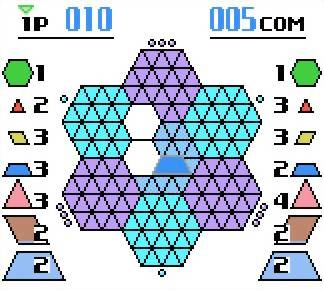
The playfield, with two hexagons placed and the player considering where to put a small trapezoid.

The seven pieces are shown on the dies of the picture above.  These take up a lot of space, but because each side is only one piece long, you’ll have no issues with sides being partially covered at least.

First there is a large hexagon that fills up six spaces on the board.  This is a large piece, and with six sides the most costly to not play.  Because all sides are only one space long, though, you won’t need to worry about whether the sides are fully covered, only that there is enough space.

Second is a small triangle, which fills up one space on the board.  It’s always good to have a good number of these.  Very useful pieces.

Third is a small rectangle.  Two spaces.  These can be quite useful.

Fourth is a small trapezoid.  Three spaces.  A good piece, but a bit harder to play than the small rectangle.

Fifth is the large triangle.  Four spaces.  The smallest of the big pieces, but remember they only have three sides.

Sixth is the large rectangle — two large triangles end to end.  Eight spaces.  Three of these fill up a hexagon on the board.

Last is the large trapezoid, three large triangles.  These are the biggest pieces and the hardest to play — each takes up a full half of a hexagon on the board.  Play these first, or you likely never will.  And be afraid when you have a lot of them and the computer starts with a hexagon, you’ll lose a lot of points if you’re unlucky.  It still is only four sided though, size has no effect on how much you lose if you don’t play it.

Remember, size has no effect on point loss, only the number of sides, so small and large rectangles and half hexagons will all cost you 20 points if there are any left at the end, for instance.  So don’t focus on playing all large pieces first, then smaller ones — there are many cases where it’s smarter to play the small rectangles and trapezoids before the large triangles, as they cost more points if left in your hand.

So, those are the game basics and rules.  Now, on to game modes.
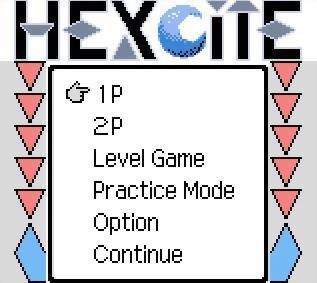
Main Menu

Main Menu

The game has One Player, Two Player, Level Game, and Practice mode modes, as well as an options screen.  Continue is for continuing a game you suspended — yes, you can stop a match in progress and continue it later in this game, which is awesome, that isn’t common on the GB or GBC.

One Player (1P) mode is for playing a single match; think of this as the quick-action mode.  You just choose a number of rounds, difficulty, a few more options (timer on/off, alternate starts or you always play first) and go.  There are five difficulty level choices.  It won’t be saving stats or anything, though if you win enough games without saving in the highest difficulty level, on a GBC, you will unlock another difficulty level above that.  This is the one thing I haven’t managed to do yet in the game, though I am trying.

Two Player (2P) mode is for a versus game.  It’s like one player but with two humans, obviously.  As this is a turn-based game, you can play two player on a single Game Boy, taking turns, if you wish.  If you’re playing on a Super Game Boy, the game supports using two SNES controllers, so that each player can use a separate controller.  It’s a nice option.  For handheld systems it also supports link cable multiplayer if you wish to play it that way.  Basically, the game supports every multiplayer method it possibly could have on the platform.  Great work.  As a great board game should be, this is a fantastic multiplayer game.

Level Gameis the main single player mode.  In this mode you save your progress into one of six slots as you go.  In each match you can choose the number of rounds; the default is six, which is what I usually go with, but you can choose any round number between two and ten.  You gain experience as you win rounds.  The game also has ranks, as the main goal here is to work from the bottom rank, E5, up to Master.  This took me a while to figure out, perhaps because I do not have the manual and this is not explained ingame, but you gain ranks not just through experience, but primarily through consecutive wins.  On the load screen, you’ll see a row of dots, or stars, at the bottom.  Each time you win a round, you get a star; if you lose, you lose the stars and the go back to blank dots.  So, in order to move up a rank, you need to get that number of wins in a row.  At first you’ll only need three wins to rank up, but by the end of the game you need seven.  These do carry over from match to match, though, so if you end a match winning three in a row, you just would need to win four straight to rank up at the end.  Winning many rounds in a row is not easy, so the farther you get, the harder it gets to progress.  You can sort of manipulate it by just playing two round matches and such of course, but still, it’s a good challenge.  As a result, it will take a good amount of time before you hit the max rank, Master, and complete the level game.  I played this mode the most by far.
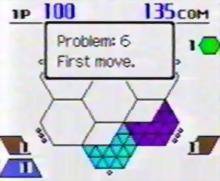
Practice Mode

Practice Mode. Fill the space with only the provided pieces.

Practice mode isn’t quite what it sounds — actually, it is basically the puzzle mode.  See the picture below — you get specific pieces and try to win.   There are sixty puzzles to solve.  I usually hate puzzle modes in puzzle games (you know, the ones where you have to use just a few pieces to clear the board), but this one is fun.  Each puzzle starts with the field mostly full and points at preset values, and you have to figure out how to win with the few plays you have.  Some of them are tricky, but I eventually got through them all.  I was surprised to enjoy this mode, because usually I can’t stand modes like this, but with this kind of game, it works great.  In a game like Puzzle League/Tetris Attack I don’t like the puzzle mode at all, and am quite terrible at it, but here it is good.  I still would rather play the main game even in Hexcite, but at least I had fun and finished all the puzzles; I’ve never done that in a Puzzle League game.  So, despite my issues with the concept, it’s great to have Puzzle mode, and it is surprisingly good.

In the Options screen, the main options of note are the music and color set choices.  There are ten music tracks and eight different color sets to choose from, and the SGB and GBC each have their own different color sets.  Many GB or GBC puzzle games would have two or three music tracks and one color set, and no battery save either, but this is a better, more feature-rich effort, and I like that about this game — it feels much more complete and like a bigger effort than most other puzzle or board games on the console.  On SGB there are fewer colors on screen of course, but still it does a good job and the game is fun on a television.  I’m not sure whether I like the GBC or SGB versions better; the main reason that I mostly play on GBC (well, GBA SP that is) is because I like playing this game while watching TV, and you can’t do that with the SGB version.  There’s a nice help menu here as well with a good, visual tutorial of how to play the game and the rules for the various modes.  There are also a few messages from some of the developers, which is a pretty cool little bonus feature.  Read them.

The final option is Continue.  You can save a game in progress in the pause menu while playing, and you load it here.  This is a temporary save — the file deletes itself when you load it.  It’s an awesome option to have, temp saves are something all Game Boy games should have had. 🙂

So, Hexcite is a really fantastic strategy board game, but it can take a while, particularly on the GBC where the AI, on higher settings, will take some time to decide on each move.  As a result, this is a perfect game to play while watching TV or something like that — the audio doesn’t matter, it’s just background music, and it’s all turn based so if you look up to watch for a while it won’t affect the game at all.  One of the only real negavtives about GBC Hexcite, apart from that that backup battery will die sometime and need replacing, is how long the AI can take to make a move.  Watching TV while playing is also a good idea because sometimes the AI takes far too long to take a turn.  At times I’m waiting a 30 seconds to a minute until the computer finally takes a turn.  Maybe those times are exaggerated, but but you can be waiting for a while sometimes.  I can understand why it is though, the AI has a good number of different moves to choose from, and that poor, slow GB CPU takes a while to deal with deciding which one to do sometimes.  Chess games often had slow move times too.  This game isn’t as complex as that, but it’s enough to have some waiting sometimes.   Oh well, I don’t feel that this hurts the game much; it’s a great, great game, waiting or no.  There is a timer option, but it’s not much use because it doesn’t limit how much time you have per move until a player has used up ten minutes of time waiting (or more), which doesn’t usually happen — the computer often uses a good amount of the meter, but not all of it even on Master difficulty.  The timer isn’t much of a restriction at all, for better or worse.

Other than the wait times, really the only other flaw in GBC Hexcite is that the AI is somewhat exploitable — over the months I was hooked to this game I figured out things I could do which the AI would rarely go after me for, even though it should. As a result, while the game is challenging and all along I lost sometimes, this did make it a bit easier. This is both good and bad, because hard AI is great to have as an option, but also I do like winning, and the AI here isn’t easy; it can definitely win. It’s just flawed. But with the wait times as long as they are, that was probably inevitable, so it’s okay. This game runs on the original Game Boy, after all! Limited CPU power there.
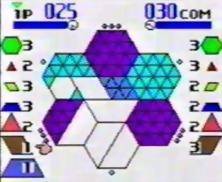
 

A game in progress

A game in progress

This is a picture of a game, midgame, with the timer on.  There are going to be leftover pieces in this match, I wonder who won…  As the board fills up more, playing pieces gets harder and harder.  Note how 1P can’t use that large trapezoid to take the lower left 30-point hex because of that one empty triangle on the upper side  And if 1P played to fill it, the computer would surely play something to block the move.

Back of the box

The lower right shot on the back of the box shows a game nearing the end.  As you reach the end of the match, the stakes get high — both players are trying hard to play as many pieces as possible, without trying to keep the other player from being able to play as many pieces as you can.  You need to carefully consider each move, not only in terms of how many points you will get from it, but for what new moves it allows the enemy to do and whether they’ll be able to play pieces you’d rather they different — one of the best ways to win is to stick the computer with large pieces they can’t play and watch them lose points for it.  Look at all possible moves, and judge which will get you the most points and, in later parts, cost the other player the most points and moves.  It’s a complicated, strategic game, and that’s what I love about it — you have to think while playing this game.  I love it.

In conclusion, Level game mode really is my favorite thing about Hexcite for the Game Boy.  I really like the addition of progression and levels to a game like this, it’s a great idea and works very well. Because of how you advance levels, through having to string together several wins in a row in order to advance, getting through the higher levels is challenging. It took me a long time to advance from rank B to rank A! I finally did it after many tries, but even if this is the “easy” version of Hexcite, it still provides a sometimes stiff challenge.

After reaching max rank in Level Game mode and thus beating the game, unfortunately I got next to no in-game reward, but I thought it was well worth it anyway because of how great the game is!  It’s a fantastic game. After accomplishing that I learned about the Grand Master AI difficulty level, which unfortunately is only in Single Player and not Level Game mode.  Very odd omission there.  You have to win five times in a row (without saving) at Master difficulty in order to unlock it, which is a good challenge. I did that and tried that hardest difficulty. Grand Master is a bit harder than Master difficulty, but it’s only a moderate step up really, and the AI strategies I’d come up with still worked, so I didn’t find it that much more challenging to beat.  Because of the games’ less exploitable AI the PC Hexcite game even at Medium felt at least as hard as GB Hexcite in Master; Hexcite is a tough game which requires a lot of thought to do well at!

Overall, I wish that GBC Hexcite had a better ending once you get a max rank in Level Game mode, and perhaps also that the AI at higher levels wasn’t quite as exploitable, but this is a really fantastic game I highly recommend.  Hexcite is an incredible handheld game, and should be on any list of the best Game Boy and Game Boy Color games.  Some version of Hexcite really is a must-try for any strategy or puzzle game fan, and while it has some drawbacks, GBC Hexcite also has some great exclusive features.  I love it.  The game gets a solid A score.   It is as good as I can imagine a Game Boy version of Hexcite being.


Hexcite (PC Digital Download, 2007)
https://www.bdstudiogames.com/hexcite.html
——————–

Beyond the GBC version, there are also Japanese Wonderswan and Game Boy Color versions, but the most accessible version for Westerners is the PC version, which is available only on Bigfish Games’s website as a download-only title, and I did purchase a while after falling in love with the GB/C game. (Note, Bigfish Games eventually changed names to BD Studio Games, hence the link above.) It’s better than the GBC version in some ways, and worse in others. The basic gameplay is still Hexcite, so I won’t explain how it plays, I’ll just mention the differences versus the GBC game above.  This is what a game screen looks like.
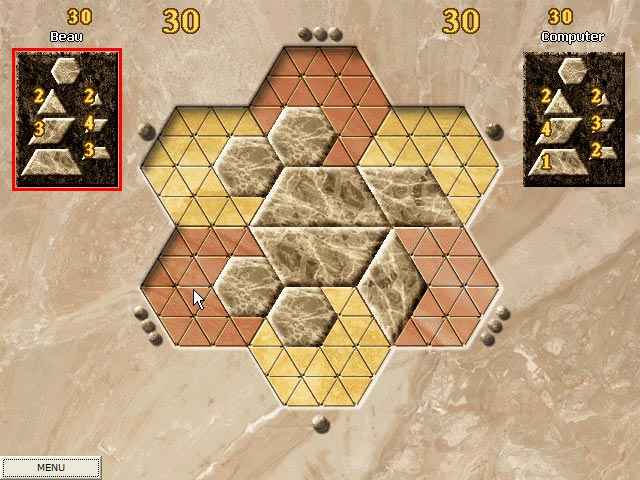
Yes, it’s Hexcite, but on the PC!  Here are the details.

-The game is clearly fairly low-budget, and has simplistic menus, few options, and limited stat saving.

-It’s got no Level Game mode, only an equivalent of One Player and Practice, as well as options. Practice works just like on the GB, solve puzzles. Match Game is the main game mode, and in that you choose your difficulty level, number of rounds, game mode, etc, and then go. The game does keep track of your stats, such as number of wins and losses, best wins and losses, etc, but it doesn’t have anything beyond that in terms of progression. Still, the very limited options are disappointing and hurt the games’ longevity.

-Multiplayer is local-only, so don’t expect online play. Cheap and lazy stuff here.

-No saving a game in progress, I believe. Again, disappointing.

-A new, shorter Hexcite game variety is added, Hexcite ES. In this you just play in one hexagon, broken up into six triangular areas which act like the hexagons in regular Hexcite — eg. you get the point bonuses for filling in each of the six triangles that make up the large hexagon. There is no empty center space here. Because of the smaller board, you have fewer pieces in this game, as the larger pieces aren’t available in ES mode. ES mode is fun for a little while, but is probably less fun than the main game because the smaller, less complex board means that there isn’t quite as much to the game. It’s an interesting option and does shorten games, but I didn’t play this much before returning to normal Hexcite.

-There are 10 or so music tracks to choose from, 13 boards, and 13 tilesets, for regular Hexcite. There is some nice variety there for sure. Hexcite ES has just two boards and two tilesets. Hexcite ES isn’t in the GBC game, though, so it’s nice to have the additional mode! Still, ES should have had more tilesets and boards, I think. Sure, most people will probably mostly play the standard mode, but why the huge disparity? As for boards, the different tileset options are cool; on GBC and SGB you have many color-palette options, but the basic look of the tiles (color aside) is always the same. With the better graphics of a PC, you can have greater graphical variety, and you see that here. The game looks almost too big blown up to a full PC screen, though… I’m used to the whole board fitting on to a GBC screen! :p

-There are just three difficulty levels, which means there are a lot fewer difficulty levels than in the GB version, and no difficulty gradient here such as the one in Level Game mode, which has many more difficulty tiers as explained above. This really is unfortunate. PC Hexcite’s Beginner mode is not challenging, but Intermediate is tough, and there’s nothing between that and Beginner. This can get frustrating. Other than that, options are similar. I did find Intermediate surprisingly challenging compared to the GBC game, perhaps because many of the strategies I was using to win on the GB/C (at any difficulty level) weren’t working as well on the PC. The harder AI is great, but I liked winning too, so both ways have their advantages. :p It would be best to have a Hexcite game with as many difficulty level options as the GBC, and also the challenge of the PC game, but unless the GBA version is like that (no, I still don’t have it; I need to import that sometime!), that doesn’t exist. Ah well.

-No long pauses while waiting for the computer to play like in GB Hexcite. 🙂 It’s nice to have AI that plays so much faster. Processor power has its benefits. This is probably also why the AI is so tough.

Overall, it’s a fine version. The graphics and piece options are nice. I just wish it had some more modes, and this is a perfect handheld game… still though, it’s pretty cool that it exists. 🙂 Hexcite is great fun; I like strategy games, and this is a fun strategy board game. This, Blokus, Callisto — block-placement strategy board games like this are fantastic! I haven’t played Hexcite nearly as much in the last few years as I did back in 2011 when I was so hooked to the GBC game, but still, it’s a very good game. This game has much lower production values than the GBC game, and the only major gameplay addition is the challenge level of the AI. The better graphics and ES mode are nice, but those are just cosmetic differences. Overall, I had more fun with the GBC version. Maybe it’s because I played it first, but also I love the Level Game concept, and its absence hurts the PC game. The cheap presentation and missing features — saving fewer stats, no saving a game in progress, few difficulty levels, etc — hurt the game. I give it a B, maybe a B+ at most; the B+ might be a bit high, considering that I was hooked to the GBC game for the better part of a year but have only quite infrequently played the PC game, but the base gameplay is the same, so the basics are pretty great. On any platform Hexcite is very good. B or maybe B+.

Posted in Classic Games, Full Reviews, Game Boy, Game Boy Color, PC, Reviews | Tagged , , , , , , | Leave a comment

Rock ‘n’ Roll Adventures (Wii) Review

  • Title: Rock ‘n’ Roll Adventures
  • Developer: Destination Software International
  • Publisher: Conspiracy Entertainment
  • Released: 2007
  • Platform: Wii

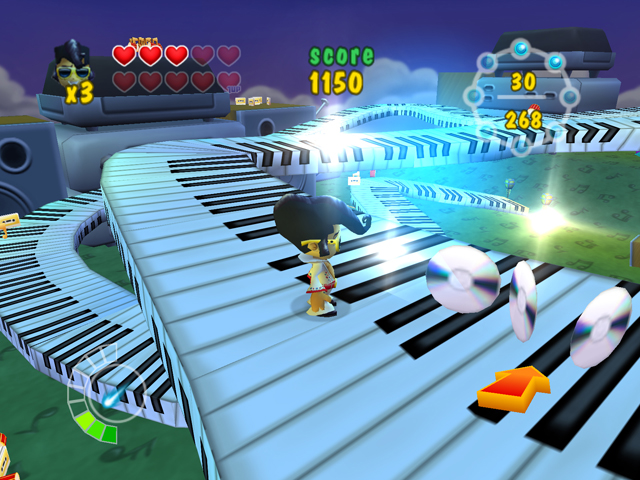
Rock ‘n’ Roll Adventures (Wii) – This is one of Data Design Interactive’s many very low budget EU PS2/PC-to-US+EU Wii ports released in ’07 through ’09.  This one is one of the 3d platformers, along with Anubis II and Ninjabread Man.  The games are extremely short, 4-level 3d platformers with some annoying motion controls and gameplay-wise play pretty much like N64 or PS1 games in the genre.   I still like those games, so I don’t mind this, and actually wanted to try one of these to see if I’d enjoy it — “It’s kind of Nintendo 64 3d platformer-like” is something that makes me WANT to try a game, not want to not try it. 🙂   So I got this game a while ago and having found this one cheaper than I’ve seen those other ones for, but hadn’t actually put it in the system until today.  Wasn’t exactly expecting much, considering the awful reviews.  I beat it an hour or so later, but I actually had fun along the way and there are some additional modes to play, so it was worth my $5.  This game’s not that bad, really, it’s just incredibly short.

I wonder if it took longer to play through the game or write this post about it… :lol

Probably play the game, because I did play some of the additional modes and stuff too, but I have written a lot about such a short game, haven’t I.  Oh well, it always ends up like this…

First, graphics and sound.   The graphics are alright, not upgraded from the PS2 original but decent enough looking for a game this low budget.  They are simple and somewhat sparse, like the N64 and PSX 3d platformers the gameplay was inspired by but using at least some of the PS2’s power.  The graphics won’t impress, but I thought they were good enough to do.  The Wii can do far more than this, but oh well, it doesn’t look bad, just low-end.  At least it has a consistent visual theme and runs fairly well.  As for the audio, it’s not rock music like the title might lead you to believe, it’s generic 3d platformer music.  I at least consider this a good thing, because I don’t like rock music, but I do like videogame music.  The music’s decent. Nothing special, but good enough. 🙂

The number one thing people seem to have complained about is the jumping controls.  If you read the manual and the ingame control explanation, it tells you to jump by waggling the nunchuck.  You attack by swinging the Wiimote (left, right, or down work, up doesn’t).  Move with the analog stick.  Your only speeds are a barely-moving crawl or a full-out run, there’s really nothing in between — makes some of the platforming a little harder than it should be, but I do like how fast he moves, at least if you miss a jump you can get back to where you were quickly (one bad design decision partially compensating for another bad design decision, perhaps? :)). Press B to go into aiming mode so you can shoot.  Problems are, first the Wiimote swinging is extremely poorly done and fails to recognize my attacks a lot of the time (this causes you to take way too many avoidable hits, and I know the Wiimote can be responsive, it just isn’t in this game), and second, the nunchuck-waggling for jumping is imprecise and hard to get right.  At least the nunchuck is responsive in that when I shake it Elviz (your character, the Elvis clone) jumps, but he often double-jumps right off, which is a big problem because lots of jumps in the game require precise double-jumping, so if it’s wasted at the start you will fall.  Over and over and over.

At least when you fall you won’t die — there’s no jumping over bottomless pits in this game, you fall to a lower platform and then try the segment again.  Very nice, particularly for anyone trying to play the whole thing with waggle jumping.  If you’re the kind of person who doesn’t like a game where you have to run around and try the same jump 10 times because you need to do it just right to clear the jump, though, you won’t like this. Wario Land 2 haters need not apply? 🙂  I found it a frustrating in a few points, but fun anyway overall.

The even nicer thing came when I pressed Z, though, and found that… Z jumps.  They didn’t bother to tell people this in the manual or controls screen, for some stupid reason, but it works.  I wish the jump button was A instead of Z, but oh well, works fine, and you can jump accurately.  Now if only there was a button for attack, too… but sadly no, for that you need the extremely unresponsive Wiimote swinging. 🙁

Oh, the camera’s not great and does get messed up, particularly after you try to return to normal play after using the gun, but one of the dpad directions centers the camera behind your character, so it’s not an issue.  You’ll just have to center the camera regularly (during jumping puzzles particularly), but that’s fine, in my opinion.

The first level is a tutorial.  After that, there are three real levels of average length.  To beat each level you need to collect the eight platinum CD items and then get to the exit.  The levels are largely linear, but there are some simple puzzles, and lots of jumping, along the way.  There are just three kinds of enemies, and all four levels have the same graphical theme.  The drum and cymbal enemies are just a minor nuisance, but the tape recorder is ar pain, you can’t jump on them (that’s the easiest way to kill enemies, given the bad wiimote-swing recognition) and they shoot at you, too. The levels are reasonably well designed and are fun to play through, I enjoyed playing through the game.

I did have to restart a level once, in level 2, because I got stuck between two platforms and couldn’t get out.  That was annoying, but it did only happen that one time and there is a ‘restart level’ option from the pause menu (and it was just a couple minutes into the level too, so I didn’t lose much progress).  Other than that the game ran well, at least the game isn’t horribly buggy even if it is seriously lacking in content.

There are no bosses in this game.  Once you beat the four levels you’re just sent back to the main menu, there’s no ending or credits (you can watch the credits from the main menu whenever you want, they aren’t shown at the end of the game).  DDI’s other platformers do this as well, I’m pretty sure.  Pretty lame.

However, at least you do unlock something — in each of the three main levels, you unlock several extra modes.  First is an item-collection mode with lots of stuff to collect scattered around the level.  You choose three difficulty settings, and that determines the percentage of the stuff you need to collect.  It’s funny, playing through the first time I didn’t even notice that the game was missing collectibles other than the health-ups you get for killing enemies and the platinum CDs, must say something about that I was enjoying myself.  The game is more fun with them though, a full game with these pickups there by default would be a better game than this.  This mode also gives a purpose to the various nooks and crannies in the levels that are just empty in the main game, now they have stuff in them. 🙂  Of course there’s a downside, though — there’s not much point.  The game doesn’t save your score or best total or anything, so all you get for winning is the satisfaction of having finished it. Great.

The second mode is time attack, where you have to finish the level in a specified amount of time.  There are three difficulties, each with a shorter timer.  This mode’s actually tricky, lots of cassette players shooting at you and a clock ticking away… again though your time, if you finish, isn’t saved.

The last mode requires you to find 20 “hidden items” hidden in the levels.  This is the hardest of the three unlockable modes, because the items are better hidden.

The manual claims that you need to beat each one of the three hidden modes to unlock the next, but in the actual game that’s not the case — beating each level in the normal game simply unlocks all three modes.  I wonder why they removed that, between the time they wrote the manual and finished the game, it’d have been nice because it’d give you an actual reason to want to play the extra modes beyond just trying to challenge them.

So yeah, that’s a DDI platformer.  Decent mechanics, okay last-gen (verging on two generations ago) graphics, almost no content unless you like playing the extra modes which don’t save your scores, and even then it won’t take more than a few hours to get through all of them most likely.  There are only three levels with the extra modes after all, each of those will take longer than getting through them the first time will but still it’s only three levels (plus the short tutorial stage).  I’m pretty sure Ninjabread Man and Anubis II are also 4-level, no-ending extravaganzas, maybe if they had combined all three of them into one game and then added a few more levels on top of that they’d have had an actual full game… it’s kind of too bad because I do find what’s here fun.  It’s got a decent level of challenge, with frustrating jumps, some tricky jumping puzzles, and more, but despite being annoyed at failing a jump for the 5th or 6th time in a row, because you aren’t punished too much (no falling in pits under jumps remember), just sent back to restart the section, it works.  Just use Z to jump most of the time, I actually find the waggle jumping entertaining and kind of fun, but it’s not precise enough to use on the longer jumps, it’ll just lead to lots of frustration trying to perfectly time your second jump, and most of the time having it do it too soon.  Even with a button jumping some of the jumps are tricky.  Quite a few jumps require you to jump right from the edge of the platform and use a near-perfect double jump in order to get across.  But that’s not really bad, if it was too easy it wouldn’t be very fun…

But I like 3d platformers, and jumping between platforms is what they’re supposed to be about, right?  I prefer 3d platformers that are actually platformers to the so-called “3d platformers” that are actually 3d action games, such as Ratchet & Clank and the second and third Jax games.  I don’t mean this game is better than those, it’s definitely not, but on a conceptual level I do prefer traditional 3d platformers to those kinds of games.  There aren’t enough true 3d platformers this generation.

Basically, my point is that only fans of the 3d platformer genre should consider playing these DDI games, but if you do like 3d platformers and can find the games for a couple of dollars, maybe think about picking them up, as long as you know about the drawbacks.  It won’t last long, but I at least had enough fun to think it was worth the time.  I might go back to try to finish the other modes, I haven’t beaten most of the extra modes yet.  And I think I want to try the other US Wii DDI 3d platformers too, if I can find them cheap I’ll probably pick them up as well.


As for a score, because of the severe lack of content I don’t think I could give this game a score above a D, but I did like it while it lasted.  IGN seems to be the only site that reviewed this game (here: http://wii.ign.com/articles/841/841408p1.html); they gave it a 3/10, but didn’t notice that there actually was a jump button, not just the shake-the-nunchuck jump mechanism.  They also didn’t mention the additional modes you unlock.  It doesn’t even mention that the game has only four levels!  It’s a pretty shoddy review.  The fact that there is a jump button has to raise the score some above that.  But I guess I’m a little lenient on games I enjoy, I don’t often give games failing grades… but in this case it’s just that what’s here is decent, for a classic-style 3d platformer, it just needed a lot more of it.  But of course, I do love the N64 and that style of 3d platformers, so I don’t mind the 5th gen 3d platformer-style gameplay at all.  DSI probably should have made one actual full game instead of a bunch of hour-long ones, but evidently they thought that this way would be more profitable, unfortunately.  The Wii has many better 3d platformers than this game, but even so I don’t regret playing it.  I do wish that they’d mentioned the jump button in the game and manual though, it’d have saved the few people who actually did play these games some frustration. Score: D+.   This is a bad but fun game!  This is the best of the three DSI Wii 3d platformers I have.

Posted in Full Reviews, Modern Games, Nintendo Wii, Reviews | Tagged , , , , , , , | Leave a comment

Ninja Crusaders (NES) review

  • Title: Ninja Crusaders
  • Developer and Publisher: Sammy
  • Released: 1990
  • Platform: Nintendo Entertainment System (NES)

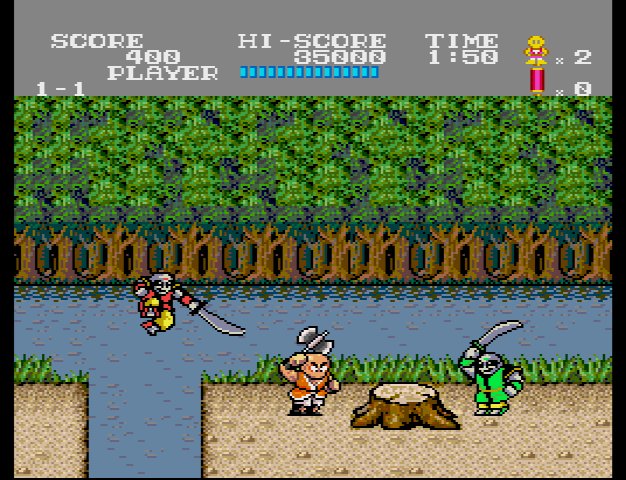
Ninja Crusaders is an action-platform game for the NES published by Sammy.  The game is a difficult and memorization-heavy title that will certainly provide a stiff challenge, but isn’t quite as hard as the NES’s most infamously difficult games.  I beat the game fairly quickly, when I played it for the first time recently, beating the game in just two days.  Ninja Crusaders wasn’t the best known game when it came out, and I can see why, it does look generic.  The cover art is quite bland, and the game has a lot of obvious similarities to Ninja Gaiden, most notably the ninja theme and the “fake isometric” graphical style, but the game’s not Ninja Gaiden.  It’s something more traditional, though not without its own unique elements.  This game doesn’t have much in the way of story for instance, with no intro except in the manual and just some lines of text at the end, and no story scenes in between.  You play as generic modern-day ninjas.  Go kill the bad evil guys.  But that’s all the story you need, right?  First thing though, one hit dies, and when you die, you get sent back to the beginning of the level (unless you’re at a boss, in which case you will start from the boss until you get game over; then you get sent back to the beginning of the level).  There are a variety of weapons to pick up, but there’s no shield or anything like that. Yeah.  It’s cruel.

However, at least the game does have infinite continues, which is certainly a big part of how I beat it so quickly.  And while each area has two stages (1-1, then 1-2 with the boss at the end of the second one), you never have to redo a stage you have beaten, you will start from the stage you’re on (so you don’t get sent back to 4-1 after getting game over at the level 4 boss).  Also the game’s not very long — there are only five levels, each with two stages, and only level 5 has a boss after the first stage of the level; in the first four the only boss is after the second stage.

Also, though I couldn’t test it yet, the game has two player co-op.  That’s pretty awesome, there are not many NES sidescrollers with two player simultaneous. 🙂

Really, I can see why this game didn’t seem to make a big impact — though nice graphically it looks a lot like Ninja Gaiden, and gameplay-wise it’s nothing very original — but the total package is solid and good quality.  I like this game, I wasn’t expecting much from this game I’d never heard of with quite generic cartridge art, but it’s good.  Yes, the difficulty level is high, and you have to enjoy frustrating games which kill you over and over and over and over while you memorize exactly where to be at each point of each level so that you do not die.  If you don’t like games like that, you will hate Ninja Crusaders, because that right there is the entire game.

However, as the fact that I beat the game barely over a day after starting it shows, the game’s not impossible.  This game may be hard, but it’s no Ninja Gaiden 1 or Jim Power or something.  It’s just difficult. 🙂

Anyway, the actual gameplay.  There are several different weapons, and the weapons are balanced so that closer ranged ones do more damage, and longer ranged ones less; still, despite this, the default shuriken is my favorite weapon because despite being weak (and you can only have one on the screen at once, too), the full-screen attack is really helpful. Sure the staff or sword are very strong, but good luck not getting hit when you’re using them, and with how dying sends you back to the start of the stage, you want to avoid getting hit.  There’s also a midrange whip or mace thing.  You can also transform into an animal form by holding up or down + attack, with a different form for each weapon.  You switch back by again holding up or down+attack.  The animal forms are only moderately useful however, and with three of the four you still die in one hit; the sword’s animal form is invincible, but it also only can be used once in a level and lasts a short time.  Still using them does make parts of the game easier, if you want a real challenge beat it without them.  That’s what I did, actually. I’m not sure why, it’s not like I needed to make this game harder…

The enemies are varied.  Each level looks different, and new enemies are constantly being introduced, until the end of the game — each area has its own new group of enemies.  Despite not being particularly original in style, the graphics are solid and look good enough, plus I do like the variety.  This game is from 1990, later in the NES’s life, and you can tell.  There is slowdown, I think, but rarely.  The music’s good but not great too.  It’s not outstanding, but it works and I liked some of the tracks.  The environments and enemies are nicely varied.  There are quite a few water stages in this game; there’s a significant amount of water in one of the two stages in each level.  Fortunately swimming’s not a problem in this game, and they aren’t too bad.

Enemies spawn when you are in certain areas, sort of like Ninja Gaiden but not quite as quickly (so you will not face a point where an unending stream of enemies materialize in front of you, each appearing as soon as you kill the last).  Many enemies take multiple hits, with the weaker weapons at least, but as I said in the weapons part that’s balanced nicely.  Enemies don’t have specific patterns they always follow no matter where you are, but instead have specific patterns that they follow that often involve aiming at you — enemies will target you, or vary how they move depending on where you are in the screen, so a big part of the game later on is learning how exactly enemies will move as you try different approaches through the level.  Despite great frustration at times, and parts where I’d just die and die and die, fifteen or twenty times maybe in the exact same screen, before finally figuring out how to approach that part, it was worthwhile.  It was always nice to see an area that I’d died in so many times before, but now I knew how to do and could get through more times than not.  🙂  The levels are also not that long; they only take a while to beat because of the difficulty level, not the length.

… I still hate those stupid fly enemies in stage 5-2 though.  For small enemies they sure are a gigantic pain!  They’re not the easiest to hit, and they just won’t go way… hope that you hit each one with your first shot at them, because if you miss one it’ll probably fly under you and below, and then fly up at an angle you can’t do much about and kill you (while another one above you makes it so you can’t jump, and of course you’re on a narrow platform so you can’t move around much either).

As for the bosses, as I said there are six in total, but they fall into two or three general types, so you’ll see multiple similar bosses through the game.  The hardest bosses are the level 3 and 5-2 (final boss) ones, which move around a lot and have tricky patterns to memorize… one hint for almost all bosses, though, is that you often can do the whole boss fight from the left edge of the screen.  This isn’t always true — the first form of the final boss cannot be fought that way — but with a bunch of other bosses, the best approach is just to not move from your starting position, or to return there often.  I mean, assuming that you’re using the shurikens like I was, for full screen range. 🙂  That doesn’t mean the bosses are easy, though, just that most of the motion required for most of them is in perfectly timing your jumps, ducks, and shots, not moving around.  All of that is quite challenging enough. 🙂  The bosses definitely can be frustrating, but all of them have patterns to memorize, and once you figure it out you’ll eventually manage to beat them.  When I finally got down the final boss’s second (and last) form’s pattern and beat it, it was pretty cool.  I will say though, the level 5-2 boss isn’t that much harder really than the level 3 or 4 bosses, its first form is actually a little easy (I can die, but usually got past it).  The second form is harder, but once I figured it out it went down.

Overall, thanks to the short length, extremely generic characters and story, Ninja Gaiden-ripoff visual style, and lack of originality this isn’t one of the NES’s great forgotten classics, but it is a solid B or C-quality game.  It’s frustrating fun that overall I quite enjoyed playing through.  Sometimes I dislike NES Hard games, but this one was decent and fun, when I didn’t want to stop playing it forever out of frustration that is. 🙂  I definitely want to try the 2-player co-op mode sometime.  I would recommend Ninja Crusaders for anyone who wants a challenging but beatable NES action-platformer.  The animal transformations, if you use them, can make some of the hard parts much easier.  Ryu Hayabusa couldn’t just fly over those tricky jumps, but in this game you can.  It’s not amazing, but it’s fun enough to be worth a try. Score: B-

Posted in Classic Games, Full Reviews, NES, Reviews | Tagged , , , , , | Leave a comment

Atomic Runner (Genesis) Review

  • Title: Atomic Runner
  • Developer and Publisher: Data East
  • Released: 1992
  • Platform: Sega Genesis / MegaDrive

Atomic Runner, also known as Chelnov in Japan, is a very good Data East game from 1992.  This Genesis version is a remake of a four or five year older arcade game, much improved versus the arcade original.  The game plays like a run & gun game, except it’s auto-scrolling, which makes it feel unique.  There are a variety of weapons and powerups to collect, lots of enemies to kill, jumps to make, some short alternate routes, challenging bosses, and more.  The game is a memorizer for sure, and the main challenge is in learning what to do at each moment.  Enemies will appear in exactly the same places each time, though many will then fire at where you are, so the game isn’t 100% identical every time.  There aren’t many levels, but it’s really good while it lasts.

The story of the game was completely changed from the arcade original, where evidently Chelnov (that’s the name of the main character in any version) was transformed into a superhero by a nuclear explosion (and this was right after Chernobyl, obvious reference…), and had to beat the badguys or something.  That’s gone on the Genesis.  Instead, your character Chelnov becomes the Atomic Runner after an alien force attacks Earth.  Supposedly they once inhabited the earth, and now are back to reclaim it from the nasty humans.  You, of course, will have to stop them.  Anyway, your family were scientists, and the aliens attack your house early in the invasion.  Chelnov’s sister is kidnapped and father mortally wounded.  Your father’s dying words are that he knew this would happen and that he had been preparing for this by readying the Atomic Runner suit, so go and save the world, Chelnov!  … Except Chelnov almost immediately gets captured and tortured, until finally he snaps and acquires his powers.  So, you start the game by breaking out of an alien facility.  Go and defeat the aliens and save your sister!  So yeah, very generic plot.  At least there are cutscenes at the beginning and end of the game, though, so this isn’t one of those games with one-line endings or something like that, it’s a substantial ending that makes the effort beating the game requires more worthwhile.

“Go, Atomic Runner!  I will not fail.  No enemy can put a stop to justice!”  Yes, the story is entertaining. 🙂

Overall, this game is very good.  It has good graphics, great art design, and great music, and the gameplay is great as well, and the unique auto-scrolling run & gun design is great.  That makes it play somewhat differently from just about anything else.  The weapons are varied and are all pretty cool, the game is well balanced and well designed, there’s a good variety of enemies and obstacles… yes, I really liked this game.   The graphics are very nice looking and your character is really well animated — Chelnov runs extremely smoothly, you don’t see that often on the Genesis.  The enemy sprites don’t animate as much as Chelnov, but all look good, and the bosses are particularly impressive, with giant Chinese dragons, animated statues, and more.  The style, which is a mixture of ancient cultures and futuristic high-tech areas, is interesting and gives the game a great look.  And the music… it’s great, catchy stuff.  Really good work.

The controls are interesting.  You can fire right and left and jump.  Enemies come from both directions, so get used to firing both ways.  Also, you cannot move backwards on the screen except for in boss fights — otherwise, you can only move forwards or stop where you are, until you hit the back end and start being forced forwards of course.  This means that you should never shoot enemies holding powerups who are behind you if you want to get the powerup, because you will not be able to go back and get it; wait until they’re in front.  This design is a little annoying at times, but it works well enough and does help keep the game original.  Also, when you are jumping, if you land on top of an enemy you’ll bounce off and do damage, instead of dying.  This is a key mechanic.  However, be sure that you’re jumping!  If an enemy hits you from below while you’re on the ground, you’ll die.  Your boots only provide invulnerability when you’re not touching the ground, evidently, for whatever reason.  This DEFINITELY can be frustrating, when you try to jump on an enemy under the floor but just miss and they come up under you and kill you… jumping on enemies can be a little hairy, but you’ve got to do it.  This is the only controls-related complaint I have with the game.  Jumping on enemies mostly works fine, but could have been done a little better.

However, it is important to mention that you cannot control how high you jump in this game. Every time you press jump you will jump the full height of your jump, so you can’t strategically choose to jump but not high enough to hit something above you, etc. This means you have to carefully plan when you’re going to jump, because you will always jump full height.

Also, you can fire either straight forwards or diagonally up. You fire diagonally by holding up while shooting. If you hold left or right while jumping, however, you will do a spin jump and fire in all directions while you’re in the air; this is annoying and unhelpful as often as it is helpful, but it’s important to remember. Holding up or down while firing will not do the spin, so remember to let go of forward when jumping if you want to continue to fire diagonally while you jump; if you jump while holding diagonal up, you’ll spin instead of continuing to shoot as you are. I’ve died a few too many times because of accidental spins, though other times they are helpful (It is good to have something at least that hits all directions, I just wish it wasn’t so easy to accidentally do them when you don’t want to).

As with most shmups and run & guns, you die in one hit.  There’s no shield.  When you die, you get sent back to the last checkpoint.  Fortunately the game has many checkpoints, so you don’t usually lose much progress.  Game over also just sends you back to the last checkpoint, though there are limited continues; you can set how many, from 3 to 15, in the options menu.  There are also difficulty settings and various control options.  I recommend, and use, control option C-1, where A fires left, B jumps, and C fires right.  The default controls have C switching direction and A firing, but the game is easier and works better with this Forgotten Worlds/Sidearms control style.

The designers even gave players a break.  Instead of sticking with the merciless difficulty that it could have, after you’ve died at a single checkpoint four or five times or so in a row, the first powerup you see after that checkpoint will change from whatever it is into a full-power one, so that you can try it with full weapon power.  This is incredibly helpful and makes a massive difference in reducing frustration, particularly at the harder bosses.  Otherwise, after you die once often bosses would become incredibly hard, having to pick away at them with weak weapons… instead, just die a few more times and you’ll have full power for the fight.  This game is quite challenging as it is, it’s great that the designers gave players a little break like this.

The final boss’ last two forms (it has three) were definitely tricky, and held me up for a few weeks — I got to the final boss a week or two ago, but got frustrated at dying there repeatedly (you have limited continues and no saving), and I quit for a while.  Well, I picked the game up again today, and beat it on my first try!  Okay, I used a bunch of continues, but I didn’t run out and have to start over, I beat the game first.  Pretty awesome, I thought I’d gotten a terrible start but as I went along I got better and remembered the game more and more… I really like this game, I’d never heard about it but it’s pretty cool.

There’s really only one major negative: It’s short.  Hard, but short.  There aren’t many levels, only seven or so, and once you start to learn them you can get through them fairly quickly.  The main part of the challenge is simply in learning things, so once you’ve done that it’s mostly just about trying to do it faster… it’s so much fun while it lasts, though, that I don’t mind.

Other than the short length and the aforementioned issue with jumping on enemies (that sometimes you miss and die instead of bouncing on the enemy as you were trying to), the only other possible negative really is that the graphics are a little small (very good looking, but the sprites are on the small side, not that I mind much), and that the backgrounds in a few levels are so gaudy and impressive that sometimes I can lose track of the enemies and bullets.  This is particularly true in the gold and jade Chinese-ish level.  It looks amazing, but sometimes the enemies can be hard to see… or maybe it’s just that the backgrounds are so awesome looking that they distract me. 🙂  Either way, it’s something you get used to.

Overall, though, those are minor compared to how great the good elements of this game are.  Atomic Runner, aka Chelnov, is a very good game, and I like this one a lot.  This game is not well known, but it should be.  Try it, you might like it.  Anyone who likes run & gun games or shmups should definitely give this a play.  This is probably one of the best unknown Genesis games I’ve played, it immediately addicted me.


90% (A-).

Here’s a video.  The set goes through all the levels, but I chose the middle one because these levels are pretty awesome.  http://www.youtube.com/watch?v=NrufeCuAnBU&p=CB54D660220DA892

Posted in Classic Games, Full Reviews, Genesis, Reviews | Tagged , , , , , , | Leave a comment

Tiger Road (TurboGrafx-16) Review

  • Title: Tiger Road
  • Arcade original by Capcom (released 1987)
  • TG16 port by Victor Interactive (released 1990)
  • Platform: TurboGrafx-16

Tiger Road is a 1987 Capcom arcade game ported by Victor to the TG16 in 1990.  I got the game less than a week ago, and beat it yesterday. That didn’t take too long… The game is one of the only platformers on HuCard on the Turbografx with backup memory save support, if you have a TurboBooster Plus or TurboGrafx CD drive (or any variety of Duo), which is awesome.

In the game, you play as a monk warrior fighting your way across what I assume is China, trying to defeat the evil king who has kidnapped the children. You fight all kinds of Chinese monters like Chinese zombies and dragons, and Japanese ones as well like Ninjas.  There are three different weapons, all with two upgrade levels, and a fourth you can unlock later in the game.  It’s frustrating and hard, but I like it. The game gets a lot of mediocre to poor reviews, but really, I think that it’s a pretty good game. I must admit, though, I made use of the backup save feature for saving and infinite continues. I don’t know that I’d ever beat this game “legit”, with no saving and with the 5 continue limit you have if you’re not using a system with saving, but, well, the option for saving and infinite continues is there, with that addon hardware, and I have a Turbo CD, so I’m definitely going to make use of it! It continues you from the stage section you’re at, so you never have to replay a stage part that you’ve beaten unless you want to challenge yourself with the non-saving version of the game and really want to memorize everything, though with how the enemies spawn infinitely, this isn’t a 100% memorizer like R-Type or Jim Power, you will have to use luck and skill as well as memorization to finish this game.

I mean, Tiger Road is HARD. It’s as hard as you’d expect for a Capcom arcade game from that era, considering that they also made games like Ghosts & Goblins.  Some things feel Ninja Gaiden-esque, except this game is older.  It’s got knockback, which always seems to hit you into a pit, infinitely spawning enemies driving you crazy, enemies attacking from all directions, frustrating bosses which can absorb a large number of hits, and more… it’s a tough game. Fun, but tough.

The game has good graphics for a midlife TG16 HuCard game, with the bright, vivid colors you expect from games on the system. I like the music as well; it is repetitive, and the sound effects are mediocre at best, but the music works well and isn’t too bad. It’s fittingly Chinese in style and fits the game’s atmosphere well. There are also bonus minigames between levels, which are simple but a nice diversion (the ‘defeat the monks’ one particularly, the other minigame is kind of easy to beat with the turbo switch on, and in this game turbo will probably be on on the attack button the whole time you’re playing).  Even though he is on a quest, our hero is still in training to the Ancient Master.

The weapons are a mace, a spear, and an axe.  The axe is the default weapon, but you collect the others via red powerup boxes.  Other powerup boxes are yellow, but those won’t contain weapons.  (On that note, don’t pick up the yellow “health” powerups!  They actually cause you to lose health.  Only grab the blue or red ones.)  Another powerup upgrades the power of your weapon, and if you succeed at enough end-of-level minigames, the Anicent Master will give you a new, more powerful weapon, the tiger shot.  You’ll lose this once your health gets too low (until you die and come back, or get a health powerup), but still, it’s a great weapon, and a strong incentive to beat the minigames.

There are only five levels, but each is broken up into many parts, and each level is longer than the last.  The last level is pretty long and has multiple bosses, including some returning from the earlier levels. Visuals and enemies do repeat, but there’s enough variety of environments and enemies to keep the game interesting, I think, and it all looks pretty nice.  Bosses are a bit annoying though, as I said; each has as many hit points as you do, except you take a lot of damage when hit, while they usually take just one HP per hit, so you will need to hit them many times before they’ll die, while avoiding taking much damage.  The boss fights can get a little long, and the first few are easy too — not a good combination.  Still, the later bosses provide a definite challenge.

Overall, it’s a good game. It is fun and challenging and kept me coming back until I finished it, despite great frustration in a few of the later areas. It’s a simple game, like most TG16 HuCard platformers, and it deserves its reputation for high difficulty, but it is good overall, particularly for anyone with a system that can save. The save feature is really awesome to have, in my opinion.  I really do prefer to be able to save in games, and far too many 16-bit platformers not on the SNES didn’t have saving… Oh, and it doesn’t just save your progress (it autosaves at the Game Over screen, so wait for that if you want to save), but it saves your top four high scores, too! Pretty cool, high score save is VERY rare on the TG16.

I give it a 80%.  It’s good, but not great; the game is a little short, and replay value is somewhat limited, unless you want to try to play it with only five continues and no save.  Also while the graphics are good they probably could have been even better, and the sound effects definitely are a little weak.  Also, of course, while it is fun, the game also gets very frustrating at times.  However, I do like the game, and it was worth getting.

Posted in Full Reviews, Reviews, TurboGrafx-16 | Tagged , , , , , , , | Leave a comment

BattleTanx (N64) Review

Title: BattleTanx
Developed and Published by 3DO
Released: December 1998
Platform: Nintendo 64

BattleTanx is the first game in a short series of tank action games by 3DO.  The series consists of BattleTanx for the N64, BattleTanx: Global Assault for the N64, BattleTanx: Global Assault for the Playstation (a port, but different enough to be listed as its own game), and BattleTanx for the Game Boy Color; while 3DO did make a few more tank games after this, before going bankrupt, even though the gameplay stayed similar they started a new series, consisting of World Destruction League (WDL) ThunderTanks (PS1 and PS2) and WDL WarJetz (PS2).   The BattleTanx games are great single and multiplayer third person tank combat games full of explosions and destruction.  I first played BattleTanx in BattleTanx: Global Assault for the N64, which I bought, and loved, back in 2000.  As a result, this review will frequently compare this game to its sequel that I know so well; I can’t help it.

The backstory for BattleTanx is that recently, there was a plague that killed 99.9% of all women on Earth.  In the aftermath, the government collapsed, cities were nuked, and roving tank gangs now rule America.  Everybody who matters has a tank, and spends all of their free time driving around in it shooting at stuff.  Basically, it’s the perfect setup for a destruction-themed series! 🙂

Just like BattleTanx: Global Assault, the first Battletanx is quite short and easy — I started it yesterday, and finished it today just a few hours of gameplay later. Still, also just like the sequel, it’s a great game. The incredibly fun shooting and destroying action is just as great here as it is in the sequel — while I’ve owned the second game for 10 years, I’d never played the first one until now.   BattleTanx’s graphics aren’t amazing, but they are good enough.  The fog is a bit distracting, and you can shoot farther than you can see — and can be hit by enemies out in the fog — things which do not happen often in the second game, but are constant issues here.  Still, you can see arrow markers on enemies farther out than you can see, so their fire should not be a complete surprise.  Also the draw distance isn’t terrible, it’s just closer than the second game, or many later N64 games for that matter.  This is clearly a first effort.  Still, overall the game looks reasonably nice.  There is a good variety of environments, lots of different buildings to blow up, nice destruction animations and explosions, and more.  There are also, of course, the many enemy tanks and turrets to destroy.  Blowing up buildings, running over cars, and flattening fences and lightposts with the game’s variety of weapons and powerups is endlessly entertaining.

The levels are well designed, with many hidden areas full of items (and turrets) and good, if straightforward and often somewhat gridlike, building layouts.  The levels in this game aren’t as unique and varied as Global Assault levels, but still they are more than fun enough to drive around in and destroy for this game to more than stand on its own.   You can’t just drive from your base to the enemies, you’ll have lots of walls, destructible obstacles, minefields, and other hazards to deal with along the way.  There are no terrain variations in this game, it’s all flat (Global Assault is similar, but at least does have underground tunnels to go through; this doesn’t have that, it’s just flat).  As always it’s also silly how those little cement barricades can completely stop a tank, if they’re not the destructible ones.  Oh well, they have to create level layouts somehow, it wouldn’t be as challenging if you could just destroy everything.  Still, even though it makes perfect sense, in these games I do find myself sometimes wishing that I could blow everything up.  It’s annoying that some buildings can’t be destroyed, blowing stuff up is fun.  🙂  Overall, the game may be short, but it’s so much fun along the way that I don’t care.

The music does a good job of keeping up the tempo too.  It’s good stuff, similar to Global Assault’s soundtrack.  It’s kind of rock-like so it isn’t my favorite kind of music, but for a game like this it works perfectly.

The story is told through cutscenes with comic book style artwork, with occasional in-engine scenes as well for scenes of tanks driving around. It looks pretty good, and I really like the style and presentation of the cutscenes. Global Assault used the same setup for its story, and one reason why I had wanted to play this game was to see the first part of the story. It’s a pretty simple tale of Griffin, your character, going on a journey across post-apocalyptic America with his tank army to get his wife back (she’s one of the lucky few women who survived the plague), but it works well enough for a simple, arcadey game like this. There’s enough story to keep you going, mostly about the various tank gangs you cross paths with during your travels, and it works. The sequel does have a better story, though, with actual drama and plot twists, which you won’t find here.  I do like the presentation of the cutscenes though, even if the actual story is fairly generic.

Where Battletanx does lack compared to Global Assault, however, is in variety. There are only three types of tanks in this game, and you only control one main one and one secondary one in the campaign; you can’t use the MotoTank. All enemies you fight will either be those three kinds of tanks or turrets, of which there are three or so variations. You fight a LOT of turrets in this game, definitely gets a little old… the sequel adds so many more types of tanks, it feels like a much more varied game.

Interestingly, most of the weapons from the second game were already in the first one; the second game adds a few more weapon types, but this game does at least have a wide variety of familiar weapons to choose from, from the guided missiles to the Swarmers, Gun Buddies, Invisibility, Health, Laser, Grenades, and even the Nuke. You lose all weapons you had when you die, though, and most powerups do not regenerate, so be careful when you collect them, you don’t want to get everything, die, and then be stuck having to use just your main gun for the rest of the level… it’s easy to do that.

In addition to the lacking variety of tanks (and all those turrets), the campaign also essentially only has two stage types, plus occasional bonus levels. All non bonus stages are either straightforward “get to the end of this path” levels, or BattleLord stages where you must capture all of the enemies’ QueenLords and bring them back to your base. The second game has much, much more level variety, with various mission objectives and more. It’s obviously something they put quite a bit of work into with that game, I think; I mean, this game is great fun, but it really is noticeable how much less gameplay variety this has. It really is all BattleLord (BattleTanx’s variant of Capture the Flag) stages and long, narrow levels you must get to the end of. Still, even if it’s lacking variety, it’s a lot of fun. BattleLord is a fantastic mode that is always fun (that was always by far the best multiplayer mode in Global Assault!), and “get to the end of the level” stuff is classic. I do like the bonus stages too, where you control a Goliath tank on a rail and see how many waves of enemy tanks you can withstand; you’ll get bonus lives if you survive longer.

Oh, and there’s no 2 player co-op campaign, like the second game has. While the game does support four player multiplayer, it’s versus only, with four modes. The most notable of course is BattleLord mode. You don’t have as many options as the second game, in modes, and there are only eight maps in this game in multiplayer (the sequel has more), but you can play with computers controlling any of the four spots in multiplayer, and the game is great fun. The BattleTanx games are some of the best multiplayer games on the N64, in my opinion, and that is no small statement, considering the great wealth of outstanding multiplayer games on the system.

Overall, short and easy, yes, and somewhat lacking in variety, but Battletanx is a great game. 85%.

Oh, and for anyone wondering, I am of course referring to the N64 version of Global Assault when I talk about it; there was a later Playstation port of the game, but the N64 original is definitely the better game. The PSX port is 2 player only, first, so it loses the great 4 player multiplayer that is one of the best features of both N64 games. It also has smaller areas than the N64 games, so the levels are less interesting to explore. They try to make up for this by adding more stages, but it’s not enough. It was presumably a technical limitation — you can only fit stages so large into the PSX’s small amount of RAM — but it’s one of those things that show off the advantages of carts, and the superiority of the N64 games. Still, if all you have is a Playstation, PSX BGTA is decent. Worth playing for series fans for the prerendered CG cutscenes and different levels, though in both cases the N64 versions are superior — I like the N64 comic book style art cutscenes better than the prerendered PSX ones, and the PSX version may have different levels, but as I’ve said they’re not as good.  Oh, and the game has CD audio music, of course, but even though it’s quite solid, I think I like the N64 games’ music better.  Still though, BTGA for the PSX isn’t terrible. Maybe I’ll get around to finishing it sometime soon, I am interested to see what they did with the ending.  Also, decent graphics for the system.

Posted in Classic Games, Full Reviews, Nintendo 64, Reviews | Tagged , , , , , | Leave a comment

Etrian Odyssey 3: The Drowned City (DS) First Impressions

  • Etrian Odyssey 3: The Drowned City
  • Developed and published by Atlus
  • Released September 21, 2010

Etrian Odyssey 3: The Drowned City was released a few weeks ago, and as a fan of the first game I was quite interested.  I finally caved yesterday and bought it.  I played a lot of the first game after getting it shortly after its release in 2007, but for some stupid reason never got EO2.  I really, really should have, I love this series and definitely regret not playing the second one… I’ll have to get it sometime, but its price is going nowhere but up.

Etrian Odyssey was designed as a return to the style of 1980s first person dungeon crawling RPGs, and aside from a complete lack of real puzzles, it did a great job of it.  EO3 is very similar to the first game in that regard, as far as I can tell.  A few new features to make things a little easier have been added, but not too many; for the most part this is still classic dungeon crawling, and still great.  I find the lack of puzzles sad, and unfortunate, but even so what’s here is more than good enough to be captivating for a very long time.

I was a little unsure if I wanted to get EO3 now or wait a little while before getting it, but remembering that I said that about EO2 and then never bought it helped push me towards getting it.  Then when I saw a copy in a local store new, with the artbook (which was a preorder bonus from participating retailers bonus; evidently this local chain is a participating retailer. 🙂 ), I knew I had to get it.

It took all of two minutes into the game when I knew I’d made a good decision, and made me really wonder again why I ever didn’t get the second game… I love the EO games, and now that I’m back into it I realized I’d been missing it.  This one’s classic EO, but with some new features as well.  I’m still quite early in the game so I can’t say too much, but I like some of the new stuff — the sailing portion is cool, for instance.  Evidently the stratums are longer this time, and there are only 25 floors, which is a little disappointing; EO1 had six stratums, each 5 floors long (30 total).  The last was a bonus, postgame-content stratum, so it also had 25 main floors, but I haven’t heard of a bonus stratum this time.  They did add the sea part to add some stuff, but that’s different, you don’t play that like a dungeon.  I like the sea part — the movement range system, exploration of the oceans, etc. is quite fun — but it’s not a replacement for a bonus stratum, if indeed there isn’t one.  Well, we’ll see, I know there is bonus postgame content for sure at least (read: really hard optional bosses).  I know that either way the game will have a ridiculous amount of content, and that like the first one I’ll probably never finish most of it, as too much of it requires a lot of grinding.  I like the game as long as I can keep going, but in EO1 for instance the postgame part really was ridiculous grinding-wise if you didn’t have exactly the right party (respecing your entire party/replacing party members with new people you now have to level up to max to exactly the party needed for the insanely difficult special bosses, specifically).  EO2 was even worse, from what I’ve heard, if you wanted to optionally get above level 70 (the first game’s max).  EO3 sounds like it’s sort of in between, getting to level 99 isn’t quite as insane, but it still does require getting through the postgame bosses.

Anyway, the EO games are just so much fun.  Party creation is great, with all-new classes and artwork this time to mix things up; EO2 brought back all the old classes with a few new additions, but this time it’s all new.  12 classes total, 2 hidden.  EO1 had 9 classes at the start, 2 more hidden; EO2 had 14 total, 3 new, but I’m not sure if they were hidden.  There is also an alternate color sets for all the portraits this time, too, which is pretty cool, more options.  You then explore the dungeon, map it out as you go, fight FOE bosses, farm resources, do quests, figure out the mystery of the dungeon (will it be another surprise somewhat bad ending like the first two games had?  At this point though it wouldn’t really be a surprise anymore would it…), and more.  It’s great classic dungeon crawling fun.  There’s lots of challenge, some grinding (some optional, some not as much), hard bosses, normal enemies that you will have to think to fight, so there’s no autopilot here, and more.

This time though as I’ve said you also can go to sea, so you travel the seas, explore, find islands, fish, and do other stuff.  You can only travel as far as the food you purchased before setting off will let you go, so you have a movement range.  It’s an interesting system, putting a little realism into the sea exploration while also making it so that you can’t just go anywhere right from the start.  Each voyage costs money too, so you’d better make it in the dungeon, or use some voyages for fishing to make back the cash.

Overall, I’m very early in the game, but I’m definitely loving it so far.  Anyone who likes EO should pick it up, preferably with the artbook if you can find a copy with it (Amazon’s copies still come with the artbook for instance, I believe).  The artbook has full-sized pages, so it’s not some tiny little DS case sized thing.  It is only 60 pages long so it definitely isn’t comprehensive, and I do find it disappointing that there isn’t more in it — I’d love to have seen more of the prelim sketches of characters and their equipment, art for all of the stratums in EOs 1 and 2 and not just some of them, the EO2 art for the EO1 classes (while all 11 original classes returned in EO2, and their costumes are the same, they were redrawn in new poses for the second game.  None of this art is in the book, only the art for the new classes.), and more, for a short-ish artbook it’s pretty cool, and it was definitely worth getting.

http://sq3.atlusnet.jp/special/sp_blogparts.html
The above link is to a neat little image creator, so you can show what characters are in your party and which costumes you’re using for each. Unfortunately it doesn’t work on this site, as far as I can tell, but for forums and such it’s a neat little extra. Too bad the US site doesn’t have a version of it. The menus are in Japanese, but in the created image class names are in English, so it’s easy to figure out which is which. Some class names are different (in the US the Warrior was changed to the Gladiator, and the Beast King to the Wilding), but that’s minor.

My starting party is a Gladiator, Monk, and Princess in the front row, and a Zodiac and Wilding in the back row. I created a bunch more characters though, so when I have to switch to some others — and in an EO game that’s an inevitability — they’re ready.

Overall, get this game if you have any interest at all in classic, dungeon crawling RPGs. Get all three of the EO games, in fact. They’re very good.

Posted in First Impressions, Modern Games, Nintendo DS | Tagged , , , , , | Leave a comment

Abadox: The Deadly Inner War (NES) Review

  • Game: Abadox
  • Developer: Natsume
  • Publisher: Natsume (Japan), Milton Bradley (USA)
  • Year: 1987 (Japan), 1990 (USA)
  • Platform: Nintendo Entertainment System

Abadox Magazine Ad

All rights reserved. Names and logos are copyright of their respective owners, all brands and logos are trademarks of their respective owners.

First — TURN ON YOUR AUTOFIRE! Seriously, it’s pretty much necessary in this game. Otherwise you’ve got to mash the button, fast, for most of the time you’re playing, and that’s just not fun. Save yourself the hassle, and the potential finger-strain, and just use your NES Advantage and turn on autofire at max speed.

Abadox: The Deadly Inner War is a shmup for the NES, as the title says, that was made by Natsume.  It was published in 1989 in Japan and 1990 in the US.  You are a warrior of some type sent to rescue the kidnapped princess from a giant living alien planet.  You fly into the planet-sized alien and spend the entire game traveling through its insides.  The game has six levels, which alternate between horizontal and vertical scrolling.  From that description it should be clear that the game was inspired by Life Force, and indeed games like Life Force, Gradius, and R-Type were clear inspirations for Abadox, but the game goes beyond just being a clone and does do its own thing. Abadox isn’t a game that I heard of when the NES was current.  I first played it a couple of years ago.  I heard that it was unique visually, but really hard, and that made me want to try it.  I almost immediately liked the game, and decided to beat it.  After a while, I did.  Now, though, I own the NES cart version of the game myself, after finding it in a local store two days ago.  I played the game immediately, and finished it within a day.  While I like shmups, I’m not great at them, particularly the newer bullet-hell style of shmup.  I’m absolutely HORRIBLE at bullet-hell games.  Abadox, though, is an older style of shmup, and while the game is hard, it’s not impossible, and it’s a kind of hard I can deal with.  I mean, I have beaten it twice now, if both times with a turbo-fire button (this time that NES Advantage joystick I mentioned).  I wouldn’t do that if it was impossible or no fun.  Yes, it was good enough to easily be worth playing more than once.  While indeed it is quite hard, the game isn’t overly long; when I beat the game, it only took a few hours to finish.  The first time it did take longer, as I would expect.  There are only six two part levels, but when you don’t have it memorized, it will take quite a while to finish, even with the infinite continues that the game gives you.  The infinite continues give you the time to learn it, if you have patience.

Abadox, you see, is a memorization-style shooter, in the R-Type school.  THe game obviously was heavily influenced by R-Type and, to a lesser but still significant degree, Gradius and Life Force.  However, Abadox is not as hard as either of those games.  It may have a reputation for extreme difficulty, just like R-Type, but some of its design decisions, the infinite continues most notably, greatly lessen the challenge level.  It is still very hard, but R-Type is harder.  R-Type is a great, great game, unquestionably one of the all-time classic shmups, but it’s so, so hard that I find that sometimes it stops being fun.  Gradius 1 for the NES is far harder than Abadox as well I would say, thanks at least in part to that game having no continues at all — die a few times and you start from the beginning again.  Abadox, in comparison, is challenging, but fun most of the time, and the infinite continues are a key help.  In these games you play, die or barely avoid dying as traps are sprung at you and enemy waves fly in, try again, get a little farther, die again, and repeat.  As a result of Abadox’s very, very memorization-heavy design and that I still remembered some of what to do from my first time playing it, when I played it yesterday it didn’t take quite as long to finish as the last time.  I noticed that there were times where, despite not really remembering the stages before seeing them again, I just instinctively went straight into the places I remembered were safe as I progressed… kind of cool.

Abadox is a visually interesting game, with a weird biological graphical theme that looks really cool and is artistically quite nice for the NES.  Even if the game was obviously inspired by Life Force in both graphics and some gameplay elements, the game does a fantastic job.  The the creepy nature of the graphics goes beyond anything in Life Force and is even more consistent to its theme and cool looking than that game is, I think.  The graphics are very detailed and look fantastic.  The amount of detail put in to every sprite and background is quite impressive and somehow reminds me of some of the more detailed, dark spritework on the NES like NES Batman or something.  Things in the background pulse and move, giant hands come out of the walls, bulbs shoot huge beams, and more — you get a real sense that this place is alive.  The creepy, very well done graphics really stand out and are a real part of why the game is such a great game. The music isn’t quite as great as the graphics, but it’s good enough, and is catchy and easy to listen to through the whole game, even though it repeats a lot in each stage.  I like the music.  It isn’t the best thing about the game, but it is good.

The game is extremely difficult, but isn’t that long at only six levels (each with two parts, with a miniboss at the middle and a final boss at the end). The only “checkpoint” in each level is after the midboss, so in effect there are 12 stages. Three levels are top-down, and three side-scrolling. Though both are tough, I find the topdown levels harder. There seem to be more pop-up surprise enemies that attack with little warning in the top-down levels, while in the side-scrolling levels I seem to have a bit better sense of what’s coming at me — and the more warning you have the better chance you have of getting through.  I found the top-down level 2 much harder than the side-scrolling level 3, and top-down level 6 harder than side-scrolling level 5.  Level 5 is the hardest of the side-scrolling stages, as you would expect, though, and it is challenging, so this only goes so far, but still, for me at least I really noticed this.  I like the side-scrolling stages better, too, and find them more fun.  But in general I do like horizontal shmups more than vertical ones, so that’s not too surprising; I like the horizontal levels better in Life Force too, for example, and Axelay on the SNES as well (though the perspective in the vert stages in that game is really cool).  But anyway, back to Abadox.

Abadox has powerups which appear when you destroy one specific enemy type, a blue ship.  Powerups are not that common, so don’t expect a constant stream of powerups coming at you, Gradius-style.  You won’t get it.  This makes getting the ones that there are even more important, if you aren’t at full power.  Also they drop specific powers, so it’s not user-selectable like Gradius.  The powerups include a speed up, rotating shield, invincibility that blocks one hit (I think), powerful straight laser, three-way shot, and five-way shot.  Each is symbolized by a letter, so if you take the time you will eventually learn which is which, or you can just get them all (except maybe to stop collecting speed at some point).  Powerups are rare enough in this game that that can be a good strategy, I think.  The game is much, much easier when your ship is powered up, and in the classic Gradius fashion you really want to avoid dying because of how hard it is to start over with nothing but the peashooter.  Whenever I die once, I’m almost sure to die quite a few more times before getting through the section, even though with full power it wouldn’t have been anywhere near as hard.  But that is how this style of shmup goes, and it makes for a fun challenge as each time you try to do better and survive longer without dying.  The stakes here aren’t as high as in the first three Gradius games, because you do have infinite continues, but still it’s a design that I like a lot, and it works very well here.   The overall goal is simple:  Try not to die.  As you play, try to memorize everything you can so that when you do die, you have a slightly better chance of getting through the next time.  Then learn what patterns of movement and shooting are required for you to get as many powerups as possible in the stage you’re in. They sometimes can be tricky to get.

One key factor makes things a lot easier than they otherwise would be: You have infinite continues, as I have said. Really, this is why I was able to beat it so quickly (or at all perhaps). You don’t have to restart the whole thing after a couple of deaths, you can just keep trying until you get it right. This really is a key to why I’d call the game not quite as hard as it sometimes seems to get a reputation for being — yeah it’s hard, but you have infinite continues! You don’t need to replay level 2 (level 2-2 is very, very hard if you die in it and have to start from the beginning of 2-2 with just the peashooter) fifty times just because you keep dying in level 5 or 6. With a game with levels this hard, which will kill you so many times until you memorize exactly where you should be at every instant, that is a huge, huge thing.  The game is challenging, but manageable.

As an example from my recent playthrough of the game, after dying midway through my first attempt at level 2-2, I think the level took me an hour to beat.  I found it one of the hardest stages in the game, in fact, going by how long it took. Levels 5 and 6 probably are harder overall, but by that point I was more used to the game again I think… but also, level 2-2 is very cruel — there are NO weapon upgrades in the whole stage. There’s just a shield, rotating guard thing, and speedup… no weapon upgrades at all. It makes the stage inordinately difficult; even one basic weapon upgrade would make a tremendous difference… but instead it’s just really frustrating.  Oh well, I got past it eventually and went on to beat the game.

Level 6 really is an awesome stage, full of all kinds of interesting challenges.  This game just keeps ramping things up, and I wish it was longer or it had sequels so that I could see more of this design.  Each level throws new challenges at you, and you have to learn how to respond.  For instance in level 6 you learn to not hold down fire all the time, because there are enemies that aren’t too threatening (they just combine and fly off the screen, just learn where to be to avoid the combining parts) if you don’t hit them, but become serious nuisances if you do destroy any of their parts — then all the other parts start flying right at you, and it’ll take some good flying to avoid getting destroyed.  It’s tricky and you will only consistently get past it with memorization, but I think that they’re some of the more interesting enemies in the game — it’s not the kind of thing you see too often in these games.

Oh, the bosses are oddly easy compared to the levels. I don’t think I died more than two or three times at most of them. A few are a bit harder, but most have multiple blind spots where you can just stay in one space and fire, and wait until the enemy dies; the others generally only require very simple back and forth movements to beat. Only a few are more complex. I’m not complaining though, because with levels as hard as this game’s are, it’s nice to have a bit of a break — and with how when you die at a boss you go all the way back to the beginning of the area (either the beginning of the level or to right after the miniboss, depending on if you’d beaten the first part or not), I don’t mind this, really. Having to replay the levels even more times would impact the fun factor, I think. Still, compared to how hard the levels are, it is a bit odd. Eh, whatever, it’s fun. The bosses are often huge and pretty impressive, so they certainly do visually impress. They just go down easier than you might think. This is true all the way to the final boss, the last boss has only one form and it’s not that much harder than any bosses before. At least the ending is decent, if simple. You rescued the princess and escaped, congratulations. (On that note, stage 7, the escape, is a fun one… not hard, but a great touch. These things became common later on, but in 1989 or 1990 when this game came out I don’t know how common these stages were… it’s not hard, but it is fun. 🙂 )

Overall, I really like this game.  It reminds me of games like Gradius and R-Type, both of which I like a lot.  Gradius particularly is probably my favorite shmup series, and R-Type’s got to be up there.  Abadox feels somewhat like those games, but it is also different enough that it is definitely its own game — this isn’t just a Life Force clone, despite the similar theme.  Abadox is a very good shooter, and anyone who wants a challenge that will really reward you as you learn the game and what do do at each point would to well to play it. It really is a fantastic game. Don’t let what I say about the difficulty stop people from trying it, it’s really worth playing, in my opinion. I think it’s an incredibly fun game, and it’s got to be one of my favorite NES shmups. Konami’s shmups are my favorites on the NES, but this is one of the best of the rest.  I’d give Abadox a pretty good score, it deserves it.


88%

Videos:

Intro: http://www.youtube.com/watch?v=H6aUh9yzBIo

Some gameplay: http://www.youtube.com/watch?v=1uJnpR2gXQM

Finally, about the magazine ad posted at the top of this post.  That’s the original US magazine ad for the game.  The scan is from NESHQ: http://www.neshq.com/media/mag/ It’s pretty good stuff, and depicts the game well.  The Abadox logo, with the name partially turning into a dripping blood or red stuff of some kind, is creepy and awesome looking, just like the game as a whole.

Oh, on that note, one odd thing is that I can’t quite tell if ingame you’re supposed to be a flying person in a suit or a spaceship… sometimes it looks like the one, sometimes the other… could they not decide or something, and both ended up in the game, or am I just not doing a good job of understanding the graphics? 🙂

link to my original post

Posted in Classic Games, Full Reviews, NES, Reviews | Tagged , , , , , | 1 Comment