
Opening Notes
Before I begin, I want to make something clear. This series is a summation of others’ opinions as much as it is mine. I have not played all of these games, not even close. Considering how long I have been working on this 1998 series — it has been over a year now — I probably should have played more of these games than I have, but my work has mostly focused on looking up reviews and facts, not playing the games myself. For genres I am not that good at, like flight simulators for example, I think looking up professional reviews is going to lead to a better sense of a games’ quality than me trying it would unless I spent a great deal of time with a game, and I don’t think I could do that while also writing this. Of course I have played some of these games, and I will mention that when discussing them, but this is not something meant to be just about me. This is a history and press review article series more than it is one about my opinions. As a result of this I have tried to minimize my anti-Sony bias here. I will make no apologies for my strong dislike of smartphone games, though. I think that is deserved.
Additionally, considering the times today, this is important to say: I wrote every word of this series myself, as I have with all of my writing in the past. I do not like or use AI for anything other than once in a rare while looking at the AI overview on a web search. Human-made work is better than “AI”, which is quite a misnomer considering that it is not intelligent.
Anyway, yes, if you have been to my site within the past year, you have seen this before. This is a longer, enhanced version of the article I posted in late October 2025. I posted my two-part 1998 retrospective about eleven months ago now, and I know it’s been way too long since I posted anything on the site. However, I have been busy: for months now I have been working on a huge update to the 1998 retrospective that more than doubles its length, adding a lot of detail that was missing from the first one, including coverage of many more games and best-of lists. There are four articles in the series now. The first is largely the same as the first sections of the original version, with a full table of contents added. The second is the rest of the first article, with an added section mentioning the names of top games in many genres and subgenres and many other additions here and there. These two articles combined are essentially a better version of the original first article, with a lot more detail.
The third article is more changed, however, for it has been entirely reworked and reorganized from the original second article. I now cover all subgenres, as named on GameFAQs, with more detail than before. Yes, it is a long list. Then the series concludes with a new fourth article that contains several different unrelated parts. This one includes the best-of lists section from the end of the original version of article two, but expanded out with lists from more sources and some commentary on some of them. The last article also includes a section on open-world games in 1998 that is an expanded version of content from the first two articles; I wanted to keep the whole piece somewhere, so it’s in article three. Additionally I put in a My Gaming Year in 1998 section that I wrote here, because why not?
This has been a huge project and it is much closer to complete now than it was in the first version from last October. However, there is always more to add. For instance, I could add the Mobygames critical average for all games that have one the first time I mention them; would that be helpful, for a more objective look at the ratings for each game? A few subgenres have these scores listed but not most of them. For anybody who does not know, Metacritic is useless here because it has very little coverage of anything from before the ’00s. Only about 45 games from 1998 have a Metacritic entry, which is very few. Mobygames’ review database is incomplete, but it is the best one we have.
I originally wrote this with no images as usual, but then decided to add pictures… my own pictures. I am a bad, BAD photographer, and I’m just as bad at video. Learning to get better at those skills just is not something I have ever found interesting enough to attempt, which is one reason why this is an article and not a Youtube video series, heh. Despite this, I took pictures for these articles of games in my collection. The photos are scattered through this article. Some relate to the section below them while others don’t, but hopefully that is okay. I know that many of the pictures are not very good, but they are MY pictures, not just images I took from somewhere on the Internet, and I want this series that I have put so much effort into to be as much my work as is possible. It may not look it, but these pretty bad pictures were the product of several days of work; it was not easy. However, while the pictures are mine, the linked videos are not mine. Linking videos of each major title, to show what they are like, is important, but I cannot film videos myself of all of these games and show them off competently, so videos from Youtube will have to do. For most games I used a video without someone talking over the gameplay, to focus just on the game. I am not responsible for anything said in these videos; some will have adult language or such. Lastly I would love to link a video of every game, but that is a task that would simply take way too long. I recommend looking them up yourselves. I may add more video links to this article here and there over time.
For sources, other than the many facts I just know by now, I mostly used Wikipedia, MobyGames, and GameFAQs for release date and factual reference, with Youtube for gameplay videos. When necessary I searched elsewhere on the internet for the information I needed. When it comes to facts, I will state them and not link a source for unless one is particularly important. I will certainly link and mention the names of all articles I discuss in these articles. Some additional references will be at the end of article three.
Additionally, I am not sure whether I should take the original version of the articles down or not. For now I think I will leave them, but edit in a link to the updated versions and change the table of contents to only link the updated ones. Because of how long I have been working on this for, I know I repeat myself sometimes, when I write similar things and then want to keep all of them. Sorry about that.
As a note on nomenclature, in these articles I often have a section in parenthesis after a games’ name. The format is (Platform, Year; Region Information). I try to mention this information the first time a game is covered in an article. If the year is omitted, that means it is a 1998 release; I only list the year for releases from other years, not the one that is the main focus of these articles. If the region information section is included that measn that it is a game which released in some regions in a different year from others, something that was very common in the ’90s and earlier. The primary regions are North America, Europe, and Japan; other parts of the world were not major game development or sale centers at that point. I am sure I will miss some region-difference information but I try to include it when relevant. Occasionally I put the region information in a separate second set of parenthesis instead of after a semicolon; it’s the same info either way. Lastly, on a platform abbreviation note, when I say GB/C or NGP/C, this means it is a game which supports both black & white original model systems and the new color models for their respective handhelds. In comparison a color-only Game Boy Color game would be listed as GBC, though I don’t think there were any of those available yet in 1998.
Table of Contents
Part I: Introduction and On the Eras of Gaming
- Introduction
- Categories: The Types of Electronic Gaming Platforms, Then and Now
- The Eras of Gaming
- Why Eras End
- Change Happens, but What is Lost?
- 1982: Gaming’s First Peak Year
- The Peak Years of the Third and Fourth Eras
Part II: Why The Year Was So Special: The Best and Most Important Games of ’98
- The Gaming World of 1998 – Platforms, Hardware, and Sprites versus Polygons
- On the Previous Generation Game Consoles In 1998
- The Current Platforms of 1998: The Year’s Primary Focus
- New Gaming Hardware of 1998
- 1998’s Best Games
- Other Peak Games
- Genre Strengths and Weaknesses of 1998
- The Weaknesses of the Electronic Games of 1998
- What Happened Next?
- Is There a Modern 1982 or 1998?
- How Will 1998’s Memory Last? Or, PC Gamer’s 2025 Best Games Ever List
- Conclusion: On why 1998 is the Greatest Year in Gaming
- Addendum: The Dead and Dying Platforms of 1998
Part III: The Other Games of 1998, By Genre
- Action
- Arcade
- Beat ’em Up
- Fighting
- Pinball
- Platformer
- Music/Rhythm
- FPS
- Flight Combat
- Car/Tank Combat
- Misc. Arcadey Action (Light Gun Shooter, Rail Shooter, Shoot ’em up (Top-down or Isometric), Run & Gun)
- Shmup
- Third Person Action or Third Person Shooter
- Action-Adventure
- General list
- General
- Linear
- Open-World
- Sandbox Third-Person Crafting
- Survival
- General list
- Adventure
- General list
- Graphic Adventure
- Visual Novel
- 3D First Person Adventure
- Text Adventure (Interactive Fiction)
- General list
- Miscellaneous
- Application
- Compilation
- Demo Disc
- Board/Card
- Edutainment
- Exercise/Fitness
- Gambling
- Party/Minigame
- Trivia/Gameshow
- Puzzle
- General list
- Stacking
- Matching
- Logic
- Hidden Object
- Puzzle-Action
- General list
- Racing
- Racing Simulation
- Arcade-style
- Arcade
- Futuristic
- Motorcycle or Snowboard
- Unrealistic modern racing (not arcade games)
- Kart or Character Racing
- Air Racing
- Topdown or Overhead-ish Racing/Combat
- Role-Playing Game (RPG)
- General [Turn-Based or Pausable Realtime]
- Action-RPG
- MMORPG
- RPG Subgenres:
- Action-RPG
- Japanese-style RPG
- Massively Multiplayer
- Roguelike
- Trainer
- Western-style
- Simulation
- Management (Building/Government or Management/Business)
- Flight (Military), Civilian Aviation, Underwater, or Tank
- Space (Combat or Civilian)
- Vehicle (Combat – Tank, Car, or Mech)
- Vehicle (Civilian)
- Vehicle (Train)
- Virtual (Career, Pet, or Virtual Life)
- Sports and Wrestling
- General List
- followed by list of all sports [Team and Individual] – see article for full list
- Strategy
- Real-Time, Turn-Based, or Wargame
- 4X Grand Strategy
- List of all subgenres – see article for full list
Part IV: On Best Game Lists, Open-World Games, and My Gaming Year in 1998
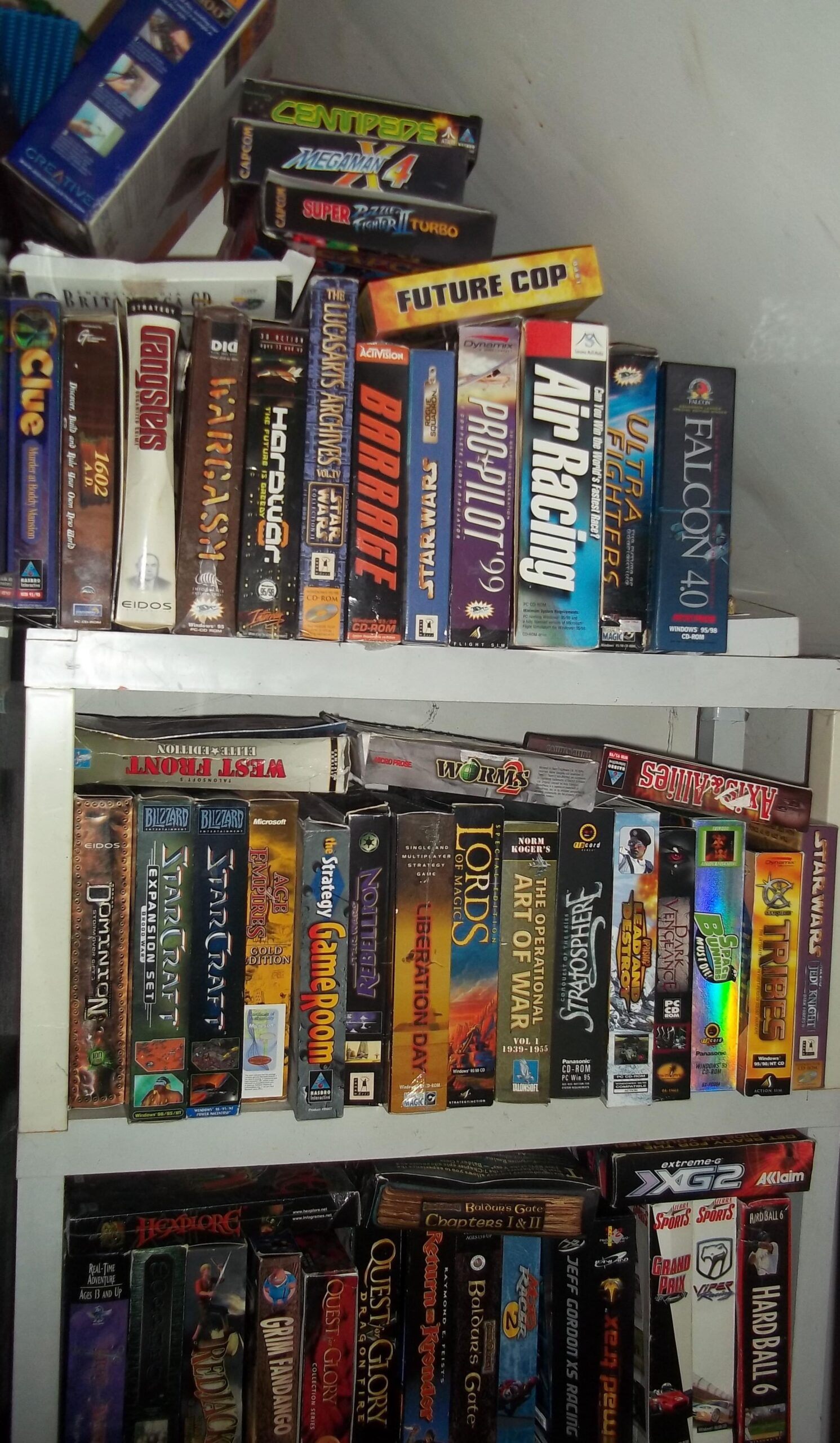
Most of my boxed PC games from 1998 are in this picture. I love these huge boxes, they look amazing! The large size allows for more space for interesting art. Note that a few titles are later collections of games from ’98, a few are bundles with games from ’97 and their expansions from ’98, and a few are ports of console games that released on console in previous years.
Introduction
1998 was twenty-eight years ago now, which is quite a while, and yet not all that long. At that time, here in America, Bill Clinton was the President, in his second term, with a presidency rocked by the Monica Lewinsky sex scandal which was the years’ biggest news story, though Clinton would retain his popularity; gas was under a dollar a gallon, which is $2.07 in 2026 dollars considering inflation; World War II nostalgia was perhaps at its peak; the New York Yankees won the World Series, beginning a threepeat that frustrated Red Sox fans like me; and Michael Jordan won his final NBA championship. Personally, at the beginning of the year I was midway through my freshman year of high school. At home we had a good modern 233Mhz Pentium PC, albeit one with a S3 ViRGE graphics “accelerator” for quite bad 3d graphics, and I still had my original Game Boy to game on portably. It was also the year of one of my familys’ last big summer trips, a more than three week long trip to the UK. As a fan of castles I particularly loved seeing Caernarvon. And, it was an amazing year for computer and video games. In fact, it was the best year for games, and it’s not just me saying it, it is most people. But why, specifically, do they say this? This question has consumed me for some time now, and this article series is my answer.
What is greatness? Thinking about it, I think that I would agree with those who say that the core of it is contrast. This idea is not my invention, but I fully agree with the concept. Greatness stands out because of the difference between the best times, or the most successful people, and the average or bad. When times are good and everything is fine, greatness can be harder to discern. It is easy to take how good things are for granted and not realize just what a special time it is. But when times get harder, discerning the great from the mediocre or awful becomes more clear.
This will be an article about videogames, but to start with a historical analogy I saw mentioned online, Alexander the Great isn’t great just because he was a prince who inherited a nation with the strongest army in the world. He was great because he did the greatest of things with that opportunity. Almost all people would fail in that place, or at best be average, but he wasn’t and became a legend for it. I am mediocre at best at most things, but I am decent at writing (I should do it more often, huh?) and historical knowledge, as well as a few other things (building Lego sets by following the instructions, for instance). But anyway, we really see Alexander’s greatness if we contrast him with other people who inherited great empires. How many of them managed things in an acceptably average way? Plenty, but generally not the memorable ones. How many squandered it, losing empires with their incompetence or evil? Some, such as Caligula or the English King John. How many were brilliant successes, leading their nation to glory? Very, very few. Anyone can inherit the building blocks of great things, but the greatest do amazing things with those blocks that others don’t even think of.
But unfortunately, the good times never last for as long as we would like. Time moves along cruelly quickly. Alexander died young and his empire rapidly crumbled. The ’empire’ of videogames is not a perfect analogy for this, as it was never united before falling to internal wars as the Macedonian empire did after Alexander and it is unlikely to completely cease to exist unless we have a general civilizational collapse, but that is probably over-analyzing the comparison. In both cases, many people looked back later on, after the great events, and said, we did great things. Why did we let it go? I think this is a solid analogy for today. Between getting older and looking at the seeming decline of the videogame industry, it has led me to look back at better times and say, what made that time special? And what happened after?
I must note, I’m not a financial analyst. Most of what I say I do think is backed up by facts, but don’t expect charts and numbers here. I have looked at some articles that do have them, though, and I think they are saying the same basic message I am. It isn’t just me noticing that the games industry of the mid 2020s seems to be in trouble, it is a common refrain among people analyzing the industry. Nintendo and Valve seem to be doing well, and, well, that’s about it. Everybody else — Microsoft, Sony, Epic, et al — is in trouble, and they are reacting to their troubles by trying to gouge as much money as they possibly can out of their users in ways that have gotten so overt that people are starting to notice, and complain about it. And then we have AI… ugh.
But to return to analogies, how about we look at a more recent example, the state of American democracy today. I would like to think that now that our democracy is under such severe threat from Trump and his fascist allies that some people may look back and recognize just how amazing the existence of American democracy has been, that at its best moments America is the shining city on the hill, the first nation in the world governed by and for its people. Unfortunately, we are far from that hilltop today, and we are reminded daily in the news of how humiliatingly far we have fallen from it thanks to our President and his supporters. I love America though and hope it can be saved. Regardless, to any who disagree with my politics, I will not return to this subject in this article. I just had to say something.
Going back a bit, around the turn of the 20th century, the way the film The Matrix treated the year 2000 as the peak of humanity seemed silly, something just chosen because that was the current day then. Of course, I’m sure that was exactly why it was chosen, but… it kind of was true, wasn’t it, in some ways. We actually kind of were at a peak that we now have fallen off of. A lot of the problems the world has now, including escalating global warming, rising fascism, microplastics and related health crises, and more, had started well before 2000, but at that point things hadn’t started to visibly break down yet. Other problems are more recent, such as exploding housing costs making home ownership unattainable. Socially there have been some improvements this century, particularly in rights for gays and lesbians, but is this enough to counteract the bad? I guess that is a matter of opinion. Regardless, many world systems are collapsing now. Times are difficult for many, and people are searching for someone who will fix it but no solutions have yet been found. Who knows where this will lead, as the future is yet to happen. Hopefully to better times. After all, the present is the time which actually exists right now; the past is just that, something prior. (As an aside, I’m not a big The Matrix fan. I saw the original movie once and reasonably enjoyed it, and saw and The Animatrix also, but wasn’t interested enough to watch any of the other sequels and still haven’t seen them. I have never played any of the games either. It just does seem that it happened to be right about our civilization’s peak, or so it seems today.)
Anyway, when you are on the peak of the mountain, everything seems great… but if you move, and time is always moving forward whether we like it or not, the only way to go from there on foot is down. While traveling to that point everything was uphill, but unless you are on a high ridgeline, a descent is in your near future. That is happening to our world this millennium, and it happened to gaming at around that same time as well, though to less disastrous consequences overall. Games are not as important to the world as those other things are, after all.
But I should get to the point: Why is 1998 nearly universally acclaimed as gaming’s best year? I think that the core of it is because multiple incredibly important events happened at the same time, and they all stand out because of major changes in the industry that happened during and after 1998 which radically changed gaming. In the same year, 3d console games fully found their way with using the new technology of polygons well; the arcade business was still in good shape, before its collapse a few years later; and the PC business saw its best games ever before starting to fail the next year. It was near the end of the period that lasted from the ’70s to the end of the ’90s where those three platforms, PC, console, and arcade, dominated electronic gaming, and all three saw all-timers release… only for two to collapse within years. Once arcade and PC games had started falling off that mountain the slide just picked up speed year after year. Consoles would benefit from the collapse of the other major branches of gaming, but today even console game is struggling due to sales flatlining while development costs go ever upwards.
So, all of these things happened at the same time, and then things changed. The kinds of games being made changed, the kinds of platforms changed, everything changed. Some of that change was good, and some of it was bad. Change goes both ways, but either way it leads to people who liked how things were before to think back on the time they remember being best, and that time is the late ’90s. But before one just blames this on nostalgia, while that is a factor, it isn’t just that. The people praising top games of ’98 are not only the people old enough to have played them when they first released; younger people can also appreciate them, and many do. How hard understanding older games is depends on the game. Some are easy to pick up, while others take adjustment, and still others are hard to learn to play. Even that last category isn’t AS tough to get used to as games were just a few years earlier, though; in most genres PC games from the early ’90s are much more challenging to go back and play than ones of the late ’90s, for instance. Game design was not what it is today, but it was worlds more advanced than it had been even just five years earlier. The games of ’98 are mostly easier to go back to than similarly complex games of the early ’90s are, and their designs are more familiar. Sure, they are different from what we see today and some games are janky messes, but on the whole, change had reached the point of perfecting the design philosophies of their time in a way not possible before, and in a way not attempted today due to changing tastes.
To sum up this section, the key to why ’98 is remembered as the best year is because of it being the perfect confluence of events. Without so many things all happening at the same time, technology and game design and everything else all hitting a happening at once, you probably would not see the year reach the heights of popularity that it has. With only the great PC games but not the console ones, for instance, the year definitely wouldn’t have the mythological status that it has; a lot of people today sadly do not play old computer games as they do old console games. But, all of those things did happen in the same year, and so 1998 stuck in peoples’ memories as no other year before or since has. One of the major eras of gaming was ending, and 1998 showed its games at their peak, just before everything changed.

This awful-as-usual photo is of some of the better console games from 1998 in my collection. I apologize for the flash in the center making BattleTanx (N64) invisible.
Categories: The Types of Electronic Gaming Platforms, Then and Now
The basic breakdown in gaming from the ’70s to late ’90s was this: there were several different types of game platforms. These types still exist today, with some changes. First I will discuss how each category was in the 20th century, then discuss the 21st century second. I will try to give some reasons beyond just the specific games themselves why fans of each branch of gaming that I just described might look back to ’98.
Something important to remember about the types below is that before the 21st century, a lot of games stayed exclusive to their format. Computer games rarely were ported to consoles. It happened once in a while, but it was uncommon, only for the most popular games. Arcade games sometimes got home ports on computers or consoles, these ports were more common than PC to console ports or vice versa, but it was never a guarantee. Console games occasionally got computer ports, but it was quite infrequent, again mostly only for the most successful games. Now, up until the early to mid ’90s many computer games got released on multiple different computer formats, it is true. Also, sometimes a successful console game would get ported to other consoles or would release on several systems at the same time. As an aside, this was much more common for Western console games than Japanese ones; if a Japanese game was multiplatform it was more likely to be a late port of a successful games to other formats, instead of releasing simultaneously for multiple systems as Western studios were more likely to do. But there are of course exceptions to this in both directions. I will mention how significant game or hardware development was in each of the three primary regions for each category below. Other regions, outside of North America, Europe, and Japan, do develop games, and this current decadeo f the 2020s has seen a major growth of games from China for example, but those regions mostly had only PC or smartphone games, and not arcade or console games other than pirate releases and such.
Please note, “Then” below is largely referring to games and platforms from the 20th century. “Now” refers to the current century, and the last decade or two particularly.
Arcade Games
Then: Arcade games focus on fast action. During this period arcade games had significantly better graphics than anything on a home platform, but the games need to be something fast and fun, and that will get the player to keep spending money at a steady rate into the machine. In this way good arcade game design has some similarities with modern mobile design — if the player isn’t spending money, isn’t being coerced into it somehow by the game, then the publisher won’t be making money. However, at least in an arcade you always got something for your money, even if it was just seconds of gameplay. You would not be spending money on some random chance of maybe getting something new. Arcade game development was massive in Japan, significant in North America, and nearly nonexistent in Europe. Home computer ports of arcade games were popular in Europe in the 1980s and 90s, but actual arcade games were not. Other regions in the world had arcade games imported from the US or Japan in certain places such as Latin America, but little local development.
Now: The situation for arcade games is much, MUCH today than at any point in the 20th century. Arcade games do not have graphics better than home platform games anymore, and haven’t since the ’00s. Very few arcade games have been made in the past decade or two, and most of the ones that do don’t get home ports. There are some arcade-inspired games, such as the fighting game genre which in the ’00s shifted from an arcade focus to a console focus, though, so some of the old arcade design ethos survived. Most fighting game fans seem to prefer newer titles over older ones, but the classics remain popular. Things are similar with the shmup fan community, except shmups are usually made on a budget. On another note, mobile smartphone gaming has taken the old arcade game design mantra of ‘design your game paced to keep the money flowing’ to heart, but with very different kinds of games that are much more exploitative of their players. What little arcade game development exists is still largely in North America and Japan, it has not spread to other regions.
Computer Games
Then: Computers cost more than consoles and have faster processors, but until the later ’90s did not have dedicated graphics hardware to make console-style graphics possible. As a result of this computers dominated in strategy games, simulations, flight games, and other kinds of games which benefit from having a mouse and keyboard and fast processor, but struggled at platformers, shmups, and other fast action games like that compared to consoles. Computer games were dominant among post-1984 crash Western game developers in North America and Europe. There were a few console game publishers and developers in the West, but the vast majority of studios, and most of the best talent, worked on computer games. Only a very few of those computer games ever released on consoles. Meanwhile, in Japan computer games were a small market mostly dominated by a few genres like computer RPGs and visual novels and were for a small niche audience.
Now: Reasons for gamers to think about the PC games of ’98 should be clear: it was probably the last year of clear PC dominance of Western game development, before the rocky interim years and console focus of the ’00s began. As many readers know the PC would eventually have a renaissance that started in the late ’00s and continues to head upwards every year, but even today PC-only games are not what they were in the ’90s. PC games today sell far more copies than they did back then, by many times, but compared to the top AAA(A) games they are made at relatively low to medium budgets, and you can tell. Most PC-only games are either very low budget indie games or are complex strategy or simulation titles that don’t control well with a gamepad and aren’t big enough budget titles for someone to port them to console anyway. The PC gamer of today may prefer modern games over older ones, but in some cases that’s probably because they haven’t played enough older ones in genres they like. Either way the case for ’98 should be easy. Anyway, in terms of regions, computer games are still mostly from North America and Europe, though larger-budget, PC-focused games have been mostly a European affair since the turn of the millenium. North American PC games are more likely to be console ports or indie titles. Meanwhile, more Japanese studios than ever port some of their games to the PC, but it still is just a place to port their console games to, not something being designed for itself.
Console Games
Then: Console games, or TV console games as I sometimes call them to differentiate TV console from handheld ones, during this period focused on faster action than computer games. Slower-paced games existed on consoles as well, of course, but they did not have instant advantages over computer games like the more action-focused games did. Consoles are designed to display game graphics as quickly as possible, while computers are not, so faster-paced action and shooting games were better on consoles. The difference was often substantial. However, American game developers mostly focused on computer games between 1984 and 2000, and European studios were always primarily focused on computers. The pre-crash console industry was huge both in the US and Japan. The console was invented in the US, but Japan adopted the idea early and had great success. Small, TV-connected consoles fit in well with Japanese homes in a way that bulky personal computers did not. After the crash here in North America, though, the American console publisher and developer market mostly dissolved, leaving Japan dominant in the field. There were a few great Western console developers and publishers during this era, but it was a distinct few compared to the many on computers. Even so, there were great Western console games in ’98, just far fewer than the great computer games. Japan, however, was at the top of its game in quality, and was almost entirely focused on console game development.
Now: TV console games had a very good decade in the ’00s, and dominated the electronic gaming conversation all decade long, with studios worldwide focusing on console games. Particularly pushed by Sony, legitimate game consoles released in more and more countries over time. However, over the time since then cracks have appeared in their edifice, as hardware sales stagnate while budgets go ever upwards. The problems caused by this are getting worse every year. Sure, I can fully understand why people would prefer the console games of the ’10s and ’20s over the ’90s. Game design has changed a lot since then in top console genres like third-person action games, and many people like the way the modern game plays as it has for the past fifteen or so years. However, when a single game takes five or ten years to finish, when studios are struggling so badly to make enough money back to fund development, when so many games blur together because interface and systems development has decided on certain design standards you see in game after game after game… well, what about the time when that process was just hitting its key moment of development, before everything became so similar, but after things progressed far enough along for the way games play to be largely recognizable to someone going back to that game today without experience in retro games? What about 1998, the year when many of the most recognized classics ever released?
Handheld Games
Then: Handhelds were portable video game consoles, with similar concepts to the TV systems but made to be portable. This often led to different design philosophies, with more shorter-form games or titles with good save systems perfect for a commute or break. The handhelds of the ’70s to ’90s were often single-game electronic platforms, not actual full platforms. The first successful full platform handhelds released in 1989. After that, handhelds were basically the same as consoles, except portable. This market was a subset of the console market mostly dominated by easier or shorter-form games that work well in a portable setting. As with console games it was heavily dominated by Japanese studios. Western handheld games from either North America or Europe were mostly cheap budget titles, dominated by licensed or puzzle titles.
Now: Today, the dedicated handheld console is a thing of the past. Starting in the ’00s this market would shrink, and that shrinkage would destroy it in the ’10s. There are no actual dedicated handhelds, anymore, only dual-purpose machines and the massive, but gameplay-vapid, world of cellphone games and their omnipresent gatcha mechanics and absence of gameplay worth caring about. It is very sad stuff. Cellphone games, which are developed by studios from all over the world unsurprisingly for universally used devices, are a race to the bottom dominated by “games” that are effectively digital gambling. The gameplay is generally much simpler and less developed than the monetary currency systems designed to get players to spend money in the game. It is highly predatory design. There are some good mobile phone games, such as puzzle games and the like, but those were good on dedicated handhelds before them as well. People who want portable games that aren’t cellphone timewasters or drivel play on dual-purpose console or PC machine markets instead, such as the Nintendo Switch or Steam Deck. Here you play regular console or PC games, aided by suspend systems that allow you to pick up your game later when you suspend the system. Fans of games designed to for portable play and quality design will probably prefer the decades from the ’90s to the ’10s. 1998 may or may not have been the best year ever for handheld games, but it was a good one across multiple platforms.
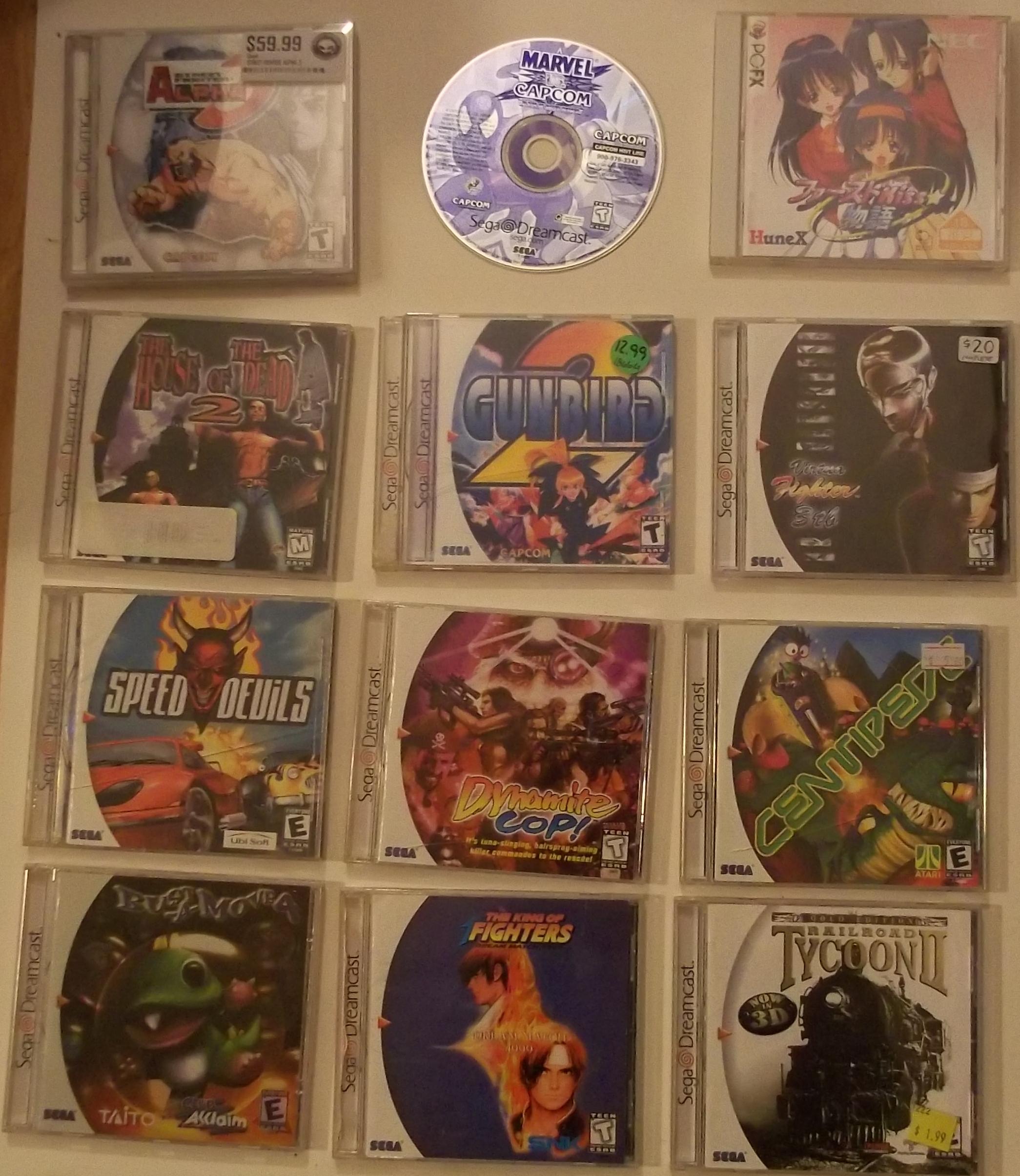
This image includes seven later Dreamcast ports of arcade games from 1998 (note that The King of Fighters Dream Match 1999 is the US title for the DC version of The King of Fighters ’98), three later Dreamcast ports of PC games from 1998 (Speed Devils/Busters, Railroad Tycoon II, Centipede), a 1998 Dreamcast port of a 1996 arcade game (Virtua Fighter 3tb), and, randomly, my one 1998 PC-FX game (upper right). I believe it was the last release for the system.
The Eras of Gaming
Time passes, and as it does things, as I have said, change. Assumptions about what the ideal kind of game change, game design ethoses change, the kinds of games being made change, the platforms change. Again, this change can be good, neutral, or bad, but regardless of that, us people interested in history try to break things down into periods based on the available technology of the time and game design expectations.
And so, the history of video game consoles can be broken up into generations based on grouping systems which were available at the same time together into a generation. There are some controversies over the boundaries, but regardless of that, there have been nine console generations since the industry’s founding in 1972. Ten, if you call the new Switch 2 a next-generation platform, but I don’t think anyone would; it’s just a late 9th generation one, I would say. Anyway, I think that we can break gaming up into about five very different eras, each separated by a transition.
- The first era is the 1960s to 1983, the early days of computers and electronic gaming, mostly from American developers, with Japan making important contributions starting from the late ’70s as well. Peak year: 1982.
- The second era is 1984 to 1998, the period where North American studios mostly focused on PC game development while Japan focused on consoles and European developers mostly made computer games that often only released in Europe. Peak year: 1998, closely followed by 1994.
- The third era is 1998 to 2009 or so, the intermediary period where consoles were dominant worldwide, though Europe had more of a lasting PC scene than the US, where developers almost entirely switched over to consoles apart from MMOs. Peak year: 2007, very closely followed by 2004.
- The fourth era is one which perhaps just ended, running from ~2010 to 2025 or so. This era was marked with the PC recovering somewhat, the rise of smartphones, and most games finally releasing worldwide almost all of the time for the first time in history, but also by game development times and costs exploding into the stratosphere, stressing the whole game development industry. Peak year: Either 2017 or it’s too early to tell, probably. Or 2023. Help me pick a year here.
- The rise of AI has led to a possible new era beginning this year. So far this era has been marked by extreme price increases for home computing technology but also the ability for people who cannot program or draw to make games, replacing the work of humans with the “work” of AI algorithms which cannot think but instead try to figure out the best possible next action based on their training from large amounts of internet data.
I would like to say a bit more about each era. The first era is the platforms of the 1960s to the early ’80s, from the founding of electronic games up to the crash of the American market in 1983 — the early, or on a console front ‘Atari’, era. This era set the four kinds of electronic gaming in stone, and we have seen variations on these four ever since. At this point, game consoles were mostly American, with a few from Japan. Computers were also mostly American, though some were European and many American computers were also sold in Europe. Japan had its own computers but they weren’t used for gaming as much as in the West and fewer people got one for their home.
Following this was a transition, with the great North American crash of 1983-1985. The second era goes from 1985 to 1998, and covers the peak of the industry for people my age and a little younger — the ‘Nintendo’ or ‘PC golden age’ era. Beginning after the crash, North American game developers mostly left consoles and arcades behind to focus on computer games. This left Japan to dominate the console space, which they did through the rest of the ’80s and ’90s. Europe, meanwhile, continued to mostly played European-made games on lower-end home computers of either American or European make. European economies had been ruined by World War II and still today have not recovered up to the level of the American economy. Many European and Japanese games only ever released within their region and not in others, but more Japanese games had wide distribution than European ones, which were mostly European exclusives. In Europe these two eras are one, differentiated only by the presence or absense of American console games that most people weren’t playing anyway.
These first two eras are different, but similar. Despite the shifts in platforms, I think that there is a clear continuity between them of game design styles. The real major break came around the turn of the millennium. Again there was continuity between the eras, but most of the industry today is much more like the industry of the early ’00s than it is the industry of the late ’90s; the differences are stark. At some point this century games start feeling modern; change has slowed down in both tech and game design. As a result, a game from 2016 feels fundamentally similar to a game from today in 2026, but a game from 1998 feels like something from a totally different universe than one from 1988.
So, 1998 marks a major point of games industry change. Following it was another period of transition, which I would say lasted from 1998 until the later ’00s. It was probably long enough to call it an era of its own, the third era. This is the ‘early modern’ period, perhaps, of TV console dominance at the expense of other platforms. This time is considered by many to be the golden age of console games, a time when a good game could be made in a year or two by a team anywhere in the three primary regions. Personally this era lost me and I spent over a decade from 2005 to 2016 mostly playing older retro games, but everyones’ experience is different and the sheer volume of quality releases makes this time very different from now. This era was marked by the collapse of PC physical media, being replaced with just digital distribution by the end of this period. Console physical media would surivive, but all console publishers opened a digital storefront by the middle of this period and would focus on it more and more over time. When it comes to the internet, there are two key points: first, starting in about 1996, game websites, online play, and free demo downloads became commonplace. Following that about a decade later, in the mid ’00s paid digital distribution of games bought entirely digitally finally became common. This third era is the intermediate period where the online world existed, but was not yet dominant across gaming.
Following this, at some point in the later ’00s to 2010, the fourth, most recent era began. This new way would dominate through the ’10s and into the ’20s. This era was marked by the dominant rise of digital distribution driving out physical media; significantly increasing game development times and costs; more studio closures than ever before; a slowing down of the rate of visible tech improvement as graphics reached a point of fidelity of being harder to discern improvements of; and a disparity between an increasingly small number of increasingly massively-budgeted AAA games on the one hand, and a massive volume of zero-budget homemade games on the other, with little in between. The quality of top games from this era was very high, but the problems were always apparent. Additionally, smartphones released in the late ’00s, and would take over the world in the early ’10s. Mobile smartphone gaming would rapidly become the most common way people worldwide play games, for better or worse, with consoles or high-end PCs only for those dedicated to higher-fidelity gaming. Smartphone gaming is exclusively digital.
Over time, this always-unstable era started to break down. It is surely too early to say this for sure, but I think that a tipping point was crossed in 2026 “thanks” to AI LLM model buildouts that have rendered building a powerful home computer or high end console multiple times more expensive than it was a year earlier, with no relief in sight. The breakdown of the videogame industry has become visibly apparent to many. The issues aren’t just about AI destroying prices, either; no, variants of the same problems which ended the second era of North American game development, of costs going too high for the current userbase to support, now are affecting the whole industry. And so, we probably are in transition to a fifth era now , but what the next era will be we do not know yet.
Even though it is far too early to say where exactly the dividing line between the fourth and fifth eras that I mark out is, right now it feels like this year was a turning point into a new era, the AI era. I generally strongly dislike AI and do not use it, but regardless of your opinion on it it is unquestionable that it has had a massive impact on gaming. However, a full discussion of modern gaming is beyond the scope of this article series; I would like to discuss gaming at a peak, not in its fascinating but troubled present. I would like to discuss each of the first two mountain-peak years here and look at which games made that year stand out so much and showed developers mastering the art of development for their era of gaming. I am sorry that I cannot discuss peak years for the third or fourth eras but I just do not know what years I should focus on for either of them, if there even are single years that can match either of these peak-for-their-era years. I think a year could be decided on for the third era, probably either 2004 or 2007 as those are the two most popular of that decade, but it is much harder for the still-recent fourth. I am not sure what the consensus year would be; perhaps 2017 or 2023? Or maybe it is none of them, as continutally-developed titles dominate so many peoples’ playtime? I am not sure. So, here I will cover 1982 in brief before moving on to the main topic, 1998. At some point I will add a section to this series about 2007 in order to compare these to the third eras’ peak year, but I have not done so yet. [My opinion on modern gaming in 2007 at the time can be summed up that despite buying a new PC that year, it was my new-to-me Dreamcast that dominated my interest. Yes, Super Mario Galaxy (Wii, 2007) is a great game, but otherwise… eh. But anyway.]
For the first two of those eras, in the last year before things started to turn, many of the best, most defining games of their era and style released. I am definitely not the right person to ask about the third but I do not think that has happened for the fourth era; perhaps development times are just too long this century for one year to hold that many relevant releases. If 2026 really has brought on a new era of AI, well, I don’t think 2025 was the best year of the past fifteen years, and I doubt many other people do either. The Switch 2 is a good console and I hate/like Mario Kart World but otherwise… well, 2025 was okay but had issues. But anyway, future analysis will need to answer that question; it is too early to say right now.
Why Eras End
The story of electronic gaming is one of constant change. Technology evolves rapidly, the number of transistors on a chip doubled every year for many decades as per ‘Moore’s Law’, the guideline Intel tried to stick to, and electronic games react to that change by always having more power available than older platforms did. More power leads to more opportunities to do more with your game, but it also leads to more challenges, as game development takes longer over time and the number of people required to make a game increases steadily as well. Development of a ‘AAA’ game in the ’70s took one or two people a few months. Today, a ‘AAA’ game costs hundreds of millions of dollars, as hundreds or thousands of people work for years, sometimes as long as a decade, on their game before it finally releases… unless the publisher decides those costs were too much and closes the studio before the project was completed, as happens sadly often these days. Are these costs sustainable? That depends on the situation; it can go either way. Sometimes, adaptations happen and the industry continues to grow. Other times, costs go above revenues, and major change happens as a result.
Yes, sometimes storms brew in the game development mountains. We live in a capitalist society, and that is fine; I am liberal but no Communist, those kinds of societal controls do not work. Stifling human ingenuity and not rewarding greatness hurts society. However, our capitalist system does require something, and that is money. In order to fund the production of a game, a studio or their publisher need to put down a lot of money up front, hoping to make that money back on sales of the game later. Movie studios have similarly front-laden costs, which is why we ended up with so few major studios; companies need to be large in order to withstand the costs of a big project failing to make back the money spent on it.
In game development, during each era things seemed great for a while, only for the eventual correction to send some out of the industry. That happened in the first era up until the crash, as a huge number of American studios entered the industry in ’81 and ’82 only for most to shut down or move to computers just a few years later. After that, the second era, defined by Western computer games and Japanese console games, lasted up until 1998. Up to the late ’90s, sales were always enough to keep this system working for all branches of gaming. But how long could the ‘numbers always go up’ system keep working? At what point would costs go above revenues, and something would need to drastically change in order for studios to survive, if they could at all?
Well, for computer gaming in North America, its first home region as this is where almost all platforms of the first era were created, that crossover point was reached in 1998. That year is when computer games started to descend off of that mountain, forever altering the industry. The decline would take five to ten years to bottom out, but once the decline began it would not be reversed for many years. As a result 1998 is the key year, the last days of PC gaming’s golden age. Sure 1997 and 1999 also had fantastic libraries, but ’97’s best look up at ’98, while in ’99 you could start to see the changes in the industry as console games gained a larger place in Western game studios’ libraries. PC Gamer (US) Magazine saw its thickest issues ever in late 1997, with only slight declines each of the next few years before it became very visibly thinner by 2001. This fits with ’98 being the peak for releases, but not profits. PC-focused game development would be sustained much longer in Europe than the US, as fewer people there had consoles. Still, even there over time in the ’00s and ’10s many studios would branch out into releasing more games on consoles.
And for arcade games, that descent off the mountain came just a year or two later. In America the peak of arcades was the early ’80s, but the early ’90s had a second peak. After that things slowly went downhill until in ’99 or ’00 all major players abandoned arcade game development. In Japan arcades lasted much longer due to the dense population, and indeed they still have a place there, but even there, over the course of the “early modern” period, arcades lost their place of dominance in the industry. By the mid ’00s arcades were no longer a place for highly expensive experiences that would get ported to home platforms; instead those games started on consoles. After this arcades became something more familiar to what they are today, a place for crane games, arcade-only experiences like racing games with fancy seat setups, and the like.
Meanwhile, console games benefited from the decline of their competitors. Developers in other fields saw the higher sales of console games and said, we want in on that! And for a good fifteen years, despite some troubles, things for the industry overall were good… until the 2020s, when rising development times and costs led to new troubles for the industry. Today console install bases have flatlined, while costs continue going nowhere but up. This is clearly not a good trend line, and developers are coping by branching out and ending “buy my platform to play my games” exclusivity in favor of releasing PC versions of most games, Nintendo excepted.
And this is why the PC is, as I said, today in the best place it’s been in decades: it’s an omnipresent platform that anyone either watching other people play games on the internet on platforms like Youtube or Twitch knows about. Or rather, it was omnipresent until this year, at least. I think that there is still a place for consoles and I hope that they continue existing, but there is no denying that the console market is in trouble. Even the AI-driven RAM and storage price explosion of the past year has not really changed this, because consoles are being hit just as hard as computers are and computers have more general use, just so long as people like AI tech CEO Sam Altman don’t win in his goal of ending home ownership of large amounts of RAM. We will see where that goes.
Change Happens, but What is Lost?
Now, you might be thinking, this has been a long article, but you’ve only infrequently been discussing your theoretical main subject, 1998! Well, I think that the full history of gaming is key to understanding why 1998 is so beloved. Without understanding the eras, that 1998 saw perhaps the most important dividing line in the industry’s’ history, I don’t think people will properly understand why 1998 is remembered as it is. The year is remembered as being as special as it is because of the changes happening in gaming at the time.
I know I have said most of this already in this article, but I want to repeat myself because it is important. I mentioned capitalism earlier, and that games cost money to develop. This requires enough money coming in to keep making the games as they had been up to that point. Sales of each game needed to either be better than the sales of the last game, or prices had to go up. As Moore’s Law progressed over time and chips got denser and denser in transistors development team sizes needed to increase steadily, and the length of time to make a game slowly went up from weeks to months to years. Thanks to this, every year games got more expensive to make than they were the previous year. This process has continued steadily from electronic gaming’s founding to today.
Change happens steadily over time, with formats and eras overlapping; it is not like a prince like Alexander inheriting the throne and suddenly changing policies, but like a steady flow of change, like a river… but along that flow certain points stick out. In the late ’90s, as I said, an era began to end. A very strong set of rapids hit the industry as costs got too high for game companies, and particularly Western computer game companies, to continue affording to make games as they had before. The solution was to go multiplatform, to stop making most games for computers only or console only but instead to make games for all formats. This new reality slowly phased in over about a decade, from the late ’90s to late ’00s, it was not immediate, and again it happened in the US first, and Europe later.
Once the transition was done, however, the PC market as we had known it was gone. I wrote a long forum thread in about 2010 mourning the death of PC gaming. I did not post it on my site at the time because I was thinking about improving it and doing so but then never put in that work, but I finally did post it in 2025, back-dated to 2010, for historical reasons. It’s partially right and partially wrong but I think it is a look at an important moment in time as the industry changed from physical media to digital. Fortunately, things did get better for PC gaming. Things would not stay down forever; PC gaming would be resurrected digitally some years later on a smaller, more boutique lower-budget scale, and that is fantastic. Even so, a modern equivalent of the old heights may never be reached again.
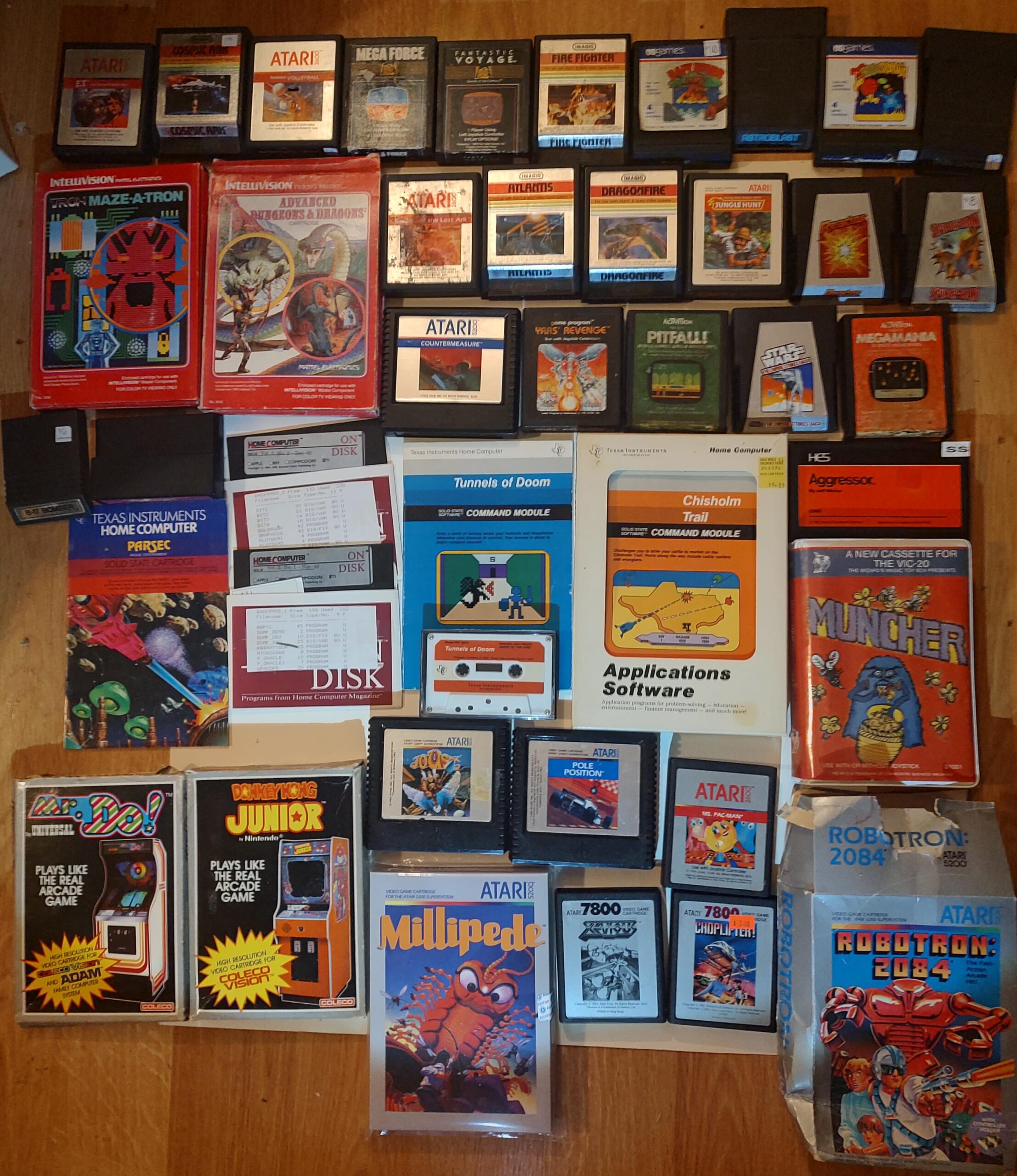
A selection of games I have from 1982. Top row: some of the piles of stuff releasing that year on the Atari 2600 that helped cause the crash. Next rows: Some of the better console games. Third row: Some computer games for TI-99/4A and Commodore VIC-20. Bottom row: Later home ports of arcade games from 1982, there to represent the originals. Note, Choplifter is a computer game from the Apple II, but sadly I don’t have any Apple II games from ’82 so this later Atari 7800 port will have to do. I apologize for the upper right of the image being blurry, but this is the best shot I’ve managed after quite a few tries.
1982: Gaming’s First Peak Year
List wars are somewhat tricky because you can make a list of games from any year after the later ’70s that contains many all-time greats. Even so, reminding people of the games that were released has at least some relevance, I think. Before moving on to the main subject, the peak year of the second era of gaming, I would like to briefly discuss electronic gaming’s first peak.
As I said, 1982 was the peak year because just after that the industry started to crash, but that year many all-time classics released. I am not going to get into the causes of the American market crash, that is beyond the scope of this article. In the US, arcades were the number one place for gaming. At home, the Atari 2600 was by far the lead gaming platform. That year two new consoles released, the Atari 5200 (a North America-exclusive machine) and Colecovision. The Colecovision would be particularly significant due to it inspiring Nintendo to enter the video game industry. Meanwhile, the rise of home computers was noticed by most everyone, and every console maker had plans to branch out into computer-console hybrids. One very noteworthy computer released as well, the Commodore 64, which was to sell many millions in the US and especially Europe.
In Japan, few people had a home console or computer yet, but arcades were very popular and they had a booming arcade game development industry. The next year would be when the first popular home consoles released in Japan, from Nintendo and Sega. Meanwhile in Europe consoles never were especially popular until the PlayStation 1, and Europe never had much of an arcade game development business based there though arcades with American and Japanese games did exist, but in ’82 the rise of home computers in Europe started with the release of the ZX Spectrum. Cheaply made games for home microcomputers would dominate the European game development industry into the early ’90s.
When I think of the top games of the pre-crash and crash era — that is, 1972-1984, primarily — for American games I think of, for arcade and console games, Pong, Combat, Breakout, Asteroids, Missile Command, Defender, Joust, Robotron 2084, Centipede, Pitfall, Ms. Pac-Man, and perhaps Tempest and Yar’s Revenge. On the computer side, Zork I, Wizardry, Ultima, The Oregon Trail, Lode Runner, Rogue, Miner 2049er, and Adventure (Colossal Cave) are probably the key titles. For Japanese games, and these are all arcade games because Japan’s console market didn’t get started until after America’s and few had a computer at home there then, Space Invaders, Space Panic, Pac-Man, Donkey Kong / Donkey Kong Jr., Galaxian / Galaga, and Xevious are probably the key titles.
As for Europe, its gaming market was slower to develop. By the late ’70s there were a few European games, but Europe never really got much of an arcade game development scene, just home computer games. but I am not too well versed in older European games, almost none of them released here other than the one developer I need to mention, Jeff Minter. He released one of his most popular early titles in ’82, Gridrunner (for A8, VIC-20, and Spectrum), and it did release in the US. His ’83 game Hovver Bovver is also noteworthy. Otherwise, as I said, the ZX Spectrum and C64 both released in ’82. One of the most popular early Spectrum games was ’83’s Manic Miner, a title inspired by Miner 2049er. I don’t think any games for either one were nearly as noteworthy as the arcade and American computer games I’ve mentioned above, but a British person’s input would be needed to get a better answer to that question.
Of those, which released in 1982? Combining regions, Ms. Pac-Man, Donkey Kong Jr., Yar’s Revenge, Xevious, Wizardry II, Ultima II, Zork III, Pitfall, Millipede, Joust, Robotron 2084, Gridrunner, Miner 2049er, Microsoft Flight Simulator (the first one), and more. Yeah, it’s a very good lineup, a bunch of games that built on and improved on pre-existing formulas, before everything began to change — you see this with the Pac-Man, Wizardry, Donkey Kong, Zork, and Ultima sequels. Meanwhile, Pitfall, Robotron 2084, and Xevious are games which would prove to be very important and influential, bringing new ideas that would be copied many times over the decades. Personally I don’t like Xevious all that much but cannot deny its influence, all three are among their respective genres’ most important early titles. Miner 2049er is somewhat forgotten today, but at the time had a massive impact. Pitfall is more famous today, but it’s Miner 2049er that most of the major Western platformers of ’83 would be inspired by — Manic Miner, Jumpman, Lode Runner, and more all clearly are based off of this game. And last but not least, Yar’s Revenge is one of the most popular games on that era’s most successful gaming platform. 1982 is no match for 1998 but it is worth mentioning here for sure as the peak year of its era.
However, in the US in particular, that massive explosion of game releases was a problem. Yes, many interesting games were releasing, but so were many uninteresting ones. 1982 is the year when the total number of games releasing absolutely exploded into an unsustainable bubble. At this point there was no way for a hardware maker to make money off of third party game sales, and all games had to be released physically in a box, so the ensuing glut of forgettable, very low-budget shovelware games was not just slop you can ignore on the Steam storefront page, but an increasingly large number of boxes sitting on store shelves and not selling. Within a year this would help take down the industry here.
As I said previously, Japanese console games and American (and sometimes European) computer games would fill in the void. Of the years from 1983 to 1997, the most popular year overall is surely 1994, which was a pretty good year — it was the year of Star Wars: TIE Fighter, Super Metroid, Sonic 3 & Knuckles, Tempest 2000, Daytona USA, Donkey Kong Country, Final Fantasy VI (III in the US), EarthBound (SNES, JP release), Warcraft: Orcs and Humans, Super Mario Land 3: Wario Land, Donkey Kong (’94), King’s Quest VII: The Princeless Bride, System Shock, Contra: Hard Corps, the first Saturn port of Virtua Fighter, Tekken, Ridge Racer, Under a Killing Moon, Magic Carpet, Mega Man X2, Puyo Puyo 2, Monster World IV, Doom II, Virtua Racing Deluxe, and many more. That is a pretty amazing lineup and it’s easy to understand why so many people rank it highly. As great as that year was, however, many genres continued to improve after that, and would keep doing so through the ’90s, and the technology of 3d gaming was still very early so polygonal 3d efforts in ’94 were rough compared to what you saw just a few years later. So, the next peak year is 1998, also regarded as gamings’ best. The rest of this article series will focus on that year, but first I would like to skip forward and, in brief, cover the years regarded as the peak years of the 21st century’s two eras.
(Insert photo of games from 2007, 2017, and 2023 here)
The Peak Years of The Third and Fourth Eras
For the third, intermediate era, the most commonly mentioned peak year I see chosen is 2007. 2007 was probably the peak year for Western Xb0x 360 and PlayStation 3 games, and probably was the Wii’s peak year as well. It was the year of Super Mario Galaxy (Wii), BioShock (Xbox 360/PS3/PC), The Orange Box and thus Portal, TeamFortress 2, and Half-Life 2: Episode Two (X360/PS3/PC), Call of Duty 4: Modern Warfare (X360/PS3/PC), Halo 3 (X360), God of War II (PlayStation 2), Crysis (PC), and World of Warcraft’s Cataclysm expansion (PC), to name the top games of the year. Some good releases that rate a bit below those include Crackdown (X360), Metroid Prime 3: Corruption (Wii), STALKER: Shadow of Chernobyl (PC), Skate (X360/PS3), The Witcher (PC), Assassin’s Creed (PC/X360/PS3), Uncharted: Drake’s Fortune (PS3), Mass Effect (PC/X360), and Rock Band (PS3/X360), to name the most popular titles of the year. It was a time when first or third person action games had come to dominate the industry, which was kind of a problem for me since I am rarely a fan of such games. Of course other kinds of games released, but they weren’t as popular. I spent the entire decade from 2005 to 2016 mostly playing retro games. It was also a time of Western developers dominating by making most of the games that Western console gamers wanted to play; other than Mario all games in the list above are Western, a dramatic change from earlier years. All those ’90s PC developers I will spend a lot of this series discussing had by this point fully quit PC games for consoles, and gamers noticed.
For the fourth era, covering about 2010 to 2025 or thereabouts, honestly the hardest thing is choosing a single year. My preference is for 2017, since that is the year that got me really interested in modern games again for the first time in a decade. Alternately, I think 2023 is a popular choice. 2017 brought us the release of the Nintendo Switch console, Starcraft Remastered (PC), The Legend of Zelda: Breath of the Wild (Wii U/Switch), Super Mario Odyssey (Switch), Cuphead (PC/X1/PS4), Hollow Knight (PC/X1/PS4), Resident Evil 7: Biohazard (PC/X1/PS4), Star Wars Battlefront II (PC/PS4/X1), Horizon: Zero Dawn (PS4), Yooka-Laylee (PC/PS4/X1), Persona 5 (PS4/PS5), NieR Automata (PS4), Hellblade: Senua’s Sacrifice (PC/PS4), PlayerUnknown’s Battlegrounds (PC), Uncharted: The Lost Legacy (PS4), Assassin’s Creed: Origins (PS4/X1/PC), Sonic Mania (PC/X1/PS4/Switch), Mario & Rabbids: Kingdom Battle (Switch), and more. Some other popular indie titles of ’17 include Slime Rancher (PC/X1/PS4), Doki Doki Literature Club! (PC), Night in the Woods (PC), and What Remains of Edith Finch (PC). I like this genre variety a lot better than those top games of ’07, that’s for sure.
Wow, that’s a fantastic lineup of games! However… 2017 was nine years ago now, more than a generation in gaming terms. We would not see that many high quality games release in the same year today, it just wouldn’t happen. Game development times have increased dramatically in the intervening years. Gaming time has elongated as at some point in the ’00s games began looking and playing good enough to feel modern when played today, but even so, I will mention some games from the most popular gaming year of the current decade, for completions’ sake. The most popular year of the current console generation, which began in earnest in about 2020, is probably 2023, the year of Baldur’s Gate III (PC), The Legend of Zelda: Tears of the Kingdom (Switch), Diablo 4 (PS4/PS5/PC/X1/XS), Super Mario Wonder (Switch), Street Fighter 6 (PS4/PS5/X1/XS/PC), and others — Hi-Fi Rush (X1/PC), Star Wars: Jedi Survivor (PC/X1/XS/PS5/PS4), Final Fantasy 16 (PS5), Starfield (XS/PC), Armored Core 6: Fires of Rubicon (PS5/PS4/X1/XS/PC), Pizza Tower (PC), and more. It was certainly a good year; I particularly like Diablo 4 and Mario Wonder. But it is probably a list slightly thinner in number of great releases than ’17, for the reasons I mentioned.
Overall, depending on who you ask, any of these lists — 1982, 1994, 1998, 2007, 2017, or 2023 — could be someones’ favorite ever. It all depends on the kinds of games you like the most, the games you have the most nostalgia for due to your age, and the platforms you most enjoy gaming on. But, as great as those more recent years are, most of their significant titles build off of the work of games from 1998, because 1998 is the most important foundational year the industry has had. And I would say that the games of ’98 are better overall than any of the lists above, as well, in just about every way other than actually getting those old PC games that don’t have modern updates running without a virtual machine or actual old PC. Heh. Newer games may take longer to finish and be designed to be more addictive and get more money out of the people playing the game, but are those things actually good? I don’t think so, if you really consider the question. And is an industry where one failed release is near-certain to doom its developer to closure, while games take five or ten years for hundreds of people to develop, actually a good, healthy industry? Clearly not, right? And when is the industry actually at its best, when all types of games are amazing, or when only some are? This last question should really push things in 1998’s direction over any of those other years, or others that are popular like 1988, 1990, 1991, 1997, 2001, or 2004.
And so, it is finally time to move on to a discussion on the best and most important games of 1998. Continue on to Part II for that.
